China Smart Manufacturing Solutions Market Size & Growth Rate
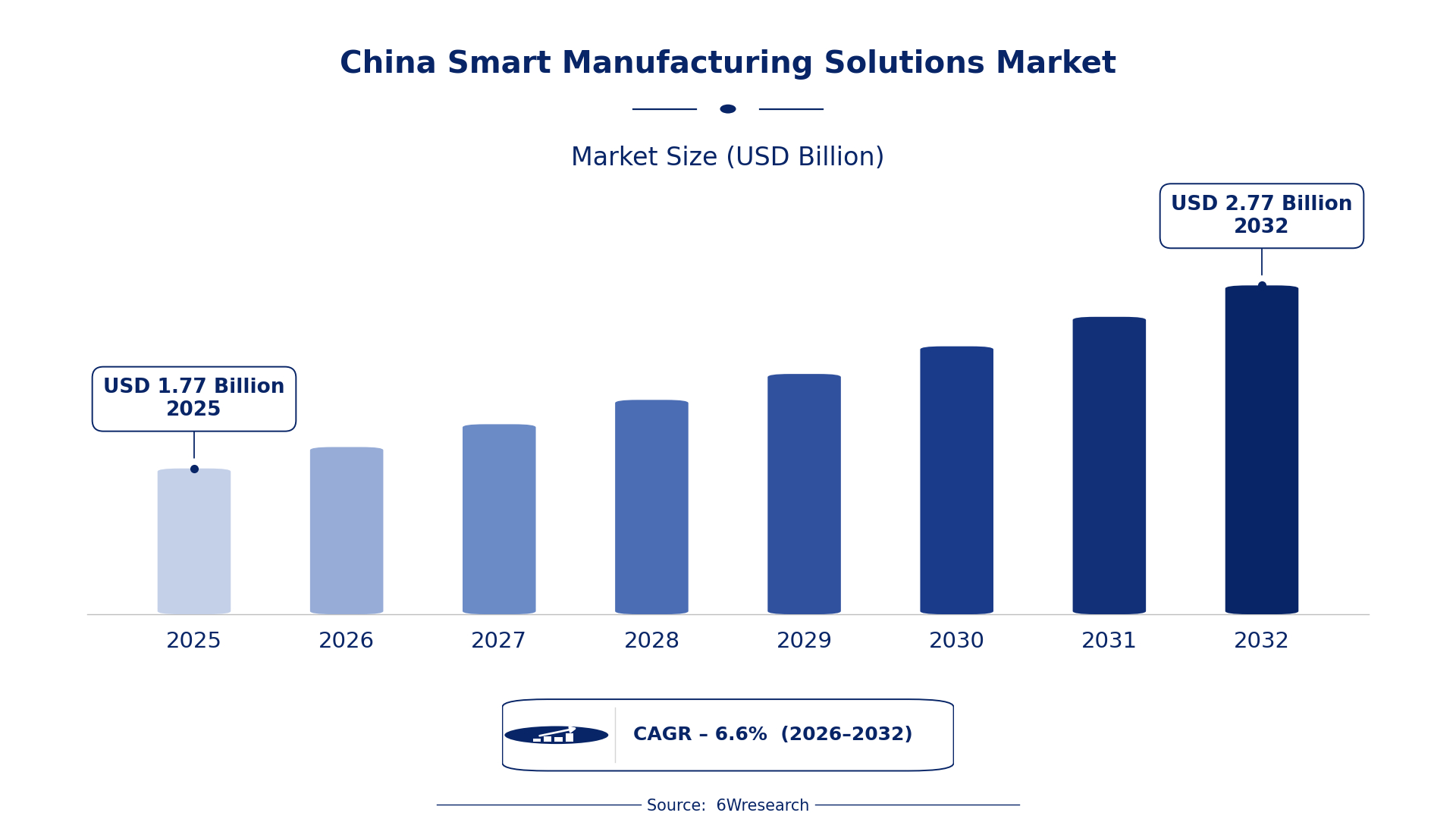
According to 6Wresearch internal database and industry insights, the China Smart Manufacturing Solutions Market was valued at USD 1.77 billion in 2025 and is projected to reach USD 2.77 billion by 2032, growing at a CAGR of approximately 6.6% during 2026–2032.
China Smart Manufacturing Solutions Market Highlights
| Report Metric | Details |
| Report Name | China Smart Manufacturing Solutions Market |
| Market Size 2025 | USD 1.77 billion |
| Market Size 2032 | USD 2.77 billion |
| Absolute Growth 2025–2032 | USD 1 billion |
| CAGR 2026–2032 | 6.6% |
| Peak Annual Growth | 8.5% in 2028 |
| Forecast Period | 2026–2032 |
| Historical Data | 2022–2025 |
| Base Year | 2025 |
| Leading Solution Type, 2025 | Smart MES (53% share) |
| Leading Core Feature, 2025 | Production Visibility (51% share) |
| Leading Integration Platform, 2025 | Cloud + IoT Platforms (50% share) |
| Leading End User, 2025 | OEMs & Assemblers (45% share) |
| Fastest-Growing Solution Type | Predictive Maintenance AI (8.8% CAGR) |
| Fastest-Growing Core Feature | Adaptive Scheduling (8.4% CAGR) |
| Fastest-Growing End User | Industrial Clients (7.6% CAGR) |
| Growing Sector | Industrial Clients |
| Key End Users | OEMs & Assemblers, Industrial Clients, Production Lines, Smart Manufacturing |
China Smart Manufacturing Solutions Market Year-wise Growth Rate and Key Drivers (2022–2032)
This graph illustrates the annual growth rates of the market from 2022 to 2032, highlighting a steady upward trajectory and projected market expansion over the forecast period.
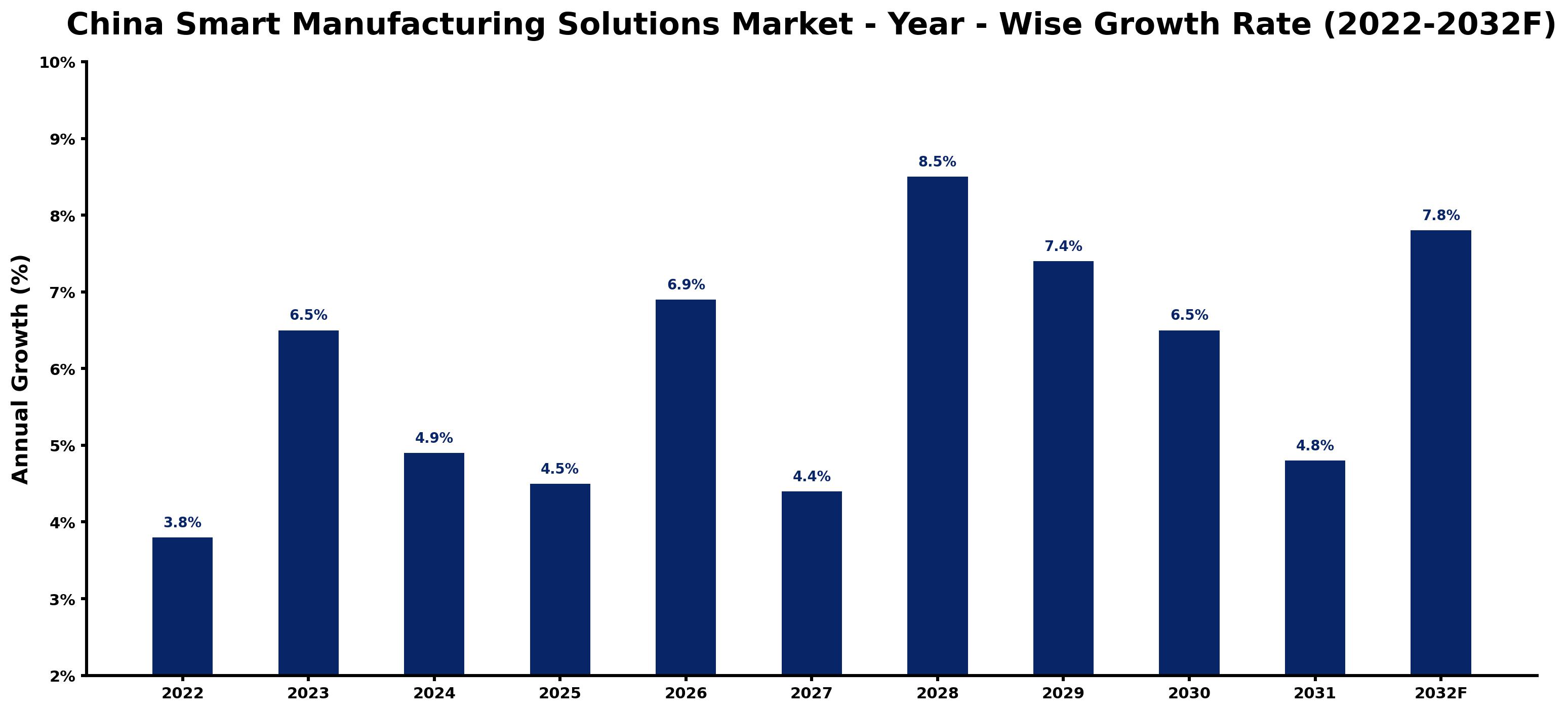
The following table presents the estimated annual growth rate for each year together with the principal factor influencing market performance.
| Year | Estimated Annual Growth (%) | Market Rationale |
| 2022 | 3.8 | The market exhibited steady growth as manufacturers began integrating smart solutions into their operations. |
| 2023 | 6.5 | Increased adoption of smart technologies by manufacturers drove faster growth compared to the previous year. |
| 2024 | 4.9 | Growth slowed as companies continued to refine their smart manufacturing strategies and implementations. |
| 2025 | 4.5 | The market experienced a further slowdown as manufacturers focused on optimising existing systems. |
| 2026 | 6.9 | Investment in smart manufacturing solutions is expected to accelerate, leading to a rise in growth rates. |
| 2027 | 4.4 | A slowdown is projected as market players adjust to evolving technology and customer needs. |
| 2028 | 8.5 | The market is expected to peak as investments in automation and AI technologies surge, supported by the 'Made in China 2025' strategy. |
| 2029 | 7.4 | Growth is anticipated to slow as the market begins to stabilise after reaching its peak, with manufacturers consolidating their smart initiatives. |
| 2030 | 6.5 | The market will continue to grow at a slower rate as companies consolidate their smart manufacturing initiatives. |
| 2031 | 4.8 | A further slowdown is expected as manufacturers focus on cost management and efficiency. |
| 2032 | 7.8 | Growth is projected to rebound as new technologies and innovations revitalise the market. |
Note: Market size estimations and growth projections presented in this report are based on 6Wresearch's proprietary forecasting methodology, utilizing the latest available industry data, government publications, and primary research inputs.
China Smart Manufacturing Solutions Market Synopsis
Smart Manufacturing Solutions in China encompass advanced technologies that optimise production efficiency and flexibility in manufacturing processes. These solutions integrate IoT, AI, and data analytics to improve production lines and reduce downtime. The China Smart Manufacturing Solutions Market is projected to reach 1 trillion yuan by 2025, driven by extensive investments from domestic manufacturers and industrial clients. Key initiatives like the 'Smart Manufacturing 2025' initiative and the 'Intelligent Manufacturing Development Plan' are crucial in promoting digital transformation across various sectors.
Market Dynamics Impact Analysis (2026–2032)
| Factor | Type | Impact | Primary Segment Affected |
| Growing investments in automation technologies drive demand for smart manufacturing solutions. | Driver | High | Smart MES |
| Increasing focus on predictive maintenance technologies enhances operational efficiency. | Driver | High | Predictive Maintenance AI |
| The ongoing digital transformation creates opportunities for innovative solutions in manufacturing. | Opportunity | High | Digital Twin Software |
| Rising demand for real-time data analytics presents new market openings. | Opportunity | High | Workflow Optimization AI |
| High initial investment costs may deter some manufacturers from adopting smart solutions. | Restraint | Medium | Smart Manufacturing |
| Limited awareness of smart manufacturing benefits restricts market growth. | Restraint | Medium | Predictive Maintenance AI |
| Supply chain disruptions can delay the implementation of smart technologies. | Challenge | High | Digital Twin Software |
| Approval delays for new technologies can hinder market entry for innovative solutions. | Challenge | High | Smart MES |
Evaluation of Drivers in China Smart Manufacturing Solutions Market (2026–2032)
Key forces behind demand, with the segment each one moves most, are listed below.
| Drivers | Primary Segment Affected | Why It Matters (Evidence) |
| Investment in automation technologies is increasing among manufacturers. | Smart MES | Over 60% of OEMs in China are investing in predictive maintenance technologies to improve operational efficiency. |
| The adoption of predictive maintenance AI is rising. | Predictive Maintenance AI | In Jiangsu province, 70% of manufacturers are implementing digital twin technologies to minimise downtime. |
| Demand for real-time data analytics is growing. | Workflow Optimization AI | The installed base of smart manufacturing solutions is projected to grow by 25% annually until 2025. |
| The push for digital transformation is strong among industrial clients. | Digital Twin Software | The 'Made in China 2025' strategy emphasises the adoption of smart manufacturing across various sectors. |
| Integration of AI technologies is becoming standard practice. | Smart MES | The 'Artificial Intelligence Innovation Action Plan' supports AI integration in manufacturing processes. |
The Smart Manufacturing Solutions market in China is growing as investment in automation technologies, an increasing focus on predictive maintenance, and demand for real-time data analytics rise. Over 60% of OEMs are investing in predictive maintenance technologies, which boost operational efficiency. The installed base of smart manufacturing solutions is expected to grow by 25% annually until 2025, driven by the 'Made in China 2025' strategy. Industrial clients are strongly pursuing digital transformation to enhance productivity and cut costs. The integration of AI technologies is becoming standard, aligning with the goals of the 'Artificial Intelligence Innovation Action Plan'.
Evaluation of Restraints in China Smart Manufacturing Solutions Market
The main factors holding the market back are set out below.
| Market Restraint | Primary Segment Affected | Why It Matters (Evidence) |
| High initial investment costs for smart manufacturing solutions can deter adoption. | Smart MES | The cost of adopting smart manufacturing solutions in China can be a barrier for many buyers, with initial investments often surpassing 10 million yuan per facility. |
| Supply chain disruptions impact the availability of components. | Predictive Maintenance AI | Supply chain issues arise as local manufacturers depend on imported components, which can delay project timelines, ultimately affecting production schedules. |
| Skills shortages limit the workforce's ability to implement advanced technologies. | Digital Twin Software | Skills shortages are evident, as many workers lack the training needed for advanced manufacturing techniques, leading to operational inefficiencies. |
| Intense competition pressures manufacturers to innovate continuously. | Workflow Optimization AI | Competition is fierce, with over 30,000 manufacturing enterprises in Guangdong adopting smart solutions, pressuring others to innovate or risk losing market share. |
| Regulatory compliance can be complex and time-consuming. | Smart MES | Manufacturers must navigate various standards and regulations, such as the 'National Standard for Smart Manufacturing Systems', which can complicate implementation. |
China Smart Manufacturing Solutions Market Challenges
The high cost of implementing smart manufacturing solutions in China can deter many buyers, with initial investments often exceeding 10 million yuan per facility. Supply chain disruptions occur as local manufacturers rely on imported components, which can extend project timelines and delay production schedules. A lack of skilled workers is problematic, as many employees do not possess the necessary training for advanced manufacturing techniques, resulting in reduced operational efficiency. Intense competition exists, with over 30,000 manufacturing enterprises in Guangdong adopting smart solutions, compelling others to innovate or risk losing market share.
Trends in the China Smart Manufacturing Solutions Market
Buyers and suppliers in the China Smart Manufacturing Solutions Market are adjusting to the following trends.
- Growth in Predictive Maintenance Adoption: In Jiangsu province, 70% of manufacturers are implementing predictive maintenance technologies, improving operational efficiency. This shift is expected to reduce downtime significantly, with an estimated 25% improvement in productivity.
- Rise of Digital Twin Technologies: Digital twin technologies are becoming prevalent in manufacturing, with over 30,000 enterprises adopting these solutions in Guangdong. This trend supports real-time monitoring and optimisation of production processes.
- Increased Investment in Automation: Investment in automation technologies is surging, particularly among OEMs and assemblers. The market is projected to reach 1 trillion yuan by 2025, driven by the 'Smart Manufacturing 2025' initiative.
- Focus on AI Integration: The integration of AI technologies is accelerating, with the 'Artificial Intelligence Innovation Action Plan' driving adoption. This trend is expected to improve decision-making and operational efficiency across the sector.
Investment Opportunities in the China Smart Manufacturing Solutions Market
Several openings in the China Smart Manufacturing Solutions Market merit attention from investors.
- Timing for Investment in Smart Solutions: With the market projected to reach 1 trillion yuan by 2025, now is an optimal time to invest in smart manufacturing solutions. OEMs and assemblers are actively seeking advanced technologies to improve productivity.
- Supply of Predictive Maintenance Technologies: There is a growing demand for predictive maintenance solutions, particularly among industrial clients. Investing in these technologies can capture a significant share of the market, especially in regions like Jiangsu.
- Expansion of Digital Twin Technologies: The increasing adoption of digital twin technologies presents a lucrative opportunity for suppliers. Collaborating with manufacturers in Guangdong can facilitate market entry and growth.
- Partnerships for AI Integration: Establishing partnerships with local firms can improve market access for AI-powered solutions. The 'Artificial Intelligence Innovation Action Plan' supports such collaborations, providing a pathway for growth.
Government Initiatives in the China Smart Manufacturing Solutions Market
The 'Digital Economy Development Strategy' introduced in 2021 promotes the use of digital technologies in manufacturing sectors, focusing on smart solutions. This strategy aims to encourage innovation and competitiveness, with a budget allocation of 5 billion yuan for related initiatives. Additionally, the 'National Standard for Smart Manufacturing Systems' established in 2022 provides guidelines for system integration, ensuring compliance and quality in smart manufacturing practices. These measures directly support producers by streamlining processes and improving operational capabilities.
The Ministry of Industry and Information Technology oversees the implementation of various initiatives, including the 'Intelligent Manufacturing Development Plan'. This plan allocates 5 billion yuan to support R&D in smart technologies, promoting innovation and adoption among manufacturers. Furthermore, the agency is responsible for approving projects that align with national standards, ensuring that manufacturers meet the required benchmarks for smart solutions. This oversight enables producers to access funding and support for their initiatives.
Future Insight of the China Smart Manufacturing Solutions Market
The future of the China Smart Manufacturing Solutions Market is set for transformation by 2032, driven by initiatives such as the 'Smart Manufacturing 2025' plan. The government’s allocation of 5 billion yuan for the 'Intelligent Manufacturing Development Plan' will support research and development in smart technologies. The integration of AI will expand, contributing to a projected annual growth of 25% in the installed base of smart solutions. As digital twin technologies gain traction in Jiangsu province, buyers will benefit from improved production efficiency while suppliers will face increased demand for advanced capabilities.
Market Segmentation Analysis
The analysis below covers each segmentation, its leading category in 2025 and its fastest-growing category through 2032.
By Solution Type – Smart MES Dominated, Predictive Maintenance AI Expected to Grow Fastest
According to Dhaval Chaurasia, Assistant Manager at 6Wresearch, in 2025, Smart MES led the solution type split with a 53% share. Smart MES holds the largest share in China's smart manufacturing solutions market due to its ability to integrate various manufacturing processes, making it essential for large-scale operations. The significant adoption by over 30,000 manufacturing enterprises in Guangdong province highlights its critical role in enhancing management efficiency. The quickest growth will come from Predictive Maintenance AI, forecast to expand at a CAGR of 8.8% between 2026 and 2032. The rapid growth of Predictive Maintenance is driven by over 60% of OEMs in China prioritising predictive maintenance to minimise equipment downtime. This trend signifies a shift towards proactive maintenance strategies that improve operational reliability and efficiency. Suppliers should focus on developing advanced predictive maintenance solutions to meet the rising demand from manufacturers.
By Core Feature – Production Visibility Dominated, Adaptive Scheduling Expected to Grow Fastest
With a 51% revenue share in 2025, Production Visibility was the largest core feature category. Production Visibility leads the market as it greatly enhances the tracking of production metrics in real-time, which is crucial for manufacturers aiming for operational excellence. This capability is particularly important for firms looking to optimise production processes and minimise inefficiencies. Adaptive Scheduling is projected to grow fastest, at a CAGR of 8.4% during 2026–2032. Adaptive Scheduling is witnessing rapid growth due to its ability to adjust production schedules based on real-time data, allowing manufacturers to respond swiftly to changing demands. This flexibility is increasingly valued in today's dynamic manufacturing environment, driving its adoption. Buyers will benefit from investing in adaptive scheduling technologies to improve their responsiveness and operational efficiency.
By Integration Platform – Cloud + IoT Platforms Dominated and Is Expected to Record the Fastest Growth
Cloud + IoT Platforms took a 50% share of integration platform in 2025, more than any other category. Cloud + IoT Platforms dominate the market as they enable extensive data collection and analysis, which is vital for modern smart manufacturing solutions. Their integration facilitates seamless communication between various manufacturing systems, significantly enhancing overall operational efficiency. The same category are also set to grow fastest, at a CAGR of 7.6% during 2026–2032. The growth of Cloud + IoT Platforms will continue to accelerate as they are essential for manufacturers to leverage data-driven insights for improved decision-making. Their dual role as both leader and fastest segment underscores their fundamental importance in smart manufacturing. Suppliers must prioritise the development of robust cloud and IoT solutions to capitalise on the increasing reliance on data-driven manufacturing.
By End User – OEMs & Assemblers Dominated, Industrial Clients Expected to Grow Fastest
OEMs & Assemblers accounted for a 45% market share by end user in 2025. OEMs & Assemblers represent the largest share of the market as they are the primary users of smart manufacturing solutions, directly integrating these technologies into their production processes. Their substantial operational scale necessitates advanced solutions for enhancing efficiency and productivity. Over 2026–2032, Industrial Clients are expected to post the fastest growth, at a CAGR of 7.6%. Industrial Clients are rapidly adopting smart solutions to improve operational efficiency, reflecting a broader trend towards digital transformation across various sectors. This growth indicates a shift in focus towards optimising existing processes and technologies. Suppliers should tailor their offerings to meet the specific needs of industrial clients, who are increasingly seeking advanced solutions to enhance their operations.
Key Attractiveness of the Report
- 10 Years of Market Numbers
- Historical Data Starting from 2022 to 2025
- Base Year 2025
- Forecast Data until 2032
- Key Performance Indicators Impacting the Market
- Major Upcoming Developments and Projects
Key Highlights of the Report:
- China Smart Manufacturing Solutions Market Outlook
- Market Size of China Smart Manufacturing Solutions Market, 2025
- Forecast of China Smart Manufacturing Solutions Market, 2032
- Historical Data and Forecast of China Smart Manufacturing Solutions Revenues & Volume for the Period 2022 - 2032F
- China Smart Manufacturing Solutions Market Trend Evolution
- China Smart Manufacturing Solutions Market Drivers and Challenges
- China Smart Manufacturing Solutions Price Trends
- China Smart Manufacturing Solutions Porter's Five Forces
- China Smart Manufacturing Solutions Industry Life Cycle
- Historical Data and Forecast of China Smart Manufacturing Solutions Market Revenues & Volume By Solution Type for the Period 2022 - 2032F
- Historical Data and Forecast of China Smart Manufacturing Solutions Market Revenues & Volume By Digital Twin Software for the Period 2022 - 2032F
- Historical Data and Forecast of China Smart Manufacturing Solutions Market Revenues & Volume By Predictive Maintenance AI for the Period 2022 - 2032F
- Historical Data and Forecast of China Smart Manufacturing Solutions Market Revenues & Volume By Smart MES for the Period 2022 - 2032F
- Historical Data and Forecast of China Smart Manufacturing Solutions Market Revenues & Volume By Workflow Optimization AI for the Period 2022 - 2032F
- Historical Data and Forecast of China Smart Manufacturing Solutions Market Revenues & Volume By Core Feature for the Period 2022 - 2032F
- Historical Data and Forecast of China Smart Manufacturing Solutions Market Revenues & Volume By Real-Time Simulation for the Period 2022 - 2032F
- Historical Data and Forecast of China Smart Manufacturing Solutions Market Revenues & Volume By Downtime Reduction for the Period 2022 - 2032F
- Historical Data and Forecast of China Smart Manufacturing Solutions Market Revenues & Volume By Production Visibility for the Period 2022 - 2032F
- Historical Data and Forecast of China Smart Manufacturing Solutions Market Revenues & Volume By Adaptive Scheduling for the Period 2022 - 2032F
- Historical Data and Forecast of China Smart Manufacturing Solutions Market Revenues & Volume By Integration Platform for the Period 2022 - 2032F
- Historical Data and Forecast of China Smart Manufacturing Solutions Market Revenues & Volume By Cloud + IoT Platforms for the Period 2022 - 2032F
- Historical Data and Forecast of China Smart Manufacturing Solutions Market Revenues & Volume By ML + Sensor Data for the Period 2022 - 2032F
- Historical Data and Forecast of China Smart Manufacturing Solutions Market Revenues & Volume By ERP + PLC Interface for the Period 2022 - 2032F
- Historical Data and Forecast of China Smart Manufacturing Solutions Market Revenues & Volume By AI-Powered Dashboards for the Period 2022 - 2032F
- Historical Data and Forecast of China Smart Manufacturing Solutions Market Revenues & Volume By End User for the Period 2022 - 2032F
- Historical Data and Forecast of China Smart Manufacturing Solutions Market Revenues & Volume By OEMs & Assemblers for the Period 2022 - 2032F
- Historical Data and Forecast of China Smart Manufacturing Solutions Market Revenues & Volume By Industrial Clients for the Period 2022 - 2032F
- Historical Data and Forecast of China Smart Manufacturing Solutions Market Revenues & Volume By Smart Manufacturing for the Period 2022 - 2032F
- Historical Data and Forecast of China Smart Manufacturing Solutions Market Revenues & Volume By Production Lines for the Period 2022 - 2032F
- China Smart Manufacturing Solutions Import Export Trade Statistics
- Market Opportunity Assessment By Solution Type
- Market Opportunity Assessment By Core Feature
- Market Opportunity Assessment By Integration Platform
- Market Opportunity Assessment By End User
- China Smart Manufacturing Solutions Top Companies Market Share
- China Smart Manufacturing Solutions Competitive Benchmarking By Technical and Operational Parameters
- China Smart Manufacturing Solutions Company Profiles
- China Smart Manufacturing Solutions Key Strategic Recommendations
Market Covered
This report examines the market across the segments below.
By Solution Type
- Digital Twin Software
- Predictive Maintenance AI
- Smart MES
- Workflow Optimization AI
By Core Feature
- Real-Time Simulation
- Downtime Reduction
- Production Visibility
- Adaptive Scheduling
By Integration Platform
- Cloud + IoT Platforms
- ML + Sensor Data
- ERP + PLC Interface
- AI-Powered Dashboards
By End User
- OEMs & Assemblers
- Industrial Clients
- Smart Manufacturing
- Production Lines































