China Smart Metering Infrastructure Market Size & Growth Rate
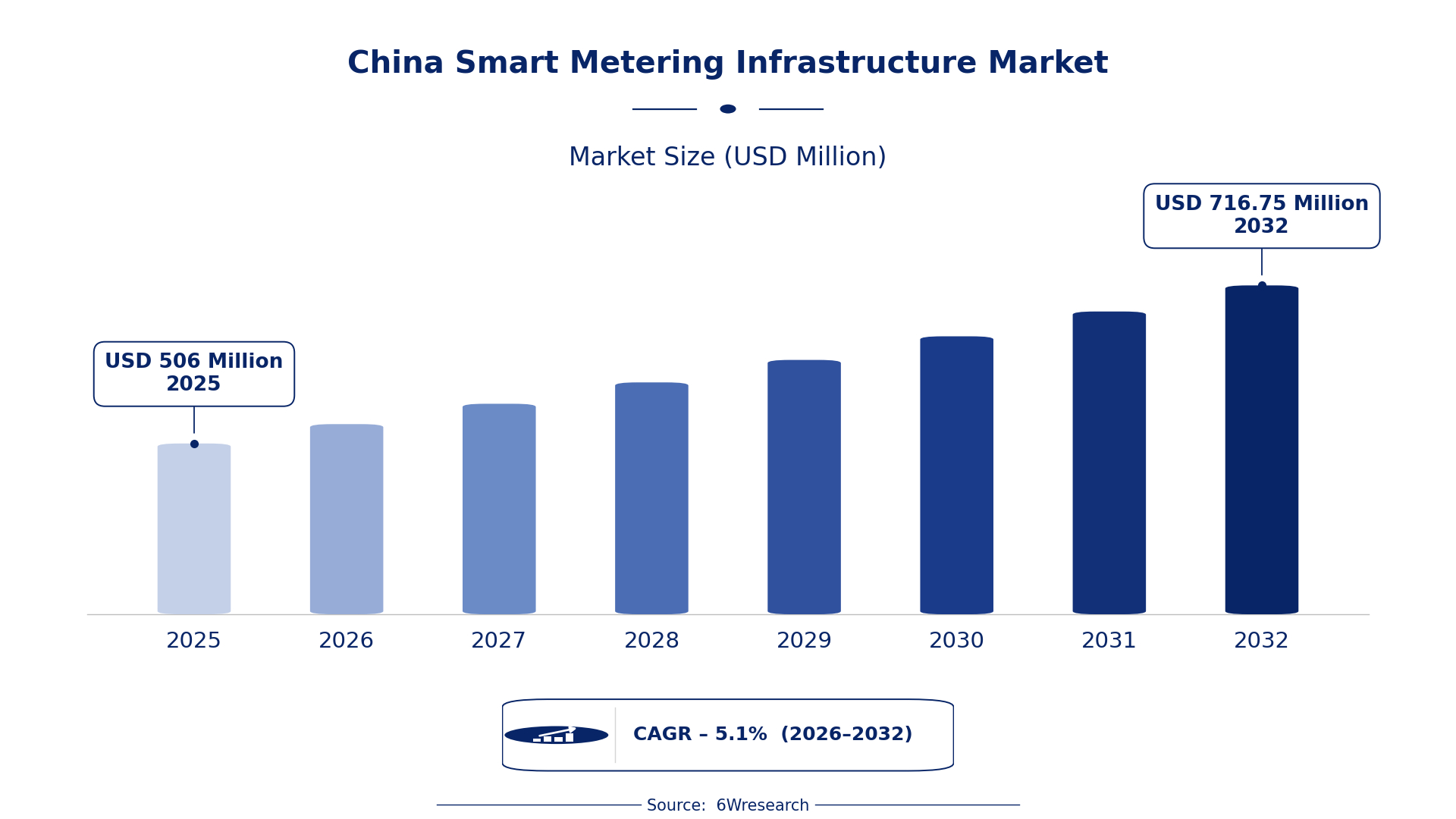
According to 6Wresearch internal database and industry insights, the China Smart Metering Infrastructure Market was valued at USD 506.0 million in 2025 and is projected to reach USD 716.75 million by 2032, growing at a CAGR of approximately 5.1% during 2026–2032.
China Smart Metering Infrastructure Market Highlights
| Report Metric | Details |
| Report Name | China Smart Metering Infrastructure Market |
| Market Size 2025 | USD 506.0 million |
| Market Size 2032 | USD 716.75 million |
| Absolute Growth 2025–2032 | USD 210.75 million |
| CAGR 2026–2032 | 5.1% |
| Peak Annual Growth | 7.3% in 2027 |
| Forecast Period | 2026–2032 |
| Historical Data | 2022–2025 |
| Base Year | 2025 |
| Leading Infrastructure Type, 2025 | AMI (Advanced Metering) (47% share) |
| Leading Smart Feature, 2025 | Two-Way Communication (38% share) |
| Leading Communication Network, 2025 | RF Mesh/Cellular (44% share) |
| Leading End User, 2025 | Utility Providers (40% share) |
| Fastest-Growing Infrastructure Type | Data Concentrators (6.7% CAGR) |
| Fastest-Growing Smart Feature | Remote Device Management (6.1% CAGR) |
| Fastest-Growing Communication Network | IoT/Edge Gateway (7.0% CAGR) |
| Fastest-Growing End User | Grid Integrators (7.1% CAGR) |
| Growing Sector | Utility Providers |
| Key End Users | Utility Providers, Grid Integrators, Energy Infrastructure |
China Smart Metering Infrastructure Market Year-wise Growth Rate and Key Drivers (2022–2032)
This graph illustrates the annual growth rates of the market from 2022 to 2032, highlighting a steady upward trajectory and projected market expansion over the forecast period.
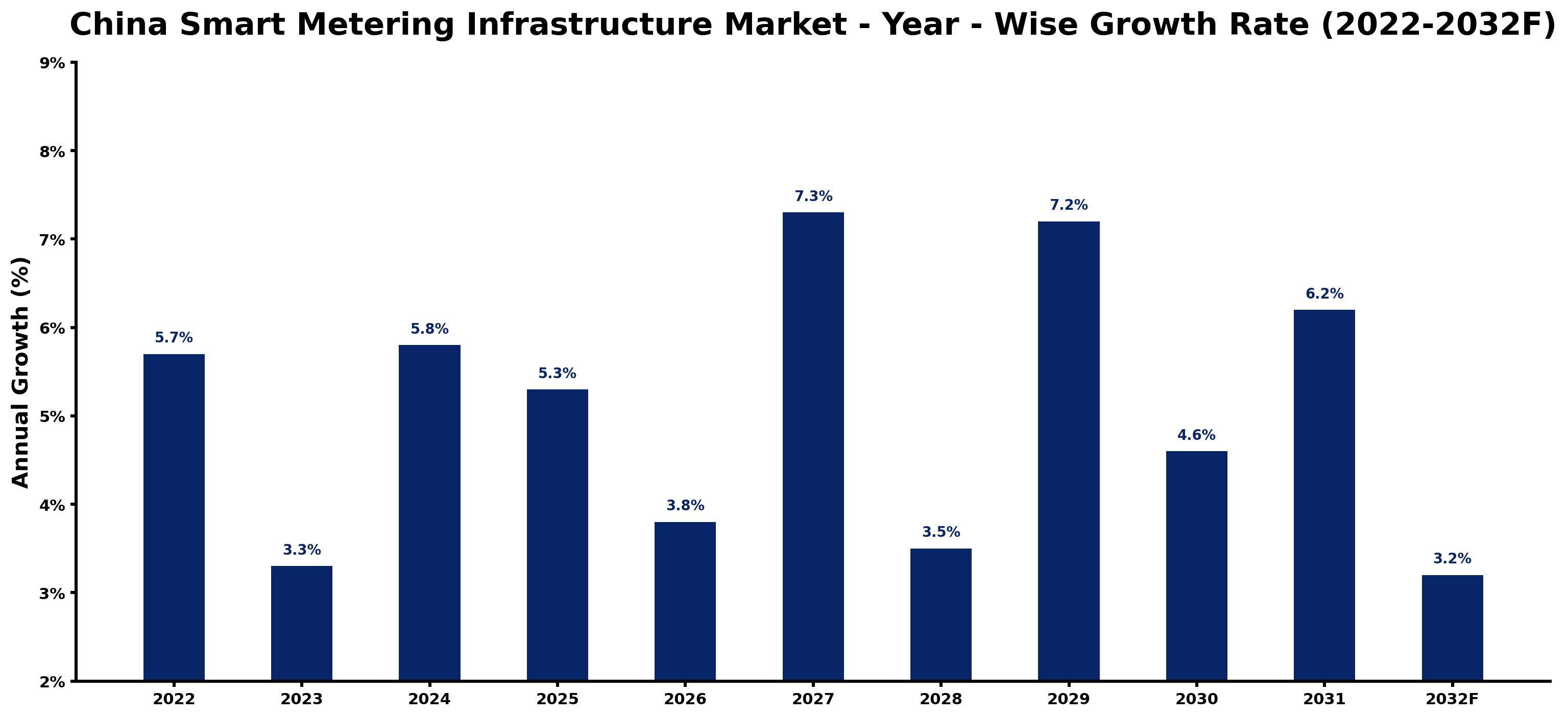
Annual growth estimates for each year appear below with the principal reason behind them, explaining the shifts that set the pace of the market.
| Year | Estimated Annual Growth (%) | Market Rationale |
| 2022 | 5.7 | The market experienced steady growth due to increased adoption of smart metering technologies by utility providers. |
| 2023 | 3.3 | Growth slowed as utility providers adjusted to the 'Smart Energy Development Plan' and new technologies. |
| 2024 | 5.8 | Demand surged as the government reinforced smart metering initiatives through the 'National Smart Grid Technology Innovation and Development Program'. |
| 2025 | 5.3 | Utility providers expanded their infrastructure to meet targets outlined in the 'Smart Energy Development Plan'. |
| 2026 | 3.8 | Growth is expected to decelerate as the market faces integration challenges with existing infrastructure and technology. |
| 2027 | 7.3 | A rise in demand is projected, driven by advancements in smart grid technologies and the push for 100% coverage. |
| 2028 | 3.5 | The market is expected to experience a slowdown as utility providers consolidate operations under new standards. |
| 2029 | 7.2 | Demand is anticipated to rebound with renewed investments in smart metering infrastructure across various provinces. |
| 2030 | 4.6 | Growth is projected to slow again as market saturation begins to set in among utility providers. |
| 2031 | 6.2 | An uptick in demand is expected as new projects commence under the 'Smart Energy Development Plan'. |
| 2032 | 3.2 | The market growth rate is projected to stabilise as utility providers focus on efficiency and compliance with new standards. |
Note: Market size estimations and growth projections presented in this report are based on 6Wresearch's proprietary forecasting methodology, utilizing the latest available industry data, government publications, and primary research inputs.
China Smart Metering Infrastructure Market Synopsis
Smart Metering Infrastructure in China encompasses advanced systems that enable utilities to efficiently monitor and manage energy consumption. These systems integrate hardware and software technologies, including smart meters and communication networks. The China Smart Metering Infrastructure Market is expanding due to rising investments in smart grid technologies and a government mandate for 100% smart meter coverage by 2025. Utility providers are increasingly adopting these solutions to enhance operational efficiency and consumer engagement, driving further growth in the sector.
Market Dynamics Impact Analysis (2026–2032)
| Factor | Type | Impact | Primary Segment Affected |
| Increased investments in smart grid technologies drive demand for smart metering solutions. | Driver | High | AMI (Advanced Metering) |
| The push for 100% smart meter coverage by 2025 creates opportunities for suppliers. | Opportunity | High | Utility Providers |
| The need for real-time monitoring and data management fuels demand for smart metering infrastructure. | Driver | High | Data Concentrators |
| The rapid deployment of smart grid pilot projects across provinces presents growth opportunities. | Opportunity | Medium | Smart Grid Controllers |
| Integration challenges with existing infrastructure limit market growth. | Restraint | High | Gateway Units |
| The high cost of smart meters can deter utility providers from upgrading. | Restraint | Medium | Smart Meter Bridging |
| The Smart Metering Infrastructure Market in China faces regulatory hurdles that slow adoption. | Challenge | High | RF Mesh/Cellular |
| Competition among utility providers can lead to price wars, impacting profitability. | Challenge | Medium | Utility Providers |
Evaluation of Drivers in China Smart Metering Infrastructure Market (2026–2032)
The factors lifting demand, and the evidence behind each, are summarised below.
| Drivers | Primary Segment Affected | Why It Matters (Evidence) |
| Increased investments in smart grid technologies drive demand for advanced metering solutions. | AMI (Advanced Metering) | The National Smart Grid Technology Innovation and Development Program allocates resources to enhance energy management capabilities, increasing demand. |
| Growing consumer engagement through smart metering drives utility providers to invest. | Gateway Units | The 'Smart Energy Development Plan' aims to improve energy efficiency and consumer interaction, increasing demand. |
| Rising need for real-time data management spurs demand for data concentrators. | Data Concentrators | In 2023, the average cost of a smart meter was approximately 300 CNY, prompting utilities to enhance data aggregation capabilities. |
| The push for operational efficiency leads to increased adoption of smart grid controllers. | Smart Grid Controllers | Utility providers in regions with numerous pilot projects can benefit from enhanced operational efficiency through these technologies. |
| The necessity for remote monitoring solutions drives demand for remote device management. | Remote Device Management | With a growing need for remote monitoring, suppliers can collaborate with utility providers to offer tailored solutions. |
Market growth in China for Smart Metering Infrastructure rests on rising investments in smart grid technologies, the push for 100% smart meter coverage by 2025, and the increasing need for efficient energy management. In 2023, smart grid investment reached 20 billion USD, prompting utilities to upgrade their systems. The target encourages utilities to modernise their infrastructure, resulting in more purchases of advanced metering solutions. Real-time monitoring capabilities are essential for data management, as 70% of urban households had access to smart meters in 2022. The expansion of smart grid pilot projects across provinces further boosts demand for smart metering solutions, creating a dynamic market environment.
Evaluation of Restraints in China Smart Metering Infrastructure Market
The table below lists the restraints and the evidence behind each.
| Market Restraint | Primary Segment Affected | Why It Matters (Evidence) |
| Supply chain disruptions hinder timely installations for utility providers. | Utility Providers | Global semiconductor shortages have delayed the sourcing of components, affecting project timelines. |
| Regulatory compliance costs can burden suppliers and utility providers. | Utility Providers | Compliance with ISO/IEC 62056 standards can impose additional costs that may reach 5% of project budgets. |
| Price competition among utility providers can lead to compromised service quality. | Utility Providers | Intense competition may force providers to reduce prices, impacting long-term sustainability. |
| Integration challenges with existing infrastructure slow market adoption. | AMI (Advanced Metering) | Utility providers face difficulties in integrating new technologies with legacy systems, delaying upgrades. |
| Market saturation limits growth potential for new entrants. | Utility Providers | As more utilities adopt smart metering, the market becomes increasingly competitive, making it hard for newcomers. |
China Smart Metering Infrastructure Market Challenges
The China Smart Metering Infrastructure Market faces notable supply chain disruptions, particularly from global semiconductor shortages, which delay installations for utility providers. Regulatory challenges arise from the need to comply with ISO/IEC 62056 standards, leading to compliance costs that can reach 5% of project budgets for suppliers. The average smart meter cost of approximately 300 CNY places pressure on budgets within the energy management sector, restricting their ability to upgrade infrastructure. Increased competition among suppliers results in aggressive pricing strategies, which can undermine profitability and sustainability for manufacturers over time.
Trends in the China Smart Metering Infrastructure Market
Buyers and suppliers in the China Smart Metering Infrastructure Market are adjusting to the following trends.
- Shift from Traditional to Smart Metering Solutions: China is moving away from traditional metering systems towards advanced smart metering solutions. The 'Smart Energy Development Plan' aims for 100% smart meter coverage by 2025, improving energy efficiency for both consumers and utilities. This transition supports the growth of smart metering infrastructure.
- Emergence of IoT-Enabled Smart Meters: The adoption of IoT-enabled smart meters is on the rise in China, driven by the demand for real-time data. In 2023, over 1,000 smart grid pilot projects were launched, highlighting the increasing integration of IoT technologies in energy management.
- Increased Focus on Data Security Standards: With the revision of the 'National Standard for Smart Meters' in 2022, data security has become a priority. This standard ensures compatibility and safety for smart metering systems, addressing consumer concerns and building trust in smart technologies.
- Expansion of Smart Metering in Jiangsu Province: Jiangsu province is at the forefront of smart metering installations, with over 50 million units deployed. This figure underscores the province's commitment to modernising energy infrastructure and enhancing efficiency.
Investment Opportunities in the China Smart Metering Infrastructure Market
Below are the investment opportunities with the strongest case in the China Smart Metering Infrastructure Market.
- Investment in Advanced Metering Infrastructure: Utility providers are seeking advanced metering infrastructure to meet the 2025 coverage target. With 100% smart meter coverage aimed by the National Energy Administration, suppliers can capitalise on this demand through partnerships with local utilities.
- Supply of Data Concentrators for Enhanced Monitoring: The demand for data concentrators is rising as utilities require better data management. In 2023, the average cost of a smart meter was approximately 300 CNY, prompting suppliers to target utility providers looking to improve their data aggregation capabilities.
- Development of Smart Grid Controllers: Smart grid controllers are essential for managing smart grid operations, presenting a significant investment opportunity. Utility providers in regions with numerous pilot projects can benefit from enhanced operational efficiency through these technologies.
- Provision of Remote Device Management Solutions: Remote device management is vital for utilities aiming to improve operational efficiency. With a growing need for remote monitoring, suppliers can enter the market by collaborating with utility providers to offer tailored solutions.
Government Initiatives in the China Smart Metering Infrastructure Market
In 2020, the Ministry of Industry and Information Technology launched the 'Smart Grid Technology Innovation Program' with a budget of 5 billion CNY. This initiative focuses on R&D and deployment of smart metering technologies, funding projects that improve energy management capabilities. Additionally, the 'Energy Efficiency Improvement Action Plan' introduced in 2023 promotes the adoption of smart metering technology among utility providers, ensuring they have the necessary resources to implement advanced metering solutions. These measures create a supportive environment for the growth of smart metering infrastructure.
The 'Smart Energy Development Plan' initiated by the National Energy Administration in 2021 aims for 100% smart meter coverage by 2025. This initiative compels utility providers to adopt smart metering technologies, ensuring they invest in modern infrastructure to meet consumer demands. The plan establishes a clear target for utilities, reflecting a broader strategy to modernise energy management across the country, driving growth in the smart metering sector. The government's commitment to this goal is demonstrated through resource allocation to support utility upgrades and infrastructure improvements.
Future Insight of the China Smart Metering Infrastructure Market
The China Smart Metering Infrastructure Market will experience substantial changes by 2032, driven by initiatives such as the National Smart Grid Technology Innovation and Development Program and the Smart Energy Development Plan. By 2025, full smart meter coverage will enhance operational efficiency for urban households. With over 1,000 smart grid pilot projects across various provinces, buyers will benefit from improved data management systems and real-time monitoring capabilities. These advancements will empower energy management sectors to optimise energy consumption and strengthen grid reliability.
Market Segmentation Analysis
The analysis below covers each segmentation, its leading category in 2025 and its fastest-growing category through 2032.
By Infrastructure Type – AMI (Advanced Metering) Dominated, Data Concentrators Expected to Grow Fastest
According to Dhaval Chaurasia, Assistant Manager at 6Wresearch, the largest infrastructure type category in 2025 was AMI (Advanced Metering), with a 47% share of total revenue. The AMI (Advanced Metering Infrastructure) segment commands the largest market share due to its critical role in enabling real-time data management for utility providers. The extensive deployment of over 50 million units in Jiangsu province illustrates the widespread acceptance and reliance on this technology. The quickest growth will come from Data Concentrators, forecast to expand at a CAGR of 6.7% between 2026 and 2032. Data Concentrators are experiencing rapid growth as they are essential for aggregating data from multiple smart meters, which is increasingly necessary for efficient energy management. The rise in smart grid pilot projects across China underscores the escalating demand for robust data aggregation solutions. This trend indicates that suppliers should concentrate on enhancing data aggregation technologies to meet the evolving needs of utility providers.
By Smart Feature – Two-Way Communication Dominated, Remote Device Management Expected to Grow Fastest
In 2025, Two-Way Communication led the smart feature split with a 38% share. Two-Way Communication holds the largest market share as it is vital for enabling interactions between utilities and consumers, which significantly enhances operational efficiency. This feature is crucial for utilities aiming to improve service delivery and foster better customer engagement. Over 2026–2032, Remote Device Management is expected to post the fastest growth, at a CAGR of 6.1%. Remote Device Management is the fastest-growing feature, propelled by the increasing necessity for utilities to facilitate remote monitoring and control of smart meters. The growing emphasis on operational efficiency in energy management is driving this segment's swift expansion. Suppliers should focus on advancing remote management capabilities to align with the shifting demands of utility providers.
By Communication Network – RF Mesh/Cellular Dominated, IoT/Edge Gateway Expected to Grow Fastest
With a 44% revenue share in 2025, RF Mesh/Cellular was the largest communication network category. RF Mesh/Cellular networks dominate the market because they are effective for data transmission across large areas, which is essential for extensive smart metering installations. This technology is particularly important for utilities operating in densely populated urban regions. IoT/Edge Gateway is set to record the highest CAGR in this split, 7.0% over 2026–2032. The IoT/Edge Gateway segment is experiencing swift growth as it facilitates edge computing for real-time processing, increasingly vital for smart metering applications. The adoption of IoT technologies in smart metering systems is a key factor driving this growth. This indicates that suppliers must invest in IoT solutions to improve their communication network offerings for smart metering.
By End User – Utility Providers Dominated, Grid Integrators Expected to Grow Fastest
Utility Providers took a 40% share of end user in 2025, more than any other category. Utility Providers represent the largest segment of the market share as they are the primary users of smart metering solutions, which are essential for effective energy distribution and consumption management. Their significant investments in smart grid technologies further stimulate the demand for advanced metering infrastructure. Grid Integrators are projected to grow fastest, at a CAGR of 7.1% during 2026–2032. Grid Integrators are the fastest-growing end user segment, as they play a crucial role in implementing smart grid technologies that require sophisticated metering solutions. The heightened focus on smart grid initiatives is accelerating their growth trajectory. This suggests that suppliers should tailor their offerings to meet the specific needs of grid integrators to capture this expanding market.
Key Attractiveness of the Report
- 10 Years of Market Numbers
- Historical Data Starting from 2022 to 2025
- Base Year 2025
- Forecast Data until 2032
- Key Performance Indicators Impacting the Market
- Major Upcoming Developments and Projects
Key Highlights of the Report:
- China Smart Metering Infrastructure Market Outlook
- Market Size of China Smart Metering Infrastructure Market, 2025
- Forecast of China Smart Metering Infrastructure Market, 2032
- Historical Data and Forecast of China Smart Metering Infrastructure Revenues & Volume for the Period 2022 - 2032F
- China Smart Metering Infrastructure Market Trend Evolution
- China Smart Metering Infrastructure Market Drivers and Challenges
- China Smart Metering Infrastructure Price Trends
- China Smart Metering Infrastructure Porter's Five Forces
- China Smart Metering Infrastructure Industry Life Cycle
- Historical Data and Forecast of China Smart Metering Infrastructure Market Revenues & Volume By Infrastructure Type for the Period 2022 - 2032F
- Historical Data and Forecast of China Smart Metering Infrastructure Market Revenues & Volume By AMI (Advanced Metering) for the Period 2022 - 2032F
- Historical Data and Forecast of China Smart Metering Infrastructure Market Revenues & Volume By Data Concentrators for the Period 2022 - 2032F
- Historical Data and Forecast of China Smart Metering Infrastructure Market Revenues & Volume By Smart Grid Controllers for the Period 2022 - 2032F
- Historical Data and Forecast of China Smart Metering Infrastructure Market Revenues & Volume By Gateway Units for the Period 2022 - 2032F
- Historical Data and Forecast of China Smart Metering Infrastructure Market Revenues & Volume By Smart Feature for the Period 2022 - 2032F
- Historical Data and Forecast of China Smart Metering Infrastructure Market Revenues & Volume By Two-Way Communication for the Period 2022 - 2032F
- Historical Data and Forecast of China Smart Metering Infrastructure Market Revenues & Volume By Meter Data Aggregation for the Period 2022 - 2032F
- Historical Data and Forecast of China Smart Metering Infrastructure Market Revenues & Volume By Remote Device Management for the Period 2022 - 2032F
- Historical Data and Forecast of China Smart Metering Infrastructure Market Revenues & Volume By Smart Meter Bridging for the Period 2022 - 2032F
- Historical Data and Forecast of China Smart Metering Infrastructure Market Revenues & Volume By Communication Network for the Period 2022 - 2032F
- Historical Data and Forecast of China Smart Metering Infrastructure Market Revenues & Volume By RF Mesh/Cellular for the Period 2022 - 2032F
- Historical Data and Forecast of China Smart Metering Infrastructure Market Revenues & Volume By WAN Interface for the Period 2022 - 2032F
- Historical Data and Forecast of China Smart Metering Infrastructure Market Revenues & Volume By IP-Based Protocols for the Period 2022 - 2032F
- Historical Data and Forecast of China Smart Metering Infrastructure Market Revenues & Volume By IoT/Edge Gateway for the Period 2022 - 2032F
- Historical Data and Forecast of China Smart Metering Infrastructure Market Revenues & Volume By End User for the Period 2022 - 2032F
- Historical Data and Forecast of China Smart Metering Infrastructure Market Revenues & Volume By Utility Providers for the Period 2022 - 2032F
- Historical Data and Forecast of China Smart Metering Infrastructure Market Revenues & Volume By Grid Integrators for the Period 2022 - 2032F
- Historical Data and Forecast of China Smart Metering Infrastructure Market Revenues & Volume By Energy Infrastructure for the Period 2022 - 2032F
- Historical Data and Forecast of China Smart Metering Infrastructure Market Revenues & Volume By Meter Manufacturers for the Period 2022 - 2032F
- China Smart Metering Infrastructure Import Export Trade Statistics
- Market Opportunity Assessment By Infrastructure Type
- Market Opportunity Assessment By Smart Feature
- Market Opportunity Assessment By Communication Network
- Market Opportunity Assessment By End User
- China Smart Metering Infrastructure Top Companies Market Share
- China Smart Metering Infrastructure Competitive Benchmarking By Technical and Operational Parameters
- China Smart Metering Infrastructure Company Profiles
- China Smart Metering Infrastructure Key Strategic Recommendations
Market Covered
This report examines the market across the segments below.
By Infrastructure Type
- AMI (Advanced Metering)
- Data Concentrators
- Smart Grid Controllers
- Gateway Units
By Smart Feature
- Two-Way Communication
- Meter Data Aggregation
- Remote Device Management
- Smart Meter Bridging
By Communication Network
- RF Mesh/Cellular
- WAN Interface
- IP-Based Protocols
- IoT/Edge Gateway
By End User
- Utility Providers
- Grid Integrators
- Energy Infrastructure
- Meter Manufacturers































