China Smart Warehouse Equipment Market Size & Growth Rate
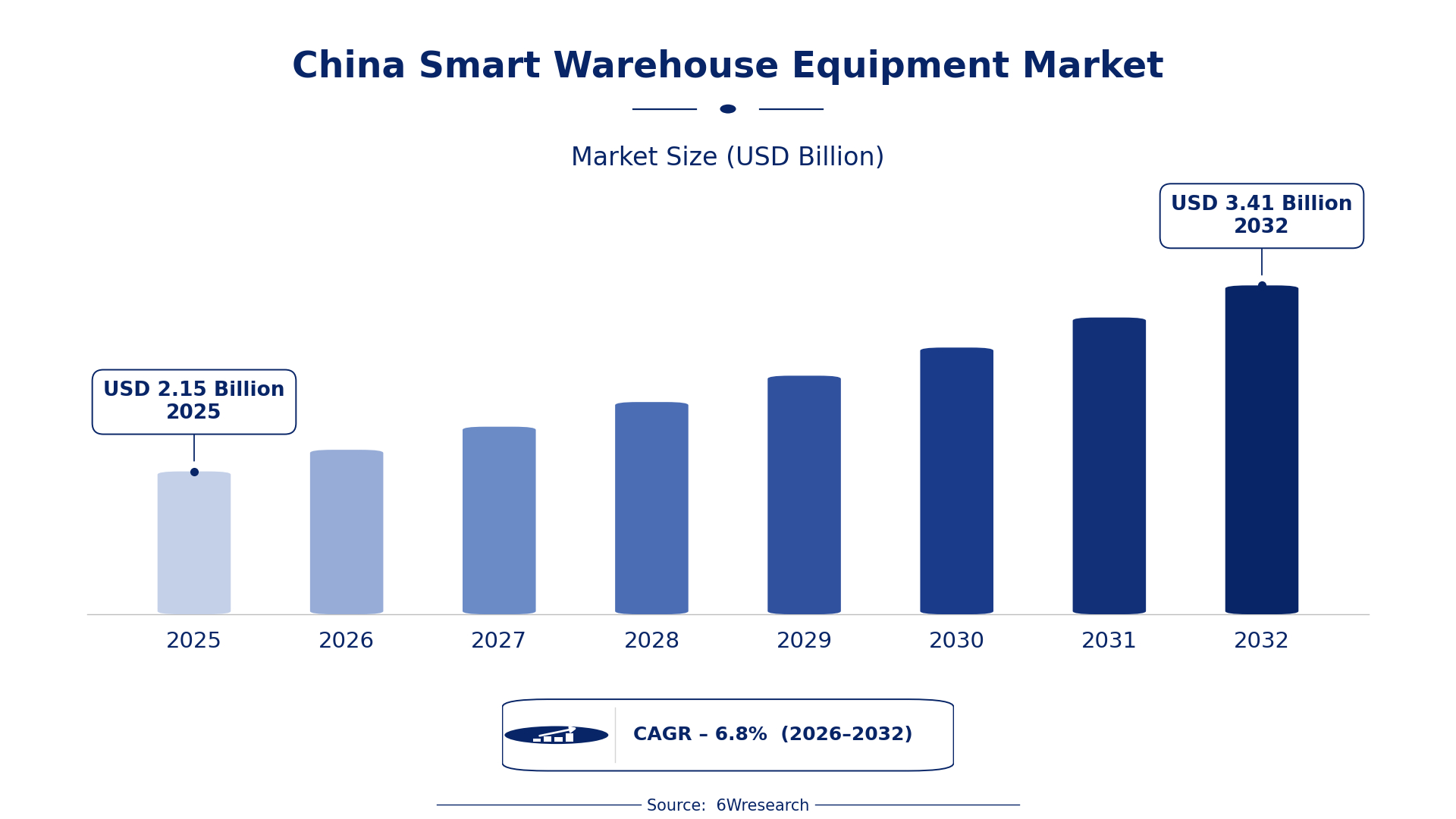
According to 6Wresearch internal database and industry insights, the China Smart Warehouse Equipment Market was valued at USD 2.15 billion in 2025 and is projected to reach USD 3.41 billion by 2032, growing at a CAGR of approximately 6.8% during 2026–2032.
China Smart Warehouse Equipment Market Highlights
| Report Metric | Details |
| Report Name | China Smart Warehouse Equipment Market |
| Market Size 2025 | USD 2.15 billion |
| Market Size 2032 | USD 3.41 billion |
| Absolute Growth 2025–2032 | USD 1.26 billion |
| CAGR 2026–2032 | 6.8% |
| Peak Annual Growth | 8.5% in 2026 |
| Forecast Period | 2026–2032 |
| Historical Data | 2022–2025 |
| Base Year | 2025 |
| Leading Equipment Type, 2025 | Autonomous Forklifts (40% share) |
| Leading Smart Feature, 2025 | Auto Inventory Tracking (46% share) |
| Leading Automation Interface, 2025 | RFID + Cloud (39% share) |
| Leading End User, 2025 | E-commerce Warehouses (54% share) |
| Fastest-Growing Equipment Type | Smart Conveyors (9.6% CAGR) |
| Fastest-Growing Smart Feature | Route + Load Optimization (8.6% CAGR) |
| Fastest-Growing Automation Interface | AI Vision (7.9% CAGR) |
| Fastest-Growing End User | Logistics Providers (9.1% CAGR) |
| Growing Sector | E-commerce |
| Key End Users | E-commerce Warehouses, Fulfillment Centers, Logistics Providers, Retail Warehouses |
China Smart Warehouse Equipment Market Year-wise Growth Rate and Key Drivers (2022–2032)
This graph illustrates the annual growth rates of the market from 2022 to 2032, highlighting a steady upward trajectory and projected market expansion over the forecast period.
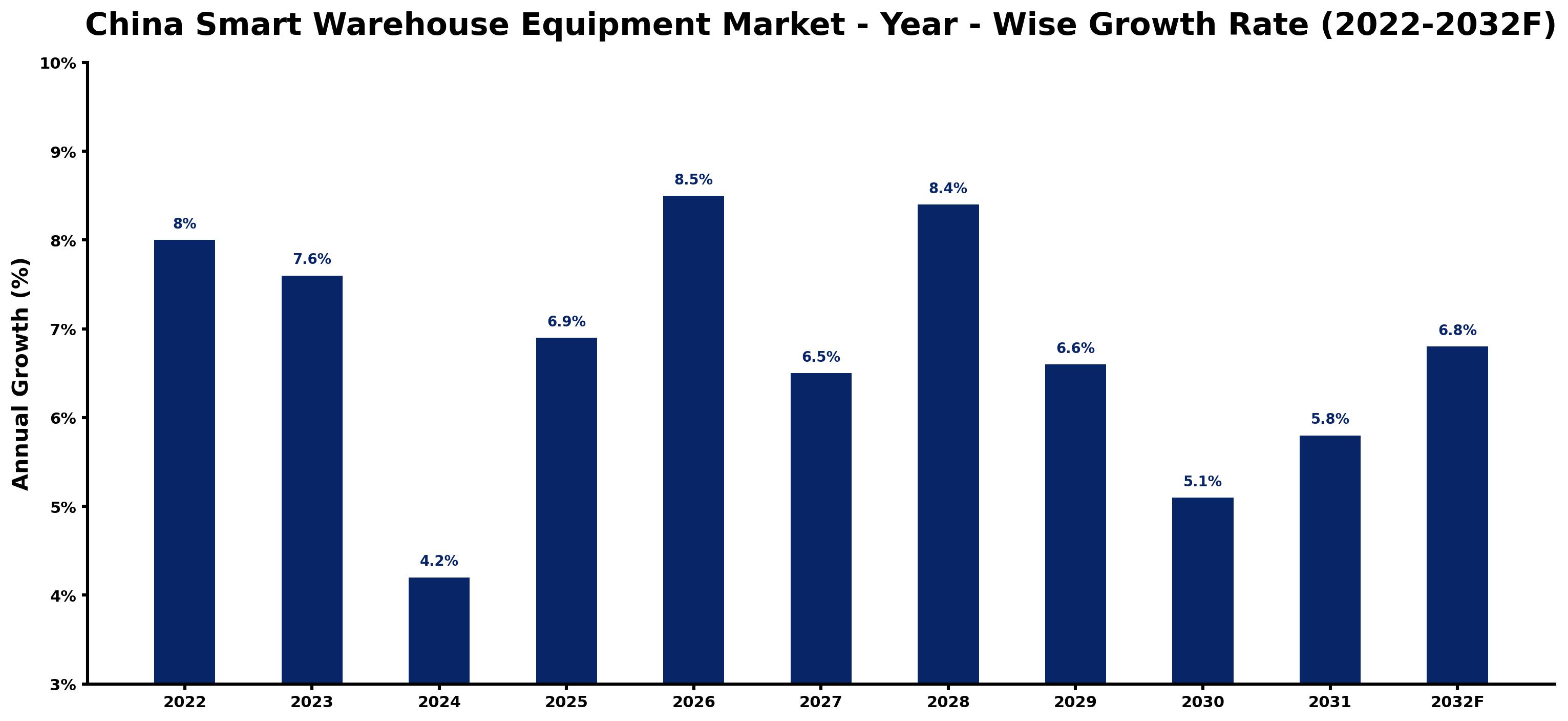
The following table presents the estimated annual growth rate for each year together with the principal factor influencing market performance.
| Year | Estimated Annual Growth (%) | Market Rationale |
| 2022 | 8.0 | The market experienced strong growth due to increased automation in logistics. |
| 2023 | 7.6 | Demand growth slowed as supply chain challenges affected equipment availability. |
| 2024 | 4.2 | Market growth continued to decelerate amid fluctuating demand from e-commerce. |
| 2025 | 6.9 | A rebound in growth occurred as logistics investments increased significantly. |
| 2026 | 8.5 | The market saw peak growth driven by the rapid adoption of smart technologies. |
| 2027 | 6.5 | Growth slowed as market maturation began to impact expansion rates. |
| 2028 | 8.4 | A resurgence in demand occurred as logistics providers upgraded their systems. |
| 2029 | 6.6 | Growth slowed again as competition intensified in the smart warehouse sector. |
| 2030 | 5.1 | Market growth decelerated as investments began to stabilise. |
| 2031 | 5.8 | An uptick in growth was noted as new technologies gained traction. |
| 2032 | 6.8 | Continued investment in logistics infrastructure supported steady market growth. |
Note: Market size estimations and growth projections presented in this report are based on 6Wresearch's proprietary forecasting methodology, utilizing the latest available industry data, government publications, and primary research inputs.
China Smart Warehouse Equipment Market Synopsis
Smart Warehouse Equipment in China includes technologies that improve efficiency in storage and retrieval processes. These systems leverage robotics, AI, and IoT technologies, primarily serving the logistics and warehousing sectors. The China Smart Warehouse Equipment Market is expanding, driven by the flourishing e-commerce sector, which reached 1.4 billion users in 2023. Furthermore, the logistics sector is anticipated to grow to $1 trillion by 2025, further elevating the demand for automation solutions.
Market Dynamics Impact Analysis (2026–2032)
| Factor | Type | Impact | Primary Segment Affected |
| Rapid growth of e-commerce users driving demand for efficient logistics solutions. | Driver | High | E-commerce Warehouses |
| Increased investment in logistics infrastructure enhancing operational efficiency. | Driver | High | Logistics Providers |
| Rising demand for automation in fulfillment centers due to increasing order volumes. | Opportunity | High | Fulfillment Centers |
| Growing need for advanced inventory management solutions in retail warehouses. | Opportunity | High | Retail Warehouses |
| Supply chain disruptions impacting equipment availability and delivery timelines. | Restraint | High | Autonomous Forklifts |
| High initial investment costs for implementing smart warehouse technologies. | Restraint | Medium | Smart Conveyors |
| The Smart Warehouse Equipment market in China faces intense competition from local manufacturers. | Challenge | High | Robotic Picking Arms |
| Technological integration challenges hinder the adoption of smart warehouse solutions. | Challenge | Medium | Smart Shelving Units |
Evaluation of Drivers in China Smart Warehouse Equipment Market (2026–2032)
The main growth drivers and the segments they affect most are set out below.
| Drivers | Primary Segment Affected | Why It Matters (Evidence) |
| Increased automation demand in logistics enhances operational efficiency. | Fulfillment Centers | The average fulfillment center now utilises over 10 types of smart warehouse equipment, improving productivity. |
| Growing e-commerce user base drives the need for efficient inventory management. | E-commerce Warehouses | China's e-commerce market reached 1.4 billion users in 2023, increasing demand for smart solutions. |
| Investment in logistics infrastructure supports the adoption of smart technologies. | Logistics Providers | The government aims to invest $50 billion in logistics infrastructure by 2025, enhancing capabilities. |
| Technological advancements in AI and robotics improve warehouse operations. | Autonomous Forklifts | AI-driven inventory tracking systems are now standard in over 60% of e-commerce warehouses. |
| Rising consumer expectations for faster delivery times necessitate automation. | Retail Warehouses | The logistics sector in China is projected to grow to $1 trillion by 2025, driving efficiency. |
Growth across the Smart Warehouse Equipment market in China is anchored in rising end-use demand and a responsive supply chain. The average fulfillment center utilises over 10 types of smart warehouse equipment, improving productivity. The logistics sector is projected to grow to $1 trillion by 2025, driving the need for efficient inventory management solutions. Investment in logistics infrastructure is expected to reach $50 billion by 2025, supporting the adoption of smart technologies. AI-driven inventory tracking systems are standard in over 60% of e-commerce warehouses, improving accuracy in stock management.
Evaluation of Restraints in China Smart Warehouse Equipment Market
The main factors holding the market back are set out below.
| Market Restraint | Primary Segment Affected | Why It Matters (Evidence) |
| Supply chain disruptions affect equipment availability and delivery timelines. | Autonomous Forklifts | Logistics delays have increased lead times for smart warehouse equipment installations by up to 20%. |
| High initial investment costs limit adoption rates for advanced technologies. | Smart Conveyors | Many logistics providers find it challenging to allocate budgets for smart warehouse upgrades, with costs rising by 15%. |
| Integration challenges with existing systems hinder technology adoption. | Smart Shelving Units | Many warehouses struggle to incorporate new technologies with legacy systems, causing delays in implementation. |
| Regulatory compliance requirements increase operational complexities. | Fulfillment Centers | New standards set by the China Federation of Logistics and Purchasing complicate equipment approvals, increasing time to market. |
| Technological integration challenges hinder the adoption of smart warehouse solutions. | Robotic Picking Arms | Many warehouses face difficulties in integrating new technologies with existing systems, leading to implementation delays. |
China Smart Warehouse Equipment Market Challenges
The China Smart Warehouse Equipment Market faces regulatory challenges that complicate compliance for buyers, particularly with the ISO 9001 standard, which can lead to project delays of several months. Suppliers also deal with supply chain disruptions due to reliance on imported advanced technologies, inflating costs by up to 15% for manufacturers. Heightened competition among local producers has driven prices down, squeezing profit margins for suppliers and limiting their capacity to invest in new technologies. Buyers are under pressure from the rapid pace of technological advancements, as over 60% of e-commerce warehouses now require AI-driven systems, necessitating costly upgrades that strain operational budgets.
Trends in the China Smart Warehouse Equipment Market
Below mentioned are some of the trends shaping the China Smart Warehouse Equipment Market growth.
- Shift Towards AI-Driven Inventory Management: In China, the shift towards AI-driven inventory management began in 2023, with over 60% of e-commerce warehouses adopting these systems. This trend improves accuracy and efficiency in stock management.
- Growing Adoption of Autonomous Forklifts: The trend of adopting autonomous forklifts is evident in the Guangdong province, where logistics innovation is thriving. By 2025, autonomous forklifts are expected to account for 40% of the market.
- Increased Focus on Smart Logistics Standards: The China Federation of Logistics and Purchasing has been promoting standards for smart logistics technologies since 2023. This initiative aims to improve interoperability and efficiency across the sector.
- Expansion of Smart Warehouse Facilities: The expansion of smart warehouse facilities is particularly notable in Shanghai, where logistics technology adoption is accelerating. In 2023, the average fulfilment centre utilised over 10 types of smart equipment.
Investment Opportunities in the China Smart Warehouse Equipment Market
Below are the investment opportunities with the strongest case in the China Smart Warehouse Equipment Market.
- Investment in Smart Warehouse Technologies: Now is an opportune time to invest in smart warehouse technologies, with the logistics sector projected to reach $1 trillion by 2025. Logistics providers are actively seeking advanced solutions to improve efficiency.
- Partnerships for Technology Integration: Forming partnerships with local firms can facilitate technology integration in warehouses. The Guangdong province is a key area for logistics innovation, presenting opportunities for collaboration.
- Supply of AI-Driven Solutions: E-commerce warehouses are increasingly in need of AI-driven solutions to manage inventory effectively. Suppliers can enter this market by offering tailored products that meet specific operational needs.
- Focus on Automation in Retail Warehouses: Retail warehouses are prioritising automation to improve inventory management. Suppliers can capitalise on this trend by providing innovative smart shelving units and related technologies.
Government Initiatives in the China Smart Warehouse Equipment Market
The "Smart Logistics Development Plan" by the National Development and Reform Commission, launched in 2021, aims to improve logistics efficiency through technology adoption. This initiative encourages the integration of smart technologies in warehouses, driving demand for innovative solutions. The "14th Five-Year Plan for Digital Economy Development" emphasises the importance of digital integration in logistics and warehousing, further supporting market growth. The "National Intelligent Manufacturing Development Strategy" initiated in 2022 promotes automation across industries, including logistics, enhancing productivity and competitiveness. These policies aim to create a more efficient logistics environment in China.
The Ministry of Industry and Information Technology oversees the implementation of various initiatives that fund and approve smart warehouse technologies. For instance, the "Digital China Construction Strategy" launched in 2020 focuses on integrating digital technologies into logistics, ensuring that producers meet modern operational standards. This strategy aims to improve operational efficiency and competitiveness within the sector. Additionally, the "China Logistics Industry Development Report" published in 2023 highlights government support for smart warehouse technologies, facilitating approvals and funding for innovative projects.
Future Insight of the China Smart Warehouse Equipment Market
The China Smart Warehouse Equipment Market will undergo notable changes by 2032, driven by the government's $50 billion investment in logistics infrastructure. The "Smart Logistics Development Plan" will enhance operational efficiency and reduce bottlenecks in the supply chain. With the logistics sector expected to grow to $1 trillion by 2025, demand for automation solutions will surge. As smart technologies become essential for warehouse operations, suppliers will need to innovate continuously to meet the evolving requirements of buyers.
Market Segmentation Analysis
Each segment group is reviewed below, with the leader by share and the fastest grower by CAGR.
By Equipment Type – Autonomous Forklifts Dominated, Smart Conveyors Expected to Grow Fastest
According to Dhaval Chaurasia, Assistant Manager at 6Wresearch, Autonomous Forklifts held a 40% share of the China Smart Warehouse Equipment Market by equipment type in 2025. Autonomous forklifts are pivotal in the China smart warehouse equipment market, significantly enhancing safety and efficiency in material transport. Their extensive use in major logistics hubs, such as Shanghai, illustrates their critical role in optimising warehouse operations. Smart Conveyors are set to record the highest CAGR in this split, 9.6% over 2026–2032. Smart conveyors are experiencing rapid growth due to their essential function in efficient material handling, particularly as e-commerce continues to expand. The logistics sector's projected growth to $1 trillion by 2025 will further amplify the demand for these systems. Suppliers should prioritise the development of smart conveyor technologies to meet the increasing demands of the logistics sector.
By Smart Feature – Auto Inventory Tracking Dominated, Route + Load Optimization Expected to Grow Fastest
With a 46% revenue share in 2025, Auto Inventory Tracking was the largest smart feature category. Auto inventory tracking is the leading feature in the market, automating stock management and significantly reducing errors in e-commerce warehouses. Its adoption in over 60% of these facilities underscores its vital role in ensuring operational accuracy and customer satisfaction. The quickest growth will come from Route + Load Optimization, forecast to expand at a CAGR of 8.6% between 2026 and 2032. Route and load optimization is rapidly gaining traction as it is crucial for enhancing logistics efficiency, especially with the growing complexity of supply chains. Government investments in logistics infrastructure will further drive the need for these advanced features. Buyers should focus on integrating smart features that improve operational efficiency, particularly those that optimise inventory and logistics processes.
By Automation Interface – RFID + Cloud Dominated, AI Vision Expected to Grow Fastest
RFID + Cloud accounted for a 39% market share by automation interface in 2025. RFID and cloud technologies are at the forefront of the market, facilitating effective data management essential for smart warehouse operations. This integration is crucial for warehouses striving to enhance efficiency and maintain competitiveness in the market. AI Vision is projected to grow fastest, at a CAGR of 7.9% during 2026–2032. AI vision is emerging as the fastest-growing interface, providing enhanced capabilities through real-time data analysis and decision-making support. As the logistics sector increasingly adopts advanced technologies, the demand for these solutions is expected to rise significantly. Suppliers must invest in AI vision technologies to stay competitive and address the evolving requirements of the smart warehouse market.
By End User – E-commerce Warehouses Dominated, Logistics Providers Expected to Grow Fastest
The largest end user category in 2025 was E-commerce Warehouses, with a 54% share of total revenue. E-commerce warehouses represent the largest share as they heavily rely on automation for efficiency, driven by the vast number of users in China's e-commerce market, which reached 1.4 billion in 2023. This segment's growth is vital for fulfilling the demands of online retail. Over 2026–2032, Logistics Providers are expected to post the fastest growth, at a CAGR of 9.1%. Logistics providers are the fastest-growing end user segment, utilising smart equipment to improve operational efficiency as they adapt to the increasing complexities of logistics operations. The projected growth of the logistics sector to $1 trillion by 2025 will further accelerate this trend. Suppliers should tailor their offerings to meet the specific needs of logistics providers, who are increasingly adopting smart warehouse solutions.
Key Attractiveness of the Report
- 10 Years of Market Numbers
- Historical Data Starting from 2022 to 2025
- Base Year 2025
- Forecast Data until 2032
- Key Performance Indicators Impacting the Market
- Major Upcoming Developments and Projects
Key Highlights of the Report:
- China Smart Warehouse Equipment Market Outlook
- Market Size of China Smart Warehouse Equipment Market, 2025
- Forecast of China Smart Warehouse Equipment Market, 2032
- Historical Data and Forecast of China Smart Warehouse Equipment Revenues & Volume for the Period 2022 - 2032F
- China Smart Warehouse Equipment Market Trend Evolution
- China Smart Warehouse Equipment Market Drivers and Challenges
- China Smart Warehouse Equipment Price Trends
- China Smart Warehouse Equipment Porter's Five Forces
- China Smart Warehouse Equipment Industry Life Cycle
- Historical Data and Forecast of China Smart Warehouse Equipment Market Revenues & Volume By Equipment Type for the Period 2022 - 2032F
- Historical Data and Forecast of China Smart Warehouse Equipment Market Revenues & Volume By Smart Conveyors for the Period 2022 - 2032F
- Historical Data and Forecast of China Smart Warehouse Equipment Market Revenues & Volume By Robotic Picking Arms for the Period 2022 - 2032F
- Historical Data and Forecast of China Smart Warehouse Equipment Market Revenues & Volume By Autonomous Forklifts for the Period 2022 - 2032F
- Historical Data and Forecast of China Smart Warehouse Equipment Market Revenues & Volume By Smart Shelving Units for the Period 2022 - 2032F
- Historical Data and Forecast of China Smart Warehouse Equipment Market Revenues & Volume By Smart Feature for the Period 2022 - 2032F
- Historical Data and Forecast of China Smart Warehouse Equipment Market Revenues & Volume By Load Detection & Sorting for the Period 2022 - 2032F
- Historical Data and Forecast of China Smart Warehouse Equipment Market Revenues & Volume By Object Identification for the Period 2022 - 2032F
- Historical Data and Forecast of China Smart Warehouse Equipment Market Revenues & Volume By Route + Load Optimization for the Period 2022 - 2032F
- Historical Data and Forecast of China Smart Warehouse Equipment Market Revenues & Volume By Auto Inventory Tracking for the Period 2022 - 2032F
- Historical Data and Forecast of China Smart Warehouse Equipment Market Revenues & Volume By Automation Interface for the Period 2022 - 2032F
- Historical Data and Forecast of China Smart Warehouse Equipment Market Revenues & Volume By Sensors + PLC for the Period 2022 - 2032F
- Historical Data and Forecast of China Smart Warehouse Equipment Market Revenues & Volume By AI Vision for the Period 2022 - 2032F
- Historical Data and Forecast of China Smart Warehouse Equipment Market Revenues & Volume By Lidar + Mapping AI for the Period 2022 - 2032F
- Historical Data and Forecast of China Smart Warehouse Equipment Market Revenues & Volume By RFID + Cloud for the Period 2022 - 2032F
- Historical Data and Forecast of China Smart Warehouse Equipment Market Revenues & Volume By End User for the Period 2022 - 2032F
- Historical Data and Forecast of China Smart Warehouse Equipment Market Revenues & Volume By Fulfillment Centers for the Period 2022 - 2032F
- Historical Data and Forecast of China Smart Warehouse Equipment Market Revenues & Volume By E-commerce Warehouses for the Period 2022 - 2032F
- Historical Data and Forecast of China Smart Warehouse Equipment Market Revenues & Volume By Logistics Providers for the Period 2022 - 2032F
- Historical Data and Forecast of China Smart Warehouse Equipment Market Revenues & Volume By Retail Warehouses for the Period 2022 - 2032F
- China Smart Warehouse Equipment Import Export Trade Statistics
- Market Opportunity Assessment By Equipment Type
- Market Opportunity Assessment By Smart Feature
- Market Opportunity Assessment By Automation Interface
- Market Opportunity Assessment By End User
- China Smart Warehouse Equipment Top Companies Market Share
- China Smart Warehouse Equipment Competitive Benchmarking By Technical and Operational Parameters
- China Smart Warehouse Equipment Company Profiles
- China Smart Warehouse Equipment Key Strategic Recommendations
Market Covered
The report offers an extensive study of the following market segments.
By Equipment Type
- Smart Conveyors
- Robotic Picking Arms
- Autonomous Forklifts
- Smart Shelving Units
By Smart Feature
- Load Detection & Sorting
- Object Identification
- Route + Load Optimization
- Auto Inventory Tracking
By Automation Interface
- Sensors + PLC
- AI Vision
- Lidar + Mapping AI
- RFID + Cloud
By End User
- Fulfillment Centers
- E-commerce Warehouses
- Logistics Providers
- Retail Warehouses































