China Smart Warehouse Infrastructure Market Size & Growth Rate
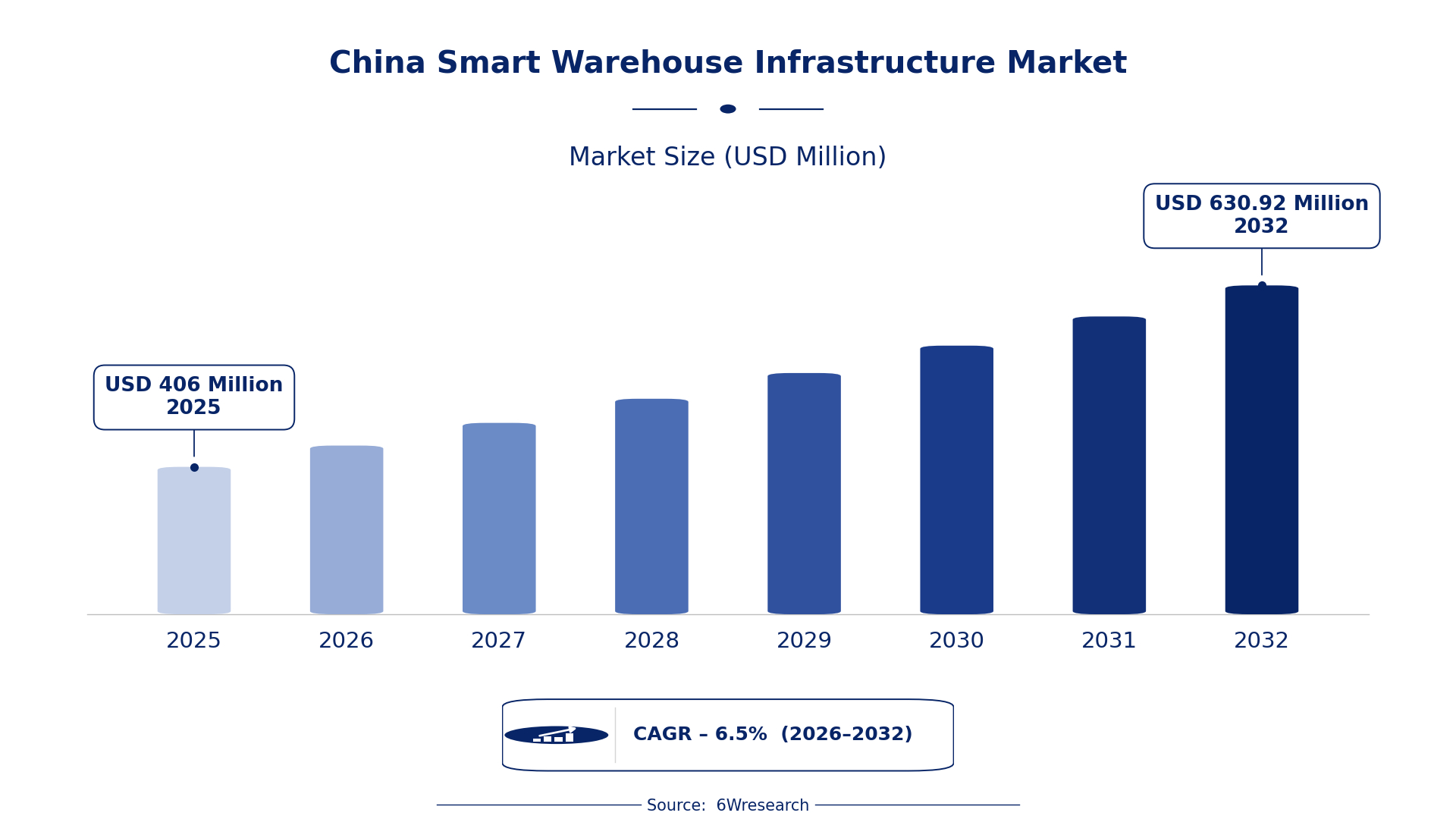
According to 6Wresearch internal database and industry insights, the China Smart Warehouse Infrastructure Market was valued at USD 406.0 million in 2025 and is projected to reach USD 630.92 million by 2032, growing at a CAGR of approximately 6.5% during 2026–2032.
China Smart Warehouse Infrastructure Market Highlights
| Report Metric | Details |
| Report Name | China Smart Warehouse Infrastructure Market |
| Market Size 2025 | USD 406.0 million |
| Market Size 2032 | USD 630.92 million |
| Absolute Growth 2025–2032 | USD 224.92 million |
| CAGR 2026–2032 | 6.5% |
| Peak Annual Growth | 7.8% in 2028 |
| Forecast Period | 2026–2032 |
| Historical Data | 2022–2025 |
| Base Year | 2025 |
| Leading Infrastructure Type, 2025 | IoT Warehouse Sensors (46% share) |
| Leading Smart Feature, 2025 | Environment + Asset Tracking (44% share) |
| Leading Network Tech, 2025 | Wi-Fi + RFID (52% share) |
| Leading End User, 2025 | Distribution Centers (48% share) |
| Fastest-Growing Infrastructure Type | Digital Twin Dashboards (8.6% CAGR) |
| Fastest-Growing Network Tech | App + Auto Schedulers (7.9% CAGR) |
| Fastest-Growing End User | Large-Scale Hubs (7.6% CAGR) |
| Growing Sector | E-commerce |
| Key End Users | Logistics companies, Distribution centers, Warehousing providers |
China Smart Warehouse Infrastructure Market Year-wise Growth Rate and Key Drivers (2022–2032)
This graph illustrates the annual growth rates of the market from 2022 to 2032, highlighting a steady upward trajectory and projected market expansion over the forecast period.
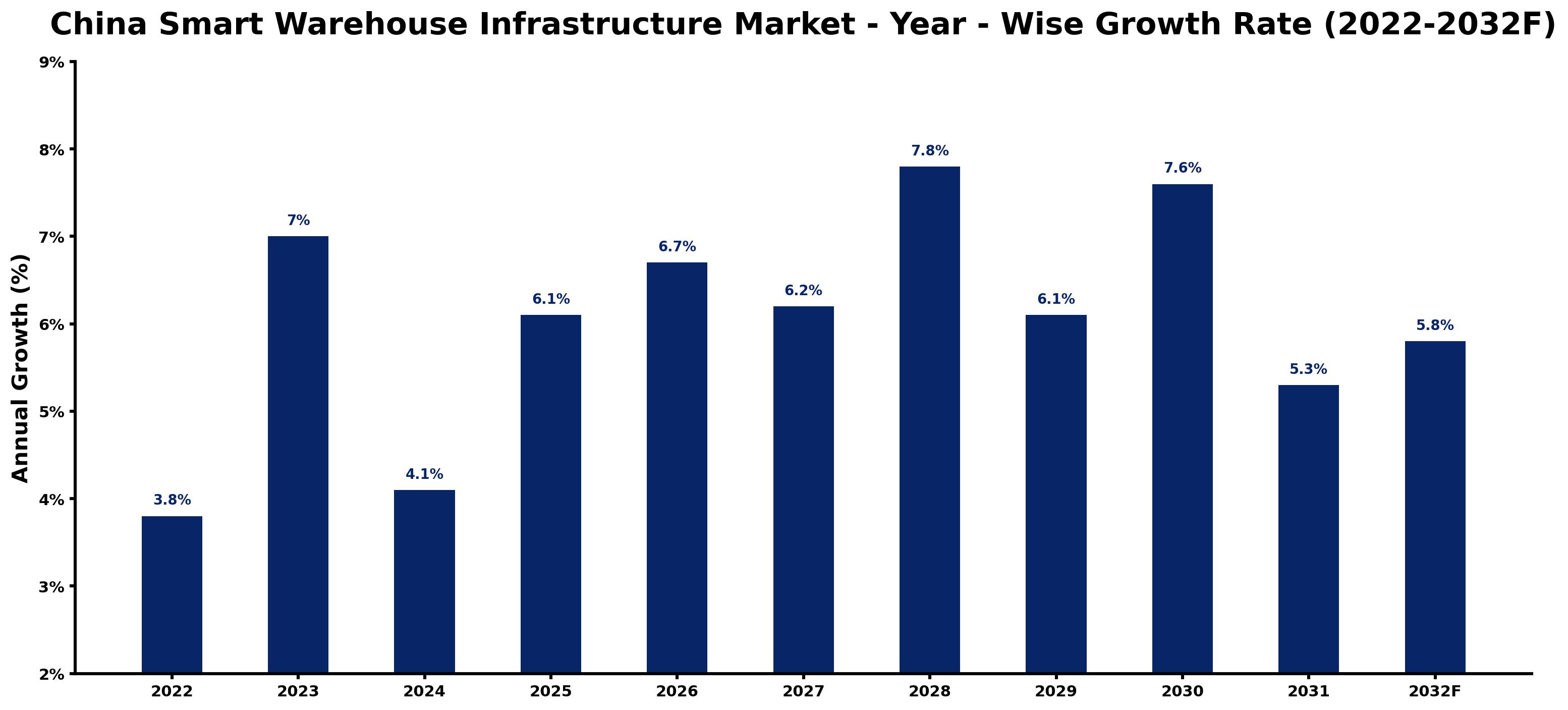
The table below sets out the estimated growth rate for each year and the main factor behind it.
| Year | Estimated Annual Growth (%) | Market Rationale |
| 2022 | 3.8 | The market experienced steady growth, driven by increasing e-commerce activities. |
| 2023 | 7.0 | Demand surged as logistics companies accelerated investments in smart technologies. |
| 2024 | 4.1 | Growth slowed due to increased competition and market adjustments in the sector. |
| 2025 | 6.1 | Investment in smart warehouse technologies rose as e-commerce expanded, supported by the 'Digital Economy Development Plan'. |
| 2026 | 6.7 | The market is expected to experience a boost from the implementation of new technology standards under the 'National Standard for Smart Warehousing'. |
| 2027 | 6.2 | Growth is projected to slow as the market stabilises after rapid expansion seen in previous years. |
| 2028 | 7.8 | A strong increase in demand is anticipated, driven by advancements in automation technologies and the 'Smart Logistics Development Plan'. |
| 2029 | 6.1 | Growth is expected to slow as the market matures and competitive pressures intensify. |
| 2030 | 7.6 | Demand is projected to increase again due to rising energy efficiency concerns in warehouses, influenced by the 'Green Warehouse Construction Guidelines'. |
| 2031 | 5.3 | Growth is anticipated to slow as market saturation begins to affect new investments in smart technologies. |
| 2032 | 5.8 | Demand is expected to rise as smart technologies become standard in logistics, driven by the 'Digital Economy Development Plan'. |
Note: Market size estimations and growth projections presented in this report are based on 6Wresearch's proprietary forecasting methodology, utilizing the latest available industry data, government publications, and primary research inputs.
China Smart Warehouse Infrastructure Market Synopsis
The China Smart Warehouse Infrastructure Market includes advanced technologies such as IoT sensors, automation systems, and data analytics. These solutions optimise inventory management and improve logistics efficiency. The market is expanding due to increasing e-commerce demand, with projections indicating that the sector will account for 45% of total retail sales by 2025. Over 70% of logistics companies are investing in IoT technologies, further driving the need for smart warehouses. This growing investment is expected to improve operational capabilities across the logistics sector.
Market Dynamics Impact Analysis (2026–2032)
| Factor | Type | Impact | Primary Segment Affected |
| Increasing e-commerce activities drive demand for efficient storage solutions. | Driver | High | Distribution Centers |
| Investment in IoT technologies enhances operational efficiency in warehouses. | Driver | High | IoT Warehouse Sensors |
| Growing demand for energy-efficient solutions creates opportunities for smart lighting systems. | Opportunity | Medium | Smart Lighting |
| The need for real-time inventory tracking presents opportunities for IoT sensors. | Opportunity | High | IoT Warehouse Sensors |
| High initial investment costs can deter smaller logistics companies from upgrading. | Restraint | High | Smart Entry & Access |
| Market saturation may limit growth potential for new entrants in the sector. | Restraint | Medium | Distribution Centers |
| Technological integration challenges can delay implementation of smart systems. | Challenge | High | Digital Twin Dashboards |
| Competition from traditional warehouse solutions may hinder market expansion. | Challenge | Medium | Cold Storage Units |
Evaluation of Drivers in China Smart Warehouse Infrastructure Market (2026–2032)
Below mentioned are some major drivers and their influence on market dynamics.
| Drivers | Primary Segment Affected | Why It Matters (Evidence) |
| Rapid growth in e-commerce drives demand for efficient warehouse solutions. | Distribution Centers | The e-commerce sector is projected to reach 45% of total retail sales by 2025, increasing the need for smart warehouses. |
| Logistics companies are investing heavily in IoT technologies for improved management. | IoT Warehouse Sensors | Over 70% of logistics companies are adopting IoT solutions to improve operational efficiency. |
| The push for energy efficiency is increasing demand for smart lighting systems. | Smart Lighting | In 2023, smart lighting systems reported average energy savings of 30% in warehouses. |
| Real-time inventory tracking is essential for modern logistics operations. | Digital Twin Dashboards | The integration of IoT sensors in warehouses exceeds 5 million units, improving tracking capabilities. |
| The need for security in warehouses drives the adoption of smart entry systems. | Smart Entry & Access | Smart entry systems are being implemented in over 60% of new warehouse constructions in urban areas. |
Market growth in China for Smart Warehouse Infrastructure rests on the rapid expansion of e-commerce and significant investments in IoT technologies. The e-commerce sector is projected to account for 45% of total retail sales by 2025, driving demand for efficient warehouse solutions. More than 70% of logistics companies are investing in IoT technologies, which is improving real-time inventory management across the sector. The installed base of IoT sensors in warehouses has surpassed 5 million units, facilitating enhanced tracking and operational efficiency. Additionally, smart lighting systems are generating average energy savings of 30%, prompting further adoption among logistics providers.
Evaluation of Restraints in China Smart Warehouse Infrastructure Market
The following restraints limit how fast demand can grow.
| Market Restraint | Primary Segment Affected | Why It Matters (Evidence) |
| High initial costs of smart technologies may deter smaller companies from adoption. | Smart Entry & Access | The investment required for smart entry systems can limit uptake among smaller logistics firms. |
| Market saturation may restrict growth opportunities for new entrants. | Distribution Centers | As the market matures, new entrants face challenges in gaining market share due to established competitors. |
| Integration challenges can delay the implementation of smart warehouse systems. | Digital Twin Dashboards | Logistics companies may struggle with the complexities of integrating new technologies into existing systems. |
| Competition from traditional warehouse solutions can hinder market growth. | Cold Storage Units | Established methods may be preferred by some companies due to their perceived reliability and lower costs. |
| Regulatory compliance costs can impact the financial viability of upgrades. | IoT Warehouse Sensors | Adhering to new standards can increase operational costs for logistics providers. |
China Smart Warehouse Infrastructure Market Challenges
The China Smart Warehouse Infrastructure Market faces rising costs, with logistics expenses increasing by 15% annually due to outdated systems. Producers must invest heavily in modern technologies to remain competitive, which can delay operational upgrades and reduce profit margins. Buyers encounter challenges as over 70% of logistics companies are investing in IoT technologies, creating fierce competition for limited resources and driving up prices for smart warehouse solutions. Workforce skills shortages complicate matters, leading to project delays and increased training costs for companies seeking to implement advanced systems.
Trends in the China Smart Warehouse Infrastructure Market
Buyers and suppliers in the China Smart Warehouse Infrastructure Market are adjusting to the following trends.
- Shift Towards Energy Efficiency in Warehousing: Logistics companies are increasingly adopting energy-efficient smart lighting systems, with an average reported energy savings of 30% in 2023. This trend reflects a growing emphasis on sustainability in warehouse operations, particularly in urban areas.
- Rise of IoT Integration for Real-Time Monitoring: Since 2022, the integration of IoT sensors in warehouses has expanded significantly, exceeding 5 million units. This shift supports enhanced real-time inventory management and operational efficiency, particularly in major logistics hubs.
- Increased Adoption of Smart Security Solutions: Smart entry systems have been adopted in over 60% of new warehouse constructions in urban areas since 2021. This trend highlights the growing importance of security in warehouse management, especially in high-value asset storage.
- Focus on Digital Transformation in Logistics: The 'Smart Logistics Development Plan' launched in 2021 is driving digital transformation in logistics. This initiative aims to enhance efficiency and technology integration by 2025, benefiting logistics companies across the country.
Investment Opportunities in the China Smart Warehouse Infrastructure Market
Some of the investment opportunities in the China Smart Warehouse Infrastructure Market are mentioned below.
- Joint Ventures for Technology Integration: With over 70% of logistics companies investing in IoT technologies, there is an opportunity for joint ventures to improve smart warehouse capabilities. This is particularly relevant in the Guangdong province, a hub for smart technology development, which can attract new partnerships.
- Investment in Energy-Efficient Solutions: As energy savings from smart lighting systems reach 30%, there is a growing market for energy-efficient solutions in warehouses. This presents opportunities for suppliers targeting distribution centres, especially in urban regions where energy costs are high.
- Expansion in Cold Storage Units: There are over 1,000 cold storage units equipped with smart technologies as of 2023, indicating a need for further investment in this area. Suppliers can enter by partnering with logistics firms in key regions, such as the Beijing-Tianjin-Hebei area.
- Enhancing Security Features in New Constructions: With smart entry systems being implemented in over 60% of new warehouse constructions, there is an opportunity for suppliers to provide advanced security solutions. This trend is particularly strong in urban areas, where security is a top priority for logistics companies.
Government Initiatives in the China Smart Warehouse Infrastructure Market
The 'Smart Logistics Development Plan' by the National Development and Reform Commission, launched in 2021, aims to improve logistics efficiency and digital transformation by 2025. This plan encourages the adoption of smart technologies in warehouses, facilitating improved management and operational efficiency. Additionally, the 'Digital Economy Development Plan' by the Ministry of Industry and Information Technology promotes smart technology adoption across logistics sectors, further supporting infrastructure improvements. The '14th Five-Year Plan for Logistics Development' approved in 2022 aims to enhance infrastructure and technology in logistics by 2025, ensuring that smart warehouses are equipped to meet future demands.
The National Development and Reform Commission oversees the implementation of the 'Smart Logistics Development Plan', which funds projects aimed at enhancing logistics efficiency. The Ministry of Industry and Information Technology also approves initiatives under the 'Digital Economy Development Plan', supporting the integration of smart technologies in warehousing and logistics operations. These measures enable producers to access funding for technology upgrades, ensuring they remain competitive in the evolving market.
Future Insight of the China Smart Warehouse Infrastructure Market
The China Smart Warehouse Infrastructure Market will see substantial changes by 2032, driven by the e-commerce sector's growth, projected to account for 45% of total retail sales. The National Development and Reform Commission's 'Smart Logistics Development Plan' will improve logistics efficiency, leading to more smart warehouses. By 2025, the installed base of IoT sensors in warehouses is expected to exceed 10 million units, streamlining operations for buyers and suppliers. These advancements will facilitate better inventory management and logistics, improving operational efficiency.
Market Segmentation Analysis
Each segment group is reviewed below, with the leader by share and the fastest grower by CAGR.
By Infrastructure Type – IoT Warehouse Sensors Dominated, Digital Twin Dashboards Expected to Grow Fastest
According to Dhaval Chaurasia, Assistant Manager at 6Wresearch, in 2025, IoT Warehouse Sensors led the infrastructure type split with a 46% share. IoT Warehouse Sensors hold the largest share in the market due to their critical function in real-time inventory and environmental monitoring. With over 5 million units installed in warehouses across China, they are indispensable for achieving operational efficiency. Digital Twin Dashboards are projected to grow fastest, at a CAGR of 8.6% during 2026–2032. Digital Twin Dashboards are rapidly gaining traction as they offer essential visualisation of warehouse operations, aiding in informed decision-making. This aligns with the growing emphasis on logistics efficiency as highlighted in the 'Smart Logistics Development Plan'. Suppliers should prioritise the integration of IoT sensors with visualisation technologies to address the increasing demands of logistics companies.
By Smart Feature – Environment + Asset Tracking Dominated and Is Expected to Record the Fastest Growth
With a 44% revenue share in 2025, Environment + Asset Tracking was the largest smart feature category. Environment + Asset Tracking holds the largest share in the market due to its critical role in managing assets and ensuring optimal conditions within warehouses. Its adoption by over 70% of logistics companies demonstrates its necessity for improving operational efficiency and inventory management. The same category is also set to grow fastest, at a CAGR of 8.4% during 2026–2032. The growth of Environment + Asset Tracking is propelled by its essential function in both asset management and environmental monitoring, which are increasingly vital for modern warehouse operations. The ongoing investments in smart technologies within the logistics sector will further solidify its leading position. Buyers should prioritise solutions that enhance asset tracking and environmental conditions to maximise their warehouse efficiency.
By Network Tech – Wi-Fi + RFID Dominated, App + Auto Schedulers Expected to Grow Fastest
Wi-Fi + RFID accounted for a 52% market share by network tech in 2025. Wi-Fi + RFID dominate the market share as they are fundamental for connectivity and inventory tracking, essential for efficient warehouse operations. Their widespread implementation among logistics firms illustrates their importance in optimising operational processes. App + Auto Schedulers are set to record the highest CAGR in this split, 7.9% over 2026–2032. App + Auto Schedulers are witnessing rapid growth due to their effectiveness in optimising logistics and scheduling, which is crucial as e-commerce demands rise. Their ability to integrate seamlessly with existing systems significantly boosts operational efficiency. Suppliers should focus on developing advanced scheduling applications to cater to logistics firms seeking improved efficiency.
By End User – Distribution Centers Dominated, Large-Scale Hubs Expected to Grow Fastest
Distribution Centers took a 48% share of end user in 2025, more than any other category. Distribution Centers capture the largest market share as they are central to supply chain management, facilitating the efficient movement of goods. Their essential function in logistics operations makes them a primary target for smart warehouse investments. The quickest growth will come from Large-Scale Hubs, forecast to expand at a CAGR of 7.6% between 2026 and 2032. Large-Scale Hubs are experiencing rapid growth due to their critical role in logistics and distribution, especially with the ongoing expansion of e-commerce. Their strategic significance in the supply chain is attracting increased investments in smart technologies. Buyers should explore solutions tailored for distribution centers to strengthen their operational capabilities in this dynamic market.
Key Attractiveness of the Report
- 10 Years of Market Numbers
- Historical Data Starting from 2022 to 2025
- Base Year 2025
- Forecast Data until 2032
- Key Performance Indicators Impacting the Market
- Major Upcoming Developments and Projects
Key Highlights of the Report:
- China Smart Warehouse Infrastructure Market Outlook
- Market Size of China Smart Warehouse Infrastructure Market, 2025
- Forecast of China Smart Warehouse Infrastructure Market, 2032
- Historical Data and Forecast of China Smart Warehouse Infrastructure Revenues & Volume for the Period 2022 - 2032F
- China Smart Warehouse Infrastructure Market Trend Evolution
- China Smart Warehouse Infrastructure Market Drivers and Challenges
- China Smart Warehouse Infrastructure Price Trends
- China Smart Warehouse Infrastructure Porter's Five Forces
- China Smart Warehouse Infrastructure Industry Life Cycle
- Historical Data and Forecast of China Smart Warehouse Infrastructure Market Revenues & Volume By Infrastructure Type for the Period 2022 - 2032F
- Historical Data and Forecast of China Smart Warehouse Infrastructure Market Revenues & Volume By IoT Warehouse Sensors for the Period 2022 - 2032F
- Historical Data and Forecast of China Smart Warehouse Infrastructure Market Revenues & Volume By Smart Entry & Access for the Period 2022 - 2032F
- Historical Data and Forecast of China Smart Warehouse Infrastructure Market Revenues & Volume By Smart Lighting for the Period 2022 - 2032F
- Historical Data and Forecast of China Smart Warehouse Infrastructure Market Revenues & Volume By Digital Twin Dashboards for the Period 2022 - 2032F
- Historical Data and Forecast of China Smart Warehouse Infrastructure Market Revenues & Volume By Smart Feature for the Period 2022 - 2032F
- Historical Data and Forecast of China Smart Warehouse Infrastructure Market Revenues & Volume By Environment + Asset Tracking for the Period 2022 - 2032F
- Historical Data and Forecast of China Smart Warehouse Infrastructure Market Revenues & Volume By Facial/ID Recognition for the Period 2022 - 2032F
- Historical Data and Forecast of China Smart Warehouse Infrastructure Market Revenues & Volume By Energy + Motion Detection for the Period 2022 - 2032F
- Historical Data and Forecast of China Smart Warehouse Infrastructure Market Revenues & Volume By Simulation + Monitoring for the Period 2022 - 2032F
- Historical Data and Forecast of China Smart Warehouse Infrastructure Market Revenues & Volume By Network Tech for the Period 2022 - 2032F
- Historical Data and Forecast of China Smart Warehouse Infrastructure Market Revenues & Volume By Wi-Fi + RFID for the Period 2022 - 2032F
- Historical Data and Forecast of China Smart Warehouse Infrastructure Market Revenues & Volume By NFC + AI for the Period 2022 - 2032F
- Historical Data and Forecast of China Smart Warehouse Infrastructure Market Revenues & Volume By App + Auto Schedulers for the Period 2022 - 2032F
- Historical Data and Forecast of China Smart Warehouse Infrastructure Market Revenues & Volume By AI + 3D Mapping for the Period 2022 - 2032F
- Historical Data and Forecast of China Smart Warehouse Infrastructure Market Revenues & Volume By End User for the Period 2022 - 2032F
- Historical Data and Forecast of China Smart Warehouse Infrastructure Market Revenues & Volume By Cold Storage Units for the Period 2022 - 2032F
- Historical Data and Forecast of China Smart Warehouse Infrastructure Market Revenues & Volume By High-Security Warehouses for the Period 2022 - 2032F
- Historical Data and Forecast of China Smart Warehouse Infrastructure Market Revenues & Volume By Large-Scale Hubs for the Period 2022 - 2032F
- Historical Data and Forecast of China Smart Warehouse Infrastructure Market Revenues & Volume By Distribution Centers for the Period 2022 - 2032F
- China Smart Warehouse Infrastructure Import Export Trade Statistics
- Market Opportunity Assessment By Infrastructure Type
- Market Opportunity Assessment By Smart Feature
- Market Opportunity Assessment By Network Tech
- Market Opportunity Assessment By End User
- China Smart Warehouse Infrastructure Top Companies Market Share
- China Smart Warehouse Infrastructure Competitive Benchmarking By Technical and Operational Parameters
- China Smart Warehouse Infrastructure Company Profiles
- China Smart Warehouse Infrastructure Key Strategic Recommendations
Market Covered
The report offers an extensive study of the following market segments.
By Infrastructure Type
- IoT Warehouse Sensors
- Smart Entry & Access
- Smart Lighting
- Digital Twin Dashboards
By Smart Feature
- Environment + Asset Tracking
- Facial/ID Recognition
- Energy + Motion Detection
- Simulation + Monitoring
By Network Tech
- Wi-Fi + RFID
- NFC + AI
- App + Auto Schedulers
- AI + 3D Mapping
By End User
- Cold Storage Units
- High-Security Warehouses
- Large-Scale Hubs
- Distribution Centers































