China Soy Protein in Feed Market Size & Growth Rate
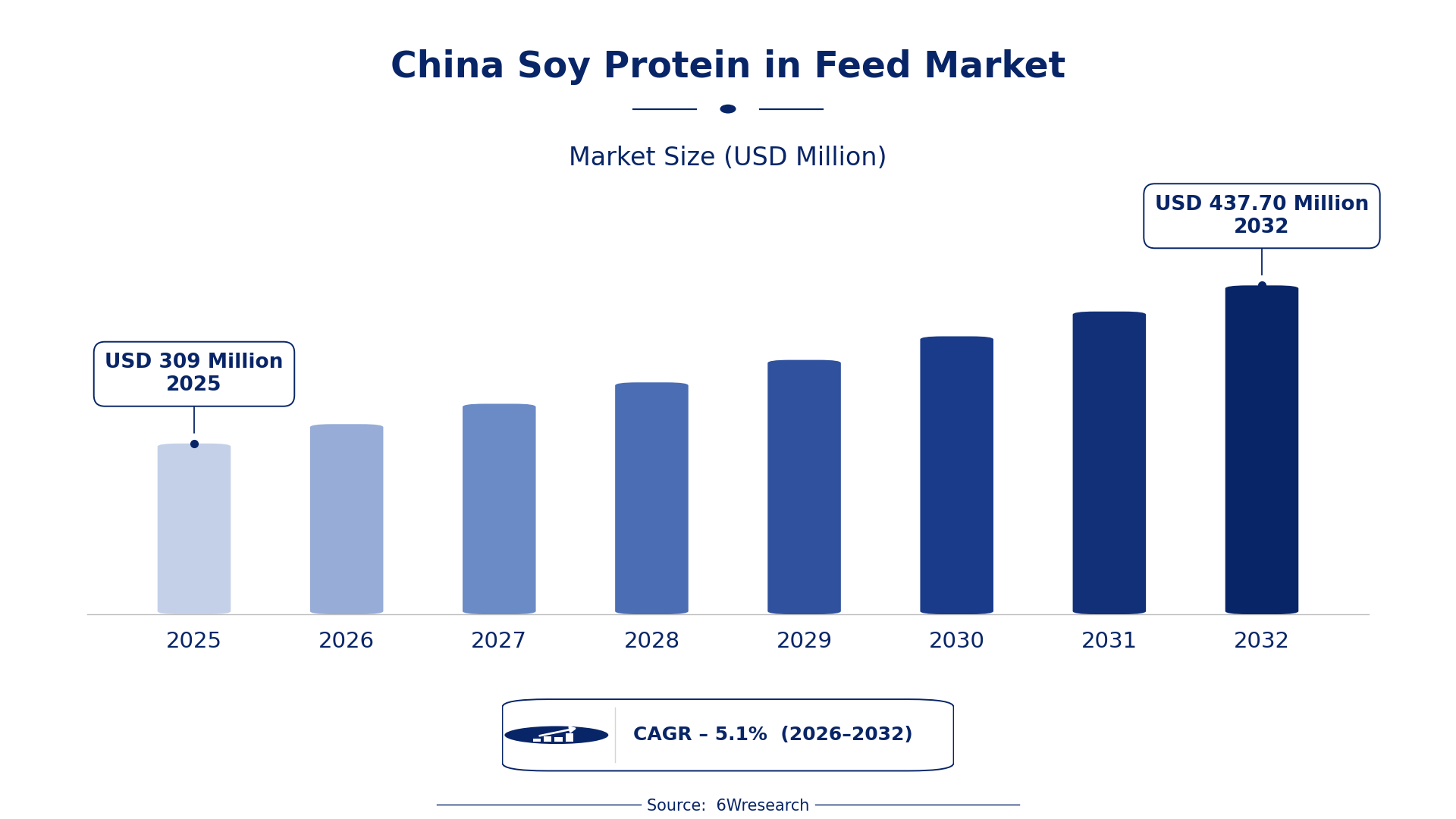
According to 6Wresearch internal database and industry insights, the China Soy Protein in Feed Market was valued at USD 309.0 million in 2025 and is projected to reach USD 437.70 million by 2032, growing at a CAGR of approximately 5.1% during 2026–2032.
China Soy Protein in Feed Market Highlights
| Report Metric | Details |
| Report Name | China Soy Protein in Feed Market |
| Market Size 2025 | USD 309.0 million |
| Market Size 2032 | USD 437.70 million |
| Absolute Growth 2025–2032 | USD 128.70 million |
| CAGR 2026–2032 | 5.1% |
| Peak Annual Growth | 7.4% in 2032 |
| Forecast Period | 2026–2032 |
| Historical Data | 2022–2025 |
| Base Year | 2025 |
| Leading Protein Type, 2025 | Soy Protein Concentrate (41% share) |
| Leading Processing Form, 2025 | Powdered (41% share) |
| Leading Animal Type, 2025 | Poultry (44% share) |
| Leading End User, 2025 | Feed Mills (40% share) |
| Fastest-Growing Protein Type | Textured Soy Protein (7.5% CAGR) |
| Fastest-Growing Processing Form | Pelletized (7.8% CAGR) |
| Fastest-Growing Animal Type | Aquaculture (7.8% CAGR) |
| Fastest-Growing End User | Fish Feed Producers (6.8% CAGR) |
| Growing Sector | Aquaculture |
| Key End Users | Feed Mills, Livestock Farms, Dairy Farmers, Fish Feed Producers |
China Soy Protein in Feed Market Year-wise Growth Rate and Key Drivers (2022–2032)
This graph illustrates the annual growth rates of the market from 2022 to 2032, highlighting a steady upward trajectory and projected market expansion over the forecast period.
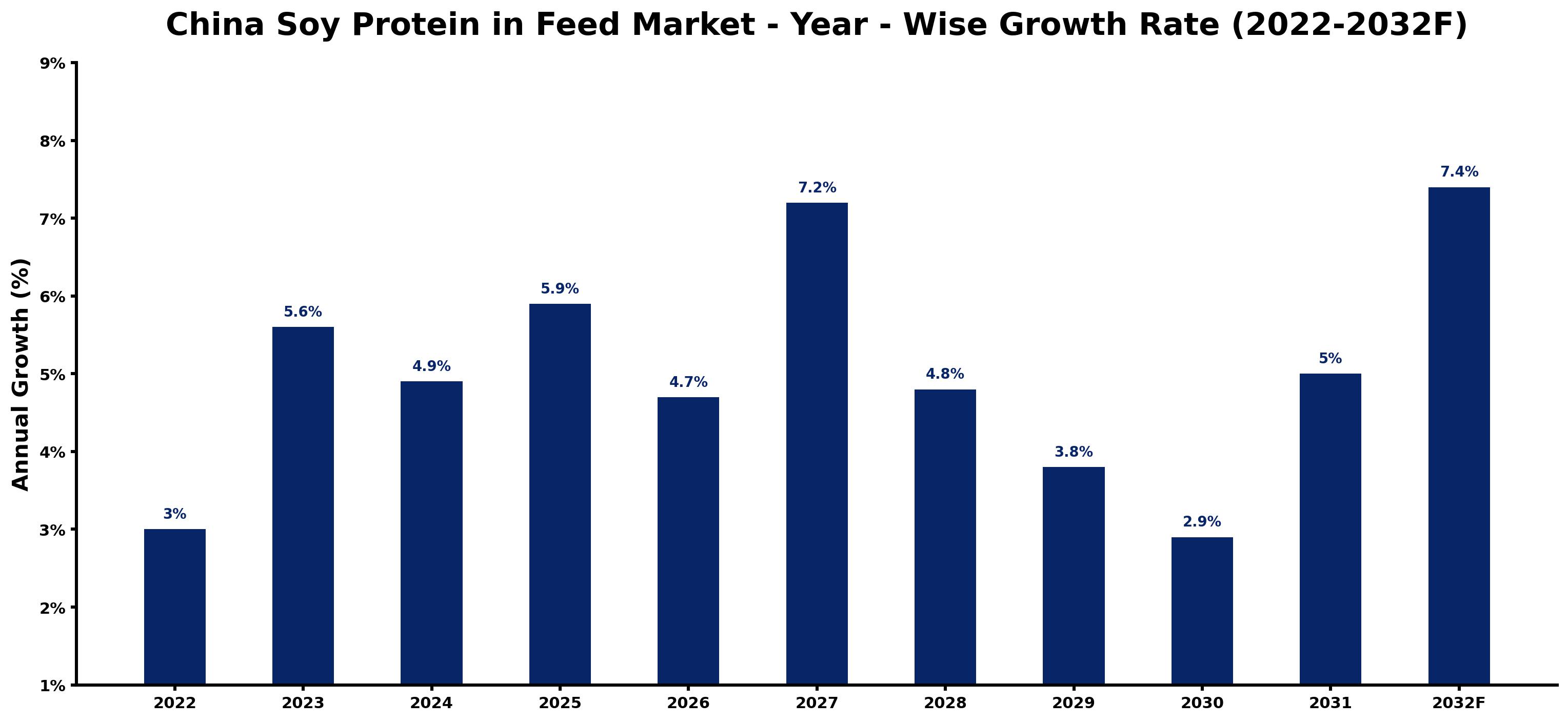
The following table presents the estimated annual growth rate for each year together with the principal factor influencing market performance.
| Year | Estimated Annual Growth (%) | Market Rationale |
| 2022 | 3.0 | The poultry population was approximately 14 billion, driving demand for soy protein in feed. |
| 2023 | 5.6 | The 'Sustainable Livestock Development Plan' was launched, promoting high-quality feed ingredients including soy protein. |
| 2024 | 4.9 | Demand growth slowed due to adjustments in livestock feed formulations and market dynamics. |
| 2025 | 5.9 | Poultry feed demand surged, leading to higher inclusion rates of soy protein in formulations. |
| 2026 | 4.7 | Growth is expected to moderate as feed mills adapt to new nutritional standards and ingredient sourcing. |
| 2027 | 7.2 | Aquaculture's rising demand for protein sources is projected to accelerate the use of soy protein in fish feed. |
| 2028 | 4.8 | The market is expected to experience a slowdown as feed producers adjust to fluctuating ingredient prices. |
| 2029 | 3.8 | Demand growth is expected to slow as livestock farms face challenges in feed cost management and sourcing. |
| 2030 | 2.9 | The market will continue to grow, albeit at a slower pace, as feed formulations evolve. |
| 2031 | 5.0 | Increased adoption of soy protein in dairy cattle feed is expected to improve milk yields, driving demand. |
| 2032 | 7.4 | Aquaculture is projected to consume over 20 million tons of soy protein, boosting market growth. |
Note: Market size estimations and growth projections presented in this report are based on 6Wresearch's proprietary forecasting methodology, utilizing the latest available industry data, government publications, and primary research inputs.
China Soy Protein in Feed Market Synopsis
China Soy Protein in Feed Market encompasses the use of soy protein derived from soybeans for animal nutrition. This protein is processed into forms like concentrate and isolate, improving feed quality for livestock. The market is growing due to the substantial poultry population and increasing aquaculture demand. In 2023, the 'Sustainable Livestock Development Plan' supports high-quality feed ingredients, further driving investments in soy protein. With the feed industry valued at over 200 billion RMB, demand for soy protein is anticipated to rise steadily.
Market Dynamics Impact Analysis (2026–2032)
| Factor | Type | Impact | Primary Segment Affected |
| Growing poultry population drives demand for protein-rich feed formulations. | Driver | High | Poultry |
| The aquaculture sector's expansion increases the need for sustainable protein sources. | Driver | High | Aquaculture |
| The 'Sustainable Livestock Development Plan' creates opportunities for high-quality feed production. | Opportunity | High | Feed Mills |
| Investment in feed quality improvement initiatives opens new avenues for soy protein suppliers. | Opportunity | High | Livestock Farms |
| Regulatory compliance costs can limit profitability for feed producers. | Restraint | Medium | Feed Mills |
| Fluctuating soybean prices can impact the cost of soy protein in feed formulations. | Restraint | Medium | Poultry |
| The China Soy Protein in Feed Market faces challenges from rising ingredient costs. | Challenge | High | Aquaculture |
| Competition from alternative protein sources poses a risk to market growth. | Challenge | Medium | Swine |
Evaluation of Drivers in China Soy Protein in Feed Market (2026–2032)
Below mentioned are some major drivers and their influence on market dynamics.
| Drivers | Primary Segment Affected | Why It Matters (Evidence) |
| Rising poultry population increases demand for soy protein in feed formulations. | Poultry | In 2022, China's poultry population was approximately 14 billion, leading to higher feed consumption. |
| Aquaculture's growth drives the need for sustainable protein sources in fish feed. | Aquaculture | The aquaculture sector is projected to consume over 20 million tons of soy protein by 2025. |
| Investment in feed safety standards improves the quality of soy protein in formulations. | Feed Mills | The 'Feed Quality Improvement Initiative' launched in 2022 aims to improve feed safety standards. |
| Increased dairy cattle feed usage of soy protein boosts milk yield. | Cattle | Soy protein isolate is increasingly used in dairy cattle feed to improve production efficiency. |
| The 'National Standard for Feed Additives' regulates the inclusion of soy protein in feed. | Swine | Updated in 2020, this standard provides guidelines for using soy protein in animal feed. |
Expansion of the Soy Protein in Feed market in China is backed by rising poultry population, increasing aquaculture demand, and investments in feed safety standards. The poultry population reached approximately 14 billion in 2022, boosting feed consumption. The aquaculture sector is projected to consume over 20 million tons of soy protein by 2025, creating substantial demand for sustainable protein sources. Increased use of soy protein in dairy cattle feed is also expected to support higher milk yields, contributing to overall market growth.
Evaluation of Restraints in China Soy Protein in Feed Market
The table below lists the restraints and the evidence behind each.
| Market Restraint | Primary Segment Affected | Why It Matters (Evidence) |
| Regulatory compliance costs can limit profitability for feed producers. | Feed Mills | Producers must adhere to stringent feed safety standards, increasing operational costs by up to 10%. |
| Fluctuating soybean prices can impact the cost of soy protein in feed formulations. | Poultry | Price volatility affects feed formulation costs, influencing purchasing decisions by approximately 15%. |
| Limited awareness of soy protein benefits among some livestock farmers. | Livestock Farms | Farmers may hesitate to adopt soy protein due to lack of information on advantages, affecting uptake by 5%. |
| Supply chain disruptions can hinder the availability of soy protein in feed. | Aquaculture | Logistical challenges can delay delivery, impacting feed production schedules by up to 20%. |
| Competition from alternative protein sources poses a risk to market growth. | Swine | Alternative proteins may offer lower-cost options, affecting soy protein demand by around 8%. |
China Soy Protein in Feed Market Challenges
In the China soy protein in feed market, buyers encounter rising costs due to fluctuating soybean prices, which can inflate feed expenses by as much as 15% within a year. Suppliers face intense competition from alternative protein sources, resulting in price wars that may reduce profit margins by 10% for those focused solely on soy. Compliance with the National Standard for Feed Safety incurs additional costs, as quality assurance investments can consume 5% of operational budgets for producers. A shortage of skilled workers restricts suppliers' capacity to innovate, potentially delaying product development timelines by six months for animal nutrition formulations.
Trends in the China Soy Protein in Feed Market
Four trends stand out in the China Soy Protein in Feed Market.
- Shift towards Sustainable Protein Sources: A growing trend towards sustainable protein sources in animal feed is emerging, particularly in aquaculture. The 'Aquatic Product Quality and Safety Improvement Plan' initiated in 2021 promotes the use of soy protein, supporting a projected consumption of over 20 million tons by 2025.
- Adoption of Pelletized Forms: Feed Mills are increasingly adopting pelletized forms of soy protein due to their ease of handling. The pelletized form is anticipated to grow at a CAGR of 7.8% from 2026 to 2032, reflecting changing preferences in feed formulations.
- Rise of Textured Soy Protein in Diets: Textured soy protein is gaining traction as a meat substitute in animal diets, particularly in swine feed. This segment is projected to grow at a CAGR of 7.5% from 2026 to 2032, indicating a shift in feed composition.
- Focus on Quality Improvement Initiatives: The 'Feed Quality Improvement Initiative' launched in 2022 emphasises improving feed safety standards. This initiative aims to raise the overall quality of feed ingredients, including soy protein, ensuring better nutritional value for livestock.
Investment Opportunities in the China Soy Protein in Feed Market
The following opportunities in the China Soy Protein in Feed Market pair current demand with a clear way in.
- Demand for Sustainable Feed Ingredients: With the growing emphasis on sustainable agriculture, there is an opportunity to supply high-quality soy protein. The aquaculture sector is expected to consume over 20 million tons of soy protein by 2025, creating demand for suppliers.
- Investment in Feed Mills: Feed Mills are increasingly looking for high-quality ingredients to improve their formulations. Investing in soy protein production can meet the needs of these mills, which produced approximately 200 million tons of animal feed in 2022.
- Supply of Soy Protein Isolate for Dairy Farmers: Dairy Farmers are increasingly adopting soy protein isolate to boost milk yield. This presents an opportunity to supply high-quality soy protein, particularly as dairy production standards evolve.
- Expansion in Aquaculture Facilities: Aquaculture facilities are expanding to meet rising protein demands. Investing in soy protein production for these facilities aligns with the projected growth of over 20 million tons by 2025.
Government Initiatives in the China Soy Protein in Feed Market
The Ministry of Agriculture has implemented various measures to improve the quality and safety of feed ingredients, including soy protein. The 'National Standard for Feed Additives' was updated in 2020 to include guidelines for the use of soy protein in animal feed. Additionally, the 'Soybean Industry Development Strategy' established in 2021 aims to increase domestic soybean production and processing, ensuring a stable supply for feed manufacturers. These regulations support producers in meeting nutritional standards and improving feed quality, with compliance costs potentially rising by 10%.
In 2023, the 'Sustainable Aquaculture Development Plan' was approved by the National Development and Reform Commission, promoting the use of soy protein in fish feed. This plan aims to improve the sustainability of aquaculture practices while ensuring high-quality feed ingredients. The Ministry of Agriculture also launched the 'Livestock Feed Innovation Program' to support research on high-quality feed ingredients, including soy protein. These initiatives provide funding and resources for producers to develop and implement innovative feed solutions, with an estimated budget of 150 million RMB.
Future Insight of the China Soy Protein in Feed Market
The China soy protein in feed market will undergo significant changes by 2032, driven by the Sustainable Livestock Development Plan that prioritises high-quality feed ingredients. Advances in processing techniques will improve the digestibility of soy protein, enhancing feed efficiency across the board. The aquaculture sector is set to require over 20 million tons of soy protein by 2025, indicating a strong focus on nutritional standards. The National Feed Industry Development Plan will further reinforce soy protein's crucial role in sustainable animal nutrition.
Market Segmentation Analysis
Each segment group is reviewed below, with the leader by share and the fastest grower by CAGR.
By Protein Type – Soy Protein Concentrate Dominated, Textured Soy Protein Expected to Grow Fastest
According to Summon Dutta, Assistant Manager at 6Wresearch, Soy Protein Concentrate held a 41% share of the China Soy Protein in Feed Market by protein type in 2025. Soy protein concentrate holds the largest market share in China due to its high digestibility and effectiveness as a protein source in poultry feed. Its extensive integration into feed formulations aligns with the country's significant poultry population, which was approximately 14 billion in 2022. Textured Soy Protein is set to record the highest CAGR in this split, 7.5% over 2026–2032. Textured soy protein is experiencing rapid growth as it serves as a meat substitute in animal diets, particularly in aquaculture, where the demand for sustainable protein sources is increasing. This trend is highlighted by the aquaculture sector's projected consumption of over 20 million tons of soy protein by 2025. Suppliers should enhance the availability and formulations of textured soy protein to meet the growing demand in aquaculture.
By Processing Form – Powdered Dominated, Pelletized Expected to Grow Fastest
In 2025, Powdered led the processing form split with a 41% share. The powdered form of soy protein dominates the market as it is commonly used for easy mixing in animal feed formulations, ensuring uniform distribution of nutrients. Its widespread acceptance among feed mills contributes to its leading share. The quickest growth will come from Pelletized, forecast to expand at a CAGR of 7.8% between 2026 and 2032. Pelletized soy protein is the fastest-growing processing form, as it offers ease of handling and feeding, making it more appealing to feed producers. This shift towards pelletized forms aligns with the industry's focus on improving feed efficiency and reducing waste. Suppliers should consider investing in pelletizing technologies to cater to the increasing demand for convenient feed forms.
By Animal Type – Poultry Dominated, Aquaculture Expected to Grow Fastest
With a 44% revenue share in 2025, Poultry was the largest animal type category. Poultry is the leading animal type segment, primarily consuming soy protein, which is essential for growth and health among China's vast poultry population. The scale of poultry farming significantly supports its dominant market share in the soy protein feed sector. Over 2026–2032, Aquaculture is expected to post the fastest growth, at a CAGR of 7.8%. Aquaculture is the fastest-growing segment, driven by rising demand for sustainable protein sources in fish feed. The sector's projected consumption of over 20 million tons of soy protein by 2025 highlights its rapid growth potential. Suppliers must tailor their offerings to meet the specific nutritional requirements of the aquaculture industry.
By End User – Feed Mills Dominated, Fish Feed Producers Expected to Grow Fastest
The largest end user category in 2025 was Feed Mills, with a 40% share of total revenue. Feed mills are the primary users of soy protein in feed formulations, establishing their position as the leading end user in the market. Their extensive production capabilities and integration of soy protein into various feed types solidify their significant market share. Fish Feed Producers are projected to grow fastest, at a CAGR of 6.8% during 2026–2032. Fish feed producers are rapidly increasing their incorporation of soy protein into sustainable aquaculture feed formulations. This growth is supported by regulatory initiatives and a rising consumer preference for environmentally friendly feed options. Suppliers should strengthen partnerships with fish feed producers to capitalise on the expanding aquaculture market.
Key Attractiveness of the Report
- 10 Years of Market Numbers
- Historical Data Starting from 2022 to 2025
- Base Year 2025
- Forecast Data until 2032
- Key Performance Indicators Impacting the Market
- Major Upcoming Developments and Projects
Key Highlights of the Report:
- China Soy Protein in Feed Market Outlook
- Market Size of China Soy Protein in Feed Market, 2025
- Forecast of China Soy Protein in Feed Market, 2032
- Historical Data and Forecast of China Soy Protein in Feed Revenues & Volume for the Period 2022 - 2032F
- China Soy Protein in Feed Market Trend Evolution
- China Soy Protein in Feed Market Drivers and Challenges
- China Soy Protein in Feed Price Trends
- China Soy Protein in Feed Porter's Five Forces
- China Soy Protein in Feed Industry Life Cycle
- Historical Data and Forecast of China Soy Protein in Feed Market Revenues & Volume By Protein Type for the Period 2022 - 2032F
- Historical Data and Forecast of China Soy Protein in Feed Market Revenues & Volume By Soy Protein Concentrate for the Period 2022 - 2032F
- Historical Data and Forecast of China Soy Protein in Feed Market Revenues & Volume By Soy Protein Isolate for the Period 2022 - 2032F
- Historical Data and Forecast of China Soy Protein in Feed Market Revenues & Volume By Textured Soy Protein for the Period 2022 - 2032F
- Historical Data and Forecast of China Soy Protein in Feed Market Revenues & Volume By Fermented Soymeal for the Period 2022 - 2032F
- Historical Data and Forecast of China Soy Protein in Feed Market Revenues & Volume By Processing Form for the Period 2022 - 2032F
- Historical Data and Forecast of China Soy Protein in Feed Market Revenues & Volume By Powdered for the Period 2022 - 2032F
- Historical Data and Forecast of China Soy Protein in Feed Market Revenues & Volume By Liquid or Meal for the Period 2022 - 2032F
- Historical Data and Forecast of China Soy Protein in Feed Market Revenues & Volume By Pelletized for the Period 2022 - 2032F
- Historical Data and Forecast of China Soy Protein in Feed Market Revenues & Volume By Granulated for the Period 2022 - 2032F
- Historical Data and Forecast of China Soy Protein in Feed Market Revenues & Volume By Animal Type for the Period 2022 - 2032F
- Historical Data and Forecast of China Soy Protein in Feed Market Revenues & Volume By Poultry for the Period 2022 - 2032F
- Historical Data and Forecast of China Soy Protein in Feed Market Revenues & Volume By Swine for the Period 2022 - 2032F
- Historical Data and Forecast of China Soy Protein in Feed Market Revenues & Volume By Cattle for the Period 2022 - 2032F
- Historical Data and Forecast of China Soy Protein in Feed Market Revenues & Volume By Aquaculture for the Period 2022 - 2032F
- Historical Data and Forecast of China Soy Protein in Feed Market Revenues & Volume By End User for the Period 2022 - 2032F
- Historical Data and Forecast of China Soy Protein in Feed Market Revenues & Volume By Feed Mills for the Period 2022 - 2032F
- Historical Data and Forecast of China Soy Protein in Feed Market Revenues & Volume By Livestock Farms for the Period 2022 - 2032F
- Historical Data and Forecast of China Soy Protein in Feed Market Revenues & Volume By Dairy Farmers for the Period 2022 - 2032F
- Historical Data and Forecast of China Soy Protein in Feed Market Revenues & Volume By Fish Feed Producers for the Period 2022 - 2032F
- China Soy Protein in Feed Import Export Trade Statistics
- Market Opportunity Assessment By Protein Type
- Market Opportunity Assessment By Processing Form
- Market Opportunity Assessment By Animal Type
- Market Opportunity Assessment By End User
- China Soy Protein in Feed Top Companies Market Share
- China Soy Protein in Feed Competitive Benchmarking By Technical and Operational Parameters
- China Soy Protein in Feed Company Profiles
- China Soy Protein in Feed Key Strategic Recommendations
Market Covered
This report examines the market across the segments below.
By Protein Type
- Soy Protein Concentrate
- Soy Protein Isolate
- Textured Soy Protein
- Fermented Soymeal
By Processing Form
- Powdered
- Liquid or Meal
- Pelletized
- Granulated
By Animal Type
- Poultry
- Swine
- Cattle
- Aquaculture
By End User
- Feed Mills
- Livestock Farms
- Dairy Farmers
- Fish Feed Producers































