China Space-Based 5G Infrastructure Market Size & Growth Rate
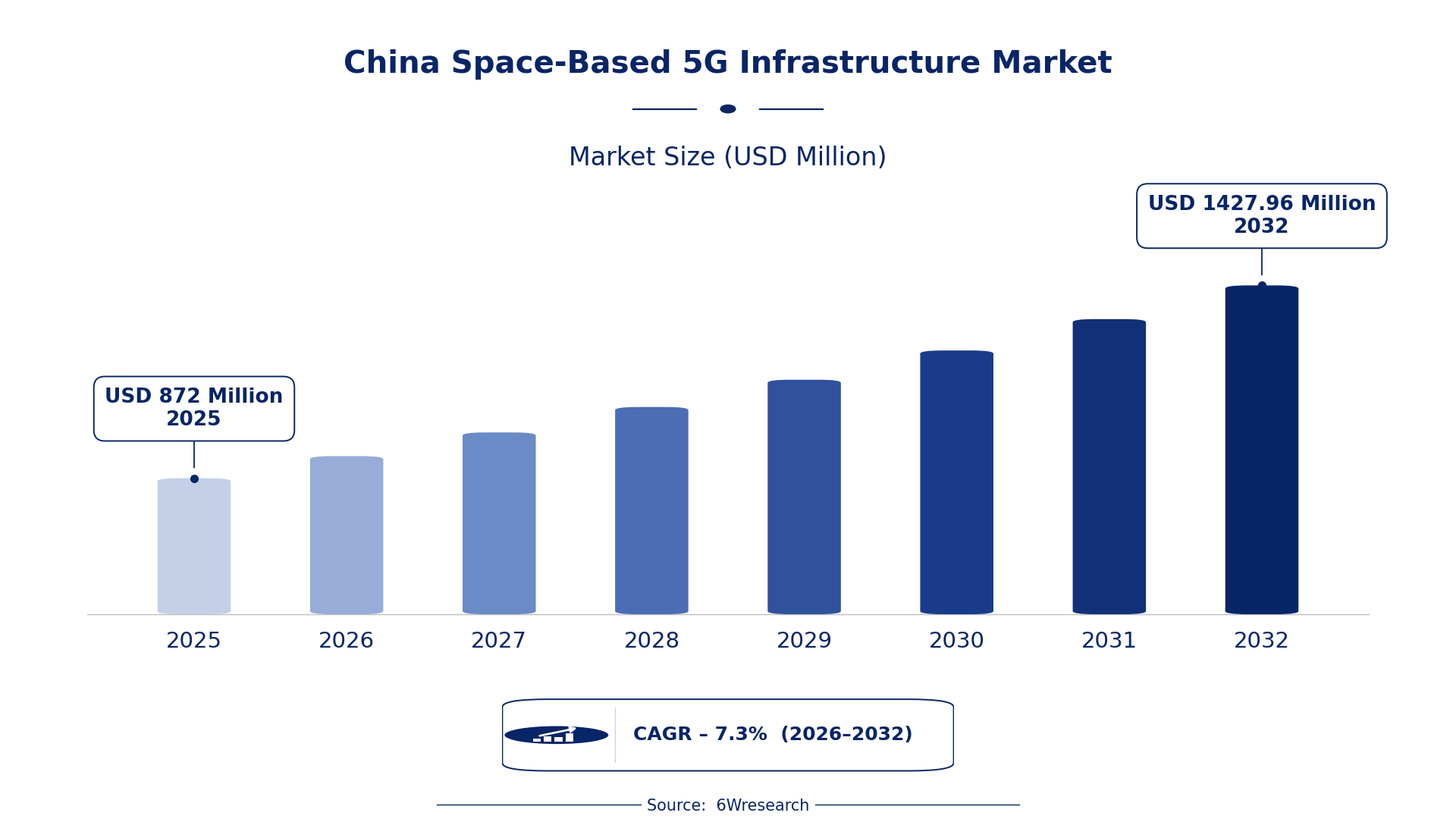
According to 6Wresearch internal database and industry insights, the China Space-Based 5G Infrastructure Market was valued at USD 872.0 million in 2025 and is projected to reach USD 1,427.96 million by 2032, growing at a CAGR of approximately 7.3% during 2026–2032.
China Space-Based 5G Infrastructure Market Highlights
| Report Metric | Details |
| Report Name | China Space-Based 5G Infrastructure Market |
| Market Size 2025 | USD 872.0 million |
| Market Size 2032 | USD 1,427.96 million |
| Absolute Growth 2025–2032 | USD 555.96 million |
| CAGR 2026–2032 | 7.3% |
| Peak Annual Growth | 9.7% in 2028 |
| Forecast Period | 2026–2032 |
| Historical Data | 2022–2025 |
| Base Year | 2025 |
| Leading Infrastructure Type, 2025 | LEO Satellite Constellations (47% share) |
| Leading Orbit Type, 2025 | Low Earth Orbit (36% share) |
| Leading Bandwidth Capability, 2025 | High-Speed Broadband (38% share) |
| Leading End User, 2025 | 5G Network Providers (49% share) |
| Fastest-Growing Infrastructure Type | Payload Modules (8.3% CAGR) |
| Fastest-Growing Orbit Type | Integrated Antennas (9.8% CAGR) |
| Fastest-Growing Bandwidth Capability | Ka/Ku Band (8.6% CAGR) |
| Fastest-Growing End User | Satellite Operators (9.5% CAGR) |
| Growing Sector | Satellite Operators |
| Key End Users | 5G Network Providers, Satellite Operators, Telecom Companies, Enterprise Connectivity |
China Space-Based 5G Infrastructure Market Year-wise Growth Rate and Key Drivers (2022–2032)
This graph illustrates the annual growth rates of the market from 2022 to 2032, highlighting a steady upward trajectory and projected market expansion over the forecast period.
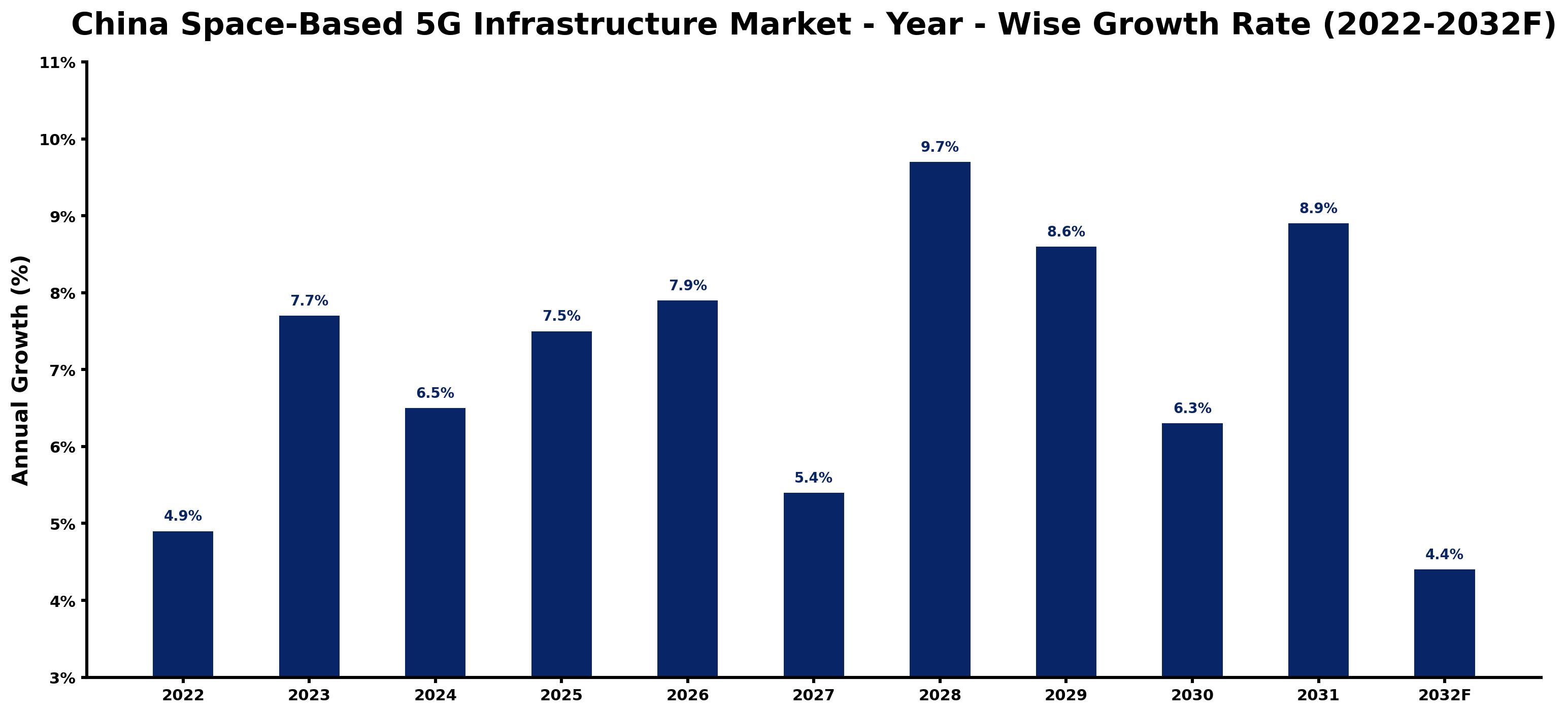
Annual growth estimates for each year appear below with the principal reason behind them, explaining the shifts that set the pace of the market.
| Year | Estimated Annual Growth (%) | Market Rationale |
| 2022 | 4.9 | The market experienced steady growth, driven by increased mobile user adoption. |
| 2023 | 7.7 | Growth accelerated due to the launch of the 'Digital China' initiative boosting infrastructure. |
| 2024 | 6.5 | The growth rate slowed as projects began to align with the initiative's goals. |
| 2025 | 7.5 | Demand surged as 5G network coverage expanded to urban areas, enhancing service offerings. |
| 2026 | 7.9 | Investment in satellite communication technology is expected to support a faster growth rate this year. |
| 2027 | 5.4 | Growth is projected to slow as companies adjust to the evolving regulatory environment. |
| 2028 | 9.7 | The market is expected to peak as satellite deployments reach critical mass, enhancing connectivity. |
| 2029 | 8.6 | Growth will slow as the market matures and competition intensifies among providers. |
| 2030 | 6.3 | A further slowdown is expected as the focus shifts to optimising existing infrastructure. |
| 2031 | 8.9 | Growth is projected to rebound with new satellite launches and increased demand for 5G services. |
| 2032 | 4.4 | The market growth rate is expected to slow as saturation in urban areas begins to take effect. |
Note: Market size estimations and growth projections presented in this report are based on 6Wresearch's proprietary forecasting methodology, utilizing the latest available industry data, government publications, and primary research inputs.
China Space-Based 5G Infrastructure Market Synopsis
Space-Based 5G Infrastructure in China refers to the technology enabling high-speed communication via satellites, primarily through Low Earth Orbit constellations. This technology improves connectivity in remote areas and supports IoT applications. The China Space-Based 5G Infrastructure Market is expanding due to substantial investments in satellite technology and government initiatives like the 'Digital China' initiative, which aims to enhance digital infrastructure. By 2030, China plans to deploy over 12,000 LEO satellites, driving demand for advanced communication capabilities and services.
Market Dynamics Impact Analysis (2026–2032)
| Factor | Type | Impact | Primary Segment Affected |
| Increased investment in satellite technology and infrastructure development | Driver | High | LEO Satellite Constellations |
| Growing demand for high-speed broadband services among telecom operators | Driver | High | High-Speed Broadband |
| Rising need for reliable communication solutions in remote areas | Opportunity | High | Enterprise Connectivity |
| Expansion of IoT applications requiring satellite backhaul | Opportunity | High | IoT Backhaul |
| Regulatory hurdles in satellite deployment and approvals | Restraint | Medium | Payload Modules |
| High costs associated with satellite manufacturing and launches | Restraint | Medium | Relay Satellites |
| Technological challenges in integrating satellite systems with terrestrial networks | Challenge | High | Space-Ground Interface |
| Competition among satellite operators leading to price pressures | Challenge | Medium | Satellite Operators |
Evaluation of Drivers in China Space-Based 5G Infrastructure Market (2026–2032)
The table below links each growth driver to the segment it affects and the evidence for it.
| Drivers | Primary Segment Affected | Why It Matters (Evidence) |
| Increased investment in satellite communication technology | LEO Satellite Constellations | China invested $5 billion in satellite communication technology under the 'Space Infrastructure Development Plan'. |
| Growing mobile user base driving demand for 5G services | High-Speed Broadband | In 2022, China reported 1.4 billion mobile users, driving demand for improved connectivity. |
| Expansion of IoT applications requiring satellite connectivity | IoT Backhaul | The 'Internet of Things Development Plan' aims to integrate satellite communication with IoT by 2025. |
| Government initiatives to boost digital infrastructure | Payload Modules | The 'Digital China' initiative launched in 2021 aims to improve digital infrastructure across the country. |
| Development of integrated antennas for improved communication | Integrated Antennas | Integrated antennas are critical for improving communication efficiency in LEO satellite design. |
Growth across the Space-Based 5G Infrastructure market in China is anchored in significant investments in satellite communication technology, a rising mobile user base, and the expansion of IoT applications. In 2023, China invested $5 billion in satellite communication technology under the 'Space Infrastructure Development Plan', which supports the development of advanced communication capabilities. The 2022 report of 1.4 billion mobile users highlighted the increasing need for 5G services, prompting telecom operators to enhance their offerings. With the 'Internet of Things Development Plan' aiming for integration by 2025, the demand for satellite backhaul is rising.
Evaluation of Restraints in China Space-Based 5G Infrastructure Market
The key brakes on demand, and where they bite hardest, are shown below.
| Market Restraint | Primary Segment Affected | Why It Matters (Evidence) |
| Intense competition for government contracts | LEO Satellite Constellations | Multiple entities compete for contracts, resulting in price wars that squeeze margins for suppliers. |
| Rising costs for telecom operators | High-Speed Broadband | Rapid expansion of satellite networks has led to increased costs, straining budgets for telecom operators. |
| Regulatory hurdles delaying project approvals | Payload Modules | Compliance with national standards can complicate market entry and delay satellite deployment timelines. |
| Technological advancements required for efficiency | Integrated Antennas | Without efficient integrated antennas, communication effectiveness suffers, impacting service quality. |
| Market maturity leading to slower growth | IoT Backhaul | As the market matures, growth rates are expected to decline due to increased competition. |
China Space-Based 5G Infrastructure Market Challenges
Intense competition in the China Space-Based 5G Infrastructure market leads to price wars, which erode profit margins for suppliers. Telecom operators face rising costs as they invest heavily in expanding satellite networks, with 2023 investments exceeding $5 billion, straining their budgets. Regulatory hurdles complicate compliance with national standards, causing project approval delays that hinder timely satellite deployment for buyers. Technological challenges persist; without advanced integrated antennas, communication efficiency suffers, resulting in lower service quality for end-users in remote areas.
Trends in the China Space-Based 5G Infrastructure Market
Several trends are reshaping the China Space-Based 5G Infrastructure Market; the most important are set out below.
- Shift towards Integrated Antennas: The demand for integrated antennas in satellite communication is rising, driven by the need for improved efficiency. In 2023, the focus on developing these components increased as they are essential for LEO satellite design.
- Transition to Low Earth Orbit Deployment: Since 2021, the deployment of Low Earth Orbit satellites has gained momentum, improving connectivity. By 2030, China plans to deploy over 12,000 LEO satellites, significantly impacting communication capabilities.
- 5G Network Providers Leading Demand: 5G network providers are increasingly adopting satellite communication solutions to improve service offerings. In 2022, 49% of the market share was held by this buyer group, reflecting their growing reliance on satellite infrastructure.
- IoT Integration with Satellite Communication: The integration of IoT with satellite communication is becoming a priority for service providers. The 'Internet of Things Development Plan' aims for this integration by 2025, indicating a shift in focus for technology development.
Investment Opportunities in the China Space-Based 5G Infrastructure Market
The following opportunities in the China Space-Based 5G Infrastructure Market pair current demand with a clear way in.
- Telecom Operators Seeking Improved Connectivity: Telecom operators are increasingly looking for satellite communication solutions to enhance service offerings. With 1.4 billion mobile users in 2022, there is a substantial demand for better connectivity.
- Beijing-Tianjin-Hebei Region as a Technological Hub: The Beijing-Tianjin-Hebei region is a major hub for satellite technology development. Investing in this area now can provide opportunities for suppliers to engage with local telecom operators.
- Growing Need for IoT Backhaul Solutions: As IoT applications expand, the demand for satellite backhaul solutions is increasing. With the 'Internet of Things Development Plan' set for 2025, suppliers can enter this market through partnerships with telecom companies.
- Entry through Joint Ventures: Establishing joint ventures with local firms can facilitate entry into the satellite communication market. This approach is timely as demand for satellite infrastructure is expected to rise significantly.
Government Initiatives in the China Space-Based 5G Infrastructure Market
The 'Space Infrastructure Development Plan' launched in 2023 allocates $5 billion to improve satellite communication technology, building on previous initiatives like the 'Digital China' initiative from 2021, which aimed to enhance digital infrastructure. This new plan mandates the development of advanced payload modules and integrated antennas, ensuring that satellite systems meet national communication standards. By focusing on Low Earth Orbit constellations, the government aims to improve connectivity across remote areas, which directly impacts the deployment of Space-Based 5G Infrastructure. The combination of these measures is expected to accelerate market growth, as they provide a clear framework for investment and development in satellite technology.
The National Development and Reform Commission oversees the funding and approval of satellite communication projects, ensuring compliance with the 'Digital China' initiative. The China National Space Administration regulates satellite launches and operations, facilitating the approval process for new satellite deployments. These agencies play a crucial role in streamlining project approvals, which is essential for meeting the ambitious target of deploying over 12,000 LEO satellites by 2030. Their efforts support the integration of satellite communication with terrestrial networks, enhancing service delivery for telecom operators and IoT applications.
Future Insight of the China Space-Based 5G Infrastructure Market
Several forward-looking factors are expected to drive the China Space-Based 5G Infrastructure market forward by 2032. The planned deployment of over 12,000 LEO satellites by 2030 will significantly improve connectivity in remote regions. The 'Digital China' initiative will catalyse further investments in digital infrastructure, creating opportunities for suppliers. The integration of satellite communication with IoT, as outlined in the 'Internet of Things Development Plan', will open new service avenues, benefiting both buyers and suppliers.
Market Segmentation Analysis
The analysis below covers each segmentation, its leading category in 2025 and its fastest-growing category through 2032.
By Infrastructure Type – LEO Satellite Constellations Dominated, Payload Modules Expected to Grow Fastest
According to Summon Dutta, Assistant Manager at 6Wresearch, LEO Satellite Constellations took a 47% share of infrastructure type in 2025, more than any other category. LEO Satellite Constellations capture the largest market share in China because they are essential for enhancing global connectivity and facilitating 5G deployment. The initiative to launch over 12,000 LEO satellites by 2030 illustrates their pivotal role in the nation's digital infrastructure. Payload Modules are projected to grow fastest, at a CAGR of 8.3% during 2026–2032. Payload Modules are growing rapidly as they are crucial for satellite functionality and communication, particularly with increased investments in satellite technology. The $5 billion commitment to satellite communication technology in 2023 highlights the urgency for developing advanced payload solutions. Suppliers should focus on creating advanced payload technologies to meet the rising demand from satellite operators.
By Orbit Type – Low Earth Orbit Dominated, Integrated Antennas Expected to Grow Fastest
The largest orbit type category in 2025 was Low Earth Orbit, with a 36% share of total revenue. Low Earth Orbit holds the largest market share due to its effectiveness in minimising latency in communications, making it ideal for 5G applications. The anticipated coverage of China's 5G network reaching 98% of urban areas by 2025 underscores its importance in the sector. The quickest growth will come from Integrated Antennas, forecast to expand at a CAGR of 9.8% between 2026 and 2032. Integrated Antennas are experiencing the fastest growth as they are vital for enhancing satellite communication capabilities. The increasing integration of satellite communication with IoT applications is significantly driving demand for these components. Buyers must prioritise sourcing high-quality integrated antennas to ensure efficient satellite communication.
By Bandwidth Capability – High-Speed Broadband Dominated, Ka/Ku Band Expected to Grow Fastest
In 2025, High-Speed Broadband led the bandwidth capability split with a 38% share. High-Speed Broadband leads the market share as it is a key service enabled by space-based infrastructure, essential for fulfilling the connectivity needs of mobile users. With 1.4 billion mobile users reported in 2022, the demand for high-speed connectivity is critical. Over 2026–2032, Ka/Ku Band is expected to post the fastest growth, at a CAGR of 8.6%. Ka/Ku Band is witnessing rapid growth due to its specific frequency bands used for satellite communications, which are crucial for high-speed data transfer. Compliance with national standards further accelerates its adoption in the market. Suppliers should invest in Ka/Ku Band technologies to capitalise on the increasing demand for high-speed satellite communication.
By End User – 5G Network Providers Dominated, Satellite Operators Expected to Grow Fastest
With a 49% revenue share in 2025, 5G Network Providers was the largest end user category. 5G Network Providers dominate the market share as they are the primary users of space-based infrastructure, vital for delivering advanced connectivity services. Their critical role in the digital ecosystem is evident through the ongoing expansion of 5G networks across China. Satellite Operators are set to record the highest CAGR in this split, 9.5% over 2026–2032. Satellite Operators are the fastest-growing segment, managing and operating satellite networks that are increasingly essential for connectivity solutions. The swift deployment of new satellites requires a robust operational framework, propelling growth in this area. Buyers should work closely with satellite operators to ensure seamless integration of satellite services into their connectivity solutions.
Key Attractiveness of the Report
- 10 Years of Market Numbers
- Historical Data Starting from 2022 to 2025
- Base Year 2025
- Forecast Data until 2032
- Key Performance Indicators Impacting the Market
- Major Upcoming Developments and Projects
Key Highlights of the Report:
- China Space-Based 5G Infrastructure Market Outlook
- Market Size of China Space-Based 5G Infrastructure Market, 2025
- Forecast of China Space-Based 5G Infrastructure Market, 2032
- Historical Data and Forecast of China Space-Based 5G Infrastructure Revenues & Volume for the Period 2022 - 2032F
- China Space-Based 5G Infrastructure Market Trend Evolution
- China Space-Based 5G Infrastructure Market Drivers and Challenges
- China Space-Based 5G Infrastructure Price Trends
- China Space-Based 5G Infrastructure Porter's Five Forces
- China Space-Based 5G Infrastructure Industry Life Cycle
- Historical Data and Forecast of China Space-Based 5G Infrastructure Market Revenues & Volume By Infrastructure Type for the Period 2022 - 2032F
- Historical Data and Forecast of China Space-Based 5G Infrastructure Market Revenues & Volume By LEO Satellite Constellations for the Period 2022 - 2032F
- Historical Data and Forecast of China Space-Based 5G Infrastructure Market Revenues & Volume By Payload Modules for the Period 2022 - 2032F
- Historical Data and Forecast of China Space-Based 5G Infrastructure Market Revenues & Volume By Relay Satellites for the Period 2022 - 2032F
- Historical Data and Forecast of China Space-Based 5G Infrastructure Market Revenues & Volume By Space-Ground Interface for the Period 2022 - 2032F
- Historical Data and Forecast of China Space-Based 5G Infrastructure Market Revenues & Volume By Orbit Type for the Period 2022 - 2032F
- Historical Data and Forecast of China Space-Based 5G Infrastructure Market Revenues & Volume By Low Earth Orbit for the Period 2022 - 2032F
- Historical Data and Forecast of China Space-Based 5G Infrastructure Market Revenues & Volume By Integrated Antennas for the Period 2022 - 2032F
- Historical Data and Forecast of China Space-Based 5G Infrastructure Market Revenues & Volume By Data Handoff for the Period 2022 - 2032F
- Historical Data and Forecast of China Space-Based 5G Infrastructure Market Revenues & Volume By IoT Backhaul for the Period 2022 - 2032F
- Historical Data and Forecast of China Space-Based 5G Infrastructure Market Revenues & Volume By Bandwidth Capability for the Period 2022 - 2032F
- Historical Data and Forecast of China Space-Based 5G Infrastructure Market Revenues & Volume By High-Speed Broadband for the Period 2022 - 2032F
- Historical Data and Forecast of China Space-Based 5G Infrastructure Market Revenues & Volume By Ka/Ku Band for the Period 2022 - 2032F
- Historical Data and Forecast of China Space-Based 5G Infrastructure Market Revenues & Volume By Multi-Band for the Period 2022 - 2032F
- Historical Data and Forecast of China Space-Based 5G Infrastructure Market Revenues & Volume By Edge Integration for the Period 2022 - 2032F
- Historical Data and Forecast of China Space-Based 5G Infrastructure Market Revenues & Volume By End User for the Period 2022 - 2032F
- Historical Data and Forecast of China Space-Based 5G Infrastructure Market Revenues & Volume By 5G Network Providers for the Period 2022 - 2032F
- Historical Data and Forecast of China Space-Based 5G Infrastructure Market Revenues & Volume By Satellite Operators for the Period 2022 - 2032F
- Historical Data and Forecast of China Space-Based 5G Infrastructure Market Revenues & Volume By Telecom Companies for the Period 2022 - 2032F
- Historical Data and Forecast of China Space-Based 5G Infrastructure Market Revenues & Volume By Enterprise Connectivity for the Period 2022 - 2032F
- China Space-Based 5G Infrastructure Import Export Trade Statistics
- Market Opportunity Assessment By Infrastructure Type
- Market Opportunity Assessment By Orbit Type
- Market Opportunity Assessment By Bandwidth Capability
- Market Opportunity Assessment By End User
- China Space-Based 5G Infrastructure Top Companies Market Share
- China Space-Based 5G Infrastructure Competitive Benchmarking By Technical and Operational Parameters
- China Space-Based 5G Infrastructure Company Profiles
- China Space-Based 5G Infrastructure Key Strategic Recommendations
Market Covered
Segments analysed in this report are listed below.
By Infrastructure Type
- LEO Satellite Constellations
- Payload Modules
- Relay Satellites
- Space-Ground Interface
By Orbit Type
- Low Earth Orbit
- Integrated Antennas
- Data Handoff
- IoT Backhaul
By Bandwidth Capability
- High-Speed Broadband
- Ka/Ku Band
- Multi-Band
- Edge Integration
By End User
- 5G Network Providers
- Satellite Operators
- Telecom Companies
- Enterprise Connectivity































