China Specialty Beer Market Size & Growth Rate
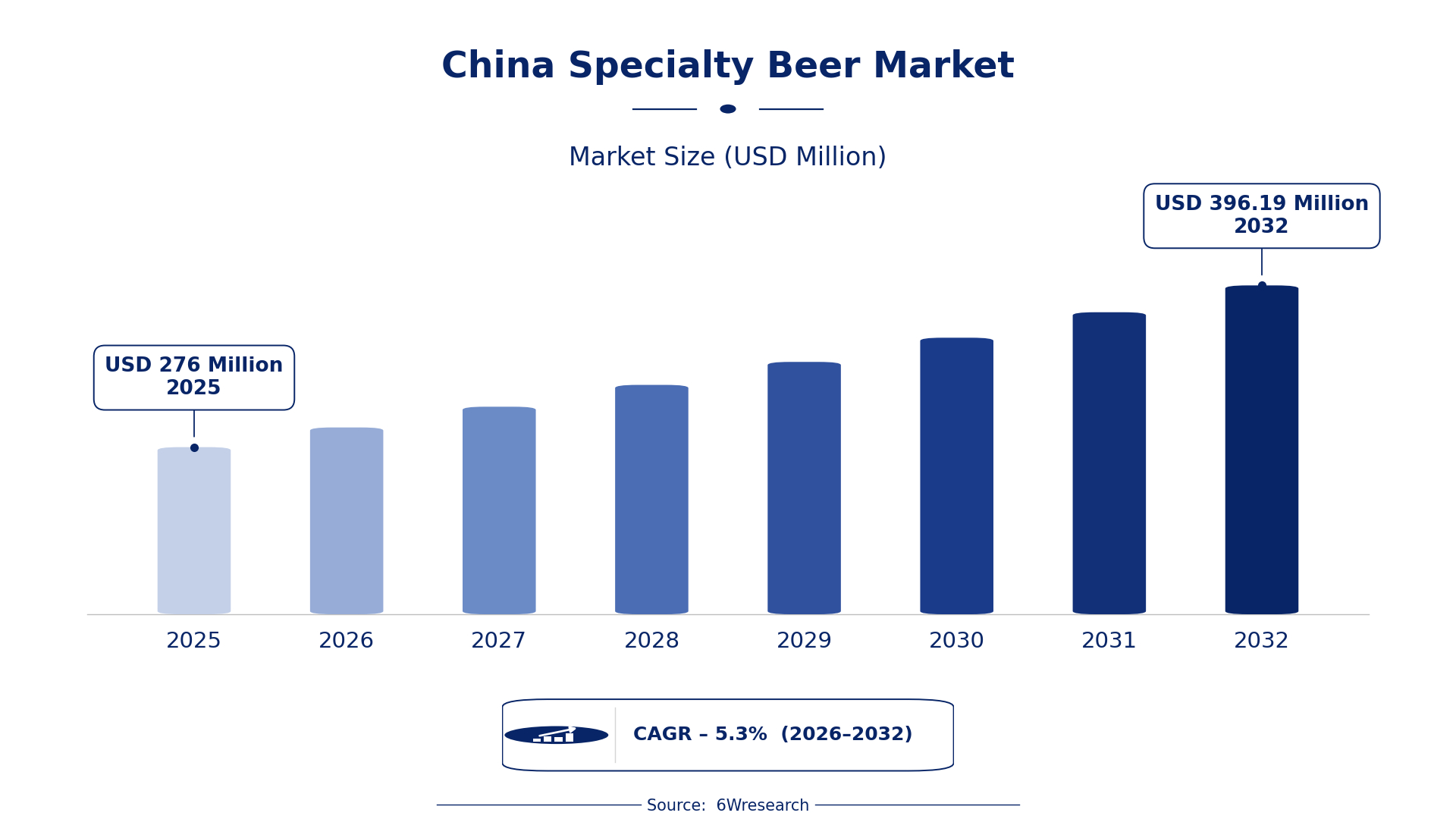
According to 6Wresearch internal database and industry insights, the China Specialty Beer Market was valued at USD 276.0 million in 2025 and is projected to reach USD 396.19 million by 2032, growing at a CAGR of approximately 5.3% during 2026–2032.
China Specialty Beer Market Highlights
| Report Metric | Details |
| Report Name | China Specialty Beer Market |
| Market Size 2025 | USD 276.0 million |
| Market Size 2032 | USD 396.19 million |
| Absolute Growth 2025–2032 | USD 120.19 million |
| CAGR 2026–2032 | 5.3% |
| Peak Annual Growth | 6.8% in 2032 |
| Forecast Period | 2026–2032 |
| Historical Data | 2022–2025 |
| Base Year | 2025 |
| Leading Beer Type, 2025 | Craft IPA (38% share) |
| Leading Flavor Profile, 2025 | Hoppy & Bitter (52% share) |
| Leading Packaging Format, 2025 | Bottles/Cans (43% share) |
| Leading End User, 2025 | Microbreweries (51% share) |
| Fastest-Growing Beer Type | Sour Beer (7.4% CAGR) |
| Fastest-Growing Flavor Profile | Fruity/Tart (7.4% CAGR) |
| Fastest-Growing Packaging Format | 6-Pack Cans (7.8% CAGR) |
| Fastest-Growing End User | Brewpubs & Taprooms (7.6% CAGR) |
| Growing Sector | Brewpubs & Taprooms |
| Key End Users | Microbreweries, Brewpubs & Taprooms, Specialty Beer Retailers, Allergy-Sensitive Drinkers |
China Specialty Beer Market Year-wise Growth Rate and Key Drivers (2022–2032)
This graph illustrates the annual growth rates of the market from 2022 to 2032, highlighting a steady upward trajectory and projected market expansion over the forecast period.
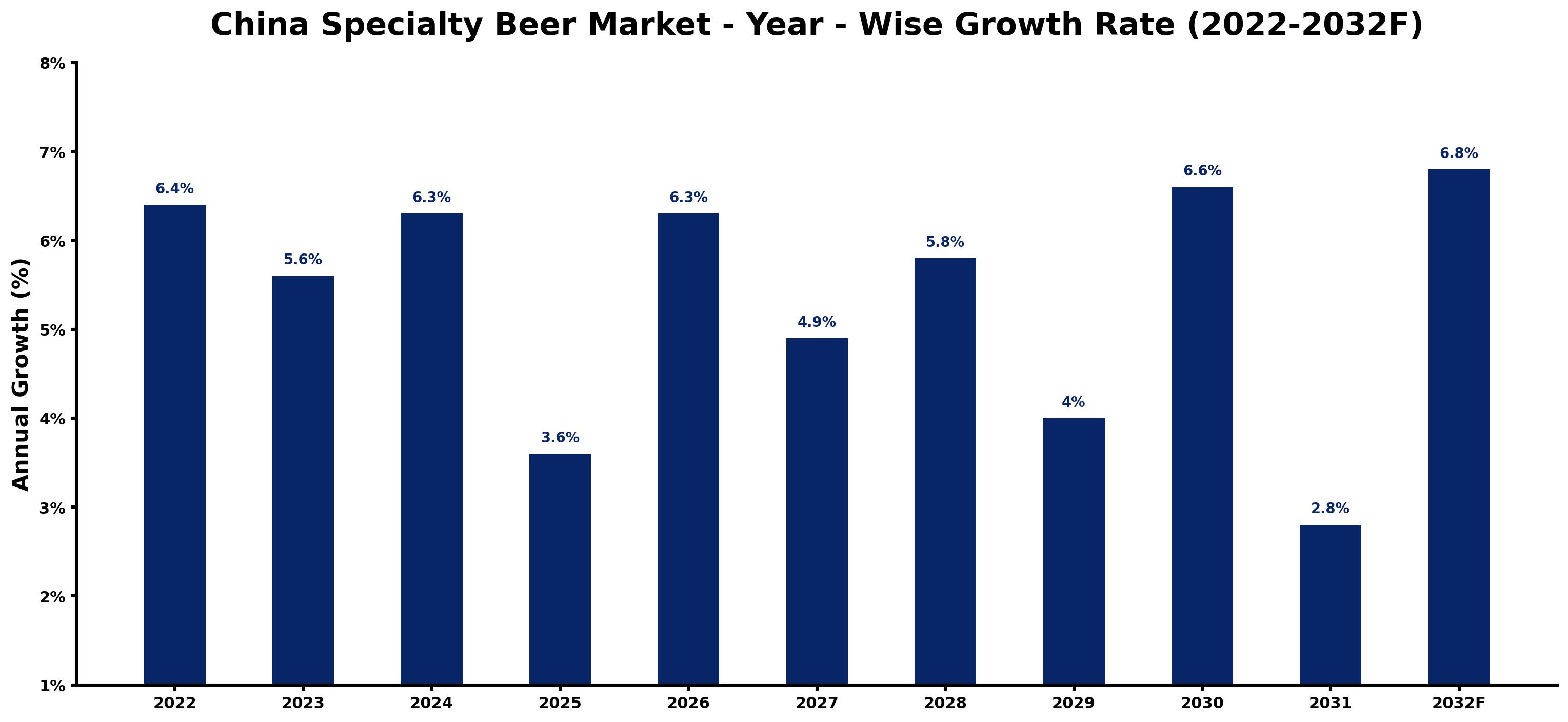
Year by year, the estimates below pair each growth rate with the development that shaped it.
| Year | Estimated Annual Growth (%) | Market Rationale |
| 2022 | 6.4 | The market saw strong interest from urban consumers seeking unique craft beer experiences. |
| 2023 | 5.6 | Demand growth slowed as consumers adjusted to rising prices and economic conditions. |
| 2024 | 6.3 | Increased interest in craft beer festivals boosted consumption in major cities. |
| 2025 | 3.6 | Growth slowed as competition intensified among local microbreweries and brewpubs. |
| 2026 | 6.3 | The introduction of new craft beer styles is expected to attract more consumers to specialty options. |
| 2027 | 4.9 | Market growth will slow as established brands face challenges from emerging microbreweries. |
| 2028 | 5.8 | A rise in health-conscious consumers seeking gluten-free options is projected to support demand. |
| 2029 | 4.0 | Growth will slow as market saturation begins to affect new entrants in the craft beer sector. |
| 2030 | 6.6 | Increased marketing efforts by local breweries will raise visibility and consumer interest. |
| 2031 | 2.8 | Demand growth is expected to slow as economic factors influence consumer spending habits. |
| 2032 | 6.8 | The market is projected to peak as consumers embrace unique flavors and brewing techniques. |
Note: Market size estimations and growth projections presented in this report are based on 6Wresearch's proprietary forecasting methodology, utilizing the latest available industry data, government publications, and primary research inputs.
China Specialty Beer Market Synopsis
Specialty Beer in China includes a wide array of unique flavours and brewing techniques, appealing to an expanding consumer base. This segment features high-quality ingredients and artisanal production methods. Increased consumption among urban populations, particularly in tier-1 cities, propels the China Specialty Beer Market forward. The rising popularity of microbreweries and events like craft beer festivals further boost demand among younger consumers. Consequently, the market is experiencing robust growth, reflecting evolving consumer preferences.
Market Dynamics Impact Analysis (2026–2032)
| Factor | Type | Impact | Primary Segment Affected |
| Growing urban population seeking unique craft beer experiences | Driver | High | Microbreweries |
| Increased availability of gluten-free beer options | Driver | High | Gluten-Free Beer |
| Emerging microbreweries entering the market | Opportunity | High | Microbreweries |
| Rising interest in craft beer festivals and events | Opportunity | Medium | Brewpubs & Taprooms |
| Intense competition among local breweries | Restraint | High | Microbreweries |
| Economic fluctuations affecting consumer spending | Restraint | Medium | Specialty Beer Retailers |
| Challenges in maintaining consistent quality across new brews | Challenge | High | Microbreweries |
| Regulatory hurdles for new craft beer labels | Challenge | Medium | Specialty Beer Retailers |
Evaluation of Drivers in China Specialty Beer Market (2026–2032)
Below mentioned are some major drivers and their influence on market dynamics.
| Drivers | Primary Segment Affected | Why It Matters (Evidence) |
| Increasing interest in craft beer among younger consumers | Microbreweries | The average age of craft beer consumers is around 25-35 years, driving demand for unique flavors. |
| Growth of craft beer festivals in major cities | Brewpubs & Taprooms | Events like the Shanghai International Beer Festival attract thousands, boosting local sales. |
| Expansion of gluten-free beer options in retail chains | Gluten-Free Beer | Growing demand from allergy-sensitive consumers has led to increased availability in major outlets. |
| Support from the Craft Beer Development Initiative | Microbreweries | The initiative provides 50 million yuan for local breweries, supporting innovation and marketing efforts. |
| Rising popularity of unique flavor profiles like Fruity/Tart | Fruity/Tart | This flavor profile appeals to younger demographics, driving sales growth. |
Market growth in China for Specialty Beer rests on increasing interest in craft beer among younger consumers and the growth of craft beer festivals. In 2022, the craft beer market was valued at approximately 20 billion yuan, reflecting strong consumer interest. Craft beer festivals attract thousands of attendees, boosting local sales and engaging communities. The average age of craft beer consumers is around 25-35 years, indicating a young demographic driving demand.
Evaluation of Restraints in China Specialty Beer Market
The following restraints limit how fast demand can grow.
| Market Restraint | Primary Segment Affected | Why It Matters (Evidence) |
| Intense competition among local breweries leading to price wars | Microbreweries | Over 1,000 microbreweries operate in China, increasing competition and affecting profit margins. |
| Economic fluctuations impacting consumer spending on specialty items | Specialty Beer Retailers | Economic conditions have led to cautious spending among consumers, affecting sales. |
| Challenges in maintaining consistent quality across new brews | Microbreweries | As new microbreweries emerge, ensuring quality can be difficult, impacting brand reputation. |
| Regulatory hurdles for new craft beer labels slowing market entry | Specialty Beer Retailers | The new approval pathway for craft beer labels introduced in 2022 can delay market entry. |
| Limited awareness of specialty beer outside urban areas | Brewpubs & Taprooms | Specialty beer consumption is primarily concentrated in tier-1 cities, limiting broader market reach. |
China Specialty Beer Market Challenges
Buyers in the China specialty beer market face a lack of gluten-free options, limiting choices for consumers with dietary restrictions. Regulatory challenges associated with the national standard GB 4927-2016 can delay product launches, as new brews require extensive testing and documentation. Importers encounter rising costs due to tariffs and logistical issues, which can elevate prices by up to 15%, impacting their market competitiveness. Skills shortages in brewing techniques restrict microbreweries from producing distinctive products, resulting in a lack of variety that could attract a broader audience.
Trends in the China Specialty Beer Market
Below mentioned are some of the trends shaping the China Specialty Beer Market growth.
- Shift towards Unique Flavor Profiles: Consumers are increasingly attracted to distinctive flavours in specialty beer, such as Fruity/Tart, which is gaining traction among younger drinkers. This trend is reflected in a CAGR of 7.4% for this flavour profile from 2026 to 2032.
- Growth of Craft Beer Festivals: Craft beer festivals are emerging as a vital platform for promoting local breweries and their offerings. The Shanghai International Beer Festival draws thousands of attendees each year, showcasing both local and international specialty beers.
- Increase in Gluten-Free Beer Options: The availability of gluten-free beer is expanding in major retail chains, catering to allergy-sensitive consumers. This growing segment is increasingly relevant as more consumers seek gluten-free alternatives.
- Expansion of Microbreweries: The number of microbreweries in China has exceeded 1,000, highlighting a vibrant craft beer scene. This growth is supported by local initiatives aimed at promoting craft beer, broadening consumer choice.
Investment Opportunities in the China Specialty Beer Market
Below are the investment opportunities with the strongest case in the China Specialty Beer Market.
- Investment in Unique Craft Beer Styles: A gap exists in the market for unique craft beer styles, particularly among younger consumers. Microbreweries can invest in distinctive brewing techniques to attract this demographic.
- Partnerships with Local Breweries: Forming partnerships with local breweries can ease market entry. The Craft Beer Development Initiative offers funding, making collaboration beneficial for newcomers.
- Investment in Sustainable Brewing Practices: As health-conscious consumers rise, investing in sustainable brewing practices can set products apart. The Green Brewing Initiative encourages microbreweries to adopt eco-friendly methods.
- Expansion of Gluten-Free Beer Offerings: The increasing demand for gluten-free beer options presents an opportunity for suppliers. Major retail chains are progressively stocking these products, catering to allergy-sensitive consumers.
Government Initiatives in the China Specialty Beer Market
In 2023, the Ministry of Agriculture launched the 'Craft Beer Development Initiative' to support local microbreweries with a budget of 50 million yuan for innovation and marketing. This initiative aims to enhance the competitiveness of local breweries and promote craft beer standards. Additionally, the National Standard for Beer (GB 4927-2016) was updated in 2021 to incorporate new quality parameters for specialty beers, ensuring that producers meet evolving consumer expectations. These measures collectively support the growth of the specialty beer market in China.
The China Alcoholic Drinks Association established the 'Craft Beer Certification Program' in 2020 to improve quality assurance among producers. This program assists breweries in meeting national standards and gaining consumer trust. Furthermore, the State Administration for Market Regulation introduced a new approval pathway for craft beer labels in 2022, streamlining the registration process for new products. This pathway facilitates quicker market entry for creative craft beers, benefiting both producers and consumers.
Future Insight of the China Specialty Beer Market
The China specialty beer market is poised for evolution by 2032, driven by the Craft Beer Development Initiative that supports local breweries and innovation. Rising consumer demand for unique flavours will motivate microbreweries to experiment with diverse ingredients and brewing methods. Craft beer festivals in cities like Beijing and Shanghai will continue to draw thousands, nurturing a vibrant specialty beer culture. By 2025, the number of craft beer festivals is expected to double, increasing visibility and competition for buyers across the country.
Market Segmentation Analysis
Each segment group is reviewed below, with the leader by share and the fastest grower by CAGR.
By Beer Type – Craft IPA Dominated, Sour Beer Expected to Grow Fastest
According to Summon Dutta, Assistant Manager at 6Wresearch, with a 38% revenue share in 2025, Craft IPA was the largest beer type category. Craft IPA holds the largest market share due to its popularity among craft beer enthusiasts, particularly in urban areas where consumers seek unique flavours. The rise of microbreweries in regions like Guangdong has further solidified its position as a favourite choice. Over 2026–2032, Sour Beer is expected to post the fastest growth, at a CAGR of 7.4%. Sour Beer is experiencing rapid growth as it gains traction in specialty beer circles, appealing to adventurous drinkers looking for new taste experiences. The increasing presence of craft beer festivals in cities like Beijing and Shanghai has also contributed to its rising popularity. Suppliers should focus on expanding their offerings of Sour Beer to capture the growing interest among consumers.
By Flavor Profile – Hoppy & Bitter Dominated, Fruity/Tart Expected to Grow Fastest
Hoppy & Bitter held a 52% share of the China Specialty Beer Market by flavor profile in 2025. Hoppy & Bitter holds the largest market share as it is a prevalent flavour profile in craft beers, appealing to consumers who appreciate its distinctive taste. This profile resonates particularly well in tier-1 cities, where the craft beer culture is flourishing and attracting a loyal customer base. Fruity/Tart is set to record the highest CAGR in this split, 7.4% over 2026–2032. Fruity/Tart is witnessing rapid growth due to its strong appeal among younger consumers who seek refreshing and unique flavour experiences. The trend towards fruit-infused beers aligns with the preferences of the average craft beer drinker aged 25-35, ensuring sustained popularity. Suppliers should expand their product lines to include more Fruity/Tart options to meet the preferences of the younger demographic.
By Packaging Format – Bottles/Cans Dominated, 6-Pack Cans Expected to Grow Fastest
Bottles/Cans accounted for a 43% market share by packaging format in 2025. Bottles/Cans command a significant market share as the standard packaging format for retail distribution, offering accessibility and convenience for consumers. This familiar packaging is widely preferred in both retail environments and social gatherings, solidifying its position in the specialty beer market. The quickest growth will come from 6-Pack Cans, forecast to expand at a CAGR of 7.8% between 2026 and 2032. 6-Pack Cans are gaining popularity rapidly due to their convenience, appealing to consumers who prefer portable packaging options. The shift towards on-the-go consumption among younger drinkers is propelling this trend, indicating a growing segment within the market. Manufacturers should prioritise the production of 6-Pack Cans to satisfy the increasing consumer demand for convenient packaging solutions.
By End User – Microbreweries Dominated, Brewpubs & Taprooms Expected to Grow Fastest
In 2025, Microbreweries led the end user split with a 51% share. Microbreweries dominate the market share as they are pivotal to the specialty beer movement, showcasing unique brewing methods and attracting dedicated craft beer enthusiasts. Their extensive presence across urban areas in China underscores their critical role in shaping the craft beer landscape. Brewpubs & Taprooms are projected to grow fastest, at a CAGR of 7.6% during 2026–2032. Brewpubs & Taprooms are emerging as the fastest-growing end user segment, serving as essential venues for specialty beer sales and providing engaging experiences for consumers. The increasing popularity of these establishments reflects a shift in consumer behaviour towards craft beer in social settings. Investors should consider supporting Brewpubs & Taprooms to leverage the rising consumer interest in unique craft beer experiences.
Key Attractiveness of the Report
- 10 Years of Market Numbers
- Historical Data Starting from 2022 to 2025
- Base Year 2025
- Forecast Data until 2032
- Key Performance Indicators Impacting the Market
- Major Upcoming Developments and Projects
Key Highlights of the Report:
- China Specialty Beer Market Outlook
- Market Size of China Specialty Beer Market, 2025
- Forecast of China Specialty Beer Market, 2032
- Historical Data and Forecast of China Specialty Beer Revenues & Volume for the Period 2022 - 2032F
- China Specialty Beer Market Trend Evolution
- China Specialty Beer Market Drivers and Challenges
- China Specialty Beer Price Trends
- China Specialty Beer Porter's Five Forces
- China Specialty Beer Industry Life Cycle
- Historical Data and Forecast of China Specialty Beer Market Revenues & Volume By Beer Type for the Period 2022 - 2032F
- Historical Data and Forecast of China Specialty Beer Market Revenues & Volume By Craft IPA for the Period 2022 - 2032F
- Historical Data and Forecast of China Specialty Beer Market Revenues & Volume By Sour Beer for the Period 2022 - 2032F
- Historical Data and Forecast of China Specialty Beer Market Revenues & Volume By Barrel-Aged Ale for the Period 2022 - 2032F
- Historical Data and Forecast of China Specialty Beer Market Revenues & Volume By Gluten-Free Beer for the Period 2022 - 2032F
- Historical Data and Forecast of China Specialty Beer Market Revenues & Volume By Flavor Profile for the Period 2022 - 2032F
- Historical Data and Forecast of China Specialty Beer Market Revenues & Volume By Hoppy & Bitter for the Period 2022 - 2032F
- Historical Data and Forecast of China Specialty Beer Market Revenues & Volume By Fruity/Tart for the Period 2022 - 2032F
- Historical Data and Forecast of China Specialty Beer Market Revenues & Volume By Smoky/Complex for the Period 2022 - 2032F
- Historical Data and Forecast of China Specialty Beer Market Revenues & Volume By Light & Crisp for the Period 2022 - 2032F
- Historical Data and Forecast of China Specialty Beer Market Revenues & Volume By Packaging Format for the Period 2022 - 2032F
- Historical Data and Forecast of China Specialty Beer Market Revenues & Volume By Bottles/Cans for the Period 2022 - 2032F
- Historical Data and Forecast of China Specialty Beer Market Revenues & Volume By Growlers for the Period 2022 - 2032F
- Historical Data and Forecast of China Specialty Beer Market Revenues & Volume By Limited Edition Bottles for the Period 2022 - 2032F
- Historical Data and Forecast of China Specialty Beer Market Revenues & Volume By 6-Pack Cans for the Period 2022 - 2032F
- Historical Data and Forecast of China Specialty Beer Market Revenues & Volume By End User for the Period 2022 - 2032F
- Historical Data and Forecast of China Specialty Beer Market Revenues & Volume By Microbreweries for the Period 2022 - 2032F
- Historical Data and Forecast of China Specialty Beer Market Revenues & Volume By Brewpubs & Taprooms for the Period 2022 - 2032F
- Historical Data and Forecast of China Specialty Beer Market Revenues & Volume By Specialty Beer Retailers for the Period 2022 - 2032F
- Historical Data and Forecast of China Specialty Beer Market Revenues & Volume By Allergy-Sensitive Drinkers for the Period 2022 - 2032F
- China Specialty Beer Import Export Trade Statistics
- Market Opportunity Assessment By Beer Type
- Market Opportunity Assessment By Flavor Profile
- Market Opportunity Assessment By Packaging Format
- Market Opportunity Assessment By End User
- China Specialty Beer Top Companies Market Share
- China Specialty Beer Competitive Benchmarking By Technical and Operational Parameters
- China Specialty Beer Company Profiles
- China Specialty Beer Key Strategic Recommendations
Market Covered
The report offers an extensive study of the following market segments.
By Beer Type
- Craft IPA
- Sour Beer
- Barrel-Aged Ale
- Gluten-Free Beer
By Flavor Profile
- Hoppy & Bitter
- Fruity/Tart
- Smoky/Complex
- Light & Crisp
By Packaging Format
- Bottles/Cans
- Growlers
- Limited Edition Bottles
- 6-Pack Cans
By End User
- Microbreweries
- Brewpubs & Taprooms
- Specialty Beer Retailers
- Allergy-Sensitive Drinkers































