China Spray Paint Market Size & Growth Rate
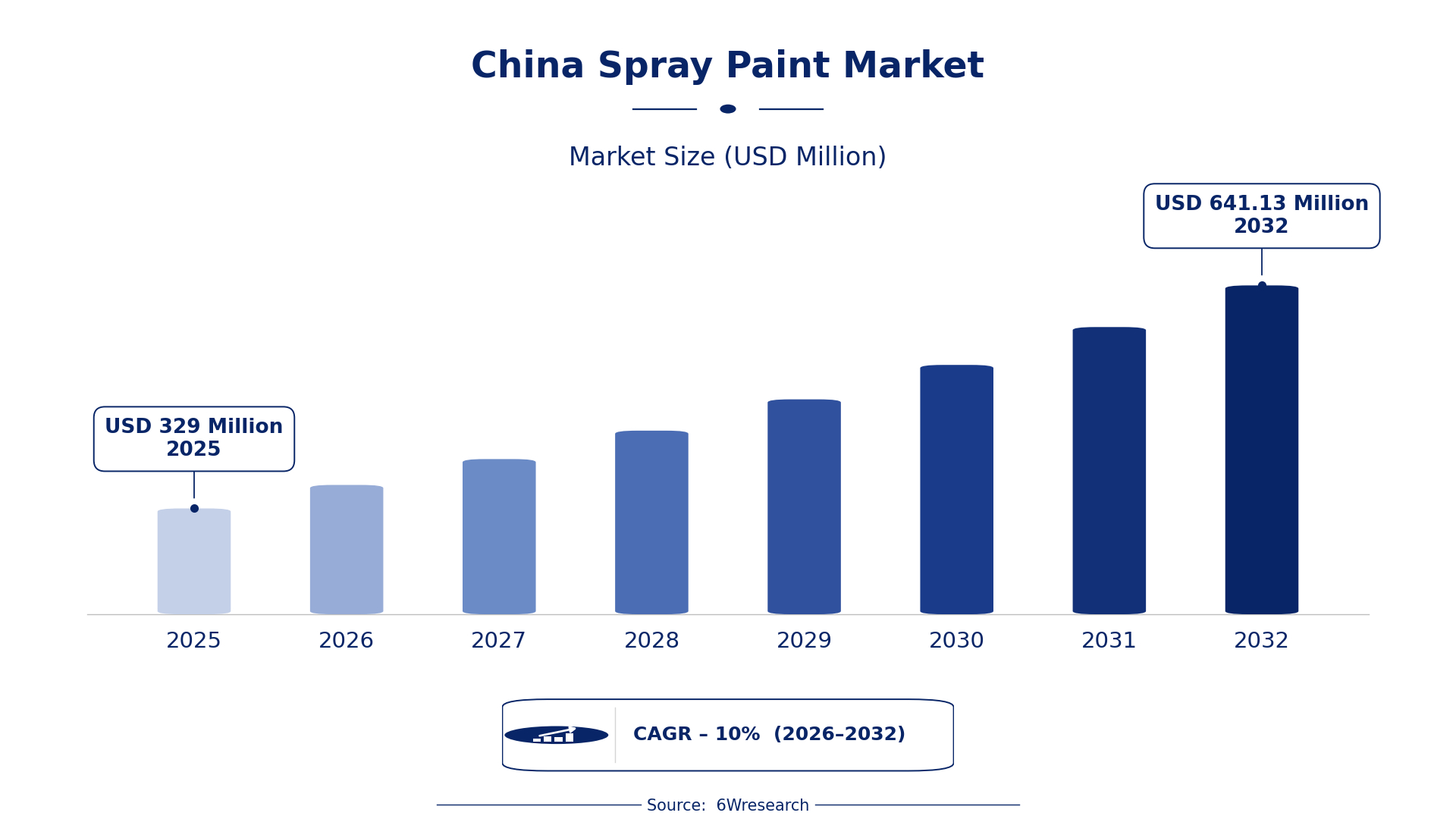
According to 6Wresearch internal database and industry insights, the China Spray Paint Market was valued at USD 329.0 million in 2025 and is projected to reach USD 641.13 million by 2032, growing at a CAGR of approximately 10% during 2026–2032.
China Spray Paint Market Highlights
| Report Metric | Details |
| Report Name | China Spray Paint Market |
| Market Size 2025 | USD 329.0 million |
| Market Size 2032 | USD 641.13 million |
| Absolute Growth 2025–2032 | USD 312.13 million |
| CAGR 2026–2032 | 10% |
| Peak Annual Growth | 11.9% in 2030 |
| Forecast Period | 2026–2032 |
| Historical Data | 2022–2025 |
| Base Year | 2025 |
| Leading Product Type, 2025 | Acrylic Spray Paint (47% share) |
| Leading Application Surface, 2025 | Walls & Ceilings (38% share) |
| Leading Delivery Channel, 2025 | Retail Stores (49% share) |
| Leading End User, 2025 | DIY Consumers (42% share) |
| Fastest-Growing Product Type | Latex Spray Paint (11.3% CAGR) |
| Fastest-Growing Application Surface | Furniture & Wood (12.6% CAGR) |
| Fastest-Growing Delivery Channel | Online Platforms (11.7% CAGR) |
| Growing Sector | DIY Home Improvement |
| Key End Users | DIY Consumers, Construction Firms, Auto Refinishers |
China Spray Paint Market Year-wise Growth Rate and Key Drivers (2022–2032)
This graph illustrates the annual growth rates of the market from 2022 to 2032, highlighting a steady upward trajectory and projected market expansion over the forecast period.
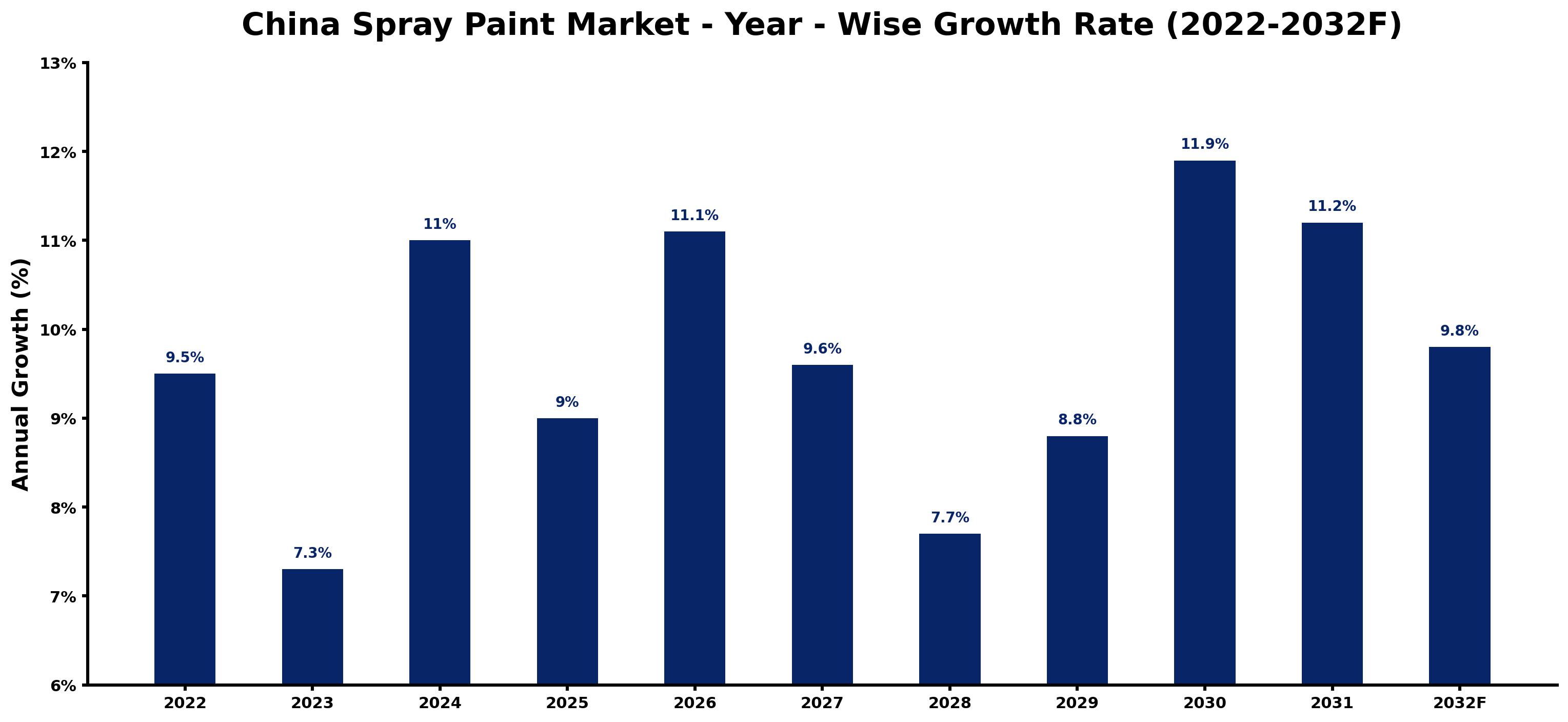
The following table presents the estimated annual growth rate for each year together with the principal factor influencing market performance.
| Year | Estimated Annual Growth (%) | Market Rationale |
| 2022 | 9.5 | The market experienced steady demand from the DIY consumer segment, particularly in urban areas. |
| 2023 | 7.3 | Demand growth slowed as the Ministry of Ecology and Environment's initiatives shifted consumer preferences towards eco-friendly products. |
| 2024 | 11.0 | Demand surged as the construction sector expanded, boosting the need for spray paint in various applications. |
| 2025 | 9.0 | Growth decelerated due to increased competition affecting overall sales potential. |
| 2026 | 11.1 | The automotive refinishing sector is expected to drive renewed growth, particularly in key regions like Guangdong. |
| 2027 | 9.6 | Demand is likely to slow slightly as consumers become more price-sensitive amid economic fluctuations. |
| 2028 | 7.7 | The market is projected to slow further as environmental regulations begin to impact production timelines. |
| 2029 | 8.8 | Growth is anticipated to rebound as new eco-friendly products gain traction among consumers. |
| 2030 | 11.9 | A peak in demand is expected as the market responds to increased construction activities and urbanisation. |
| 2031 | 11.2 | Growth will moderate slightly as the market adjusts to new environmental standards and consumer habits. |
| 2032 | 9.8 | Demand is projected to stabilise as the market matures and adapts to changing consumer preferences. |
Note: Market size estimations and growth projections presented in this report are based on 6Wresearch's proprietary forecasting methodology, utilizing the latest available industry data, government publications, and primary research inputs.
China Spray Paint Market Synopsis
Spray paint in China includes various types such as acrylic, epoxy, enamel, and latex, commonly used in automotive refinishing, home improvement, and industrial applications. The market benefits from a growing DIY consumer segment, especially in urban areas, alongside a thriving construction sector valued at over 4 trillion CNY in 2022. The surge in online sales channels, which have increased by 30% in the past year, further propels market growth. Government initiatives aimed at reducing VOC emissions promote sustainable practices within the industry.
Market Dynamics Impact Analysis (2026–2032)
| Factor | Type | Impact | Primary Segment Affected |
| Growing demand from the DIY consumer segment, particularly in urban areas. | Driver | High | DIY Consumers |
| Expansion of the construction sector, which was valued at over 4 trillion CNY in 2022. | Driver | High | Construction Firms |
| Increasing demand for eco-friendly spray paint alternatives in urban areas. | Opportunity | High | DIY Consumers |
| Rising online sales channels, which have seen a 30% growth in the past year. | Opportunity | High | Retail Stores |
| Stricter quality standards under the updated Product Quality Law of 2022. | Restraint | High | Acrylic Spray Paint |
| Environmental regulations aimed at reducing VOC emissions by 30% by 2025. | Restraint | High | Acrylic Spray Paint |
| The challenge of meeting new environmental standards for producers. | Challenge | High | Acrylic Spray Paint |
| Supply chain disruptions affecting the availability of raw materials. | Challenge | Medium | Acrylic Spray Paint |
Evaluation of Drivers in China Spray Paint Market (2026–2032)
Key forces behind demand, with the segment each one moves most, are listed below.
| Drivers | Primary Segment Affected | Why It Matters (Evidence) |
| Increased DIY home improvement projects driving demand for spray paint. | DIY Consumers | The average urban household spends around 500 CNY annually on DIY supplies, boosting spray paint purchases. |
| Growth in the construction sector requiring spray paint for finishing. | Construction Firms | The construction sector's value exceeding 4 trillion CNY in 2022 has led to higher demand for coatings. |
| Rising interest in eco-friendly spray paint alternatives among consumers. | DIY Consumers | Government initiatives promoting sustainable practices are increasing the demand for low-VOC spray paints. |
| Expansion of online sales channels providing greater access to consumers. | Retail Stores | Online platforms for spray paint have grown by 30% in the past year, improving consumer purchasing options. |
| Automotive refinishing market growth in key regions like Guangdong. | Auto Refinishers | The automotive refinishing sector is a major consumer of spray paint, particularly in high-demand areas. |
Expansion of the Spray Paint market in China is backed by increasing DIY home improvement projects, a booming construction sector, and a rising preference for eco-friendly products. The construction sector, valued at over 4 trillion CNY in 2022, boosts the need for coatings. With online sales channels growing by 30% in the past year, consumer access to spray paint is improving. Urban households are spending significantly on DIY supplies, driving growth in spray paint consumption.
Evaluation of Restraints in China Spray Paint Market
The table below lists the restraints and the evidence behind each.
| Market Restraint | Primary Segment Affected | Why It Matters (Evidence) |
| Stricter quality standards under the updated Product Quality Law of 2022. | Acrylic Spray Paint | Producers must invest in compliance measures, increasing operational costs. |
| Environmental regulations aimed at reducing VOC emissions by 30% by 2025. | Acrylic Spray Paint | Manufacturers face challenges in reformulating products to meet new standards, delaying production. |
| Supply chain disruptions affecting the availability of raw materials. | Acrylic Spray Paint | Increased lead times and costs impact suppliers and manufacturers, limiting market responsiveness. |
| Market saturation affecting growth potential in established segments. | Acrylic Spray Paint | As competition intensifies, price pressures may limit profitability for producers. |
| Consumer shift towards eco-friendly products impacting traditional spray paint sales. | Acrylic Spray Paint | Producers may need to adapt quickly to changing preferences, incurring additional R&D costs. |
China Spray Paint Market Challenges
Buyers in the China spray paint market encounter fierce competition, leading to lower prices and reduced profit margins for producers. A shortage of skilled workers hampers production efficiency, as the rapid industry growth has outstripped the development of training programs, causing delays in product availability. Rising raw material costs, particularly for solvents, have raised production expenses by approximately 15%, compelling manufacturers to pass these costs onto buyers. New regulations aimed at reducing VOC emissions necessitate compliance investments that can exceed 1 million CNY for some producers, straining their financial resources.
Trends in the China Spray Paint Market
Several trends are reshaping the China Spray Paint Market; the most important are set out below.
- Shift towards Eco-Friendly Spray Paints: DIY Consumers are increasingly opting for eco-friendly spray paint alternatives, influenced by government initiatives promoting sustainability. In 2023, the Ministry of Ecology and Environment launched a program to reduce VOC emissions in coatings, impacting consumer choices.
- Growth of Online Sales Channels: Retail Stores are experiencing a shift towards online sales, which grew by 30% last year. This trend reflects changing consumer purchasing behaviours, making spray paint more accessible to a wider audience.
- Increased Demand in Construction Applications: Construction Firms are experiencing heightened demand for spray paint, particularly for finishing applications. The construction sector in China was valued at over 4 trillion CNY in 2022, driving growth in this area.
- Rising Popularity of DIY Projects: DIY Consumers are increasingly engaging in home improvement projects, leading to a surge in spray paint usage. Urban households spend significantly on DIY supplies, further driving this trend.
Investment Opportunities in the China Spray Paint Market
Below are the investment opportunities with the strongest case in the China Spray Paint Market.
- Expansion of Eco-Friendly Product Lines: Manufacturers can invest in developing eco-friendly spray paint alternatives, responding to rising consumer demand. The government's target to reduce solvent-based paint usage by 20% by 2025 creates a favourable environment for innovation.
- Growth in Urban DIY Market: The online sales channel for spray paint has grown by 30% in the past year. Investing in e-commerce strategies can help suppliers reach a broader audience.
- Investment in Sustainable Practices: With the government's push for sustainability, there is an opportunity for manufacturers to invest in low-VOC spray paint production. Collaborating with local distributors can facilitate market entry.
- Targeting Urbanisation Trends: Manufacturers can focus on urban areas where the DIY consumer segment is expanding. China's population of approximately 1.4 billion creates a vast market for spray paint.
Government Initiatives in the China Spray Paint Market
The National VOC Emission Reduction Plan launched by the Ministry of Ecology and Environment in 2021 aims to cut emissions from coatings by 30% by 2025. This measure compels producers to adopt cleaner technologies and reformulate products, ensuring compliance with environmental standards. Additionally, the updated Product Quality Law in 2022 enforces stricter quality standards for spray paints, requiring manufacturers to invest in quality assurance processes to meet regulatory expectations.
The State Administration for Market Regulation oversees the enforcement of the Product Quality Law, ensuring that manufacturers comply with stringent quality standards. The Ministry of Industry and Information Technology initiated the Green Coatings Development Program in 2023, promoting eco-friendly alternatives and funding research into sustainable practices within the spray paint sector. The National Development and Reform Commission also supports innovation through the Coatings Industry Development Strategy, which aims to enhance sustainability and competitiveness.
Future Insight of the China Spray Paint Market
By 2032, buyers and suppliers in the China spray paint market can expect a shift towards eco-friendly products, driven by the government's target to reduce solvent-based paint usage by 20%. The expansion of online sales channels, which have grown by 30% in the past year, will improve accessibility for consumers. Enhanced training initiatives will address workforce skill gaps, leading to increased production capabilities. The automotive refinishing market will continue to be a key demand driver, particularly in regions prioritising sustainable practices.
Market Segmentation Analysis
The report offers a comprehensive study of the following market segments and their leading categories in the market.
By Product Type – Acrylic Spray Paint Dominated, Latex Spray Paint Expected to Grow Fastest
According to Summon Dutta, Assistant Manager at 6Wresearch, in 2025, Acrylic Spray Paint led the product type split with a 47% share. Acrylic spray paint holds the largest share in China due to its quick-drying properties and versatility across various applications. This type is especially popular among DIY consumers for home improvement projects, making it a go-to choice for many households. The quickest growth will come from Latex Spray Paint, forecast to expand at a CAGR of 11.3% between 2026 and 2032. Latex spray paint is experiencing rapid growth as consumers increasingly seek low VOC options for indoor applications, particularly for painting walls. The rising awareness of environmental concerns is driving demand for these eco-friendly alternatives, ensuring a robust market trajectory. Suppliers should focus on developing acrylic and latex spray paint products to meet the growing consumer demand for versatile and environmentally friendly options.
By Application Surface – Walls & Ceilings Dominated, Furniture & Wood Expected to Grow Fastest
Walls & Ceilings took a 38% share of application surface in 2025, more than any other category. Walls and ceilings represent the largest share of the spray paint market in China, primarily due to their frequent use in both residential and commercial settings. Ongoing construction and renovation activities in urban areas further fuel this demand, solidifying its market position. Over 2026–2032, Furniture & Wood is expected to post the fastest growth, at a CAGR of 12.6%. Furniture and wood applications are witnessing significant growth as consumers increasingly engage in home decor and restoration projects, reflecting a shift towards personalised living spaces. The rise of DIY culture is enhancing the appeal of this segment, driving its rapid expansion. Manufacturers should direct marketing efforts towards furniture and wood applications to capitalise on the growing DIY trend among consumers.
By Delivery Channel – Retail Stores Dominated, Online Platforms Expected to Grow Fastest
With a 49% revenue share in 2025, Retail Stores was the largest delivery channel category. Retail stores dominate the spray paint purchasing landscape, offering consumers immediate access to a wide range of products. Their extensive presence in urban areas caters to the convenience needs of DIY enthusiasts, making them the preferred shopping channel. Online Platforms are projected to grow fastest, at a CAGR of 11.7% during 2026–2032. Online platforms are rapidly gaining traction, with a remarkable 30% growth in sales over the past year, as consumers appreciate the convenience of shopping from home. This trend is expected to continue, as e-commerce becomes increasingly integrated into consumer purchasing habits. Suppliers must enhance their online presence and adapt distribution strategies to capture the growing segment of consumers who prefer online shopping.
By End User – DIY Consumers Dominated and Is Expected to Record the Fastest Growth
DIY Consumers accounted for a 42% market share by end user in 2025. DIY consumers dominate the market as they actively engage in home improvement projects, driving a steady demand for spray paint. This segment's substantial share reflects a cultural shift towards self-sufficiency in home decor and maintenance. The same category are also set to grow fastest, at a CAGR of 11.9% during 2026–2032. The DIY consumer segment is both the largest and the fastest-growing, with more individuals undertaking home projects, particularly in urban environments. This trend is expected to persist, further emphasising the significance of this user group. Suppliers should customise their products and marketing strategies to meet the specific needs and preferences of DIY consumers.
Key Attractiveness of the Report
- 10 Years of Market Numbers
- Historical Data Starting from 2022 to 2025
- Base Year 2025
- Forecast Data until 2032
- Key Performance Indicators Impacting the Market
- Major Upcoming Developments and Projects
Key Highlights of the Report:
- China Spray Paint Market Outlook
- Market Size of China Spray Paint Market, 2025
- Forecast of China Spray Paint Market, 2032
- Historical Data and Forecast of China Spray Paint Revenues & Volume for the Period 2022 - 2032F
- China Spray Paint Market Trend Evolution
- China Spray Paint Market Drivers and Challenges
- China Spray Paint Price Trends
- China Spray Paint Porter's Five Forces
- China Spray Paint Industry Life Cycle
- Historical Data and Forecast of China Spray Paint Market Revenues & Volume By Product Type for the Period 2022 - 2032F
- Historical Data and Forecast of China Spray Paint Market Revenues & Volume By Acrylic Spray Paint for the Period 2022 - 2032F
- Historical Data and Forecast of China Spray Paint Market Revenues & Volume By Epoxy Spray Paint for the Period 2022 - 2032F
- Historical Data and Forecast of China Spray Paint Market Revenues & Volume By Enamel Spray Paint for the Period 2022 - 2032F
- Historical Data and Forecast of China Spray Paint Market Revenues & Volume By Latex Spray Paint for the Period 2022 - 2032F
- Historical Data and Forecast of China Spray Paint Market Revenues & Volume By Application Surface for the Period 2022 - 2032F
- Historical Data and Forecast of China Spray Paint Market Revenues & Volume By Metal & Plastic for the Period 2022 - 2032F
- Historical Data and Forecast of China Spray Paint Market Revenues & Volume By Industrial Equipment for the Period 2022 - 2032F
- Historical Data and Forecast of China Spray Paint Market Revenues & Volume By Furniture & Wood for the Period 2022 - 2032F
- Historical Data and Forecast of China Spray Paint Market Revenues & Volume By Walls & Ceilings for the Period 2022 - 2032F
- Historical Data and Forecast of China Spray Paint Market Revenues & Volume By Delivery Channel for the Period 2022 - 2032F
- Historical Data and Forecast of China Spray Paint Market Revenues & Volume By Retail Stores for the Period 2022 - 2032F
- Historical Data and Forecast of China Spray Paint Market Revenues & Volume By Industrial Distributors for the Period 2022 - 2032F
- Historical Data and Forecast of China Spray Paint Market Revenues & Volume By Online Platforms for the Period 2022 - 2032F
- Historical Data and Forecast of China Spray Paint Market Revenues & Volume By Wholesale for the Period 2022 - 2032F
- Historical Data and Forecast of China Spray Paint Market Revenues & Volume By End User for the Period 2022 - 2032F
- Historical Data and Forecast of China Spray Paint Market Revenues & Volume By DIY Consumers for the Period 2022 - 2032F
- Historical Data and Forecast of China Spray Paint Market Revenues & Volume By Auto Refinishers for the Period 2022 - 2032F
- Historical Data and Forecast of China Spray Paint Market Revenues & Volume By Interior Designers for the Period 2022 - 2032F
- Historical Data and Forecast of China Spray Paint Market Revenues & Volume By Construction Firms for the Period 2022 - 2032F
- China Spray Paint Import Export Trade Statistics
- Market Opportunity Assessment By Product Type
- Market Opportunity Assessment By Application Surface
- Market Opportunity Assessment By Delivery Channel
- Market Opportunity Assessment By End User
- China Spray Paint Top Companies Market Share
- China Spray Paint Competitive Benchmarking By Technical and Operational Parameters
- China Spray Paint Company Profiles
- China Spray Paint Key Strategic Recommendations
Market Covered
This report examines the market across the segments below.
By Product Type
- Acrylic Spray Paint
- Epoxy Spray Paint
- Enamel Spray Paint
- Latex Spray Paint
By Application Surface
- Metal & Plastic
- Industrial Equipment
- Furniture & Wood
- Walls & Ceilings
By Delivery Channel
- Retail Stores
- Industrial Distributors
- Online Platforms
- Wholesale
By End User
- DIY Consumers
- Auto Refinishers
- Interior Designers
- Construction Firms































