China Stress Detection AI Market Size & Growth Rate
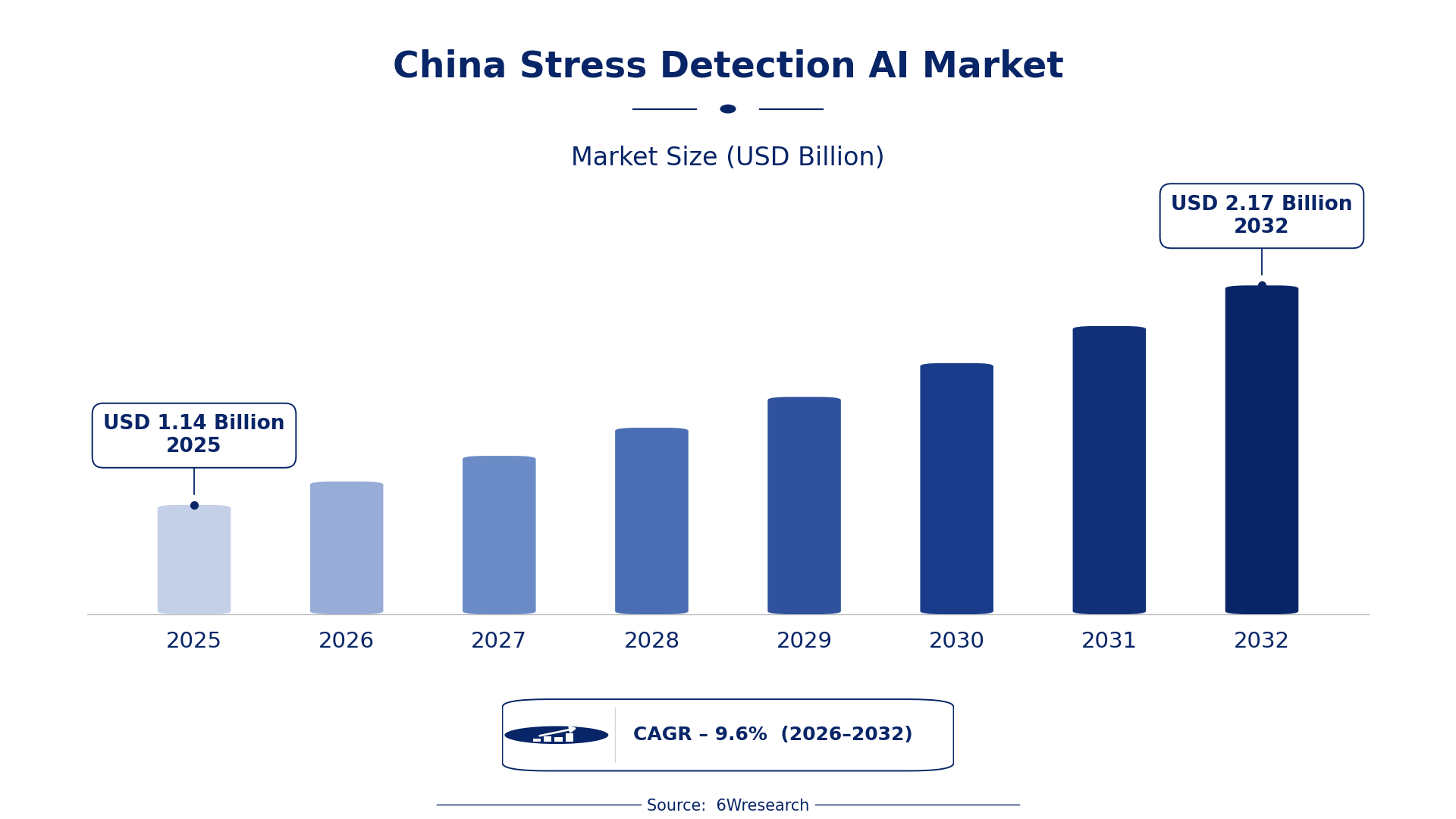
According to 6Wresearch internal database and industry insights, the China Stress Detection AI Market was valued at USD 1.14 billion in 2025 and is projected to reach USD 2.17 billion by 2032, growing at a CAGR of approximately 9.6% during 2026–2032.
China Stress Detection AI Market Highlights
| Report Metric | Details |
| Report Name | China Stress Detection AI Market |
| Market Size 2025 | USD 1.14 billion |
| Market Size 2032 | USD 2.17 billion |
| Absolute Growth 2025–2032 | USD 1.03 billion |
| CAGR 2026–2032 | 9.6% |
| Peak Annual Growth | 12.1% in 2032 |
| Forecast Period | 2026–2032 |
| Historical Data | 2022–2025 |
| Base Year | 2025 |
| Leading Technology Type, 2025 | Wearable Stress AI (42% share) |
| Leading Sensing Method, 2025 | Heart Rate/EDA (42% share) |
| Leading Application Area, 2025 | Personal Wellness (40% share) |
| Leading End User, 2025 | Health Tech Startups (56% share) |
| Fastest-Growing Technology Type | Emotion Recognition AI (12.3% CAGR) |
| Fastest-Growing Sensing Method | Facial Analysis (10.8% CAGR) |
| Fastest-Growing Application Area | Education/Training (11.7% CAGR) |
| Growing Sector | Health Tech |
| Key End Users | Health Tech Startups, HR Departments, Educational Institutions, Corporate Wellness Programs |
China Stress Detection AI Market Year-wise Growth Rate and Key Drivers (2022–2032)
This graph illustrates the annual growth rates of the market from 2022 to 2032, highlighting a steady upward trajectory and projected market expansion over the forecast period.
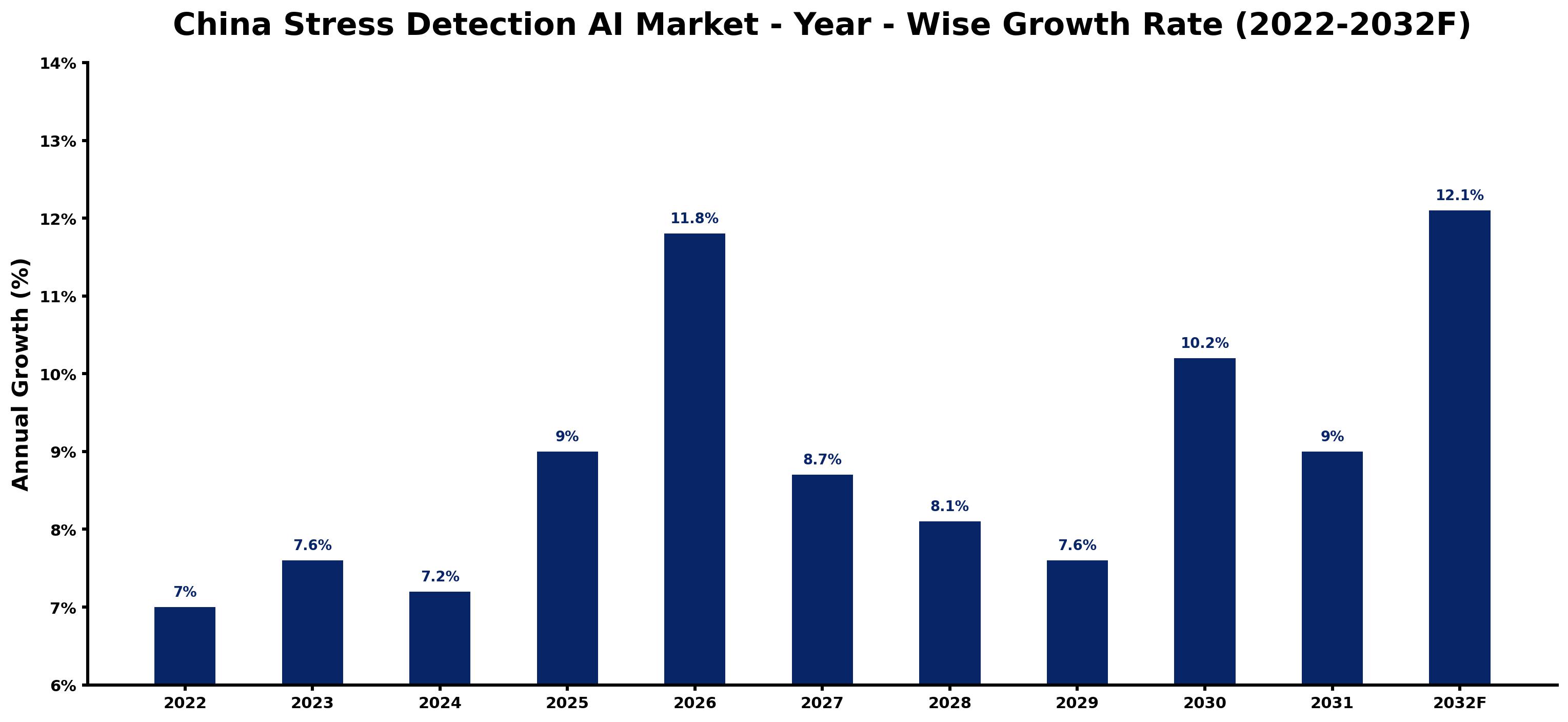
Below, each year's estimated growth is shown next to the factor that most influenced it.
| Year | Estimated Annual Growth (%) | Market Rationale |
| 2022 | 7.0 | The market experienced initial growth due to rising awareness of mental health issues and stress management. |
| 2023 | 7.6 | Adoption of employee wellness programs by over 60% of companies accelerated market expansion and demand. |
| 2024 | 7.2 | Growth slowed slightly as companies adjusted their wellness strategies and budgets in response to market dynamics. |
| 2025 | 9.0 | A surge in demand for personal wellness applications drove faster growth in the market. |
| 2026 | 11.8 | The introduction of AI-driven stress management in schools is expected to boost market momentum and adoption. |
| 2027 | 8.7 | Growth is projected to slow as market participants focus on refining existing technologies and solutions. |
| 2028 | 8.1 | Continued emphasis on workplace wellness programs is expected to contribute to a slowdown in growth rates. |
| 2029 | 7.6 | Market growth is anticipated to decelerate as competition intensifies among health tech startups and offerings. |
| 2030 | 10.2 | New initiatives targeting mental health services accessibility will spur demand for stress detection technologies. |
| 2031 | 9.0 | The market is projected to see a slowdown as companies reassess their AI investments and strategies. |
| 2032 | 12.1 | A peak in growth is expected as the 'Healthy China 2030' initiative drives demand for stress detection solutions. |
Note: Market size estimations and growth projections presented in this report are based on 6Wresearch's proprietary forecasting methodology, utilizing the latest available industry data, government publications, and primary research inputs.
China Stress Detection AI Market Synopsis
The China Stress Detection AI Market includes technologies that evaluate and track stress levels through algorithms and data analytics. Applications span personal wellness, workplace monitoring, and educational settings. The market is growing as mental health gains prominence, with over 60% of companies implementing employee wellness programmes. Initiatives such as the 'Mental Health Work Plan (2021-2025)' are driving demand for these technologies. Health tech startups are also pushing advancements in this area, shaping the market's evolution.
Market Dynamics Impact Analysis (2026–2032)
| Factor | Type | Impact | Primary Segment Affected |
| Growing focus on mental health initiatives | Driver | High | Personal Wellness |
| Increased adoption of AI technologies in workplaces | Driver | High | Corporate Monitoring |
| Expansion of mental health services accessibility | Opportunity | High | Education/Training |
| Rising demand for AI-driven stress management solutions | Opportunity | High | Health Tech Startups |
| Limited public awareness of stress management solutions | Restraint | Medium | Emotion Recognition AI |
| Competition among health tech startups | Restraint | Medium | Wearable Stress AI |
| The Stress Detection AI market in China faces regulatory hurdles | Challenge | High | Voice Stress Analytics |
| Market participants struggle with technology integration | Challenge | Medium | Cognitive Load Tracking |
Evaluation of Drivers in China Stress Detection AI Market (2026–2032)
Key forces behind demand, with the segment each one moves most, are listed below.
| Drivers | Primary Segment Affected | Why It Matters (Evidence) |
| Increased mental health awareness | Personal Wellness | Over 60% of companies have adopted employee wellness programs, driving demand for stress detection solutions. |
| Integration of AI in workplace wellness | Corporate Monitoring | The National Health Commission's 'Mental Health Work Plan (2021-2025)' encourages companies to implement AI for employee stress management. |
| Growing educational programs on stress management | Education/Training | The Ministry of Education's program promotes stress management training in schools, boosting demand for related technologies. |
| Rise of health tech startups focusing on mental health | Health Tech Startups | The Beijing region is a hub for startups developing AI-driven mental health solutions, fostering innovation. |
| Adoption of ISO 9001 standards | Wearable Stress AI | Health tech firms are implementing quality management systems to ensure product reliability and consumer trust. |
The National Health Commission's 'Mental Health Work Plan (2021-2025)' promotes AI integration in workplace wellness, further stimulating market expansion. The Beijing region has emerged as a centre for startups developing AI-driven mental health solutions, encouraging innovation in this field. These elements are propelling the demand for stress detection technologies across various applications.
Evaluation of Restraints in China Stress Detection AI Market
The following restraints limit how fast demand can grow.
| Market Restraint | Primary Segment Affected | Why It Matters (Evidence) |
| Limited public awareness of stress management solutions | Emotion Recognition AI | Despite growing interest, many consumers remain unaware of available stress detection technologies, hindering adoption. |
| Intense competition among health tech startups | Wearable Stress AI | Numerous startups in the Beijing region create a crowded market, making it challenging for new entrants to gain traction. |
| Regulatory hurdles in technology integration | Voice Stress Analytics | Compliance with evolving regulations can delay product development and market entry for new technologies. |
| Challenges in securing funding for AI projects | Cognitive Load Tracking | Startups often struggle to secure investment for developing AI-driven stress detection solutions, impacting growth. |
| Market fragmentation due to diverse applications | Corporate Monitoring | The variety of applications leads to a complex market, complicating product positioning for suppliers. |
China Stress Detection AI Market Challenges
The China Stress Detection AI market encounters regulatory challenges that complicate compliance for developers, leading to higher costs and delays in product launches for startups. Fierce competition among health tech firms results in price wars, which can squeeze profit margins for suppliers and limit their capacity to invest in new developments. Buyers face obstacles due to a lack of standardisation in stress detection technologies, complicating the assessment of product quality and effectiveness, which may lead to poor purchasing decisions. Supply chain issues arise from dependence on imported components for AI systems, causing production delays and restricting the availability of stress detection solutions for end users.
Trends in the China Stress Detection AI Market
Several trends are reshaping the China Stress Detection AI Market; the most important are set out below.
- Shift towards AI-driven Stress Management in Education: In 2023, the Ministry of Education launched a programme to integrate stress management training in schools, promoting AI-driven solutions. This shift aims to enhance student well-being and learning outcomes, reflecting an increasing emphasis on mental health in education.
- Rise of Health Tech Startups in Beijing: The Beijing region has experienced a rise in health tech startups concentrating on AI-driven mental health solutions, with substantial funding allocated for mental health services expansion in 2023. This trend is transforming market conditions and spurring innovation.
- Growing Adoption of ISO 9001 in Health Tech: Health tech companies are increasingly embracing ISO 9001 standards to ensure quality management in stress detection technologies. This trend is likely to enhance product reliability and consumer trust, benefiting both producers and buyers.
- Increased Corporate Wellness Programs: As of 2023, over 60% of Chinese companies have established employee wellness programmes, driving demand for stress detection AI solutions. This trend reflects a broader commitment to mental health in the workplace, creating opportunities for suppliers.
Investment Opportunities in the China Stress Detection AI Market
Investors looking at the China Stress Detection AI Market should consider the following areas.
- Beijing as a Hub for Health Tech Innovation: With substantial funding directed towards mental health services expansion, Beijing offers an opportunity for investment in AI-driven stress detection solutions. Collaborating with local startups can facilitate market entry and growth.
- Supply of AI Technologies for Education: The Ministry of Education's initiative to incorporate stress management training in schools generates a demand for AI technologies. Suppliers can engage with educational institutions to deliver tailored solutions that address specific needs.
- Growing Demand for Corporate Wellness Solutions: The market for corporate wellness programmes is on the rise, with over 60% of companies adopting such initiatives. Suppliers can target HR departments to provide stress detection technologies that promote employee well-being.
- Investment in Mental Health Services Expansion: The Chinese government's goal to increase mental health service accessibility by 30% by 2025 presents an investment opportunity for technology providers. Partnering with health tech startups can enhance service delivery and market reach.
Government Initiatives in the China Stress Detection AI Market
In 2023, the National Development and Reform Commission introduced a funding scheme for AI applications in mental health, with a budget of $500 million. This initiative complements the 'Mental Health Work Plan (2021-2025)', which aims to improve mental health services nationwide. Together, these efforts are expected to increase the availability and quality of stress detection technologies in the market, benefiting producers and buyers alike.
The Ministry of Education's 'Guidelines for Mental Health Education in Schools' advocate for the integration of AI-driven stress management techniques in educational settings. Schools are encouraged to adopt these guidelines, which aim to enhance student well-being and learning efficiency. This initiative supports the broader aim of improving mental health services and accessibility across China, allowing schools to implement effective stress management solutions.
Future Insight of the China Stress Detection AI Market
The China Stress Detection AI market is set to undergo substantial changes by 2032, as the government aims for a 30% increase in mental health service accessibility by 2025. Funding initiatives from the National Development and Reform Commission will accelerate AI integration in healthcare, driving advancements in stress detection technologies. Education systems will adapt as stress management training becomes standard practice in schools, promoting mental wellness from an early age. New mental health initiatives will increase public awareness and adoption of stress detection solutions, creating opportunities for both buyers and suppliers.
Market Segmentation Analysis
Each segment group is reviewed below, with the leader by share and the fastest grower by CAGR.
By Technology Type – Wearable Stress AI Dominated, Emotion Recognition AI Expected to Grow Fastest
According to Summon Dutta, Assistant Manager at 6Wresearch, Wearable Stress AI accounted for a 42% market share by technology type in 2025. Wearable Stress AI holds the largest market share due to its widespread use for real-time stress monitoring among health-conscious consumers. This technology is prevalent in devices like fitness trackers, appealing to individuals focused on personal wellness and proactive health management. Emotion Recognition AI is set to record the highest CAGR in this split, 12.3% over 2026–2032. Emotion Recognition AI is experiencing rapid growth because it effectively assesses stress by analysing facial expressions, which is increasingly recognised in workplace settings. The rising emphasis on mental health awareness is propelling demand for this technology, ensuring its swift adoption. Suppliers should focus on enhancing Emotion Recognition AI capabilities to meet the increasing demand across various sectors.
By Sensing Method – Heart Rate/EDA Dominated, Facial Analysis Expected to Grow Fastest
The largest sensing method category in 2025 was Heart Rate/EDA, with a 42% share of total revenue. Heart Rate/EDA dominates the market as it provides crucial physiological indicators necessary for accurate stress detection. This method is widely used in wearable devices, making it a preferred option for consumers seeking effective monitoring solutions. The quickest growth will come from Facial Analysis, forecast to expand at a CAGR of 10.8% between 2026 and 2032. Facial Analysis is the fastest-growing method, driven by its ability to capture real-time emotional responses through visual cues. The growing emphasis on mental health awareness and stress management in educational environments is significantly boosting its adoption. Buyers should consider integrating Facial Analysis into their stress detection strategies to stay competitive and responsive to market trends.
By Application Area – Personal Wellness Dominated, Education/Training Expected to Grow Fastest
With a 40% revenue share in 2025, Personal Wellness was the largest application area category. Personal Wellness dominates the market due to its direct impact on individual health and well-being, with a substantial portion of the population seeking tools to manage stress. The increasing emphasis on mental health initiatives further solidifies its leading position. Over 2026–2032, Education/Training is expected to post the fastest growth, at a CAGR of 11.7%. Education/Training is the fastest-growing application area, driven by initiatives aimed at incorporating stress management training in schools. This focus on student well-being and learning efficiency is creating new opportunities for stress detection technologies. Suppliers should target the education sector to broaden their reach and develop tailored solutions for stress management in learning environments.
By End User – Health Tech Startups Dominated and Is Expected to Record the Fastest Growth
In 2025, Health Tech Startups led the end user split with a 56% share. Health Tech Startups lead the market as they are the primary innovators developing tailored stress management solutions. Their focus on mental health and agility in adapting to consumer needs positions them as key players in the Stress Detection AI market. Its lead should widen, with a projected CAGR of 11.1% during 2026–2032, the highest in this split. Health Tech Startups are also the fastest-growing end user group, benefiting from increased funding and support for mental health initiatives. Their continuous innovation in stress detection applications ensures they maintain a competitive edge in the market. Suppliers should engage with Health Tech Startups to foster partnerships that drive innovation and address emerging market demands.
Key Attractiveness of the Report
- 10 Years of Market Numbers
- Historical Data Starting from 2022 to 2025
- Base Year 2025
- Forecast Data until 2032
- Key Performance Indicators Impacting the Market
- Major Upcoming Developments and Projects
Key Highlights of the Report:
- China Stress Detection AI Market Outlook
- Market Size of China Stress Detection AI Market, 2025
- Forecast of China Stress Detection AI Market, 2032
- Historical Data and Forecast of China Stress Detection AI Revenues & Volume for the Period 2022 - 2032F
- China Stress Detection AI Market Trend Evolution
- China Stress Detection AI Market Drivers and Challenges
- China Stress Detection AI Price Trends
- China Stress Detection AI Porter's Five Forces
- China Stress Detection AI Industry Life Cycle
- Historical Data and Forecast of China Stress Detection AI Market Revenues & Volume By Technology Type for the Period 2022 - 2032F
- Historical Data and Forecast of China Stress Detection AI Market Revenues & Volume By Wearable Stress AI for the Period 2022 - 2032F
- Historical Data and Forecast of China Stress Detection AI Market Revenues & Volume By Emotion Recognition AI for the Period 2022 - 2032F
- Historical Data and Forecast of China Stress Detection AI Market Revenues & Volume By Voice Stress Analytics for the Period 2022 - 2032F
- Historical Data and Forecast of China Stress Detection AI Market Revenues & Volume By Cognitive Load Tracking for the Period 2022 - 2032F
- Historical Data and Forecast of China Stress Detection AI Market Revenues & Volume By Sensing Method for the Period 2022 - 2032F
- Historical Data and Forecast of China Stress Detection AI Market Revenues & Volume By Heart Rate/EDA for the Period 2022 - 2032F
- Historical Data and Forecast of China Stress Detection AI Market Revenues & Volume By Facial Analysis for the Period 2022 - 2032F
- Historical Data and Forecast of China Stress Detection AI Market Revenues & Volume By Voice Modulation for the Period 2022 - 2032F
- Historical Data and Forecast of China Stress Detection AI Market Revenues & Volume By EEG-Based for the Period 2022 - 2032F
- Historical Data and Forecast of China Stress Detection AI Market Revenues & Volume By Application Area for the Period 2022 - 2032F
- Historical Data and Forecast of China Stress Detection AI Market Revenues & Volume By Personal Wellness for the Period 2022 - 2032F
- Historical Data and Forecast of China Stress Detection AI Market Revenues & Volume By Corporate Monitoring for the Period 2022 - 2032F
- Historical Data and Forecast of China Stress Detection AI Market Revenues & Volume By Call Centers for the Period 2022 - 2032F
- Historical Data and Forecast of China Stress Detection AI Market Revenues & Volume By Education/Training for the Period 2022 - 2032F
- Historical Data and Forecast of China Stress Detection AI Market Revenues & Volume By End User for the Period 2022 - 2032F
- Historical Data and Forecast of China Stress Detection AI Market Revenues & Volume By Health Tech Startups for the Period 2022 - 2032F
- Historical Data and Forecast of China Stress Detection AI Market Revenues & Volume By HR Departments for the Period 2022 - 2032F
- Historical Data and Forecast of China Stress Detection AI Market Revenues & Volume By Customer Service Firms for the Period 2022 - 2032F
- Historical Data and Forecast of China Stress Detection AI Market Revenues & Volume By EdTech Providers for the Period 2022 - 2032F
- China Stress Detection AI Import Export Trade Statistics
- Market Opportunity Assessment By Technology Type
- Market Opportunity Assessment By Sensing Method
- Market Opportunity Assessment By Application Area
- Market Opportunity Assessment By End User
- China Stress Detection AI Top Companies Market Share
- China Stress Detection AI Competitive Benchmarking By Technical and Operational Parameters
- China Stress Detection AI Company Profiles
- China Stress Detection AI Key Strategic Recommendations
Market Covered
Segments analysed in this report are listed below.
By Technology Type
- Wearable Stress AI
- Emotion Recognition AI
- Voice Stress Analytics
- Cognitive Load Tracking
By Sensing Method
- Heart Rate/EDA
- Facial Analysis
- Voice Modulation
- EEG-Based
By Application Area
- Personal Wellness
- Corporate Monitoring
- Call Centers
- Education/Training
By End User
- Health Tech Startups
- HR Departments
- Customer Service Firms
- EdTech Providers































