China Structural Reinforcement Market Size & Growth Rate
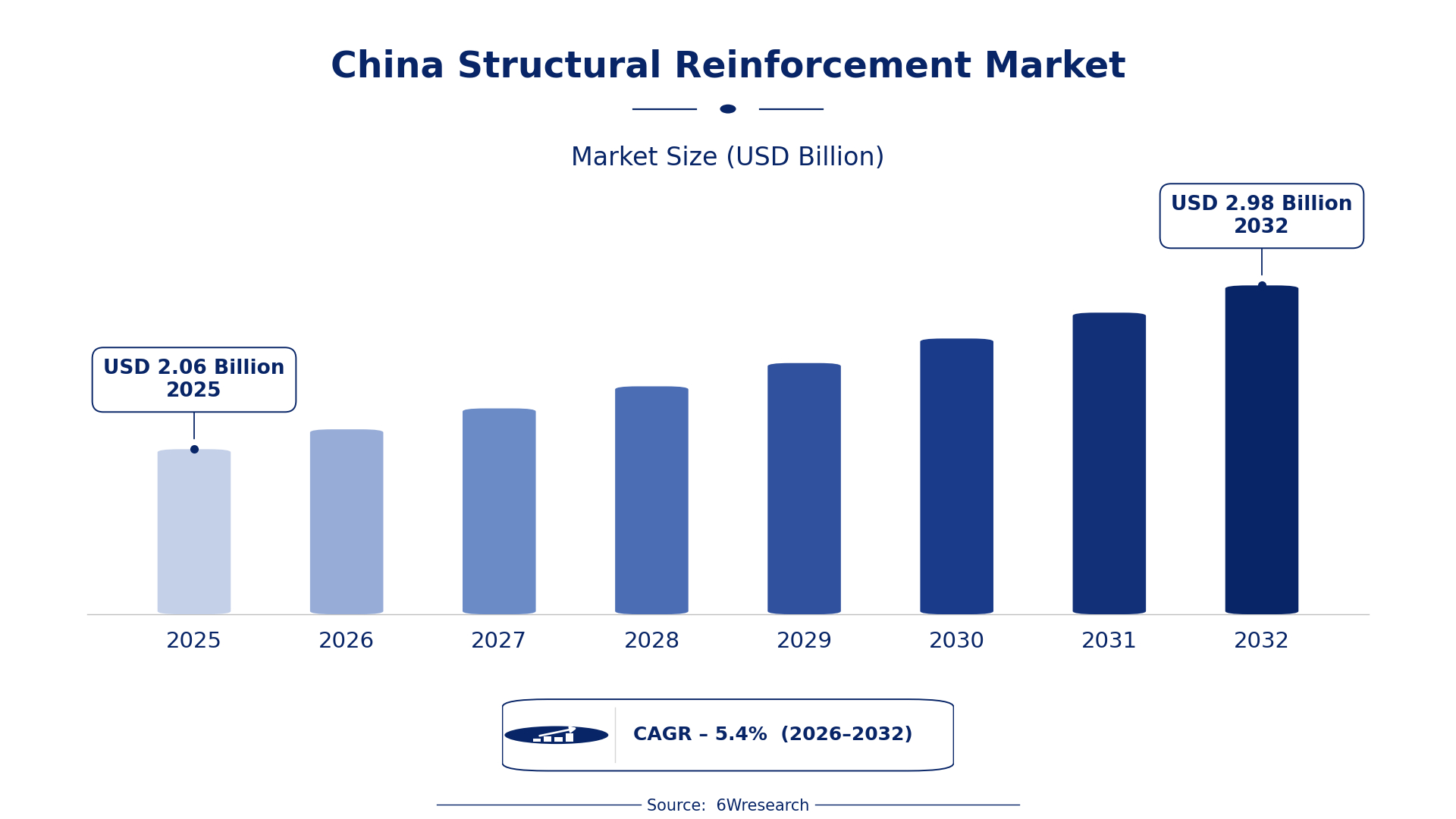
According to 6Wresearch internal database and industry insights, the China Structural Reinforcement Market was valued at USD 2.06 billion in 2025 and is projected to reach USD 2.98 billion by 2032, growing at a CAGR of approximately 5.4% during 2026–2032.
China Structural Reinforcement Market Highlights
| Report Metric | Details |
| Report Name | China Structural Reinforcement Market |
| Market Size 2025 | USD 2.06 billion |
| Market Size 2032 | USD 2.98 billion |
| Absolute Growth 2025–2032 | USD 0.92 billion |
| CAGR 2026–2032 | 5.4% |
| Peak Annual Growth | 8.5% in 2032 |
| Forecast Period | 2026–2032 |
| Historical Data | 2022–2025 |
| Base Year | 2025 |
| Leading Reinforcement Type, 2025 | Rebar Mesh (45% share) |
| Leading Material Used, 2025 | Steel (44% share) |
| Leading Application Structure, 2025 | Slabs & Foundations (40% share) |
| Leading End User, 2025 | Concrete Contractors (40% share) |
| Fastest-Growing Reinforcement Type | Fiber Reinforcement (7.8% CAGR) |
| Fastest-Growing Material Used | Glass/Carbon Fiber (6.9% CAGR) |
| Fastest-Growing Application Structure | Seismic Retrofit (7.5% CAGR) |
| Fastest-Growing End User | Infrastructure Firms (7.6% CAGR) |
| Growing Sector | Construction and Infrastructure |
| Key End Users | Concrete Contractors, Infrastructure Firms, Civil Engineers, Structural Consultants |
China Structural Reinforcement Market Year-wise Growth Rate and Key Drivers (2022–2032)
This graph illustrates the annual growth rates of the market from 2022 to 2032, highlighting a steady upward trajectory and projected market expansion over the forecast period.
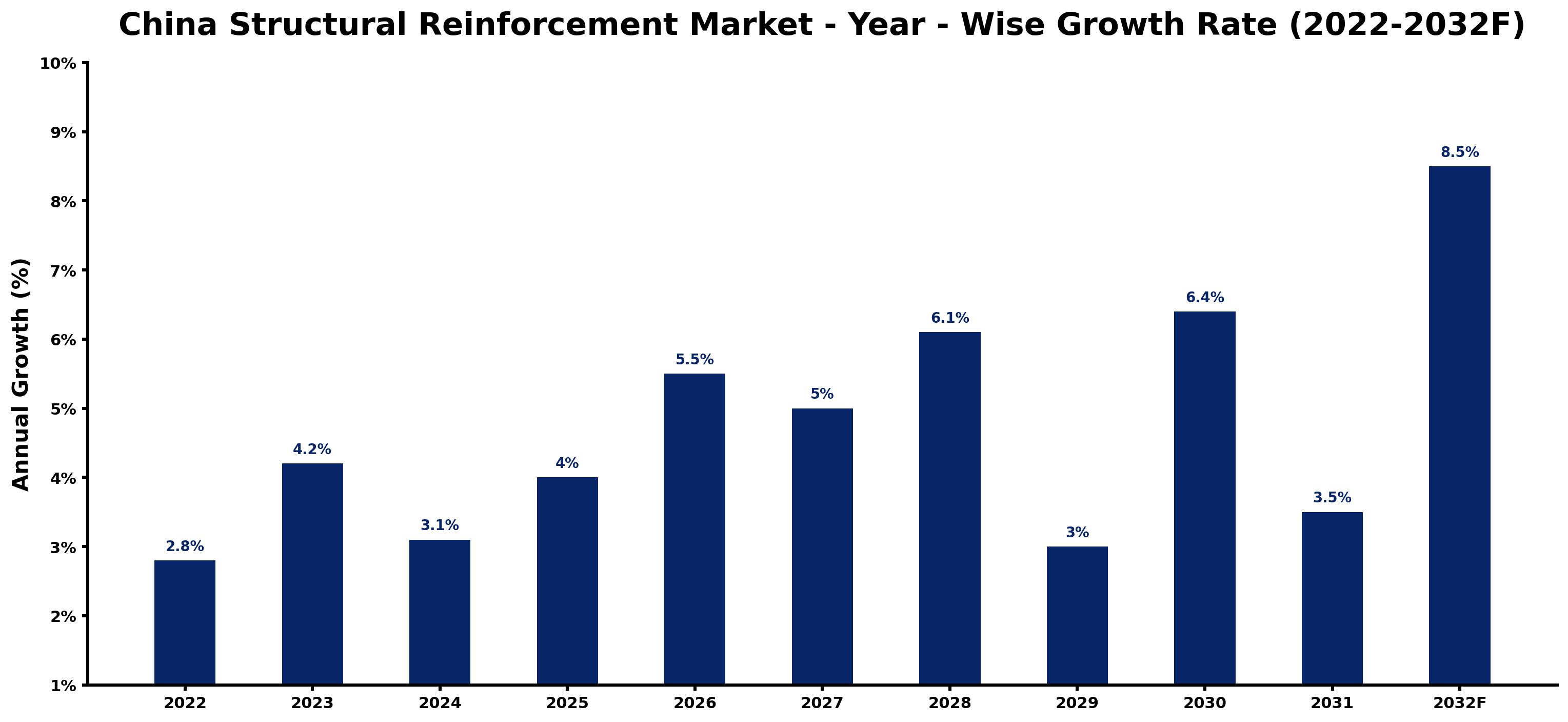
Annual growth estimates for each year appear below with the principal reason behind them, explaining the shifts that set the pace of the market.
| Year | Estimated Annual Growth (%) | Market Rationale |
| 2022 | 2.8 | The market experienced steady growth due to ongoing construction projects across urban areas. |
| 2023 | 4.2 | Demand surged as the construction sector reached a market size of 20 trillion yuan. |
| 2024 | 3.1 | Growth slowed slightly as projects faced delays in material supply chains. |
| 2025 | 4.0 | Increased investments in infrastructure drove a faster growth rate this year. |
| 2026 | 5.5 | The implementation of new seismic retrofitting standards is expected to boost market demand. |
| 2027 | 5.0 | Growth is expected to moderate as some projects are postponed due to regulatory changes. |
| 2028 | 6.1 | Rising urbanisation and infrastructure development will lead to a resurgence in demand. |
| 2029 | 3.0 | A slowdown is expected as market adjustments take place amid changing regulations. |
| 2030 | 6.4 | Demand will accelerate again as new technologies in reinforcement gain traction. |
| 2031 | 3.5 | Growth will slow due to a temporary reduction in large-scale construction projects. |
| 2032 | 8.5 | The market is projected to peak as urban infrastructure resilience initiatives expand. |
Note: Market size estimations and growth projections presented in this report are based on 6Wresearch's proprietary forecasting methodology, utilizing the latest available industry data, government publications, and primary research inputs.
China Structural Reinforcement Market Synopsis
Structural Reinforcement in China includes materials and systems that improve the load-bearing capacity of structures. Primarily composed of steel and fibre composites, it is crucial for strengthening concrete structures and retrofitting buildings for seismic resistance. The China Structural Reinforcement Market is expanding due to strong demand from the construction sector and urbanisation efforts. In 2022, China produced over 1 billion tons of steel, a key material in this market. Government initiatives, such as the National Seismic Safety Plan, are further driving demand.
Market Dynamics Impact Analysis (2026–2032)
| Factor | Type | Impact | Primary Segment Affected |
| Increased investments in infrastructure projects drive demand for structural reinforcement materials. | Driver | High | Rebar Mesh |
| The growing adoption of fiber-reinforced concrete enhances the performance of high-rise buildings. | Driver | High | Fiber Reinforcement |
| The Yangtze River Delta is experiencing rapid infrastructure development, creating opportunities for suppliers. | Opportunity | High | Tunnels & Bridges |
| The demand for lightweight and corrosion-resistant materials is rising in bridge construction. | Opportunity | Medium | FRP Rods |
| Regulatory changes may delay project approvals, affecting market growth. | Restraint | High | Steel Plates |
| Supply chain disruptions can hinder the availability of essential materials for construction. | Restraint | Medium | Rebar Mesh |
| This market still has to solve a few problems, including supply chain issues affecting availability. | Challenge | High | Fiber Reinforcement |
| Skilled labour shortages in construction impact project timelines and costs. | Challenge | Medium | Concrete Contractors |
Evaluation of Drivers in China Structural Reinforcement Market (2026–2032)
Key forces behind demand, with the segment each one moves most, are listed below.
| Drivers | Primary Segment Affected | Why It Matters (Evidence) |
| Increased government funding for infrastructure projects boosts demand for structural reinforcement materials. | Steel | China invested 1.5 trillion yuan in infrastructure projects in 2022, increasing purchases. |
| The rising number of high-rise buildings necessitates advanced reinforcement solutions. | Fiber Reinforcement | Fiber-reinforced concrete is increasingly adopted in high-rise buildings for improved performance. |
| Urbanisation efforts lead to a surge in construction activities, driving demand for reinforcement. | Rebar Mesh | Rebar mesh is commonly used in over 70% of concrete applications in urban construction. |
| New seismic retrofitting standards create a need for upgraded reinforcement materials. | Seismic Retrofit | In 2023, the Ministry of Housing launched a program to improve seismic retrofitting standards. |
| The growing focus on infrastructure durability increases the use of advanced materials. | FRP Rods | The use of FRP rods is growing in bridge construction due to their lightweight properties. |
Growth in the Structural Reinforcement market in China comes from rising investments in infrastructure, increasing urbanisation, and the adoption of advanced materials. In 2022, China invested 1.5 trillion yuan in infrastructure projects, boosting demand for structural reinforcement materials. The construction sector is projected to reach a market size of 20 trillion yuan by 2025, further driving purchases. The implementation of new seismic retrofitting standards in 2023 is expected to create demand for upgraded reinforcement solutions. The growing focus on high-rise buildings necessitates the use of fiber-reinforced concrete, which is increasingly adopted for improved performance.
Evaluation of Restraints in China Structural Reinforcement Market
The key brakes on demand, and where they bite hardest, are shown below.
| Market Restraint | Primary Segment Affected | Why It Matters (Evidence) |
| Regulatory changes may lead to delays in project approvals, impacting market growth. | Steel Plates | Changes in the National Standards of People's Republic of China can slow down project timelines. |
| Supply chain disruptions can hinder the availability of essential materials for construction. | Rebar Mesh | Global supply chain issues have affected the timely delivery of materials since 2022. |
| Increased costs of raw materials can limit the affordability of structural reinforcement solutions. | Fiber Reinforcement | The price of steel has risen, impacting overall project budgets. |
| Limited awareness of advanced materials can restrict their adoption in some projects. | FRP Rods | Some contractors remain hesitant to use new materials due to unfamiliarity. |
| Skilled labour shortages in construction impact project timelines and costs. | Concrete Contractors | The construction industry has faced a talent gap, delaying project completions. |
China Structural Reinforcement Market Challenges
Buyers in the China Structural Reinforcement Market encounter supply challenges as reliance on a limited number of domestic steel manufacturers can disrupt material availability, delaying construction timelines for contractors. Cost pressures arise from fluctuating steel prices, which can inflate project budgets, complicating financial planning for developers. Regulatory compliance with the National Standard GB 50010-2010 can extend project approval processes, impacting builders' schedules. In competitive regions like the Yangtze River Delta, intense rivalry among firms leads to reduced pricing power, squeezing profit margins for suppliers and affecting their sustainability.
Trends in the China Structural Reinforcement Market
The trends below show where the China Structural Reinforcement Market is heading.
- Shift towards Advanced Materials: China is increasingly adopting advanced materials like fibre-reinforced concrete in construction. In 2022, the National Standards were updated to include new guidelines for these materials, increasing their usage. This shift means suppliers must adapt to changing material specifications.
- Transition from Traditional to Innovative Reinforcement Techniques: The use of innovative reinforcement techniques is growing, particularly in urban areas. The Ministry of Transport's Bridge Safety Enhancement Program initiated in 2022 promotes these methods, leading to improved infrastructure durability. This trend presents opportunities for suppliers of advanced materials.
- Emergence of Seismic Retrofit Projects: Seismic retrofit projects are gaining momentum, especially in regions prone to earthquakes. In Sichuan Province, such projects increased by 30% since 2021 due to government initiatives. This growth indicates a rising demand for specialised reinforcement solutions.
- Prioritisation of Urban Infrastructure Resilience: Urban infrastructure resilience is becoming a priority for government initiatives. The National Development and Reform Commission's target to enhance urban infrastructure resilience by 2025 is driving demand for structural reinforcement. This focus opens new avenues for suppliers.
Investment Opportunities in the China Structural Reinforcement Market
The following opportunities in the China Structural Reinforcement Market pair current demand with a clear way in.
- Investment in Urban Infrastructure: With the construction sector projected to reach 20 trillion yuan by 2025, there is a gap for investment in urban infrastructure. Infrastructure firms are key buyers, and entering through local partnerships can facilitate market entry.
- Growing Demand for Seismic Retrofitting: The increasing focus on seismic retrofitting presents an opportunity, especially in earthquake-prone regions. Sichuan Province is a prime area for investment, and suppliers can engage through joint ventures with local contractors.
- Expansion in Bridge Construction: The use of FRP rods in bridge construction is on the rise, with a growing need for lightweight materials. The Bridge Safety Enhancement Program provides a clear entry point for suppliers looking to participate in this sector.
- Enhancing High-Rise Building Standards: As high-rise buildings become more common, the demand for fibre-reinforced concrete is increasing. Concrete contractors are looking for innovative solutions, and suppliers can enter the market by obtaining necessary certifications.
Government Initiatives in the China Structural Reinforcement Market
In 2023, the Ministry of Housing and Urban-Rural Development launched the 'National Seismic Safety Plan', which improves building resilience with a focus on retrofitting existing structures. This measure builds on previous laws by establishing clearer guidelines for seismic safety in construction, ensuring that new projects adhere to updated standards. The plan aims to improve the overall safety of buildings across the country, particularly in earthquake-prone regions, with a target of reducing seismic risks by 30% by 2025.
The Ministry of Transport oversees the Bridge Safety Enhancement Program, which funds upgrades to existing bridges using advanced reinforcement materials. This agency also approves new construction projects that meet enhanced safety standards. Additionally, the National Development and Reform Commission supports initiatives aimed at improving urban infrastructure resilience, providing funding for projects that align with national safety goals. These efforts ensure that buyers and producers comply with the latest regulations and standards.
Future Insight of the China Structural Reinforcement Market
By 2032, buyers and suppliers in the China Structural Reinforcement Market will benefit from enhanced seismic retrofitting standards due to government initiatives, which will improve safety in construction. The adoption of fibre-reinforced concrete will increase in high-rise buildings, driven by its superior performance. Infrastructure investment will continue to thrive, with 1 trillion yuan allocated for various projects, ensuring a consistent demand for reinforcement materials. The National Development and Reform Commission's emphasis on urban infrastructure resilience will create new opportunities for suppliers and contractors, encouraging advancements in construction methodologies.
Market Segmentation Analysis
The report offers a comprehensive study of the following market segments and their leading categories in the market.
By Reinforcement Type – Rebar Mesh Dominated, Fiber Reinforcement Expected to Grow Fastest
According to Summon Dutta, Assistant Manager at 6Wresearch, Rebar Mesh accounted for a 45% market share by reinforcement type in 2025. Rebar mesh captures the largest share in the China Structural Reinforcement Market because it is essential for concrete reinforcement in slabs and foundations. Its widespread use in over 70% of urban construction projects highlights its critical role in the industry. Fiber Reinforcement is set to record the highest CAGR in this split, 7.8% over 2026–2032. The rapid growth of fiber reinforcement is driven by its increasing adoption in high-rise buildings, where enhanced tensile strength in concrete mixtures is crucial. This trend is expected to continue as urbanisation fuels the demand for stronger structures. Suppliers should consider expanding their offerings to include fiber reinforcement to align with the rising market demand.
By Material Used – Steel Dominated, Glass/Carbon Fiber Expected to Grow Fastest
In 2025, Steel led the material used split with a 44% share. Steel dominates the market share as the primary material for reinforcement in construction, crucial for a wide range of structural applications. With over 1 billion tons produced in 2022, steel's significance in the structural reinforcement sector in China remains unchallenged. The quickest growth will come from Glass/Carbon Fiber, forecast to expand at a CAGR of 6.9% between 2026 and 2032. The swift growth of glass and carbon fiber is propelled by their use in specialised lightweight structures, which are increasingly preferred in contemporary construction. This shift indicates a move towards more efficient building materials in the market. Buyers should explore alternative materials like glass and carbon fiber to enhance project efficiency and performance.
By Application Structure – Slabs & Foundations Dominated, Seismic Retrofit Expected to Grow Fastest
With a 40% revenue share in 2025, Slabs & Foundations was the largest application structure category. Slabs and foundations account for the largest market share as they are essential for load distribution in buildings, ensuring structural integrity. The strong construction sector in China heavily relies on these applications for new developments. Seismic Retrofit is projected to grow fastest, at a CAGR of 7.5% during 2026–2032. Seismic retrofit applications are experiencing rapid growth, propelled by the need to improve earthquake resilience in vulnerable structures, particularly following government initiatives. This emphasis on safety is expected to drive demand for retrofitting solutions. Suppliers should focus on seismic retrofit solutions to align with regulatory trends and the increasing emphasis on safety in construction.
By End User – Concrete Contractors Dominated, Infrastructure Firms Expected to Grow Fastest
Concrete Contractors took a 40% share of end user in 2025, more than any other category. Concrete contractors maintain the largest market share as the primary users of structural reinforcement materials across diverse construction projects. Their pivotal role in the construction sector reinforces their dominant position in the market. Over 2026–2032, Infrastructure Firms are expected to post the fastest growth, at a CAGR of 7.6%. Infrastructure firms are the fastest-growing segment, driven by significant investments in large-scale projects that require substantial amounts of structural reinforcement. Their demand is anticipated to rise as urban infrastructure development accelerates. Suppliers should focus on infrastructure firms to capitalise on the increasing investments in large-scale construction initiatives.
Key Attractiveness of the Report
- 10 Years of Market Numbers
- Historical Data Starting from 2022 to 2025
- Base Year 2025
- Forecast Data until 2032
- Key Performance Indicators Impacting the Market
- Major Upcoming Developments and Projects
Key Highlights of the Report:
- China Structural Reinforcement Market Outlook
- Market Size of China Structural Reinforcement Market, 2025
- Forecast of China Structural Reinforcement Market, 2032
- Historical Data and Forecast of China Structural Reinforcement Revenues & Volume for the Period 2022 - 2032F
- China Structural Reinforcement Market Trend Evolution
- China Structural Reinforcement Market Drivers and Challenges
- China Structural Reinforcement Price Trends
- China Structural Reinforcement Porter's Five Forces
- China Structural Reinforcement Industry Life Cycle
- Historical Data and Forecast of China Structural Reinforcement Market Revenues & Volume By Reinforcement Type for the Period 2022 - 2032F
- Historical Data and Forecast of China Structural Reinforcement Market Revenues & Volume By Rebar Mesh for the Period 2022 - 2032F
- Historical Data and Forecast of China Structural Reinforcement Market Revenues & Volume By Fiber Reinforcement for the Period 2022 - 2032F
- Historical Data and Forecast of China Structural Reinforcement Market Revenues & Volume By FRP Rods for the Period 2022 - 2032F
- Historical Data and Forecast of China Structural Reinforcement Market Revenues & Volume By Steel Plates for the Period 2022 - 2032F
- Historical Data and Forecast of China Structural Reinforcement Market Revenues & Volume By Material Used for the Period 2022 - 2032F
- Historical Data and Forecast of China Structural Reinforcement Market Revenues & Volume By Steel for the Period 2022 - 2032F
- Historical Data and Forecast of China Structural Reinforcement Market Revenues & Volume By Glass/Carbon Fiber for the Period 2022 - 2032F
- Historical Data and Forecast of China Structural Reinforcement Market Revenues & Volume By Polymer Composites for the Period 2022 - 2032F
- Historical Data and Forecast of China Structural Reinforcement Market Revenues & Volume By Carbon Steel for the Period 2022 - 2032F
- Historical Data and Forecast of China Structural Reinforcement Market Revenues & Volume By Application Structure for the Period 2022 - 2032F
- Historical Data and Forecast of China Structural Reinforcement Market Revenues & Volume By Slabs & Foundations for the Period 2022 - 2032F
- Historical Data and Forecast of China Structural Reinforcement Market Revenues & Volume By Beams & Columns for the Period 2022 - 2032F
- Historical Data and Forecast of China Structural Reinforcement Market Revenues & Volume By Tunnels & Bridges for the Period 2022 - 2032F
- Historical Data and Forecast of China Structural Reinforcement Market Revenues & Volume By Seismic Retrofit for the Period 2022 - 2032F
- Historical Data and Forecast of China Structural Reinforcement Market Revenues & Volume By End User for the Period 2022 - 2032F
- Historical Data and Forecast of China Structural Reinforcement Market Revenues & Volume By Concrete Contractors for the Period 2022 - 2032F
- Historical Data and Forecast of China Structural Reinforcement Market Revenues & Volume By Infrastructure Firms for the Period 2022 - 2032F
- Historical Data and Forecast of China Structural Reinforcement Market Revenues & Volume By Civil Engineers for the Period 2022 - 2032F
- Historical Data and Forecast of China Structural Reinforcement Market Revenues & Volume By Structural Consultants for the Period 2022 - 2032F
- China Structural Reinforcement Import Export Trade Statistics
- Market Opportunity Assessment By Reinforcement Type
- Market Opportunity Assessment By Material Used
- Market Opportunity Assessment By Application Structure
- Market Opportunity Assessment By End User
- China Structural Reinforcement Top Companies Market Share
- China Structural Reinforcement Competitive Benchmarking By Technical and Operational Parameters
- China Structural Reinforcement Company Profiles
- China Structural Reinforcement Key Strategic Recommendations
Market Covered
Segments analysed in this report are listed below.
By Reinforcement Type
- Rebar Mesh
- Fiber Reinforcement
- FRP Rods
- Steel Plates
By Material Used
- Steel
- Glass/Carbon Fiber
- Polymer Composites
- Carbon Steel
By Application Structure
- Slabs & Foundations
- Beams & Columns
- Tunnels & Bridges
- Seismic Retrofit
By End User
- Concrete Contractors
- Infrastructure Firms
- Civil Engineers
- Structural Consultants































