China Sugarcane-Based Biofuel Market Size & Growth Rate
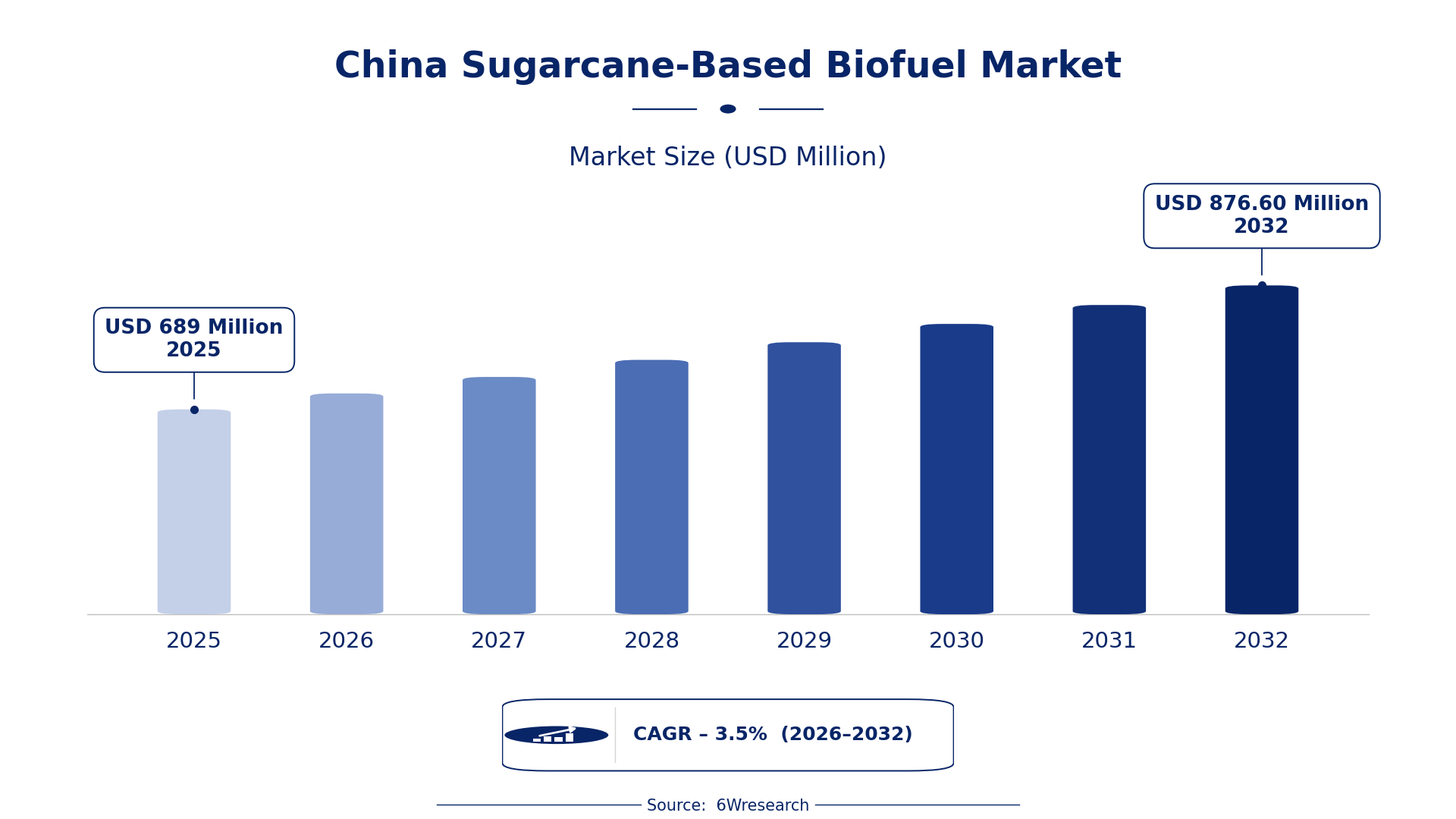
According to 6Wresearch internal database and industry insights, the China Sugarcane-Based Biofuel Market was valued at USD 689.0 million in 2025 and is projected to reach USD 876.60 million by 2032, growing at a CAGR of approximately 3.5% during 2026–2032.
China Sugarcane-Based Biofuel Market Highlights
| Report Metric | Details |
| Report Name | China Sugarcane-Based Biofuel Market |
| Market Size 2025 | USD 689.0 million |
| Market Size 2032 | USD 876.60 million |
| Absolute Growth 2025–2032 | USD 187.60 million |
| CAGR 2026–2032 | 3.5% |
| Peak Annual Growth | 6.1% in 2032 |
| Forecast Period | 2026–2032 |
| Historical Data | 2022–2025 |
| Base Year | 2025 |
| Leading Fuel Type, 2025 | Ethanol (35% share) |
| Leading Processing Method, 2025 | Fermentation (42% share) |
| Leading Use Case, 2025 | Transportation Fuel (36% share) |
| Leading End User, 2025 | Fuel Blending Facilities (37% share) |
| Fastest-Growing Fuel Type | Biogas (5.8% CAGR) |
| Fastest-Growing Processing Method | Anaerobic Digestion (5.7% CAGR) |
| Fastest-Growing Use Case | Power Generation (4.6% CAGR) |
| Fastest-Growing End User | Rural Energy Providers (5.4% CAGR) |
| Growing Sector | Transportation Fuel |
| Key End Users | Fuel Blending Facilities, Biofuel Distributors, Rural Energy Providers |
China Sugarcane-Based Biofuel Market Year-wise Growth Rate and Key Drivers (2022–2032)
This graph illustrates the annual growth rates of the market from 2022 to 2032, highlighting a steady upward trajectory and projected market expansion over the forecast period.
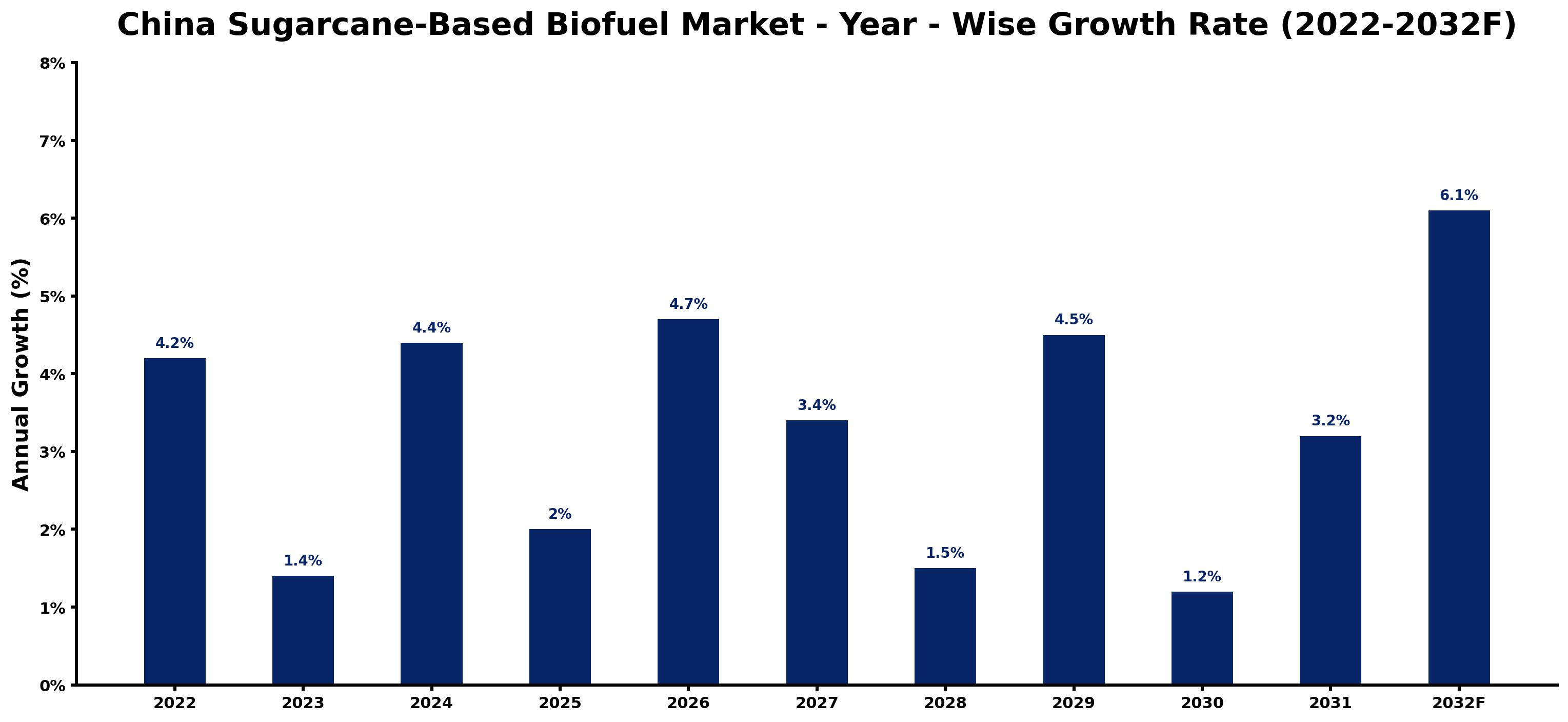
Each row of the following table gives one year's estimated growth and the event or demand shift that explains it.
| Year | Estimated Annual Growth (%) | Market Rationale |
| 2022 | 4.2 | The market showed strong activity with a notable production of bioethanol. |
| 2023 | 1.4 | Growth slowed as biofuel blending facilities adjusted to market demands. |
| 2024 | 4.4 | Increased production efficiency led to a faster growth rate compared to the previous year. |
| 2025 | 2.0 | Demand stabilised as blending targets were met, resulting in slower growth. |
| 2026 | 4.7 | Investment in biofuel infrastructure sparked renewed interest and growth in production. |
| 2027 | 3.4 | The market experienced a slowdown as production adjustments took place. |
| 2028 | 1.5 | Growth continued to slow due to market saturation and established production limits. |
| 2029 | 4.5 | Renewed interest in biofuels led to a faster growth rate as new facilities opened. |
| 2030 | 1.2 | Growth slowed again as the market approached a new equilibrium. |
| 2031 | 3.2 | Increased blending targets drove a faster growth rate in biofuel production. |
| 2032 | 6.1 | The market peaked as demand surged ahead of the 10% blending target. |
Note: Market size estimations and growth projections presented in this report are based on 6Wresearch's proprietary forecasting methodology, utilizing the latest available industry data, government publications, and primary research inputs.
China Sugarcane-Based Biofuel Market Synopsis
Sugarcane-Based Biofuel in China encompasses renewable energy derived from sugarcane fermentation, primarily used for transportation fuel and power generation. In 2022, China produced approximately 2.5 million tons of bioethanol, reflecting strong domestic demand. The China Sugarcane-Based Biofuel Market is expanding due to rising energy needs and government support for biofuel blending initiatives. The National Biofuel Development Plan aims for 10% biofuel blending by 2025, driving further investment in production facilities and infrastructure.
Market Dynamics Impact Analysis (2026–2032)
| Factor | Type | Impact | Primary Segment Affected |
| Government support for biofuel blending initiatives drives demand among fuel blending facilities. | Driver | High | Fuel Blending Facilities |
| Growing energy needs from a population exceeding 1.4 billion fuels demand for biofuels. | Driver | High | Transportation Fuel |
| Investment in biofuel infrastructure presents opportunities for new facilities and technology. | Opportunity | High | Anaerobic Digestion |
| The shift towards sustainable energy sources creates openings for innovative biofuel solutions. | Opportunity | High | Biogas |
| High production costs hinder the competitiveness of biofuels against fossil fuels. | Restraint | High | Bioethanol |
| Limited awareness of biofuel benefits restricts market growth among potential users. | Restraint | Medium | Transportation Fuel |
| Sugarcane-Based Biofuel in China faces challenges from fluctuating raw material prices. | Challenge | High | Ethanol |
| Competition from alternative renewable energy sources complicates market positioning. | Challenge | Medium | Biogas |
Evaluation of Drivers in China Sugarcane-Based Biofuel Market (2026–2032)
The factors lifting demand, and the evidence behind each, are summarised below.
| Drivers | Primary Segment Affected | Why It Matters (Evidence) |
| Government initiatives promote biofuel blending, increasing production demand. | Fuel Blending Facilities | The National Biofuel Development Plan targets 10% blending by 2025, driving facility upgrades. |
| Rising energy needs from a large population boost biofuel consumption. | Transportation Fuel | China's population of over 1.4 billion creates a strong demand for renewable energy sources. |
| Investment in biofuel infrastructure increases production capacity and efficiency. | Anaerobic Digestion | The Chinese government has allocated $500 million for biofuel infrastructure since 2020, supporting facility expansions. |
| Growing interest in sustainable energy sources drives innovation in biofuels. | Biogas | Sustainable Development Goals influence production strategies, increasing demand for eco-friendly biofuels. |
| Technological advancements in fermentation processes improve biofuel yields. | Fermentation | New techniques lead to higher bioethanol production rates, meeting rising demand. |
Market growth in China for Sugarcane-Based Biofuel rests on substantial investments in biofuel infrastructure, growing energy needs, and increasing end-use demand. With a population exceeding 1.4 billion, energy demand continues to rise, prompting more purchases of biofuels. The National Biofuel Development Plan aims for 10% blending by 2025, further driving facility upgrades. Technological advancements in fermentation processes are also improving biofuel yields, supporting the market's expansion.
Evaluation of Restraints in China Sugarcane-Based Biofuel Market
The main factors holding the market back are set out below.
| Market Restraint | Primary Segment Affected | Why It Matters (Evidence) |
| High production costs limit competitiveness against fossil fuels. | Bioethanol | Production costs for bioethanol remain high, making it less attractive compared to cheaper fossil fuels. |
| Limited awareness of biofuel benefits restricts market growth. | Transportation Fuel | Many potential users lack knowledge about the advantages of biofuels, hindering adoption. |
| Fluctuating raw material prices create uncertainty for producers. | Ethanol | Variability in sugarcane prices affects production costs and profit margins for biofuel producers. |
| Regulatory hurdles complicate the establishment of new biofuel facilities. | Biogas | Strict regulations can delay approvals for new biofuel production sites, impacting supply. |
| Market saturation limits growth opportunities for existing producers. | Fermentation | As more facilities enter the market, competition increases, making it harder to capture market share. |
China Sugarcane-Based Biofuel Market Challenges
The China Sugarcane-Based Biofuel Market faces high input costs due to limited sugarcane production in key provinces like Yunnan and Guangxi, which can increase prices for buyers by as much as 20%. Regulatory hurdles exist as compliance with ISO 14064 standards can delay project approvals, extending timelines for producers by several months. Competition from alternative energy sources pressures suppliers to reduce prices, potentially compromising product quality and profitability. Skills shortages in biofuel technology limit production efficiency, raising operational costs for manufacturers and threatening overall market stability.
Trends in the China Sugarcane-Based Biofuel Market
The trends below show where the China Sugarcane-Based Biofuel Market is heading.
- Shift from Traditional to Advanced Fermentation Techniques: China is increasingly adopting advanced fermentation methods to improve bioethanol production efficiency. In 2023, approximately 5 million tons of biofuel production capacity was installed, reflecting this shift. This trend allows producers to meet demand more effectively.
- Transition from Bioethanol to Biogas: Since 2020, there has been a notable shift towards biogas production in China, driven by sustainability goals. Biogas is projected to grow at a CAGR of 5.8% from 2026 to 2032, indicating a significant market transition.
- Emergence of Sustainable Biofuel Blending: The focus on sustainable energy has led to increased biofuel blending in urban areas. In 2025, the aim is to achieve 10% biofuel blending, driving demand for infrastructure and distribution facilities.
- Growth in Rural Energy Solutions: Rural energy providers are increasingly adopting biofuels to meet local energy needs. This trend is supported by government initiatives, with biofuel distributors playing a key role in expanding access.
Investment Opportunities in the China Sugarcane-Based Biofuel Market
Some of the investment opportunities in the China Sugarcane-Based Biofuel Market are mentioned below.
- Collaborative Ventures for Infrastructure Development: Partnering with local entities to develop biofuel facilities can bridge the investment gap. With $500 million allocated for biofuel infrastructure, there is a promising opportunity for growth in production capacity.
- Supply of Advanced Fermentation Technologies: The demand for advanced fermentation technologies is rising, with facilities seeking improved efficiency. Investing in technology solutions can cater to the needs of fuel blending facilities in southern China.
- Expansion of Biogas Production Facilities: The growing interest in biogas presents opportunities for new production facilities. With a projected CAGR of 5.8%, establishing biogas plants in Yunnan and Guangxi can capture market demand.
- Certification for Sustainable Biofuels: Obtaining ISO 14064 certification can improve market access for biofuel producers. This standard is increasingly sought after by blending facilities aiming to meet sustainability goals.
Government Initiatives in the China Sugarcane-Based Biofuel Market
The Renewable Energy Law supports biofuel development initiatives, promoting the use of sugarcane for biofuel production. This law encourages investment in biofuel facilities and provides a framework for blending operations. The Ministry of Agriculture promotes biofuel crops through subsidies, enhancing production incentives for farmers. These measures aim to increase biofuel output and support market growth, targeting a 10% blending rate by 2025.
The National Biofuel Development Plan allocates significant resources for biofuel projects, overseen by the National Energy Administration. This plan includes funding for infrastructure improvements and facility upgrades, ensuring compliance with sustainability standards. The administration also ensures compliance with regulations, enabling producers to meet market demands effectively.
Future Insight of the China Sugarcane-Based Biofuel Market
By 2032, buyers and suppliers in the China Sugarcane-Based Biofuel Market can expect notable advancements driven by the National Biofuel Development Plan, which aims for 10% biofuel blending by 2025. The installed production capacity is projected to reach 8 million tons, improving supply capabilities. Government investments in biofuel infrastructure will enhance distribution networks, while the promotion of biofuel crops under the National Agricultural Policy will stimulate production. These factors will create a more competitive landscape, benefiting both buyers and suppliers.
Market Segmentation Analysis
The analysis below covers each segmentation, its leading category in 2025 and its fastest-growing category through 2032.
By Fuel Type – Ethanol Dominated, Biogas Expected to Grow Fastest
According to Sumit Sagar, AM at 6Wresearch, in 2025, Ethanol led the fuel type split with a 35% share. Ethanol dominates the China Sugarcane-Based Biofuel Market due to its widespread use as a transportation fuel, particularly in urban areas where it is blended with gasoline. The National Biofuel Development Plan's target of 10% biofuel blending by 2025 solidifies its leading market share. Biogas are set to record the highest CAGR in this split, 5.8% over 2026–2032. Biogas is experiencing rapid growth, driven by significant investments in anaerobic digestion technologies, with the installed capacity for biofuel production reaching 5 million tons in 2023. This method is gaining traction for its efficiency in renewable energy generation, which will further enhance its market presence. Suppliers should focus on biogas solutions to align with the growing demand and capture increased market share.
By Processing Method – Fermentation Dominated, Anaerobic Digestion Expected to Grow Fastest
The largest processing method category in 2025 was Fermentation, with a 42% share of total revenue. Fermentation is the primary method for biofuel production, essential for converting sugarcane into ethanol, which is vital for meeting the rising energy demands in China. The established processes and infrastructure around fermentation further reinforce its leading share. The quickest growth will come from Anaerobic Digestion, forecast to expand at a CAGR of 5.7% between 2026 and 2032. Anaerobic digestion is rapidly advancing due to its effectiveness in producing biogas, a cleaner energy source, as evidenced by the growing number of facilities adopting this method. This trend indicates a shift towards more sustainable energy solutions. Buyers should consider investing in anaerobic digestion technologies to stay competitive in the evolving biofuel market.
By Use Case – Transportation Fuel Dominated, Power Generation Expected to Grow Fastest
With a 36% revenue share in 2025, Transportation Fuel was the largest use case category. Transportation fuel is the largest segment in the market, fuelled by the rising demand for cleaner alternatives in urban settings. Government initiatives that promote biofuels for transportation are crucial in maintaining this segment's leading market share. Power Generation is projected to grow fastest, at a CAGR of 4.6% during 2026–2032. Power generation is the fastest-growing segment as the shift towards renewable energy sources accelerates, with biofuels playing a critical role in energy diversification. The increasing focus on sustainable energy solutions is driving this segment's rapid expansion. Suppliers need to adapt their strategies to incorporate power generation solutions to meet the surging demand.
By End User – Fuel Blending Facilities Dominated, Rural Energy Providers Expected to Grow Fastest
Fuel Blending Facilities took a 37% share of end user in 2025, more than any other category. Fuel blending facilities are vital for the distribution of biofuels, serving as a key link in the integration of ethanol into the fuel supply chain. Their strategic positioning in southern China, near major sugarcane production sites, enhances their operational effectiveness and market share. Over 2026–2032, Rural Energy Providers are expected to post the fastest growth, at a CAGR of 5.4%. Rural energy providers are rapidly expanding as they address local energy needs, supported by government incentives and subsidies for biofuel crops. This growth reflects a broader commitment to enhancing energy access in rural regions. Suppliers should establish partnerships with rural energy providers to leverage this growing market opportunity.
Key Attractiveness of the Report
- 10 Years of Market Numbers
- Historical Data Starting from 2022 to 2025
- Base Year 2025
- Forecast Data until 2032
- Key Performance Indicators Impacting the Market
- Major Upcoming Developments and Projects
Key Highlights of the Report:
- China Sugarcane-Based Biofuel Market Outlook
- Market Size of China Sugarcane-Based Biofuel Market, 2025
- Forecast of China Sugarcane-Based Biofuel Market, 2032
- Historical Data and Forecast of China Sugarcane-Based Biofuel Revenues & Volume for the Period 2022 - 2032F
- China Sugarcane-Based Biofuel Market Trend Evolution
- China Sugarcane-Based Biofuel Market Drivers and Challenges
- China Sugarcane-Based Biofuel Price Trends
- China Sugarcane-Based Biofuel Porter's Five Forces
- China Sugarcane-Based Biofuel Industry Life Cycle
- Historical Data and Forecast of China Sugarcane-Based Biofuel Market Revenues & Volume By Fuel Type for the Period 2022 - 2032F
- Historical Data and Forecast of China Sugarcane-Based Biofuel Market Revenues & Volume By Ethanol for the Period 2022 - 2032F
- Historical Data and Forecast of China Sugarcane-Based Biofuel Market Revenues & Volume By Biogas for the Period 2022 - 2032F
- Historical Data and Forecast of China Sugarcane-Based Biofuel Market Revenues & Volume By Butanol for the Period 2022 - 2032F
- Historical Data and Forecast of China Sugarcane-Based Biofuel Market Revenues & Volume By Bioethanol for the Period 2022 - 2032F
- Historical Data and Forecast of China Sugarcane-Based Biofuel Market Revenues & Volume By Processing Method for the Period 2022 - 2032F
- Historical Data and Forecast of China Sugarcane-Based Biofuel Market Revenues & Volume By Fermentation for the Period 2022 - 2032F
- Historical Data and Forecast of China Sugarcane-Based Biofuel Market Revenues & Volume By Anaerobic Digestion for the Period 2022 - 2032F
- Historical Data and Forecast of China Sugarcane-Based Biofuel Market Revenues & Volume By Advanced Fermentation for the Period 2022 - 2032F
- Historical Data and Forecast of China Sugarcane-Based Biofuel Market Revenues & Volume By Molasses Conversion for the Period 2022 - 2032F
- Historical Data and Forecast of China Sugarcane-Based Biofuel Market Revenues & Volume By Use Case for the Period 2022 - 2032F
- Historical Data and Forecast of China Sugarcane-Based Biofuel Market Revenues & Volume By Transportation Fuel for the Period 2022 - 2032F
- Historical Data and Forecast of China Sugarcane-Based Biofuel Market Revenues & Volume By Power Generation for the Period 2022 - 2032F
- Historical Data and Forecast of China Sugarcane-Based Biofuel Market Revenues & Volume By Industrial Solvents for the Period 2022 - 2032F
- Historical Data and Forecast of China Sugarcane-Based Biofuel Market Revenues & Volume By Vehicle Fuel for the Period 2022 - 2032F
- Historical Data and Forecast of China Sugarcane-Based Biofuel Market Revenues & Volume By End User for the Period 2022 - 2032F
- Historical Data and Forecast of China Sugarcane-Based Biofuel Market Revenues & Volume By Fuel Blending Facilities for the Period 2022 - 2032F
- Historical Data and Forecast of China Sugarcane-Based Biofuel Market Revenues & Volume By Rural Energy Providers for the Period 2022 - 2032F
- Historical Data and Forecast of China Sugarcane-Based Biofuel Market Revenues & Volume By Chemical Manufacturers for the Period 2022 - 2032F
- Historical Data and Forecast of China Sugarcane-Based Biofuel Market Revenues & Volume By Biofuel Distributors for the Period 2022 - 2032F
- China Sugarcane-Based Biofuel Import Export Trade Statistics
- Market Opportunity Assessment By Fuel Type
- Market Opportunity Assessment By Processing Method
- Market Opportunity Assessment By Use Case
- Market Opportunity Assessment By End User
- China Sugarcane-Based Biofuel Top Companies Market Share
- China Sugarcane-Based Biofuel Competitive Benchmarking By Technical and Operational Parameters
- China Sugarcane-Based Biofuel Company Profiles
- China Sugarcane-Based Biofuel Key Strategic Recommendations
Market Covered
The report offers an extensive study of the following market segments.
By Fuel Type
- Ethanol
- Biogas
- Butanol
- Bioethanol
By Processing Method
- Fermentation
- Anaerobic Digestion
- Advanced Fermentation
- Molasses Conversion
By Use Case
- Transportation Fuel
- Power Generation
- Industrial Solvents
- Vehicle Fuel
By End User
- Fuel Blending Facilities
- Rural Energy Providers
- Chemical Manufacturers
- Biofuel Distributors































