China Supercritical Boiler Market Size & Growth Rate
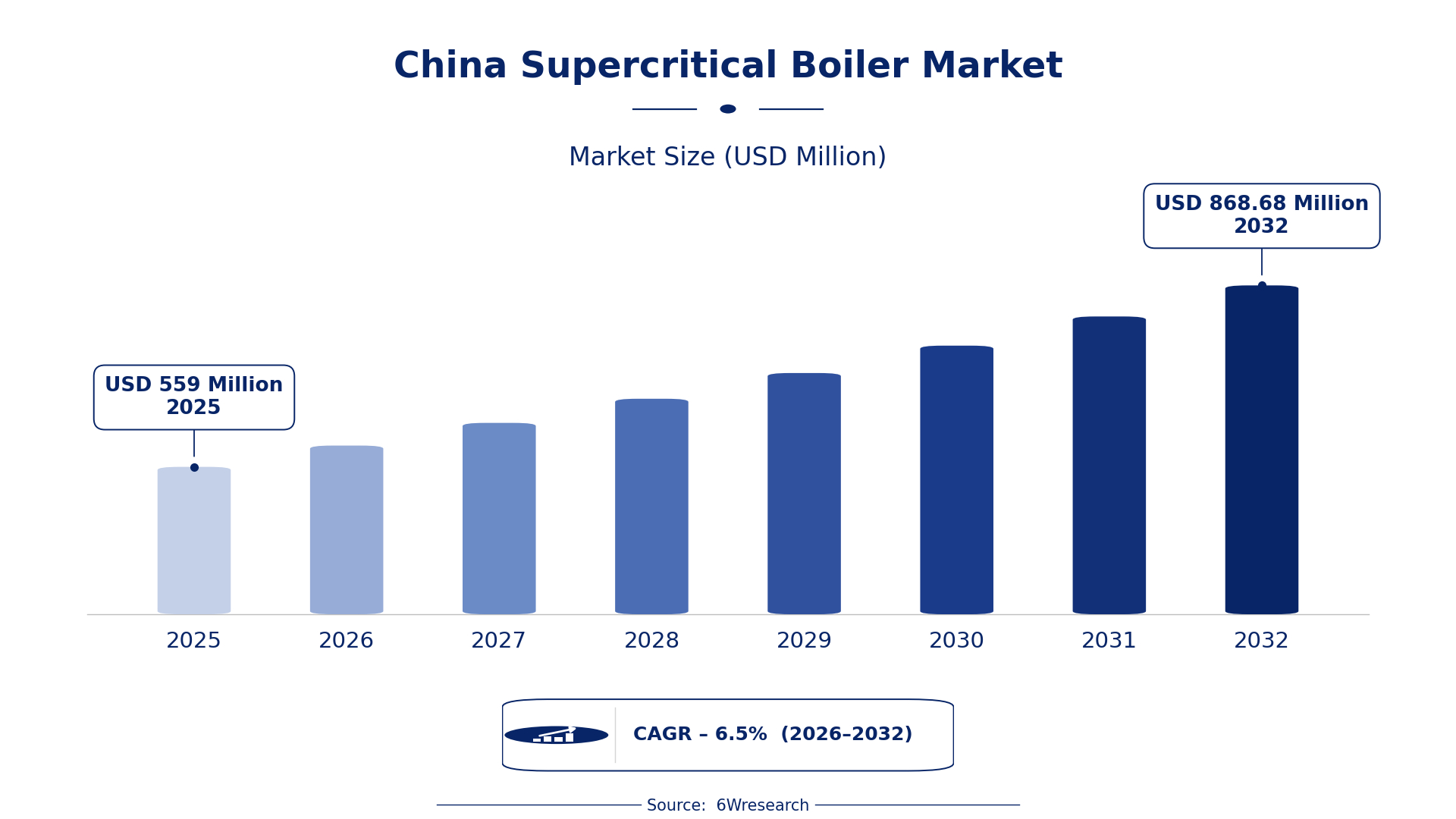
According to 6Wresearch internal database and industry insights, the China Supercritical Boiler Market was valued at USD 559.0 million in 2025 and is projected to reach USD 868.68 million by 2032, growing at a CAGR of approximately 6.5% during 2026–2032.
China Supercritical Boiler Market Highlights
| Report Metric | Details |
| Report Name | China Supercritical Boiler Market |
| Market Size 2025 | USD 559.0 million |
| Market Size 2032 | USD 868.68 million |
| Absolute Growth 2025–2032 | USD 309.68 million |
| CAGR 2026–2032 | 6.5% |
| Peak Annual Growth | 9.0% in 2028 |
| Forecast Period | 2026–2032 |
| Historical Data | 2022–2025 |
| Base Year | 2025 |
| Leading Boiler Type, 2025 | Ultra-Supercritical (54% share) |
| Leading Pressure Level, 2025 | Supercritical (50% share) |
| Leading Fuel Type, 2025 | Coal-Based (40% share) |
| Leading End User, 2025 | Thermal Power Plants (34% share) |
| Fastest-Growing Pressure Level | >25 MPa (7.8% CAGR) |
| Fastest-Growing Fuel Type | Gas-Based (8.0% CAGR) |
| Fastest-Growing End User | Independent Power Producers (8.7% CAGR) |
| Growing Sector | Thermal Power Generation |
| Key End Users | Thermal Power Plants, Independent Power Producers, Utility Companies |
China Supercritical Boiler Market Year-wise Growth Rate and Key Drivers (2022–2032)
This graph illustrates the annual growth rates of the market from 2022 to 2032, highlighting a steady upward trajectory and projected market expansion over the forecast period.
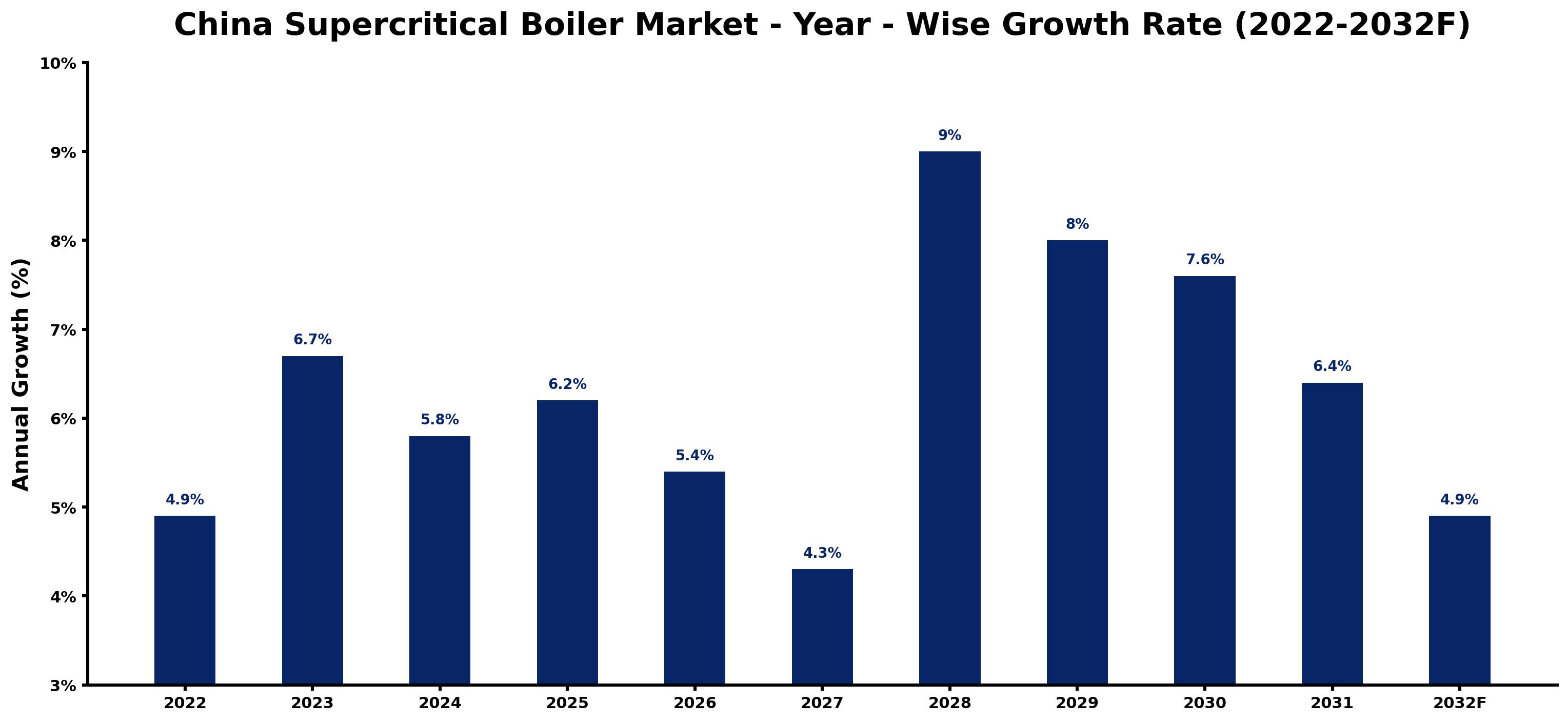
Annual growth estimates for each year appear below with the principal reason behind them, explaining the shifts that set the pace of the market.
| Year | Estimated Annual Growth (%) | Market Rationale |
| 2022 | 4.9 | The market experienced steady growth due to ongoing energy demands in the thermal power sector. |
| 2023 | 6.7 | Increased installations were driven by the National Energy Administration's support for supercritical technology. |
| 2024 | 5.8 | Growth slowed as some projects faced delays in approvals and financing. |
| 2025 | 6.2 | Demand accelerated again with rising electricity needs and new thermal power plant projects. |
| 2026 | 5.4 | A slowdown occurred as regulatory compliance challenges emerged following the previous growth surge. |
| 2027 | 4.3 | Continued demand for supercritical boilers was driven by the need for cleaner energy solutions. |
| 2028 | 9.0 | A significant increase in installations occurred as the market responded to heightened energy demands. |
| 2029 | 8.0 | Growth slowed, but demand remained strong as projects continued to progress. |
| 2030 | 7.6 | A further slowdown was noted as the market adjusted after rapid expansion. |
| 2031 | 6.4 | Demand continued to grow, albeit at a slower rate, as new projects were initiated. |
| 2032 | 4.9 | The market is expected to maintain growth as energy efficiency remains a priority. |
Note: Market size estimations and growth projections presented in this report are based on 6Wresearch's proprietary forecasting methodology, utilizing the latest available industry data, government publications, and primary research inputs.
China Supercritical Boiler Market Synopsis
These boilers are primarily used in power generation within thermal power plants, which are vital for meeting domestic energy needs. The market is expanding due to a 15% increase in installations in 2023 and ongoing support from government initiatives. Key regions like Beijing and Jiangsu are driving demand as they focus on cleaner energy solutions. The anticipated rise in electricity demand by 3% annually further fuels this growth.
Market Dynamics Impact Analysis (2026–2032)
| Factor | Type | Impact | Primary Segment Affected |
| Increased installations driven by government initiatives | Driver | High | Supercritical |
| Growing demand for cleaner energy sources | Driver | High | Coal-Based |
| Investment in supercritical technology upgrades | Opportunity | High | Ultra-Supercritical |
| Expansion of independent power producers | Opportunity | High | Independent Power Producers |
| High initial investment costs for new installations | Restraint | High | Supercritical |
| Strict emission standards impacting operational costs | Restraint | High | Coal-Based |
| Regulatory compliance challenges for new projects | Challenge | Medium | Ultra-Supercritical |
| Technological complexities in boiler manufacturing | Challenge | Medium | Supercritical |
Evaluation of Drivers in China Supercritical Boiler Market (2026–2032)
The main growth drivers and the segments they affect most are set out below.
| Drivers | Primary Segment Affected | Why It Matters (Evidence) |
| Government support for supercritical technology | Supercritical | The National Energy Administration's initiatives have led to a 15% increase in installations in 2023. |
| Rising electricity demand from thermal power plants | Coal-Based | Electricity demand is projected to rise by 3% annually, prompting more purchases of supercritical boilers. |
| Investment in energy efficiency upgrades | Ultra-Supercritical | The 2021 Energy Development Strategy Action Plan promotes supercritical technology for improved efficiency, targeting a 30% increase by 2025. |
| Expansion of independent power producers | Independent Power Producers | Independent power producers are increasingly investing in supercritical technology to meet energy supply needs, reflecting a growing market. |
| Technological advancements in boiler design | Supercritical | Innovations in manufacturing processes are improving the performance and efficiency of supercritical boilers, leading to increased adoption. |
Growth across the Supercritical Boiler market in China is anchored in rising electricity demand, support for cleaner energy, and ongoing investments in technology upgrades. The electricity demand is expected to rise by 3% annually, prompting thermal power plants to invest in supercritical boilers. The 2021 Energy Development Strategy Action Plan promotes supercritical technology, improving efficiency in power generation. Independent power producers are also expanding their investments in supercritical technology to meet energy supply needs.
Evaluation of Restraints in China Supercritical Boiler Market
The key brakes on demand, and where they bite hardest, are shown below.
| Market Restraint | Primary Segment Affected | Why It Matters (Evidence) |
| High initial investment costs for supercritical installations | Supercritical | The cost of implementing supercritical technology can deter potential buyers, impacting market growth. |
| Strict emission standards increasing operational costs | Coal-Based | Compliance with the Ministry of Ecology and Environment's emission standards raises costs for operators. |
| Regulatory compliance challenges for new projects | Ultra-Supercritical | Navigating complex regulations can delay project timelines and increase costs for developers. |
| Technological complexities in boiler manufacturing | Supercritical | The advanced engineering required for supercritical boilers can lead to longer production times and higher costs. |
| Limited availability of skilled workforce | Supercritical | A shortage of qualified personnel can hinder the implementation of new projects and increase training costs. |
China Supercritical Boiler Market Challenges
The China Supercritical Boiler Market still has to solve a few problems, and the first is cost. High manufacturing expenses for supercritical boilers can raise prices for producers, making it challenging to maintain competitive rates. Buyers face delays in project timelines due to a skills shortage in advanced boiler technology, which can extend installation periods and increase overall project costs by up to 15%. Rapid technological advancements demand continuous training, straining resources for producers and impacting their ability to keep pace. Compliance with stringent emission standards set by the Ministry of Ecology and Environment incurs additional operational costs for producers, squeezing their profit margins.
Trends in the China Supercritical Boiler Market
Four trends stand out in the China Supercritical Boiler Market.
- Shift towards Cleaner Energy Solutions: Beijing is increasingly adopting supercritical technology in thermal power plants, with 60% of new installations in 2022 being supercritical. This shift aims to improve energy efficiency and reduce emissions significantly.
- Independent Power Producers Expanding Capacity: Independent Power Producers in Jiangsu are investing in supercritical boilers, with a projected 8.7% CAGR from 2026 to 2032. This trend reflects a growing focus on reliable energy supply and sustainability.
- Adoption of ISO 50001 Standards: The implementation of ISO 50001 standards in boiler operations is gaining traction, promoting energy management practices. This is anticipated to improve operational efficiency across the sector and reduce costs.
- Increased Focus on Emission Reduction: The Ministry of Ecology and Environment's updated emission standards are pushing for cleaner technologies in power generation. This is driving the adoption of supercritical boilers to meet stricter requirements and enhance compliance.
Investment Opportunities in the China Supercritical Boiler Market
Investors looking at the China Supercritical Boiler Market should consider the following areas.
- Investment in Modern Thermal Power Plants: Beijing is seeing a surge in demand for supercritical boilers, with 60% of new thermal power plants adopting this technology. This creates opportunities for suppliers to meet the growing needs of the sector.
- Supply of Upgraded Supercritical Systems: With a projected 30% increase in efficiency by 2025, there is an opportunity to supply upgraded supercritical systems to existing plants. This is particularly relevant for utility companies looking to enhance performance.
- Expansion of Independent Power Producers: Independent Power Producers are increasingly investing in supercritical technology, presenting opportunities for suppliers to partner and provide necessary equipment. This sector is expected to grow rapidly, reflecting a strong demand for energy.
- Development of Cleaner Fuel Alternatives: The shift towards gas-based supercritical boilers presents an opportunity for suppliers to develop cleaner fuel alternatives for power generation, aligning with national energy goals.
Government Initiatives in the China Supercritical Boiler Market
The State Council approved the 'Energy Development Strategy' in 2023, which strengthens the framework for supercritical boiler adoption. This measure builds on the 'Clean Energy Action Plan' from 2021, which aimed for a 30% efficiency increase by 2025. Together, these initiatives promote the use of supercritical technology in power generation, ensuring compliance with emission standards. The updated regulations encourage investments in advanced boiler systems, aligning with national energy goals and enhancing operational efficiency.
The National Energy Administration oversees the implementation of the 'Clean Energy Action Plan', which funds projects aimed at increasing supercritical boiler usage. The Ministry of Ecology and Environment also plays a significant role by approving emission standards that ensure compliance and environmental protection. These agencies facilitate the transition to cleaner energy sources, supporting the development of supercritical technology and ensuring adherence to updated regulations.
Future Insight of the China Supercritical Boiler Market
The China Supercritical Boiler Market will experience significant changes by 2032, driven by advancements in clean coal technology and increasing electricity demand. The National Development and Reform Commission's support for clean coal initiatives will accelerate the adoption of supercritical systems, which reduce CO2 emissions by 20% compared to older technologies. By 2025, the installed capacity for supercritical boilers is expected to surpass 1,000 GW, providing benefits to buyers and suppliers through improved efficiency and lower operational costs. Enhanced training programs will also address the skills gap, ensuring a more proficient workforce for the evolving market.
Market Segmentation Analysis
The analysis below covers each segmentation, its leading category in 2025 and its fastest-growing category through 2032.
By Boiler Type – Ultra-Supercritical Dominated and Is Expected to Record the Fastest Growth
According to Sumit Sagar, AM at 6Wresearch, in 2025, Ultra-Supercritical led the boiler type split with a 54% share. Ultra-supercritical boilers dominate the market due to their high efficiency and are preferred for new thermal power projects. With an installed capacity of 1,000 GW in 2022, they are a key component in China's energy strategy. The same category is also set to grow fastest, at a CAGR of 7.5% during 2026–2032. The ultra-supercritical segment is expected to maintain its rapid growth as more projects adopt this technology, supported by the 2021 Energy Development Strategy Action Plan. This initiative aligns with the country's goals for improved thermal efficiency and reduced emissions. Suppliers should focus on ultra-supercritical technology to capture the growing market share in China's supercritical boiler sector.
By Pressure Level – Supercritical Dominated, >25 MPa Expected to Grow Fastest
The largest pressure level category in 2025 was Supercritical, with a 50% share of total revenue. Supercritical boilers dominate the market share as they serve as the standard for new thermal power plants in China, ensuring high efficiency and compliance with stringent emission regulations. The substantial installed capacity of 1,000 GW in 2022 further illustrates their critical role in the energy sector. >25 MPa is projected to grow fastest, at a CAGR of 7.8% during 2026–2032. >25 MPa pressure level boilers are increasingly preferred in specialized applications, driven by the need for superior performance in advanced energy projects. This growth indicates a rising demand for high-pressure systems, which could lead to further advancements in technology. Suppliers should focus on the growing demand for supercritical and high-pressure systems to maintain a competitive edge in the market.
By Fuel Type – Coal-Based Dominated, Gas-Based Expected to Grow Fastest
Coal-Based accounted for a 40% market share by fuel type in 2025. Coal-based supercritical boilers are the dominant fuel type in China's power generation, accounting for a substantial share of the installed capacity. The reliance on coal for energy needs continues to drive this segment's strong position in the market. Over 2026–2032, Gas-Based is expected to post the fastest growth, at a CAGR of 8.0%. Gas-based systems are experiencing rapid growth as the country seeks cleaner energy alternatives, with increased installations reflecting a shift towards lower emissions. This trend is supported by governmental initiatives promoting cleaner fuel technologies. Suppliers should consider diversifying their offerings to include gas-based systems to meet the changing preferences of energy producers.
By End User – Thermal Power Plants Dominated, Independent Power Producers Expected to Grow Fastest
With a 34% revenue share in 2025, Thermal Power Plants was the largest end user category. Thermal power plants hold the largest market share due to their extensive reliance on supercritical boilers for efficient energy production. With China's installed capacity reaching 1,000 GW in 2022, these facilities are crucial for addressing the country's energy demands. The quickest growth will come from Independent Power Producers, forecast to expand at a CAGR of 8.7% between 2026 and 2032. Independent power producers are experiencing rapid growth in supercritical boiler adoption, driven by the need to enhance energy supply efficiency in a competitive market. This trend is underscored by a 15% increase in installations reported in 2023, indicating a strong shift towards advanced technologies. This trend suggests that suppliers should focus on developing tailored solutions for independent power producers to capture emerging market opportunities.
Key Attractiveness of the Report
- 10 Years of Market Numbers
- Historical Data Starting from 2022 to 2025
- Base Year 2025
- Forecast Data until 2032
- Key Performance Indicators Impacting the Market
- Major Upcoming Developments and Projects
Key Highlights of the Report:
- China Supercritical Boiler Market Outlook
- Market Size of China Supercritical Boiler Market, 2025
- Forecast of China Supercritical Boiler Market, 2032
- Historical Data and Forecast of China Supercritical Boiler Revenues & Volume for the Period 2022 - 2032F
- China Supercritical Boiler Market Trend Evolution
- China Supercritical Boiler Market Drivers and Challenges
- China Supercritical Boiler Price Trends
- China Supercritical Boiler Porter's Five Forces
- China Supercritical Boiler Industry Life Cycle
- Historical Data and Forecast of China Supercritical Boiler Market Revenues & Volume By Boiler Type for the Period 2022 - 2032F
- Historical Data and Forecast of China Supercritical Boiler Market Revenues & Volume By Once-Through Boilers for the Period 2022 - 2032F
- Historical Data and Forecast of China Supercritical Boiler Market Revenues & Volume By Drum-Type Boilers for the Period 2022 - 2032F
- Historical Data and Forecast of China Supercritical Boiler Market Revenues & Volume By Ultra-Supercritical for the Period 2022 - 2032F
- Historical Data and Forecast of China Supercritical Boiler Market Revenues & Volume By Sub-Critical Retrofit for the Period 2022 - 2032F
- Historical Data and Forecast of China Supercritical Boiler Market Revenues & Volume By Pressure Level for the Period 2022 - 2032F
- Historical Data and Forecast of China Supercritical Boiler Market Revenues & Volume By >22 MPa for the Period 2022 - 2032F
- Historical Data and Forecast of China Supercritical Boiler Market Revenues & Volume By Supercritical for the Period 2022 - 2032F
- Historical Data and Forecast of China Supercritical Boiler Market Revenues & Volume By >25 MPa for the Period 2022 - 2032F
- Historical Data and Forecast of China Supercritical Boiler Market Revenues & Volume By Upgraded Systems for the Period 2022 - 2032F
- Historical Data and Forecast of China Supercritical Boiler Market Revenues & Volume By Fuel Type for the Period 2022 - 2032F
- Historical Data and Forecast of China Supercritical Boiler Market Revenues & Volume By Coal-Based for the Period 2022 - 2032F
- Historical Data and Forecast of China Supercritical Boiler Market Revenues & Volume By Gas-Based for the Period 2022 - 2032F
- Historical Data and Forecast of China Supercritical Boiler Market Revenues & Volume By Biomass for the Period 2022 - 2032F
- Historical Data and Forecast of China Supercritical Boiler Market Revenues & Volume By Oil for the Period 2022 - 2032F
- Historical Data and Forecast of China Supercritical Boiler Market Revenues & Volume By End User for the Period 2022 - 2032F
- Historical Data and Forecast of China Supercritical Boiler Market Revenues & Volume By Thermal Power Plants for the Period 2022 - 2032F
- Historical Data and Forecast of China Supercritical Boiler Market Revenues & Volume By Independent Power Producers for the Period 2022 - 2032F
- Historical Data and Forecast of China Supercritical Boiler Market Revenues & Volume By Renewable Energy Providers for the Period 2022 - 2032F
- Historical Data and Forecast of China Supercritical Boiler Market Revenues & Volume By Utility Companies for the Period 2022 - 2032F
- China Supercritical Boiler Import Export Trade Statistics
- Market Opportunity Assessment By Boiler Type
- Market Opportunity Assessment By Pressure Level
- Market Opportunity Assessment By Fuel Type
- Market Opportunity Assessment By End User
- China Supercritical Boiler Top Companies Market Share
- China Supercritical Boiler Competitive Benchmarking By Technical and Operational Parameters
- China Supercritical Boiler Company Profiles
- China Supercritical Boiler Key Strategic Recommendations
Market Covered
The report offers an extensive study of the following market segments.
By Boiler Type
- Once-Through Boilers
- Drum-Type Boilers
- Ultra-Supercritical
- Sub-Critical Retrofit
By Pressure Level
- >22 MPa
- Supercritical
- >25 MPa
- Upgraded Systems
By Fuel Type
- Coal-Based
- Gas-Based
- Biomass
- Oil
By End User
- Thermal Power Plants
- Independent Power Producers
- Renewable Energy Providers
- Utility Companies































