China Supply Chain Authentication Market Size & Growth Rate
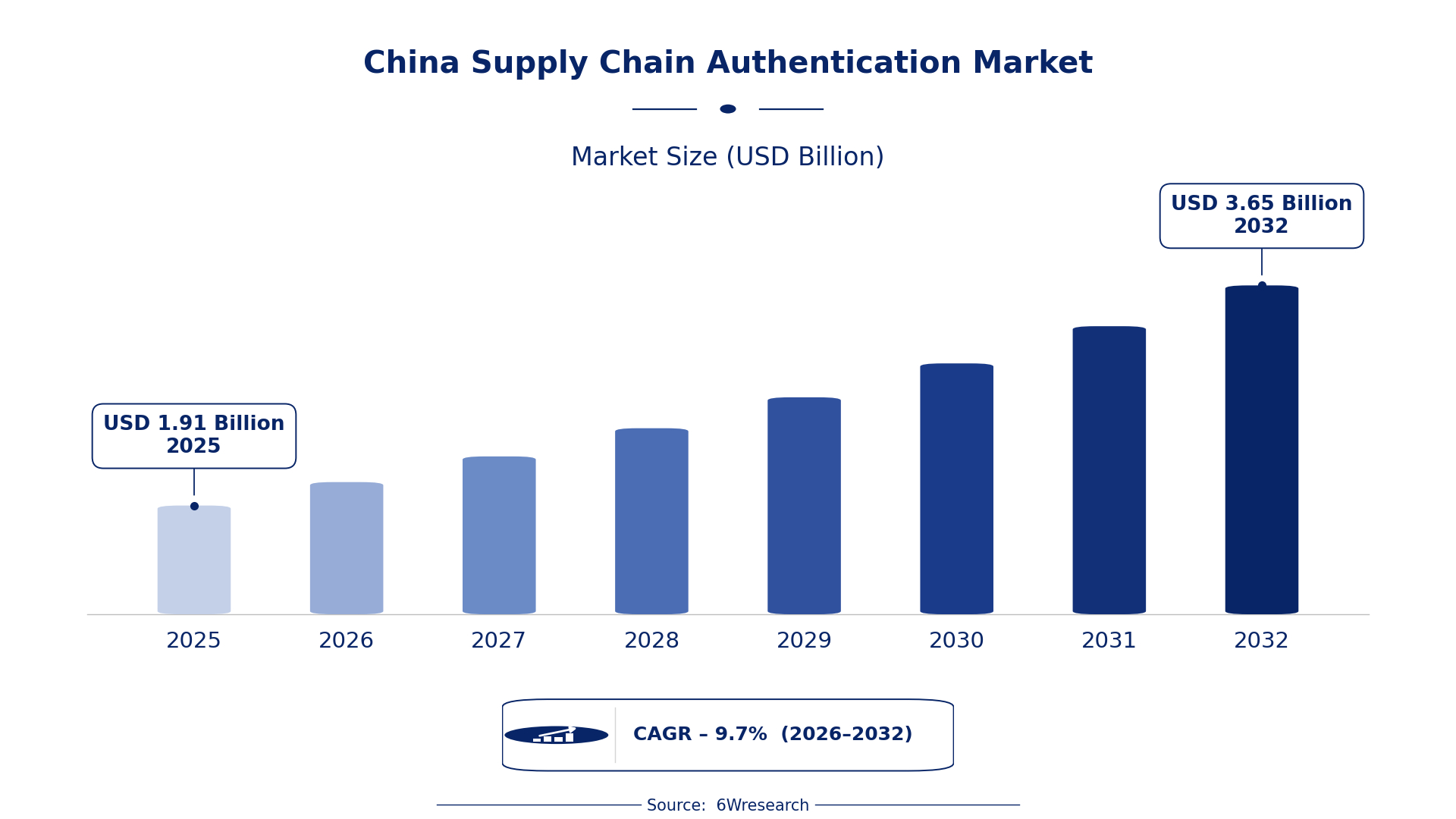
According to 6Wresearch internal database and industry insights, the China Supply Chain Authentication Market was valued at USD 1.91 billion in 2025 and is projected to reach USD 3.65 billion by 2032, growing at a CAGR of approximately 9.7% during 2026–2032.
China Supply Chain Authentication Market Highlights
| Report Metric | Details |
| Report Name | China Supply Chain Authentication Market |
| Market Size 2025 | USD 1.91 billion |
| Market Size 2032 | USD 3.65 billion |
| Absolute Growth 2025–2032 | USD 1.74 billion |
| CAGR 2026–2032 | 9.7% |
| Peak Annual Growth | 11.8% in 2027 |
| Forecast Period | 2026–2032 |
| Historical Data | 2022–2025 |
| Base Year | 2025 |
| Leading Authentication Type, 2025 | Product Serialization (49% share) |
| Leading Technology Used, 2025 | QR Code/RFID (47% share) |
| Leading Industry Application, 2025 | Pharma (45% share) |
| Leading End User, 2025 | Medical Supply Chains (44% share) |
| Fastest-Growing Authentication Type | Blockchain-Based Tracking (11.5% CAGR) |
| Fastest-Growing Technology Used | Distributed Ledger (11.3% CAGR) |
| Fastest-Growing Industry Application | Luxury Goods (10.7% CAGR) |
| Growing Sector | Pharmaceuticals |
| Key End Users | Pharmaceutical companies, Luxury goods manufacturers, Electronics producers, E-commerce platforms |
China Supply Chain Authentication Market Year-wise Growth Rate and Key Drivers (2022–2032)
This graph illustrates the annual growth rates of the market from 2022 to 2032, highlighting a steady upward trajectory and projected market expansion over the forecast period.
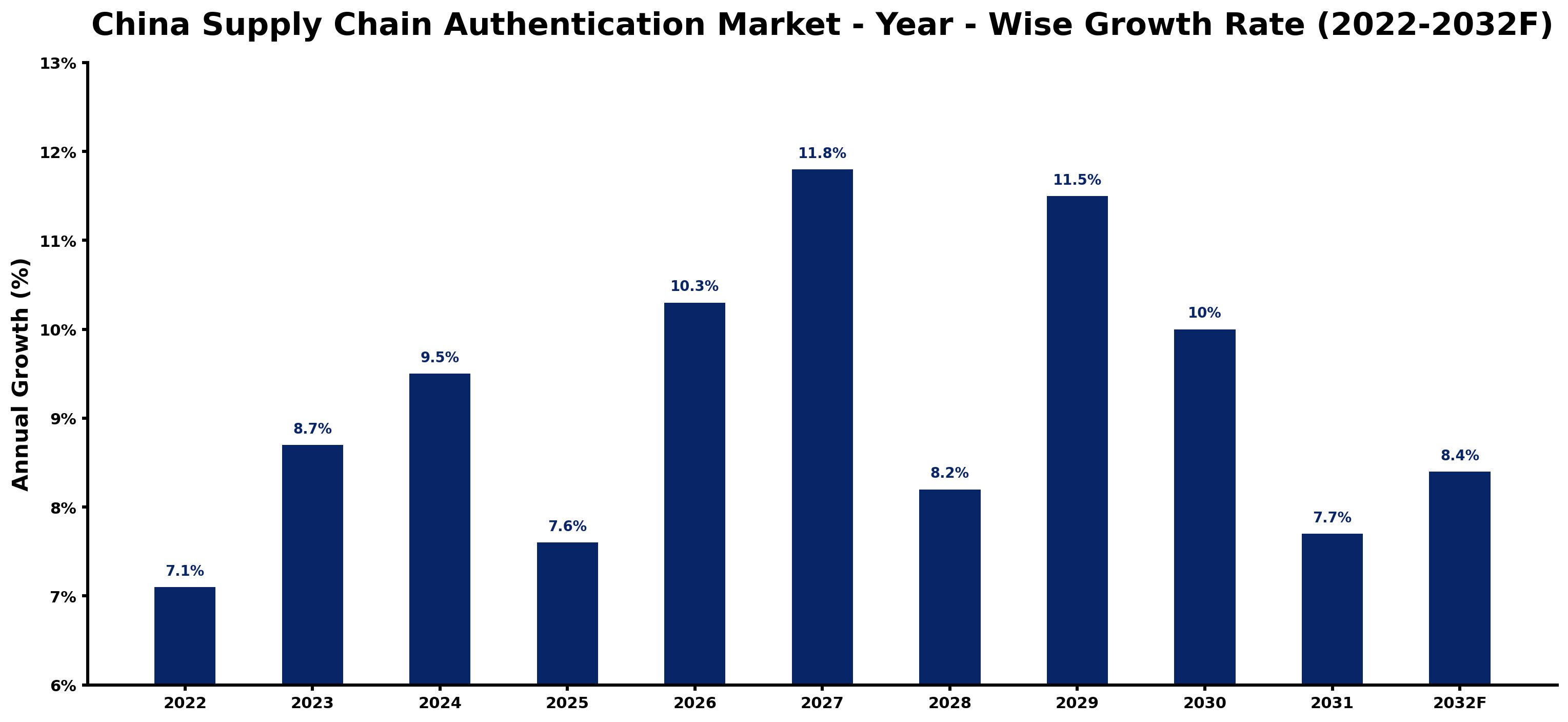
Year by year, the estimates below pair each growth rate with the development that shaped it.
| Year | Estimated Annual Growth (%) | Market Rationale |
| 2022 | 7.1 | The market experienced steady growth due to increasing awareness of product authenticity. |
| 2023 | 8.7 | A surge in demand for secure supply chains accelerated growth beyond the previous year. |
| 2024 | 9.5 | The implementation of the National Standards of China (GB/T 35273-2020) in the pharmaceutical sector further boosted market expansion. |
| 2025 | 7.6 | Growth slowed slightly as firms adjusted to evolving compliance requirements in various industries. |
| 2026 | 10.3 | The renewed focus on blockchain technology adoption is expected to spur faster growth in the market. |
| 2027 | 11.8 | Heightened investments in anti-counterfeiting solutions will drive peak growth rates. |
| 2028 | 8.2 | Market growth is projected to moderate as companies consolidate their authentication strategies. |
| 2029 | 11.5 | A resurgence in demand for luxury goods authentication will lead to increased market activity. |
| 2030 | 10.0 | Growth is expected to slow as the market reaches a more mature phase with established practices. |
| 2031 | 7.7 | Ongoing technological advancements in authentication will continue to expand the market. |
| 2032 | 8.4 | A rise in consumer demand for verified products is projected to sustain growth. |
Note: Market size estimations and growth projections presented in this report are based on 6Wresearch's proprietary forecasting methodology, utilizing the latest available industry data, government publications, and primary research inputs.
China Supply Chain Authentication Market Synopsis
Supply Chain Authentication in China involves technologies and methods used to verify product integrity and origin. This includes digital solutions like blockchain and serialization techniques, essential for preventing counterfeiting and ensuring compliance in pharmaceuticals. The China Supply Chain Authentication Market is expanding due to escalating domestic demand and exports, particularly in pharmaceuticals and electronics. The pharmaceutical sector is projected to reach a market size of 1.5 trillion yuan by 2025, driving further investment in authentication technologies. The implementation of the National Anti-Counterfeiting Technology Development Plan in 2023 supports product verification efforts.
Market Dynamics Impact Analysis (2026–2032)
| Factor | Type | Impact | Primary Segment Affected |
| Growing demand for secure product verification methods | Driver | High | Product Serialization |
| Increased investments in blockchain technology | Driver | High | Blockchain-Based Tracking |
| Rising consumer awareness of counterfeiting issues | Opportunity | High | Tamper-Proof Labels |
| Expansion of the luxury goods market | Opportunity | Medium | Luxury Goods |
| Compliance challenges in the pharmaceutical sector | Restraint | High | Pharma |
| Limited adoption of advanced technologies in smaller firms | Restraint | Medium | Electronics |
| High costs associated with implementing authentication systems | Challenge | High | Medical Supply Chains |
| Technological integration issues among supply chain partners | Challenge | Medium | Supply Chain Security Firms |
Evaluation of Drivers in China Supply Chain Authentication Market (2026–2032)
Below mentioned are some major drivers and their influence on market dynamics.
| Drivers | Primary Segment Affected | Why It Matters (Evidence) |
| Increased regulatory requirements for product verification | Pharma | The National Standards of China (GB/T 35273-2020) mandates serialization, leading to higher investments in authentication, estimated at 20% of total compliance costs. |
| Rising consumer demand for verified luxury products | Luxury Goods | Over 70% of luxury brands in China have adopted tamper-proof labels to protect brand integrity, resulting in a 30% increase in consumer trust. |
| Growing adoption of blockchain technology for transparency | Blockchain-Based Tracking | The Blockchain Technology Innovation and Application Development Plan supports widespread blockchain implementation in supply chains, with investments projected to reach 500 million yuan by 2025. |
| Expansion of e-commerce platforms requiring authentication solutions | Retail | The E-commerce Anti-Counterfeiting Action Plan promotes the use of digital certificates for online transactions, increasing demand by 25% in the sector. |
| Increased focus on supply chain security measures | Supply Chain Security Firms | The Supply Chain Security Strategy initiated in 2023 emphasizes improving authentication across industries, leading to a projected 15% increase in market size. |
The pharmaceutical sector's projected market size of 1.5 trillion yuan by 2025 necessitates effective authentication methods. Over 70% of luxury brands have implemented tamper-proof labels to protect against counterfeiting, enhancing consumer confidence. The support from the Blockchain Technology Innovation and Application Development Plan facilitates transparency in supply chains, encouraging investment in secure technologies. The E-commerce Anti-Counterfeiting Action Plan promotes digital certificates, driving demand for innovative authentication solutions in retail.
Evaluation of Restraints in China Supply Chain Authentication Market
Below mentioned are some major restraints and their influence on market dynamics.
| Market Restraint | Primary Segment Affected | Why It Matters (Evidence) |
| High costs associated with implementing authentication systems | Medical Supply Chains | Many medical supply chains face financial barriers, limiting their ability to adopt advanced authentication technologies. |
| Compliance challenges in the pharmaceutical sector | Pharma | Stringent regulations increase operational costs and complexity for pharmaceutical companies implementing authentication, raising expenses by approximately 15%. |
| Limited adoption of advanced technologies in smaller firms | Electronics | Many small electronics manufacturers lack resources to invest in necessary authentication technologies, hindering their competitiveness. |
| Technological integration issues among supply chain partners | Supply Chain Security Firms | Fragmented systems create hurdles for integrating authentication solutions across different partners, delaying implementation by an average of 6 months. |
| Market saturation in certain segments | Luxury Goods | The luxury goods market is becoming saturated with authentication solutions, limiting growth opportunities as competition intensifies. |
China Supply Chain Authentication Market Challenges
The China Supply Chain Authentication market still faces several critical issues, beginning with technology gaps. Many suppliers lack the necessary digital solutions for effective product verification, which delays compliance for pharmaceutical companies that must meet stringent regulations. Increased competition among producers results in price wars, which compromise product quality and erode trust for buyers. Rising costs associated with implementing anti-counterfeiting measures strain budgets for luxury brands, forcing them to make tough choices between quality and affordability. Regulatory changes, such as the National Standards for serialization, require swift adaptation, disrupting operations for manufacturers across the sector.
Trends in the China Supply Chain Authentication Market
Four trends stand out in the China Supply Chain Authentication Market.
- Shift from Traditional to Digital Authentication: Since 2021, the use of digital certificates for product verification has surged, with a 30% increase reported in 2023. This shift is propelled by the demand for faster and more secure verification methods, especially in e-commerce.
- Transition to Blockchain-Based Tracking: In 2021, the State Council endorsed the National Blockchain Technology Development Plan, promoting blockchain adoption throughout supply chains. This initiative is set to enhance transparency and security, attracting more investments in authentication technologies.
- Emergence of Tamper-Proof Labels: As of 2023, over 70% of luxury brands in China have implemented tamper-proof labels to combat counterfeiting. This trend highlights the growing importance of brand protection in a competitive market.
- Growing Integration of QR Code Technology: In 2022, guidelines for QR code usage in electronics supply chains were published, leading to increased adoption. This integration simplifies product tracking and boosts consumer trust in product authenticity.
Investment Opportunities in the China Supply Chain Authentication Market
Investors looking at the China Supply Chain Authentication Market should consider the following areas.
- Medical Supply Chains Seeking Advanced Solutions: Medical supply chains are increasingly pursuing authentication solutions, driven by compliance needs. The projected market size of 1.5 trillion yuan by 2025 presents an opportunity for suppliers to deliver advanced technologies.
- Luxury Goods Market Expanding: The luxury goods sector is anticipated to grow significantly, with a 10.7% increase expected until 2032. Suppliers can enter this market by providing innovative anti-counterfeiting technologies to luxury brands.
- E-commerce Platforms Requiring Authentication: With the rise of online shopping, e-commerce platforms are in need of effective authentication solutions. The E-commerce Anti-Counterfeiting Action Plan offers a pathway for suppliers to engage with these platforms.
- Investment in Blockchain Technology: The government’s push for blockchain technology adoption creates opportunities for companies offering related solutions. Suppliers can collaborate with firms in Guangdong province, a major electronics hub.
Government Initiatives in the China Supply Chain Authentication Market
The Product Quality Law, updated in 2020, mandates stricter regulations on product serialization and tracking, significantly impacting supply chain authentication in China. This law compels manufacturers to implement robust verification systems to ensure compliance and product integrity. In 2021, the National Blockchain Technology Development Plan was approved to enhance transparency and security through blockchain adoption, further solidifying the need for digital solutions. The Digital Economy Development Plan, announced in 2022, promotes the integration of digital authentication technologies, facilitating smoother operations for various sectors. These measures collectively aim to bolster consumer trust and combat counterfeiting effectively.
The Ministry of Industry and Information Technology oversees the implementation of the Digital Economy Development Plan, which funds the integration of digital authentication technologies in supply chains. The National Development and Reform Commission initiated the Supply Chain Security Strategy in 2023, focusing on improving authentication measures across industries. The E-commerce Anti-Counterfeiting Action Plan, launched by the Ministry of Commerce in 2022, promotes the use of authentication technologies in online retail, ensuring safer transactions for consumers. These initiatives support buyers by enhancing product verification processes and reducing the prevalence of counterfeit goods.
Future Insight of the China Supply Chain Authentication Market
By 2032, the China Supply Chain Authentication market is expected to evolve considerably, driven by key developments. The Digital China Initiative will integrate advanced technologies like NFC into supply chains, improving product traceability. The pharmaceutical sector is projected to grow, with a market size reaching 1.5 trillion yuan by 2025, increasing the demand for authentication solutions. The Blockchain Technology Innovation and Application Development Plan will simplify verification processes, benefiting both buyers and suppliers. A growing middle class will heighten the demand for authenticated products, prompting brands to invest in more robust supply chain practices.
Market Segmentation Analysis
Each segment group is reviewed below, with the leader by share and the fastest grower by CAGR.
By Authentication Type – Product Serialization Dominated, Blockchain-Based Tracking Expected to Grow Fastest
According to Sumit Sagar, AM at 6Wresearch, with a 49% revenue share in 2025, Product Serialization was the largest authentication type category. Product serialization holds the largest share in the China Supply Chain Authentication Market due to its critical role in ensuring compliance and traceability in pharmaceuticals. The National Standards of China outline requirements for product serialization, making it essential for buyers in this sector to maintain safety and authenticity. Blockchain-Based Tracking is projected to grow fastest, at a CAGR of 11.5% during 2026–2032. Blockchain-based tracking is rapidly gaining traction as it offers a secure and transparent method for verifying product origins. The 'Blockchain Technology Innovation and Application Development Plan' initiated by the State Council in 2021 has significantly accelerated its adoption across various sectors, ensuring its growth continues to outpace others. Suppliers should enhance their product serialization capabilities to align with regulatory demands and meet customer expectations.
By Technology Used – QR Code/RFID Dominated, Distributed Ledger Expected to Grow Fastest
QR Code/RFID accounted for a 47% market share by technology used in 2025. QR Code and RFID technologies dominate the market as they provide easy access to product information and facilitate tracking. Their widespread implementation across industries, particularly in pharmaceuticals, reinforces their leading market share and appeal to buyers seeking efficient solutions. Over 2026–2032, Distributed Ledger is expected to post the fastest growth, at a CAGR of 11.3%. Distributed ledger technology is experiencing rapid growth due to its capacity to offer secure and immutable records, which are increasingly sought after in supply chains. The rising demand for enhanced verification methods, particularly in pharmaceuticals and luxury goods, highlights its importance in the market. Buyers should invest in distributed ledger technology to bolster transparency and security within their supply chains.
By Industry Application – Pharma Dominated, Luxury Goods Expected to Grow Fastest
Pharma held a 45% share of the China Supply Chain Authentication Market by industry application in 2025. The pharmaceutical sector commands the largest share in the market, driven by stringent compliance requirements and safety concerns in drug supply chains. With China's pharmaceutical market projected to reach 1.5 trillion yuan by 2025, the demand for effective supply chain authentication will continue to escalate, making it a priority for stakeholders. Luxury Goods are set to record the highest CAGR in this split, 10.7% over 2026–2032. Luxury goods are witnessing the fastest growth as brands seek to protect their integrity and combat counterfeiting amid rising consumer awareness. The critical need for advanced authentication technologies is prompting luxury brands to invest significantly in anti-counterfeiting measures, driving this segment's rapid expansion. Suppliers targeting the luxury goods sector must prioritise authentication solutions to safeguard brand reputation and consumer trust.
By End User – Medical Supply Chains Dominated and Is Expected to Record the Fastest Growth
Medical Supply Chains took a 44% share of end user in 2025, more than any other category. Medical supply chains represent the largest share of the market, as they are vital for maintaining safety and compliance standards in healthcare. The increasing regulatory scrutiny in the medical field necessitates robust authentication measures to ensure product integrity, making this segment crucial for buyers. Medical Supply Chains are also forecast to expand faster than any other category, at a CAGR of 11.1% over 2026–2032. Medical supply chains are also the fastest-growing segment, as the demand for compliance and safety standards continues to rise. The ongoing focus on improving supply chain security in healthcare reinforces this segment's growth trajectory, ensuring its prominence in the market. Suppliers must enhance their offerings for medical supply chains to address the rising demand for stringent authentication solutions.
Key Attractiveness of the Report
- 10 Years of Market Numbers
- Historical Data Starting from 2022 to 2025
- Base Year 2025
- Forecast Data until 2032
- Key Performance Indicators Impacting the Market
- Major Upcoming Developments and Projects
Key Highlights of the Report:
- China Supply Chain Authentication Market Outlook
- Market Size of China Supply Chain Authentication Market, 2025
- Forecast of China Supply Chain Authentication Market, 2032
- Historical Data and Forecast of China Supply Chain Authentication Revenues & Volume for the Period 2022 - 2032F
- China Supply Chain Authentication Market Trend Evolution
- China Supply Chain Authentication Market Drivers and Challenges
- China Supply Chain Authentication Price Trends
- China Supply Chain Authentication Porter's Five Forces
- China Supply Chain Authentication Industry Life Cycle
- Historical Data and Forecast of China Supply Chain Authentication Market Revenues & Volume By Authentication Type for the Period 2022 - 2032F
- Historical Data and Forecast of China Supply Chain Authentication Market Revenues & Volume By Product Serialization for the Period 2022 - 2032F
- Historical Data and Forecast of China Supply Chain Authentication Market Revenues & Volume By Blockchain-Based Tracking for the Period 2022 - 2032F
- Historical Data and Forecast of China Supply Chain Authentication Market Revenues & Volume By Digital Certificates for the Period 2022 - 2032F
- Historical Data and Forecast of China Supply Chain Authentication Market Revenues & Volume By Tamper-Proof Labels for the Period 2022 - 2032F
- Historical Data and Forecast of China Supply Chain Authentication Market Revenues & Volume By Technology Used for the Period 2022 - 2032F
- Historical Data and Forecast of China Supply Chain Authentication Market Revenues & Volume By QR Code/RFID for the Period 2022 - 2032F
- Historical Data and Forecast of China Supply Chain Authentication Market Revenues & Volume By Distributed Ledger for the Period 2022 - 2032F
- Historical Data and Forecast of China Supply Chain Authentication Market Revenues & Volume By Cloud-Based API for the Period 2022 - 2032F
- Historical Data and Forecast of China Supply Chain Authentication Market Revenues & Volume By NFC for the Period 2022 - 2032F
- Historical Data and Forecast of China Supply Chain Authentication Market Revenues & Volume By Industry Application for the Period 2022 - 2032F
- Historical Data and Forecast of China Supply Chain Authentication Market Revenues & Volume By Pharma for the Period 2022 - 2032F
- Historical Data and Forecast of China Supply Chain Authentication Market Revenues & Volume By Luxury Goods for the Period 2022 - 2032F
- Historical Data and Forecast of China Supply Chain Authentication Market Revenues & Volume By Electronics for the Period 2022 - 2032F
- Historical Data and Forecast of China Supply Chain Authentication Market Revenues & Volume By Retail for the Period 2022 - 2032F
- Historical Data and Forecast of China Supply Chain Authentication Market Revenues & Volume By End User for the Period 2022 - 2032F
- Historical Data and Forecast of China Supply Chain Authentication Market Revenues & Volume By Medical Supply Chains for the Period 2022 - 2032F
- Historical Data and Forecast of China Supply Chain Authentication Market Revenues & Volume By Anti-Counterfeit Solutions for the Period 2022 - 2032F
- Historical Data and Forecast of China Supply Chain Authentication Market Revenues & Volume By Hardware OEMs for the Period 2022 - 2032F
- Historical Data and Forecast of China Supply Chain Authentication Market Revenues & Volume By Supply Chain Security Firms for the Period 2022 - 2032F
- China Supply Chain Authentication Import Export Trade Statistics
- Market Opportunity Assessment By Authentication Type
- Market Opportunity Assessment By Technology Used
- Market Opportunity Assessment By Industry Application
- Market Opportunity Assessment By End User
- China Supply Chain Authentication Top Companies Market Share
- China Supply Chain Authentication Competitive Benchmarking By Technical and Operational Parameters
- China Supply Chain Authentication Company Profiles
- China Supply Chain Authentication Key Strategic Recommendations
Market Covered
The report offers an extensive study of the following market segments.
By Authentication Type
- Product Serialization
- Blockchain-Based Tracking
- Digital Certificates
- Tamper-Proof Labels
By Technology Used
- QR Code/RFID
- Distributed Ledger
- Cloud-Based API
- NFC
By Industry Application
- Pharma
- Luxury Goods
- Electronics
- Retail
By End User
- Medical Supply Chains
- Anti-Counterfeit Solutions
- Hardware OEMs
- Supply Chain Security Firms































