China Supply Chain Optimization AI Market Size & Growth Rate
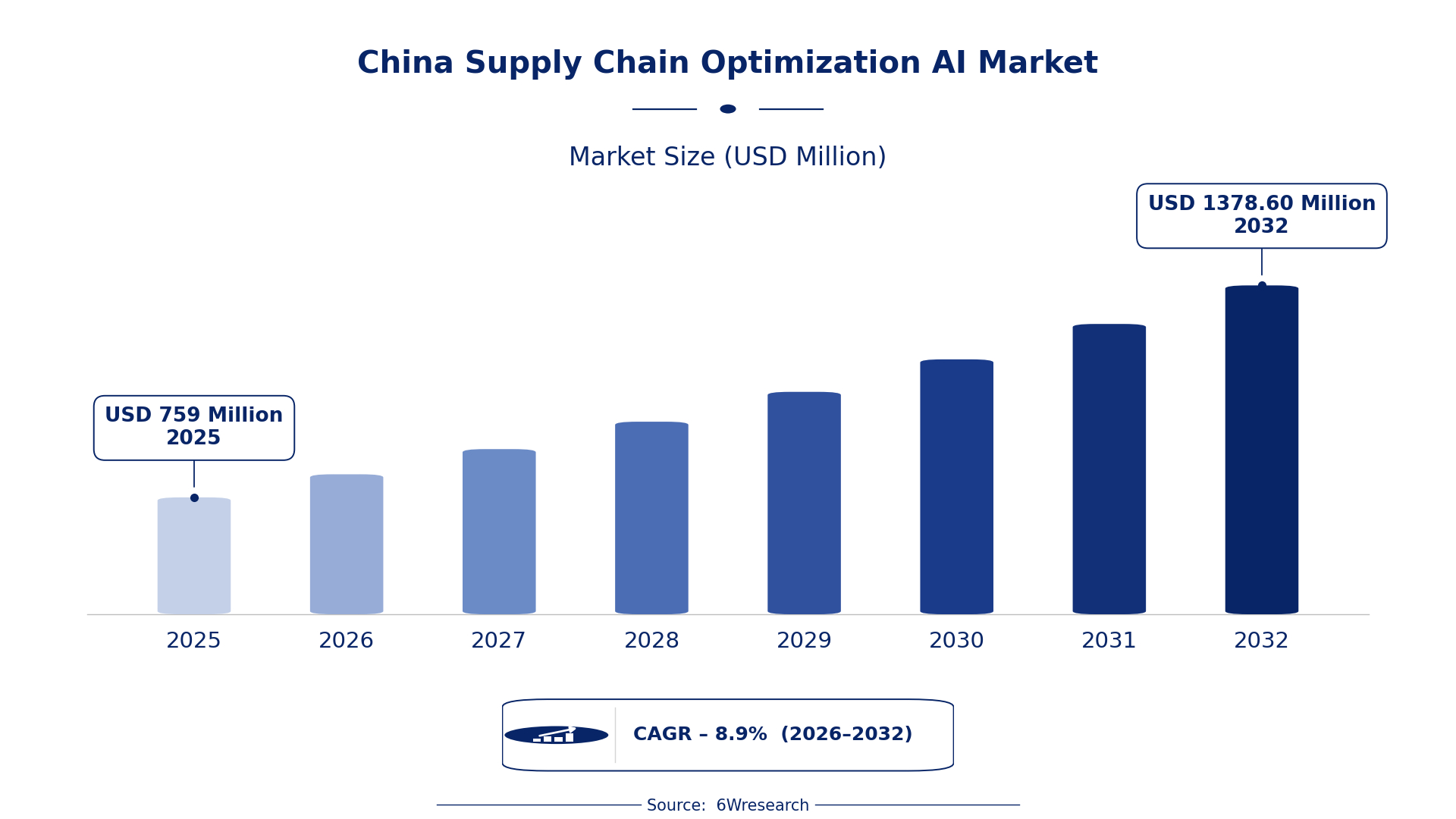
According to 6Wresearch internal database and industry insights, the China Supply Chain Optimization AI Market was valued at USD 759.0 million in 2025 and is projected to reach USD 1,378.60 million by 2032, growing at a CAGR of approximately 8.9% during 2026–2032.
China Supply Chain Optimization AI Market Highlights
| Report Metric | Details |
| Report Name | China Supply Chain Optimization AI Market |
| Market Size 2025 | USD 759.0 million |
| Market Size 2032 | USD 1,378.60 million |
| Absolute Growth 2025–2032 | USD 619.60 million |
| CAGR 2026–2032 | 8.9% |
| Peak Annual Growth | 11.0% in 2026 |
| Forecast Period | 2026–2032 |
| Historical Data | 2022–2025 |
| Base Year | 2025 |
| Leading Optimization Type, 2025 | Demand Forecasting AI (53% share) |
| Leading AI Capability, 2025 | Predictive Analytics (49% share) |
| Leading Business Function, 2025 | Inventory Planning (43% share) |
| Leading End User, 2025 | Retailers (43% share) |
| Fastest-Growing Optimization Type | Procurement AI (10.9% CAGR) |
| Fastest-Growing Business Function | Sourcing & Bidding (11.5% CAGR) |
| Fastest-Growing End User | E-commerce Fulfillment Hubs (11.6% CAGR) |
| Growing Sector | E-commerce Fulfillment Hubs |
| Key End Users | Retailers, Logistics Operators, Enterprises, E-commerce Fulfillment Hubs |
China Supply Chain Optimization AI Market Year-wise Growth Rate and Key Drivers (2022–2032)
This graph illustrates the annual growth rates of the market from 2022 to 2032, highlighting a steady upward trajectory and projected market expansion over the forecast period.
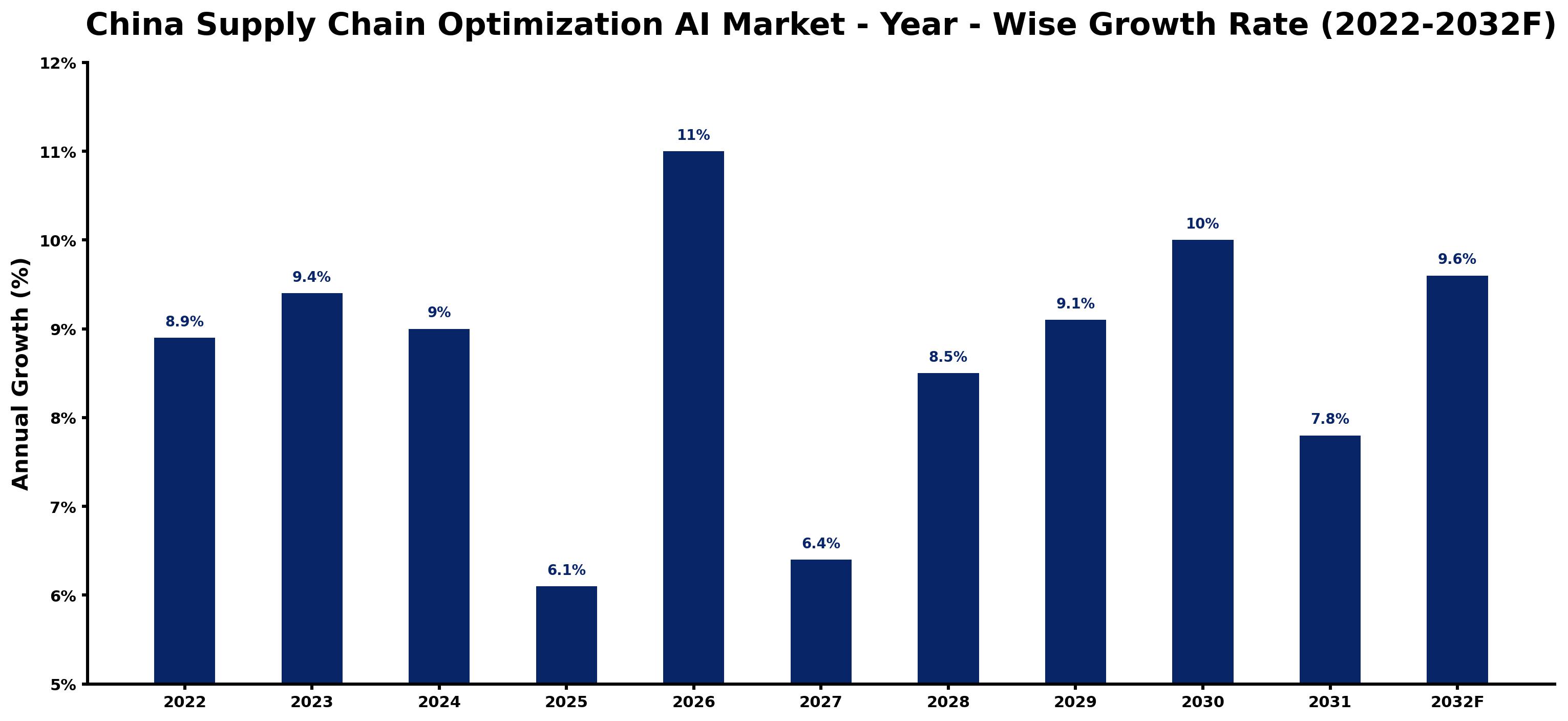
The table below sets out the estimated growth rate for each year and the main factor behind it.
| Year | Estimated Annual Growth (%) | Market Rationale |
| 2022 | 8.9 | The market saw strong demand from the logistics sector, reflecting ongoing digital transformation efforts. |
| 2023 | 9.4 | Growth accelerated due to increased e-commerce activities, boosting the need for optimization solutions. |
| 2024 | 9.0 | Demand continued but at a slower pace as companies adjusted to previous investments in AI. |
| 2025 | 6.1 | The 'National Intelligent Logistics Development Plan' began to influence purchasing decisions. |
| 2026 | 11.0 | An upturn in growth is expected as the 'AI in Supply Chain' initiative gains traction among enterprises. |
| 2027 | 6.4 | Growth is projected to slow again as companies focus on integrating existing AI solutions into operations. |
| 2028 | 8.5 | The market is expected to rebound as advancements in predictive analytics draw renewed interest from retailers. |
| 2029 | 9.1 | Demand is projected to rise again as logistics operators seek to improve efficiency through AI technologies. |
| 2030 | 10.0 | Increased investments in infrastructure will support growth as urban populations continue to rise. |
| 2031 | 7.8 | Growth is expected to moderate as businesses reassess their AI strategies in light of evolving market conditions. |
| 2032 | 9.6 | A resurgence in demand is projected as more retailers adopt AI for inventory management. |
Note: Market size estimations and growth projections presented in this report are based on 6Wresearch's proprietary forecasting methodology, utilizing the latest available industry data, government publications, and primary research inputs.
China Supply Chain Optimization AI Market Synopsis
The China Supply Chain Optimization AI Market refers to the application of artificial intelligence technologies to improve supply chain processes. This includes demand forecasting, route optimization, and real-time inventory management. The market is valued at approximately USD 759.0 million by 2025, driven by a booming logistics industry valued at around 15 trillion yuan. Factors such as the rapid growth of e-commerce, with over 2.8 trillion yuan in sales, and government initiatives like the 'AI in Supply Chain' initiative are propelling market expansion.
Market Dynamics Impact Analysis (2026–2032)
| Factor | Type | Impact | Primary Segment Affected |
| Increased e-commerce activities drive demand for efficient logistics solutions. | Driver | High | Demand Forecasting AI |
| Growing urban population necessitates improved supply chain efficiency. | Driver | High | Real-Time Optimization |
| The logistics sector is rapidly adopting AI technologies to enhance operations. | Opportunity | High | Route Optimization AI |
| The 'Digital Economy Development Plan' aims to boost AI adoption in logistics. | Opportunity | High | Procurement AI |
| Integration challenges with existing systems can hinder AI implementation. | Restraint | Medium | Inventory Planning |
| Limited understanding of AI capabilities among smaller enterprises restricts growth. | Restraint | Medium | Transportation |
| High initial investment costs can deter smaller players from adopting AI. | Challenge | Medium | Fulfillment |
| Rapid technological advancements may outpace current industry standards. | Challenge | Medium | Sourcing & Bidding |
Evaluation of Drivers in China Supply Chain Optimization AI Market (2026–2032)
The table below links each growth driver to the segment it affects and the evidence for it.
| Drivers | Primary Segment Affected | Why It Matters (Evidence) |
| Rising e-commerce sales necessitate accurate demand forecasting. | Demand Forecasting AI | E-commerce in China reached over 2.8 trillion yuan in 2022, prompting retailers to invest in AI solutions. |
| Urban population growth increases demand for efficient logistics. | Real-Time Optimization | China's urban population exceeds 900 million, driving the need for optimized supply chains. |
| AI technologies enhance operational efficiency in logistics. | Route Optimization AI | The logistics sector is valued at approximately 15 trillion yuan, encouraging investment in AI. |
| Government initiatives promote AI integration in supply chains. | Procurement AI | The Ministry of Industry and Information Technology launched the 'AI in Supply Chain' initiative in 2023. |
| Retailers are increasingly adopting AI for inventory management. | Inventory Planning | Over 80% of retailers in China are expected to adopt AI by 2025. |
E-commerce reached over 3 trillion yuan in 2022, prompting retailers to invest in AI solutions for better demand forecasting. With an urban population exceeding 900 million, the need for efficient logistics has never been greater. The logistics sector, valued at approximately 15 trillion yuan, is encouraging investment in AI technologies.
Evaluation of Restraints in China Supply Chain Optimization AI Market
The following restraints limit how fast demand can grow.
| Market Restraint | Primary Segment Affected | Why It Matters (Evidence) |
| Integration challenges with existing systems can hinder AI implementation. | Inventory Planning | Many companies struggle to integrate new AI technologies with legacy systems, delaying benefits. |
| Limited understanding of AI capabilities among smaller enterprises restricts growth. | Transportation | Smaller logistics operators often lack the resources to implement advanced AI solutions. |
| High initial investment costs can deter smaller players from adopting AI. | Fulfillment | The upfront costs associated with AI technologies can be prohibitive for many businesses. |
| Data privacy concerns may limit the sharing of necessary information. | Sourcing & Bidding | Regulatory frameworks around data protection can restrict data availability for AI training. |
| Rapid technological advancements may outpace current industry standards. | Procurement AI | Keeping up with the latest AI developments can be challenging for many companies. |
China Supply Chain Optimization AI Market Challenges
The China Supply Chain Optimization AI market still has to solve a few problems, starting with intense competition among producers. This competition arises from a saturated market with numerous players, leading to price wars that can erode profit margins for producers. Rising operational costs present a second challenge, as logistics expenses in China can consume up to 30% of total supply chain costs, straining budgets for importers. Buyers face difficulties in integrating AI technologies, with over 50% reporting inadequate training, which delays implementation and reduces efficiency. Regulatory changes can disrupt operations, causing delays for distributors and increasing lead times by up to 20%.
Trends in the China Supply Chain Optimization AI Market
Several trends are reshaping the China Supply Chain Optimization AI Market; the most important are set out below.
- Shift towards AI-Driven Logistics in Guangdong: Guangdong province is increasingly adopting AI technologies to improve logistics efficiency, with the logistics sector projected to employ over 10 million people by 2025. This shift reflects a broader trend across China.
- Transition from Manual to Automated Inventory Management: Retailers are transitioning from manual inventory management to AI-driven solutions, with over 80% expected to adopt AI by 2025. This change is motivated by the need for improved accuracy and efficiency.
- Emergence of Predictive Analytics in Supply Chains: Predictive analytics is gaining traction in supply chains, with a projected CAGR of 10.5% from 2026 to 2032. This trend is reshaping how companies forecast demand and manage inventory.
- E-commerce Fulfillment Hubs Prioritising AI Solutions: E-commerce fulfillment hubs are increasingly prioritising AI solutions to manage high order volumes, with a projected CAGR of 11.6% from 2026 to 2032. This reflects the growing need for efficiency in logistics.
Investment Opportunities in the China Supply Chain Optimization AI Market
Investors looking at the China Supply Chain Optimization AI Market should consider the following areas.
- Over 3 trillion yuan in e-commerce sales creates demand for AI solutions: The booming e-commerce sector offers opportunities to supply AI technologies that improve logistics efficiency. Retailers in urban areas are particularly keen to adopt these solutions.
- Guangdong's logistics hubs require advanced AI technologies: Guangdong province is a major logistics hub, presenting opportunities for AI suppliers to improve operational efficiency. Partnerships with local logistics operators can facilitate market entry.
- AI-driven inventory management systems are in high demand: With over 80% of retailers expected to adopt AI for inventory management by 2025, suppliers can target this growing market segment. Collaborating with retail associations can aid in penetration.
- The 'AI in Supply Chain' initiative opens avenues for investment: The government's 'AI in Supply Chain' initiative encourages investment in AI technologies. Suppliers can engage with government-backed projects to strengthen their market presence.
Government Initiatives in the China Supply Chain Optimization AI Market
In 2021, the Ministry of Industry and Information Technology launched the 'AI Innovation Action Plan' to promote AI in logistics, targeting a 30% efficiency improvement by 2025. This plan requires companies to invest in AI technologies to enhance their operational capabilities, ensuring they remain competitive in the market. The 'National Intelligent Logistics Development Plan' was approved in 2022, aiming to integrate AI technologies into logistics operations nationwide, which mandates compliance with new AI standards for logistics providers. This integration will facilitate better decision-making and efficiency across the sector.
The '14th Five-Year Plan for Logistics Development' emphasises AI implementation across supply chains to boost competitiveness by 2025. This plan encourages logistics operators to adopt AI solutions, providing funding opportunities for those who comply with its guidelines. The State Council also introduced the 'New Infrastructure Plan' in 2023 to enhance digital logistics capabilities, focusing on AI and big data, which will support the development of smart logistics systems.
Future Insight of the China Supply Chain Optimization AI Market
The Supply Chain Optimization AI market in China is poised for notable advancements by 2032, driven by several key initiatives. The 'AI in Supply Chain' initiative launched in 2023 is expected to accelerate technology adoption across logistics. By 2025, over 80% of retailers are projected to adopt AI for inventory management, improving operational efficiency. The National AI Strategy aims to position China as a global leader in AI by 2030, creating a favourable environment for innovations. These developments will ultimately streamline processes and improve efficiency for buyers and suppliers alike.
Market Segmentation Analysis
The analysis below covers each segmentation, its leading category in 2025 and its fastest-growing category through 2032.
By Optimization Type – Demand Forecasting AI Dominated, Procurement AI Expected to Grow Fastest
According to Sumit Sagar, AM at 6Wresearch, with a 53% revenue share in 2025, Demand Forecasting AI was the largest optimization type category. Demand Forecasting AI captures the largest share as it is essential for predicting future product demand, enabling retailers to align inventory with consumer trends. This technology is particularly vital in the logistics sector, which is valued at approximately 15 trillion yuan in China. Procurement AI is set to record the highest CAGR in this split, 10.9% over 2026–2032. Procurement AI is experiencing rapid growth due to the increasing reliance on data analysis for informed purchasing decisions. The expansion of e-commerce, which reached over 2.8 trillion yuan in 2022, is propelling this segment as businesses seek to enhance supplier evaluation processes. Suppliers should focus on developing advanced procurement solutions to meet the rising demand from businesses aiming to optimise their purchasing operations.
By AI Capability – Predictive Analytics Dominated and Is Expected to Record the Fastest Growth
Predictive Analytics held a 49% share of the China Supply Chain Optimization AI Market by ai capability in 2025. Predictive Analytics holds the largest share as it is crucial for analysing trends that forecast supply chain performance and risks. This capability allows companies to proactively manage their supply chains, minimising disruptions and enhancing overall efficiency in a competitive market. Its lead should widen, with a projected CAGR of 10.5% during 2026–2032, the highest in this split. Predictive Analytics is also the fastest-growing segment, as its applications across various sectors are expanding significantly. The increasing demand for accurate forecasting in supply chain management is driving this growth, ensuring businesses remain agile and responsive to market changes. Buyers should invest in predictive analytics tools to improve their decision-making processes and maintain a competitive edge in the market.
By Business Function – Inventory Planning Dominated, Sourcing & Bidding Expected to Grow Fastest
In 2025, Inventory Planning led the business function split with a 43% share. Inventory Planning leads the market share as it plays a fundamental role in managing stock levels and minimising excess inventory, which is critical for retailers. Effective inventory management directly impacts profitability and customer satisfaction, making it a priority for businesses in the thriving logistics sector. Over 2026–2032, Sourcing & Bidding is expected to post the fastest growth, at a CAGR of 11.5%. Sourcing & Bidding is the fastest-growing function as companies seek to improve supplier selection and contract negotiations amid rising competition. The necessity for efficient procurement processes is becoming increasingly important as businesses aim to optimise costs and enhance supplier relationships. Suppliers must enhance their offerings in sourcing and bidding solutions to meet the growing demand from businesses looking to streamline their procurement processes.
By End User – Retailers Dominated, E-commerce Fulfillment Hubs Expected to Grow Fastest
The largest end user category in 2025 was Retailers, with a 43% share of total revenue. Retailers dominate the market share as they are the primary users of supply chain optimisation technologies, which enhance customer experience through improved inventory management and demand forecasting. The competitive retail landscape in China necessitates the adoption of these technologies to effectively meet consumer expectations. The quickest growth will come from E-commerce Fulfillment Hubs, forecast to expand at a CAGR of 11.6% between 2026 and 2032. E-commerce Fulfillment Hubs are experiencing the fastest growth, driven by the surge in online shopping and the need for efficient order management. As e-commerce continues to expand, these hubs are essential for handling high volumes of orders and ensuring timely deliveries. Suppliers should tailor their solutions to meet the specific needs of e-commerce fulfillment hubs, which are crucial for managing the increasing demand for fast and reliable order processing.
Key Attractiveness of the Report
- 10 Years of Market Numbers
- Historical Data Starting from 2022 to 2025
- Base Year 2025
- Forecast Data until 2032
- Key Performance Indicators Impacting the Market
- Major Upcoming Developments and Projects
Key Highlights of the Report:
- China Supply Chain Optimization AI Market Outlook
- Market Size of China Supply Chain Optimization AI Market, 2025
- Forecast of China Supply Chain Optimization AI Market, 2032
- Historical Data and Forecast of China Supply Chain Optimization AI Revenues & Volume for the Period 2022 - 2032F
- China Supply Chain Optimization AI Market Trend Evolution
- China Supply Chain Optimization AI Market Drivers and Challenges
- China Supply Chain Optimization AI Price Trends
- China Supply Chain Optimization AI Porter's Five Forces
- China Supply Chain Optimization AI Industry Life Cycle
- Historical Data and Forecast of China Supply Chain Optimization AI Market Revenues & Volume By Optimization Type for the Period 2022 - 2032F
- Historical Data and Forecast of China Supply Chain Optimization AI Market Revenues & Volume By Demand Forecasting AI for the Period 2022 - 2032F
- Historical Data and Forecast of China Supply Chain Optimization AI Market Revenues & Volume By Route Optimization AI for the Period 2022 - 2032F
- Historical Data and Forecast of China Supply Chain Optimization AI Market Revenues & Volume By Procurement AI for the Period 2022 - 2032F
- Historical Data and Forecast of China Supply Chain Optimization AI Market Revenues & Volume By Real-Time Optimization for the Period 2022 - 2032F
- Historical Data and Forecast of China Supply Chain Optimization AI Market Revenues & Volume By AI Capability for the Period 2022 - 2032F
- Historical Data and Forecast of China Supply Chain Optimization AI Market Revenues & Volume By Predictive Analytics for the Period 2022 - 2032F
- Historical Data and Forecast of China Supply Chain Optimization AI Market Revenues & Volume By Machine Learning for the Period 2022 - 2032F
- Historical Data and Forecast of China Supply Chain Optimization AI Market Revenues & Volume By NLP/Automation for the Period 2022 - 2032F
- Historical Data and Forecast of China Supply Chain Optimization AI Market Revenues & Volume By Reinforcement Learning for the Period 2022 - 2032F
- Historical Data and Forecast of China Supply Chain Optimization AI Market Revenues & Volume By Business Function for the Period 2022 - 2032F
- Historical Data and Forecast of China Supply Chain Optimization AI Market Revenues & Volume By Inventory Planning for the Period 2022 - 2032F
- Historical Data and Forecast of China Supply Chain Optimization AI Market Revenues & Volume By Transportation for the Period 2022 - 2032F
- Historical Data and Forecast of China Supply Chain Optimization AI Market Revenues & Volume By Sourcing & Bidding for the Period 2022 - 2032F
- Historical Data and Forecast of China Supply Chain Optimization AI Market Revenues & Volume By Fulfillment for the Period 2022 - 2032F
- Historical Data and Forecast of China Supply Chain Optimization AI Market Revenues & Volume By End User for the Period 2022 - 2032F
- Historical Data and Forecast of China Supply Chain Optimization AI Market Revenues & Volume By Retailers for the Period 2022 - 2032F
- Historical Data and Forecast of China Supply Chain Optimization AI Market Revenues & Volume By Logistics Operators for the Period 2022 - 2032F
- Historical Data and Forecast of China Supply Chain Optimization AI Market Revenues & Volume By Enterprises for the Period 2022 - 2032F
- Historical Data and Forecast of China Supply Chain Optimization AI Market Revenues & Volume By E-commerce Fulfillment Hubs for the Period 2022 - 2032F
- China Supply Chain Optimization AI Import Export Trade Statistics
- Market Opportunity Assessment By Optimization Type
- Market Opportunity Assessment By AI Capability
- Market Opportunity Assessment By Business Function
- Market Opportunity Assessment By End User
- China Supply Chain Optimization AI Top Companies Market Share
- China Supply Chain Optimization AI Competitive Benchmarking By Technical and Operational Parameters
- China Supply Chain Optimization AI Company Profiles
- China Supply Chain Optimization AI Key Strategic Recommendations
Market Covered
The report offers an extensive study of the following market segments.
By Optimization Type
- Demand Forecasting AI
- Route Optimization AI
- Procurement AI
- Real-Time Optimization
By AI Capability
- Predictive Analytics
- Machine Learning
- NLP/Automation
- Reinforcement Learning
By Business Function
- Inventory Planning
- Transportation
- Sourcing & Bidding
- Fulfillment
By End User
- Retailers
- Logistics Operators
- Enterprises
- E-commerce Fulfillment Hubs































