China Surgical Workflow Software Market Size & Growth Rate
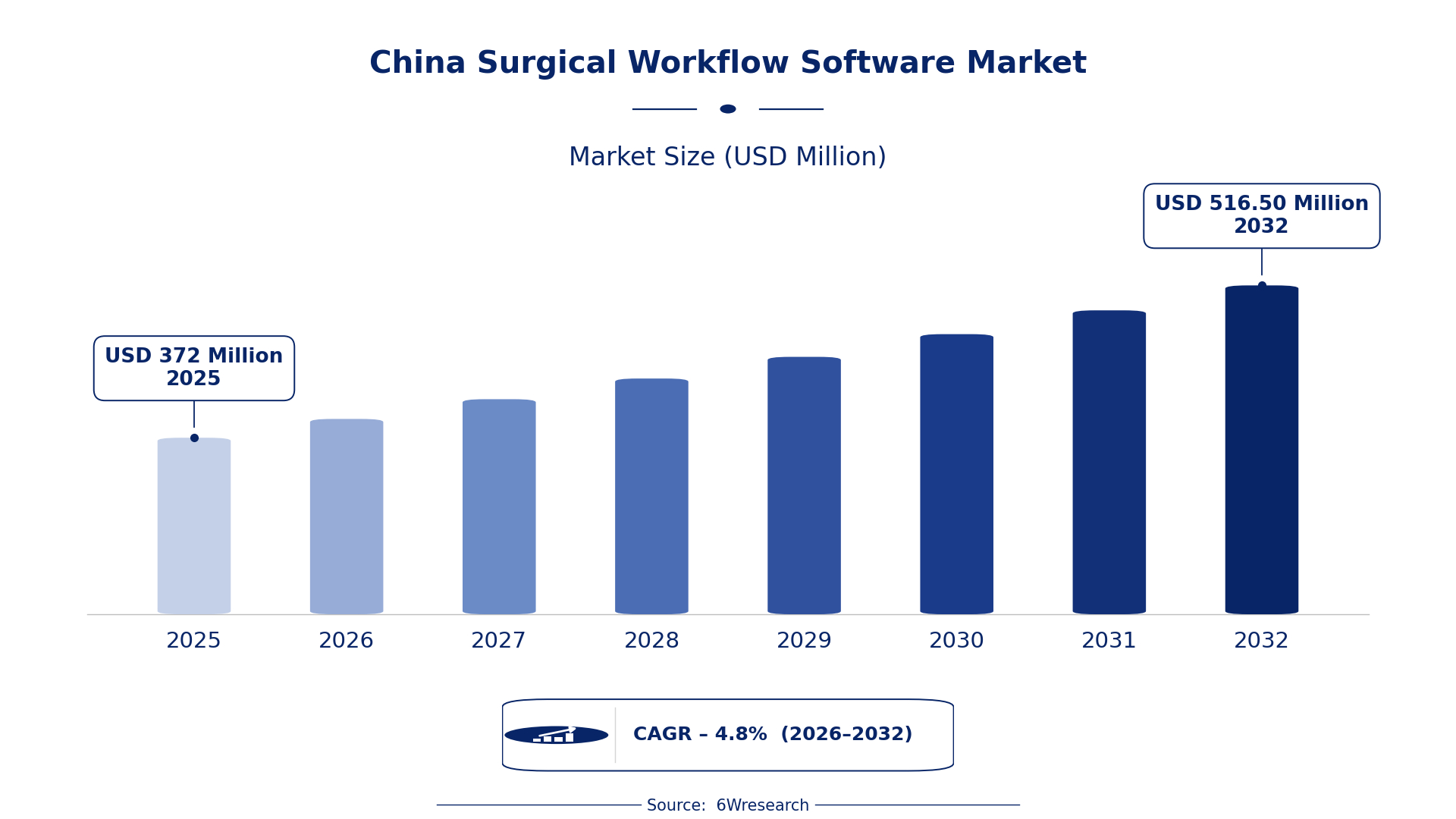
According to 6Wresearch internal database and industry insights, the China Surgical Workflow Software Market was valued at USD 372.0 million in 2025 and is projected to reach USD 516.50 million by 2032, growing at a CAGR of approximately 4.8% during 2026–2032.
China Surgical Workflow Software Market Highlights
| Report Metric | Details |
| Report Name | China Surgical Workflow Software Market |
| Market Size 2025 | USD 372.0 million |
| Market Size 2032 | USD 516.50 million |
| Absolute Growth 2025–2032 | USD 144.50 million |
| CAGR 2026–2032 | 4.8% |
| Peak Annual Growth | 7.4% in 2031 |
| Forecast Period | 2026–2032 |
| Historical Data | 2022–2025 |
| Base Year | 2025 |
| Leading Software Type, 2025 | OR Scheduling Software (41% share) |
| Leading Core Function, 2025 | Workflow Optimization (35% share) |
| Leading Deployment Model, 2025 | Cloud/On-prem (42% share) |
| Leading End User, 2025 | Hospital Admins (40% share) |
| Fastest-Growing Software Type | Data Analytics Tools (7.6% CAGR) |
| Fastest-Growing Deployment Model | SaaS (6.5% CAGR) |
| Fastest-Growing End User | Health IT Teams (6.7% CAGR) |
| Growing Sector | Healthcare |
| Key End Users | Hospitals, Surgical Departments, Health IT Teams, Hospital Administrators |
China Surgical Workflow Software Market Year-wise Growth Rate and Key Drivers (2022–2032)
This graph illustrates the annual growth rates of the market from 2022 to 2032, highlighting a steady upward trajectory and projected market expansion over the forecast period.
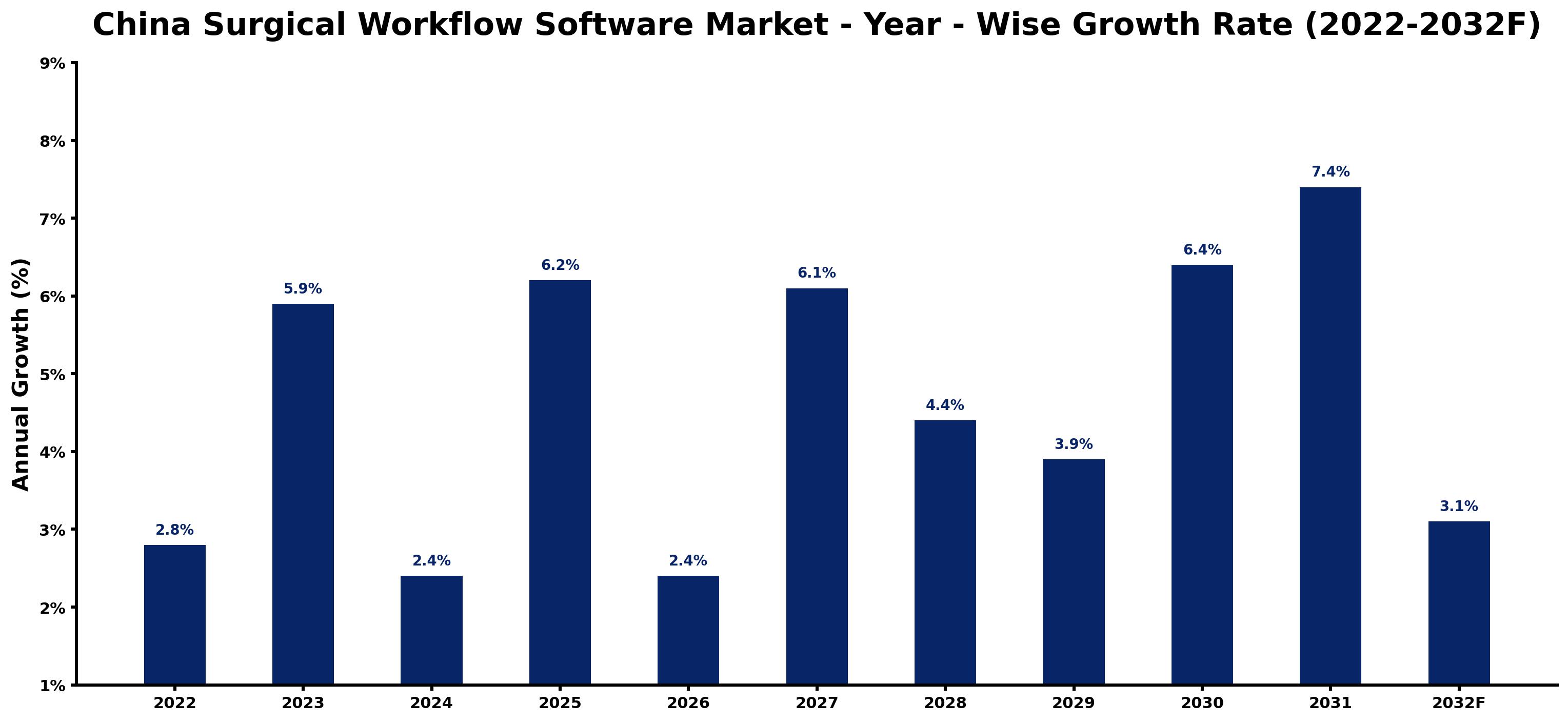
The table below sets out the estimated growth rate for each year and the main factor behind it.
| Year | Estimated Annual Growth (%) | Market Rationale |
| 2022 | 2.8 | The market experienced steady growth as hospitals began integrating digital solutions into surgical processes. |
| 2023 | 5.9 | Increased adoption of surgical workflow software was driven by the Ministry of Health's digital health initiative. |
| 2024 | 2.4 | Growth slowed as hospitals faced challenges in fully implementing advanced software solutions. |
| 2025 | 6.2 | The market rebounded with faster growth due to the rising number of surgical procedures performed annually. |
| 2026 | 2.4 | A slowdown occurred as hospitals adjusted to the new technologies and workflows introduced. |
| 2027 | 6.1 | Demand surged as hospitals continued to improve operational efficiencies through software integration. |
| 2028 | 4.4 | Growth decelerated as hospitals focused on optimising existing systems rather than new investments. |
| 2029 | 3.9 | The market saw a further slowdown as hospitals prioritised budget constraints amid ongoing digital transformations. |
| 2030 | 6.4 | Growth accelerated again as hospitals recognised the benefits of improved surgical outcomes from software use. |
| 2031 | 7.4 | The market peaked with advancements in surgical navigation systems integrated into workflows. |
| 2032 | 3.1 | A slowdown in growth was noted as the market matured and hospitals stabilised their software use. |
Note: Market size estimations and growth projections presented in this report are based on 6Wresearch's proprietary forecasting methodology, utilizing the latest available industry data, government publications, and primary research inputs.
China Surgical Workflow Software Market Synopsis
The China Surgical Workflow Software Market includes technologies aimed at optimising surgical processes within hospitals. This software combines functions such as scheduling, instrument tracking, and data management to improve efficiency and ensure patient safety. In 2023, more than 30% of hospitals adopted this software, indicating a rising demand. Initiatives from the Ministry of Health and the anticipated growth in surgical procedures are driving this expansion.
Market Dynamics Impact Analysis (2026–2032)
| Factor | Type | Impact | Primary Segment Affected |
| Growing adoption of digital solutions in hospitals | Driver | High | OR Scheduling Software |
| Increased number of surgical procedures annually | Driver | High | OR Scheduling Software |
| Integration of advanced software in surgical departments | Opportunity | High | Data Analytics Tools |
| Expansion of cloud-based solutions in healthcare | Opportunity | Medium | Cloud/On-prem |
| Budget constraints limiting software investments | Restraint | High | OR Scheduling Software |
| Challenges in training staff on new technologies | Restraint | Medium | OR Scheduling Software |
| Limited integration capabilities with existing systems | Challenge | High | OR Scheduling Software |
| Regulatory compliance requirements delaying adoption | Challenge | Medium | OR Scheduling Software |
Evaluation of Drivers in China Surgical Workflow Software Market (2026–2032)
Below mentioned are some major drivers and their influence on market dynamics.
| Drivers | Primary Segment Affected | Why It Matters (Evidence) |
| Increased funding for digital transformation in healthcare | OR Scheduling Software | In 2023, the government allocated 500 million RMB for the Smart Hospital Initiative, prompting hospitals to invest in software. |
| Rising number of surgical procedures per hospital | OR Scheduling Software | With approximately 1,200 procedures annually, hospitals are seeking efficient scheduling and tracking solutions. |
| Integration of surgical navigation systems | Surgical Navigation | These systems improve precision in surgeries, leading to increased adoption of workflow software. |
| Growing emphasis on data analytics for patient outcomes | Data Analytics Tools | The National Health Commission promotes data analytics in surgical departments, driving software demand. |
| Cloud-based solutions offering flexibility | Cloud/On-prem | The growth rate for cloud-based solutions is expected to reach 20% by 2026, attracting hospitals. |
Market growth for Surgical Workflow Software in China is underpinned by the increasing number of surgical procedures and the integration of advanced technologies. Approximately 1,200 surgical procedures are performed annually per hospital, driving demand for efficient scheduling and tracking. The push for data analytics tools in surgical departments further fuels software adoption. The expected growth of cloud-based solutions by 2026 highlights a shift towards flexible software options in healthcare facilities.
Evaluation of Restraints in China Surgical Workflow Software Market
Below mentioned are some major restraints and their influence on market dynamics.
| Market Restraint | Primary Segment Affected | Why It Matters (Evidence) |
| Budget constraints limiting software investments | OR Scheduling Software | Many hospitals face tight budgets, restricting their ability to invest in new technologies. |
| Challenges in training staff on new technologies | OR Scheduling Software | Hospitals struggle to train staff effectively, delaying the implementation of new software solutions. |
| Limited integration capabilities with existing systems | OR Scheduling Software | Incompatibility with legacy systems can hinder the adoption of new workflow software. |
| Regulatory compliance requirements delaying adoption | OR Scheduling Software | Hospitals must navigate complex regulations, which can slow down software implementation. |
| Concerns over data security and privacy | Data Analytics Tools | Hospitals are cautious about adopting analytics tools due to potential data breaches. |
China Surgical Workflow Software Market Challenges
Hospitals in the China surgical workflow software market encounter regulatory obstacles that can postpone software implementation, resulting in an average operational inefficiency cost of 15%. Supply chain disruptions complicate access, with 30% of facilities reporting delays in critical software updates, leading to increased downtime in surgical departments. Integration issues remain, as 70% of health IT teams find it challenging to merge new software with existing systems, causing a 20% rise in training expenses for staff. Hospitals may need to allocate up to 25% of their IT budgets to implement these advanced workflow solutions, putting pressure on their financial resources.
Trends in the China Surgical Workflow Software Market
Several trends are reshaping the China Surgical Workflow Software Market; the most important are set out below.
- Shift towards Cloud-based Solutions: Hospitals are increasingly adopting cloud-based surgical workflow software for its flexibility and cost-effectiveness. In 2023, over 30% of hospitals implemented such solutions, reflecting a growing trend towards digital transformation.
- Integration of Surgical Navigation Systems: Surgical navigation systems are becoming a standard feature in workflow software, improving precision in procedures. This integration is expected to rise, with more hospitals recognising its benefits for patient outcomes.
- Increased Focus on Data Analytics: Healthcare facilities are prioritising data analytics tools to improve surgical outcomes. The National Health Commission's initiative promotes these tools, leading to a notable increase in their adoption across surgical departments.
- Growth in Workflow Optimization Features: Workflow optimization is gaining traction as hospitals seek to improve operational efficiency. The share of this feature in surgical workflow software is projected to grow, driven by the need for streamlined processes.
Investment Opportunities in the China Surgical Workflow Software Market
Some of the investment opportunities in the China Surgical Workflow Software Market are mentioned below.
- Investment in Smart Hospitals: The Smart Hospital Initiative presents an opportunity for software suppliers, with 500 million RMB allocated for digital transformation. Hospitals across China are looking to improve their surgical workflows.
- Expansion of Data Analytics Tools: With the National Health Commission promoting data analytics, there is a growing demand for these tools. Suppliers can target surgical departments looking to improve patient outcomes through analytics.
- Cloud-based Solutions Adoption: The expected 20% growth in cloud-based surgical workflow solutions by 2026 indicates a market gap. Suppliers can enter by partnering with hospitals to provide tailored cloud solutions.
- Enhancing Surgical Navigation Integration: As surgical navigation systems are increasingly integrated into workflow software, suppliers have an opportunity to develop advanced solutions. Hospitals are actively seeking these technologies to improve surgical precision.
Government Initiatives in the China Surgical Workflow Software Market
In 2021, the National Health Commission launched the 'Digital Health Promotion Plan' to improve healthcare IT infrastructure across 1,500 hospitals by 2025. This initiative supports the integration of advanced software solutions in surgical departments. In 2022, the Ministry of Industry and Information Technology introduced the 'Healthcare IT Development Strategy', focusing on the adoption of digital technologies in healthcare. The establishment of the 'National Standards for Surgical Workflow Software' in 2022 ensures quality and interoperability among systems, benefiting producers and buyers alike.
The 'Smart Hospital Initiative' provides funding for digital transformation projects, with a budget of 600 million RMB approved in 2023 to support the adoption of surgical workflow software. The 'Healthcare Quality Improvement Program' mandates the use of data analytics tools in surgical workflows, improving patient outcomes. Health IT teams in hospitals are responsible for implementing these approved technologies, ensuring compliance with national standards.
Future Insight of the China Surgical Workflow Software Market
By 2032, buyers and suppliers in the China surgical workflow software market can expect substantial advancements, with 50% of surgical departments projected to adopt these technologies. This shift will be driven by the government's digital health initiative, which aims to fund 1,000 hospitals, and the rising popularity of cloud-based solutions, expected to grow at 20% annually. Enhanced integration of surgical navigation systems will improve precision in procedures, while the adoption of ISO 9001 standards will elevate software quality, ultimately benefiting healthcare providers and patients alike.
Market Segmentation Analysis
The analysis below covers each segmentation, its leading category in 2025 and its fastest-growing category through 2032.
By Software Type – OR Scheduling Software Dominated, Data Analytics Tools Expected to Grow Fastest
According to Sumit Sagar, AM at 6Wresearch, with a 41% revenue share in 2025, OR Scheduling Software was the largest software type category. OR Scheduling Software commands the largest share as it plays a crucial role in managing surgical schedules efficiently across hospitals. With over 30% of hospitals in China implementing this software, it is essential for optimising surgical workflow management. Data Analytics Tools are set to record the highest CAGR in this split, 7.6% over 2026–2032. Data Analytics Tools are experiencing rapid growth due to the increasing focus on using data to improve surgical outcomes. The National Health Commission's efforts to promote these tools within surgical departments are significantly driving their adoption. Suppliers should focus on enhancing data analytics capabilities to meet the growing needs of healthcare providers.
By Core Function – Workflow Optimization Dominated and Is Expected to Record the Fastest Growth
Workflow Optimization accounted for a 35% market share by core function in 2025. Workflow Optimization leads the market because it is essential for improving surgical workflows and enhancing overall efficiency in hospital settings. Its significance is highlighted by the positive effects it has on patient safety and operational effectiveness. The same category is also set to grow fastest, at a CAGR of 6.9% during 2026–2032. The growth of Workflow Optimization will continue as hospitals adopt more digital solutions to streamline surgical processes. The Ministry of Health's digital health initiative further supports this ongoing trend. Investing in advanced workflow optimization solutions will help buyers achieve better surgical outcomes.
By Deployment Model – Cloud/On-prem Dominated, SaaS Expected to Grow Fastest
The largest deployment model category in 2025 was Cloud/On-prem, with a 42% share of total revenue. Cloud/On-prem holds the largest share due to its adaptability to various hospital infrastructure needs, allowing facilities to choose the best fit for their operations. This flexibility is vital as hospitals aim to modernise their surgical processes. The quickest growth will come from SaaS, forecast to expand at a CAGR of 6.5% between 2026 and 2032. SaaS is growing rapidly because it offers flexibility and lower upfront costs, making it attractive for hospitals looking to implement surgical workflow software. The increasing number of hospitals adopting cloud-based solutions reflects this trend. Suppliers should prioritise developing SaaS models to cater to the rising demand for cost-effective and flexible software solutions.
By End User – Hospital Admins Dominated, Health IT Teams Expected to Grow Fastest
Hospital Admins took a 40% share of end user in 2025, more than any other category. Hospital Admins hold the largest share in the market as they are the primary users responsible for managing surgical workflows effectively. Their central role ensures that surgical operations are conducted smoothly across various hospital departments. Health IT Teams are projected to grow fastest, at a CAGR of 6.7% during 2026–2032. Health IT Teams are experiencing the fastest growth as their expertise is vital for implementing and maintaining surgical workflow software in hospitals. As healthcare facilities digitise their surgical processes, the demand for their skills is increasing rapidly. Suppliers should collaborate with Health IT Teams to ensure their solutions meet the evolving technical needs of modern healthcare.
Key Attractiveness of the Report
- 10 Years of Market Numbers
- Historical Data Starting from 2022 to 2025
- Base Year 2025
- Forecast Data until 2032
- Key Performance Indicators Impacting the Market
- Major Upcoming Developments and Projects
Key Highlights of the Report:
- China Surgical Workflow Software Market Outlook
- Market Size of China Surgical Workflow Software Market, 2025
- Forecast of China Surgical Workflow Software Market, 2032
- Historical Data and Forecast of China Surgical Workflow Software Revenues & Volume for the Period 2022 - 2032F
- China Surgical Workflow Software Market Trend Evolution
- China Surgical Workflow Software Market Drivers and Challenges
- China Surgical Workflow Software Price Trends
- China Surgical Workflow Software Porter's Five Forces
- China Surgical Workflow Software Industry Life Cycle
- Historical Data and Forecast of China Surgical Workflow Software Market Revenues & Volume By Software Type for the Period 2022 - 2032F
- Historical Data and Forecast of China Surgical Workflow Software Market Revenues & Volume By OR Scheduling Software for the Period 2022 - 2032F
- Historical Data and Forecast of China Surgical Workflow Software Market Revenues & Volume By Instrument Tracking for the Period 2022 - 2032F
- Historical Data and Forecast of China Surgical Workflow Software Market Revenues & Volume By Surgical Navigation for the Period 2022 - 2032F
- Historical Data and Forecast of China Surgical Workflow Software Market Revenues & Volume By Data Analytics Tools for the Period 2022 - 2032F
- Historical Data and Forecast of China Surgical Workflow Software Market Revenues & Volume By Core Function for the Period 2022 - 2032F
- Historical Data and Forecast of China Surgical Workflow Software Market Revenues & Volume By Case Management for the Period 2022 - 2032F
- Historical Data and Forecast of China Surgical Workflow Software Market Revenues & Volume By Asset Management for the Period 2022 - 2032F
- Historical Data and Forecast of China Surgical Workflow Software Market Revenues & Volume By Image Integration for the Period 2022 - 2032F
- Historical Data and Forecast of China Surgical Workflow Software Market Revenues & Volume By Workflow Optimization for the Period 2022 - 2032F
- Historical Data and Forecast of China Surgical Workflow Software Market Revenues & Volume By Deployment Model for the Period 2022 - 2032F
- Historical Data and Forecast of China Surgical Workflow Software Market Revenues & Volume By Cloud/On-prem for the Period 2022 - 2032F
- Historical Data and Forecast of China Surgical Workflow Software Market Revenues & Volume By Barcode/RFID for the Period 2022 - 2032F
- Historical Data and Forecast of China Surgical Workflow Software Market Revenues & Volume By On-Premise for the Period 2022 - 2032F
- Historical Data and Forecast of China Surgical Workflow Software Market Revenues & Volume By SaaS for the Period 2022 - 2032F
- Historical Data and Forecast of China Surgical Workflow Software Market Revenues & Volume By End User for the Period 2022 - 2032F
- Historical Data and Forecast of China Surgical Workflow Software Market Revenues & Volume By Hospital Admins for the Period 2022 - 2032F
- Historical Data and Forecast of China Surgical Workflow Software Market Revenues & Volume By Sterile Processing Units for the Period 2022 - 2032F
- Historical Data and Forecast of China Surgical Workflow Software Market Revenues & Volume By OR Teams for the Period 2022 - 2032F
- Historical Data and Forecast of China Surgical Workflow Software Market Revenues & Volume By Health IT Teams for the Period 2022 - 2032F
- China Surgical Workflow Software Import Export Trade Statistics
- Market Opportunity Assessment By Software Type
- Market Opportunity Assessment By Core Function
- Market Opportunity Assessment By Deployment Model
- Market Opportunity Assessment By End User
- China Surgical Workflow Software Top Companies Market Share
- China Surgical Workflow Software Competitive Benchmarking By Technical and Operational Parameters
- China Surgical Workflow Software Company Profiles
- China Surgical Workflow Software Key Strategic Recommendations
Market Covered
Segments analysed in this report are listed below.
By Software Type
- OR Scheduling Software
- Instrument Tracking
- Surgical Navigation
- Data Analytics Tools
By Core Function
- Case Management
- Asset Management
- Image Integration
- Workflow Optimization
By Deployment Model
- Cloud/On-prem
- Barcode/RFID
- On-Premise
- SaaS
By End User
- Hospital Admins
- Sterile Processing Units
- OR Teams
- Health IT Teams































