China Sustainable Baby Care Products Market Size & Growth Rate
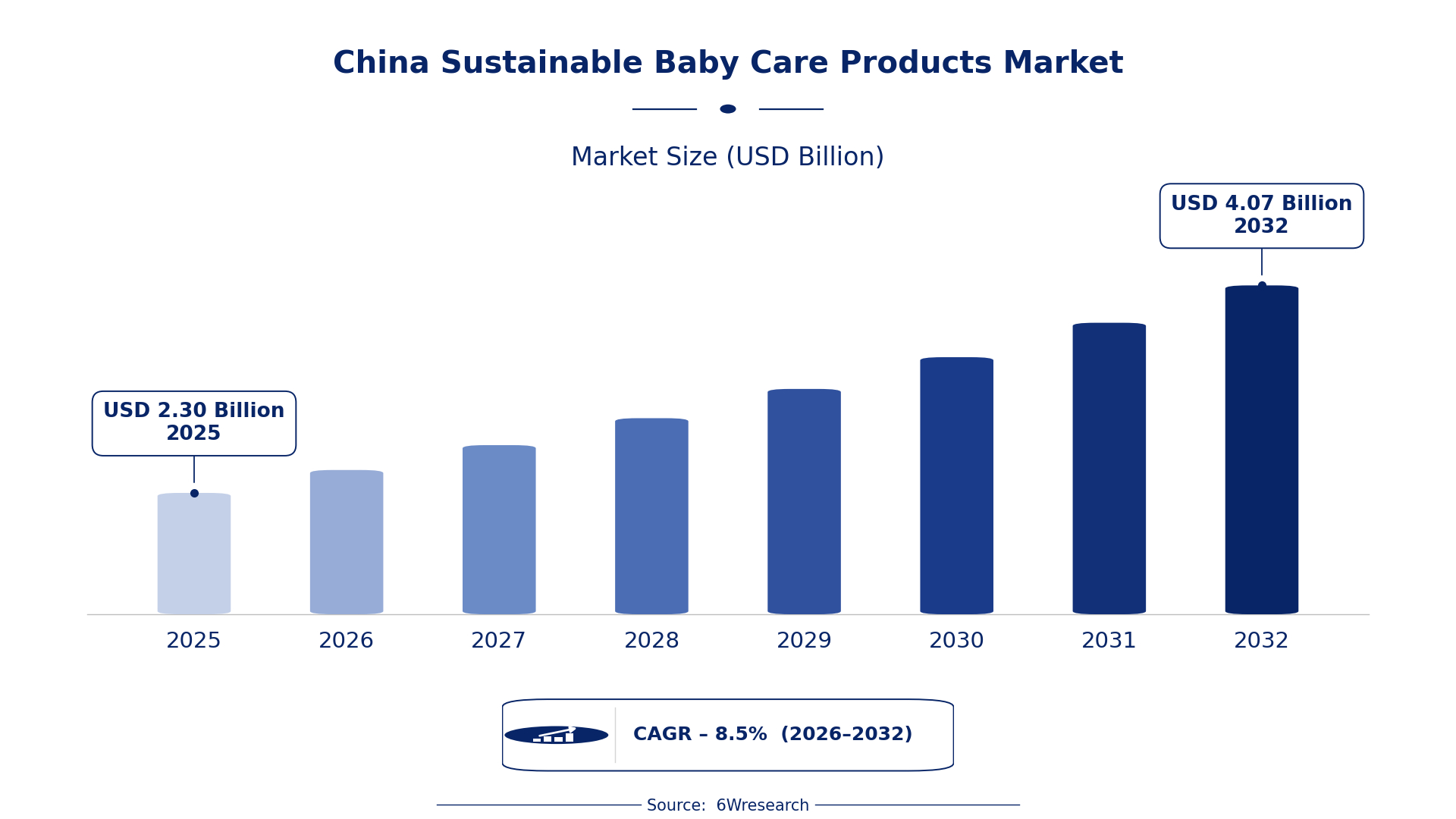
According to 6Wresearch internal database and industry insights, the China Sustainable Baby Care Products Market was valued at USD 2.30 billion in 2025 and is projected to reach USD 4.07 billion by 2032, growing at a CAGR of approximately 8.5% during 2026–2032.
China Sustainable Baby Care Products Market Highlights
| Report Metric | Details |
| Report Name | China Sustainable Baby Care Products Market |
| Market Size 2025 | USD 2.30 billion |
| Market Size 2032 | USD 4.07 billion |
| Absolute Growth 2025–2032 | USD 1.77 billion |
| CAGR 2026–2032 | 8.5% |
| Peak Annual Growth | 10.7% in 2026 |
| Forecast Period | 2026–2032 |
| Historical Data | 2022–2025 |
| Base Year | 2025 |
| Leading Product Type, 2025 | Diapers (49% share) |
| Leading Material Source, 2025 | Organic/Plant-Based (36% share) |
| Leading Age Group, 2025 | 0–2 years (49% share) |
| Leading Distribution Channel, 2025 | Online Retailers (42% share) |
| Fastest-Growing Product Type | Baby Wipes (10.6% CAGR) |
| Fastest-Growing Material Source | Biodegradable Fiber (11.1% CAGR) |
| Fastest-Growing Age Group | Toddlers (11.1% CAGR) |
| Growing Sector | Eco-friendly baby care products |
| Key End Users | Urban parents, eco-conscious families, health-focused consumers, online shoppers |
China Sustainable Baby Care Products Market Year-wise Growth Rate and Key Drivers (2022–2032)
This graph illustrates the annual growth rates of the market from 2022 to 2032, highlighting a steady upward trajectory and projected market expansion over the forecast period.
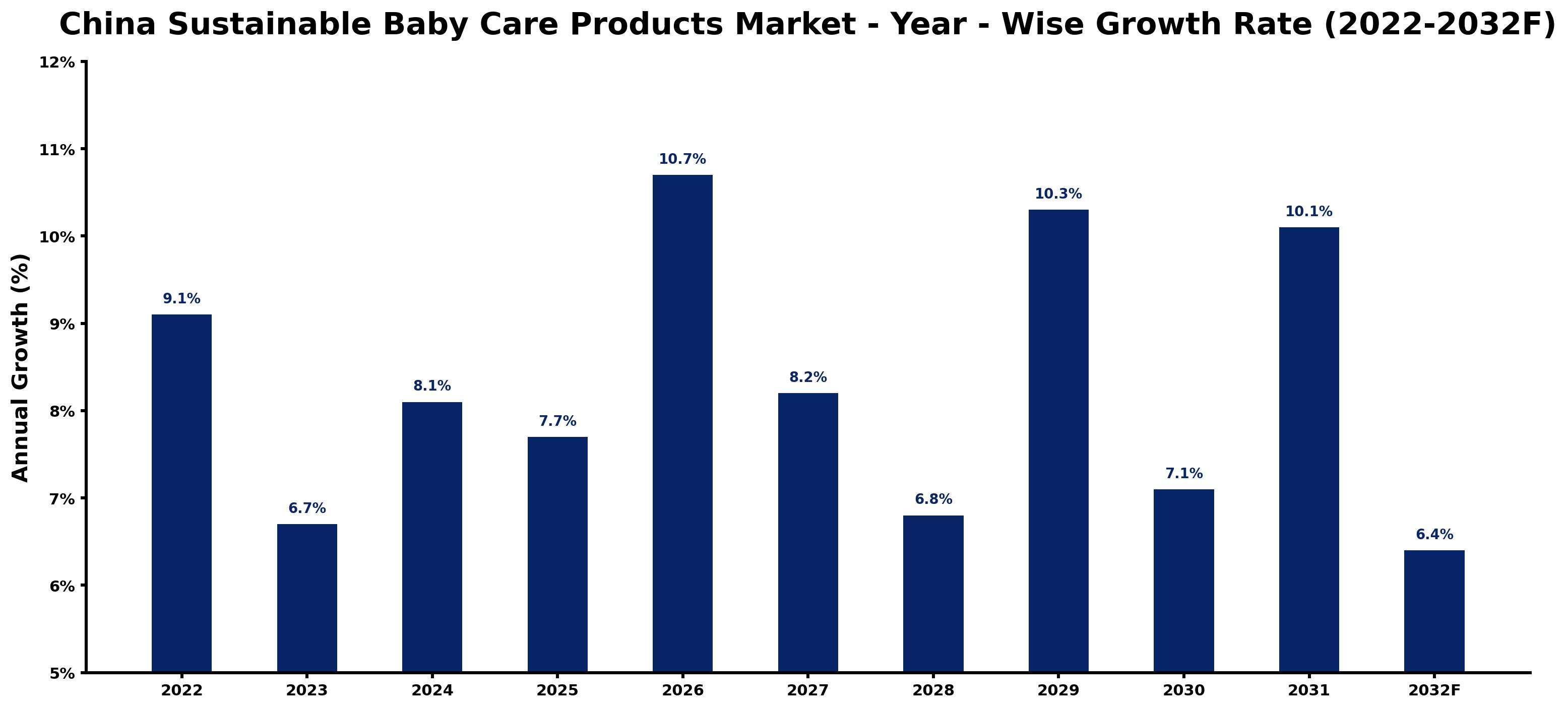
The table below sets out the estimated growth rate for each year and the main factor behind it.
| Year | Estimated Annual Growth (%) | Market Rationale |
| 2022 | 9.1 | The market saw strong demand from urban parents seeking eco-friendly options for their children. |
| 2023 | 6.7 | Growth slowed as consumers adjusted to rising prices of sustainable baby care products. |
| 2024 | 8.1 | Increased awareness of environmental issues spurred demand for organic baby care items. |
| 2025 | 7.7 | The introduction of new eco-friendly standards encouraged purchases of compliant products. |
| 2026 | 10.7 | A surge in urbanisation and eco-consciousness drove growth in sustainable baby care. |
| 2027 | 8.2 | Consumer interest in biodegradable materials moderated growth as supply chains faced challenges. |
| 2028 | 6.8 | Demand for eco-friendly products remained steady, influenced by ongoing marketing campaigns. |
| 2029 | 10.3 | A rise in disposable income among families boosted purchases of premium sustainable items. |
| 2030 | 7.1 | Growth slowed as market saturation began to affect new customer acquisition. |
| 2031 | 10.1 | Renewed interest in organic products led to increased purchases among health-conscious parents. |
| 2032 | 6.4 | The market is projected to stabilise as consumer preferences become more defined. |
Note: Market size estimations and growth projections presented in this report are based on 6Wresearch's proprietary forecasting methodology, utilizing the latest available industry data, government publications, and primary research inputs.
China Sustainable Baby Care Products Market Synopsis
Sustainable Baby Care Products in China encompass eco-friendly items designed for infants and toddlers, including diapers, lotions, and wipes. These products are made from natural or biodegradable materials, minimising environmental impact. The China Sustainable Baby Care Products Market is growing due to rising consumer awareness and demand for eco-friendly options. In 2023, approximately 80 million children aged 0-2 years are driving this demand, with urban areas like Beijing and Shanghai leading the way. The Eco-Friendly Baby Care Initiative is further promoting sustainable practices among parents.
Market Dynamics Impact Analysis (2026–2032)
| Factor | Type | Impact | Primary Segment Affected |
| Increasing consumer awareness of environmental issues drives demand for eco-friendly products. | Driver | High | Diapers |
| Urbanisation is creating a larger market for sustainable baby care products in cities. | Driver | High | Baby Wipes |
| Growing demand for organic products presents opportunities for new entrants. | Opportunity | High | Lotions & Creams |
| The rise of online retailing creates access to a broader customer base. | Opportunity | High | Online Retailers |
| Higher production costs for sustainable materials may limit profit margins. | Restraint | Medium | Bamboo-based |
| Regulatory compliance can be challenging for new brands entering the market. | Restraint | Medium | Organic/Plant-Based |
| Supply chain disruptions can delay product availability for retailers. | Challenge | High | Baby Shampoo |
| Competition from established brands may hinder market entry for newcomers. | Challenge | Medium | Diapers |
Evaluation of Drivers in China Sustainable Baby Care Products Market (2026–2032)
Below mentioned are some major drivers and their influence on market dynamics.
| Drivers | Primary Segment Affected | Why It Matters (Evidence) |
| Rising awareness of environmental issues encourages parents to choose eco-friendly diapers. | Diapers | In urban centres, the adoption rate of eco-friendly baby products is around 35%. |
| Increased disposable income allows families to invest in premium baby care products. | Lotions & Creams | The average family spends about 2,000 RMB annually on baby care products. |
| The Eco-Friendly Baby Care Initiative promotes sustainable practices among parents. | Baby Wipes | This initiative is expected to increase the market for baby wipes to 30 billion RMB by 2025. |
| The Green Product Certification program incentivises manufacturers to produce sustainable items. | Baby Shampoo | This program aims for 30% of products to meet eco-friendly standards by 2025. |
| Growing online retail channels provide easier access to sustainable baby care products. | Online Retailers | Online retailers are projected to hold a 42% market share in 2025. |
Market growth for Sustainable Baby Care Products in China is underpinned by rising awareness of environmental issues and increased disposable income among families. In urban centres, the adoption rate of eco-friendly baby products is around 35%, driving demand for various items. The market for baby wipes is projected to reach 30 billion RMB by 2025, as families seek sustainable options. The Eco-Friendly Manufacturing Strategy aims for a 20% increase in biodegradable product production by 2025, encouraging manufacturers to innovate. Online retail channels are set to capture a 42% market share in 2025, facilitating access to these products for consumers.
Evaluation of Restraints in China Sustainable Baby Care Products Market
Below mentioned are some major restraints and their influence on market dynamics.
| Market Restraint | Primary Segment Affected | Why It Matters (Evidence) |
| Higher production costs for sustainable materials may limit profit margins. | Bamboo-based | Producers face increased costs, which can lead to higher retail prices for consumers. |
| Regulatory compliance can be challenging for new brands entering the market. | Organic/Plant-Based | New entrants must navigate complex safety and environmental standards, increasing time to market. |
| Supply chain disruptions can delay product availability for retailers. | Baby Shampoo | Manufacturers may struggle to source biodegradable materials, impacting inventory levels. |
| Consumer price sensitivity may limit the uptake of premium products. | Diapers | As families manage budgets, they may opt for cheaper alternatives over sustainable options. |
| Limited awareness of sustainable options among rural consumers can restrict market growth. | Lotions & Creams | Rural areas may not have access to eco-friendly products, reducing overall demand. |
China Sustainable Baby Care Products Market Challenges
The China Sustainable Baby Care Products Market struggles with technological limitations in producing biodegradable materials, as many manufacturers lack the necessary processing capabilities. This shortfall can delay product launches, increasing costs for suppliers by up to 20%. High material costs also hinder growth; for example, the average price of organic baby lotion is around 150 RMB, which may deter budget-conscious buyers. Regulatory compliance with standards like GB 28050-2011 can take months, delaying product availability for clinics and retailers. Competition is fierce, with over 1,000 brands vying for market share, forcing existing players to invest heavily in marketing to maintain customer loyalty.
Trends in the China Sustainable Baby Care Products Market
Four trends stand out in the China Sustainable Baby Care Products Market.
- Shift from Traditional to Eco-Friendly Products: Since 2021, urban parents increasingly prefer eco-friendly baby care items. The Shanghai International Baby Products Expo highlighted sustainable innovations, reflecting a growing market trend. In 2023, the adoption rate of eco-friendly baby products among urban parents reached around 35%.
- Transition from In-Store to Online Shopping: In 2023, online retailers are becoming the primary purchasing channel for baby care products. The convenience of online shopping is driving growth, with online sales projected to capture 42% of the market by 2025. This shift is reshaping how parents access sustainable options.
- Emergence of Biodegradable Materials: The focus on biodegradable materials is gaining traction among manufacturers. The Eco-Friendly Manufacturing Strategy announced in 2023 aims to increase production of biodegradable baby care products by 20% by 2025, indicating a notable industry shift.
- Growing Demand for Organic Ingredients: Since 2020, there has been a marked increase in demand for organic baby care products. The National Health Commission's Healthy China 2030 plan promotes organic options, with a target of improving child health through better product choices.
Investment Opportunities in the China Sustainable Baby Care Products Market
Some of the investment opportunities in the China Sustainable Baby Care Products Market are mentioned below.
- Urban Parents Seeking Eco-Friendly Options: Urban parents are increasingly pursuing sustainable baby care products, with a market projected to reach 4.07 billion USD by 2032. Collaborating with local distributors can assist new brands in effectively penetrating this expanding market.
- Expanding Demand for Eco-Friendly Diapers: The demand for eco-friendly diapers is on the rise, particularly in major urban areas. With the market for organic lotions expected to reach 1.2 billion RMB by 2025, suppliers can focus on biodegradable options to satisfy this need.
- Investment in Biodegradable Materials: With the Eco-Friendly Manufacturing Strategy aiming for a 20% increase in biodegradable product production by 2025, there is a clear opportunity for investment. Partnering with manufacturers in Guangdong province can yield fruitful results.
- Online Retail Expansion: The growth of online shopping creates opportunities for brands offering sustainable baby care products. By forming partnerships with e-commerce platforms, companies can tap into the expanding online market, projected to hold a 42% share by 2025.
Government Initiatives in the China Sustainable Baby Care Products Market
The China Quality Certification Centre provides certifications for eco-friendly baby products, ensuring compliance with safety and environmental standards. In 2023, the National Development and Reform Commission introduced the Green Consumption Initiative, encouraging consumers to choose sustainable baby care products through awareness campaigns. This initiative aims to increase consumer engagement and drive demand for eco-friendly options, particularly among urban families. The Eco-Friendly Manufacturing Strategy, announced in 2023, focuses on increasing the production of biodegradable baby care products by 20% by 2025, improving market availability.
The Healthy China 2030 plan, initiated by the National Health Commission in 2020, promotes the use of organic and natural baby care products to improve child health. This plan encourages manufacturers to innovate and align with health-focused standards. The Ministry of Ecology and Environment oversees regulations for biodegradable materials, ensuring that products meet environmental criteria. The updated national standards for baby care products, established by the State Administration for Market Regulation in 2022, include stricter safety and environmental criteria.
Future Insight of the China Sustainable Baby Care Products Market
The China Sustainable Baby Care Products Market is set to undergo notable changes by 2032, driven by government initiatives such as the Eco-Friendly Baby Care Initiative. Urban parents are expected to increase their adoption rate of sustainable products to over 50%, reflecting a growing commitment to eco-friendly options. The development of new guidelines by the China National Institute of Standardization will enhance product safety and quality, benefiting suppliers and buyers alike. The Green Product Certification program will encourage sustainable practices, boosting market credibility and consumer trust.
Market Segmentation Analysis
The report offers a comprehensive study of the following market segments and their leading categories in the market.
By Product Type – Diapers Dominated, Baby Wipes Expected to Grow Fastest
According to Sumit Sagar, AM at 6Wresearch, with a 49% revenue share in 2025, Diapers was the largest product type category. Diapers hold the largest market share due to their essential role in maintaining infant hygiene, particularly among urban families who increasingly prefer eco-friendly options. In major cities like Beijing and Shanghai, the demand for sustainable diapers is growing as parents become more environmentally conscious. Baby Wipes are set to record the highest CAGR in this split, 10.6% over 2026–2032. The baby wipes segment is experiencing the fastest growth, with an adoption rate of around 35% among urban parents highlighting their necessity for cleaning infants. The Eco-Friendly Baby Care Initiative further stimulates the market for sustainable wipes, ensuring their continued expansion. Suppliers should focus on developing eco-friendly baby wipes to cater to the rising demand from environmentally aware consumers.
By Material Source – Organic/Plant-Based Dominated, Biodegradable Fiber Expected to Grow Fastest
The largest material source category in 2025 was Organic/Plant-Based, with a 36% share of total revenue. Organic/plant-based materials dominate the market share because they are preferred by health-conscious parents seeking safer options for their children. The Chinese government's support for plant-based materials through subsidies has further solidified this preference. The quickest growth will come from Biodegradable Fiber, forecast to expand at a CAGR of 11.1% between 2026 and 2032. Biodegradable fiber is the fastest-growing segment, as more consumers are motivated by environmental concerns and the desire for sustainable products. The Green Product Certification program has also encouraged manufacturers to adopt biodegradable materials. Buyers are increasingly prioritising products made from biodegradable fibers, prompting suppliers to innovate in this area to meet consumer expectations.
By Age Group – 0–2 years Dominated, Toddlers Expected to Grow Fastest
0–2 years accounted for a 49% market share by age group in 2025. The 0–2 years age group holds the largest market share, representing the primary target demographic for sustainable baby care products. With around 80 million children in this age range, the demand for eco-friendly items is substantial and continues to grow. Over 2026–2032, Toddlers are expected to post the fastest growth, at a CAGR of 11.1%. Toddlers are the fastest-growing segment, as parents increasingly seek sustainable products for this age group. This trend is particularly noticeable in regions like Beijing-Tianjin-Hebei, where adoption rates are climbing rapidly. Suppliers should focus their marketing strategies on the toddler segment, which is emerging as a critical area for eco-friendly product development.
By Distribution Channel – Online Retailers Dominated and Is Expected to Record the Fastest Growth
Online Retailers held a 42% share of the China Sustainable Baby Care Products Market by distribution channel in 2025. Online retailers dominate the market share, providing parents with easy access to a wide variety of sustainable baby care products. The increasing popularity of e-commerce in China has made online shopping the go-to choice for families seeking eco-friendly options. The same category are also set to grow fastest, at a CAGR of 10.7% during 2026–2032. Online retailers are also the fastest-growing distribution channel, as more consumers turn to online shopping for sustainable products. The convenience and broad selection available online significantly contribute to this growth trend. Suppliers need to improve their online presence and marketing strategies to capitalise on the rapid expansion of e-commerce in the sustainable baby care market.
Key Attractiveness of the Report
- 10 Years of Market Numbers
- Historical Data Starting from 2022 to 2025
- Base Year 2025
- Forecast Data until 2032
- Key Performance Indicators Impacting the Market
- Major Upcoming Developments and Projects
Key Highlights of the Report:
- China Sustainable Baby Care Products Market Outlook
- Market Size of China Sustainable Baby Care Products Market, 2025
- Forecast of China Sustainable Baby Care Products Market, 2032
- Historical Data and Forecast of China Sustainable Baby Care Products Revenues & Volume for the Period 2022 - 2032F
- China Sustainable Baby Care Products Market Trend Evolution
- China Sustainable Baby Care Products Market Drivers and Challenges
- China Sustainable Baby Care Products Price Trends
- China Sustainable Baby Care Products Porter's Five Forces
- China Sustainable Baby Care Products Industry Life Cycle
- Historical Data and Forecast of China Sustainable Baby Care Products Market Revenues & Volume By Product Type for the Period 2022 - 2032F
- Historical Data and Forecast of China Sustainable Baby Care Products Market Revenues & Volume By Diapers for the Period 2022 - 2032F
- Historical Data and Forecast of China Sustainable Baby Care Products Market Revenues & Volume By Lotions & Creams for the Period 2022 - 2032F
- Historical Data and Forecast of China Sustainable Baby Care Products Market Revenues & Volume By Baby Wipes for the Period 2022 - 2032F
- Historical Data and Forecast of China Sustainable Baby Care Products Market Revenues & Volume By Baby Shampoo for the Period 2022 - 2032F
- Historical Data and Forecast of China Sustainable Baby Care Products Market Revenues & Volume By Material Source for the Period 2022 - 2032F
- Historical Data and Forecast of China Sustainable Baby Care Products Market Revenues & Volume By Bamboo-based for the Period 2022 - 2032F
- Historical Data and Forecast of China Sustainable Baby Care Products Market Revenues & Volume By Organic/Plant-Based for the Period 2022 - 2032F
- Historical Data and Forecast of China Sustainable Baby Care Products Market Revenues & Volume By Biodegradable Fiber for the Period 2022 - 2032F
- Historical Data and Forecast of China Sustainable Baby Care Products Market Revenues & Volume By No Sulfate/Paraben-Free for the Period 2022 - 2032F
- Historical Data and Forecast of China Sustainable Baby Care Products Market Revenues & Volume By Age Group for the Period 2022 - 2032F
- Historical Data and Forecast of China Sustainable Baby Care Products Market Revenues & Volume By 0 2 years for the Period 2022 - 2032F
- Historical Data and Forecast of China Sustainable Baby Care Products Market Revenues & Volume By Newborns for the Period 2022 - 2032F
- Historical Data and Forecast of China Sustainable Baby Care Products Market Revenues & Volume By Toddlers for the Period 2022 - 2032F
- Historical Data and Forecast of China Sustainable Baby Care Products Market Revenues & Volume By Infants for the Period 2022 - 2032F
- Historical Data and Forecast of China Sustainable Baby Care Products Market Revenues & Volume By Distribution Channel for the Period 2022 - 2032F
- Historical Data and Forecast of China Sustainable Baby Care Products Market Revenues & Volume By Online Retailers for the Period 2022 - 2032F
- Historical Data and Forecast of China Sustainable Baby Care Products Market Revenues & Volume By Supermarkets for the Period 2022 - 2032F
- Historical Data and Forecast of China Sustainable Baby Care Products Market Revenues & Volume By Pharmacies for the Period 2022 - 2032F
- Historical Data and Forecast of China Sustainable Baby Care Products Market Revenues & Volume By Organic Specialty Stores for the Period 2022 - 2032F
- China Sustainable Baby Care Products Import Export Trade Statistics
- Market Opportunity Assessment By Product Type
- Market Opportunity Assessment By Material Source
- Market Opportunity Assessment By Age Group
- Market Opportunity Assessment By Distribution Channel
- China Sustainable Baby Care Products Top Companies Market Share
- China Sustainable Baby Care Products Competitive Benchmarking By Technical and Operational Parameters
- China Sustainable Baby Care Products Company Profiles
- China Sustainable Baby Care Products Key Strategic Recommendations
Market Covered
The report offers an extensive study of the following market segments.
By Product Type
- Diapers
- Lotions & Creams
- Baby Wipes
- Baby Shampoo
By Material Source
- Bamboo-based
- Organic/Plant-Based
- Biodegradable Fiber
- No Sulfate/Paraben-Free
By Age Group
- 0–2 years
- Newborns
- Toddlers
- Infants
By Distribution Channel
- Online Retailers
- Supermarkets
- Pharmacies
- Organic Specialty Stores































