India Sustainable Baby Care Products Market Size & Growth Rate
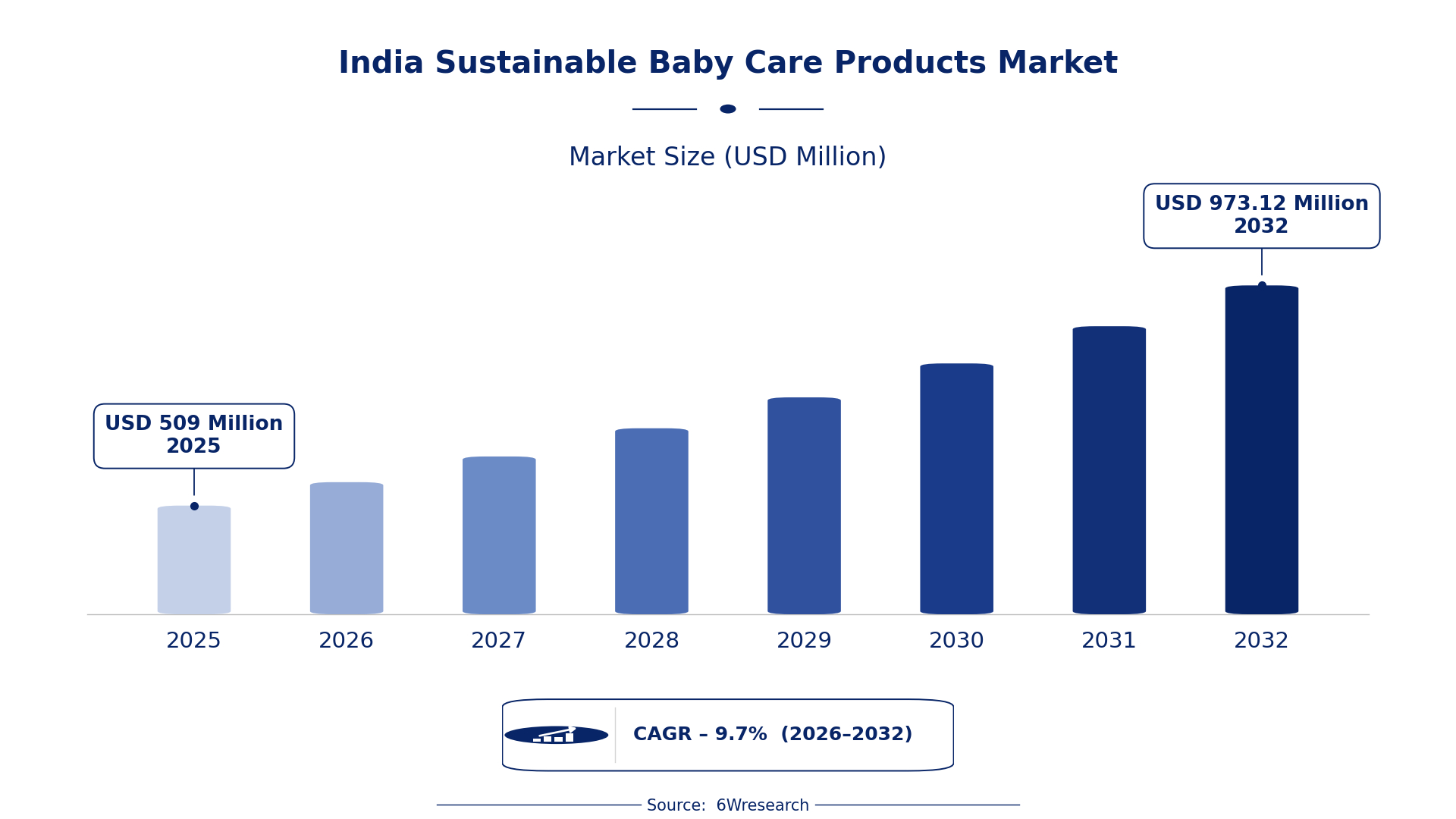
According to 6Wresearch internal database and industry insights, the India Sustainable Baby Care Products Market was valued at USD 509.0 million in 2025 and is projected to reach USD 973.12 million by 2032, growing at a CAGR of approximately 9.7% during 2026–2032.
India Sustainable Baby Care Products Market Highlights
| Report Metric | Details |
| Report Name | India Sustainable Baby Care Products Market |
| Market Size 2025 | USD 509.0 million |
| Market Size 2032 | USD 973.12 million |
| Absolute Growth 2025–2032 | USD 464.12 million |
| CAGR 2026–2032 | 9.7% |
| Peak Annual Growth | 12.1% in 2026 |
| Forecast Period | 2026–2032 |
| Historical Data | 2022–2025 |
| Base Year | 2025 |
| Leading Product Type, 2025 | Diapers (35% share) |
| Leading Material Source, 2025 | Bamboo-based (43% share) |
| Leading Age Group, 2025 | 0–2 years (38% share) |
| Leading Distribution Channel, 2025 | Online Retailers (37% share) |
| Fastest-Growing Product Type | Baby Wipes (11.1% CAGR) |
| Fastest-Growing Material Source | Organic/Plant-Based (11.8% CAGR) |
| Fastest-Growing Age Group | Toddlers (12.5% CAGR) |
| Growing Sector | Online Retailers |
| Key End Users | Online Retailers, Supermarkets, Pharmacies, Organic Specialty Stores |
India Sustainable Baby Care Products Market Year-wise Growth Rate and Key Drivers (2022–2032)
This graph illustrates the annual growth rates of the market from 2022 to 2032, highlighting a steady upward trajectory and projected market expansion over the forecast period.
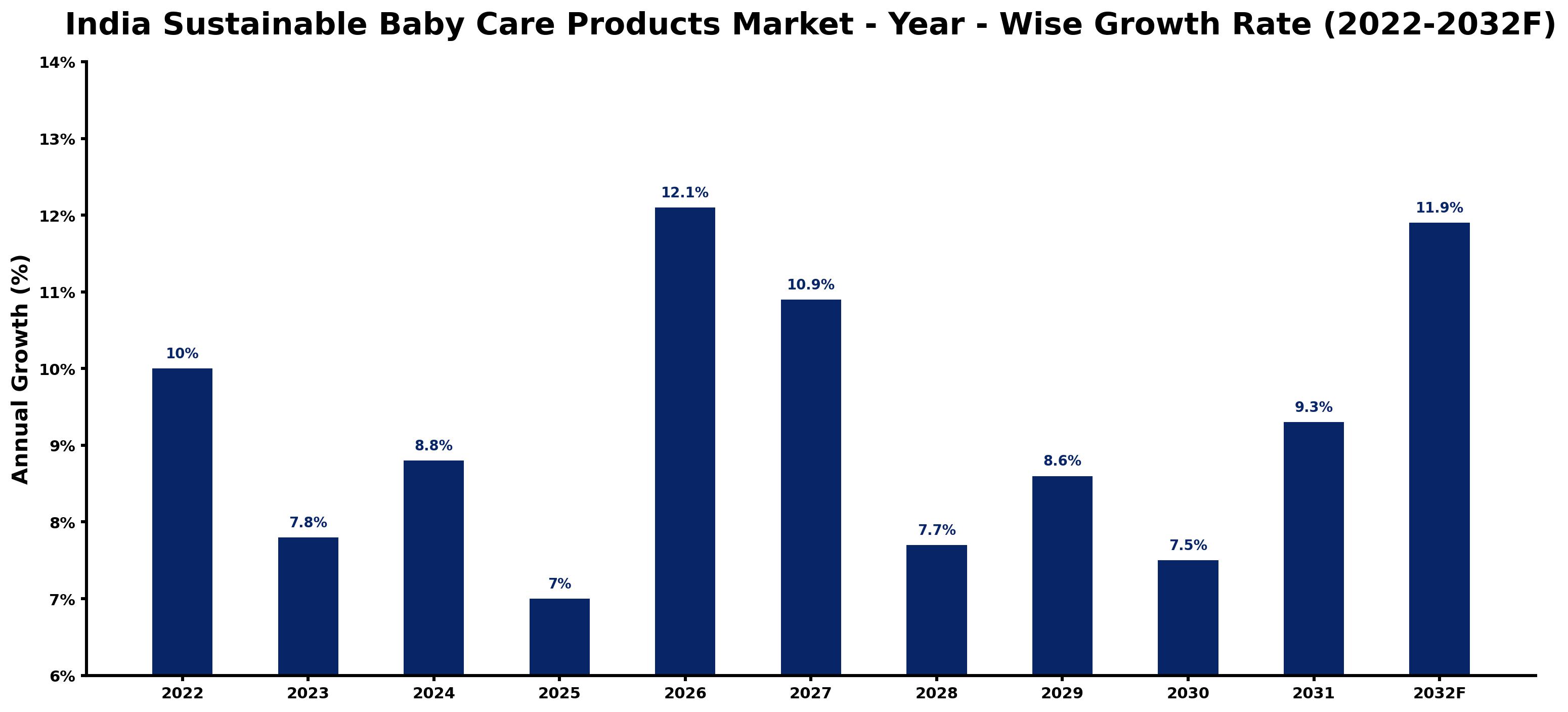
Year by year, the estimates below pair each growth rate with the development that shaped it.
| Year | Estimated Annual Growth (%) | Market Rationale |
| 2022 | 10.0 | The market experienced strong demand due to rising awareness of sustainability among parents. |
| 2023 | 7.8 | Growth slowed as consumers became more selective about eco-friendly options and pricing. |
| 2024 | 8.8 | Increased interest in organic products boosted market performance as parents sought safer choices. |
| 2025 | 7.0 | Demand continued but at a slower pace as the market adjusted to changing consumer preferences. |
| 2026 | 12.1 | A surge in investment in sustainable materials is expected to drive growth in the market. |
| 2027 | 10.9 | Demand is projected to moderate as competition intensifies among sustainable product offerings. |
| 2028 | 7.7 | Market expansion is anticipated to slow as consumers become more discerning in their purchases. |
| 2029 | 8.6 | A renewed interest in eco-friendly products will lead to an increase in market activity. |
| 2030 | 7.5 | Growth is expected to slow again as the introduction of new organic certifications impacts the market. |
| 2031 | 9.3 | An uptick in health consciousness among parents will spur renewed demand for organic products. |
| 2032 | 11.9 | The market is projected to grow as urbanisation continues to drive eco-friendly purchasing. |
Note: Market size estimations and growth projections presented in this report are based on 6Wresearch's proprietary forecasting methodology, utilizing the latest available industry data, government publications, and primary research inputs.
India Sustainable Baby Care Products Market Synopsis
The India Sustainable Baby Care Products Market encompasses eco-friendly items designed for infants and toddlers, primarily made from organic or biodegradable materials. Urban parents increasingly prefer sustainable options, with over 60% opting for these products. The India Sustainable Baby Care Products Market is expanding due to rising awareness of sustainability, increased investment in organic materials, and a shift towards online retail channels. The organic baby care segment grew by 15% in 2022, indicating strong future demand for these items.
Market Dynamics Impact Analysis (2026–2032)
| Factor | Type | Impact | Primary Segment Affected |
| Growing preference for eco-friendly products among urban parents drives demand. | Driver | High | Diapers |
| Investment in organic farming practices enhances the supply of sustainable materials. | Driver | High | Organic/Plant-Based |
| Increasing online sales of baby care products creates opportunities for suppliers. | Opportunity | High | Online Retailers |
| Expansion of organic specialty stores allows for niche market growth. | Opportunity | Medium | Organic Specialty Stores |
| Higher costs of sustainable materials may deter some price-sensitive consumers. | Restraint | High | Bamboo-based |
| Limited awareness in rural areas restricts market penetration for eco-friendly products. | Restraint | Medium | Biodegradable Fiber |
| The Sustainable Baby Care Products market faces challenges from traditional product preferences. | Challenge | High | Baby Wipes |
| Supply chain disruptions can delay the availability of sustainable materials. | Challenge | Medium | Diapers |
Evaluation of Drivers in India Sustainable Baby Care Products Market (2026–2032)
Key forces behind demand, with the segment each one moves most, are listed below.
| Drivers | Primary Segment Affected | Why It Matters (Evidence) |
| Rising urbanisation leads to increased demand for eco-friendly baby care options. | Diapers | Over 60% of urban parents prefer sustainable options, driving higher sales. |
| Growing health consciousness among parents boosts the organic baby care segment. | Organic/Plant-Based | The organic baby care market grew by 15% in 2022, reflecting consumer preferences. |
| Investment in e-commerce platforms improves product accessibility for consumers. | Online Retailers | The Indian market saw a 20% increase in online sales of baby care products in 2023. |
| Government initiatives promote the use of biodegradable materials in consumer products. | Biodegradable Fiber | Policies encourage manufacturers to adopt eco-friendly practices, leading to increased offerings. |
| Rising disposable incomes among urban families support premium product purchases. | Baby Shampoo | The average household spends about 10% of their income on baby care items. |
The Sustainable Baby Care Products market in India is expanding as rising urbanisation, increasing health consciousness, and investment in e-commerce platforms create demand. Urban parents are increasingly opting for sustainable options, which drives higher sales in the diaper segment. The organic baby care market grew by 15% in 2022, reflecting consumer preferences for safer products. The market saw a 20% increase in online sales of baby care products in 2023, improving accessibility for consumers.
Evaluation of Restraints in India Sustainable Baby Care Products Market
The key brakes on demand, and where they bite hardest, are shown below.
| Market Restraint | Primary Segment Affected | Why It Matters (Evidence) |
| Higher costs of sustainable materials may deter some price-sensitive consumers. | Bamboo-based | The premium pricing of bamboo-based products limits their appeal to budget-conscious families. |
| Limited awareness in rural areas restricts market penetration for eco-friendly products. | Biodegradable Fiber | Many rural consumers remain unaware of the benefits of biodegradable options, hindering growth. |
| Traditional product preferences can slow the adoption of sustainable alternatives. | Baby Wipes | Parents accustomed to conventional wipes may resist switching to eco-friendly versions. |
| Supply chain disruptions can delay the availability of sustainable materials. | Diapers | Logistical challenges can impact the timely production and distribution of eco-friendly diapers. |
| Regulatory hurdles may complicate the certification process for organic products. | Organic/Plant-Based | Complex certification requirements can deter new entrants into the organic baby care market. |
India Sustainable Baby Care Products Market Challenges
The Sustainable Baby Care Products market in India faces a critical skills gap, as many suppliers lack trained personnel to meet the increasing demand for eco-friendly items. This issue arises from a shortage of educational programs focused on sustainable practices, resulting in delays for producers who struggle to innovate. Insufficient technology adoption hampers efficiency; many manufacturers still use outdated production methods, limiting their ability to scale and meet the preferences of urban parents. Rising costs of organic materials are impacting affordability, forcing buyers to spend over 10% of their income on these products, while navigating the National Standards for Organic Products complicates compliance for suppliers, causing further delays in product launches.
Trends in the India Sustainable Baby Care Products Market
Several trends are reshaping the India Sustainable Baby Care Products Market; the most important are set out below.
- Shift to Online Retail for Baby Care Products: Urban areas in India are increasingly turning to online platforms for baby care items, reflecting changing shopping habits. In 2023, online sales of baby care products increased by 20%, indicating a shift towards digital channels.
- Growing Preference for Organic Materials: Parents are increasingly seeking organic baby care products, driven by health consciousness. The organic baby care segment grew by 15% in 2022, highlighting a trend towards safer, eco-friendly options.
- Rise of Eco-Friendly Certifications: The introduction of the National Standards for Organic Products (NSOP) in India has increased consumer trust in organic baby care items. This measure supports the growth of certified organic products, boosting market credibility.
- Increased Awareness of Sustainability: The Ministry of Environment's 2023 campaign for eco-friendly products has raised awareness among consumers. This initiative aligns with the growing demand for sustainable baby care products, driving market expansion.
Investment Opportunities in the India Sustainable Baby Care Products Market
Below are the investment opportunities with the strongest case in the India Sustainable Baby Care Products Market.
- Expansion of Online Retail Channels: The online retail segment is set to grow, with a 20% increase in 2023. Investing in e-commerce platforms will help reach urban parents seeking sustainable options.
- Investment in Organic Material Production: With the organic baby care segment growing by 15% in 2022, there is a demand for organic materials. Collaborating with local farmers can strengthen supply chains and product offerings.
- Development of Eco-Friendly Certifications: The introduction of eco-friendly certifications can boost consumer trust. Engaging with the Bureau of Indian Standards can facilitate compliance and market entry.
- Focus on Rural Market Penetration: With approximately 120 million children under 5 years in India, targeting rural areas presents a significant opportunity. Establishing partnerships with local distributors can improve market access.
Government Initiatives in the India Sustainable Baby Care Products Market
The National Policy on Biofuels, launched in 2021, promotes the use of bio-based materials in consumer products, including baby care items. This measure encourages manufacturers to adopt sustainable practices and materials, thereby improving the eco-friendliness of the market. Additionally, the Swachh Bharat Mission, initiated in 2020, encourages the use of biodegradable products to reduce waste, further supporting sustainable baby care initiatives.
In 2023, the Ministry of Environment launched a campaign for eco-friendly products, supporting the growth of sustainable baby care items. This initiative aims to raise awareness and encourage consumers to choose biodegradable options, further promoting market expansion. The Central Pollution Control Board also plays a role in funding projects that enhance sustainable product development, ensuring compliance with environmental standards.
Future Insight of the India Sustainable Baby Care Products Market
By 2032, buyers and suppliers in the Sustainable Baby Care Products market can expect enhanced offerings driven by government initiatives that promote biodegradable materials and organic certifications. The organic segment is projected to expand, supported by a growing awareness of health and sustainability among parents. Online sales are set to increase, reflecting a shift towards digital shopping for eco-friendly items. Collaborations with organisations promoting organic farming will strengthen supply chains, ensuring a consistent supply of sustainable materials for production.
Market Segmentation Analysis
The analysis below covers each segmentation, its leading category in 2025 and its fastest-growing category through 2032.
By Product Type – Diapers Dominated, Baby Wipes Expected to Grow Fastest
According to Sumit Sagar, AM at 6Wresearch, Diapers accounted for a 35% market share by product type in 2025. Diapers hold the largest market share as they are essential for infant care, with urban parents increasingly choosing sustainable options. For instance, the rising preference for eco-friendly diapers among over 60% of urban parents highlights a robust demand for this product type. Baby Wipes are set to record the highest CAGR in this split, 11.1% over 2026–2032. Baby wipes are growing rapidly as they are deemed necessary for hygiene, particularly among parents who value convenience and sustainability. The organic baby care segment, which includes wipes, experienced a notable growth rate of 15% in 2022, indicating a shift towards eco-conscious choices. This suggests that suppliers should prioritise expanding their product offerings in the diaper and baby wipe categories to align with the increasing consumer demand.
By Material Source – Bamboo-based Dominated, Organic/Plant-Based Expected to Grow Fastest
In 2025, Bamboo-based led the material source split with a 43% share. Bamboo-based materials dominate the market share due to their recognised sustainability and appeal to eco-conscious parents. The increasing popularity of bamboo-based diapers illustrates this trend, reflecting strong consumer preference for sustainable materials. Over 2026–2032, Organic/Plant-Based is expected to post the fastest growth, at a CAGR of 11.8%. The organic/plant-based segment is witnessing rapid growth, spurred by a rising health consciousness among parents seeking safe and natural products for their children. Additionally, government initiatives promoting organic farming practices are further fuelling this demand surge. Suppliers should focus on enhancing their product lines with organic and plant-based materials to take advantage of this growing trend.
By Age Group – 0–2 years Dominated, Toddlers Expected to Grow Fastest
The largest age group category in 2025 was 0–2 years, with a 38% share of total revenue. The 2 years age group captures the largest market share as it represents the primary target for baby care products, with approximately 120 million children under five in India. This demographic focus ensures consistent demand for essential products like diapers and wipes. The quickest growth will come from Toddlers, forecast to expand at a CAGR of 12.5% between 2026 and 2032. Toddlers are the fastest-growing segment, as parents increasingly seek products tailored to their developmental needs and hygiene. This growth is likely to continue as more parents become aware of the importance of sustainable options for their toddlers. This suggests that suppliers should tailor their marketing strategies to effectively target the toddler segment.
By Distribution Channel – Online Retailers Dominated and Is Expected to Record the Fastest Growth
With a 37% revenue share in 2025, Online Retailers was the largest distribution channel category. Online retailers lead the market share as the primary distribution channel, driven by the convenience of online shopping and the increasing trend of purchasing baby care products digitally. The 20% increase in online sales in 2023 underscores the shift towards e-commerce in this sector. Its lead should widen, with a projected CAGR of 10.7% during 2026–2032, the highest in this split. Online retailers are also the fastest-growing channel, as more parents turn to digital platforms for their shopping needs, particularly in urban areas. This trend is reinforced by the ongoing expansion of the Indian retail market for baby care products. This highlights the importance for suppliers to invest in strong online presence and e-commerce strategies.
Key Attractiveness of the Report
- 10 Years of Market Numbers
- Historical Data Starting from 2022 to 2025
- Base Year 2025
- Forecast Data until 2032
- Key Performance Indicators Impacting the Market
- Major Upcoming Developments and Projects
Key Highlights of the Report:
- India Sustainable Baby Care Products Market Outlook
- Market Size of India Sustainable Baby Care Products Market, 2025
- Forecast of India Sustainable Baby Care Products Market, 2032
- Historical Data and Forecast of India Sustainable Baby Care Products Revenues & Volume for the Period 2022 - 2032F
- India Sustainable Baby Care Products Market Trend Evolution
- India Sustainable Baby Care Products Market Drivers and Challenges
- India Sustainable Baby Care Products Price Trends
- India Sustainable Baby Care Products Porter's Five Forces
- India Sustainable Baby Care Products Industry Life Cycle
- Historical Data and Forecast of India Sustainable Baby Care Products Market Revenues & Volume By Product Type for the Period 2022 - 2032F
- Historical Data and Forecast of India Sustainable Baby Care Products Market Revenues & Volume By Diapers for the Period 2022 - 2032F
- Historical Data and Forecast of India Sustainable Baby Care Products Market Revenues & Volume By Lotions & Creams for the Period 2022 - 2032F
- Historical Data and Forecast of India Sustainable Baby Care Products Market Revenues & Volume By Baby Wipes for the Period 2022 - 2032F
- Historical Data and Forecast of India Sustainable Baby Care Products Market Revenues & Volume By Baby Shampoo for the Period 2022 - 2032F
- Historical Data and Forecast of India Sustainable Baby Care Products Market Revenues & Volume By Material Source for the Period 2022 - 2032F
- Historical Data and Forecast of India Sustainable Baby Care Products Market Revenues & Volume By Bamboo-based for the Period 2022 - 2032F
- Historical Data and Forecast of India Sustainable Baby Care Products Market Revenues & Volume By Organic/Plant-Based for the Period 2022 - 2032F
- Historical Data and Forecast of India Sustainable Baby Care Products Market Revenues & Volume By Biodegradable Fiber for the Period 2022 - 2032F
- Historical Data and Forecast of India Sustainable Baby Care Products Market Revenues & Volume By No Sulfate/Paraben-Free for the Period 2022 - 2032F
- Historical Data and Forecast of India Sustainable Baby Care Products Market Revenues & Volume By Age Group for the Period 2022 - 2032F
- Historical Data and Forecast of India Sustainable Baby Care Products Market Revenues & Volume By 0 2 years for the Period 2022 - 2032F
- Historical Data and Forecast of India Sustainable Baby Care Products Market Revenues & Volume By Newborns for the Period 2022 - 2032F
- Historical Data and Forecast of India Sustainable Baby Care Products Market Revenues & Volume By Toddlers for the Period 2022 - 2032F
- Historical Data and Forecast of India Sustainable Baby Care Products Market Revenues & Volume By Infants for the Period 2022 - 2032F
- Historical Data and Forecast of India Sustainable Baby Care Products Market Revenues & Volume By Distribution Channel for the Period 2022 - 2032F
- Historical Data and Forecast of India Sustainable Baby Care Products Market Revenues & Volume By Online Retailers for the Period 2022 - 2032F
- Historical Data and Forecast of India Sustainable Baby Care Products Market Revenues & Volume By Supermarkets for the Period 2022 - 2032F
- Historical Data and Forecast of India Sustainable Baby Care Products Market Revenues & Volume By Pharmacies for the Period 2022 - 2032F
- Historical Data and Forecast of India Sustainable Baby Care Products Market Revenues & Volume By Organic Specialty Stores for the Period 2022 - 2032F
- India Sustainable Baby Care Products Import Export Trade Statistics
- Market Opportunity Assessment By Product Type
- Market Opportunity Assessment By Material Source
- Market Opportunity Assessment By Age Group
- Market Opportunity Assessment By Distribution Channel
- India Sustainable Baby Care Products Top Companies Market Share
- India Sustainable Baby Care Products Competitive Benchmarking By Technical and Operational Parameters
- India Sustainable Baby Care Products Company Profiles
- India Sustainable Baby Care Products Key Strategic Recommendations
Market Covered
This report examines the market across the segments below.
By Product Type
- Diapers
- Lotions & Creams
- Baby Wipes
- Baby Shampoo
By Material Source
- Bamboo-based
- Organic/Plant-Based
- Biodegradable Fiber
- No Sulfate/Paraben-Free
By Age Group
- 0–2 years
- Newborns
- Toddlers
- Infants
By Distribution Channel
- Online Retailers
- Supermarkets
- Pharmacies
- Organic Specialty Stores































