China Sustainable Feed Market Size & Growth Rate
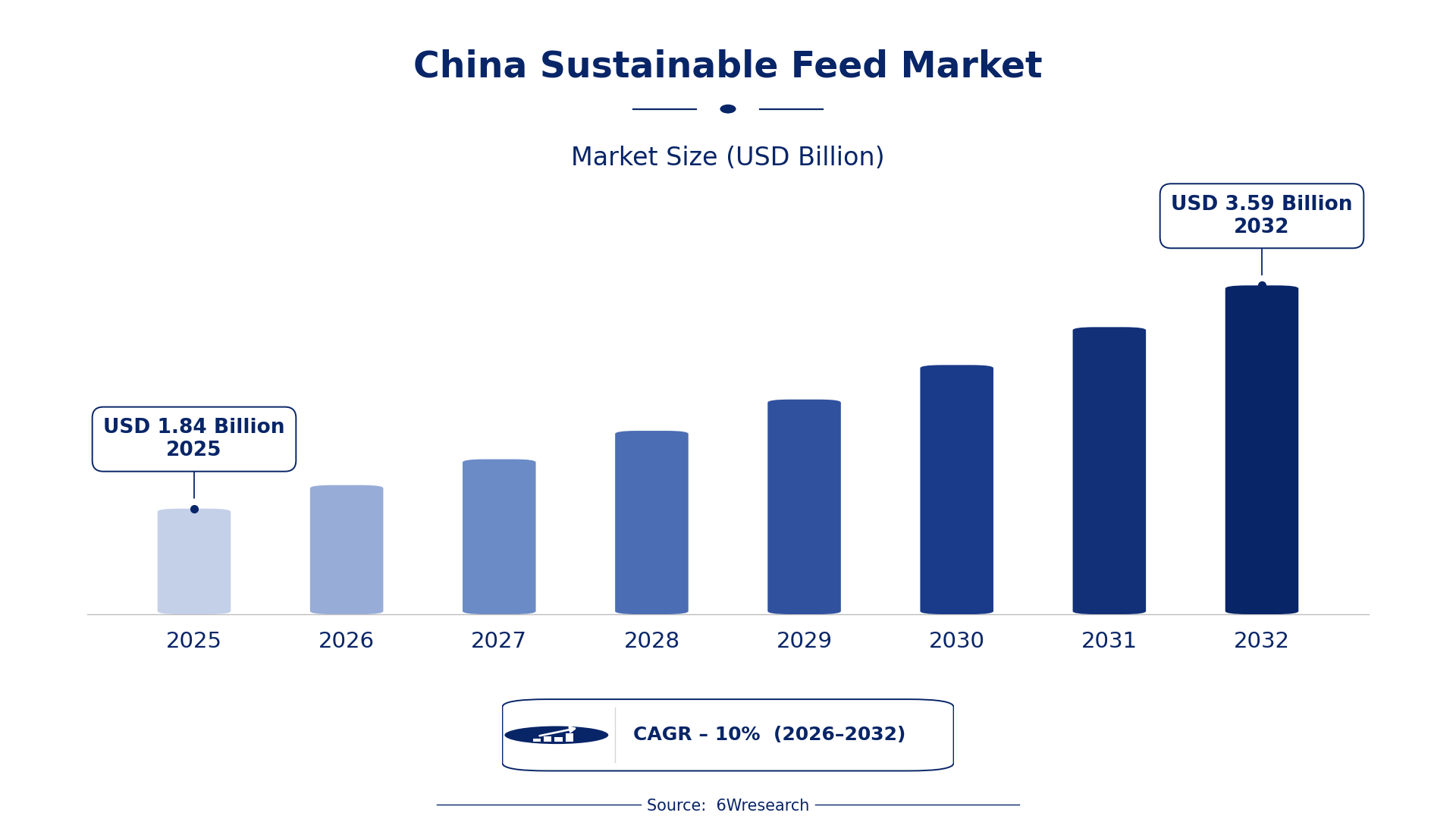
According to 6Wresearch internal database and industry insights, the China Sustainable Feed Market was valued at USD 1.84 billion in 2025 and is projected to reach USD 3.59 billion by 2032, growing at a CAGR of approximately 10% during 2026–2032.
China Sustainable Feed Market Highlights
| Report Metric | Details |
| Report Name | China Sustainable Feed Market |
| Market Size 2025 | USD 1.84 billion |
| Market Size 2032 | USD 3.59 billion |
| Absolute Growth 2025–2032 | USD 1.75 billion |
| CAGR 2026–2032 | 10% |
| Peak Annual Growth | 12.0% in 2029 |
| Forecast Period | 2026–2032 |
| Historical Data | 2022–2025 |
| Base Year | 2025 |
| Leading Feed Type, 2025 | Insect-Based Feed (41% share) |
| Leading Source Material, 2025 | Black Soldier Fly (41% share) |
| Leading Livestock Category, 2025 | Poultry (36% share) |
| Leading End User, 2025 | Poultry Farmers (45% share) |
| Fastest-Growing Feed Type | Seaweed-Enriched Feed (11.5% CAGR) |
| Fastest-Growing Source Material | Kelp/Red Algae (12.4% CAGR) |
| Fastest-Growing Livestock Category | Cattle (12.7% CAGR) |
| Fastest-Growing End User | Dairy Cooperatives (11.1% CAGR) |
| Growing Sector | Poultry |
| Key End Users | Poultry Farmers, Dairy Cooperatives, Pig Farms, Smallholder Farms |
China Sustainable Feed Market Year-wise Growth Rate and Key Drivers (2022–2032)
This graph illustrates the annual growth rates of the market from 2022 to 2032, highlighting a steady upward trajectory and projected market expansion over the forecast period.
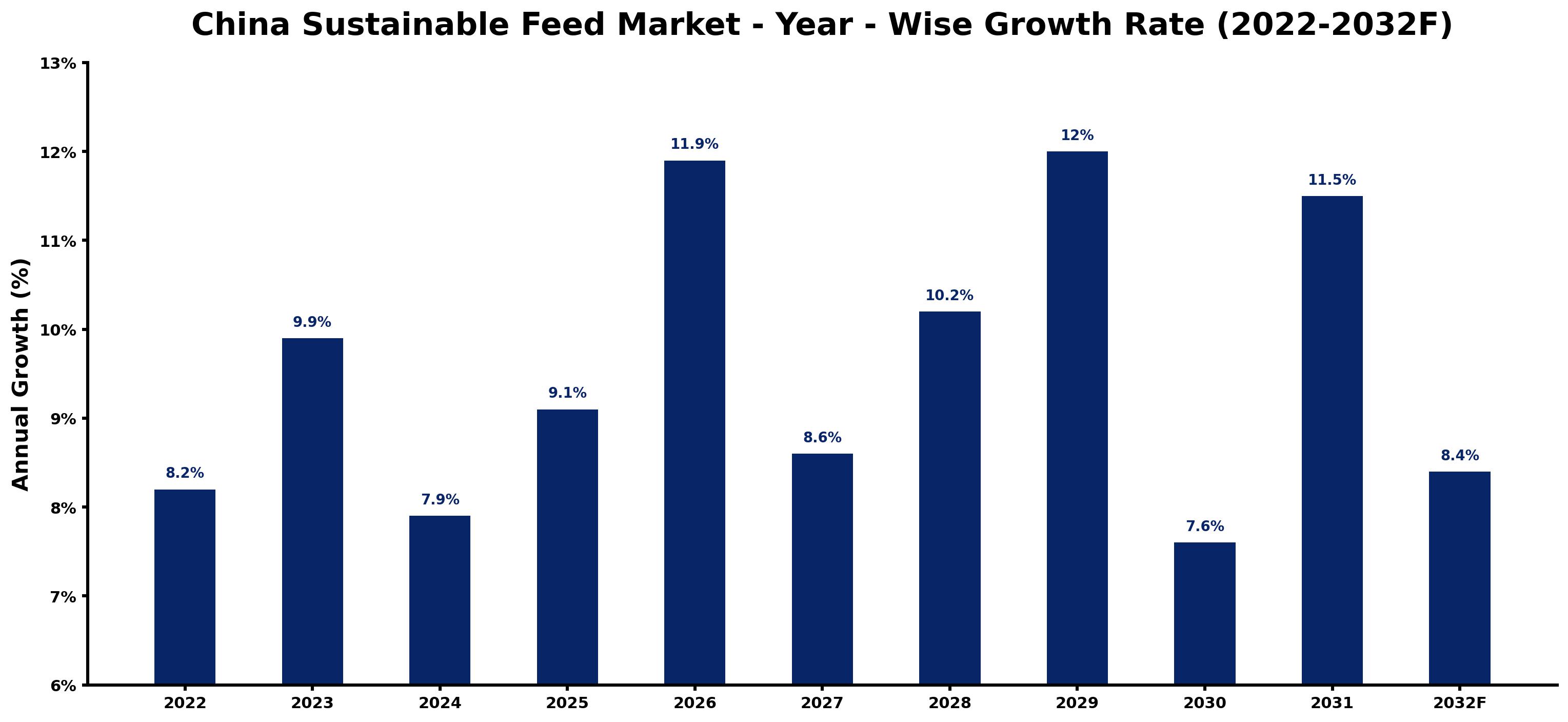
Each row of the following table gives one year's estimated growth and the event or demand shift that explains it.
| Year | Estimated Annual Growth (%) | Market Rationale |
| 2022 | 8.2 | The market experienced steady growth due to rising awareness of sustainable practices among livestock farmers. |
| 2023 | 9.9 | Demand surged as China's poultry population reached 14 billion, driving sustainable feed consumption. |
| 2024 | 7.9 | Growth slowed slightly as farmers adjusted to new sustainable feed options and practices. |
| 2025 | 9.1 | The adoption of sustainable feed practices among dairy cooperatives contributed to market growth. |
| 2026 | 11.9 | The launch of the 'Green Feed Initiative' is expected to encourage further investment in sustainable feed production. |
| 2027 | 8.6 | The market will see a slowdown as producers face challenges in sourcing sustainable materials. |
| 2028 | 10.2 | Growth is projected to accelerate again as innovations in feed technology improve efficiency and nutrition. |
| 2029 | 12.0 | The market is expected to peak as demand for sustainable feed reaches new heights among poultry farmers. |
| 2030 | 7.6 | Growth will slow as the market begins to stabilise after rapid expansion in previous years. |
| 2031 | 11.5 | A resurgence in demand is likely as smallholder farms increasingly adopt sustainable feed practices. |
| 2032 | 8.4 | The market is projected to continue growing as awareness of environmental impacts drives further sustainable feed adoption. |
Note: Market size estimations and growth projections presented in this report are based on 6Wresearch's proprietary forecasting methodology, utilizing the latest available industry data, government publications, and primary research inputs.
China Sustainable Feed Market Synopsis
Sustainable Feed in China refers to animal feed produced from environmentally friendly sources, including insects and agricultural byproducts. This type of feed improves livestock health and reduces environmental impact. The China Sustainable Feed Market is expanding due to the immense poultry population and initiatives like the 'Green Feed Initiative'.
Market Dynamics Impact Analysis (2026–2032)
| Factor | Type | Impact | Primary Segment Affected |
| Rising poultry population drives demand for sustainable feed to support livestock health. | Driver | High | Poultry |
| Government initiatives encourage the adoption of sustainable feed practices among farmers. | Driver | High | Smallholder Farms |
| Growing interest in sustainable practices creates opportunities for innovative feed solutions. | Opportunity | High | Insect-Based Feed |
| Investment in sustainable feed production facilities is increasing in regions like Guangdong. | Opportunity | High | Seaweed-Enriched Feed |
| High production costs can limit the affordability of sustainable feed for smallholder farms. | Restraint | High | Spent Grain Feed |
| Limited access to sustainable feed ingredients may hinder market growth in remote areas. | Restraint | Medium | Fermented Feed |
| The Sustainable Feed market in China faces challenges related to sourcing sustainable materials. | Challenge | High | Black Soldier Fly |
| Competition from traditional feed sources may restrict the growth of sustainable feed adoption. | Challenge | Medium | Kelp/Red Algae |
Evaluation of Drivers in China Sustainable Feed Market (2026–2032)
Key forces behind demand, with the segment each one moves most, are listed below.
| Drivers | Primary Segment Affected | Why It Matters (Evidence) |
| Increased poultry population drives demand for sustainable feed to improve livestock health. | Poultry | China's poultry population reached 14 billion in 2022, boosting feed consumption. |
| Government initiatives promote sustainable practices, encouraging feed production methods. | Smallholder Farms | The 'Green Feed Initiative' launched in 2023 encourages farmers to adopt sustainable feed. |
| Rising awareness of environmental impacts boosts demand for sustainable feed solutions. | Insect-Based Feed | Sustainable feed can reduce greenhouse gas emissions by up to 30% in livestock farming. |
| Investment in innovative feed technologies improves efficiency and nutrition for livestock. | Seaweed-Enriched Feed | The average protein content in insect-based feed is around 40-50%, making it highly nutritious. |
| Growing adoption of sustainable practices among dairy cooperatives increases market demand. | Dairy Cooperatives | China's dairy industry is expected to adopt sustainable feed practices more widely by 2025. |
In 2022, China's poultry population reached 14 billion, boosting feed consumption. Sustainable feed can reduce greenhouse gas emissions by up to 30% in livestock farming, appealing to environmentally conscious producers. The average protein content in insect-based feed is around 40-50%, making it highly nutritious and desirable for livestock farmers.
Evaluation of Restraints in China Sustainable Feed Market
The main factors holding the market back are set out below.
| Market Restraint | Primary Segment Affected | Why It Matters (Evidence) |
| High production costs can limit the affordability of sustainable feed for smallholder farms. | Spent Grain Feed | Production costs for sustainable feed can be higher than traditional feed options. |
| Limited access to sustainable feed ingredients may hinder market growth in remote areas. | Fermented Feed | Farmers in remote regions often struggle to source sustainable ingredients for feed production. |
| Sourcing sustainable materials poses challenges for producers in the market. | Black Soldier Fly | The availability of sustainable materials for feed production can be inconsistent. |
| Competition from traditional feed sources may restrict the growth of sustainable feed adoption. | Kelp/Red Algae | Many farmers still prefer conventional feed options due to cost and familiarity. |
| Regulatory hurdles can slow down the introduction of new sustainable feed products. | Seaweed-Enriched Feed | Producers must navigate complex regulations regarding feed safety and ingredient approval. |
China Sustainable Feed Market Challenges
The China Sustainable Feed Market faces several practical problems, starting with limited technology adoption among producers. Many producers lack access to advanced processing techniques, which hampers their ability to create high-quality sustainable feed. This results in buyers receiving lower nutritional value, negatively impacting livestock health and productivity. Unpredictable demand from buyers complicates production planning, leading to excess inventory that costs producers up to 15% in lost revenue. Regulatory compliance with the National Standard for Feed Safety creates delays; adhering to these regulations can postpone product launches by several months, affecting market entry for new sustainable feed products.
Trends in the China Sustainable Feed Market
Below mentioned are some of the trends shaping the China Sustainable Feed Market growth.
- Shift from Traditional to Sustainable Feed: Since 2023, the 'Green Feed Initiative' has encouraged livestock farmers to transition from conventional to sustainable feed. This shift is reflected in the growing market for sustainable feed, particularly in the poultry sector.
- Emergence of Insect-Based Feed: In 2022, insect-based feed gained traction among farmers looking for sustainable protein sources. With an average protein content of 40-50%, this feed type is becoming increasingly popular in livestock diets across China.
- Growing Adoption of Seaweed-Enriched Feed: In Guangdong province, the use of seaweed in livestock feed has become a trend since 2023. This feed type improves livestock health and reduces methane emissions, appealing to environmentally conscious farmers.
- Increased Focus on Feed Efficiency: Since 2022, there has been a notable increase in the use of fermented feed to improve livestock feed efficiency. This type of feed has been shown to enhance digestibility and nutrient absorption by 10-15%, making it attractive to farmers.
Investment Opportunities in the China Sustainable Feed Market
Some of the investment opportunities in the China Sustainable Feed Market are mentioned below.
- USD 100 million funding for sustainable feed practices: With a budget of 100 million yuan, the 'Green Feed Initiative' launched in 2023 presents an opportunity for investment in sustainable feed production. Farmers can access funds to adopt new practices, particularly in regions like Guangdong.
- Demand for insect-based feed: As the poultry population continues to rise, there is a strong demand for insect-based feed, which accounted for 41% of the market share in 2025. Suppliers can tap into this opportunity by developing local production facilities.
- Investment in dairy cooperative practices: Dairy cooperatives are increasingly adopting sustainable feed practices, with a projected growth rate of 11.1% from 2026 to 2032. This trend offers opportunities for suppliers to provide tailored sustainable feed solutions.
- Expansion of smallholder farm initiatives: With the increasing focus on sustainable practices, smallholder farms are becoming key players in the sustainable feed market. Investing in training and resources for these farmers can yield significant returns.
Government Initiatives in the China Sustainable Feed Market
In 2023, the Ministry of Agriculture and Rural Affairs launched the 'Green Feed Initiative' with a budget of 100 million yuan to promote sustainable feed practices. This initiative complements the National Feed Industry Development Plan from 2021, which aims to improve sustainable production methods across China. The new initiative focuses on improving livestock health and reducing environmental impacts, encouraging farmers to adopt sustainable practices.
The Ministry of Ecology and Environment supports sustainable feed initiatives through various subsidies. This agency approves funding for projects that promote sustainable practices in feed production, helping farmers transition to more environmentally friendly options. The Agricultural Technology Promotion Law, enacted in 2020, encourages research and development in sustainable feed technologies, aiming to improve livestock productivity and reduce environmental impact.
Future Insight of the China Sustainable Feed Market
Several forward-looking factors should support the China Sustainable Feed Market over the coming years. The Green Feed Initiative will drive innovation in sustainable practices, motivating producers to adopt new technologies. By 2025, the dairy industry is set to adopt sustainable feed practices more widely, which will improve overall product quality. Ongoing support from the Ministry of Agriculture through subsidies will encourage investment in sustainable production methods. Consequently, buyers can expect better availability of nutritious feed options, which will enhance livestock health and reduce environmental impact.
Market Segmentation Analysis
The analysis below covers each segmentation, its leading category in 2025 and its fastest-growing category through 2032.
By Feed Type – Insect-Based Feed Dominated, Seaweed-Enriched Feed Expected to Grow Fastest
According to Sumit Sagar, AM at 6Wresearch, in 2025, Insect-Based Feed led the feed type split with a 41% share. Insect-based feed holds the largest share in the China Sustainable Feed Market due to its high protein content, essential for livestock diets. The poultry population, which reached 14 billion in 2022, significantly drives the demand for this feed type. Seaweed-Enriched Feed is set to record the highest CAGR in this split, 11.5% over 2026–2032. Seaweed-enriched feed is rapidly growing because it provides essential nutrients and enhances livestock health, aligning with the government's 'Green Feed Initiative' launched in 2023. This initiative encourages sustainable practices, further boosting the demand for seaweed-based products. Suppliers should focus on developing seaweed-enriched products to capture the growing market share driven by sustainability initiatives.
By Source Material – Black Soldier Fly Dominated, Kelp/Red Algae Expected to Grow Fastest
Black Soldier Fly accounted for a 41% market share by source material in 2025. Black soldier fly is the leading source material in the sustainable feed market, primarily due to its rich protein and fat content that livestock require. The Ministry of Agriculture and Rural Affairs promotes its use, reinforcing its prevalence in feed formulations. Kelp/Red Algae is projected to grow fastest, at a CAGR of 12.4% during 2026–2032. Kelp and red algae are gaining traction as they are rich in minerals and vitamins essential for livestock health. The increasing awareness of these benefits among farmers accelerates their incorporation into feed formulations. Buyers should integrate kelp and red algae into their feed strategies to enhance livestock health and align with market demands.
By Livestock Category – Poultry Dominated, Cattle Expected to Grow Fastest
Poultry took a 36% share of livestock category in 2025, more than any other category. Poultry dominates the sustainable feed market, primarily due to its substantial consumption of sustainable feed for optimal growth and productivity. The large poultry population in China significantly drives the demand for nutritious feed solutions. Over 2026–2032, Cattle is expected to post the fastest growth, at a CAGR of 12.7%. Cattle are emerging as the fastest-growing category, particularly as the dairy industry is expected to adopt sustainable feed practices more widely by 2025. The increasing focus on sustainable dairy production is a key factor in this growth. Suppliers should tailor their offerings to meet the specific needs of the cattle sector, which is rapidly embracing sustainable feed solutions.
By End User – Poultry Farmers Dominated, Dairy Cooperatives Expected to Grow Fastest
With a 45% revenue share in 2025, Poultry Farmers was the largest end user category. Poultry farmers represent the largest end-user group in the sustainable feed market, being the primary consumers of sustainable feed products for their livestock. Their significant market share stems from the need for efficient and healthy feed options to support poultry operations. The quickest growth will come from Dairy Cooperatives, forecast to expand at a CAGR of 11.1% between 2026 and 2032. Dairy cooperatives are the fastest-growing end-user segment, increasingly adopting sustainable feed practices to improve production efficiency and meet consumer demands for sustainable products. This shift is expected to accelerate as more cooperatives recognise the benefits of sustainable feed. Suppliers should engage with dairy cooperatives to develop tailored sustainable feed solutions that meet their specific requirements.
Key Attractiveness of the Report
- 10 Years of Market Numbers
- Historical Data Starting from 2022 to 2025
- Base Year 2025
- Forecast Data until 2032
- Key Performance Indicators Impacting the Market
- Major Upcoming Developments and Projects
Key Highlights of the Report:
- China Sustainable Feed Market Outlook
- Market Size of China Sustainable Feed Market, 2025
- Forecast of China Sustainable Feed Market, 2032
- Historical Data and Forecast of China Sustainable Feed Revenues & Volume for the Period 2022 - 2032F
- China Sustainable Feed Market Trend Evolution
- China Sustainable Feed Market Drivers and Challenges
- China Sustainable Feed Price Trends
- China Sustainable Feed Porter's Five Forces
- China Sustainable Feed Industry Life Cycle
- Historical Data and Forecast of China Sustainable Feed Market Revenues & Volume By Feed Type for the Period 2022 - 2032F
- Historical Data and Forecast of China Sustainable Feed Market Revenues & Volume By Insect-Based Feed for the Period 2022 - 2032F
- Historical Data and Forecast of China Sustainable Feed Market Revenues & Volume By Seaweed-Enriched Feed for the Period 2022 - 2032F
- Historical Data and Forecast of China Sustainable Feed Market Revenues & Volume By Fermented Feed for the Period 2022 - 2032F
- Historical Data and Forecast of China Sustainable Feed Market Revenues & Volume By Spent Grain Feed for the Period 2022 - 2032F
- Historical Data and Forecast of China Sustainable Feed Market Revenues & Volume By Source Material for the Period 2022 - 2032F
- Historical Data and Forecast of China Sustainable Feed Market Revenues & Volume By Black Soldier Fly for the Period 2022 - 2032F
- Historical Data and Forecast of China Sustainable Feed Market Revenues & Volume By Kelp/Red Algae for the Period 2022 - 2032F
- Historical Data and Forecast of China Sustainable Feed Market Revenues & Volume By Agricultural Residue for the Period 2022 - 2032F
- Historical Data and Forecast of China Sustainable Feed Market Revenues & Volume By Brewery Waste for the Period 2022 - 2032F
- Historical Data and Forecast of China Sustainable Feed Market Revenues & Volume By Livestock Category for the Period 2022 - 2032F
- Historical Data and Forecast of China Sustainable Feed Market Revenues & Volume By Poultry for the Period 2022 - 2032F
- Historical Data and Forecast of China Sustainable Feed Market Revenues & Volume By Cattle for the Period 2022 - 2032F
- Historical Data and Forecast of China Sustainable Feed Market Revenues & Volume By Swine for the Period 2022 - 2032F
- Historical Data and Forecast of China Sustainable Feed Market Revenues & Volume By Sheep & Goats for the Period 2022 - 2032F
- Historical Data and Forecast of China Sustainable Feed Market Revenues & Volume By End User for the Period 2022 - 2032F
- Historical Data and Forecast of China Sustainable Feed Market Revenues & Volume By Poultry Farmers for the Period 2022 - 2032F
- Historical Data and Forecast of China Sustainable Feed Market Revenues & Volume By Dairy Cooperatives for the Period 2022 - 2032F
- Historical Data and Forecast of China Sustainable Feed Market Revenues & Volume By Pig Farms for the Period 2022 - 2032F
- Historical Data and Forecast of China Sustainable Feed Market Revenues & Volume By Smallholder Farms for the Period 2022 - 2032F
- China Sustainable Feed Import Export Trade Statistics
- Market Opportunity Assessment By Feed Type
- Market Opportunity Assessment By Source Material
- Market Opportunity Assessment By Livestock Category
- Market Opportunity Assessment By End User
- China Sustainable Feed Top Companies Market Share
- China Sustainable Feed Competitive Benchmarking By Technical and Operational Parameters
- China Sustainable Feed Company Profiles
- China Sustainable Feed Key Strategic Recommendations
Market Covered
Segments analysed in this report are listed below.
By Feed Type
- Insect-Based Feed
- Seaweed-Enriched Feed
- Fermented Feed
- Spent Grain Feed
By Source Material
- Black Soldier Fly
- Kelp/Red Algae
- Agricultural Residue
- Brewery Waste
By Livestock Category
- Poultry
- Cattle
- Swine
- Sheep & Goats
By End User
- Poultry Farmers
- Dairy Cooperatives
- Pig Farms
- Smallholder Farms































