China Sustainable Mobility Market Size & Growth Rate
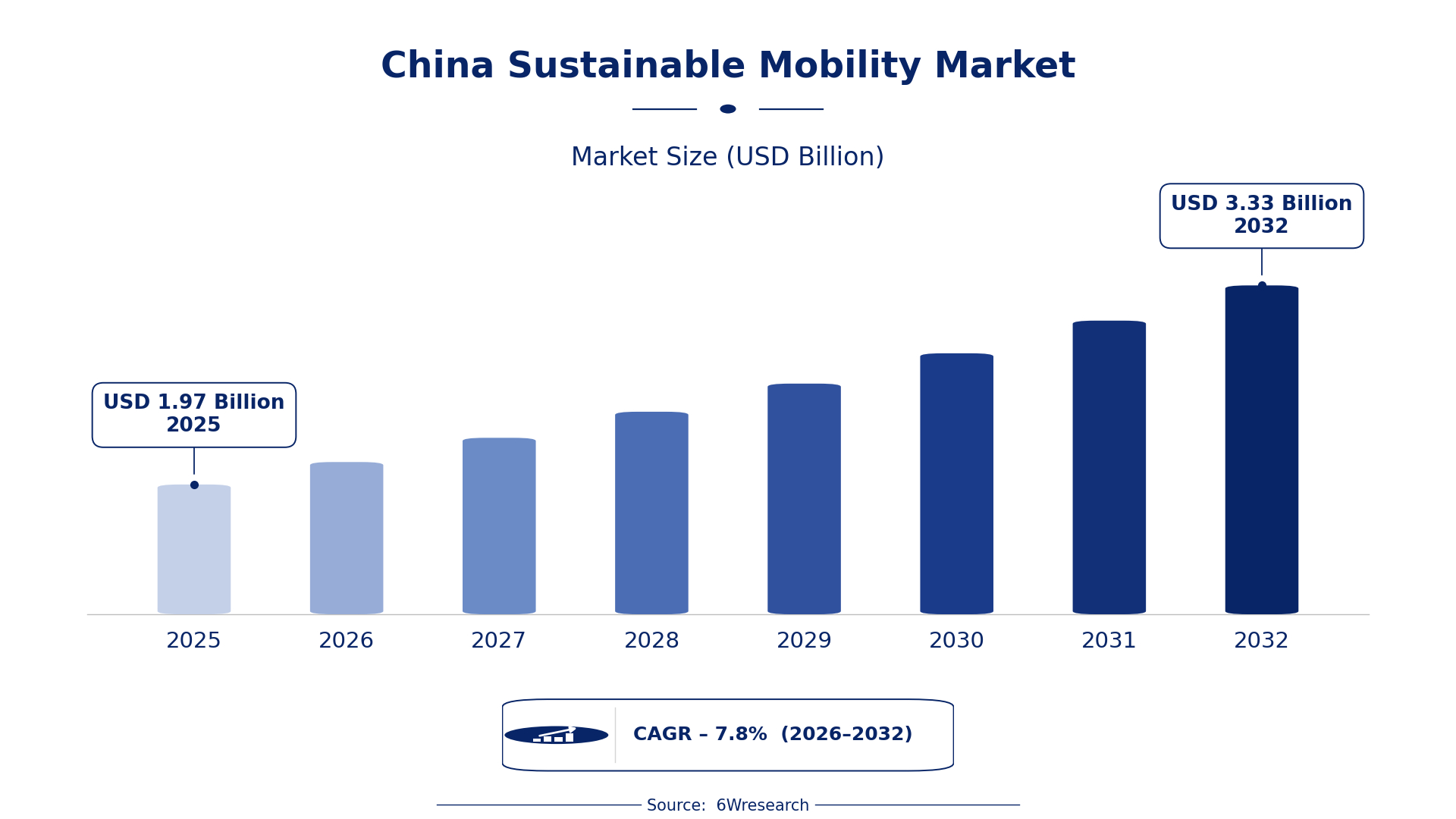
According to 6Wresearch internal database and industry insights, the China Sustainable Mobility Market was valued at USD 1.97 billion in 2025 and is projected to reach USD 3.33 billion by 2032, growing at a CAGR of approximately 7.8% during 2026–2032.
China Sustainable Mobility Market Highlights
| Report Metric | Details |
| Report Name | China Sustainable Mobility Market |
| Market Size 2025 | USD 1.97 billion |
| Market Size 2032 | USD 3.33 billion |
| Absolute Growth 2025–2032 | USD 1.36 billion |
| CAGR 2026–2032 | 7.8% |
| Peak Annual Growth | 9.5% in 2027 |
| Forecast Period | 2026–2032 |
| Historical Data | 2022–2025 |
| Base Year | 2025 |
| Leading Mobility Type, 2025 | Electric Vehicles (45% share) |
| Leading Energy Source, 2025 | Battery Electric (51% share) |
| Leading Application Area, 2025 | Urban Commute (39% share) |
| Leading End User, 2025 | City Transport Providers (39% share) |
| Fastest-Growing Mobility Type | Shared Mobility (10.5% CAGR) |
| Fastest-Growing Energy Source | Renewable Electricity (9.9% CAGR) |
| Fastest-Growing Application Area | Rideshare Services (10.2% CAGR) |
| Fastest-Growing End User | Mobility Platforms (8.8% CAGR) |
| Growing Sector | Urban Commute |
| Key End Users | City Transport Providers, Mobility Platforms, Municipal Operators, Transport Authorities |
China Sustainable Mobility Market Year-wise Growth Rate and Key Drivers (2022–2032)
This graph illustrates the annual growth rates of the market from 2022 to 2032, highlighting a steady upward trajectory and projected market expansion over the forecast period.
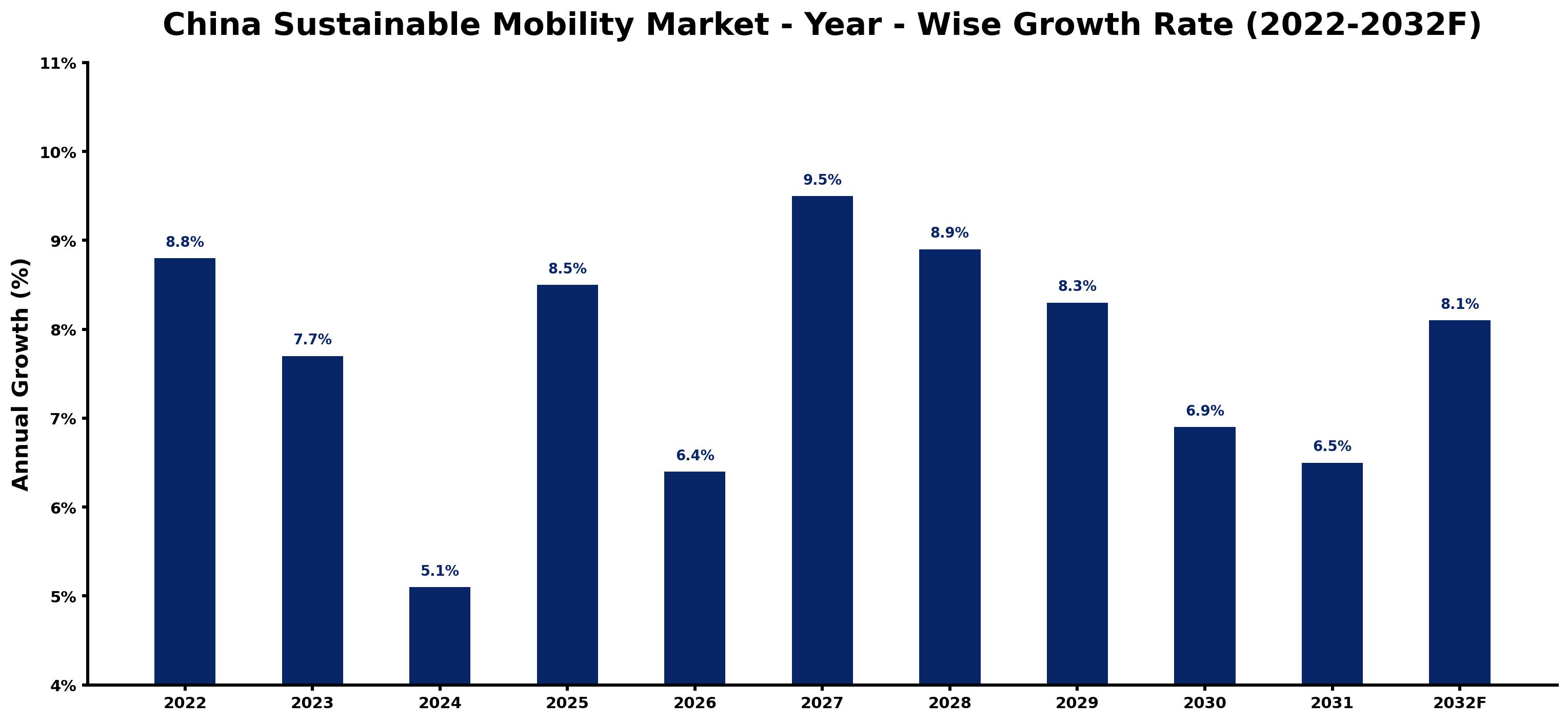
The following table presents the estimated annual growth rate for each year together with the principal factor influencing market performance.
| Year | Estimated Annual Growth (%) | Market Rationale |
| 2022 | 8.8 | Electric vehicle sales surged, reflecting strong consumer interest and government support. |
| 2023 | 7.7 | Growth slowed as market adjustments took place following the previous year's peak. |
| 2024 | 5.1 | Demand continued to decelerate as the market faced challenges in infrastructure expansion. |
| 2025 | 8.5 | A rebound in growth occurred due to increased electric vehicle adoption and charging infrastructure. |
| 2026 | 6.4 | Market growth slowed again as competition intensified among electric vehicle manufacturers. |
| 2027 | 9.5 | A peak in growth is anticipated as urban populations drive demand for sustainable transport. |
| 2028 | 8.9 | Growth is expected to moderate as the market adjusts to new supply chain dynamics. |
| 2029 | 8.3 | Demand remains strong, but growth rates are stabilising as market maturity sets in. |
| 2030 | 6.9 | Growth slows as the focus shifts towards enhancing existing infrastructure and services. |
| 2031 | 6.5 | Continued growth is expected as urban mobility solutions gain traction among consumers. |
| 2032 | 8.1 | A resurgence in growth is projected as new technologies and policies support market expansion. |
Note: Market size estimations and growth projections presented in this report are based on 6Wresearch's proprietary forecasting methodology, utilizing the latest available industry data, government publications, and primary research inputs.
China Sustainable Mobility Market Synopsis
Sustainable Mobility in China includes technologies focused on minimising environmental impact in transportation, such as electric vehicles and shared mobility solutions. The market is thriving, driven by urban demand and government initiatives that promote green transport. Electric vehicle sales reached 6.9 million units in 2022, with expectations for substantial growth. The government targets 20% of all vehicles to be electric by 2025, further boosting demand. Urban populations are anticipated to hit 1 billion by 2030, heightening the need for sustainable mobility solutions.
Market Dynamics Impact Analysis (2026–2032)
| Factor | Type | Impact | Primary Segment Affected |
| Growing urban population demanding efficient transport solutions | Driver | High | Urban Commute |
| Investment in charging infrastructure and electric vehicle production | Driver | High | Electric Vehicles |
| Expansion of shared mobility platforms in urban areas | Opportunity | High | Shared Mobility |
| Development of hydrogen fuel cell infrastructure | Opportunity | Medium | Hydrogen Vehicles |
| Limited charging infrastructure in rural areas | Restraint | High | Electric Vehicles |
| High initial costs of electric vehicles compared to traditional vehicles | Restraint | Medium | Electric Vehicles |
| Supply chain disruptions affecting vehicle production | Challenge | High | Electric Vehicles |
| Regulatory hurdles for new vehicle types and technologies | Challenge | Medium | Hydrogen Vehicles |
Evaluation of Drivers in China Sustainable Mobility Market (2026–2032)
The factors lifting demand, and the evidence behind each, are summarised below.
| Drivers | Primary Segment Affected | Why It Matters (Evidence) |
| Increasing electric vehicle sales due to urban demand | Electric Vehicles | Electric vehicle sales reached 6.9 million units in 2022, prompting manufacturers to increase production. |
| Government investment in charging infrastructure | Electric Vehicles | The National Development and Reform Commission approved funding for 500 new charging stations nationwide in 2022 to support growth. |
| Growing adoption of shared mobility solutions | Shared Mobility | In 2023, over 1,500 shared mobility platforms are operating, with Shanghai leading in user adoption, driving demand for new transport options. |
| Support for renewable energy integration in transport | Renewable Electricity | The Ministry of Ecology and Environment promotes renewable energy integration, improving electric mobility solutions. |
| Public transport electrification initiatives | Urban Commute | In 2022, 30% of public transport vehicles in Shenzhen were electric, boosting sustainable transport adoption. |
Market growth for Sustainable Mobility in China stems from considerable investments in electric vehicle production, the expansion of charging infrastructure, and rising urban demand for efficient transport solutions. Shared mobility platforms are thriving, with over 1,500 operating in major cities, creating additional demand for new transport options. In 2022, investment in sustainable mobility technologies surpassed $30 billion, reflecting a commitment to green transport solutions.
Evaluation of Restraints in China Sustainable Mobility Market
Below mentioned are some major restraints and their influence on market dynamics.
| Market Restraint | Primary Segment Affected | Why It Matters (Evidence) |
| Limited charging infrastructure in rural areas | Electric Vehicles | Rural areas lack sufficient charging stations, hindering electric vehicle adoption outside urban centres. |
| High initial costs of electric vehicles | Electric Vehicles | Electric vehicles remain more expensive than traditional vehicles, deterring some potential buyers. |
| Supply chain disruptions affecting vehicle production | Electric Vehicles | Global supply chain issues have delayed the production of electric vehicles, impacting availability. |
| Regulatory hurdles for new vehicle types | Hydrogen Vehicles | Complex approval processes for hydrogen vehicles slow down their market entry and adoption. |
| Consumer hesitance towards new technologies | Hydrogen Vehicles | Limited awareness and understanding of hydrogen vehicles lead to lower consumer interest. |
China Sustainable Mobility Market Challenges
The China Sustainable Mobility Market encounters a notable technological challenge due to inadequate charging infrastructure, which limits electric vehicle adoption. With only 1,000 charging stations in Beijing, consumers face delays in accessing convenient charging options. Skills shortages in advanced manufacturing lead to production bottlenecks, impacting suppliers who struggle to find qualified workers to meet rising demand. High production costs for sustainable mobility technologies weigh on producers, as investments exceeded $30 billion in 2022, restricting their ability to scale. Regulatory complexities also hinder market entry for new players, resulting in prolonged approval times that delay product launches for buyers.
Trends in the China Sustainable Mobility Market
Below mentioned are some of the trends shaping the China Sustainable Mobility Market growth.
- Shift towards Electric Vehicle Adoption: Since 2022, electric vehicle adoption has accelerated in urban areas, with 6.9 million units sold. This trend reflects a growing commitment to sustainable transport, supported by government initiatives.
- Rise of Shared Mobility Solutions: In 2023, over 1,500 shared mobility platforms are operating, with Shanghai leading in user adoption. This shift indicates a preference for cost-effective transport options among urban populations.
- Growth in E-Scooter Usage: As of 2023, 200,000 e-scooters are in operation across major cities, reflecting a trend towards micro-mobility solutions for short-distance travel and improving urban transport efficiency.
- Expansion of Hydrogen Fuel Cell Infrastructure: The introduction of the 'Hydrogen Energy Industry Development Plan' in 2021 aims to expand hydrogen infrastructure, supporting the gradual adoption of hydrogen vehicles in urban transport.
Investment Opportunities in the China Sustainable Mobility Market
Investors looking at the China Sustainable Mobility Market should consider the following areas.
- Partnerships for Charging Infrastructure Development: Now is an ideal time to invest in charging infrastructure, with the government funding new stations. Collaborating with city transport providers can improve access to electric vehicles.
- Supply of Electric Buses for Public Transport: With 30% of public transport vehicles in Shenzhen being electric, there is a growing need for electric buses. Suppliers can enter through partnerships with municipal operators.
- Investment in Shared Mobility Platforms: The rise in shared mobility usage presents an opportunity for investments in platform technology. Engaging with mobility platforms in Shanghai can yield strong returns.
- Hydrogen Vehicle Technology Development: As the government promotes hydrogen vehicles, investing in technology and infrastructure now can position suppliers advantageously. Collaborating with transport authorities can facilitate market entry.
Government Initiatives in the China Sustainable Mobility Market
The '14th Five-Year Plan for the Development of the New Energy Vehicle Industry' issued by the State Council in 2021 aims for 20% market share by 2025, promoting electric vehicle adoption and infrastructure development. The 'Green Transport Development Plan' launched by the Ministry of Transport in 2021 further supports electric and hydrogen vehicles, accelerating market growth. These measures are designed to enhance the transition towards sustainable mobility solutions across China. The 'National Standard for Electric Vehicle Charging Interfaces' established in 2020 standardises charging infrastructure, making it easier for consumers to access electric vehicles.
City transport providers benefit from various government schemes, including funding for electric vehicle charging stations and incentives for adopting electric buses. The National Development and Reform Commission approved funding for 500 new charging stations in 2022, directly supporting electric vehicle growth. Additionally, the 'Smart City Initiative' aims to integrate sustainable mobility solutions into urban planning, improving transport efficiency and accessibility for urban populations.
Future Insight of the China Sustainable Mobility Market
The China Sustainable Mobility Market is set to evolve by 2032, driven by urban population growth and supportive government initiatives. By 2030, the urban population is projected to reach 1 billion, significantly increasing the demand for efficient transport solutions. The government aims for 7 million new energy vehicles by 2025, encouraging suppliers to innovate in battery technology and charging infrastructure. The 'Smart Mobility Initiative' will enhance transport efficiency, while the 'Hydrogen Energy Industry Development Plan' will expand hydrogen infrastructure, providing diverse options for buyers.
Market Segmentation Analysis
Each segment group is reviewed below, with the leader by share and the fastest grower by CAGR.
By Mobility Type – Electric Vehicles Dominated, Shared Mobility Expected to Grow Fastest
According to Sumit Sagar, AM at 6Wresearch, Electric Vehicles took a 45% share of mobility type in 2025, more than any other category. Electric vehicles are the leading segment in the market due to their widespread adoption for personal and public transport in urban areas. The infrastructure, such as Beijing's over 1,000 charging stations, supports this extensive usage and enhances consumer confidence. The quickest growth will come from Shared Mobility, forecast to expand at a CAGR of 10.5% between 2026 and 2032. Shared mobility is witnessing rapid growth as urban populations seek cost-effective transport solutions, with Shanghai having over 1 million users. This trend is expected to accelerate as cities invest in enhancing shared mobility services and platforms. Suppliers should prioritise infrastructure development to meet the increasing demand for shared mobility solutions.
By Energy Source – Battery Electric Dominated, Renewable Electricity Expected to Grow Fastest
In 2025, Battery Electric led the energy source split with a 51% share. Battery electric technology is the primary energy source for electric vehicles, making it a crucial component of the sustainable mobility market. The government's target for 20% of vehicles to be electric by 2025 underscores the importance of battery electric systems in this transition. Renewable Electricity is projected to grow fastest, at a CAGR of 9.9% during 2026–2032. Renewable electricity is gaining traction as a key energy source for electric mobility, bolstered by government initiatives that promote renewable energy integration in transport. This shift is essential for achieving long-term sustainability in the mobility sector. Buyers should consider integrating renewable electricity to align with sustainability goals and enhance operational efficiency.
By Application Area – Urban Commute Dominated, Rideshare Services Expected to Grow Fastest
Urban Commute accounted for a 39% market share by application area in 2025. Urban commute represents the major application area for sustainable mobility, as cities increasingly adopt electric vehicles for daily transportation needs. The projected growth of urban populations in China underscores the importance of efficient urban commuting solutions. Over 2026–2032, Rideshare Services are expected to post the fastest growth, at a CAGR of 10.2%. Rideshare services are rapidly becoming integral to shared mobility solutions in cities, providing flexible and accessible transport options. The rise of these services aligns with the growing demand for convenient travel alternatives among urban residents. Suppliers must innovate and adapt their offerings to cater to the evolving preferences of urban commuters seeking rideshare solutions.
By End User – City Transport Providers Dominated, Mobility Platforms Expected to Grow Fastest
City Transport Providers held a 39% share of the China Sustainable Mobility Market by end user in 2025. City transport providers account for the largest share of users of sustainable mobility technologies, playing a pivotal role in the adoption of electric vehicles and shared mobility solutions. Their commitment to sustainability significantly influences the implementation of these technologies in urban areas. Mobility Platforms are set to record the highest CAGR in this split, 8.8% over 2026–2032. Mobility platforms are rapidly expanding, enhancing shared and electric mobility services that cater to urban populations. This growth is driven by the increasing number of platforms that improve accessibility and convenience for users. Suppliers should collaborate with mobility platforms to create partnerships that enhance service delivery and user satisfaction.
Key Attractiveness of the Report
- 10 Years of Market Numbers
- Historical Data Starting from 2022 to 2025
- Base Year 2025
- Forecast Data until 2032
- Key Performance Indicators Impacting the Market
- Major Upcoming Developments and Projects
Key Highlights of the Report:
- China Sustainable Mobility Market Outlook
- Market Size of China Sustainable Mobility Market, 2025
- Forecast of China Sustainable Mobility Market, 2032
- Historical Data and Forecast of China Sustainable Mobility Revenues & Volume for the Period 2022 - 2032F
- China Sustainable Mobility Market Trend Evolution
- China Sustainable Mobility Market Drivers and Challenges
- China Sustainable Mobility Price Trends
- China Sustainable Mobility Porter's Five Forces
- China Sustainable Mobility Industry Life Cycle
- Historical Data and Forecast of China Sustainable Mobility Market Revenues & Volume By Mobility Type for the Period 2022 - 2032F
- Historical Data and Forecast of China Sustainable Mobility Market Revenues & Volume By Electric Vehicles for the Period 2022 - 2032F
- Historical Data and Forecast of China Sustainable Mobility Market Revenues & Volume By Shared Mobility for the Period 2022 - 2032F
- Historical Data and Forecast of China Sustainable Mobility Market Revenues & Volume By Micro-Mobility for the Period 2022 - 2032F
- Historical Data and Forecast of China Sustainable Mobility Market Revenues & Volume By Hydrogen Vehicles for the Period 2022 - 2032F
- Historical Data and Forecast of China Sustainable Mobility Market Revenues & Volume By Energy Source for the Period 2022 - 2032F
- Historical Data and Forecast of China Sustainable Mobility Market Revenues & Volume By Battery Electric for the Period 2022 - 2032F
- Historical Data and Forecast of China Sustainable Mobility Market Revenues & Volume By Renewable Electricity for the Period 2022 - 2032F
- Historical Data and Forecast of China Sustainable Mobility Market Revenues & Volume By E-Scooters/Bikes for the Period 2022 - 2032F
- Historical Data and Forecast of China Sustainable Mobility Market Revenues & Volume By Hydrogen Fuel Cell for the Period 2022 - 2032F
- Historical Data and Forecast of China Sustainable Mobility Market Revenues & Volume By Application Area for the Period 2022 - 2032F
- Historical Data and Forecast of China Sustainable Mobility Market Revenues & Volume By Urban Commute for the Period 2022 - 2032F
- Historical Data and Forecast of China Sustainable Mobility Market Revenues & Volume By Rideshare Services for the Period 2022 - 2032F
- Historical Data and Forecast of China Sustainable Mobility Market Revenues & Volume By First/Last Mile Travel for the Period 2022 - 2032F
- Historical Data and Forecast of China Sustainable Mobility Market Revenues & Volume By Intercity Mobility for the Period 2022 - 2032F
- Historical Data and Forecast of China Sustainable Mobility Market Revenues & Volume By End User for the Period 2022 - 2032F
- Historical Data and Forecast of China Sustainable Mobility Market Revenues & Volume By City Transport Providers for the Period 2022 - 2032F
- Historical Data and Forecast of China Sustainable Mobility Market Revenues & Volume By Mobility Platforms for the Period 2022 - 2032F
- Historical Data and Forecast of China Sustainable Mobility Market Revenues & Volume By Municipal Operators for the Period 2022 - 2032F
- Historical Data and Forecast of China Sustainable Mobility Market Revenues & Volume By Transport Authorities for the Period 2022 - 2032F
- China Sustainable Mobility Import Export Trade Statistics
- Market Opportunity Assessment By Mobility Type
- Market Opportunity Assessment By Energy Source
- Market Opportunity Assessment By Application Area
- Market Opportunity Assessment By End User
- China Sustainable Mobility Top Companies Market Share
- China Sustainable Mobility Competitive Benchmarking By Technical and Operational Parameters
- China Sustainable Mobility Company Profiles
- China Sustainable Mobility Key Strategic Recommendations
Market Covered
Segments analysed in this report are listed below.
By Mobility Type
- Electric Vehicles
- Shared Mobility
- Micro-Mobility
- Hydrogen Vehicles
By Energy Source
- Battery Electric
- Renewable Electricity
- E-Scooters/Bikes
- Hydrogen Fuel Cell
By Application Area
- Urban Commute
- Rideshare Services
- First/Last Mile Travel
- Intercity Mobility
By End User
- City Transport Providers
- Mobility Platforms
- Municipal Operators
- Transport Authorities































