China Sustainable Textiles Market Size & Growth Rate
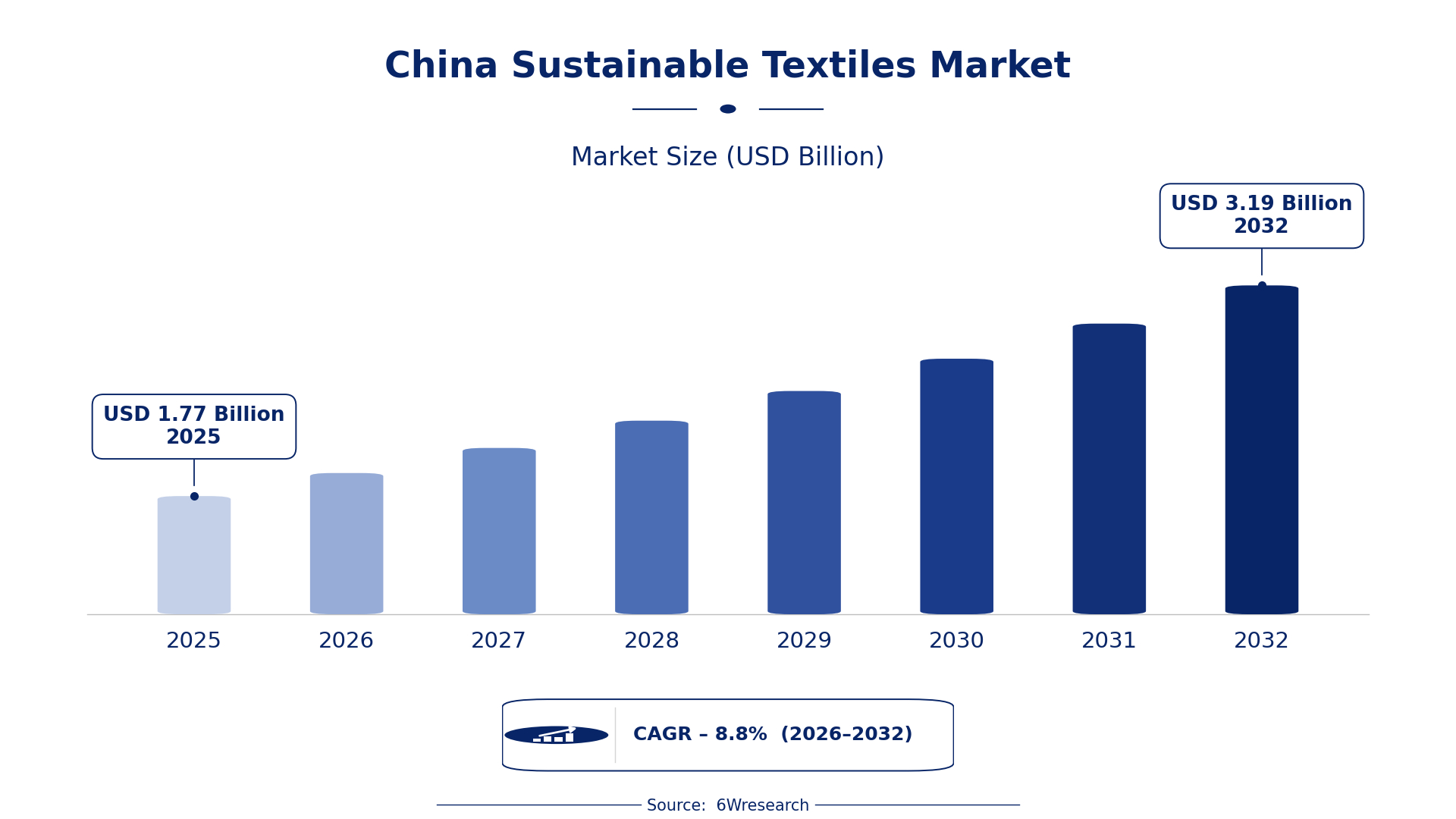
According to 6Wresearch internal database and industry insights, the China Sustainable Textiles Market was valued at USD 1.77 billion in 2025 and is projected to reach USD 3.19 billion by 2032, growing at a CAGR of approximately 8.8% during 2026–2032.
China Sustainable Textiles Market Highlights
| Report Metric | Details |
| Report Name | China Sustainable Textiles Market |
| Market Size 2025 | USD 1.77 billion |
| Market Size 2032 | USD 3.19 billion |
| Absolute Growth 2025–2032 | USD 1.42 billion |
| CAGR 2026–2032 | 8.8% |
| Peak Annual Growth | 11.0% in 2032 |
| Forecast Period | 2026–2032 |
| Historical Data | 2022–2025 |
| Base Year | 2025 |
| Leading Textile Type, 2025 | Hemp Textiles (46% share) |
| Leading Material Source, 2025 | Natural Fiber (47% share) |
| Leading Application Use, 2025 | Apparel (36% share) |
| Leading End User, 2025 | Eco Fashion Brands (39% share) |
| Fastest-Growing Textile Type | Organic Cotton (10.7% CAGR) |
| Fastest-Growing Material Source | GOTS Certified Farms (11.2% CAGR) |
| Fastest-Growing Application Use | Accessories (9.9% CAGR) |
| Fastest-Growing End User | Mass Apparel Retailers (10.9% CAGR) |
| Growing Sector | Eco Fashion Brands |
| Key End Users | Eco Fashion Brands, Mass Apparel Retailers, Sportswear Brands |
China Sustainable Textiles Market Year-wise Growth Rate and Key Drivers (2022–2032)
This graph illustrates the annual growth rates of the market from 2022 to 2032, highlighting a steady upward trajectory and projected market expansion over the forecast period.
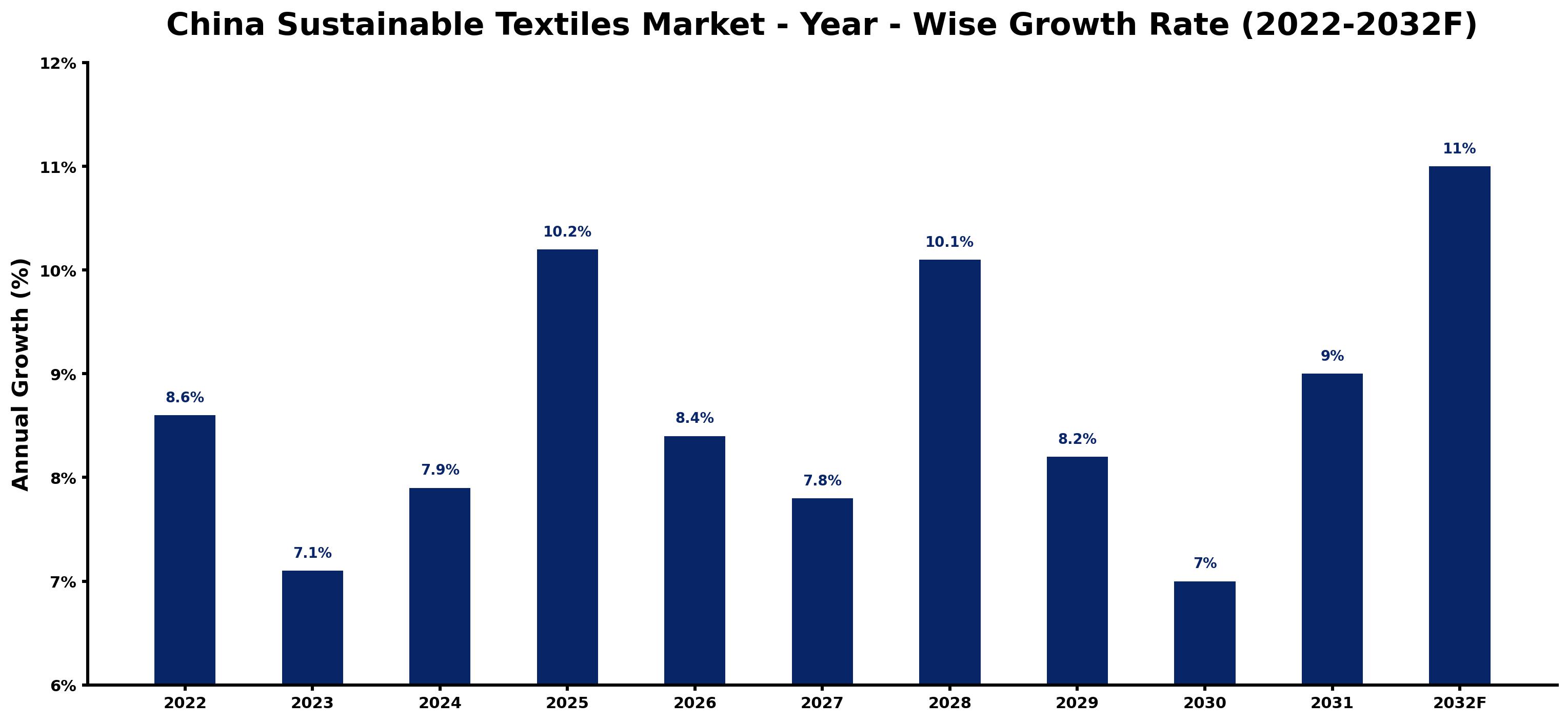
Year by year, the estimates below pair each growth rate with the development that shaped it.
| Year | Estimated Annual Growth (%) | Market Rationale |
| 2022 | 8.6 | The market showed strong demand from eco-fashion brands and sustainable initiatives. |
| 2023 | 7.1 | Growth slowed as manufacturers adjusted to changing consumer preferences and supply chain issues. |
| 2024 | 7.9 | Increased interest in organic materials spurred a rise in sustainable textile production. |
| 2025 | 10.2 | The market peaked due to heightened consumer awareness and demand for eco-friendly products. |
| 2026 | 8.4 | Growth slowed as manufacturers faced challenges in sourcing sustainable materials. |
| 2027 | 7.8 | Market expansion continued but at a reduced pace due to rising production costs. |
| 2028 | 10.1 | Demand surged as youth demographics increasingly preferred sustainable activewear. |
| 2029 | 8.2 | Growth slowed as competition intensified among eco-fashion brands. |
| 2030 | 7.0 | The market grew steadily as the 'Circular Economy Promotion Law' promoted sustainable practices in textiles. |
| 2031 | 9.0 | Demand increased as more mass apparel retailers adopted sustainable lines. |
| 2032 | 11.0 | The market peaked again, driven by government initiatives and consumer demand. |
Note: Market size estimations and growth projections presented in this report are based on 6Wresearch's proprietary forecasting methodology, utilizing the latest available industry data, government publications, and primary research inputs.
China Sustainable Textiles Market Synopsis
Sustainable Textiles in China includes eco-friendly fabrics crafted from organic or recycled materials. These textiles are produced through methods that minimise environmental impact, primarily used in clothing and home textiles. The China Sustainable Textiles Market is expanding due to increasing demand from over 200 eco-fashion brands and substantial investments in sustainable production. The 'Green Manufacturing' initiative and the 'Circular Economy Promotion Law' further encourage this trend, establishing a supportive environment for sustainable textile innovation and production.
Market Dynamics Impact Analysis (2026–2032)
| Factor | Type | Impact | Primary Segment Affected |
| Rising demand for eco-friendly apparel drives growth in sustainable textiles. | Driver | High | Apparel |
| Growing interest in organic cotton among consumers boosts production. | Driver | High | Organic Cotton |
| The need for sustainable materials presents opportunities for eco-fashion brands. | Opportunity | High | Eco Fashion Brands |
| Increasing demand for recycled polyester opens new markets for suppliers. | Opportunity | High | Recycled Polyester |
| High production costs for sustainable materials limit market growth. | Restraint | High | Natural Fiber |
| Supply chain disruptions hinder the availability of organic cotton. | Restraint | Medium | Organic Cotton |
| Regulatory compliance costs can deter new entrants into the market. | Challenge | Medium | Hemp Textiles |
| Limited consumer awareness of sustainable options slows adoption rates. | Challenge | Medium | Eco Fashion Brands |
Evaluation of Drivers in China Sustainable Textiles Market (2026–2032)
The table below links each growth driver to the segment it affects and the evidence for it.
| Drivers | Primary Segment Affected | Why It Matters (Evidence) |
| Growing consumer preference for eco-friendly products | Eco Fashion Brands | This trend leads to increased purchases of sustainable textiles, with over 200 eco-fashion brands actively sourcing these materials. |
| Government initiatives promoting sustainable practices | Natural Fiber | The 'Green Manufacturing' initiative encourages investment in sustainable production, boosting demand for natural fibers. |
| Rising production of recycled materials | Recycled Polyester | In 2022, 15 million tons of recycled polyester were produced, enhancing supply for activewear and casual clothing. |
| Youth interest in sustainable fashion | Activewear | The market for activewear made from sustainable materials is growing rapidly, particularly among younger demographics. |
| Expansion of GOTS certified facilities | GOTS Certified Farms | With over 500 certified facilities, the availability of organic textiles is increasing, driving demand among eco-conscious brands. |
Over 200 eco-fashion brands are driving demand for sustainable textiles, leading to higher purchases. In 2022, 15 million tons of recycled polyester were produced, boosting supply for activewear. Youth interest in sustainable activewear is expanding the market further, particularly among younger consumers.
Evaluation of Restraints in China Sustainable Textiles Market
Below mentioned are some major restraints and their influence on market dynamics.
| Market Restraint | Primary Segment Affected | Why It Matters (Evidence) |
| High production costs for sustainable materials limit market growth. | Natural Fiber | Production costs for sustainable materials can exceed traditional textiles, affecting pricing by up to 20%. |
| Supply chain disruptions hinder the availability of organic cotton. | Organic Cotton | Organic cotton production is concentrated in Xinjiang, making it vulnerable to disruptions that can delay supply. |
| Regulatory compliance costs can deter new entrants into the market. | Hemp Textiles | New producers face high costs to meet sustainability certifications and standards, impacting profitability. |
| Limited consumer awareness of sustainable options slows adoption rates. | Eco Fashion Brands | Many consumers remain unaware of the benefits of sustainable textiles, limiting market potential. |
| Competition from traditional textiles affects market penetration. | Apparel | Traditional textiles often have lower prices, making it hard for sustainable options to compete effectively. |
China Sustainable Textiles Market Challenges
The China Sustainable Textiles Market encounters fierce competition, which compresses profit margins for producers. This competition arises from an influx of local and foreign brands, leading to price reductions that can diminish earnings by up to 20% for domestic manufacturers. Sourcing organic materials poses another challenge, as over 70% of organic cotton is produced in Xinjiang, making supply chains susceptible to regional disruptions. This concentration can delay production timelines by several weeks for manufacturers reliant on steady supplies. A shortage of skilled workers in eco-friendly production techniques complicates operations, resulting in a 15% increase in production costs for producers. Buyers also face rising prices due to heightened demand for sustainable textiles, with some retailers experiencing a 10% increase in costs, affecting their pricing strategies.
Trends in the China Sustainable Textiles Market
Several trends are reshaping the China Sustainable Textiles Market; the most important are set out below.
- Shift from Conventional to Sustainable Materials: Since 2021, manufacturers have increasingly embraced sustainable practices, with over 30% of textile production now sourced from sustainable origins, reflecting a notable shift in the industry.
- Emergence of Organic Cotton: The focus on organic cotton has intensified since 2020, with production centred in Xinjiang, which accounts for 70% of China's organic cotton output, underscoring the rising demand for organic materials.
- Rise of Eco Fashion Brands: The number of eco-fashion brands has surged since 2020, with over 200 now operating in China, indicating a consumer shift towards sustainable fashion choices that drive further market growth.
- Increased Recycling Initiatives: The 'Circular Economy Promotion Law', enacted in 2020, has energised recycling efforts within the textile industry. In 2022, 15 million tons of recycled polyester were produced, illustrating this trend towards sustainability.
Investment Opportunities in the China Sustainable Textiles Market
Below are the investment opportunities with the strongest case in the China Sustainable Textiles Market.
- Investment in Sustainable Production Facilities: With over 30% of textile production now sustainable, there is a pressing need for new production facilities. Eco-fashion brands in urban centres are particularly seeking local partnerships to strengthen their supply chains.
- Supply of Organic Cotton: The demand for organic cotton is on the rise, especially in regions like Xinjiang. Suppliers can tap into this market by collaborating with local farmers and obtaining GOTS certification to meet increasing needs.
- Development of Recycled Polyester Products: The production of 15 million tons of recycled polyester in 2022 indicates a burgeoning market. Suppliers can target activewear brands seeking sustainable materials to satisfy consumer demand.
- Expansion of Eco-Friendly Apparel Lines: Mass apparel retailers are progressively incorporating sustainable lines, driven by consumer demand for eco-friendly products. This presents an opportunity for suppliers to provide sustainable materials to align with this trend.
Government Initiatives in the China Sustainable Textiles Market
The 'Circular Economy Promotion Law', enacted in 2020, supports recycling and sustainable practices in various industries, including textiles. This law encourages manufacturers to adopt eco-friendly methods and reduces waste in production. Additionally, the 'Green Manufacturing' initiative launched in 2021 by the Ministry of Industry and Information Technology promotes investment in eco-friendly production methods, aiming to transform the textile industry towards sustainability. These measures collectively ensure compliance with environmental standards and improve production efficiency.
The National Development and Reform Commission oversees the implementation of the subsidy program for sustainable textile production, which provides financial support to manufacturers adopting eco-friendly methods. In 2022, this program funded numerous projects aimed at improving sustainable practices. Furthermore, the Ministry of Agriculture and Rural Affairs supports organic farming practices through the 'Organic Agriculture Development Plan', updated in 2021, which promotes the cultivation of organic materials for textile production. These initiatives collectively strengthen the sustainable textile framework in China.
Future Insight of the China Sustainable Textiles Market
By 2032, buyers and suppliers in the China Sustainable Textiles Market can anticipate substantial changes driven by government support and technological advancements. The 'Green Manufacturing' initiative will improve production efficiency, while the 'Circular Economy Promotion Law' will encourage recycling practices within the industry. In 2022, China produced 15 million tons of recycled polyester, highlighting the increasing focus on eco-friendly materials. The rising number of eco-fashion brands will further boost demand for sustainable textiles, particularly among younger consumers, creating new opportunities for suppliers.
Market Segmentation Analysis
Each segment group is reviewed below, with the leader by share and the fastest grower by CAGR.
By Textile Type – Hemp Textiles Dominated, Organic Cotton Expected to Grow Fastest
According to Sumit Sagar, AM at 6Wresearch, Hemp Textiles accounted for a 46% market share by textile type in 2025. Hemp textiles hold the largest share in the China Sustainable Textiles Market due to their versatility and demand from eco-friendly apparel and home decor sectors. The increasing number of eco-fashion brands utilising hemp further solidifies its position as a preferred material. Organic Cotton is projected to grow fastest, at a CAGR of 10.7% during 2026–2032. Organic cotton is experiencing rapid growth because of the rising consumer preference for organic products, particularly in clothing. The concentration of organic cotton production in Xinjiang, which accounts for 70% of China's output, supports this growth. Suppliers should focus on expanding their offerings in organic cotton to meet the growing demand from eco-fashion brands.
By Material Source – Natural Fiber Dominated, GOTS Certified Farms Expected to Grow Fastest
The largest material source category in 2025 was Natural Fiber, with a 47% share of total revenue. Natural fiber leads the market share as it serves as a common base material for various sustainable textiles, appealing to both manufacturers and consumers. Its widespread use across multiple applications reinforces its dominance in the market. The quickest growth will come from GOTS Certified Farms, forecast to expand at a CAGR of 11.2% between 2026 and 2032. GOTS certified farms are growing rapidly as they are essential for ensuring organic certification, which is increasingly demanded by consumers. The push for certified organic textiles aligns with the government's support for sustainable practices. Buyers should prioritise sourcing from GOTS certified farms to ensure compliance with organic standards and meet consumer expectations.
By Application Use – Apparel Dominated, Accessories Expected to Grow Fastest
Apparel took a 36% share of application use in 2025, more than any other category. Apparel dominates the market share as the largest application area for sustainable textiles, driven by a strong consumer preference for eco-friendly clothing. The presence of numerous eco-fashion brands focusing on apparel reinforces this segment's leading position. Over 2026–2032, Accessories are expected to post the fastest growth, at a CAGR of 9.9%. Accessories are witnessing rapid growth due to a surge in demand for sustainable fashion items among environmentally conscious consumers. This trend reflects a broader shift towards eco-friendly choices in the fashion accessories market. Suppliers should consider diversifying their product lines to include sustainable accessories, capitalising on this expanding market opportunity.
By End User – Eco Fashion Brands Dominated, Mass Apparel Retailers Expected to Grow Fastest
In 2025, Eco Fashion Brands led the end user split with a 39% share. Eco fashion brands hold the largest market share as they are the primary users of sustainable textiles, significantly shaping the demand for eco-friendly materials. Their commitment to sustainability plays a crucial role in influencing the overall market dynamics. Mass Apparel Retailers are set to record the highest CAGR in this split, 10.9% over 2026–2032. Mass apparel retailers are quickly adopting sustainable lines in response to rising consumer interest in eco-friendly products. This trend is expected to continue as these retailers align their offerings with consumer preferences for sustainability. Suppliers must establish strong partnerships with mass apparel retailers to ensure their sustainable textiles gain visibility in mainstream fashion.
Key Attractiveness of the Report
- 10 Years of Market Numbers
- Historical Data Starting from 2022 to 2025
- Base Year 2025
- Forecast Data until 2032
- Key Performance Indicators Impacting the Market
- Major Upcoming Developments and Projects
Key Highlights of the Report:
- China Sustainable Textiles Market Outlook
- Market Size of China Sustainable Textiles Market, 2025
- Forecast of China Sustainable Textiles Market, 2032
- Historical Data and Forecast of China Sustainable Textiles Revenues & Volume for the Period 2022 - 2032F
- China Sustainable Textiles Market Trend Evolution
- China Sustainable Textiles Market Drivers and Challenges
- China Sustainable Textiles Price Trends
- China Sustainable Textiles Porter's Five Forces
- China Sustainable Textiles Industry Life Cycle
- Historical Data and Forecast of China Sustainable Textiles Market Revenues & Volume By Textile Type for the Period 2022 - 2032F
- Historical Data and Forecast of China Sustainable Textiles Market Revenues & Volume By Hemp Textiles for the Period 2022 - 2032F
- Historical Data and Forecast of China Sustainable Textiles Market Revenues & Volume By Organic Cotton for the Period 2022 - 2032F
- Historical Data and Forecast of China Sustainable Textiles Market Revenues & Volume By Recycled Polyester for the Period 2022 - 2032F
- Historical Data and Forecast of China Sustainable Textiles Market Revenues & Volume By Banana/Soy Fiber for the Period 2022 - 2032F
- Historical Data and Forecast of China Sustainable Textiles Market Revenues & Volume By Material Source for the Period 2022 - 2032F
- Historical Data and Forecast of China Sustainable Textiles Market Revenues & Volume By Natural Fiber for the Period 2022 - 2032F
- Historical Data and Forecast of China Sustainable Textiles Market Revenues & Volume By GOTS Certified Farms for the Period 2022 - 2032F
- Historical Data and Forecast of China Sustainable Textiles Market Revenues & Volume By PET Bottles for the Period 2022 - 2032F
- Historical Data and Forecast of China Sustainable Textiles Market Revenues & Volume By Agricultural Waste for the Period 2022 - 2032F
- Historical Data and Forecast of China Sustainable Textiles Market Revenues & Volume By Application Use for the Period 2022 - 2032F
- Historical Data and Forecast of China Sustainable Textiles Market Revenues & Volume By Apparel, Accessories for the Period 2022 - 2032F
- Historical Data and Forecast of China Sustainable Textiles Market Revenues & Volume By T-Shirts, Innerwear for the Period 2022 - 2032F
- Historical Data and Forecast of China Sustainable Textiles Market Revenues & Volume By Activewear for the Period 2022 - 2032F
- Historical Data and Forecast of China Sustainable Textiles Market Revenues & Volume By Towels, Home D cor for the Period 2022 - 2032F
- Historical Data and Forecast of China Sustainable Textiles Market Revenues & Volume By End User for the Period 2022 - 2032F
- Historical Data and Forecast of China Sustainable Textiles Market Revenues & Volume By Eco Fashion Brands for the Period 2022 - 2032F
- Historical Data and Forecast of China Sustainable Textiles Market Revenues & Volume By Mass Apparel Retailers for the Period 2022 - 2032F
- Historical Data and Forecast of China Sustainable Textiles Market Revenues & Volume By Sportswear Brands for the Period 2022 - 2032F
- Historical Data and Forecast of China Sustainable Textiles Market Revenues & Volume By Green Interior Labels for the Period 2022 - 2032F
- China Sustainable Textiles Import Export Trade Statistics
- Market Opportunity Assessment By Textile Type
- Market Opportunity Assessment By Material Source
- Market Opportunity Assessment By Application Use
- Market Opportunity Assessment By End User
- China Sustainable Textiles Top Companies Market Share
- China Sustainable Textiles Competitive Benchmarking By Technical and Operational Parameters
- China Sustainable Textiles Company Profiles
- China Sustainable Textiles Key Strategic Recommendations
Market Covered
This report examines the market across the segments below.
By Textile Type
- Hemp Textiles
- Organic Cotton
- Recycled Polyester
- Banana/Soy Fiber
By Material Source
- Natural Fiber
- GOTS Certified Farms
- PET Bottles
- Agricultural Waste
By Application Use
- Apparel
- Accessories
- T-Shirts
- Innerwear
- Activewear
- Towels
- Home Décor
By End User
- Eco Fashion Brands
- Mass Apparel Retailers
- Sportswear Brands
- Green Interior Labels































