India Sustainable Textiles Market Size & Growth Rate
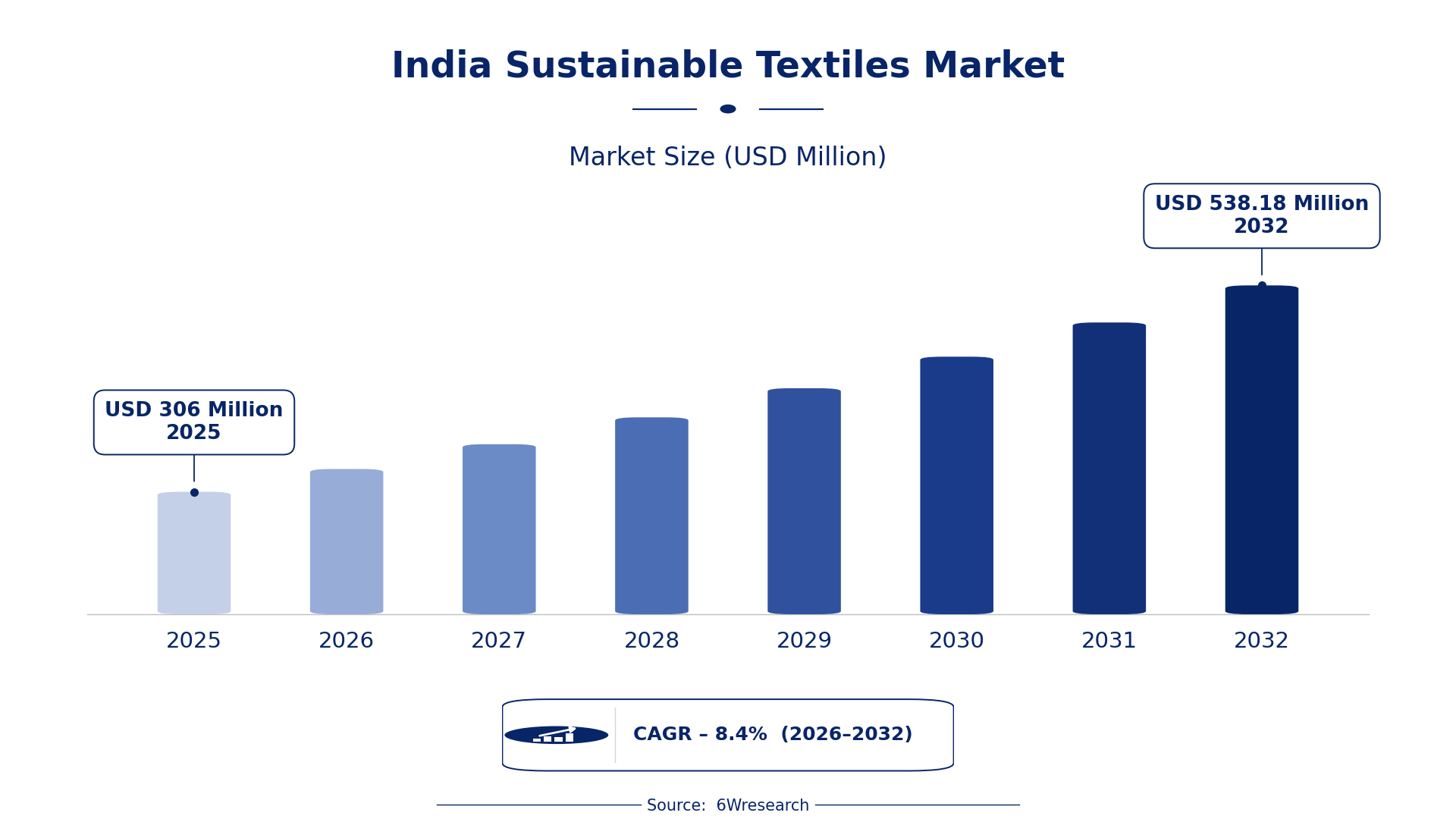
According to 6Wresearch internal database and industry insights, the India Sustainable Textiles Market was valued at USD 306.0 million in 2025 and is projected to reach USD 538.18 million by 2032, growing at a CAGR of approximately 8.4% during 2026–2032.
India Sustainable Textiles Market Highlights
| Report Metric | Details |
| Report Name | India Sustainable Textiles Market |
| Market Size 2025 | USD 306.0 million |
| Market Size 2032 | USD 538.18 million |
| Absolute Growth 2025–2032 | USD 232.18 million |
| CAGR 2026–2032 | 8.4% |
| Peak Annual Growth | 10.9% in 2032 |
| Forecast Period | 2026–2032 |
| Historical Data | 2022–2025 |
| Base Year | 2025 |
| Leading Textile Type, 2025 | Organic Cotton (43% share) |
| Leading Material Source, 2025 | Natural Fiber (45% share) |
| Leading Application Use, 2025 | Apparel (40% share) |
| Leading End User, 2025 | Eco Fashion Brands (47% share) |
| Fastest-Growing Textile Type | Hemp Textiles (10.5% CAGR) |
| Fastest-Growing Material Source | Agricultural Waste (9.5% CAGR) |
| Fastest-Growing Application Use | Activewear (9.4% CAGR) |
| Growing Sector | Apparel |
| Key End Users | Eco Fashion Brands, Mass Apparel Retailers, Sportswear Brands |
India Sustainable Textiles Market Year-wise Growth Rate and Key Drivers (2022–2032)
This graph illustrates the annual growth rates of the market from 2022 to 2032, highlighting a steady upward trajectory and projected market expansion over the forecast period.
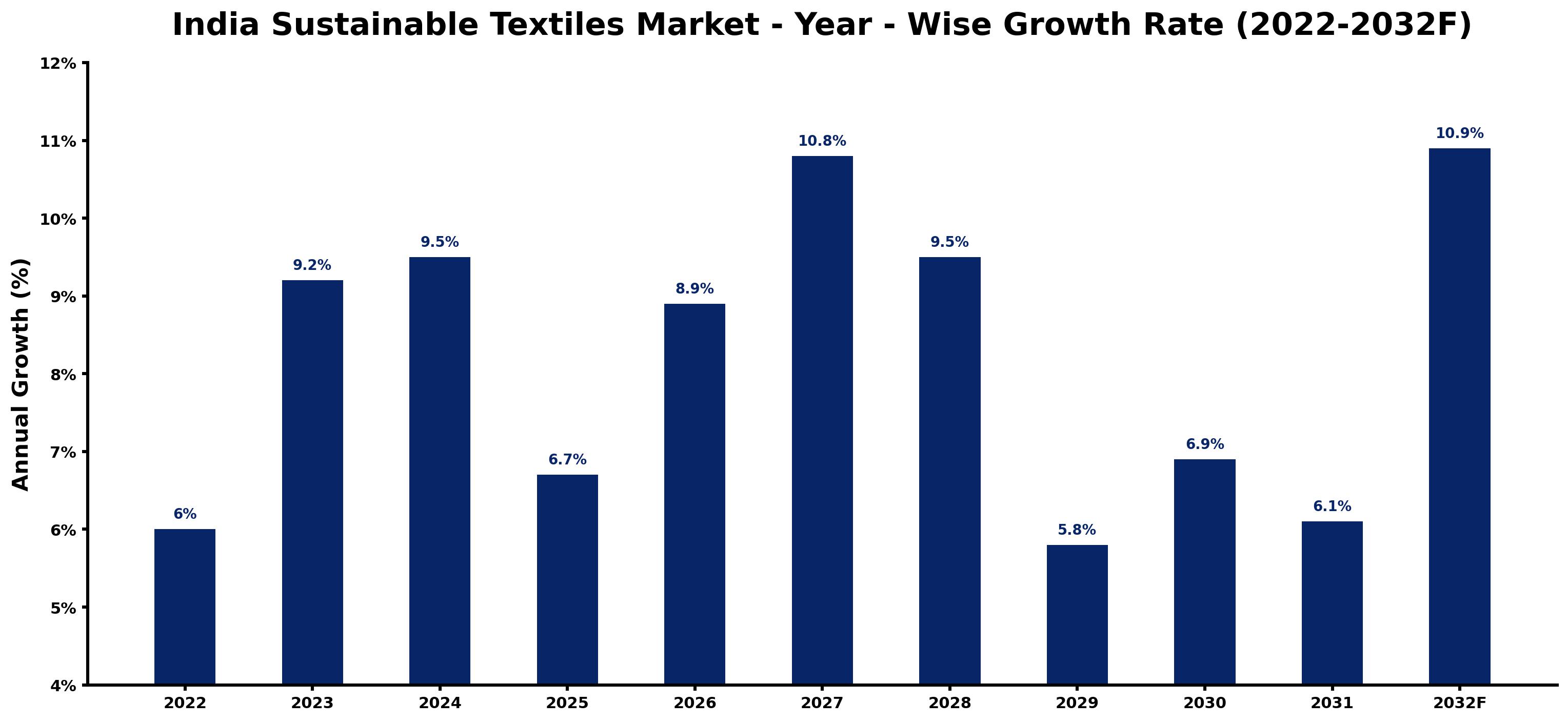
Below, each year's estimated growth is shown next to the factor that most influenced it.
| Year | Estimated Annual Growth (%) | Market Rationale |
| 2022 | 6.0 | The market experienced steady growth as eco-conscious consumers began prioritising sustainable options. |
| 2023 | 9.2 | Increased interest from eco fashion brands drove demand for sustainable textiles, boosting market performance. |
| 2024 | 9.5 | The market maintained strong momentum due to rising production of organic cotton and hemp textiles. |
| 2025 | 6.7 | Growth slowed slightly as the market adjusted to changing consumer preferences and supply chain issues. |
| 2026 | 8.9 | A resurgence in demand is anticipated as the 'Textiles Mission' promotes sustainable practices among producers. |
| 2027 | 10.8 | Accelerated growth is expected as activewear lines made from sustainable textiles expand. |
| 2028 | 9.5 | Growth is projected to decelerate as competition intensifies among sustainable textile producers and brands. |
| 2029 | 5.8 | A further slowdown is anticipated as buyers become more selective, focusing on quality and certification standards. |
| 2030 | 6.9 | Demand is expected to increase again as eco fashion brands expand their offerings and consumer awareness grows. |
| 2031 | 6.1 | The market will face another slowdown as producers adjust to fluctuating raw material prices and availability. |
| 2032 | 10.9 | A peak in growth is projected as sustainable practices become mainstream across the textile sector. |
Note: Market size estimations and growth projections presented in this report are based on 6Wresearch's proprietary forecasting methodology, utilizing the latest available industry data, government publications, and primary research inputs.
India Sustainable Textiles Market Synopsis
Sustainable Textiles in India include eco-friendly fabrics crafted from organic or recycled materials, produced through environmentally responsible methods. These textiles find primary use in the apparel and home décor sectors. The market is thriving, propelled by a rise in eco-conscious consumerism and the growing adoption of sustainable practices by brands. The textile sector is set to expand, with eco fashion brands anticipated to secure 20% of the apparel market by 2025. Initiatives like the 'Textiles Mission' further encourage this growth by advocating sustainable practices throughout the industry.
Market Dynamics Impact Analysis (2026–2032)
| Factor | Type | Impact | Primary Segment Affected |
| Rising consumer awareness and demand for eco-friendly products | Driver | High | Eco Fashion Brands |
| Growing production of organic cotton and hemp textiles | Driver | High | Organic Cotton |
| Increasing investment in recycling initiatives for PET bottles | Opportunity | High | Recycled Polyester |
| Expansion of sustainable apparel lines by mass retailers | Opportunity | Medium | Mass Apparel Retailers |
| Challenges in sourcing certified organic materials | Restraint | High | Organic Cotton |
| Competition from cheaper, non-sustainable textile options | Restraint | Medium | Hemp Textiles |
| Supply chain disruptions affecting raw material availability | Challenge | High | Recycled Polyester |
| Fluctuating prices of sustainable materials impacting production costs | Challenge | Medium | Natural Fiber |
Evaluation of Drivers in India Sustainable Textiles Market (2026–2032)
The table below links each growth driver to the segment it affects and the evidence for it.
| Drivers | Primary Segment Affected | Why It Matters (Evidence) |
| Increased consumer demand for eco-friendly textiles | Eco Fashion Brands | This demand has led to a projected 20% share of the apparel market by 2025, driving sales. |
| Expansion of organic cotton production across 600,000 hectares | Organic Cotton | This growth supports the need for sustainable clothing options, encouraging more purchases from eco-conscious consumers. |
| Government initiatives to recycle 1 million PET bottles annually | Recycled Polyester | These initiatives encourage producers to source recycled materials, boosting production and attracting buyers. |
| Growing interest in activewear made from sustainable textiles | Activewear | This segment is expected to grow by 15% annually, attracting more buyers seeking eco-friendly options. |
| The rise of eco fashion brands focusing on sustainability | Eco Fashion Brands | This trend is driving demand for sustainable textile solutions, increasing market opportunities. |
The textile industry is valued at approximately $150 billion, with eco fashion brands projected to capture 20% of the apparel market by 2025. Organic cotton production now spans around 600,000 hectares, boosting sustainable clothing options. Interest in activewear made from sustainable textiles is expected to further drive demand in the coming years.
Evaluation of Restraints in India Sustainable Textiles Market
The key brakes on demand, and where they bite hardest, are shown below.
| Market Restraint | Primary Segment Affected | Why It Matters (Evidence) |
| Limited availability of certified organic materials | Organic Cotton | This scarcity can hinder production and increase costs for manufacturers, affecting their ability to meet demand. |
| Competition from cheaper non-sustainable textile options | Hemp Textiles | This competition pressures sustainable brands to lower prices, impacting profitability and market share. |
| Supply chain disruptions affecting raw material sourcing | Recycled Polyester | These disruptions can delay production schedules and increase operational costs for manufacturers. |
| Fluctuating prices of sustainable materials | Natural Fiber | Price volatility can create uncertainty in budgeting and financial planning for producers, complicating operations. |
| Consumer hesitance towards higher-priced sustainable options | Eco Fashion Brands | This hesitance can limit market growth as buyers opt for cheaper alternatives, affecting sales. |
India Sustainable Textiles Market Challenges
The India Sustainable Textiles Market still has to solve a few problems, starting with high production costs. Sustainable materials often require more expensive inputs, which can raise prices for buyers in the apparel sector. Next, eco-conscious consumers face limited availability of certified products, as only over 1,000 farms hold GOTS certification, restricting choices for brands. Skills shortages in eco-friendly production methods hinder growth, with many workers lacking necessary training, delaying product launches for suppliers. Supply chain disruptions can occur due to reliance on specific regions for raw materials like hemp, affecting timely delivery for manufacturers.
Trends in the India Sustainable Textiles Market
Buyers and suppliers in the India Sustainable Textiles Market are adjusting to the following trends.
- Shift towards Organic Cotton Production: Organic cotton production in India is on the rise, covering around 600,000 hectares as of 2023. This shift is driven by increasing consumer demand for sustainable apparel, leading to a greater emphasis on eco-friendly farming practices.
- Growth of Activewear Segment: The activewear segment is seeing growth, with an expected annual increase of 15%. This trend is particularly noticeable among eco fashion brands, which are increasingly providing sustainable sports clothing options.
- Rise in Recycling Initiatives: India is intensifying efforts to recycle 1 million PET bottles annually, bolstering the supply of recycled polyester. This initiative is crucial for promoting sustainable textile production and attracting environmentally conscious consumers.
- Expansion of Eco Fashion Brands: Eco fashion brands are gaining momentum in the Indian market, projected to capture 20% of the apparel sector by 2025. This growth reflects a broader consumer shift towards sustainability and ethical fashion.
Investment Opportunities in the India Sustainable Textiles Market
Investors looking at the India Sustainable Textiles Market should consider the following areas.
- Partnerships with Local Producers: Now is an ideal time to invest in partnerships with local producers focusing on sustainable textiles. The market is valued at approximately $150 billion, presenting opportunities for collaboration.
- Investment in Recycling Technologies: With the aim to recycle 1 million PET bottles annually, investing in recycling technologies can fill the gap in sustainable material sourcing. Collaborating with local recycling facilities can strengthen supply chains.
- Certification for Organic Textiles: The GOTS certification program, reinforced in 2023, offers a pathway for businesses to enter the sustainable textiles market. Gaining certification can attract eco-conscious consumers and enhance brand credibility.
- Expansion into Activewear Production: With activewear expected to grow by 15% annually, investing in sustainable activewear production can meet rising demand. Targeting eco fashion brands can facilitate market entry.
Government Initiatives in the India Sustainable Textiles Market
The 'Textiles Mission', launched in 2021 by the Ministry of Textiles, aims to promote sustainable practices with a budget of ₹1,000 crores. This initiative supports producers adopting eco-friendly methods and encourages investment in sustainable textile technologies. The updated 'National Policy on Textiles' in 2022 further integrates sustainability goals, ensuring that the textile sector aligns with environmental standards and practices. This policy aims to boost the overall growth of sustainable textiles in India, promoting a more responsible industry.
Eco fashion brands are utilising the 'Pradhan Mantri Mudra Yojana', which supports small textile businesses focusing on sustainable practices. This scheme provides financial assistance to entrepreneurs, enabling them to invest in sustainable production methods. Additionally, the 'Atmanirbhar Bharat' initiative encourages local production of sustainable textiles through various subsidies. These measures help small businesses enhance their capabilities while promoting eco-friendly practices across the industry.
Future Insight of the India Sustainable Textiles Market
Several forward-looking factors should support the India Sustainable Textiles Market over the coming years. The government's 'Textiles Mission' promotes eco-friendly practices, encouraging more producers to adopt sustainable methods. By 2025, eco fashion brands are projected to capture 20% of the apparel market, driving demand for eco-friendly fabrics. The Bureau of Indian Standards' guidelines will standardise production processes, ensuring quality across the sector. Initiatives to recycle 1 million PET bottles annually will increase the availability of recycled materials, benefiting suppliers and buyers alike.
Market Segmentation Analysis
Each segment group is reviewed below, with the leader by share and the fastest grower by CAGR.
By Textile Type – Organic Cotton Dominated, Hemp Textiles Expected to Grow Fastest
According to Sumit Sagar, AM at 6Wresearch, with a 43% revenue share in 2025, Organic Cotton was the largest textile type category. Organic cotton holds the largest share in India's sustainable textiles market due to its widespread use in sustainable clothing. With over 600,000 hectares dedicated to organic cotton production, it serves as a primary choice for eco-conscious consumers and brands. The quickest growth will come from Hemp Textiles, forecast to expand at a CAGR of 10.5% between 2026 and 2032. Hemp textiles are experiencing rapid growth, driven by their increasing adoption in eco-friendly apparel and home décor. The production is concentrated in states like Uttarakhand and Himachal Pradesh, which supports local economies and sustainability efforts. Suppliers should focus on organic cotton to maintain market share, while buyers may find more options in hemp textiles as demand rises.
By Material Source – Natural Fiber Dominated, Agricultural Waste Expected to Grow Fastest
Natural Fiber accounted for a 45% market share by material source in 2025. Natural fiber dominates the market share as the core material for sustainable textiles, appealing to consumers seeking eco-friendly options. Its versatility and established supply chains make it a preferred choice among manufacturers. Over 2026–2032, Agricultural Waste is expected to post the fastest growth, at a CAGR of 9.5%. Agricultural waste is emerging as the fastest-growing segment, as innovations in creating fibers from by-products like banana and soy gain traction. This shift not only reduces waste but also opens new avenues for sustainable production. Suppliers should explore agricultural waste to diversify their offerings, while buyers can benefit from more sustainable material options.
By Application Use – Apparel Dominated, Activewear Expected to Grow Fastest
Apparel took a 40% share of application use in 2025, more than any other category. Apparel commands the largest share in the sustainable textiles market due to a robust consumer demand for eco-friendly clothing. The established presence of numerous brands focused on sustainable practices further solidifies this segment's dominance. Activewear is set to record the highest CAGR in this split, 9.4% over 2026–2032. Activewear is set to grow rapidly, with an annual increase of 15%, driven by a rising trend in fitness and the preference for sustainable sportswear. This growth indicates a shift towards more environmentally responsible choices among health-conscious consumers. This trend means suppliers should prioritise activewear offerings, while buyers will benefit from a broader range of sustainable apparel choices.
By End User – Eco Fashion Brands Dominated and Is Expected to Record the Fastest Growth
The largest end user category in 2025 was Eco Fashion Brands, with a 47% share of total revenue. Eco fashion brands lead the market share as primary consumers of sustainable textiles, aligning their offerings with the values of eco-conscious consumers. Their commitment to sustainability drives demand for organic materials and ethical production practices. Its lead should widen, with a projected CAGR of 10.1% during 2026–2032, the highest in this split. Eco fashion brands are also the fastest-growing segment, as their influence expands and they capture a larger portion of the apparel market. This growth reflects a broader consumer shift towards sustainability and ethical fashion choices, reinforcing their market position. Suppliers must engage with eco fashion brands to align with market trends, while buyers can expect a wider array of sustainable products from these brands.
Key Attractiveness of the Report
- 10 Years of Market Numbers
- Historical Data Starting from 2022 to 2025
- Base Year 2025
- Forecast Data until 2032
- Key Performance Indicators Impacting the Market
- Major Upcoming Developments and Projects
Key Highlights of the Report:
- India Sustainable Textiles Market Outlook
- Market Size of India Sustainable Textiles Market, 2025
- Forecast of India Sustainable Textiles Market, 2032
- Historical Data and Forecast of India Sustainable Textiles Revenues & Volume for the Period 2022 - 2032F
- India Sustainable Textiles Market Trend Evolution
- India Sustainable Textiles Market Drivers and Challenges
- India Sustainable Textiles Price Trends
- India Sustainable Textiles Porter's Five Forces
- India Sustainable Textiles Industry Life Cycle
- Historical Data and Forecast of India Sustainable Textiles Market Revenues & Volume By Textile Type for the Period 2022 - 2032F
- Historical Data and Forecast of India Sustainable Textiles Market Revenues & Volume By Hemp Textiles for the Period 2022 - 2032F
- Historical Data and Forecast of India Sustainable Textiles Market Revenues & Volume By Organic Cotton for the Period 2022 - 2032F
- Historical Data and Forecast of India Sustainable Textiles Market Revenues & Volume By Recycled Polyester for the Period 2022 - 2032F
- Historical Data and Forecast of India Sustainable Textiles Market Revenues & Volume By Banana/Soy Fiber for the Period 2022 - 2032F
- Historical Data and Forecast of India Sustainable Textiles Market Revenues & Volume By Material Source for the Period 2022 - 2032F
- Historical Data and Forecast of India Sustainable Textiles Market Revenues & Volume By Natural Fiber for the Period 2022 - 2032F
- Historical Data and Forecast of India Sustainable Textiles Market Revenues & Volume By GOTS Certified Farms for the Period 2022 - 2032F
- Historical Data and Forecast of India Sustainable Textiles Market Revenues & Volume By PET Bottles for the Period 2022 - 2032F
- Historical Data and Forecast of India Sustainable Textiles Market Revenues & Volume By Agricultural Waste for the Period 2022 - 2032F
- Historical Data and Forecast of India Sustainable Textiles Market Revenues & Volume By Application Use for the Period 2022 - 2032F
- Historical Data and Forecast of India Sustainable Textiles Market Revenues & Volume By Apparel, Accessories for the Period 2022 - 2032F
- Historical Data and Forecast of India Sustainable Textiles Market Revenues & Volume By T-Shirts, Innerwear for the Period 2022 - 2032F
- Historical Data and Forecast of India Sustainable Textiles Market Revenues & Volume By Activewear for the Period 2022 - 2032F
- Historical Data and Forecast of India Sustainable Textiles Market Revenues & Volume By Towels, Home D cor for the Period 2022 - 2032F
- Historical Data and Forecast of India Sustainable Textiles Market Revenues & Volume By End User for the Period 2022 - 2032F
- Historical Data and Forecast of India Sustainable Textiles Market Revenues & Volume By Eco Fashion Brands for the Period 2022 - 2032F
- Historical Data and Forecast of India Sustainable Textiles Market Revenues & Volume By Mass Apparel Retailers for the Period 2022 - 2032F
- Historical Data and Forecast of India Sustainable Textiles Market Revenues & Volume By Sportswear Brands for the Period 2022 - 2032F
- Historical Data and Forecast of India Sustainable Textiles Market Revenues & Volume By Green Interior Labels for the Period 2022 - 2032F
- India Sustainable Textiles Import Export Trade Statistics
- Market Opportunity Assessment By Textile Type
- Market Opportunity Assessment By Material Source
- Market Opportunity Assessment By Application Use
- Market Opportunity Assessment By End User
- India Sustainable Textiles Top Companies Market Share
- India Sustainable Textiles Competitive Benchmarking By Technical and Operational Parameters
- India Sustainable Textiles Company Profiles
- India Sustainable Textiles Key Strategic Recommendations
Market Covered
The report offers an extensive study of the following market segments.
By Textile Type
- Hemp Textiles
- Organic Cotton
- Recycled Polyester
- Banana/Soy Fiber
By Material Source
- Natural Fiber
- GOTS Certified Farms
- PET Bottles
- Agricultural Waste
By Application Use
- Apparel
- Accessories
- T-Shirts
- Innerwear
- Activewear
- Towels
- Home Décor
By End User
- Eco Fashion Brands
- Mass Apparel Retailers
- Sportswear Brands
- Green Interior Labels































