China Symptom Checker AI Market Size & Growth Rate
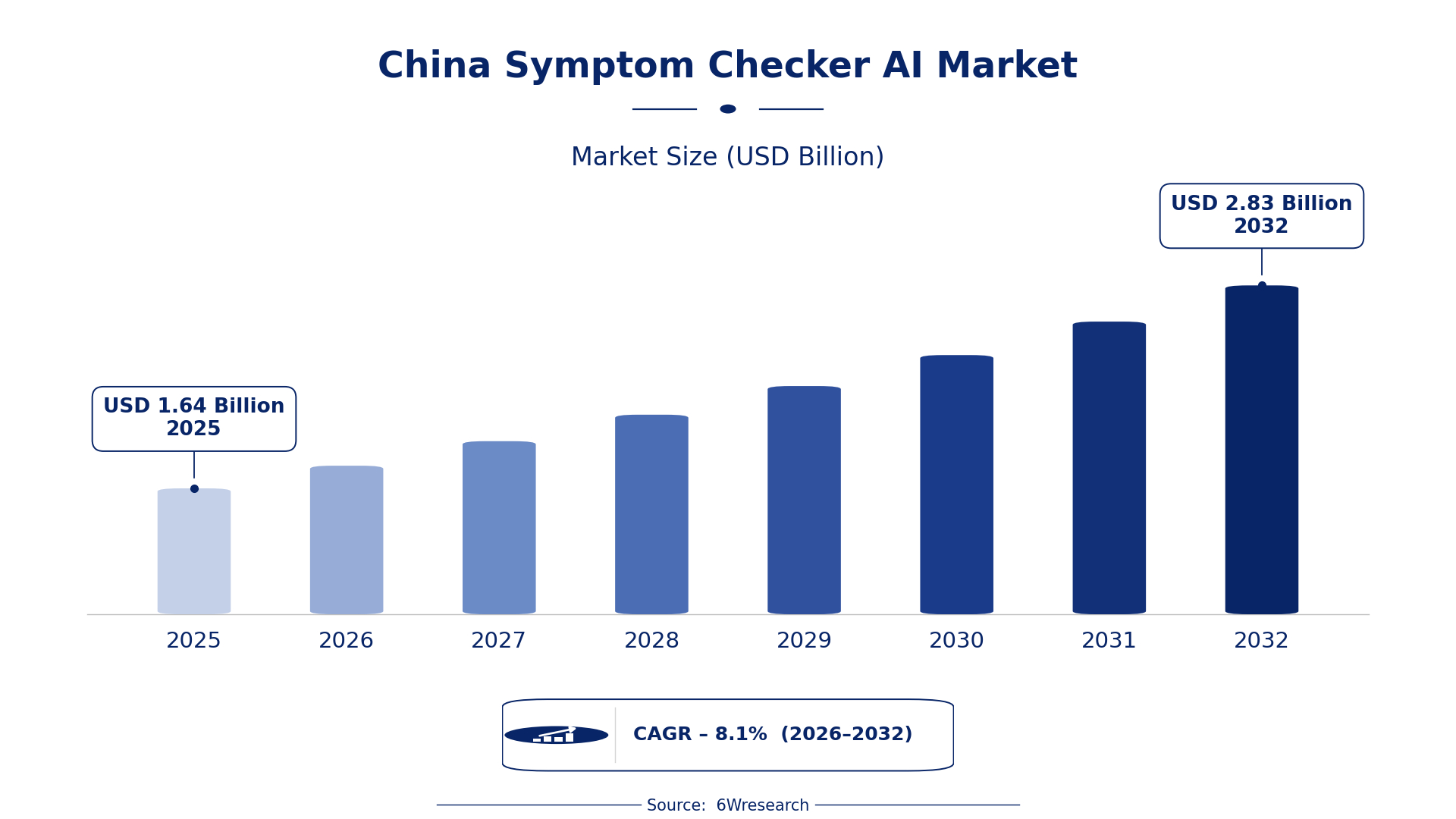
According to 6Wresearch internal database and industry insights, the China Symptom Checker AI Market was valued at USD 1.64 billion in 2025 and is projected to reach USD 2.83 billion by 2032, growing at a CAGR of approximately 8.1% during 2026–2032.
China Symptom Checker AI Market Highlights
| Report Metric | Details |
| Report Name | China Symptom Checker AI Market |
| Market Size 2025 | USD 1.64 billion |
| Market Size 2032 | USD 2.83 billion |
| Absolute Growth 2025–2032 | USD 1.19 billion |
| CAGR 2026–2032 | 8.1% |
| Peak Annual Growth | 9.8% in 2030 |
| Forecast Period | 2026–2032 |
| Historical Data | 2022–2025 |
| Base Year | 2025 |
| Leading AI Tool Type, 2025 | Chatbot-Based Tools (46% share) |
| Leading Diagnostic Model, 2025 | NLP + Decision Trees (45% share) |
| Leading User Interface, 2025 | Web/App Interface (39% share) |
| Leading End User, 2025 | Telehealth Providers (34% share) |
| Fastest-Growing AI Tool Type | Clinical Support AI (10.8% CAGR) |
| Fastest-Growing Diagnostic Model | Image Recognition AI (10.0% CAGR) |
| Fastest-Growing End User | Patients (10.2% CAGR) |
| Growing Sector | Patients |
| Key End Users | Telehealth Providers, Patients, Physicians, Preventive Health Users |
China Symptom Checker AI Market Year-wise Growth Rate and Key Drivers (2022–2032)
This graph illustrates the annual growth rates of the market from 2022 to 2032, highlighting a steady upward trajectory and projected market expansion over the forecast period.
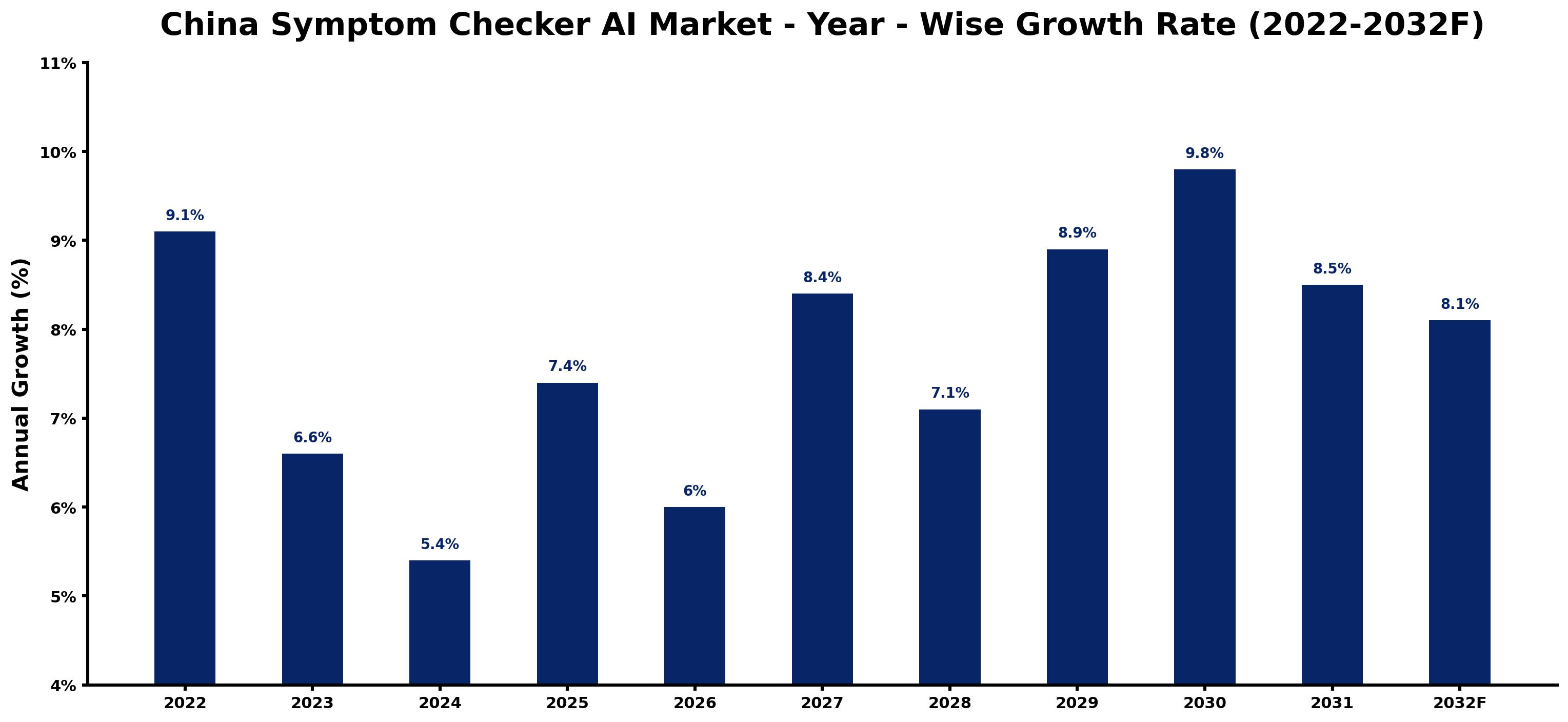
Annual growth estimates for each year appear below with the principal reason behind them, explaining the shifts that set the pace of the market.
| Year | Estimated Annual Growth (%) | Market Rationale |
| 2022 | 9.1 | The market experienced strong demand due to the rapid adoption of telehealth services. |
| 2023 | 6.6 | Growth slowed as initial implementation challenges arose with AI tool integration in telehealth settings. |
| 2024 | 5.4 | Demand continued to rise, but at a slower pace due to adjustments from the 'Digital Health Promotion Plan'. |
| 2025 | 7.4 | Growth accelerated again as more telehealth providers adopted AI solutions to enhance patient engagement. |
| 2026 | 6.0 | A slowdown is anticipated as the National Medical Products Administration's approval pathway becomes more competitive. |
| 2027 | 8.4 | Demand will surge as healthcare providers increasingly recognise the benefits of AI tools for patient management. |
| 2028 | 7.1 | Growth will slow again as market saturation begins to take effect in urban areas with established telehealth services. |
| 2029 | 8.9 | The market will rebound with renewed interest in AI-driven healthcare solutions as new technologies emerge. |
| 2030 | 9.8 | Growth will peak as AI tools become essential for telehealth providers, enhancing service delivery. |
| 2031 | 8.5 | A slight slowdown will occur as the market stabilises after rapid expansion in AI tool adoption. |
| 2032 | 8.1 | The market will continue to grow, supported by ongoing integration of AI technologies in healthcare. |
Note: Market size estimations and growth projections presented in this report are based on 6Wresearch's proprietary forecasting methodology, utilizing the latest available industry data, government publications, and primary research inputs.
China Symptom Checker AI Market Synopsis
The China Symptom Checker AI Market includes AI technology that analyses user inputs to provide preliminary health assessments. Developed through machine learning algorithms and natural language processing, this technology supports patient self-assessment and aids healthcare professionals. The market is expanding due to the rising number of telehealth users, expected to reach 50 million in 2023, particularly in urban centres with advanced healthcare infrastructure. Furthermore, AI tools are now integrated into 70% of telehealth platforms, improving service efficiency and accessibility for users.
Market Dynamics Impact Analysis (2026–2032)
| Factor | Type | Impact | Primary Segment Affected |
| Growing adoption of AI tools among telehealth providers | Driver | High | Telehealth Providers |
| Increasing demand for remote healthcare solutions | Driver | High | Patients |
| Expansion of telehealth services in urban areas | Opportunity | High | Telehealth Providers |
| Rising need for efficient patient management systems | Opportunity | High | Chatbot-Based Tools |
| Regulatory challenges in AI tool approvals | Restraint | Medium | Clinical Support AI |
| Concerns over data privacy and security | Restraint | Medium | Chatbot-Based Tools |
| Limited awareness among users about AI capabilities | Challenge | Medium | Patients |
| High development costs for AI tools | Challenge | Medium | Clinical Support AI |
Evaluation of Drivers in China Symptom Checker AI Market (2026–2032)
Key forces behind demand, with the segment each one moves most, are listed below.
| Drivers | Primary Segment Affected | Why It Matters (Evidence) |
| Increased telehealth adoption | Telehealth Providers | Over 80% of healthcare providers in major cities are adopting AI tools for patient management. |
| Growing internet user base | Patients | As of 2023, there are over 300 million internet users seeking online health consultations. |
| Integration of AI in healthcare standards | Clinical Support AI | China has established national standards for AI in healthcare, including GB/T 35273-2020. |
| Demand for efficient healthcare solutions | Chatbot-Based Tools | AI tools are expected to reduce patient wait times by 30% in telehealth settings. |
| Support from government initiatives | Visual Symptom Input | The National Health Commission promotes AI in healthcare through the 'Healthy China 2030' initiative. |
The Symptom Checker AI market in China is growing on the back of increased telehealth adoption, a growing internet user base, and the integration of AI in healthcare standards. Over 80% of healthcare providers in major cities are adopting AI tools for patient management, improving service efficiency. As of 2023, there are over 300 million internet users seeking online health consultations, driving demand for symptom checker technologies. The establishment of national standards for AI in healthcare, including GB/T 35273-2020, supports this growth. The funding of 1 billion yuan for AI development promotes further integration and innovation in the sector, enabling faster patient assessments and improved service delivery.
Evaluation of Restraints in China Symptom Checker AI Market
The main factors holding the market back are set out below.
| Market Restraint | Primary Segment Affected | Why It Matters (Evidence) |
| Regulatory hurdles in AI tool approvals | Clinical Support AI | The National Medical Products Administration's fast-track approval pathway reduces approval times by 30%, impacting development timelines for new AI tools. |
| Data privacy concerns among users | Chatbot-Based Tools | Concerns over data privacy and security deter users from adopting AI-driven solutions, limiting market growth. |
| Limited understanding of AI capabilities | Patients | Limited awareness among users about AI capabilities restricts market growth and adoption of symptom checker technologies. |
| High costs associated with AI development | Clinical Support AI | Development costs for AI tools can exceed 5 million yuan, limiting access for smaller healthcare providers and startups. |
| Competition among AI tool developers | Visual Symptom Input | Increasing competition among AI tool developers can lead to market saturation, affecting pricing and innovation. |
China Symptom Checker AI Market Challenges
Buyers and suppliers in the China Symptom Checker AI market face several pressing issues, starting with intense competition as over 80% of healthcare providers in major cities adopt AI tools, leading smaller firms to reduce prices and jeopardising their profitability. Regulatory compliance presents another challenge; national standards impose strict requirements that can delay product launches for new entrants by up to six months, hindering their ability to compete. High development costs pose a barrier, with advanced AI algorithms exceeding 5 million yuan, straining the budgets of startups and limiting their market entry. Integration difficulties persist, as 30% of telehealth platforms lack the necessary infrastructure to support AI tools, diminishing effectiveness for users seeking online health consultations.
Trends in the China Symptom Checker AI Market
Below mentioned are some of the trends shaping the China Symptom Checker AI Market growth.
- Shift Towards AI-Driven Telehealth Solutions: In 2023, AI-driven symptom checkers are integrated into 70% of telehealth platforms in urban areas, improving patient engagement and efficiency, with over 50 million users projected in the telehealth market.
- Growth of Clinical Support AI: The Clinical Support AI segment is projected to grow at a 10.8% CAGR, as healthcare providers increasingly rely on AI for decision support, enhancing diagnostic accuracy and patient outcomes.
- Rise of Visual Symptom Input Tools: Visual Symptom Input tools are gaining traction, allowing users to input symptoms visually, which improves diagnostic accuracy and user experience, with a growing user base in urban centres.
- Increased Internet Connectivity: With over 300 million internet users seeking online health consultations, the demand for AI-driven healthcare solutions is anticipated to rise, facilitating better access to telehealth services.
Investment Opportunities in the China Symptom Checker AI Market
Below are the investment opportunities with the strongest case in the China Symptom Checker AI Market.
- Partnerships with Telehealth Providers: Investing in partnerships with telehealth providers is vital, as over 80% are adopting AI tools, improving patient management and engagement, presenting opportunities for technology developers.
- Investment in AI Development: With a budget of 1 billion yuan for 2023, the Ministry of Industry and Information Technology supports AI development, creating opportunities for advanced solutions in healthcare technology.
- Focus on Urban Healthcare Markets: The urban healthcare market is expanding rapidly, with a projected 50 million telehealth users in 2023, creating demand for advanced AI tools tailored for urban healthcare settings.
- Certification for AI Tools: Securing certifications for AI tools can open doors to a growing market, especially with the National Medical Products Administration's fast-track approval pathway, facilitating quicker market entry.
Government Initiatives in the China Symptom Checker AI Market
The Ministry of Industry and Information Technology oversees a budget of 1 billion yuan for AI development in 2023, promoting advancements in medical technologies. This funding supports research and implementation of AI tools in telehealth settings, ensuring safety and efficacy. The State Administration for Market Regulation updated guidelines for AI healthcare applications in 2023, impacting all AI tool developers and streamlining the approval process for new technologies. These measures aim to benefit both producers and users in the healthcare sector, enhancing the integration of AI in medical services.
In 2021, the National Health Commission launched the 'AI in Healthcare Development Plan' to promote AI integration in medical services, targeting a 50% adoption rate by 2025. The Ministry of Science and Technology initiated the 'Smart Healthcare Initiative' in 2022, with a budget of 500 million yuan for AI research and development, further supporting the sector's growth. These initiatives enable healthcare providers to adopt AI tools more readily, improving patient care and operational efficiency.
Future Insight of the China Symptom Checker AI Market
The China Symptom Checker AI market will experience notable transformations by 2032, driven by the 'Healthy China 2030' initiative which promotes AI integration in healthcare. By that time, AI tools are expected to be integrated into 90% of telehealth platforms, significantly improving user experience and accessibility. The Ministry of Industry and Information Technology's budget for AI development will foster innovation, leading to quicker patient assessments. As a result, buyers will benefit from reduced patient wait times, while suppliers will need to adapt to a more competitive landscape.
Market Segmentation Analysis
The report offers a comprehensive study of the following market segments and their leading categories in the market.
By AI Tool Type – Chatbot-Based Tools Dominated, Clinical Support AI Expected to Grow Fastest
According to Sumit Sagar, AM at 6Wresearch, Chatbot-Based Tools accounted for a 46% market share by ai tool type in 2025. Chatbot-based tools hold the largest share in the China Symptom Checker AI market because they are crucial for initial patient interaction and triage, particularly in urban telehealth services. Their integration into 70% of telehealth platforms illustrates their essential role in enhancing patient engagement and streamlining healthcare delivery. Clinical Support AI is set to record the highest CAGR in this split, 10.8% over 2026–2032. The Clinical Support AI segment is experiencing rapid growth as it provides essential decision support to healthcare professionals, with over 60% of physicians using these tools for clinical assistance. This increasing reliance on clinical support capabilities will likely widen the lead of chatbot-based tools in the market. Suppliers should focus on enhancing chatbot-based tools while investing in clinical support features to meet the evolving needs of telehealth providers.
By Diagnostic Model – NLP + Decision Trees Dominated, Image Recognition AI Expected to Grow Fastest
In 2025, NLP + Decision Trees led the diagnostic model split with a 45% share. NLP + Decision Trees dominate the market share due to their effectiveness in processing user queries and conducting symptom analysis, which are vital for accurate health assessments. Their widespread application in telehealth platforms reinforces their leading position in the market. The quickest growth will come from Image Recognition AI, forecast to expand at a CAGR of 10.0% between 2026 and 2032. Image Recognition AI is rapidly gaining traction as it plays a key role in analysing visual symptoms for diagnostics, a demand that is increasing alongside telehealth consultations. This technology's potential to improve diagnostic accuracy is expected to further accelerate its adoption. Suppliers should prioritise advancing NLP + Decision Trees while exploring opportunities in Image Recognition AI to address diverse diagnostic requirements.
By User Interface – Web/App Interface Dominated and Is Expected to Record the Fastest Growth
Web/App Interface held a 39% share of the China Symptom Checker AI Market by user interface in 2025. The Web/App Interface leads the market as it serves as the primary mode for user interaction with AI technologies, facilitating easy access to health information for millions of users. Its widespread adoption aligns with the growing telehealth market, which is projected to reach 50 million users in 2023. The same category is also set to grow fastest, at a CAGR of 10.8% during 2026–2032. The Web/App Interface is also the fastest-growing segment, as it continues to evolve in response to user preferences for accessible health consultations. This dual role as both leader and fastest indicates a strong market position that is likely to expand as telehealth services grow. Suppliers must ensure that their web and app interfaces remain user-friendly and responsive to maintain competitive advantage in the expanding telehealth market.
By End User – Telehealth Providers Dominated, Patients Expected to Grow Fastest
With a 34% revenue share in 2025, Telehealth Providers was the largest end user category. Telehealth providers represent the largest share of the market as they are major users of symptom checker technology for patient engagement, utilising these tools to improve service delivery. The high adoption rate among over 80% of healthcare providers in major cities reinforces their market dominance. Patients are projected to grow fastest, at a CAGR of 10.2% during 2026–2032. Patients are the fastest-growing segment, driven by an increasing number of internet users seeking online health consultations, which currently exceeds 300 million. This shift towards patient-driven healthcare highlights the need for accessible symptom checkers. Suppliers should focus on developing tailored solutions for telehealth providers while also addressing the growing needs of patients seeking immediate health information.
Key Attractiveness of the Report
- 10 Years of Market Numbers
- Historical Data Starting from 2022 to 2025
- Base Year 2025
- Forecast Data until 2032
- Key Performance Indicators Impacting the Market
- Major Upcoming Developments and Projects
Key Highlights of the Report:
- China Symptom Checker AI Market Outlook
- Market Size of China Symptom Checker AI Market, 2025
- Forecast of China Symptom Checker AI Market, 2032
- Historical Data and Forecast of China Symptom Checker AI Revenues & Volume for the Period 2022 - 2032F
- China Symptom Checker AI Market Trend Evolution
- China Symptom Checker AI Market Drivers and Challenges
- China Symptom Checker AI Price Trends
- China Symptom Checker AI Porter's Five Forces
- China Symptom Checker AI Industry Life Cycle
- Historical Data and Forecast of China Symptom Checker AI Market Revenues & Volume By AI Tool Type for the Period 2022 - 2032F
- Historical Data and Forecast of China Symptom Checker AI Market Revenues & Volume By Chatbot-Based Tools for the Period 2022 - 2032F
- Historical Data and Forecast of China Symptom Checker AI Market Revenues & Volume By Visual Symptom Input for the Period 2022 - 2032F
- Historical Data and Forecast of China Symptom Checker AI Market Revenues & Volume By Clinical Support AI for the Period 2022 - 2032F
- Historical Data and Forecast of China Symptom Checker AI Market Revenues & Volume By Wearable-Linked AI for the Period 2022 - 2032F
- Historical Data and Forecast of China Symptom Checker AI Market Revenues & Volume By Diagnostic Model for the Period 2022 - 2032F
- Historical Data and Forecast of China Symptom Checker AI Market Revenues & Volume By NLP + Decision Trees for the Period 2022 - 2032F
- Historical Data and Forecast of China Symptom Checker AI Market Revenues & Volume By Image Recognition AI for the Period 2022 - 2032F
- Historical Data and Forecast of China Symptom Checker AI Market Revenues & Volume By Bayesian/ML Algorithms for the Period 2022 - 2032F
- Historical Data and Forecast of China Symptom Checker AI Market Revenues & Volume By Sensor Fusion + Predictive for the Period 2022 - 2032F
- Historical Data and Forecast of China Symptom Checker AI Market Revenues & Volume By User Interface for the Period 2022 - 2032F
- Historical Data and Forecast of China Symptom Checker AI Market Revenues & Volume By Web/App Interface for the Period 2022 - 2032F
- Historical Data and Forecast of China Symptom Checker AI Market Revenues & Volume By Mobile Camera for the Period 2022 - 2032F
- Historical Data and Forecast of China Symptom Checker AI Market Revenues & Volume By EMR Integration for the Period 2022 - 2032F
- Historical Data and Forecast of China Symptom Checker AI Market Revenues & Volume By Wearables + App for the Period 2022 - 2032F
- Historical Data and Forecast of China Symptom Checker AI Market Revenues & Volume By End User for the Period 2022 - 2032F
- Historical Data and Forecast of China Symptom Checker AI Market Revenues & Volume By Telehealth Providers for the Period 2022 - 2032F
- Historical Data and Forecast of China Symptom Checker AI Market Revenues & Volume By Patients for the Period 2022 - 2032F
- Historical Data and Forecast of China Symptom Checker AI Market Revenues & Volume By Physicians for the Period 2022 - 2032F
- Historical Data and Forecast of China Symptom Checker AI Market Revenues & Volume By Preventive Health Users for the Period 2022 - 2032F
- China Symptom Checker AI Import Export Trade Statistics
- Market Opportunity Assessment By AI Tool Type
- Market Opportunity Assessment By Diagnostic Model
- Market Opportunity Assessment By User Interface
- Market Opportunity Assessment By End User
- China Symptom Checker AI Top Companies Market Share
- China Symptom Checker AI Competitive Benchmarking By Technical and Operational Parameters
- China Symptom Checker AI Company Profiles
- China Symptom Checker AI Key Strategic Recommendations
Market Covered
Segments analysed in this report are listed below.
By AI Tool Type
- Chatbot-Based Tools
- Visual Symptom Input
- Clinical Support AI
- Wearable-Linked AI
By Diagnostic Model
- NLP + Decision Trees
- Image Recognition AI
- Bayesian/ML Algorithms
- Sensor Fusion + Predictive
By User Interface
- Web/App Interface
- Mobile Camera
- EMR Integration
- Wearables + App
By End User
- Telehealth Providers
- Patients
- Physicians
- Preventive Health Users































