China Synthetic Blood Market Size & Growth Rate
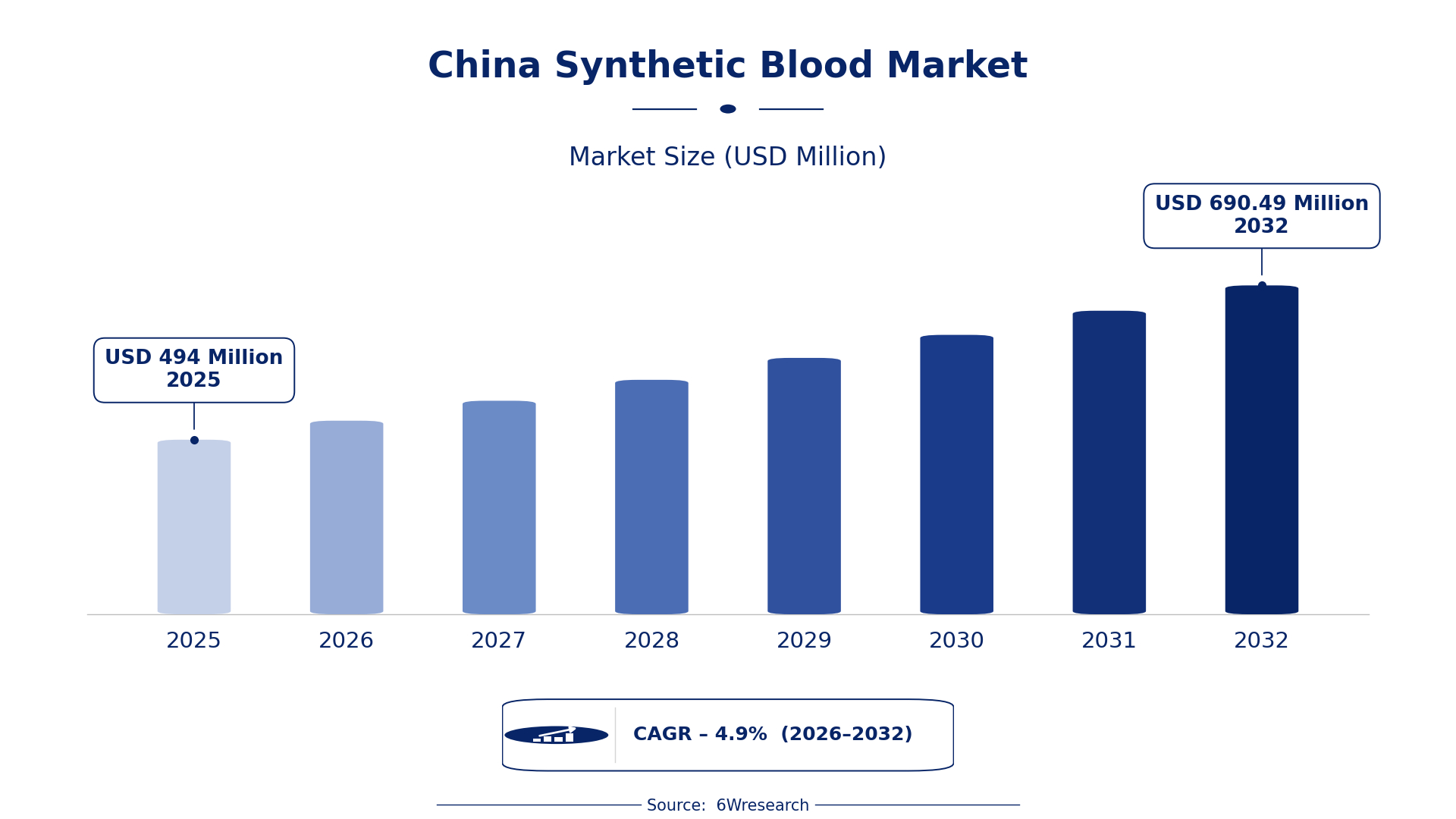
According to 6Wresearch internal database and industry insights, the China Synthetic Blood Market was valued at USD 494.0 million in 2025 and is projected to reach USD 690.49 million by 2032, growing at a CAGR of approximately 4.9% during 2026–2032.
China Synthetic Blood Market Highlights
| Report Metric | Details |
| Report Name | China Synthetic Blood Market |
| Market Size 2025 | USD 494.0 million |
| Market Size 2032 | USD 690.49 million |
| Absolute Growth 2025–2032 | USD 196.49 million |
| CAGR 2026–2032 | 4.9% |
| Peak Annual Growth | 6.5% in 2031 |
| Forecast Period | 2026–2032 |
| Historical Data | 2022–2025 |
| Base Year | 2025 |
| Leading Product Type, 2025 | Hemoglobin-Based (46% share) |
| Leading Oxygen Carrier Type, 2025 | HBOC (44% share) |
| Leading Application Segment, 2025 | Trauma & Surgery (42% share) |
| Leading End User, 2025 | Emergency Clinics (44% share) |
| Fastest-Growing Product Type | Perfluorocarbon-Based (5.9% CAGR) |
| Fastest-Growing Oxygen Carrier Type | PFC Emulsions (6.1% CAGR) |
| Fastest-Growing Application Segment | ICU/Organ Transplants (6.8% CAGR) |
| Fastest-Growing End User | Critical Care Units (7.3% CAGR) |
| Growing Sector | ICU/Organ Transplants |
| Key End Users | Trauma & Surgery, ICU/Organ Transplants, Military & Disaster Relief, Cross-Type Transfusion |
China Synthetic Blood Market Year-wise Growth Rate and Key Drivers (2022–2032)
This graph illustrates the annual growth rates of the market from 2022 to 2032, highlighting a steady upward trajectory and projected market expansion over the forecast period.
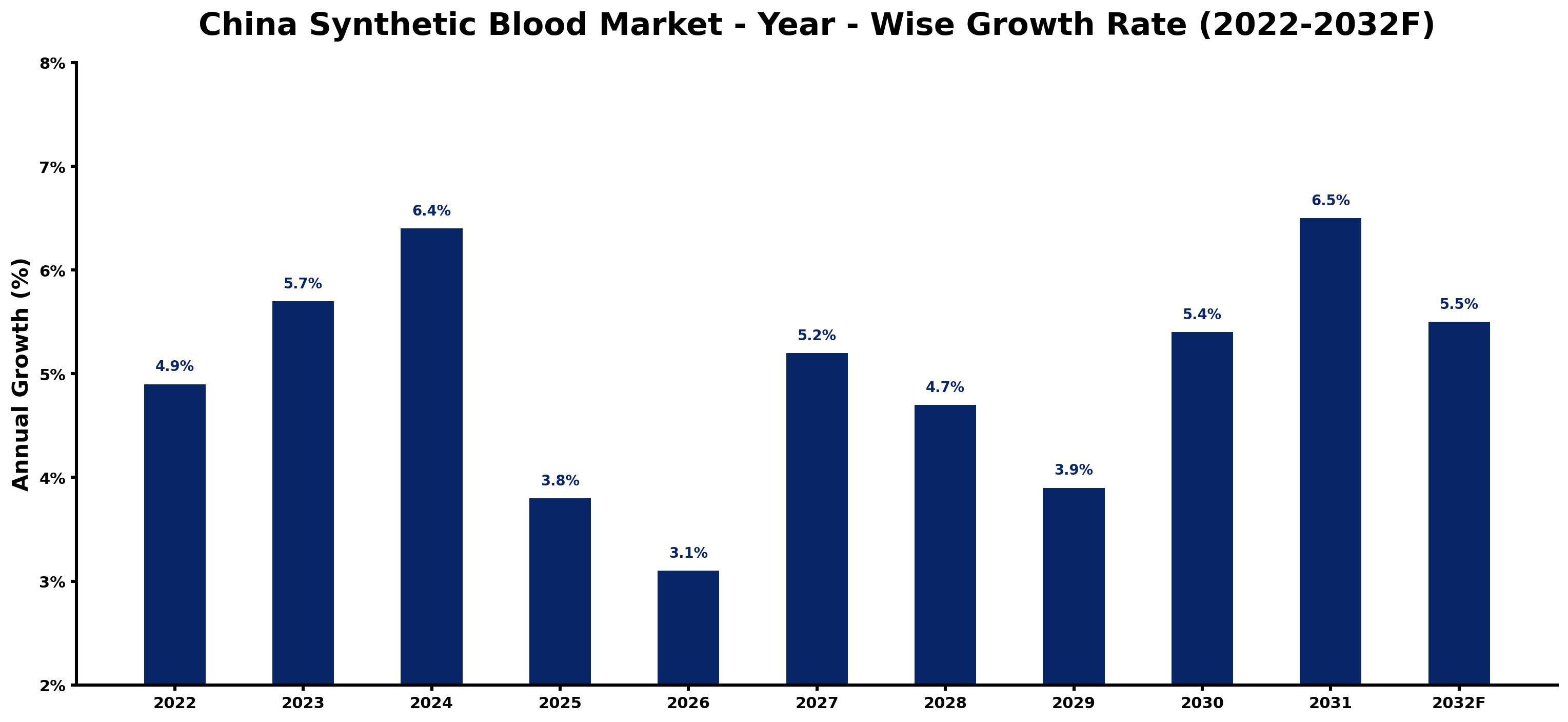
The table below sets out the estimated growth rate for each year and the main factor behind it.
| Year | Estimated Annual Growth (%) | Market Rationale |
| 2022 | 4.9 | The market showed steady growth driven by the 'Synthetic Blood Development Plan' launched by the National Health Commission. |
| 2023 | 5.7 | Demand rose due to ongoing clinical trials for hemoglobin-based oxygen carriers in five provinces. |
| 2024 | 6.4 | Growth accelerated as hospitals began adopting synthetic blood for trauma and surgery applications. |
| 2025 | 3.8 | The market experienced a slowdown as competition among blood substitute products intensified. |
| 2026 | 3.1 | Demand is expected to continue growing at a slower pace due to evolving safety standards in the industry. |
| 2027 | 5.2 | Increased funding for blood substitute research will spur growth in synthetic blood applications. |
| 2028 | 4.7 | The market is projected to see a slowdown in growth as hospitals adapt to new regulations and standards. |
| 2029 | 3.9 | Demand is expected to remain steady, driven by military hospitals testing synthetic blood for trauma care. |
| 2030 | 5.4 | Growth is projected to pick up again as emergency clinics expand their use of synthetic blood products. |
| 2031 | 6.5 | The market is expected to peak as hospitals report successful outcomes using synthetic blood in critical care. |
| 2032 | 5.5 | Growth is projected to slow as the market stabilises with established products and ongoing evaluations. |
Note: Market size estimations and growth projections presented in this report are based on 6Wresearch's proprietary forecasting methodology, utilizing the latest available industry data, government publications, and primary research inputs.
China Synthetic Blood Market Synopsis
The Synthetic Blood Market in China includes products that mimic human blood functions for transfusion. This medical advancement primarily utilises hemoglobin or perfluorocarbons, particularly in emergencies and surgical procedures. Demand is increasing from hospitals and emergency services, especially given the country's population of over 1.4 billion. Continuous clinical trials and government initiatives like the 'Innovative Blood Substitute Program' are propelling this growth.
Market Dynamics Impact Analysis (2026–2032)
| Factor | Type | Impact | Primary Segment Affected |
| Increasing hospital adoption of synthetic blood for trauma care | Driver | High | Trauma & Surgery |
| Growing military applications for synthetic blood in disaster relief | Driver | High | Military & Disaster Relief |
| Emerging opportunities in clinical trials for new synthetic blood products | Opportunity | High | Hemoglobin-Based |
| Potential for partnerships with research institutions in blood substitute development | Opportunity | Medium | Perfluorocarbon-Based |
| Regulatory challenges affecting the approval of new synthetic blood products | Restraint | High | HBOC |
| Limited public awareness about synthetic blood alternatives | Restraint | Medium | PFC Emulsions |
| The Synthetic Blood market in China faces regulatory hurdles that slow product approvals | Challenge | High | Universal Synthetic Blood |
| Competition from traditional blood products remains a significant barrier | Challenge | Medium | Artificial RBCs |
Evaluation of Drivers in China Synthetic Blood Market (2026–2032)
The table below links each growth driver to the segment it affects and the evidence for it.
| Drivers | Primary Segment Affected | Why It Matters (Evidence) |
| Increased funding for synthetic blood research | Hemoglobin-Based | The government allocated $50 million for blood substitute research, boosting hospital capabilities. |
| Growing military applications for synthetic blood | Military & Disaster Relief | Testing of synthetic blood in military hospitals is increasing demand for emergency products. |
| Rising number of emergency clinics adopting synthetic blood | Emergency Clinics | With 1,400 emergency clinics in 2022, demand for synthetic blood products is on the rise. |
| Clinical trials for new synthetic blood products | Perfluorocarbon-Based | Trials in five provinces are expected to expand the market for synthetic blood alternatives. |
| Partnerships with hospitals for synthetic blood promotion | Trauma & Surgery | The Chinese Red Cross Society promotes synthetic blood research, increasing adoption rates. |
The Synthetic Blood market in China is expanding as increased funding for research, growing military applications, and rising hospital adoption drive demand. Military hospitals are increasing their testing of synthetic blood, which raises demand for emergency products. Ongoing clinical trials for hemoglobin-based oxygen carriers in five provinces are expected to expand the market for synthetic blood alternatives, further supporting growth.
Evaluation of Restraints in China Synthetic Blood Market
Below mentioned are some major restraints and their influence on market dynamics.
| Market Restraint | Primary Segment Affected | Why It Matters (Evidence) |
| Regulatory challenges affecting the approval of new synthetic blood products | Universal Synthetic Blood | The National Medical Products Administration's stringent regulations delay product approvals, impacting market entry. |
| High development costs for new synthetic blood products | HBOC | Research institutions face funding limitations, slowing innovation and market growth. |
| Limited public awareness about synthetic blood alternatives | PFC Emulsions | The Chinese Red Cross Society's efforts to promote synthetic blood face challenges in public education and outreach. |
| Slow adoption rates in some hospitals due to safety concerns | Perfluorocarbon-Based | New safety standards implemented in 2022 have made hospitals cautious in adopting synthetic blood. |
| Competition from traditional blood products | Artificial RBCs | The average annual demand for blood products in China is estimated at 10 million units, limiting market share. |
China Synthetic Blood Market Challenges
The China Synthetic Blood Market encounters sourcing challenges, as limited access to high-quality hemoglobin and perfluorocarbons restricts production. This shortage drives up costs for producers, leading to higher prices for hospitals and emergency clinics reliant on these products. Technological delays are apparent; ongoing clinical trials in five provinces hinder the introduction of new synthetic blood alternatives, delaying critical care solutions for patients. A lack of skilled professionals in synthetic blood research also constrains development, ultimately impacting the quality and safety of products available to hospitals and emergency services.
Trends in the China Synthetic Blood Market
Buyers and suppliers in the China Synthetic Blood Market are adjusting to the following trends.
- Shift towards Military Applications: Military hospitals are increasingly testing synthetic blood for trauma care, reflecting a shift in emergency medicine. This trend is expected to improve operational readiness in field operations, with ongoing trials in various facilities.
- Expansion of Emergency Clinics: The growth of emergency clinics in China is driving higher demand for synthetic blood products. With 1,400 clinics in 2022, suppliers have opportunities to meet urgent medical needs across the country.
- Increased Focus on Clinical Trials: Ongoing clinical trials for hemoglobin-based oxygen carriers in five provinces are shaping the market. These trials are essential for validating synthetic blood's efficacy and safety in critical care settings.
- Innovative Blood Substitute Program: The Ministry of Science and Technology's 2022 initiative aims for a 30% increase in synthetic blood usage by 2025. This programme is encouraging hospitals to explore synthetic alternatives, improving patient care and safety.
Investment Opportunities in the China Synthetic Blood Market
Investors looking at the China Synthetic Blood Market should consider the following areas.
- $50 million funding for blood substitute research: The Chinese government allocated $50 million for blood substitute research, creating an opportunity for suppliers. Collaborating with research institutions can improve product development and market entry.
- Growing military demand for synthetic blood: With military hospitals testing synthetic blood, there is a strong opportunity to supply innovative products. Engaging with military procurement channels can facilitate market access and partnerships.
- Rising need for synthetic blood in emergency clinics: The increasing number of emergency clinics presents a timely opportunity to supply synthetic blood products. Establishing partnerships with healthcare providers can improve distribution and reach.
- Clinical trials paving the way for new products: Ongoing clinical trials for hemoglobin-based oxygen carriers are opening avenues for new product introductions. Suppliers should focus on meeting regulatory requirements to enter this expanding market.
Government Initiatives in the China Synthetic Blood Market
The 'Synthetic Blood Development Plan' launched in 2021 by the National Health Commission aims to improve research and application of synthetic blood technologies in emergency medicine. This initiative is designed to enhance the quality and availability of synthetic blood products across hospitals in China. Following this, the 'Innovative Blood Substitute Program' initiated by the Ministry of Science and Technology in 2022 targets a 30% increase in synthetic blood usage in hospitals by 2025. These measures reflect the government's commitment to advancing synthetic blood technologies and ensuring patient safety.
In 2023, the National Medical Products Administration updated regulations for synthetic blood products to streamline approval processes for clinical trials. This agency ensures that products meet safety and efficacy standards, which is vital for market entry. The State Administration for Market Regulation has also implemented new safety standards for synthetic blood, improving quality control measures for manufacturers. These efforts are expected to facilitate the growth of the synthetic blood market in China.
Future Insight of the China Synthetic Blood Market
The China Synthetic Blood Market is set for transformative changes by 2032, driven by increased government funding and research initiatives. The Ministry of Health's program to evaluate synthetic blood products by 2025 aims to establish clear regulatory standards, ensuring safer options for hospitals. Clinical trials in military hospitals will yield critical data, encouraging broader adoption across emergency services. With an average annual demand for blood products estimated at 10 million units, the rising population presents significant growth opportunities for suppliers.
Market Segmentation Analysis
Each segment group is reviewed below, with the leader by share and the fastest grower by CAGR.
By Product Type – Hemoglobin-Based Dominated, Perfluorocarbon-Based Expected to Grow Fastest
According to Sumit Sagar, AM at 6Wresearch, Hemoglobin-Based accounted for a 46% market share by product type in 2025. Hemoglobin-Based synthetic blood commands the largest market share due to its essential role in trauma and surgical settings, where immediate transfusions are critical. This product type is heavily relied upon by the 1,400 emergency clinics across China, ensuring its significant presence in patient care. The quickest growth will come from Perfluorocarbon-Based, forecast to expand at a CAGR of 5.9% between 2026 and 2032. Perfluorocarbon-Based synthetic blood is experiencing rapid growth as it proves effective for oxygen transport, particularly in military hospitals dedicated to trauma care. The ongoing clinical trials in five provinces highlight its potential for wider adoption in critical situations. Suppliers should focus on developing Perfluorocarbon-Based products to cater to the growing demand in critical care environments.
By Oxygen Carrier Type – HBOC Dominated, PFC Emulsions Expected to Grow Fastest
With a 44% revenue share in 2025, HBOC was the largest oxygen carrier type category. HBOC leads the market primarily due to its use in emergency medicine for trauma patients, fulfilling a crucial need for effective blood substitutes in urgent medical scenarios. Regulatory backing from the National Medical Products Administration enhances its acceptance across healthcare facilities in China. Over 2026–2032, PFC Emulsions are expected to post the fastest growth, at a CAGR of 6.1%. PFC Emulsions are witnessing the fastest growth, particularly in military and disaster relief operations where rapid oxygen delivery is paramount. The recent government funding for blood substitute research further accelerates this segment's expansion in the market. Buyers in emergency medicine should consider incorporating PFC Emulsions into their protocols to improve readiness for various medical emergencies.
By Application Segment – Trauma & Surgery Dominated, ICU/Organ Transplants Expected to Grow Fastest
Trauma & Surgery took a 42% share of application segment in 2025, more than any other category. Trauma & Surgery is the leading application segment for synthetic blood, as it serves as the primary alternative for blood transfusions in critical situations. The high average annual demand for blood products in China reinforces the importance of this segment. ICU/Organ Transplants are projected to grow fastest, at a CAGR of 6.8% during 2026–2032. ICU/Organ Transplants is the fastest-growing application segment, driven by the increasing need for blood substitutes in critical care environments. The ongoing clinical trials and evaluations by health authorities indicate a promising future for this segment. Suppliers must prioritise development in the ICU/Organ Transplant area to meet the rising demand for effective blood substitutes.
By End User – Emergency Clinics Dominated, Critical Care Units Expected to Grow Fastest
The largest end user category in 2025 was Emergency Clinics, with a 44% share of total revenue. Emergency Clinics represent the largest market share as they frequently utilise synthetic blood for immediate patient care, particularly in trauma cases. The extensive network of 1,400 clinics throughout China ensures a steady demand for these vital products. Critical Care Units are set to record the highest CAGR in this split, 7.3% over 2026–2032. Critical Care Units are experiencing the fastest growth due to their critical role in managing patients in ICUs, where synthetic blood is increasingly viewed as a necessary alternative to traditional blood products. This trend is likely to continue as healthcare facilities enhance their capabilities. Suppliers should target Critical Care Units to align with the rising demand for advanced patient management solutions.
Key Attractiveness of the Report
- 10 Years of Market Numbers
- Historical Data Starting from 2022 to 2025
- Base Year 2025
- Forecast Data until 2032
- Key Performance Indicators Impacting the Market
- Major Upcoming Developments and Projects
Key Highlights of the Report:
- China Synthetic Blood Market Outlook
- Market Size of China Synthetic Blood Market, 2025
- Forecast of China Synthetic Blood Market, 2032
- Historical Data and Forecast of China Synthetic Blood Revenues & Volume for the Period 2022 - 2032F
- China Synthetic Blood Market Trend Evolution
- China Synthetic Blood Market Drivers and Challenges
- China Synthetic Blood Price Trends
- China Synthetic Blood Porter's Five Forces
- China Synthetic Blood Industry Life Cycle
- Historical Data and Forecast of China Synthetic Blood Market Revenues & Volume By Product Type for the Period 2022 - 2032F
- Historical Data and Forecast of China Synthetic Blood Market Revenues & Volume By Hemoglobin-Based for the Period 2022 - 2032F
- Historical Data and Forecast of China Synthetic Blood Market Revenues & Volume By Perfluorocarbon-Based for the Period 2022 - 2032F
- Historical Data and Forecast of China Synthetic Blood Market Revenues & Volume By Artificial RBCs for the Period 2022 - 2032F
- Historical Data and Forecast of China Synthetic Blood Market Revenues & Volume By Universal Synthetic Blood for the Period 2022 - 2032F
- Historical Data and Forecast of China Synthetic Blood Market Revenues & Volume By Oxygen Carrier Type for the Period 2022 - 2032F
- Historical Data and Forecast of China Synthetic Blood Market Revenues & Volume By HBOC for the Period 2022 - 2032F
- Historical Data and Forecast of China Synthetic Blood Market Revenues & Volume By PFC Emulsions for the Period 2022 - 2032F
- Historical Data and Forecast of China Synthetic Blood Market Revenues & Volume By Encapsulated Hemoglobin for the Period 2022 - 2032F
- Historical Data and Forecast of China Synthetic Blood Market Revenues & Volume By Oxygen Nanocarriers for the Period 2022 - 2032F
- Historical Data and Forecast of China Synthetic Blood Market Revenues & Volume By Application Segment for the Period 2022 - 2032F
- Historical Data and Forecast of China Synthetic Blood Market Revenues & Volume By Trauma & Surgery for the Period 2022 - 2032F
- Historical Data and Forecast of China Synthetic Blood Market Revenues & Volume By Military & Disaster Relief for the Period 2022 - 2032F
- Historical Data and Forecast of China Synthetic Blood Market Revenues & Volume By ICU/Organ Transplants for the Period 2022 - 2032F
- Historical Data and Forecast of China Synthetic Blood Market Revenues & Volume By Cross-Type Transfusion for the Period 2022 - 2032F
- Historical Data and Forecast of China Synthetic Blood Market Revenues & Volume By End User for the Period 2022 - 2032F
- Historical Data and Forecast of China Synthetic Blood Market Revenues & Volume By Emergency Clinics for the Period 2022 - 2032F
- Historical Data and Forecast of China Synthetic Blood Market Revenues & Volume By Field Hospitals for the Period 2022 - 2032F
- Historical Data and Forecast of China Synthetic Blood Market Revenues & Volume By Critical Care Units for the Period 2022 - 2032F
- Historical Data and Forecast of China Synthetic Blood Market Revenues & Volume By Blood Banks for the Period 2022 - 2032F
- China Synthetic Blood Import Export Trade Statistics
- Market Opportunity Assessment By Product Type
- Market Opportunity Assessment By Oxygen Carrier Type
- Market Opportunity Assessment By Application Segment
- Market Opportunity Assessment By End User
- China Synthetic Blood Top Companies Market Share
- China Synthetic Blood Competitive Benchmarking By Technical and Operational Parameters
- China Synthetic Blood Company Profiles
- China Synthetic Blood Key Strategic Recommendations
Market Covered
The report offers an extensive study of the following market segments.
By Product Type
- Hemoglobin-Based
- Perfluorocarbon-Based
- Artificial RBCs
- Universal Synthetic Blood
By Oxygen Carrier Type
- HBOC
- PFC Emulsions
- Encapsulated Hemoglobin
- Oxygen Nanocarriers
By Application Segment
- Trauma & Surgery
- Military & Disaster Relief
- ICU/Organ Transplants
- Cross-Type Transfusion
By End User
- Emergency Clinics
- Field Hospitals
- Critical Care Units
- Blood Banks































