China Synthetic Plants Market Size & Growth Rate
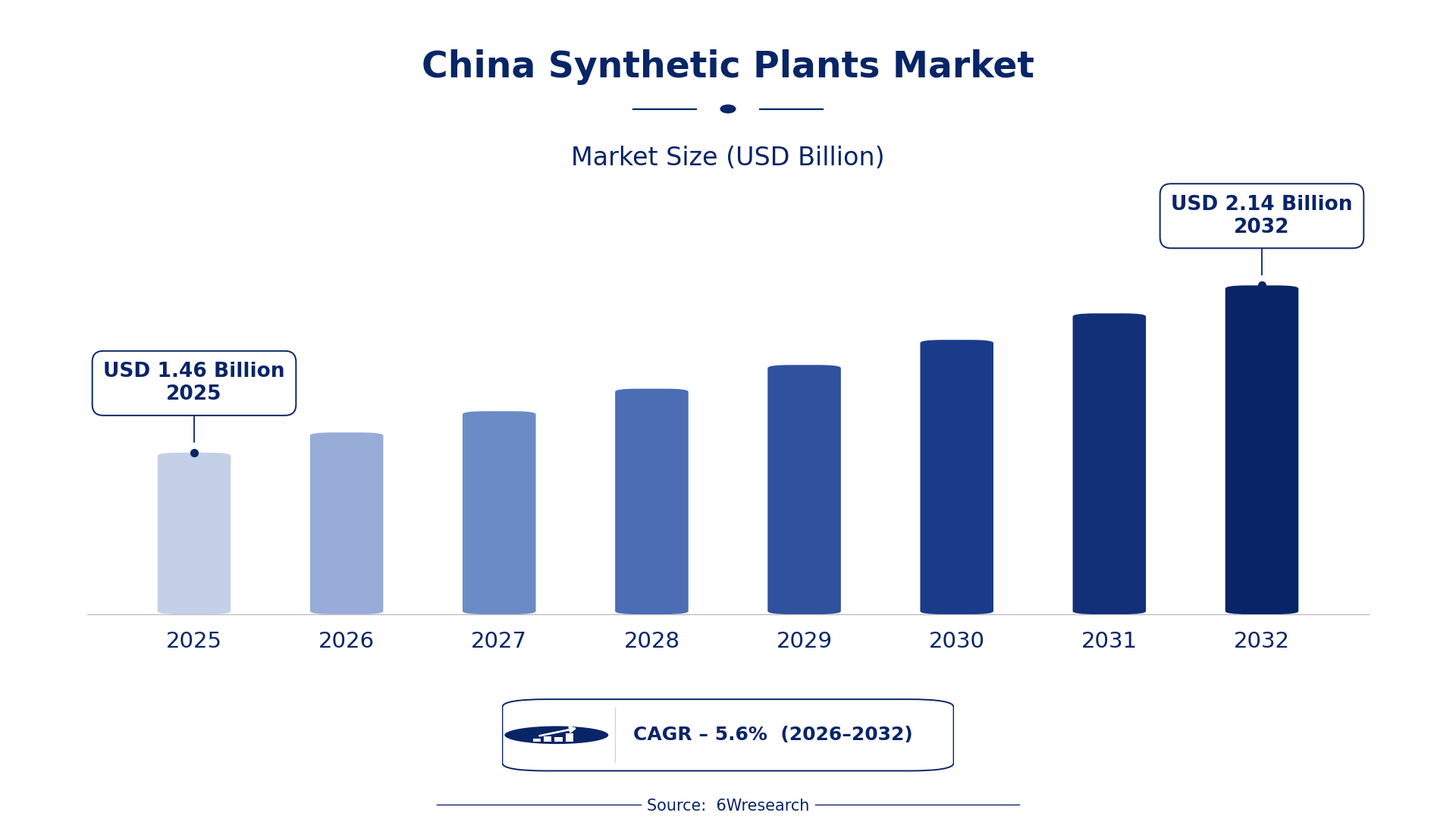
According to 6Wresearch internal database and industry insights, the China Synthetic Plants Market was valued at USD 1.46 billion in 2025 and is projected to reach USD 2.14 billion by 2032, growing at a CAGR of approximately 5.6% during 2026–2032.
China Synthetic Plants Market Highlights
| Report Metric | Details |
| Report Name | China Synthetic Plants Market |
| Market Size 2025 | USD 1.46 billion |
| Market Size 2032 | USD 2.14 billion |
| Absolute Growth 2025–2032 | USD 0.68 billion |
| CAGR 2026–2032 | 5.6% |
| Peak Annual Growth | 8.0% in 2030 |
| Forecast Period | 2026–2032 |
| Historical Data | 2022–2025 |
| Base Year | 2025 |
| Leading Synthetic Plants, 2025 | Artificial Trees (39% share) |
| Leading Product Type, 2025 | Potted Plants (38% share) |
| Leading Material Type, 2025 | Plastic/Silk (40% share) |
| Leading Distribution Channel, 2025 | Online Platforms (38% share) |
| Leading End User Industry, 2025 | Home Decor (48% share) |
| Fastest-Growing Synthetic Plants | Faux Succulents (6.8% CAGR) |
| Fastest-Growing Product Type | UV-Resistant Plants (7.5% CAGR) |
| Fastest-Growing Material Type | PE + Fabric (6.9% CAGR) |
| Fastest-Growing End User Industry | Landscaping Services (7.8% CAGR) |
| Growing Sector | Home Decor |
| Key End Users | Homeowners, Hotels, Landscaping Services, Retailers |
China Synthetic Plants Market Year-wise Growth Rate and Key Drivers (2022–2032)
This graph illustrates the annual growth rates of the market from 2022 to 2032, highlighting a steady upward trajectory and projected market expansion over the forecast period.
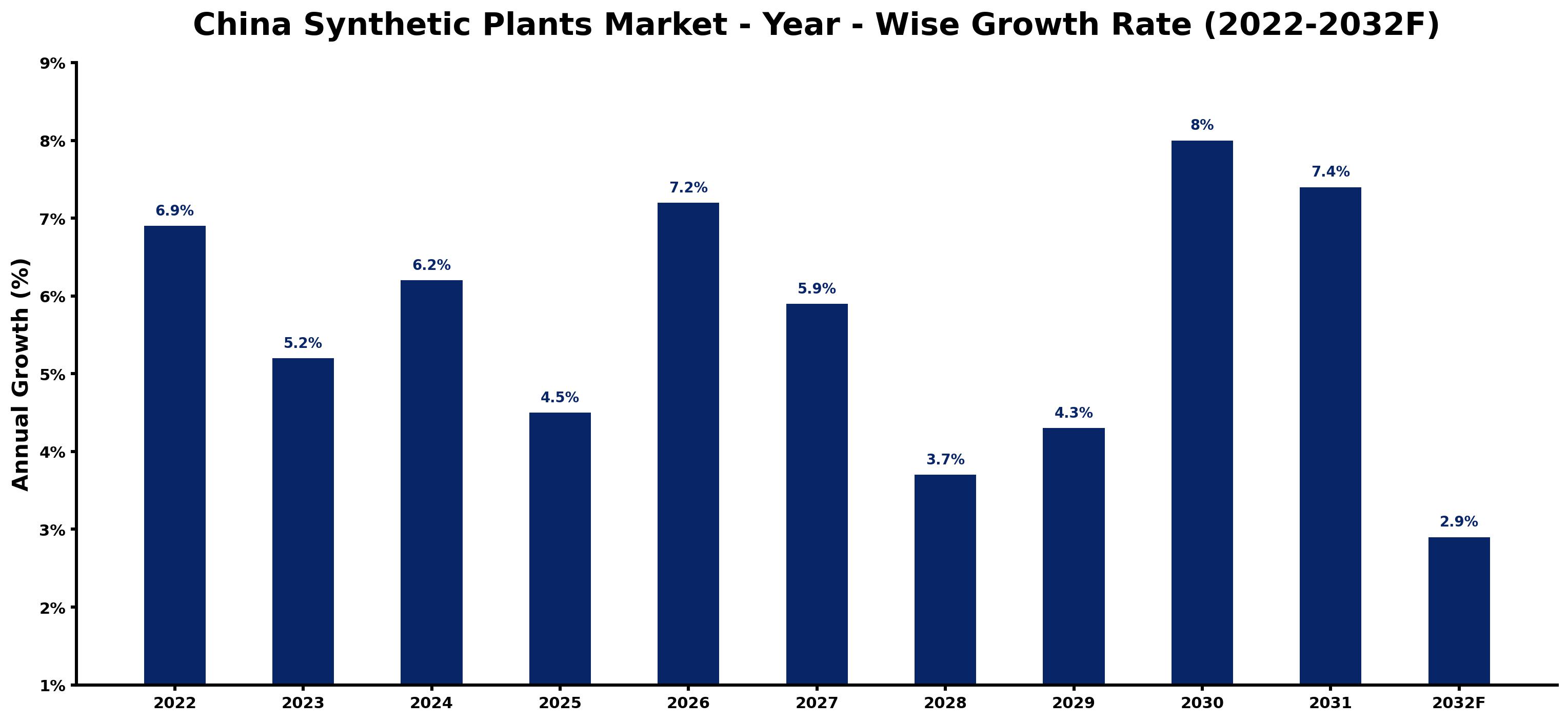
The table below sets out the estimated growth rate for each year and the main factor behind it.
| Year | Estimated Annual Growth (%) | Market Rationale |
| 2022 | 6.9 | The market experienced strong demand from consumers seeking low-maintenance decorative solutions. |
| 2023 | 5.2 | Growth slowed as consumers adjusted to rising prices and economic uncertainties. |
| 2024 | 6.2 | Demand increased due to the popularity of synthetic plants in urban home decor. |
| 2025 | 4.5 | Growth decelerated as market saturation began to affect purchasing decisions. |
| 2026 | 7.2 | A resurgence in demand is expected due to the launch of new eco-friendly products. |
| 2027 | 5.9 | Growth is projected to slow as competition intensifies in the synthetic plants sector. |
| 2028 | 3.7 | Demand is expected to face challenges due to changing consumer preferences towards natural plants. |
| 2029 | 4.3 | An uptick in growth is projected as more retailers embrace online sales channels. |
| 2030 | 8.0 | The peak growth is expected to be propelled by the increasing adoption of synthetic plants in hotels. |
| 2031 | 7.4 | Growth is projected to slow as market maturity leads to more cautious purchasing behavior. |
| 2032 | 2.9 | Demand is expected to stabilise as consumers become more selective in their purchases. |
Note: Market size estimations and growth projections presented in this report are based on 6Wresearch's proprietary forecasting methodology, utilizing the latest available industry data, government publications, and primary research inputs.
China Synthetic Plants Market Synopsis
Synthetic Plants in China are artificial replicas made from materials like plastic and silk, used primarily for home decor, landscaping, and commercial settings. The market was valued at approximately 15 billion yuan in 2022. The China Synthetic Plants Market is growing due to rising urbanisation and the demand for low-maintenance decorative solutions. The 'Green Urbanization Initiative' is promoting sustainable landscaping practices, further boosting market potential. With over 40% of purchases occurring online, the shift in buying habits is also driving growth.
Market Dynamics Impact Analysis (2026–2032)
| Factor | Type | Impact | Primary Segment Affected |
| Rising demand for low-maintenance decor solutions drives purchases from homeowners and businesses. | Driver | High | Home Decor |
| The increasing popularity of synthetic plants in hotels and restaurants boosts sales. | Driver | High | Hotels & Offices |
| The growing trend of eco-friendly landscaping creates opportunities for synthetic plant suppliers. | Opportunity | High | Landscaping Services |
| Urban areas are increasingly adopting synthetic plants for public spaces, expanding market reach. | Opportunity | Medium | Artificial Trees |
| High competition from natural plant suppliers may limit market growth. | Restraint | High | Decorative Plants |
| Consumer preferences shifting towards authentic plants may restrain synthetic plant sales. | Restraint | Medium | Indoor Trees |
| The market still has to solve a few problems, including high competition and changing preferences. | Challenge | High | Artificial Trees |
| Sustainability concerns regarding synthetic materials may affect buyer confidence. | Challenge | Medium | Artificial Trees |
Evaluation of Drivers in China Synthetic Plants Market (2026–2032)
Below mentioned are some major drivers and their influence on market dynamics.
| Drivers | Primary Segment Affected | Why It Matters (Evidence) |
| Increased urbanisation leads to higher demand for decorative solutions in homes. | Home Decor | The average urban household has at least 3 decorative plants, driving purchases. |
| The rise in hotel establishments opting for synthetic plants drives market growth. | Hotels & Offices | Over 60% of new hotels choose synthetic plants for decor, boosting sales. |
| The popularity of online shopping channels facilitates easier access to synthetic plants. | Online Platforms | Online sales account for over 40% of purchases, increasing consumer access. |
| The launch of the 'Green Urbanization Initiative' promotes sustainable landscaping. | Artificial Trees | This initiative encourages the use of synthetic plants in urban landscaping projects. |
| Growing interest in low-maintenance options drives demand for synthetic plants. | Landscaping Services | Consumers and businesses seek durable, easy-care solutions for outdoor spaces. |
Market growth in China for Synthetic Plants rests on end-use demand from homeowners and businesses seeking low-maintenance decor solutions, alongside a strong supply response from manufacturers. The average urban household owns at least 3 decorative plants, driving significant purchases. Over 60% of new hotels are opting for synthetic plants, reflecting a shift in decor preferences. Online platforms account for over 40% of sales, enhancing accessibility for consumers.
Evaluation of Restraints in China Synthetic Plants Market
Below mentioned are some major restraints and their influence on market dynamics.
| Market Restraint | Primary Segment Affected | Why It Matters (Evidence) |
| Intense competition from natural plant suppliers limits market share for synthetic plants. | Decorative Plants | Natural plants are often preferred for their authenticity, impacting sales. |
| Shifting consumer preferences towards authentic plants may reduce synthetic plant demand. | Indoor Trees | Consumers are increasingly valuing natural aesthetics, affecting purchasing decisions. |
| High production costs for synthetic materials may impact profit margins for producers. | Artificial Trees | Producers face challenges in sourcing affordable materials, affecting pricing. |
| Regulatory compliance for quality standards can delay product launches. | Artificial Trees | The National Standard GB/T 28264-2018 requires rigorous testing for safety. |
| Market saturation in urban areas may limit growth opportunities for new entrants. | Faux Succulents | An oversupply of products can lead to price competition and reduced margins. |
China Synthetic Plants Market Challenges
In 2022, producers in the China synthetic plants market faced a 15% increase in production costs due to supply chain disruptions, which hindered their ability to offer competitive pricing. Importers contend with intense competition from local manufacturers, potentially squeezing profit margins by up to 20%, making it challenging to maintain profitability. Buyers encounter limited technology options, as many synthetic plants lack UV resistance, diminishing their appeal in coastal areas where this feature is crucial. Regulatory compliance with the National Standards of China complicates operations, as adhering to these quality guidelines can delay product launches and increase costs for producers.
Trends in the China Synthetic Plants Market
The trends below show where the China Synthetic Plants Market is heading.
- Shift towards Eco-Friendly Landscaping: The 'Green Urbanization Initiative' launched in 2023 promotes sustainable landscaping, encouraging the use of synthetic plants in urban areas. This initiative is projected to increase the market share of synthetic plants by 15% over the next few years.
- Rise of Online Sales Channels: Since 2022, online platforms have become the primary purchasing channel for synthetic plants, accounting for over 40% of sales. This shift is driving convenience and accessibility for urban consumers, resulting in increased market penetration.
- Growing Popularity in Hospitality Sector: Hotels have increasingly adopted synthetic plants for decor, with over 60% of new establishments choosing them since 2022. This trend reflects a shift towards low-maintenance solutions in the hospitality industry.
- Increased Adoption of UV-Resistant Plants: Since 2021, UV-resistant synthetic plants have gained popularity in coastal areas, driven by their durability against sunlight. This trend supports the demand for outdoor decorative solutions.
Investment Opportunities in the China Synthetic Plants Market
Below are the investment opportunities with the strongest case in the China Synthetic Plants Market.
- Urban Public Spaces: Urban areas are increasingly integrating synthetic plants into public projects, supported by the 'Green Urbanization Initiative'. This presents a valuable opportunity for suppliers to engage with local governments and landscape designers.
- Sustainable Landscaping Products: There is a growing demand for eco-friendly synthetic plants, particularly in urban settings. Suppliers can target landscaping services that prioritise sustainable solutions, capitalising on the trend towards green urbanisation.
- Partnerships with Retailers: Retail stores in major cities like Beijing and Shanghai are reporting increased sales. Establishing partnerships with these retailers can facilitate market entry and enhance visibility for new products.
- Expansion in Online Platforms: With online sales channels accounting for over 40% of purchases, investing in e-commerce strategies can help suppliers reach a broader audience. Engaging with digital marketing can drive sales growth.
Government Initiatives in the China Synthetic Plants Market
The Ministry of Ecology and Environment oversees the 'Eco-Friendly Landscaping Program', which encourages the adoption of synthetic plants in public parks and gardens. This program supports funding for projects that integrate synthetic plants into urban areas, enhancing public spaces. The China National Gardening Association actively promotes synthetic plants through workshops and educational programs for landscape designers, helping to raise awareness and drive demand for these products. Their initiatives aim to improve the quality and design of synthetic plants in the market.
The Ministry of Housing and Urban-Rural Development administers the 'Green Urbanization Initiative', which funds sustainable landscaping projects. This initiative aims to increase the use of synthetic plants in urban environments, providing financial support for local governments and landscape designers to incorporate these products into their designs. The initiative is expected to boost the overall market for synthetic plants in China.
Future Insight of the China Synthetic Plants Market
Several forward-looking factors should support the synthetic plants market in China over the coming years. The 'Green Urbanization Initiative' launched in 2023 is expected to drive demand for sustainable landscaping solutions, encouraging buyers to opt for synthetic plants. New guidelines for public space usage will create additional opportunities for suppliers in urban environments. Online sales channels are anticipated to grow significantly, with over 40% of purchases currently made online, indicating a shift towards digital retail that will benefit both buyers and sellers.
Market Segmentation Analysis
The report offers a comprehensive study of the following market segments and their leading categories in the market.
By Synthetic Plants – Artificial Trees Dominated, Faux Succulents Expected to Grow Fastest
According to Sumit Sagar, AM at 6Wresearch, the largest synthetic plants category in 2025 was Artificial Trees, with a 39% share of total revenue. Artificial trees hold the largest share in the synthetic plants market due to their extensive use in large-scale decorative installations, particularly in urban public spaces. Their role in enhancing the aesthetic appeal of parks and plazas solidifies their leading position. Faux Succulents are set to record the highest CAGR in this split, 6.8% over 2026–2032. Faux succulents are rapidly gaining popularity as they cater to the rising demand for low-maintenance indoor decor solutions. This trend is particularly evident in urban households, where the preference for decorative options requiring minimal upkeep is increasing. Suppliers should focus on developing innovative designs that appeal to urban consumers seeking low-maintenance decorative solutions.
By Product Type – Potted Plants Dominated, UV-Resistant Plants Expected to Grow Fastest
Potted Plants held a 38% share of the China Synthetic Plants Market by product type in 2025. Potted plants hold the largest market share as they are widely used in home and office environments, appealing to a diverse consumer base. Their adaptability in various settings reinforces their strong position in the synthetic plants market. UV-Resistant Plants are projected to grow fastest, at a CAGR of 7.5% during 2026–2032. UV-resistant plants are gaining popularity due to their durability in outdoor settings, where they can withstand sunlight and harsh weather. This trend is driven by the growing demand for resilient decorative solutions in gardens and public areas. Suppliers should expand their product lines to include more UV-resistant options to cater to the increasing consumer demand for outdoor decor.
By Material Type – Plastic/Silk Dominated, PE + Fabric Expected to Grow Fastest
Plastic/Silk took a 40% share of material type in 2025, more than any other category. Plastic and silk are the primary materials used in synthetic plants, offering both durability and a realistic appearance that attracts consumers. Their widespread application across various settings reinforces their leading market share. Over 2026–2032, PE + Fabric is expected to post the fastest growth, at a CAGR of 6.9%. PE and fabric are increasingly favoured for their ability to provide realistic textures that enhance the visual appeal of decorative plants. This growth is driven by consumer preferences for high-quality, lifelike products. Manufacturers should invest in creating new offerings using PE and fabric to attract discerning buyers looking for quality.
By Distribution Channel – Online Platforms Dominated and Is Expected to Record the Fastest Growth
Online Platforms accounted for a 38% market share by distribution channel in 2025. Online platforms lead the distribution of synthetic plants, accounting for over 40% of purchases in urban areas. The convenience of online shopping aligns with consumer preferences for easy access to a wide range of products. The same category are also set to grow fastest, at a CAGR of 7.7% during 2026–2032. Online platforms are also the fastest-growing channel as more consumers shift towards e-commerce for their shopping needs. This trend is expected to continue as digital shopping becomes an integral part of daily life. Suppliers must enhance their online marketing strategies to capitalise on the growing trend of e-commerce in the synthetic plants market.
By End User Industry – Home Decor Dominated, Landscaping Services Expected to Grow Fastest
With a 48% revenue share in 2025, Home Decor was the largest end user industry category. Home decor is the largest end user industry for synthetic plants, significantly enhancing aesthetic appeal in residential settings. The average urban household's inclination towards decorative plants reinforces this segment's leading market share. Landscaping Services are set to record the highest CAGR in this split, 7.8% over 2026–2032. Landscaping services are experiencing rapid growth as they play a crucial role in outdoor design and maintenance, particularly in urban areas. The increasing emphasis on beautifying public spaces drives this segment's expansion. Suppliers should target landscaping services with tailored products to leverage the rising demand in this sector.
Key Attractiveness of the Report
- 10 Years of Market Numbers
- Historical Data Starting from 2022 to 2025
- Base Year 2025
- Forecast Data until 2032
- Key Performance Indicators Impacting the Market
- Major Upcoming Developments and Projects
Key Highlights of the Report:
- China Synthetic Plants Market Outlook
- Market Size of China Synthetic Plants Market, 2025
- Forecast of China Synthetic Plants Market, 2032
- Historical Data and Forecast of China Synthetic Plants Revenues & Volume for the Period 2022 - 2032F
- China Synthetic Plants Market Trend Evolution
- China Synthetic Plants Market Drivers and Challenges
- China Synthetic Plants Price Trends
- China Synthetic Plants Porter's Five Forces
- China Synthetic Plants Industry Life Cycle
- Historical Data and Forecast of China Synthetic Plants Market Revenues & Volume By Synthetic Plants for the Period 2022 - 2032F
- Historical Data and Forecast of China Synthetic Plants Market Revenues & Volume By Decorative Plants for the Period 2022 - 2032F
- Historical Data and Forecast of China Synthetic Plants Market Revenues & Volume By Artificial Trees for the Period 2022 - 2032F
- Historical Data and Forecast of China Synthetic Plants Market Revenues & Volume By Faux Succulents for the Period 2022 - 2032F
- Historical Data and Forecast of China Synthetic Plants Market Revenues & Volume By Outdoor Plants for the Period 2022 - 2032F
- Historical Data and Forecast of China Synthetic Plants Market Revenues & Volume By Product Type for the Period 2022 - 2032F
- Historical Data and Forecast of China Synthetic Plants Market Revenues & Volume By Potted Plants for the Period 2022 - 2032F
- Historical Data and Forecast of China Synthetic Plants Market Revenues & Volume By Indoor Trees for the Period 2022 - 2032F
- Historical Data and Forecast of China Synthetic Plants Market Revenues & Volume By Miniatures for the Period 2022 - 2032F
- Historical Data and Forecast of China Synthetic Plants Market Revenues & Volume By UV-Resistant Plants for the Period 2022 - 2032F
- Historical Data and Forecast of China Synthetic Plants Market Revenues & Volume By Material Type for the Period 2022 - 2032F
- Historical Data and Forecast of China Synthetic Plants Market Revenues & Volume By Plastic/Silk for the Period 2022 - 2032F
- Historical Data and Forecast of China Synthetic Plants Market Revenues & Volume By PE + Fabric for the Period 2022 - 2032F
- Historical Data and Forecast of China Synthetic Plants Market Revenues & Volume By Rubber for the Period 2022 - 2032F
- Historical Data and Forecast of China Synthetic Plants Market Revenues & Volume By Polyethylene for the Period 2022 - 2032F
- Historical Data and Forecast of China Synthetic Plants Market Revenues & Volume By Distribution Channel for the Period 2022 - 2032F
- Historical Data and Forecast of China Synthetic Plants Market Revenues & Volume By Online Platforms for the Period 2022 - 2032F
- Historical Data and Forecast of China Synthetic Plants Market Revenues & Volume By Retail Stores for the Period 2022 - 2032F
- Historical Data and Forecast of China Synthetic Plants Market Revenues & Volume By Specialty Stores for the Period 2022 - 2032F
- Historical Data and Forecast of China Synthetic Plants Market Revenues & Volume By Direct Sales for the Period 2022 - 2032F
- Historical Data and Forecast of China Synthetic Plants Market Revenues & Volume By End User Industry for the Period 2022 - 2032F
- Historical Data and Forecast of China Synthetic Plants Market Revenues & Volume By Home Decor for the Period 2022 - 2032F
- Historical Data and Forecast of China Synthetic Plants Market Revenues & Volume By Hotels & Offices for the Period 2022 - 2032F
- Historical Data and Forecast of China Synthetic Plants Market Revenues & Volume By Restaurants for the Period 2022 - 2032F
- Historical Data and Forecast of China Synthetic Plants Market Revenues & Volume By Landscaping Services for the Period 2022 - 2032F
- China Synthetic Plants Import Export Trade Statistics
- Market Opportunity Assessment By Synthetic Plants
- Market Opportunity Assessment By Product Type
- Market Opportunity Assessment By Material Type
- Market Opportunity Assessment By Distribution Channel
- Market Opportunity Assessment By End User Industry
- China Synthetic Plants Top Companies Market Share
- China Synthetic Plants Competitive Benchmarking By Technical and Operational Parameters
- China Synthetic Plants Company Profiles
- China Synthetic Plants Key Strategic Recommendations
Market Covered
This report examines the market across the segments below.
By Synthetic Plants
- Decorative Plants
- Artificial Trees
- Faux Succulents
- Outdoor Plants
By Product Type
- Potted Plants
- Indoor Trees
- Miniatures
- UV-Resistant Plants
By Material Type
- Plastic/Silk
- PE + Fabric
- Rubber
- Polyethylene
By Distribution Channel
- Online Platforms
- Retail Stores
- Specialty Stores
- Direct Sales
By End User Industry
- Home Decor
- Hotels & Offices
- Restaurants
- Landscaping Services































