China Synthetic Tanning Agents Market Size & Growth Rate
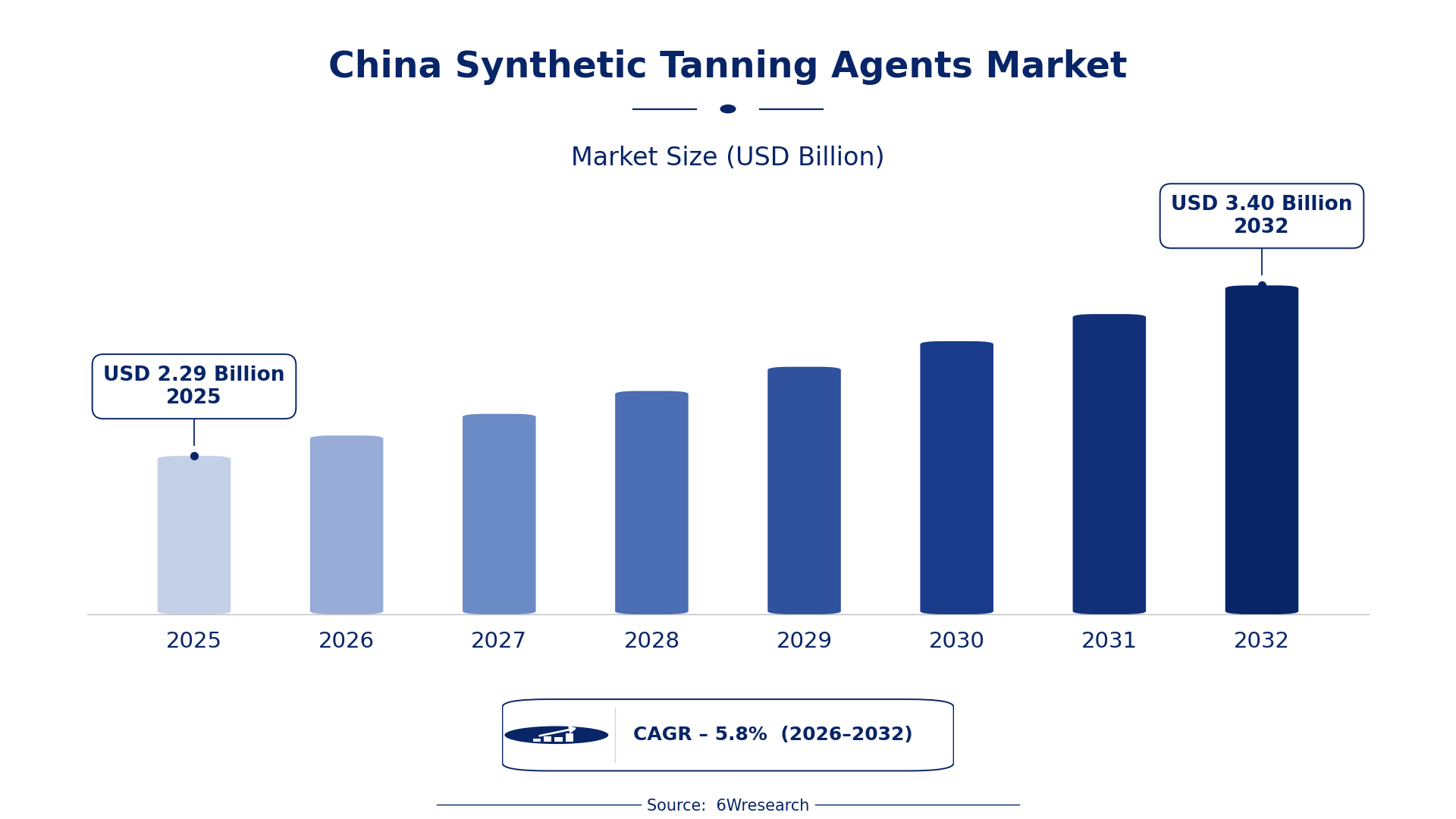
According to 6Wresearch internal database and industry insights, the China Synthetic Tanning Agents Market was valued at USD 2.29 billion in 2025 and is projected to reach USD 3.40 billion by 2032, growing at a CAGR of approximately 5.8% during 2026–2032.
China Synthetic Tanning Agents Market Highlights
| Report Metric | Details |
| Report Name | China Synthetic Tanning Agents Market |
| Market Size 2025 | USD 2.29 billion |
| Market Size 2032 | USD 3.40 billion |
| Absolute Growth 2025–2032 | USD 1.11 billion |
| CAGR 2026–2032 | 5.8% |
| Peak Annual Growth | 7.6% in 2031 |
| Forecast Period | 2026–2032 |
| Historical Data | 2022–2025 |
| Base Year | 2025 |
| Leading Synthetic Tanning Agents, 2025 | Acrylic Tanning Agents (41% share) |
| Leading Product Type, 2025 | Acrylic Polymers (51% share) |
| Leading Agent Type, 2025 | Synthetic Acrylic (47% share) |
| Leading Distribution Channel, 2025 | Direct Sales (46% share) |
| Leading End User Industry, 2025 | Leather Manufacturing (50% share) |
| Fastest-Growing Synthetic Tanning Agents | Polyurethane Agents (8.4% CAGR) |
| Fastest-Growing Product Type | PU Dispersions (7.3% CAGR) |
| Fastest-Growing Agent Type | Polyurethane (7.1% CAGR) |
| Fastest-Growing Distribution Channel | Online Platforms (7.6% CAGR) |
| Fastest-Growing End User Industry | Automotive Upholstery (7.5% CAGR) |
| Growing Sector | Automotive Upholstery |
| Key End Users | Leather Manufacturing, Footwear Industry, Automotive Upholstery, Garment Industry |
China Synthetic Tanning Agents Market Year-wise Growth Rate and Key Drivers (2022–2032)
This graph illustrates the annual growth rates of the market from 2022 to 2032, highlighting a steady upward trajectory and projected market expansion over the forecast period.
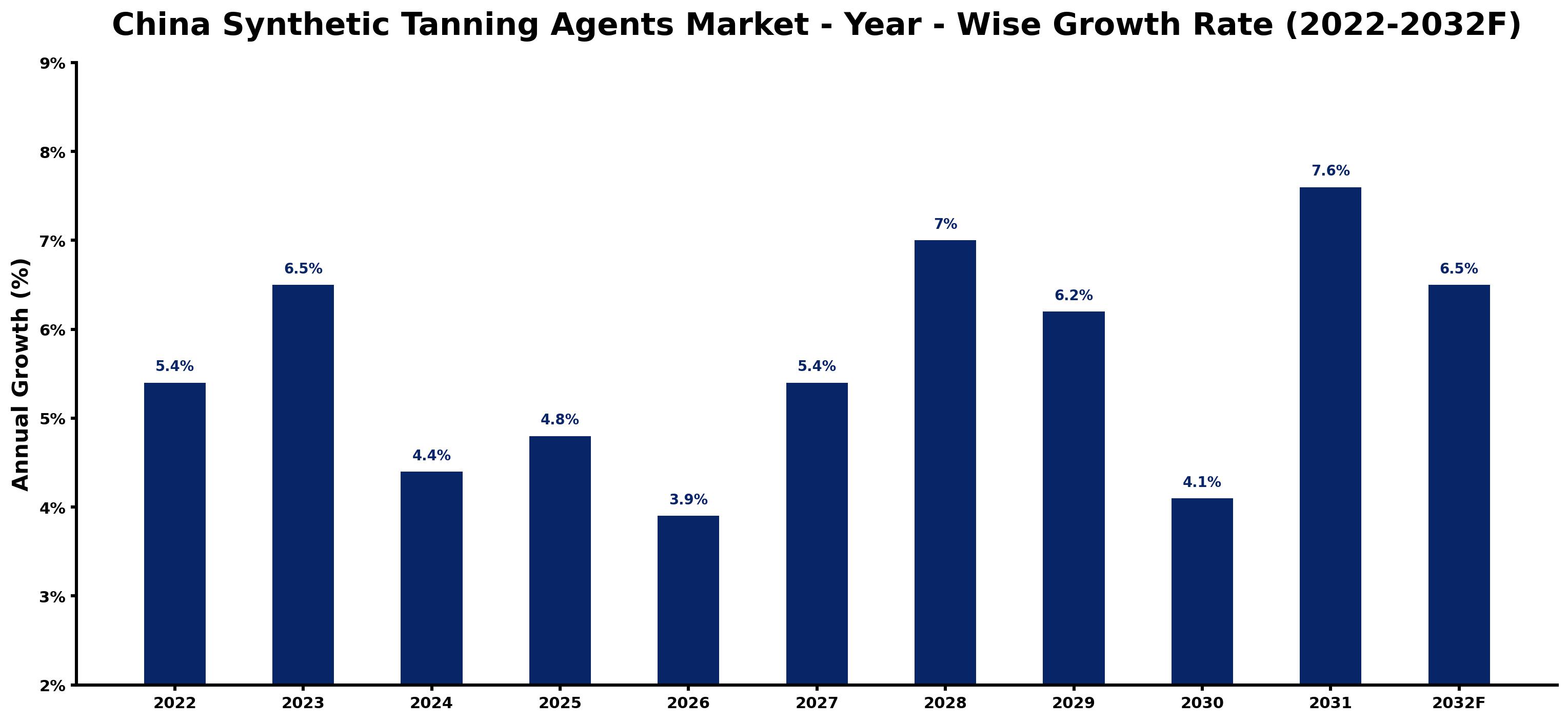
Annual growth estimates for each year appear below with the principal reason behind them, explaining the shifts that set the pace of the market.
| Year | Estimated Annual Growth (%) | Market Rationale |
| 2022 | 5.4 | The market showed steady growth due to ongoing demand from the leather manufacturing sector. |
| 2023 | 6.5 | Growth accelerated as the footwear industry generated over 200 billion yuan in revenue. |
| 2024 | 4.4 | Growth slowed as manufacturers adjusted to changing consumer preferences in leather products. |
| 2025 | 4.8 | Renewed growth occurred due to the expansion of the automotive upholstery sector, boosting demand for synthetic tanning agents. |
| 2026 | 3.9 | Demand growth is expected to slow as manufacturers face challenges in sourcing sustainable raw materials. |
| 2027 | 5.4 | Growth is projected to pick up as the leather manufacturing sector increases its production capacity. |
| 2028 | 7.0 | The market is expected to grow faster due to rising demand for automotive upholstery products. |
| 2029 | 6.2 | Growth is anticipated to slow as manufacturers adapt to evolving environmental regulations affecting production. |
| 2030 | 4.1 | Demand growth is expected to slow as the market stabilises after fluctuations in raw material availability. |
| 2031 | 7.6 | Growth will surge as the 'Leather Industry Revitalization Plan' takes effect, boosting production. |
| 2032 | 6.5 | The market will continue to grow as sustainable practices gain traction among manufacturers. |
Note: Market size estimations and growth projections presented in this report are based on 6Wresearch's proprietary forecasting methodology, utilizing the latest available industry data, government publications, and primary research inputs.
China Synthetic Tanning Agents Market Synopsis
Synthetic Tanning Agents in China encompass chemical compounds used in leather processing to improve durability and appearance. These agents are primarily produced through chemical synthesis and are essential for leather manufacturing, footwear production, and automotive upholstery. The China Synthetic Tanning Agents Market is expanding due to strong domestic demand and significant production capacity.
Market Dynamics Impact Analysis (2026–2032)
| Factor | Type | Impact | Primary Segment Affected |
| Growing demand from the leather manufacturing sector. | Driver | High | Leather Manufacturing |
| Expansion of the automotive upholstery market. | Driver | High | Automotive Upholstery |
| Investment in eco-friendly tanning technologies. | Opportunity | High | Acrylic Tanning Agents |
| Increasing exports of leather products. | Opportunity | Medium | Leather Manufacturing |
| Environmental regulations impacting production processes. | Restraint | High | Acrylic Tanning Agents |
| Competition from alternative tanning methods. | Restraint | Medium | Acrylic Tanning Agents |
| Challenges in sourcing sustainable raw materials. | Challenge | High | Acrylic Tanning Agents |
| Fluctuations in global leather prices affecting profitability. | Challenge | Medium | Leather Manufacturing |
Evaluation of Drivers in China Synthetic Tanning Agents Market (2026–2032)
The table below links each growth driver to the segment it affects and the evidence for it.
| Drivers | Primary Segment Affected | Why It Matters (Evidence) |
| Increased production capacity in leather manufacturing. | Leather Manufacturing | The leather industry employs over 2 million people, driving demand for synthetic tanning agents and boosting production. |
| Growth in the automotive upholstery sector. | Automotive Upholstery | This sector is expected to reach 100 billion yuan by 2025, increasing demand for tanned leather products. |
| Rising exports of leather products. | Leather Manufacturing | China produces approximately 1.5 billion square feet of leather annually, boosting demand for synthetic tanning agents. |
| Investment in eco-friendly tanning processes. | Acrylic Tanning Agents | The 'Leather Industry Pollution Control Plan' aims to reduce emissions from tanneries, encouraging sustainable practices. |
| Technological advancements in tanning processes. | Acrylic Tanning Agents | Acrylic tanning agents account for over 40% of the market, improving efficiency in leather processing. |
The Synthetic Tanning Agents market in China is expanding as demand from the leather manufacturing and automotive upholstery sectors increases. The leather industry employs over 2 million people, creating a strong need for synthetic agents. The 'Leather Industry Pollution Control Plan' has spurred investment in eco-friendly tanning technologies, promoting sustainability in production. This shift towards sustainable practices is making synthetic tanning agents more attractive to producers, resulting in higher purchases across the industry.
Evaluation of Restraints in China Synthetic Tanning Agents Market
The following restraints limit how fast demand can grow.
| Market Restraint | Primary Segment Affected | Why It Matters (Evidence) |
| Environmental regulations increasing production costs. | Acrylic Tanning Agents | The 'Leather Industry Pollution Control Plan' mandates stricter emissions standards, raising compliance costs for producers. |
| Competition from alternative tanning methods. | Acrylic Tanning Agents | Emerging natural tanning methods pose a threat to traditional synthetic agents, impacting market share. |
| Fluctuating raw material prices impacting profitability. | Leather Manufacturing | Volatility in global leather prices affects the cost structure for manufacturers, increasing operational costs. |
| Challenges in sourcing sustainable materials. | Acrylic Tanning Agents | Increased focus on sustainability complicates raw material procurement for producers, raising costs and delays. |
| Market saturation in certain product segments. | Acrylic Tanning Agents | High competition among established players limits growth opportunities and pricing power. |
China Synthetic Tanning Agents Market Challenges
The China Synthetic Tanning Agents Market encounters several practical issues, with production inefficiencies costing manufacturers up to 20% more due to reliance on outdated technologies. Regulatory compliance with the National Standard for leather products complicates operations, leading to delays in product approvals that can extend for several months for suppliers. Price volatility impacts buyers, with costs increasing by 15% during peak demand periods due to supply chain disruptions. Limited availability of raw materials forces producers to stockpile resources, raising their holding costs by 10% and straining cash flow.
Trends in the China Synthetic Tanning Agents Market
The trends below show where the China Synthetic Tanning Agents Market is heading.
- Shift towards Eco-Friendly Tanning Practices: In Guangdong province, leather manufacturers are increasingly adopting eco-friendly tanning processes, spurred by the 'Leather Industry Pollution Control Plan'. This shift is expected to improve sustainability in production, with over 60% of tanneries now using glutaraldehyde.
- Growing Demand for Automotive Upholstery: The automotive upholstery sector is experiencing rapid growth, projected to reach 100 billion yuan by 2025. This demand is prompting leather manufacturers to improve their production capabilities, resulting in a 7.5% CAGR in this segment.
- Transition from Traditional to Synthetic Tanning Agents: Since 2022, the leather industry has seen a notable shift towards synthetic tanning agents, with acrylic tanning agents accounting for over 40% of the market. This trend reflects a growing preference for efficiency and quality in leather processing.
- Rise of Online Distribution Channels: The use of online platforms for distributing synthetic tanning agents has increased significantly, with a projected CAGR of 7.6% from 2026 to 2032. This trend allows smaller suppliers to reach a broader customer base more effectively.
Investment Opportunities in the China Synthetic Tanning Agents Market
The following opportunities in the China Synthetic Tanning Agents Market pair current demand with a clear way in.
- Investment in Eco-Friendly Tanning Facilities: With the 'Leather Industry Revitalization Plan' in place, there is an opportunity to invest in eco-friendly tanning facilities. This initiative aims to improve sustainability and production efficiency, targeting a 30% reduction in emissions by 2025.
- Expansion into Automotive Upholstery Supply: The automotive upholstery market is expected to reach 100 billion yuan by 2025, presenting an opportunity for suppliers of synthetic tanning agents. Manufacturers can enter this market by collaborating with automotive producers in key regions.
- Growth in Export Markets for Leather Products: China's leather exports are expected to increase, driven by rising global demand. Suppliers can target international markets by ensuring compliance with international quality standards and certifications to enhance their competitive edge.
- Development of Innovative Tanning Technologies: Investment in innovative tanning technologies is essential as the market shifts towards sustainability. Suppliers can explore partnerships with research institutions to develop new eco-friendly tanning agents that meet emerging market needs.
Government Initiatives in the China Synthetic Tanning Agents Market
The 'National Leather Industry Development Plan (2021-2025)' aims to improve competitiveness and sustainability in the leather sector, impacting synthetic tanning agents producers by promoting eco-friendly practices. The 'Leather Industry Pollution Control Plan' implemented in 2021 mandates emission reductions from tanneries, requiring manufacturers to invest in cleaner technologies. Compliance with these regulations ensures that producers can meet market demands while adhering to environmental standards. The 'China Leather Industry Green Development Action Plan' launched in 2023 further supports sustainable practices, encouraging investment in innovative tanning solutions. These measures aim to improve the overall quality and safety of leather products in the market.
The Ministry of Ecology and Environment oversees the implementation of pollution control measures, ensuring compliance with environmental regulations. The Ministry of Industry and Information Technology funds initiatives aimed at promoting sustainable tanning technologies, providing subsidies for eco-friendly practices. The State Administration for Market Regulation is responsible for updating standards for leather products, ensuring that manufacturers meet quality and safety requirements. These agencies play a crucial role in shaping the operational environment for synthetic tanning agents, influencing production methods and market conditions.
Future Insight of the China Synthetic Tanning Agents Market
The China Synthetic Tanning Agents Market will undergo transformative changes by 2032, driven by advancements in production technologies and supportive regulatory frameworks. The 'Leather Industry Revitalization Plan' will streamline operations and promote sustainable practices across the sector. The focus on ISO 9001 certification will elevate quality standards, ensuring buyers receive more reliable and higher-performing products.
Market Segmentation Analysis
The report offers a comprehensive study of the following market segments and their leading categories in the market.
By Synthetic Tanning Agents – Acrylic Tanning Agents Dominated, Polyurethane Agents Expected to Grow Fastest
According to Sumit Sagar, AM at 6Wresearch, Acrylic Tanning Agents took a 41% share of synthetic tanning agents in 2025, more than any other category. Acrylic tanning agents dominate the market due to their efficiency in leather processing, crucial for producing high-quality leather products. Their prevalence is evident as they account for over 40% of the market share, making them essential for manufacturers in the leather industry. Polyurethane Agents are projected to grow fastest, at a CAGR of 8.4% during 2026–2032. Polyurethane agents are experiencing rapid growth, primarily due to their flexibility and durability in leather products. Their increasing adoption is particularly significant in the automotive upholstery market, projected to reach 100 billion yuan by 2025, indicating strong demand. Suppliers should focus on increasing the production of polyurethane agents to cater to the rising needs of the automotive sector.
By Product Type – Acrylic Polymers Dominated, PU Dispersions Expected to Grow Fastest
The largest product type category in 2025 was Acrylic Polymers, with a 51% share of total revenue. Acrylic polymers lead the product type segment as they are essential in formulations for leather finishes, significantly improving the quality of leather products. Their effectiveness and versatility make them the preferred choice among manufacturers in the leather processing industry. PU Dispersions are set to record the highest CAGR in this split, 7.3% over 2026–2032. PU dispersions are the fastest-growing product type, driven by their application in surface coatings that enhance the aesthetic appeal of leather goods. This trend signifies a shift towards more resilient and flexible finishes in the market, reflecting changing consumer preferences. Buyers should explore incorporating PU dispersions to improve the quality and durability of their leather products.
By Agent Type – Synthetic Acrylic Dominated, Polyurethane Expected to Grow Fastest
Synthetic Acrylic held a 47% share of the China Synthetic Tanning Agents Market by agent type in 2025. Synthetic acrylic agents hold the largest share in the agent type category, primarily due to their widespread use in various leather processing applications. Their established presence in the market makes them a reliable choice for manufacturers. Over 2026–2032, Polyurethane is expected to post the fastest growth, at a CAGR of 7.1%. Polyurethane agents are growing quickly, primarily due to their application in coatings rather than tanning, which aligns with the industry's shift towards high-performance leather products. This trend indicates a potential for further market expansion in this segment. Suppliers should consider diversifying their offerings to include more polyurethane options to meet evolving market demands.
By Distribution Channel – Direct Sales Dominated, Online Platforms Expected to Grow Fastest
Direct Sales accounted for a 46% market share by distribution channel in 2025. Direct sales are the primary distribution channel, allowing manufacturers to establish strong relationships and ensure a consistent supply of synthetic tanning agents. This channel is critical for large-scale producers who require reliable quality and availability in their operations. The quickest growth will come from Online Platforms, forecast to expand at a CAGR of 7.6% between 2026 and 2032. Online platforms are emerging as the fastest-growing distribution channel, enabling smaller suppliers to reach a broader audience. This trend underscores the increasing digitalisation of purchasing behaviours within the leather industry, providing new opportunities for suppliers. Suppliers should enhance their online presence to attract the growing segment of buyers who prefer digital purchasing options.
By End User Industry – Leather Manufacturing Dominated, Automotive Upholstery Expected to Grow Fastest
With a 50% revenue share in 2025, Leather Manufacturing was the largest end user industry category. Leather manufacturing is the largest end user of synthetic tanning agents, directly consuming these agents in the production of various leather goods. The robust demand from this sector is supported by China's substantial leather production capacity, estimated at 1.5 billion square feet annually. Automotive Upholstery is projected to grow fastest, at a CAGR of 7.5% during 2026–2032. The automotive upholstery sector is rapidly expanding, using leather processed with synthetic tanning agents to meet the rising demand for quality automotive interiors. This growth mirrors broader consumer trends favouring premium experiences in the automotive market. Manufacturers should adjust their production strategies to align with the increasing demands of the automotive upholstery market.
Key Attractiveness of the Report
- 10 Years of Market Numbers
- Historical Data Starting from 2022 to 2025
- Base Year 2025
- Forecast Data until 2032
- Key Performance Indicators Impacting the Market
- Major Upcoming Developments and Projects
Key Highlights of the Report:
- China Synthetic Tanning Agents Market Outlook
- Market Size of China Synthetic Tanning Agents Market, 2025
- Forecast of China Synthetic Tanning Agents Market, 2032
- Historical Data and Forecast of China Synthetic Tanning Agents Revenues & Volume for the Period 2022 - 2032F
- China Synthetic Tanning Agents Market Trend Evolution
- China Synthetic Tanning Agents Market Drivers and Challenges
- China Synthetic Tanning Agents Price Trends
- China Synthetic Tanning Agents Porter's Five Forces
- China Synthetic Tanning Agents Industry Life Cycle
- Historical Data and Forecast of China Synthetic Tanning Agents Market Revenues & Volume By Synthetic Tanning Agents for the Period 2022 - 2032F
- Historical Data and Forecast of China Synthetic Tanning Agents Market Revenues & Volume By Acrylic Tanning Agents for the Period 2022 - 2032F
- Historical Data and Forecast of China Synthetic Tanning Agents Market Revenues & Volume By Phenolic Agents for the Period 2022 - 2032F
- Historical Data and Forecast of China Synthetic Tanning Agents Market Revenues & Volume By Polyurethane Agents for the Period 2022 - 2032F
- Historical Data and Forecast of China Synthetic Tanning Agents Market Revenues & Volume By Aldehyde Tanning Agents for the Period 2022 - 2032F
- Historical Data and Forecast of China Synthetic Tanning Agents Market Revenues & Volume By Product Type for the Period 2022 - 2032F
- Historical Data and Forecast of China Synthetic Tanning Agents Market Revenues & Volume By Acrylic Polymers for the Period 2022 - 2032F
- Historical Data and Forecast of China Synthetic Tanning Agents Market Revenues & Volume By Resin-Based Agents for the Period 2022 - 2032F
- Historical Data and Forecast of China Synthetic Tanning Agents Market Revenues & Volume By PU Dispersions for the Period 2022 - 2032F
- Historical Data and Forecast of China Synthetic Tanning Agents Market Revenues & Volume By Glutaraldehyde for the Period 2022 - 2032F
- Historical Data and Forecast of China Synthetic Tanning Agents Market Revenues & Volume By Agent Type for the Period 2022 - 2032F
- Historical Data and Forecast of China Synthetic Tanning Agents Market Revenues & Volume By Synthetic Acrylic for the Period 2022 - 2032F
- Historical Data and Forecast of China Synthetic Tanning Agents Market Revenues & Volume By Phenolic for the Period 2022 - 2032F
- Historical Data and Forecast of China Synthetic Tanning Agents Market Revenues & Volume By Polyurethane for the Period 2022 - 2032F
- Historical Data and Forecast of China Synthetic Tanning Agents Market Revenues & Volume By Synthetic Aldehyde for the Period 2022 - 2032F
- Historical Data and Forecast of China Synthetic Tanning Agents Market Revenues & Volume By Distribution Channel for the Period 2022 - 2032F
- Historical Data and Forecast of China Synthetic Tanning Agents Market Revenues & Volume By Direct Sales for the Period 2022 - 2032F
- Historical Data and Forecast of China Synthetic Tanning Agents Market Revenues & Volume By Industrial Distributors for the Period 2022 - 2032F
- Historical Data and Forecast of China Synthetic Tanning Agents Market Revenues & Volume By Online Platforms for the Period 2022 - 2032F
- Historical Data and Forecast of China Synthetic Tanning Agents Market Revenues & Volume By Specialty Stores for the Period 2022 - 2032F
- Historical Data and Forecast of China Synthetic Tanning Agents Market Revenues & Volume By End User Industry for the Period 2022 - 2032F
- Historical Data and Forecast of China Synthetic Tanning Agents Market Revenues & Volume By Leather Manufacturing for the Period 2022 - 2032F
- Historical Data and Forecast of China Synthetic Tanning Agents Market Revenues & Volume By Footwear Industry for the Period 2022 - 2032F
- Historical Data and Forecast of China Synthetic Tanning Agents Market Revenues & Volume By Automotive Upholstery for the Period 2022 - 2032F
- Historical Data and Forecast of China Synthetic Tanning Agents Market Revenues & Volume By Garment Industry for the Period 2022 - 2032F
- China Synthetic Tanning Agents Import Export Trade Statistics
- Market Opportunity Assessment By Synthetic Tanning Agents
- Market Opportunity Assessment By Product Type
- Market Opportunity Assessment By Agent Type
- Market Opportunity Assessment By Distribution Channel
- Market Opportunity Assessment By End User Industry
- China Synthetic Tanning Agents Top Companies Market Share
- China Synthetic Tanning Agents Competitive Benchmarking By Technical and Operational Parameters
- China Synthetic Tanning Agents Company Profiles
- China Synthetic Tanning Agents Key Strategic Recommendations
Market Covered
This report examines the market across the segments below.
By Synthetic Tanning Agents
- Acrylic Tanning Agents
- Phenolic Agents
- Polyurethane Agents
- Aldehyde Tanning Agents
By Product Type
- Acrylic Polymers
- Resin-Based Agents
- PU Dispersions
- Glutaraldehyde
By Agent Type
- Synthetic Acrylic
- Phenolic
- Polyurethane
- Synthetic Aldehyde
By Distribution Channel
- Direct Sales
- Industrial Distributors
- Online Platforms
- Specialty Stores
By End User Industry
- Leather Manufacturing
- Footwear Industry
- Automotive Upholstery
- Garment Industry































