China Synthetic Textile Market Size & Growth Rate
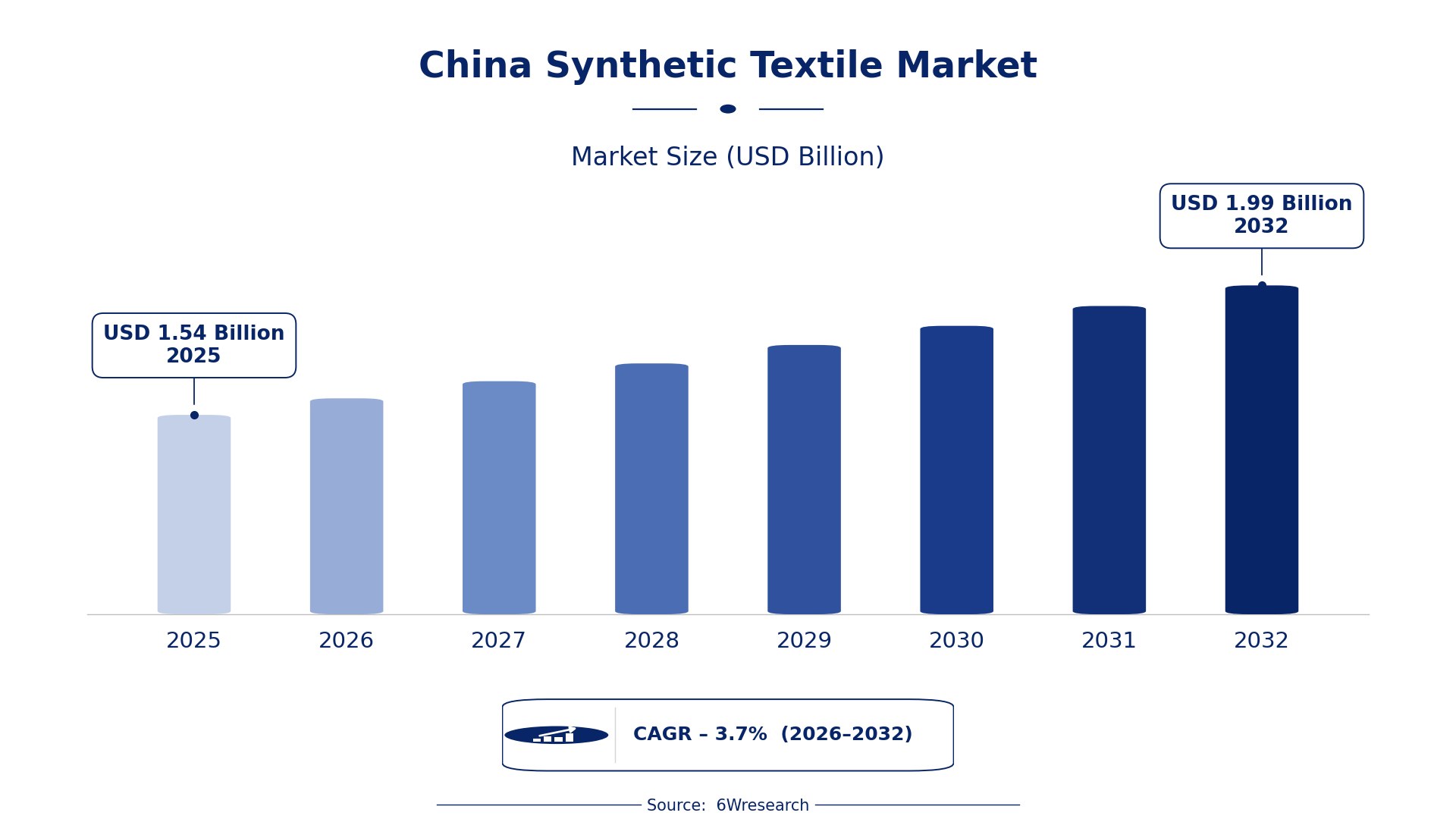
According to 6Wresearch internal database and industry insights, the China Synthetic Textile Market was valued at USD 1.54 billion in 2025 and is projected to reach USD 1.99 billion by 2032, growing at a CAGR of approximately 3.7% during 2026–2032.
China Synthetic Textile Market Highlights
| Report Metric | Details |
| Report Name | China Synthetic Textile Market |
| Market Size 2025 | USD 1.54 billion |
| Market Size 2032 | USD 1.99 billion |
| Absolute Growth 2025–2032 | USD 0.45 billion |
| CAGR 2026–2032 | 3.7% |
| Peak Annual Growth | 5.6% in 2027 |
| Forecast Period | 2026–2032 |
| Historical Data | 2022–2025 |
| Base Year | 2025 |
| Leading Synthetic Textile, 2025 | Polyester Fabrics (51% share) |
| Leading Product Type, 2025 | Woven/Knitted (39% share) |
| Leading Fiber Type, 2025 | Polyester (42% share) |
| Leading Distribution Channel, 2025 | Direct Sales (44% share) |
| Leading End User Industry, 2025 | Apparel Manufacturing (50% share) |
| Fastest-Growing Synthetic Textile | Nylon Fabrics (6.4% CAGR) |
| Fastest-Growing Product Type | Stretchable Wear (5.3% CAGR) |
| Fastest-Growing Fiber Type | Nylon (6.3% CAGR) |
| Fastest-Growing Distribution Channel | Online Platforms (5.4% CAGR) |
| Fastest-Growing End User Industry | Fitness Wear Sector (5.5% CAGR) |
| Growing Sector | Fitness Wear Sector |
| Key End Users | Apparel Manufacturers, Sportswear Brands, Home Textile Producers, Fitness Wear Sector |
China Synthetic Textile Market Year-wise Growth Rate and Key Drivers (2022–2032)
This graph illustrates the annual growth rates of the market from 2022 to 2032, highlighting a steady upward trajectory and projected market expansion over the forecast period.
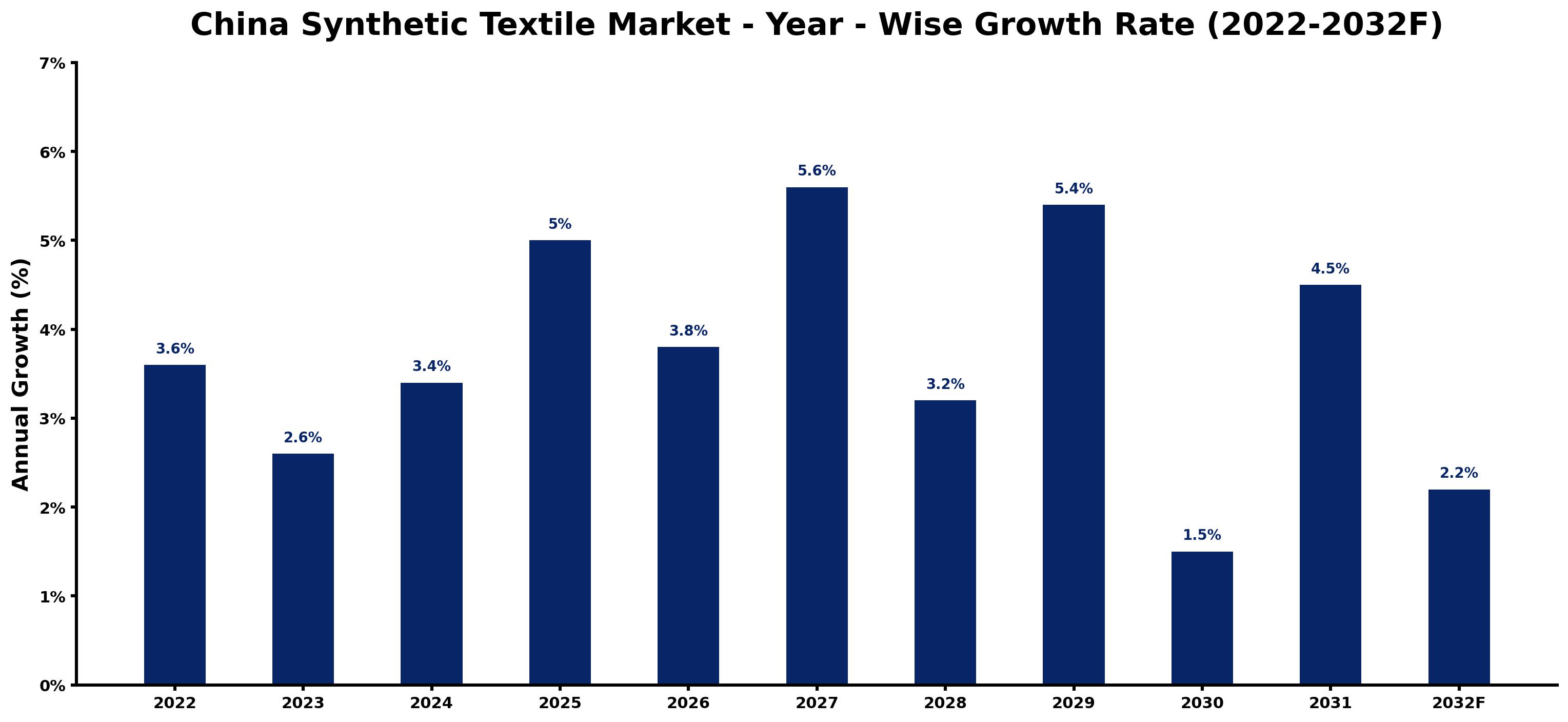
Each row of the following table gives one year's estimated growth and the event or demand shift that explains it.
| Year | Estimated Annual Growth (%) | Market Rationale |
| 2022 | 3.6 | The textile industry experienced steady demand from apparel manufacturing and home textiles. |
| 2023 | 2.6 | Growth slowed as global supply chain disruptions affected textile production and distribution. |
| 2024 | 3.4 | Demand increased due to a rise in online sales and consumer preferences for synthetic textiles. |
| 2025 | 5.0 | The market saw a boost as investments in innovation began to take effect. |
| 2026 | 3.8 | Growth is expected to slow as the market adjusts to new production standards and consumer trends. |
| 2027 | 5.6 | A surge in demand for performance fabrics in sportswear will drive market growth. |
| 2028 | 3.2 | Growth is projected to slow as the market faces challenges in raw material sourcing and costs. |
| 2029 | 5.4 | Demand is expected to increase due to rising consumer interest in fitness wear and active lifestyles. |
| 2030 | 1.5 | Growth is projected to slow as the 'Textile Industry Revitalization Plan' begins to impact market dynamics. |
| 2031 | 4.5 | A rebound in demand for home textiles and apparel manufacturing will lead to increased growth. |
| 2032 | 2.2 | Growth is expected to slow as the market stabilises after a period of rapid expansion. |
Note: Market size estimations and growth projections presented in this report are based on 6Wresearch's proprietary forecasting methodology, utilizing the latest available industry data, government publications, and primary research inputs.
China Synthetic Textile Market Synopsis
The China Synthetic Textile Market includes synthetic textiles, which are man-made fibres primarily used in clothing, upholstery, and industrial applications. In 2022, China produced over 50 million tons of synthetic fibres, demonstrating strong domestic demand. The market is expanding due to investments in innovation and a growing consumer preference for sustainable and performance-oriented fabrics, supported by initiatives like the 'Textile Industry Revitalization Plan'.
Market Dynamics Impact Analysis (2026–2032)
| Factor | Type | Impact | Primary Segment Affected |
| Rising demand for performance fabrics in sportswear and fitness apparel. | Driver | High | Nylon Fabrics |
| Increased online sales channels facilitating consumer access to synthetic textiles. | Driver | High | Direct Sales |
| Investment opportunities in sustainable textile production technologies. | Opportunity | High | Polyester Fabrics |
| Growing demand for eco-friendly textiles among environmentally conscious consumers. | Opportunity | Medium | Acrylic Fabrics |
| Supply chain disruptions affecting raw material availability and costs. | Restraint | High | Spandex Fabrics |
| Stringent quality standards impacting production timelines and costs. | Restraint | Medium | Woven/Knitted |
| High production costs due to fluctuating petrochemical prices. | Challenge | High | Polyester |
| Limited access to advanced manufacturing technologies for smaller producers. | Challenge | Medium | Nylon Fabrics |
Evaluation of Drivers in China Synthetic Textile Market (2026–2032)
The main growth drivers and the segments they affect most are set out below.
| Drivers | Primary Segment Affected | Why It Matters (Evidence) |
| Increased demand for high-performance fabrics in sportswear. | Nylon Fabrics | This trend results from the growing fitness culture, leading to higher purchases from sportswear brands. |
| Rising online sales of textiles, growing by 15% year-on-year in 2022. | Direct Sales | Consumers prefer online shopping, boosting sales through digital platforms. |
| Investments in innovation projected at $10 billion by 2025. | Polyester Fabrics | This funding improves production capabilities and product quality, attracting more buyers. |
| The 'Textile Industry Revitalization Plan' aims to enhance competitiveness. | Spandex Fabrics | This initiative encourages investment in advanced technologies, increasing demand for innovative products. |
| Consumer preference for sustainable textiles is rising. | Acrylic Fabrics | This shift prompts manufacturers to invest in eco-friendly production methods, increasing market purchases. |
Growth in the Synthetic Textile market in China comes from rising demand for high-performance fabrics and increased online sales channels. In 2022, online sales of textiles grew by 15% year-on-year, reflecting a shift in consumer purchasing behaviour. Investments in innovation, projected at $10 billion by 2025, are improving production capabilities and product quality. The growing consumer preference for sustainable textiles is prompting manufacturers to invest in eco-friendly production methods, which increases purchases across various segments. The demand for high-performance fabrics in sportswear is driving market growth, as fitness culture continues to expand.
Evaluation of Restraints in China Synthetic Textile Market
The following restraints limit how fast demand can grow.
| Market Restraint | Primary Segment Affected | Why It Matters (Evidence) |
| Supply chain disruptions affecting raw material availability. | Polyester | These disruptions have increased production costs, impacting profitability for manufacturers. |
| Stringent quality standards impacting production timelines. | Spandex Fabrics | Compliance with revised standards can delay product launches and raise operational costs. |
| High production costs due to fluctuating petrochemical prices. | Nylon Fabrics | These fluctuations create uncertainty for buyers, affecting their purchasing decisions. |
| Limited access to advanced manufacturing technologies for smaller producers. | Woven/Knitted | This limitation restricts their ability to compete effectively in the market. |
| Market saturation in certain textile segments leading to price competition. | Acrylic Fabrics | This saturation can reduce margins and discourage new investments. |
China Synthetic Textile Market Challenges
In the China Synthetic Textile Market, rising production costs pose a challenge for buyers, with petrochemical prices surging by approximately 20%, inflating expenses for synthetic fibre manufacturing. Suppliers face intense competition from low-cost imports, forcing them to reduce prices and eroding profit margins by up to 15%. Supply chain disruptions create significant hurdles, as delays in raw material availability can lead to production halts, impacting delivery schedules for manufacturers. A skills gap exists within the workforce, as the industry requires advanced technical expertise that is currently lacking, affecting suppliers' efficiency and innovation.
Trends in the China Synthetic Textile Market
Below mentioned are some of the trends shaping the China Synthetic Textile Market growth.
- Shift towards Sustainable Textile Production: The textile industry in China is increasingly prioritising sustainable practices, driven by consumer demand for eco-friendly products. The 'Green Development Action Plan for Textile Industry' aims to promote environmentally friendly practices, targeting a 30% reduction in waste by 2025.
- Growth of Online Sales Channels: Online platforms are becoming a dominant sales channel for synthetic textiles, with a 15% year-on-year growth in 2022. This trend is particularly noticeable in urban areas where consumers prefer the convenience of online shopping.
- Rise of Performance Fabrics in Activewear: The fitness wear sector is experiencing rapid growth, with a CAGR of 5.5% projected through 2032. This trend is driven by increasing health consciousness among consumers, particularly in metropolitan regions.
- Expansion of Direct Sales Channels: Direct sales are leading the distribution of synthetic textiles, accounting for 44% of market share in 2025. This trend is encouraged by manufacturers seeking to engage directly with consumers.
Investment Opportunities in the China Synthetic Textile Market
Investors looking at the China Synthetic Textile Market should consider the following areas.
- Partnerships for Sustainable Production: Local partnerships can facilitate entry into the sustainable textile market, projected to grow significantly. The 'Green Textile Certification' program encourages eco-friendly practices, creating opportunities for manufacturers.
- Investment in High-Performance Fabrics: The demand for high-performance fabrics is increasing, particularly in the fitness wear sector. Investing in advanced technologies can capture this growing market segment, especially in urban areas.
- Expansion into Online Retail: With online sales of textiles growing by 15% year-on-year, investing in e-commerce platforms presents a substantial opportunity. Manufacturers can partner with online retailers to reach a broader consumer base.
- Focus on Innovation in Textile Manufacturing: The projected $10 billion investment in innovation by 2025 presents opportunities for suppliers of advanced textile machinery. Collaborating with textile manufacturers can improve production capabilities.
Government Initiatives in the China Synthetic Textile Market
The 'Textile Industry Revitalization Plan' launched in 2021 by the Ministry of Industry and Information Technology aims to improve competitiveness and innovation in the textile sector. This plan focuses on modernising production processes and improving product quality, which directly benefits textile manufacturers. The initiative encourages investments in research and development, fostering a more innovative environment within the industry. Additionally, the 'Made in China 2025' initiative includes specific targets for textile technology advancements, promoting sustainable practices and improving the overall quality of textile products.
In 2023, the 'Green Development Action Plan for Textile Industry' was introduced to promote environmentally friendly practices in textile production. This plan is overseen by the Ministry of Industry and Information Technology, which funds projects aimed at reducing environmental impact. The 'National Standard for Textile Quality' was revised in 2022 by the Standardization Administration to improve product quality and safety. This standardisation ensures that manufacturers adhere to strict quality controls, enhancing consumer confidence in textile products.
Future Insight of the China Synthetic Textile Market
Several forward-looking factors are expected to support the China Synthetic Textile Market over the coming years. The government's 'Textile Industry Revitalization Plan' aims to enhance innovation, with a projected investment of $10 billion by 2025. The 'Made in China 2025' initiative will modernise production processes, boosting competitiveness across the sector. The growth of online sales, which increased by 15% year-on-year in 2022, indicates a shift in consumer behaviour, creating new opportunities for suppliers to reach a broader audience. The focus on sustainable practices through the 'Circular Economy Development Plan' will promote eco-friendly production methods.
Market Segmentation Analysis
The report offers a comprehensive study of the following market segments and their leading categories in the market.
By Synthetic Textile – Polyester Fabrics Dominated, Nylon Fabrics Expected to Grow Fastest
According to Sumit Sagar, AM at 6Wresearch, Polyester Fabrics accounted for a 51% market share by synthetic textile in 2025. Polyester fabrics dominate the China synthetic textile market due to their extensive use in apparel and home textiles, reflecting the significant production of over 50 million tons of synthetic fibers in 2022. This high volume underscores polyester's essential role in satisfying the robust domestic demand for textiles. Nylon Fabrics are set to record the highest CAGR in this split, 6.4% over 2026–2032. Nylon fabrics are rapidly gaining traction, particularly in the sportswear segment, as consumers increasingly seek high-performance materials for outdoor activities. This growing preference for durability and functionality is propelling nylon's demand forward, solidifying its position as a key growth driver. Suppliers should enhance their nylon offerings to meet the rising demand for performance-oriented textiles.
By Product Type – Woven/Knitted Dominated, Stretchable Wear Expected to Grow Fastest
In 2025, Woven/Knitted led the product type split with a 39% share. Woven and knitted fabrics hold the largest share in the market as they are the primary methods for fabric production, extensively used across various textile applications. Their established presence is reinforced by the strong apparel manufacturing sector that relies heavily on these fabric types. Over 2026–2032, Stretchable Wear is expected to post the fastest growth, at a CAGR of 5.3%. Stretchable wear is experiencing rapid growth, particularly in the fitness and activewear markets, driven by consumer demand for comfort and flexibility in clothing. The increasing health consciousness among consumers significantly propels this trend forward, indicating a shift in preferences. Manufacturers should consider expanding their range of stretchable wear to align with the rising consumer demand for active and comfortable clothing.
By Fiber Type – Polyester Dominated, Nylon Expected to Grow Fastest
With a 42% revenue share in 2025, Polyester was the largest fiber type category. Polyester remains the dominant fiber in the textile industry, accounting for approximately 70% of total fiber production in China. Its versatility and cost-effectiveness make it the preferred choice for a wide range of applications, ensuring its leading market share. Nylon is projected to grow fastest, at a CAGR of 6.3% during 2026–2032. Nylon is witnessing significant growth, particularly in performance fabrics, as it meets the needs of consumers seeking durability and functionality in their clothing. The increasing popularity of active lifestyles is driving this segment's expansion. Suppliers should invest in nylon innovations to cater to the expanding market for high-performance textile applications.
By Distribution Channel – Direct Sales Dominated, Online Platforms Expected to Grow Fastest
The largest distribution channel category in 2025 was Direct Sales, with a 44% share of total revenue. Direct sales are the most common channel for textile sales, allowing manufacturers to build strong relationships with buyers and ensure efficient distribution. This method's effectiveness is reflected in its widespread adoption across various segments of the textile market. The quickest growth will come from Online Platforms, forecast to expand at a CAGR of 5.4% between 2026 and 2032. Online platforms are rapidly becoming the preferred channel for consumer purchases, driven by the convenience and accessibility they offer. The 15% year-on-year growth in online textile sales highlights the shift towards digital shopping experiences. Retailers should enhance their online presence to capture the growing consumer shift towards e-commerce in the textile market.
By End User Industry – Apparel Manufacturing Dominated, Fitness Wear Sector Expected to Grow Fastest
Apparel Manufacturing took a 50% share of end user industry in 2025, more than any other category. Apparel manufacturing is the largest consumer of synthetic textiles, driven by the high demand for clothing in China. The sector's substantial workforce and production capabilities reinforce its dominant position in the market. Fitness Wear Sector is set to record the highest CAGR in this split, 5.5% over 2026–2032. The fitness wear sector is experiencing rapid growth as consumers increasingly prioritise health and wellness, leading to a surge in demand for specialised clothing. This trend is supported by the growing popularity of fitness activities across the population. Brands should focus on developing innovative fitness wear to capitalise on the expanding market driven by health-conscious consumers.
Key Attractiveness of the Report
- 10 Years of Market Numbers
- Historical Data Starting from 2022 to 2025
- Base Year 2025
- Forecast Data until 2032
- Key Performance Indicators Impacting the Market
- Major Upcoming Developments and Projects
Key Highlights of the Report:
- China Synthetic Textile Market Outlook
- Market Size of China Synthetic Textile Market, 2025
- Forecast of China Synthetic Textile Market, 2032
- Historical Data and Forecast of China Synthetic Textile Revenues & Volume for the Period 2022 - 2032F
- China Synthetic Textile Market Trend Evolution
- China Synthetic Textile Market Drivers and Challenges
- China Synthetic Textile Price Trends
- China Synthetic Textile Porter's Five Forces
- China Synthetic Textile Industry Life Cycle
- Historical Data and Forecast of China Synthetic Textile Market Revenues & Volume By Synthetic Textile for the Period 2022 - 2032F
- Historical Data and Forecast of China Synthetic Textile Market Revenues & Volume By Polyester Fabrics for the Period 2022 - 2032F
- Historical Data and Forecast of China Synthetic Textile Market Revenues & Volume By Nylon Fabrics for the Period 2022 - 2032F
- Historical Data and Forecast of China Synthetic Textile Market Revenues & Volume By Acrylic Fabrics for the Period 2022 - 2032F
- Historical Data and Forecast of China Synthetic Textile Market Revenues & Volume By Spandex Fabrics for the Period 2022 - 2032F
- Historical Data and Forecast of China Synthetic Textile Market Revenues & Volume By Product Type for the Period 2022 - 2032F
- Historical Data and Forecast of China Synthetic Textile Market Revenues & Volume By Woven/Knitted for the Period 2022 - 2032F
- Historical Data and Forecast of China Synthetic Textile Market Revenues & Volume By Tulle, Satin for the Period 2022 - 2032F
- Historical Data and Forecast of China Synthetic Textile Market Revenues & Volume By Sweaters, Blankets for the Period 2022 - 2032F
- Historical Data and Forecast of China Synthetic Textile Market Revenues & Volume By Stretchable Wear for the Period 2022 - 2032F
- Historical Data and Forecast of China Synthetic Textile Market Revenues & Volume By Fiber Type for the Period 2022 - 2032F
- Historical Data and Forecast of China Synthetic Textile Market Revenues & Volume By Polyester for the Period 2022 - 2032F
- Historical Data and Forecast of China Synthetic Textile Market Revenues & Volume By Nylon for the Period 2022 - 2032F
- Historical Data and Forecast of China Synthetic Textile Market Revenues & Volume By Acrylic for the Period 2022 - 2032F
- Historical Data and Forecast of China Synthetic Textile Market Revenues & Volume By Spandex/Elastane for the Period 2022 - 2032F
- Historical Data and Forecast of China Synthetic Textile Market Revenues & Volume By Distribution Channel for the Period 2022 - 2032F
- Historical Data and Forecast of China Synthetic Textile Market Revenues & Volume By Direct Sales for the Period 2022 - 2032F
- Historical Data and Forecast of China Synthetic Textile Market Revenues & Volume By Textile Distributors for the Period 2022 - 2032F
- Historical Data and Forecast of China Synthetic Textile Market Revenues & Volume By Online Platforms for the Period 2022 - 2032F
- Historical Data and Forecast of China Synthetic Textile Market Revenues & Volume By Specialty Stores for the Period 2022 - 2032F
- Historical Data and Forecast of China Synthetic Textile Market Revenues & Volume By End User Industry for the Period 2022 - 2032F
- Historical Data and Forecast of China Synthetic Textile Market Revenues & Volume By Apparel Manufacturing for the Period 2022 - 2032F
- Historical Data and Forecast of China Synthetic Textile Market Revenues & Volume By Sportswear Brands for the Period 2022 - 2032F
- Historical Data and Forecast of China Synthetic Textile Market Revenues & Volume By Home Textiles for the Period 2022 - 2032F
- Historical Data and Forecast of China Synthetic Textile Market Revenues & Volume By Fitness Wear Sector for the Period 2022 - 2032F
- China Synthetic Textile Import Export Trade Statistics
- Market Opportunity Assessment By Synthetic Textile
- Market Opportunity Assessment By Product Type
- Market Opportunity Assessment By Fiber Type
- Market Opportunity Assessment By Distribution Channel
- Market Opportunity Assessment By End User Industry
- China Synthetic Textile Top Companies Market Share
- China Synthetic Textile Competitive Benchmarking By Technical and Operational Parameters
- China Synthetic Textile Company Profiles
- China Synthetic Textile Key Strategic Recommendations
Market Covered
This report examines the market across the segments below.
By Synthetic Textile
- Polyester Fabrics
- Nylon Fabrics
- Acrylic Fabrics
- Spandex Fabrics
By Product Type
- Woven/Knitted
- Tulle
- Satin
- Sweaters
- Blankets
- Stretchable Wear
By Fiber Type
- Polyester
- Nylon
- Acrylic
- Spandex/Elastane
By Distribution Channel
- Direct Sales
- Textile Distributors
- Online Platforms
- Specialty Stores
By End User Industry
- Apparel Manufacturing
- Sportswear Brands
- Home Textiles
- Fitness Wear Sector































