China Synthetic Yarn Market Size & Growth Rate
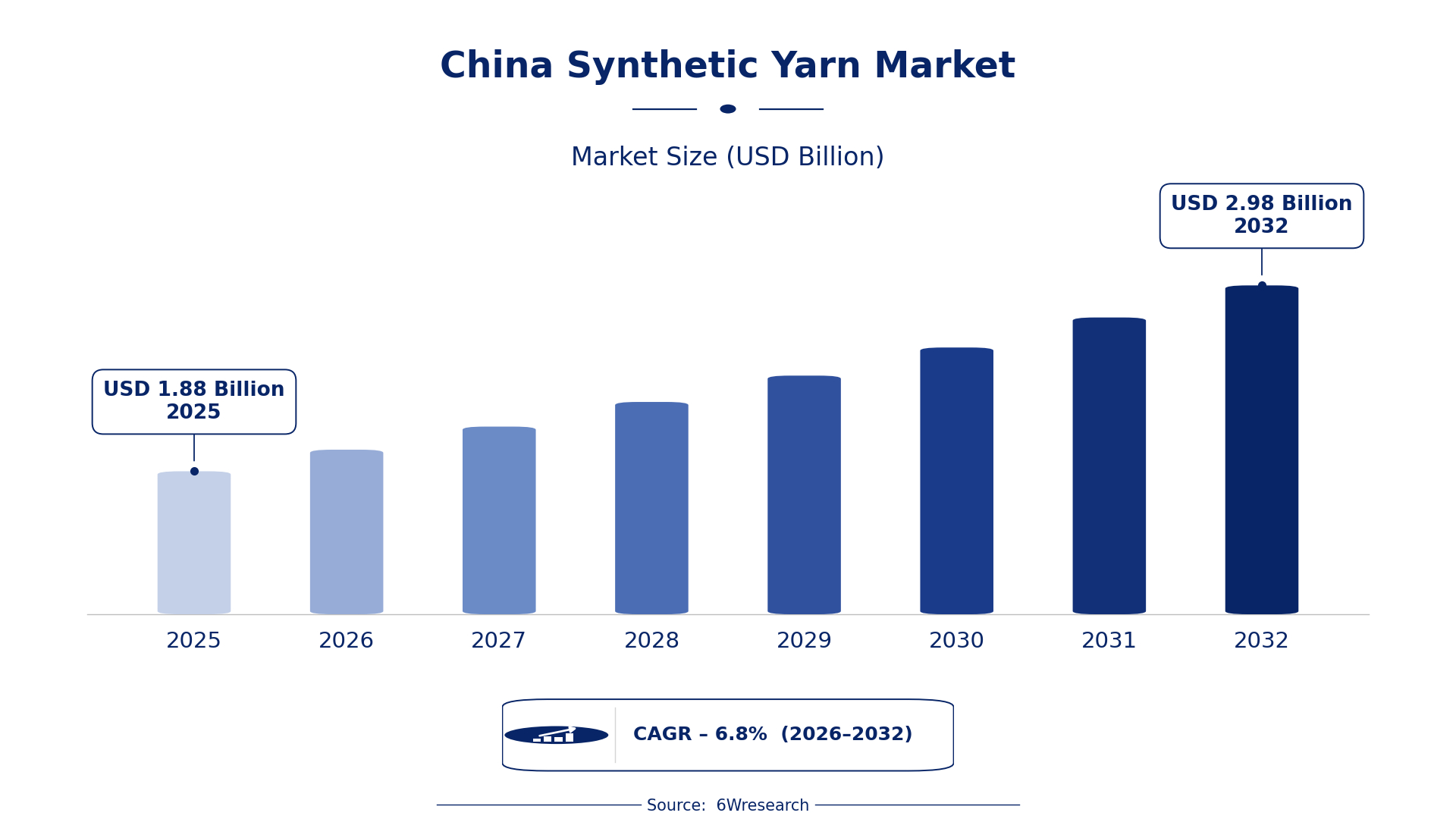
According to 6Wresearch internal database and industry insights, the China Synthetic Yarn Market was valued at USD 1.88 billion in 2025 and is projected to reach USD 2.98 billion by 2032, growing at a CAGR of approximately 6.8% during 2026–2032.
China Synthetic Yarn Market Highlights
| Report Metric | Details |
| Report Name | China Synthetic Yarn Market |
| Market Size 2025 | USD 1.88 billion |
| Market Size 2032 | USD 2.98 billion |
| Absolute Growth 2025–2032 | USD 1.10 billion |
| CAGR 2026–2032 | 6.8% |
| Peak Annual Growth | 8.4% in 2029 |
| Forecast Period | 2026–2032 |
| Historical Data | 2022–2025 |
| Base Year | 2025 |
| Leading Synthetic Yarn, 2025 | Polyester Yarn (36% share) |
| Leading Product Type, 2025 | POY/DTY/FDY (44% share) |
| Leading Fiber Type, 2025 | Polyester (52% share) |
| Leading Distribution Channel, 2025 | Direct Sales (49% share) |
| Leading End User Industry, 2025 | Textile Manufacturing (52% share) |
| Fastest-Growing Synthetic Yarn | Nylon Yarn (8.0% CAGR) |
| Fastest-Growing Product Type | Textured Yarn (9.0% CAGR) |
| Fastest-Growing Fiber Type | Nylon 6/66 (8.1% CAGR) |
| Fastest-Growing Distribution Channel | Online Platforms (9.0% CAGR) |
| Fastest-Growing End User Industry | Hosiery & Lingerie (8.2% CAGR) |
| Growing Sector | Textile Manufacturing |
| Key End Users | Textile Manufacturers, Hosiery Producers, Knitwear Manufacturers, Carpet Manufacturers |
China Synthetic Yarn Market Year-wise Growth Rate and Key Drivers (2022–2032)
This graph illustrates the annual growth rates of the market from 2022 to 2032, highlighting a steady upward trajectory and projected market expansion over the forecast period.
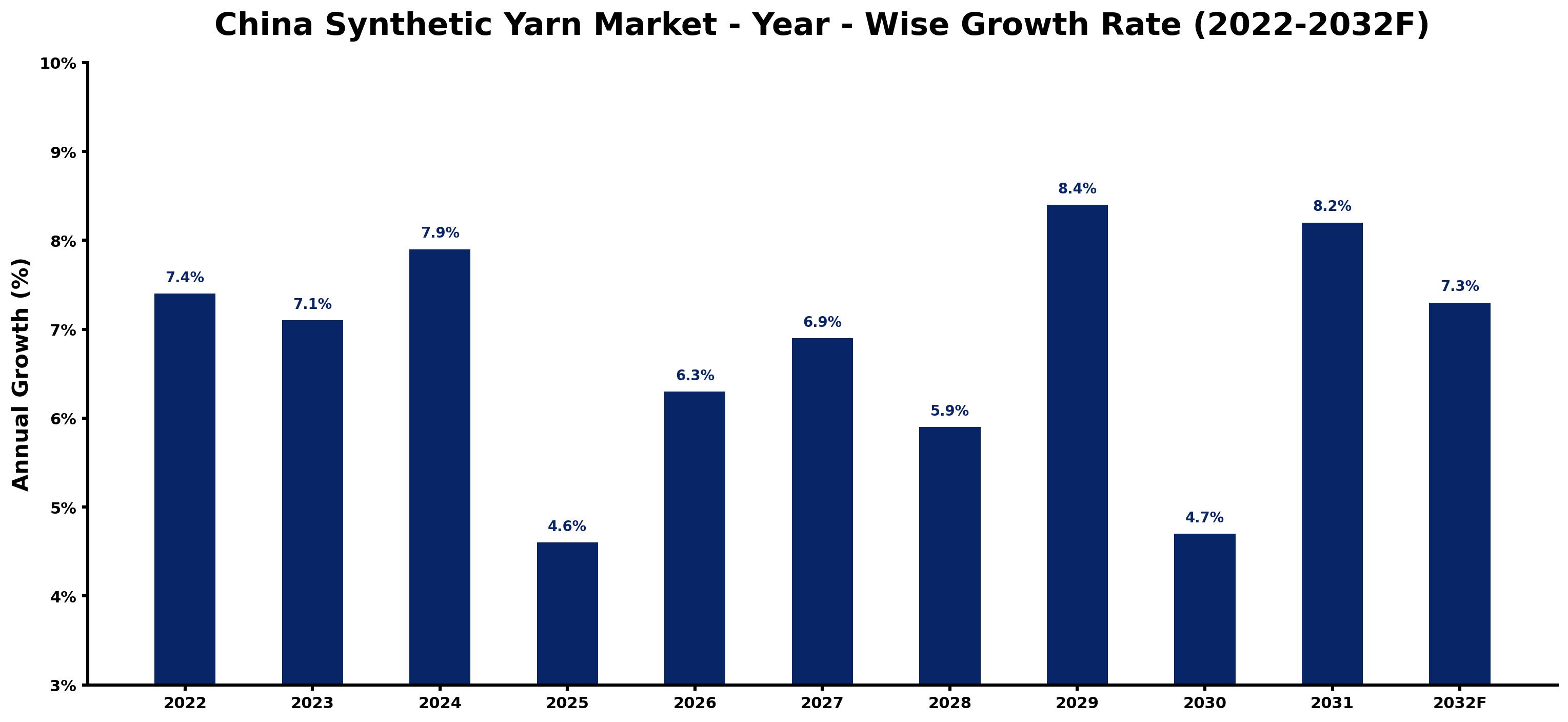
Below, each year's estimated growth is shown next to the factor that most influenced it.
| Year | Estimated Annual Growth (%) | Market Rationale |
| 2022 | 7.4 | The textile manufacturing sector employed over 25 million people, driving demand for synthetic yarn. |
| 2023 | 7.1 | Growth slowed as the industry adjusted to the impacts of the 'Textile Industry Transformation and Upgrade Plan'. |
| 2024 | 7.9 | Production technology improvements led to increased efficiency and higher demand for synthetic yarn. |
| 2025 | 4.6 | Demand growth slowed due to challenges from environmental regulations affecting production. |
| 2026 | 6.3 | Investment in sustainable practices is expected to boost production and demand for synthetic yarn. |
| 2027 | 6.9 | Rising exports and domestic consumption will support growth in synthetic yarn demand. |
| 2028 | 5.9 | Market growth is projected to slow as manufacturers adapt to new eco-friendly standards. |
| 2029 | 8.4 | The peak growth rate is driven by the increasing need for high-performance textiles in various sectors. |
| 2030 | 4.7 | Growth is expected to slow as manufacturers focus on optimizing production processes. |
| 2031 | 8.2 | Demand for nylon yarn surged, driven by its applications in hosiery and activewear. |
| 2032 | 7.3 | Growth is projected to slow as the market stabilizes after reaching high production capacity. |
Note: Market size estimations and growth projections presented in this report are based on 6Wresearch's proprietary forecasting methodology, utilizing the latest available industry data, government publications, and primary research inputs.
China Synthetic Yarn Market Synopsis
The Synthetic Yarn Market in China encompasses man-made fibers produced primarily from petrochemical products. These fibers are essential in textiles for clothing, upholstery, and industrial applications. The market is expanding due to strong domestic textile manufacturing and significant exports, with the textile sector employing over 25 million people. The 'Textile Industry Transformation and Upgrade Plan' launched in 2021 aims to enhance production efficiency, further driving demand for synthetic yarn. As a result, the market is expected to grow steadily through 2032.
Market Dynamics Impact Analysis (2026–2032)
| Factor | Type | Impact | Primary Segment Affected |
| Rising domestic textile manufacturing | Driver | High | Textile Manufacturing |
| Increased exports of synthetic yarn | Driver | High | Polyester Yarn |
| Growing demand for eco-friendly materials | Opportunity | Medium | Polyester Yarn |
| Expansion of online sales channels | Opportunity | Medium | Direct Sales |
| Environmental regulations increasing production costs | Restraint | High | Nylon Yarn |
| Competition from alternative fibers | Restraint | Medium | Acrylic Yarn |
| Supply chain disruptions affecting production schedules | Challenge | High | Polypropylene Yarn |
| Fluctuating raw material prices impacting profitability | Challenge | Medium | Spun Yarn |
Evaluation of Drivers in China Synthetic Yarn Market (2026–2032)
The main growth drivers and the segments they affect most are set out below.
| Drivers | Primary Segment Affected | Why It Matters (Evidence) |
| Increased investment in production technology | POY/DTY/FDY | This investment improves production efficiency, resulting in higher output and demand from textile manufacturers. |
| Rising domestic consumption of textiles | Textile Manufacturing | As the largest consumer, the textile sector drives demand for synthetic yarn, reflecting the industry's growth. |
| Expansion of online retail platforms | Online Platforms | The shift to online sales has increased accessibility, resulting in a 15% rise in yarn purchases in 2022. |
| Growing international trade in synthetic yarn | Polyester Yarn | With exports reaching $300 billion in 2022, demand from foreign markets boosts production. |
| Sustainability initiatives in textile production | Polyester Yarn | The 'China Textile Industry Development Plan (2021-2025)' promotes sustainable materials, increasing demand for eco-friendly yarn. |
Growth in the Synthetic Yarn market in China comes from increased investment in production technology, rising domestic consumption of textiles, and the expansion of online retail platforms. In 2022, online sales of synthetic yarn increased by 15%, reflecting changing consumer purchasing habits. The textile manufacturing sector, employing over 25 million people, remains a major consumer of synthetic yarn. The 'Textile Industry Transformation and Upgrade Plan' promotes sustainable practices, boosting demand for eco-friendly materials. With exports reaching $300 billion in 2022, international trade also plays a vital role in driving market growth.
Evaluation of Restraints in China Synthetic Yarn Market
The main factors holding the market back are set out below.
| Market Restraint | Primary Segment Affected | Why It Matters (Evidence) |
| Environmental regulations increasing production costs | Nylon Yarn | The 'Action Plan for Pollution Prevention and Control in the Textile Industry' increases compliance costs for manufacturers. |
| Competition from alternative fibers | Acrylic Yarn | Growing popularity of natural fibers poses a challenge to synthetic yarn demand in the textile market. |
| Supply chain disruptions affecting production schedules | Polypropylene Yarn | Recent disruptions have delayed deliveries, impacting the availability of synthetic yarn for manufacturers. |
| Fluctuating raw material prices impacting profitability | Spun Yarn | Volatility in petrochemical prices affects production costs, squeezing margins for yarn producers. |
| Limited awareness of sustainable yarn options | Polyester Yarn | Buyers may overlook eco-friendly alternatives, hindering market growth for sustainable synthetic yarn. |
China Synthetic Yarn Market Challenges
The China Synthetic Yarn Market still has to solve a few problems, starting with buyer reliance on conventional suppliers, which limits their options and can delay production timelines. Rising production costs, driven by volatile petrochemical prices, have led to a 10% increase in synthetic yarn prices this year, squeezing margins for manufacturers. Limited expertise in advanced textile technologies hampers the industry's capacity to innovate, putting local producers at a disadvantage. Heightened competition from global markets pressures domestic suppliers to reduce prices, which can lead to compromised quality and diminished profitability for manufacturers.
Trends in the China Synthetic Yarn Market
Buyers and suppliers in the China Synthetic Yarn Market are adjusting to the following trends.
- Shift from Traditional to Sustainable Practices: Since 2021, the textile industry has increasingly embraced sustainable practices, driven by the 'Textile Industry Transformation and Upgrade Plan'. This shift aims to improve production efficiency and lessen environmental impact, targeting an increase in sustainable materials in production.
- Emergence of Online Sales Channels: In 2022, online sales of synthetic yarn grew by 15%, reflecting evolving consumer purchasing habits. This trend is reshaping distribution, enabling manufacturers to reach a wider audience more effectively.
- Transition to High-Performance Textiles: The demand for high-performance textiles has surged, particularly in the sports and activewear sectors. This trend is supported by the increasing annual demand for nylon yarn, estimated at around 1.5 million tons.
- Growth in Export Markets: China's textile exports reached $300 billion in 2022, with synthetic yarn being a major contributor. This growth is driven by rising international demand for Chinese textile products.
Investment Opportunities in the China Synthetic Yarn Market
Investors looking at the China Synthetic Yarn Market should consider the following areas.
- Investment in Eco-Friendly Production: With the increasing focus on sustainability, there is a strong opportunity to invest in eco-friendly synthetic yarn production. The 'Green Manufacturing Standard System' introduced in 2020 promotes these practices, appealing to environmentally conscious buyers.
- Expansion of Online Retail Platforms: The growing trend of online sales channels presents an opportunity for manufacturers to strengthen their market presence. With a 15% increase in online sales in 2022, investing in digital platforms can attract new buyers.
- Development of High-Performance Yarn Products: The rising demand for high-performance textiles, especially in the sportswear sector, creates opportunities for specialized yarn development. Targeting knitwear manufacturers can lead to increased sales and market share.
- Focus on Export Growth: With textile exports reaching $300 billion in 2022, there is a strong opportunity to expand into international markets. Collaborating with export agencies can facilitate entry into new regions.
Government Initiatives in the China Synthetic Yarn Market
In 2023, the State Council issued the 'National Strategy for Sustainable Development of the Textile Industry', which builds on previous measures aimed at promoting eco-friendly practices. This strategy complements the 'Textile Industry Transformation and Upgrade Plan' from 2021, which focused on improving production technology and efficiency. Together, these initiatives encourage manufacturers to adopt sustainable practices and reduce environmental impact, aligning with global standards. The strategy aims to increase the use of sustainable materials in production by 30% by 2025, benefiting both producers and buyers.
The 'Export Credit Insurance Scheme', initiated by the Ministry of Commerce in 2020, supports textile exporters, including synthetic yarn manufacturers. This scheme provides financial backing and risk coverage, enabling buyers to confidently engage in international trade. By facilitating access to export markets, the scheme helps manufacturers expand their reach and increase sales. In 2022, the scheme supported over 1,000 textile exporters, enhancing their competitiveness in the global market.
Future Insight of the China Synthetic Yarn Market
Several forward-looking factors should support the China Synthetic Yarn Market in the coming years. The 'Textile Industry Transformation and Upgrade Plan' will enhance production efficiency, allowing suppliers to respond more effectively to market demands. By 2025, the annual demand for nylon yarn is projected to reach 1.5 million tons, driven by its expanding use in various applications. The 'Made in China 2025' initiative will encourage advancements in textile manufacturing technologies, enabling buyers to access superior synthetic yarn products.
Market Segmentation Analysis
Each segment group is reviewed below, with the leader by share and the fastest grower by CAGR.
By Synthetic Yarn – Polyester Yarn Dominated, Nylon Yarn Expected to Grow Fastest
According to Sumit Sagar, AM at 6Wresearch, in 2025, Polyester Yarn led the synthetic yarn split with a 36% share. Polyester yarn holds the largest share in the China synthetic yarn market due to its extensive use in clothing and textiles, particularly in the Jiangsu and Zhejiang provinces. The substantial production of polyester, with approximately 20 million tons in 2021, reinforces its dominant position in the industry. Nylon Yarn is projected to grow fastest, at a CAGR of 8.0% during 2026–2032. Nylon yarn is experiencing rapid growth, primarily driven by its rising demand in hosiery and activewear, which are increasingly popular among consumers. With an estimated annual demand of around 1.5 million tons, nylon yarn's appeal is expected to continue expanding, further solidifying its market presence. Suppliers should focus on enhancing their nylon yarn offerings to capitalise on the increasing demand in the hosiery and activewear segments.
By Product Type – POY/DTY/FDY Dominated, Textured Yarn Expected to Grow Fastest
POY/DTY/FDY accounted for a 44% market share by product type in 2025. POY/DTY/FDY leads the market as it is essential for producing a wide variety of textile products, catering to diverse manufacturing needs. The total installed capacity for polyester yarn production reached 30 million tons in 2023, highlighting its critical role in the synthetic yarn market. The quickest growth will come from Textured Yarn, forecast to expand at a CAGR of 9.0% between 2026 and 2032. Textured yarn is witnessing the fastest growth due to its ability to enhance fabric properties, which are increasingly sought after in the textile industry. The demand for sophisticated fabrics is driving the expansion of textured yarn, making it a vital segment in the market. Manufacturers should invest in textured yarn production to meet the evolving demands of the textile market.
By Fiber Type – Polyester Dominated, Nylon 6/66 Expected to Grow Fastest
Polyester took a 52% share of fiber type in 2025, more than any other category. Polyester is the dominant fiber in the synthetic textiles market, capturing the largest share due to its versatility and extensive applications across various textile products. The strong production capabilities in China reinforce polyester's established presence in the industry. Nylon 6/66 is set to record the highest CAGR in this split, 8.1% over 2026–2032. Nylon 6/66 is experiencing rapid growth, particularly in high-strength applications where durability is crucial. This trend reflects the increasing use of nylon in performance-oriented textiles, indicating a shift towards more resilient materials. Suppliers should prioritise nylon to align with the trend towards durable and high-performance textile applications.
By Distribution Channel – Direct Sales Dominated, Online Platforms Expected to Grow Fastest
The largest distribution channel category in 2025 was Direct Sales, with a 49% share of total revenue. Direct sales dominate the distribution channel in the China synthetic yarn market, as manufacturers prefer this method for efficient customer engagement. This approach allows for better pricing control and stronger customer relationships, making it the preferred choice for many producers. Over 2026–2032, Online Platforms are expected to post the fastest growth, at a CAGR of 9.0%. Online platforms are the fastest-growing distribution channel, reflecting a shift in consumer purchasing habits towards digital solutions. The 15% increase in online sales of synthetic yarn in 2022 underscores the importance of adapting to this trend. Suppliers need to enhance their online presence to capture the growing market share through digital sales channels.
By End User Industry – Textile Manufacturing Dominated, Hosiery & Lingerie Expected to Grow Fastest
Textile Manufacturing held a 52% share of the China Synthetic Yarn Market by end user industry in 2025. Textile manufacturing is the largest consumer of synthetic yarn, representing a significant share of the market due to its extensive use in various textile applications. The sector's employment of over 25 million people highlights its crucial role in the economy and sustained demand for synthetic yarn. Hosiery & Lingerie is projected to grow fastest, at a CAGR of 8.2% during 2026–2032. Hosiery and lingerie are the fastest-growing segments, driven by the increasing popularity of nylon yarn in these applications. The focus on comfort and performance in hosiery is driving demand, making this end-user industry a key growth area. Suppliers should target the hosiery and lingerie sectors to leverage the rapid growth and changing consumer preferences.
Key Attractiveness of the Report
- 10 Years of Market Numbers
- Historical Data Starting from 2022 to 2025
- Base Year 2025
- Forecast Data until 2032
- Key Performance Indicators Impacting the Market
- Major Upcoming Developments and Projects
Key Highlights of the Report:
- China Synthetic Yarn Market Outlook
- Market Size of China Synthetic Yarn Market, 2025
- Forecast of China Synthetic Yarn Market, 2032
- Historical Data and Forecast of China Synthetic Yarn Revenues & Volume for the Period 2022 - 2032F
- China Synthetic Yarn Market Trend Evolution
- China Synthetic Yarn Market Drivers and Challenges
- China Synthetic Yarn Price Trends
- China Synthetic Yarn Porter's Five Forces
- China Synthetic Yarn Industry Life Cycle
- Historical Data and Forecast of China Synthetic Yarn Market Revenues & Volume By Synthetic Yarn for the Period 2022 - 2032F
- Historical Data and Forecast of China Synthetic Yarn Market Revenues & Volume By Polyester Yarn for the Period 2022 - 2032F
- Historical Data and Forecast of China Synthetic Yarn Market Revenues & Volume By Nylon Yarn for the Period 2022 - 2032F
- Historical Data and Forecast of China Synthetic Yarn Market Revenues & Volume By Acrylic Yarn for the Period 2022 - 2032F
- Historical Data and Forecast of China Synthetic Yarn Market Revenues & Volume By Polypropylene Yarn for the Period 2022 - 2032F
- Historical Data and Forecast of China Synthetic Yarn Market Revenues & Volume By Product Type for the Period 2022 - 2032F
- Historical Data and Forecast of China Synthetic Yarn Market Revenues & Volume By POY/DTY/FDY for the Period 2022 - 2032F
- Historical Data and Forecast of China Synthetic Yarn Market Revenues & Volume By Textured Yarn for the Period 2022 - 2032F
- Historical Data and Forecast of China Synthetic Yarn Market Revenues & Volume By Spun Yarn for the Period 2022 - 2032F
- Historical Data and Forecast of China Synthetic Yarn Market Revenues & Volume By Multifilament Yarn for the Period 2022 - 2032F
- Historical Data and Forecast of China Synthetic Yarn Market Revenues & Volume By Fiber Type for the Period 2022 - 2032F
- Historical Data and Forecast of China Synthetic Yarn Market Revenues & Volume By Polyester for the Period 2022 - 2032F
- Historical Data and Forecast of China Synthetic Yarn Market Revenues & Volume By Nylon 6/66 for the Period 2022 - 2032F
- Historical Data and Forecast of China Synthetic Yarn Market Revenues & Volume By Acrylic for the Period 2022 - 2032F
- Historical Data and Forecast of China Synthetic Yarn Market Revenues & Volume By PP for the Period 2022 - 2032F
- Historical Data and Forecast of China Synthetic Yarn Market Revenues & Volume By Distribution Channel for the Period 2022 - 2032F
- Historical Data and Forecast of China Synthetic Yarn Market Revenues & Volume By Direct Sales for the Period 2022 - 2032F
- Historical Data and Forecast of China Synthetic Yarn Market Revenues & Volume By Industrial Distributors for the Period 2022 - 2032F
- Historical Data and Forecast of China Synthetic Yarn Market Revenues & Volume By Online Platforms for the Period 2022 - 2032F
- Historical Data and Forecast of China Synthetic Yarn Market Revenues & Volume By Retail Chains for the Period 2022 - 2032F
- Historical Data and Forecast of China Synthetic Yarn Market Revenues & Volume By End User Industry for the Period 2022 - 2032F
- Historical Data and Forecast of China Synthetic Yarn Market Revenues & Volume By Textile Manufacturing for the Period 2022 - 2032F
- Historical Data and Forecast of China Synthetic Yarn Market Revenues & Volume By Hosiery & Lingerie for the Period 2022 - 2032F
- Historical Data and Forecast of China Synthetic Yarn Market Revenues & Volume By Knitwear Manufacturers for the Period 2022 - 2032F
- Historical Data and Forecast of China Synthetic Yarn Market Revenues & Volume By Carpet & Rugs Industry for the Period 2022 - 2032F
- China Synthetic Yarn Import Export Trade Statistics
- Market Opportunity Assessment By Synthetic Yarn
- Market Opportunity Assessment By Product Type
- Market Opportunity Assessment By Fiber Type
- Market Opportunity Assessment By Distribution Channel
- Market Opportunity Assessment By End User Industry
- China Synthetic Yarn Top Companies Market Share
- China Synthetic Yarn Competitive Benchmarking By Technical and Operational Parameters
- China Synthetic Yarn Company Profiles
- China Synthetic Yarn Key Strategic Recommendations
Market Covered
The report offers an extensive study of the following market segments.
By Synthetic Yarn
- Polyester Yarn
- Nylon Yarn
- Acrylic Yarn
- Polypropylene Yarn
By Product Type
- POY/DTY/FDY
- Textured Yarn
- Spun Yarn
- Multifilament Yarn
By Fiber Type
- Polyester
- Nylon 6/66
- Acrylic
- PP
By Distribution Channel
- Direct Sales
- Industrial Distributors
- Online Platforms
- Retail Chains
By End User Industry
- Textile Manufacturing
- Hosiery & Lingerie
- Knitwear Manufacturers
- Carpet & Rugs Industry































