China Tactical Airborne ISR Market Size & Growth Rate
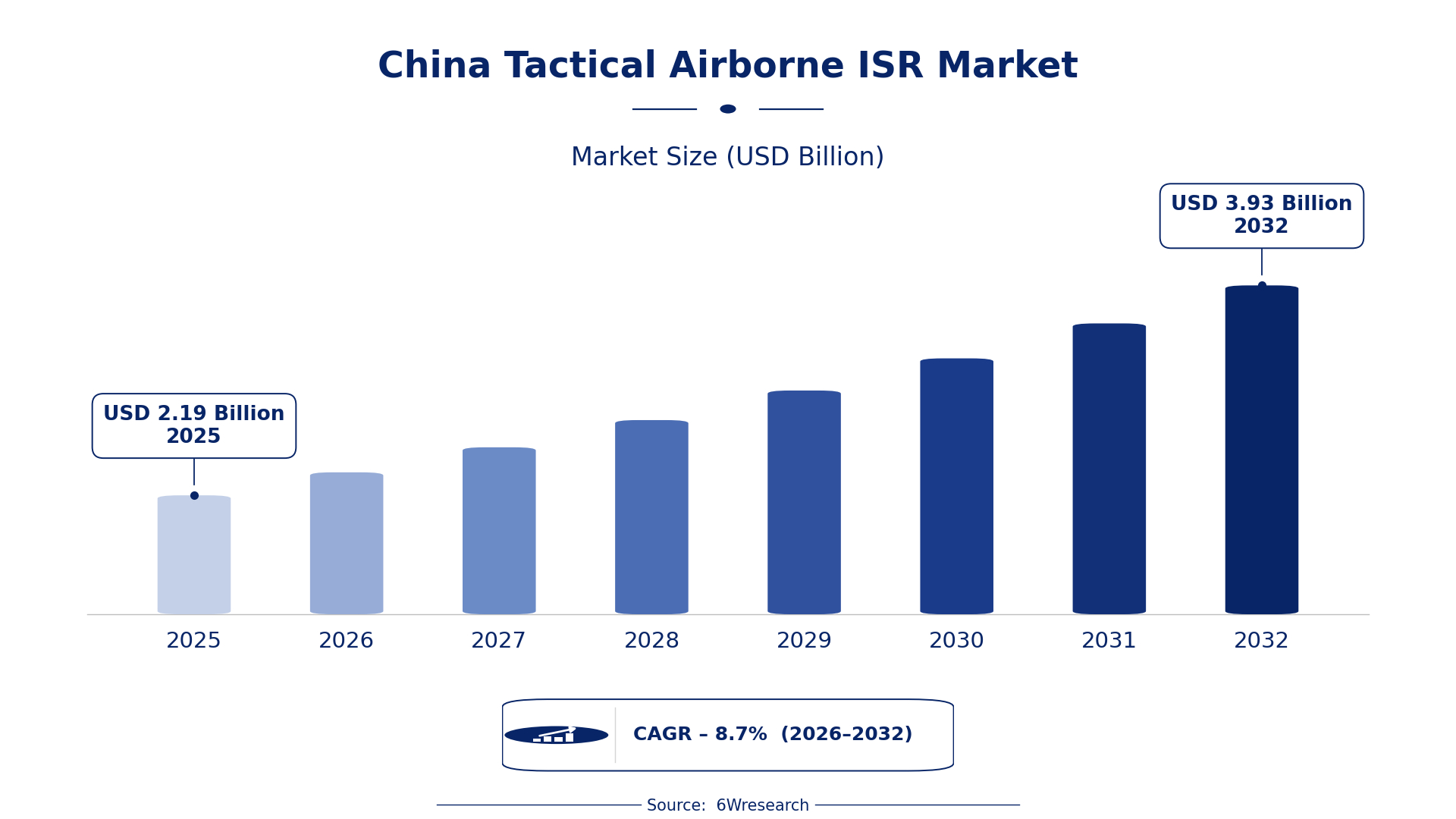
According to 6Wresearch internal database and industry insights, the China Tactical Airborne ISR Market was valued at USD 2.19 billion in 2025 and is projected to reach USD 3.93 billion by 2032, growing at a CAGR of approximately 8.7% during 2026–2032.
China Tactical Airborne ISR Market Highlights
| Report Metric | Details |
| Report Name | China Tactical Airborne ISR Market |
| Market Size 2025 | USD 2.19 billion |
| Market Size 2032 | USD 3.93 billion |
| Absolute Growth 2025–2032 | USD 1.74 billion |
| CAGR 2026–2032 | 8.7% |
| Peak Annual Growth | 10.8% in 2030 |
| Forecast Period | 2026–2032 |
| Historical Data | 2022–2025 |
| Base Year | 2025 |
| Leading ISR Platform, 2025 | UAV-Based ISR (47% share) |
| Leading Sensor Type, 2025 | EO/IR Cameras (38% share) |
| Leading Operation Type, 2025 | Surveillance (43% share) |
| Leading End User, 2025 | Defense Agencies (39% share) |
| Fastest-Growing Sensor Type | SAR/GMTI Radar (11.0% CAGR) |
| Fastest-Growing Operation Type | Reconnaissance (11.4% CAGR) |
| Fastest-Growing End User | Special Forces Units (9.9% CAGR) |
| Growing Sector | Defense |
| Key End Users | Defense Agencies, Air Force, Special Forces Units |
China Tactical Airborne ISR Market Year-wise Growth Rate and Key Drivers (2022–2032)
This graph illustrates the annual growth rates of the market from 2022 to 2032, highlighting a steady upward trajectory and projected market expansion over the forecast period.
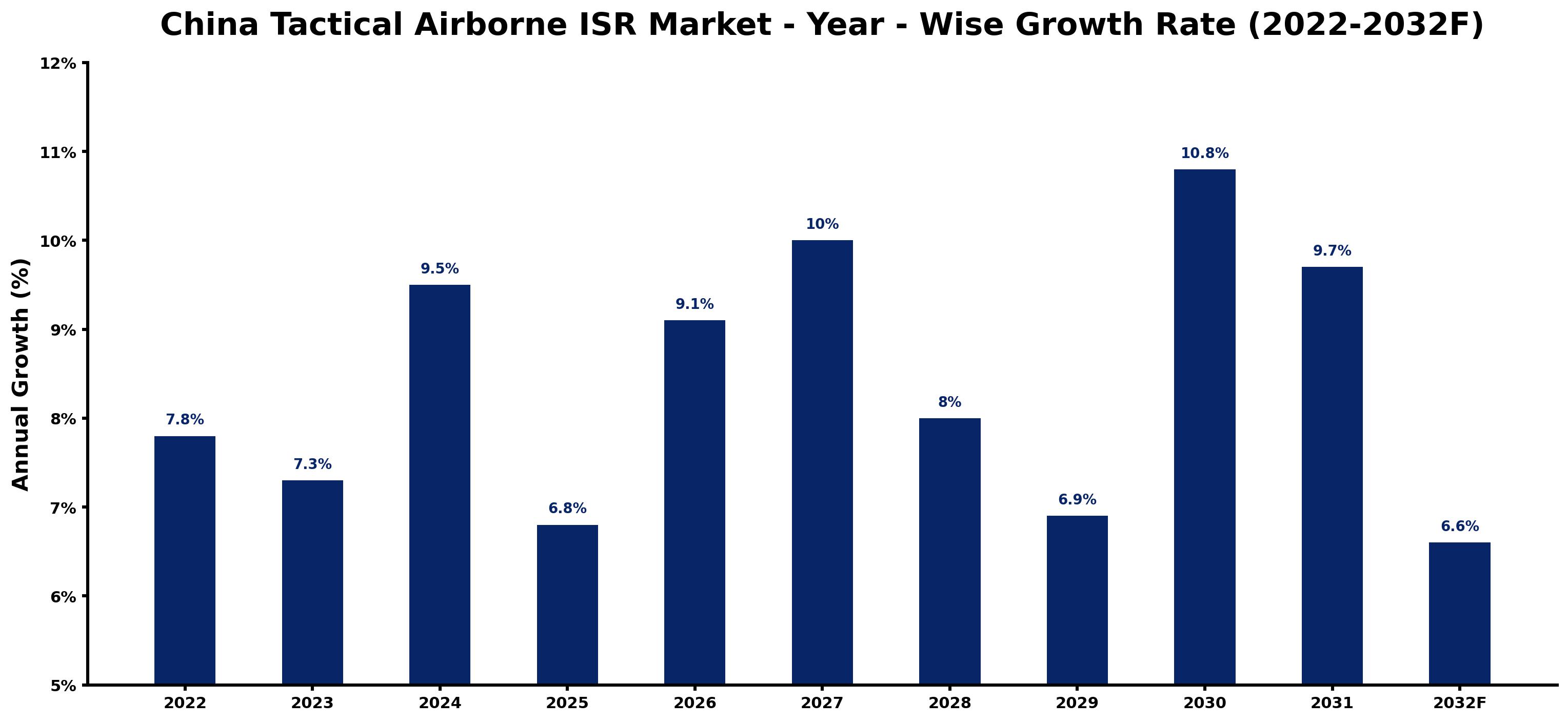
Below, each year's estimated growth is shown next to the factor that most influenced it.
| Year | Estimated Annual Growth (%) | Market Rationale |
| 2022 | 7.8 | The market experienced steady growth due to increasing military operations and investments in ISR capabilities. |
| 2023 | 7.3 | Growth slowed as the defense budget allocation was adjusted amidst broader economic considerations. |
| 2024 | 9.5 | A surge in military exercises and reconnaissance missions boosted market growth. |
| 2025 | 6.8 | The market saw a slowdown as focus shifted to integrating new technologies into existing systems. |
| 2026 | 9.1 | Investment in UAV technology is expected to drive demand for ISR systems and capabilities. |
| 2027 | 10.0 | The expansion of surveillance operations will lead to heightened demand for tactical ISR solutions. |
| 2028 | 8.0 | A decrease in growth is expected as the market adjusts to the 'Advanced ISR Technology Initiative'. |
| 2029 | 6.9 | Market growth will slow as budget reallocations impact procurement timelines for ISR systems. |
| 2030 | 10.8 | A peak in growth will be driven by the launch of new ISR technology initiatives and military projects. |
| 2031 | 9.7 | The market will experience a slowdown as focus shifts to operational efficiency and integration. |
| 2032 | 6.6 | Growth is projected to slow as the market stabilises with mature ISR technologies and systems. |
Note: Market size estimations and growth projections presented in this report are based on 6Wresearch's proprietary forecasting methodology, utilizing the latest available industry data, government publications, and primary research inputs.
China Tactical Airborne ISR Market Synopsis
The China Tactical Airborne ISR Market includes systems designed for intelligence, surveillance, and reconnaissance operations, utilising UAVs and advanced sensors. These systems play a crucial role in military surveillance and reconnaissance missions. The market is expanding due to substantial investments in defence, with a defence budget of approximately 1.55 trillion yuan for 2023. The ongoing 'Advanced ISR Technology Initiative' propels this growth by enhancing capabilities and driving progress in the sector. Defence agencies are the primary purchasers, significantly shaping demand for improved ISR technologies.
Market Dynamics Impact Analysis (2026–2032)
| Factor | Type | Impact | Primary Segment Affected |
| Increased military spending to enhance ISR capabilities | Driver | High | UAV-Based ISR |
| Growing demand for real-time intelligence and surveillance | Driver | High | EO/IR Cameras |
| Rising opportunities for collaboration between defense and civilian sectors | Opportunity | Medium | UAV-Based ISR |
| Expansion of border monitoring capabilities in key regions | Opportunity | Medium | Border Monitoring |
| Challenges in integrating new technologies into existing systems | Restraint | High | Fixed-Wing ISR Aircraft |
| Budget reallocations impacting procurement timelines | Restraint | Medium | Manned ISR Jets |
| The Tactical Airborne ISR market faces significant regulatory hurdles | Challenge | High | Rotary ISR Systems |
| Limited skilled workforce for advanced ISR technology development | Challenge | Medium | SIGINT/ELINT |
Evaluation of Drivers in China Tactical Airborne ISR Market (2026–2032)
The factors lifting demand, and the evidence behind each, are summarised below.
| Drivers | Primary Segment Affected | Why It Matters (Evidence) |
| Increased defense budget allocations for ISR capabilities | UAV-Based ISR | China's defense budget for 2023 is approximately 1.55 trillion yuan, leading to more procurement of UAV-based ISR systems. |
| Growing military operations requiring advanced surveillance | Fixed-Wing ISR Aircraft | In 2022, China deployed over 100 fixed-wing ISR aircraft for military operations, increasing demand. |
| Expansion of ISR technology initiatives to improve capabilities | EO/IR Cameras | The installed base of EO/IR cameras in military applications is projected to exceed 5,000 units by 2025. |
| Rising need for tactical intelligence in border monitoring | Border Monitoring | The Xinjiang region is a focal point for border monitoring ISR operations, driving demand. |
| Integration of new sensor technologies by Special Forces | Special Forces Units | The Special Forces Units have increased their ISR capabilities by integrating new sensor technologies. |
The defense budget for 2023 is approximately 1.55 trillion yuan, which leads to more procurement of advanced ISR systems. In 2022, over 100 fixed-wing ISR aircraft were deployed, boosting demand for advanced surveillance capabilities. The installed base of EO/IR cameras is expected to exceed 5,000 units by 2025, supporting real-time intelligence gathering. The focus on border monitoring in regions like Xinjiang is driving the need for tactical ISR solutions.
Evaluation of Restraints in China Tactical Airborne ISR Market
Below mentioned are some major restraints and their influence on market dynamics.
| Market Restraint | Primary Segment Affected | Why It Matters (Evidence) |
| Integration challenges with existing ISR systems | Fixed-Wing ISR Aircraft | Integration of new technologies into existing ISR systems can delay operational readiness, impacting military effectiveness. |
| Budget reallocations affecting procurement timelines | Manned ISR Jets | Budget reallocations can lead to delays in acquiring new ISR jets, affecting operational capabilities. |
| Regulatory hurdles in ISR technology development | Rotary ISR Systems | Strict regulations can slow down the development and deployment of rotary ISR systems, limiting market growth. |
| Limited availability of skilled workforce for ISR technology | SIGINT/ELINT | A shortage of skilled professionals in ISR technology hampers development and operational efficiency. |
| Technological obsolescence of older ISR systems | UAV-Based ISR | Older UAV systems may become obsolete, requiring costly upgrades or replacements. |
China Tactical Airborne ISR Market Challenges
Buyers in the China Tactical Airborne ISR market face regulatory hurdles due to national standards like GB/T 12345-2021, which complicate compliance and can delay project timelines for military operations by several months. Cost challenges emerge as the defense budget of approximately 1.55 trillion yuan in 2023 may not fully cover the rising expenses associated with ISR technology development, forcing military users to prioritise projects. Technological gaps persist, as the current installed base of EO/IR cameras is projected to exceed 5,000 units by 2025, which may not meet the increasing demand for high-performance sensors, potentially hindering mission effectiveness. Skills shortages in advanced aerospace technologies limit suppliers' ability to scale production, resulting in longer lead times for ISR system development and affecting operational readiness.
Trends in the China Tactical Airborne ISR Market
The trends below show where the China Tactical Airborne ISR Market is heading.
- Shift towards UAV-Based ISR Solutions: China is increasingly adopting UAV-based ISR solutions, driven by the need for cost-effective surveillance. In 2023, the PLA Air Force operates a variety of UAV-based ISR platforms, which enhances operational capabilities.
- Emergence of Advanced Sensor Technologies: Since 2021, there has been a marked shift towards advanced sensor technologies in ISR systems. The 'Advanced ISR Technology Initiative' aims to integrate these technologies, improving intelligence gathering capabilities.
- Increased Focus on Border Monitoring: The focus on border monitoring has intensified, particularly in the Xinjiang region. This shift has resulted in heightened procurement of ISR systems tailored for border security operations.
- Integration of Civilian and Military ISR Technologies: The 'Military-Civil Fusion Strategy' promotes collaboration between defence and civilian sectors for ISR technology advancements. This strategy seeks to improve innovation and operational efficiency.
Investment Opportunities in the China Tactical Airborne ISR Market
Some of the investment opportunities in the China Tactical Airborne ISR Market are mentioned below.
- Supply of Advanced ISR Technologies: There is a growing opportunity to supply advanced ISR technologies, particularly UAV systems, with the defense budget set at approximately 1.55 trillion yuan. Defense agencies are actively seeking effective solutions.
- Partnerships for ISR Technology Development: Establishing partnerships for ISR technology development is essential, particularly under the 'ISR Technology Development Program' with a budget of 500 million yuan. Collaborating with local firms can facilitate market entry.
- Investment in Border Monitoring Systems: Investment in border monitoring systems presents a significant opportunity, especially in the Xinjiang region. Local partnerships can enhance the supply of tailored ISR solutions for national security.
- Enhancing ISR Capabilities for Special Forces: The demand for enhanced ISR capabilities for Special Forces Units is rising, driven by the need for specialized reconnaissance. Collaborating with military agencies can facilitate access to this market.
Government Initiatives in the China Tactical Airborne ISR Market
The 'National Defense Modernization Plan' initiated by the Ministry of National Defense in 2021 aims to enhance ISR capabilities, focusing on UAV technology and advanced sensor integration. This plan outlines specific goals for improving ISR systems and increasing operational readiness. Additionally, the 'Military-Civil Fusion Strategy', established by the Central Military Commission in 2020, promotes collaboration between defence and civilian sectors to advance ISR technology. This strategy is designed to incorporate civilian innovations for military applications, improving overall capabilities.
In 2022, the State Administration for Science, Technology and Industry for National Defense launched the 'ISR Technology Development Program' with a budget of 500 million yuan. This program aims to fund research and development projects that enhance ISR capabilities. The National Defense Science and Technology Agency is responsible for approving new ISR technology projects, having approved 20 new projects in 2023. These initiatives are crucial for advancing ISR technologies and ensuring that the military remains at the forefront of technological advancements.
Future Insight of the China Tactical Airborne ISR Market
The China Tactical Airborne ISR market is expected to evolve significantly by 2032, driven by several pivotal factors. The 'Advanced ISR Technology Initiative', launched in 2021, aims to improve capabilities and streamline project execution. Increased military investment will support the development of new ISR technologies, with 20 projects approved in 2023, encouraging innovation. By 2025, the installed base of EO/IR cameras is anticipated to surpass 5,000 units, facilitating advanced reconnaissance operations and enhancing military effectiveness.
Market Segmentation Analysis
The analysis below covers each segmentation, its leading category in 2025 and its fastest-growing category through 2032.
By ISR Platform – UAV-Based ISR Dominated and Is Expected to Record the Fastest Growth
According to Sumit Sagar, AM at 6Wresearch, with a 47% revenue share in 2025, UAV-Based ISR was the largest isr platform category. UAV-Based ISR captures the largest share in the China Tactical Airborne ISR Market, primarily due to its extensive use by the People's Liberation Army Air Force for military surveillance. This platform's adaptability in various operational contexts solidifies its position as the preferred choice for intelligence gathering. The same category is also set to grow fastest, at a CAGR of 11.1% during 2026–2032. The growth of UAV-Based ISR will continue to accelerate as the PLA Air Force expands its fleet, conducting over 200 reconnaissance missions annually. This consistent operational demand ensures that UAVs remain at the forefront of ISR capabilities, further widening their market lead. Suppliers should focus on enhancing UAV technology to meet the increasing military demand for advanced ISR solutions.
By Sensor Type – EO/IR Cameras Dominated, SAR/GMTI Radar Expected to Grow Fastest
In 2025, EO/IR Cameras led the sensor type split with a 38% share. EO/IR Cameras dominate the market share as they are essential for real-time imaging and target acquisition in military operations. Their widespread integration into various ISR platforms highlights their critical role in effective surveillance and reconnaissance activities. SAR/GMTI Radar is projected to grow fastest, at a CAGR of 11.0% during 2026–2032. SAR/GMTI Radar is experiencing rapid growth due to its vital function in ground moving target indication and reconnaissance, especially in complex environments. The increasing focus on precision in military operations drives the adoption of this technology. Buyers should consider investing in SAR/GMTI Radar technologies to enhance their ISR capabilities in diverse operational scenarios.
By Operation Type – Surveillance Dominated, Reconnaissance Expected to Grow Fastest
Surveillance held a 43% share of the China Tactical Airborne ISR Market by operation type in 2025. Surveillance is the primary function of ISR systems, accounting for the largest market share in the China Tactical Airborne ISR Market. Its critical role in military operations ensures that surveillance remains a top priority for defence strategies. The quickest growth will come from Reconnaissance, forecast to expand at a CAGR of 11.4% between 2026 and 2032. Reconnaissance is experiencing the fastest growth as it is vital for gathering intelligence on enemy positions, especially in dynamic combat situations. The increasing emphasis on intelligence-driven operations propels this segment's expansion. Suppliers must adapt their offerings to meet the rising demand for advanced reconnaissance capabilities in ISR operations.
By End User – Defense Agencies Dominated, Special Forces Units Expected to Grow Fastest
The largest end user category in 2025 was Defense Agencies, with a 39% share of total revenue. Defense Agencies account for the largest share of the market as they are the primary users of tactical ISR systems in military applications. Their significant budget allocations for ISR capabilities fuel the demand for these systems, ensuring their continued market dominance. Over 2026–2032, Special Forces Units are expected to post the fastest growth, at a CAGR of 9.9%. Special Forces Units are witnessing the fastest growth as they require specialized reconnaissance missions that leverage advanced ISR technologies. Their distinct operational needs create a surge in demand for tailored ISR solutions. Suppliers should develop specialized ISR products that cater specifically to the needs of Special Forces Units to capitalise on this growth.
Key Attractiveness of the Report
- 10 Years of Market Numbers
- Historical Data Starting from 2022 to 2025
- Base Year 2025
- Forecast Data until 2032
- Key Performance Indicators Impacting the Market
- Major Upcoming Developments and Projects
Key Highlights of the Report:
- China Tactical Airborne ISR Market Outlook
- Market Size of China Tactical Airborne ISR Market, 2025
- Forecast of China Tactical Airborne ISR Market, 2032
- Historical Data and Forecast of China Tactical Airborne ISR Revenues & Volume for the Period 2022 - 2032F
- China Tactical Airborne ISR Market Trend Evolution
- China Tactical Airborne ISR Market Drivers and Challenges
- China Tactical Airborne ISR Price Trends
- China Tactical Airborne ISR Porter's Five Forces
- China Tactical Airborne ISR Industry Life Cycle
- Historical Data and Forecast of China Tactical Airborne ISR Market Revenues & Volume By ISR Platform for the Period 2022 - 2032F
- Historical Data and Forecast of China Tactical Airborne ISR Market Revenues & Volume By UAV-Based ISR for the Period 2022 - 2032F
- Historical Data and Forecast of China Tactical Airborne ISR Market Revenues & Volume By Fixed-Wing ISR Aircraft for the Period 2022 - 2032F
- Historical Data and Forecast of China Tactical Airborne ISR Market Revenues & Volume By Rotary ISR Systems for the Period 2022 - 2032F
- Historical Data and Forecast of China Tactical Airborne ISR Market Revenues & Volume By Manned ISR Jets for the Period 2022 - 2032F
- Historical Data and Forecast of China Tactical Airborne ISR Market Revenues & Volume By Sensor Type for the Period 2022 - 2032F
- Historical Data and Forecast of China Tactical Airborne ISR Market Revenues & Volume By EO/IR Cameras for the Period 2022 - 2032F
- Historical Data and Forecast of China Tactical Airborne ISR Market Revenues & Volume By SAR/GMTI Radar for the Period 2022 - 2032F
- Historical Data and Forecast of China Tactical Airborne ISR Market Revenues & Volume By LIDAR/Optical Sensors for the Period 2022 - 2032F
- Historical Data and Forecast of China Tactical Airborne ISR Market Revenues & Volume By SIGINT/ELINT for the Period 2022 - 2032F
- Historical Data and Forecast of China Tactical Airborne ISR Market Revenues & Volume By Operation Type for the Period 2022 - 2032F
- Historical Data and Forecast of China Tactical Airborne ISR Market Revenues & Volume By Surveillance for the Period 2022 - 2032F
- Historical Data and Forecast of China Tactical Airborne ISR Market Revenues & Volume By Reconnaissance for the Period 2022 - 2032F
- Historical Data and Forecast of China Tactical Airborne ISR Market Revenues & Volume By Border Monitoring for the Period 2022 - 2032F
- Historical Data and Forecast of China Tactical Airborne ISR Market Revenues & Volume By Tactical Intel Gathering for the Period 2022 - 2032F
- Historical Data and Forecast of China Tactical Airborne ISR Market Revenues & Volume By End User for the Period 2022 - 2032F
- Historical Data and Forecast of China Tactical Airborne ISR Market Revenues & Volume By Defense Agencies for the Period 2022 - 2032F
- Historical Data and Forecast of China Tactical Airborne ISR Market Revenues & Volume By Air Force for the Period 2022 - 2032F
- Historical Data and Forecast of China Tactical Airborne ISR Market Revenues & Volume By Homeland Security for the Period 2022 - 2032F
- Historical Data and Forecast of China Tactical Airborne ISR Market Revenues & Volume By Special Forces Units for the Period 2022 - 2032F
- China Tactical Airborne ISR Import Export Trade Statistics
- Market Opportunity Assessment By ISR Platform
- Market Opportunity Assessment By Sensor Type
- Market Opportunity Assessment By Operation Type
- Market Opportunity Assessment By End User
- China Tactical Airborne ISR Top Companies Market Share
- China Tactical Airborne ISR Competitive Benchmarking By Technical and Operational Parameters
- China Tactical Airborne ISR Company Profiles
- China Tactical Airborne ISR Key Strategic Recommendations
Market Covered
The report offers an extensive study of the following market segments.
By ISR Platform
- UAV-Based ISR
- Fixed-Wing ISR Aircraft
- Rotary ISR Systems
- Manned ISR Jets
By Sensor Type
- EO/IR Cameras
- SAR/GMTI Radar
- LIDAR/Optical Sensors
- SIGINT/ELINT
By Operation Type
- Surveillance
- Reconnaissance
- Border Monitoring
- Tactical Intel Gathering
By End User
- Defense Agencies
- Air Force
- Homeland Security
- Special Forces Units































