China Target Identification AI Market Size & Growth Rate
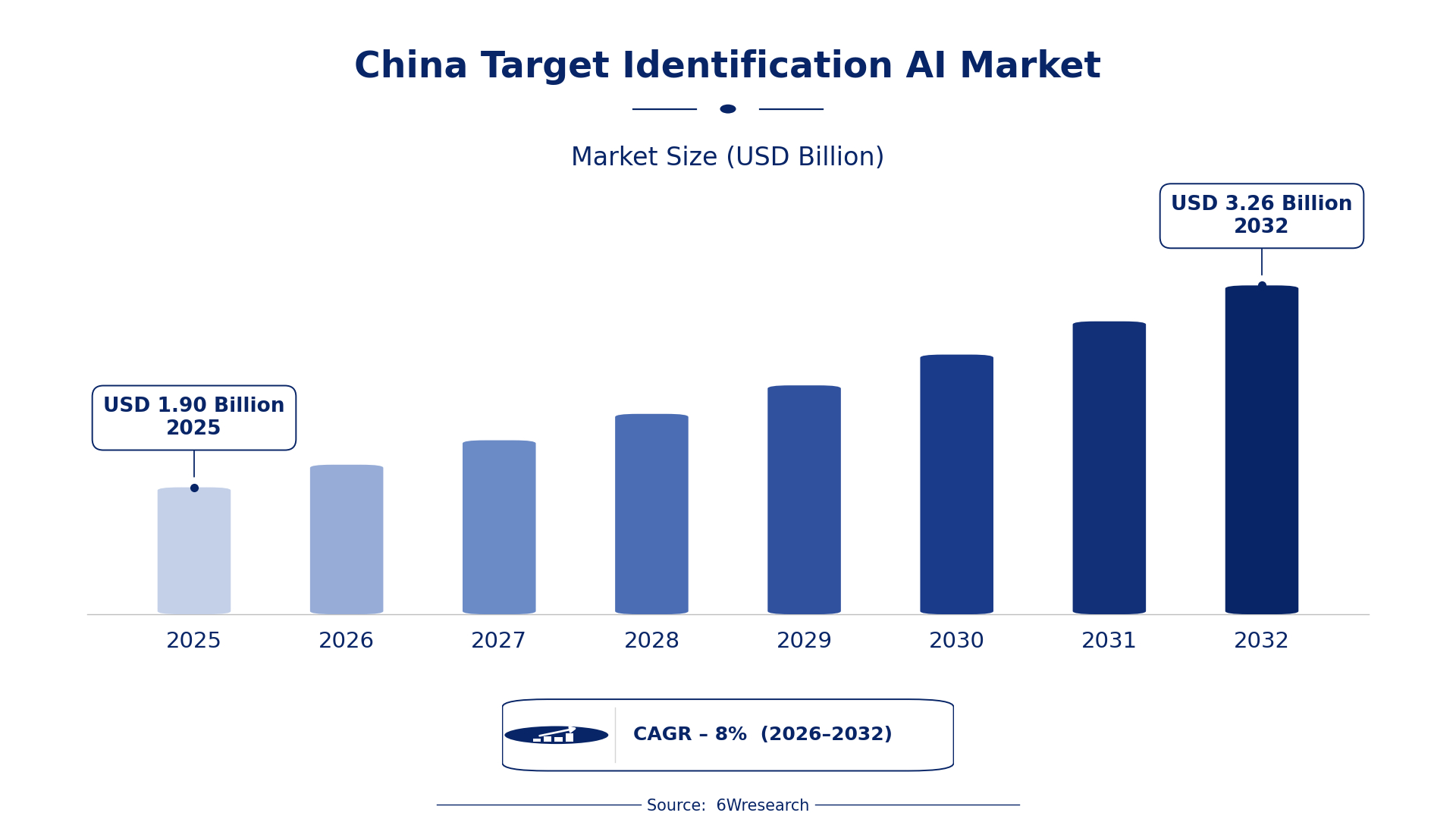
According to 6Wresearch internal database and industry insights, the China Target Identification AI Market was valued at USD 1.90 billion in 2025 and is projected to reach USD 3.26 billion by 2032, growing at a CAGR of approximately 8% during 2026–2032.
China Target Identification AI Market Highlights
| Report Metric | Details |
| Report Name | China Target Identification AI Market |
| Market Size 2025 | USD 1.90 billion |
| Market Size 2032 | USD 3.26 billion |
| Absolute Growth 2025–2032 | USD 1.36 billion |
| CAGR 2026–2032 | 8% |
| Peak Annual Growth | 10.5% in 2028 |
| Forecast Period | 2026–2032 |
| Historical Data | 2022–2025 |
| Base Year | 2025 |
| Leading Target Identification AI, 2025 | Drone Targeting AI (45% share) |
| Leading Product Type, 2025 | Surveillance AI (47% share) |
| Leading AI Model Type, 2025 | Deep Learning (47% share) |
| Leading Distribution Channel, 2025 | Government Agencies (40% share) |
| Leading End User Industry, 2025 | UAV Operations (52% share) |
| Fastest-Growing Target Identification AI | Facial Recognition Systems (9.2% CAGR) |
| Fastest-Growing AI Model Type | Real-time Vision (9.7% CAGR) |
| Fastest-Growing Distribution Channel | Defense Programs (10.5% CAGR) |
| Fastest-Growing End User Industry | Border Patrol (10.4% CAGR) |
| Growing Sector | Border Patrol |
| Key End Users | UAV Operations, Border Patrol, Strategic Command, Armored Vehicles |
China Target Identification AI Market Year-wise Growth Rate and Key Drivers (2022–2032)
This graph illustrates the annual growth rates of the market from 2022 to 2032, highlighting a steady upward trajectory and projected market expansion over the forecast period.
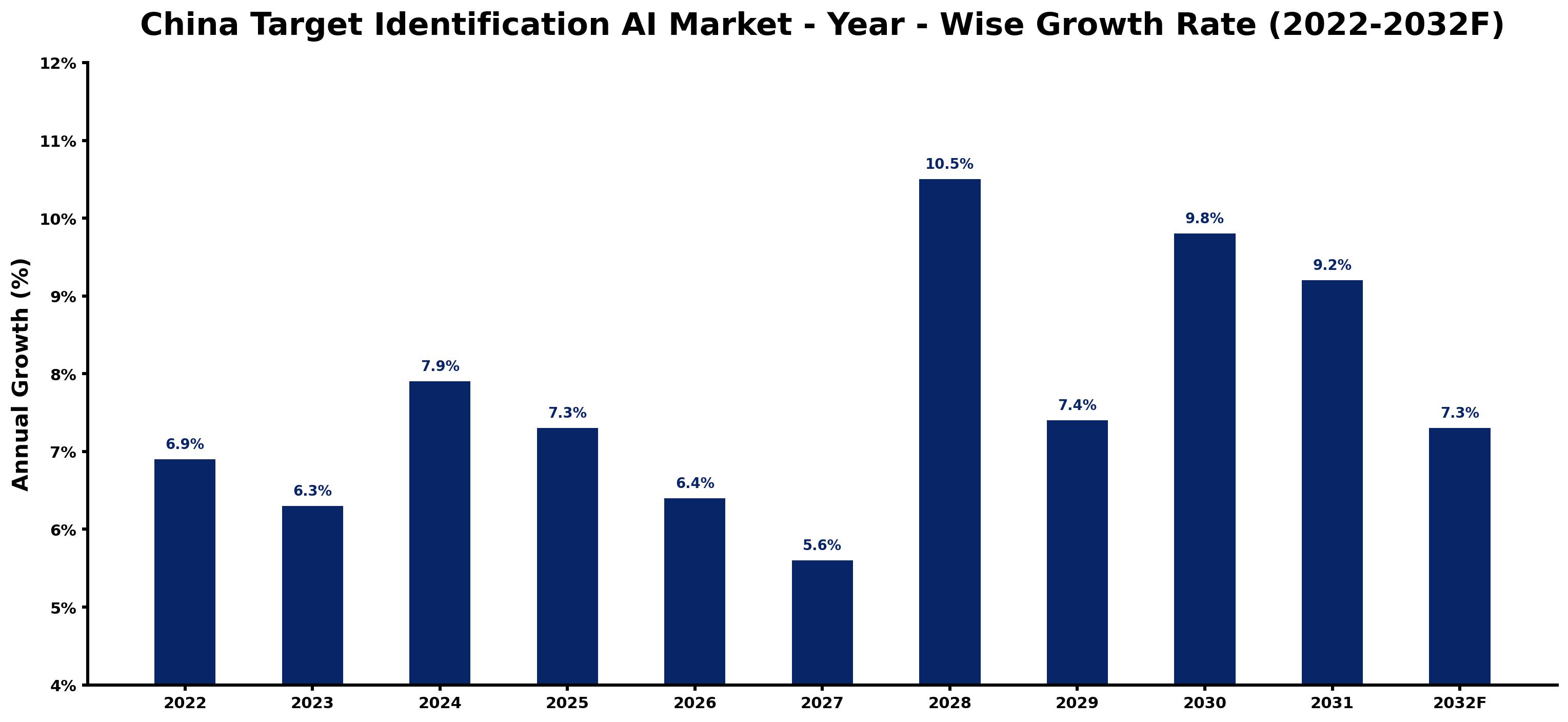
Annual growth estimates for each year appear below with the principal reason behind them, explaining the shifts that set the pace of the market.
| Year | Estimated Annual Growth (%) | Market Rationale |
| 2022 | 6.9 | Demand for military applications of AI technologies was driven by national security needs. |
| 2023 | 6.3 | Growth slowed due to increased scrutiny on AI deployment in sensitive areas. |
| 2024 | 7.9 | Surge in military budget allocations for AI technologies boosted market performance. |
| 2025 | 7.3 | Demand for surveillance technologies remained strong, maintaining market growth. |
| 2026 | 6.4 | Investment in AI for border security projects is expected to contribute to market momentum. |
| 2027 | 5.6 | Focus on integrating AI in military operations will continue to support growth. |
| 2028 | 10.5 | Rapid advancements in drone targeting capabilities from the 'AI for Defense' initiative are projected to spur market expansion. |
| 2029 | 7.4 | Market growth is expected to slow as regulatory frameworks begin to tighten. |
| 2030 | 9.8 | Increased funding for AI military research under the 'National AI Development Plan' will lead to a resurgence in demand. |
| 2031 | 9.2 | Adoption of AI in strategic command operations is projected to contribute to steady growth. |
| 2032 | 7.3 | Market growth will slow as the focus shifts towards regulatory compliance. |
Note: Market size estimations and growth projections presented in this report are based on 6Wresearch's proprietary forecasting methodology, utilizing the latest available industry data, government publications, and primary research inputs.
China Target Identification AI Market Synopsis
Target Identification AI in China encompasses advanced systems that utilise artificial intelligence for identifying and tracking targets, primarily in military surveillance and border security. These systems employ machine learning algorithms and data from sensors and cameras. The China Target Identification AI Market is experiencing growth driven by substantial military investments and government initiatives. In 2023, the military budget for AI technologies reached 200 billion CNY, reflecting the increasing demand for advanced surveillance systems. The 'AI for Defense' initiative, launched in 2021, further supports military capabilities through AI integration.
Market Dynamics Impact Analysis (2026–2032)
| Factor | Type | Impact | Primary Segment Affected |
| Increased military investment in AI technologies | Driver | High | Drone Targeting AI |
| Growing demand for surveillance systems in urban areas | Driver | High | Surveillance AI |
| Integration of AI in border security initiatives | Opportunity | High | Facial Recognition Systems |
| Expansion of UAV operations in military applications | Opportunity | High | UAV Operations |
| Regulatory scrutiny on AI deployment in military applications | Restraint | Medium | Drone Targeting AI |
| High development costs for advanced AI systems | Restraint | Medium | Surveillance AI |
| Challenges in securing data privacy for AI systems | Challenge | High | Facial Recognition Systems |
| Dependence on government funding for AI research | Challenge | Medium | Drone Targeting AI |
Evaluation of Drivers in China Target Identification AI Market (2026–2032)
Key forces behind demand, with the segment each one moves most, are listed below.
| Drivers | Primary Segment Affected | Why It Matters (Evidence) |
| Increased military budget allocations for AI technologies | Drone Targeting AI | China's military budget for AI technologies reached 200 billion CNY in 2023, driving demand for advanced targeting systems. |
| Deployment of AI in urban surveillance projects | Surveillance AI | Facial recognition technology is now operational in over 300 cities, leading to higher demand for surveillance systems. |
| Focus on improving border security through AI | Facial Recognition Systems | The 'Smart Border' program aims to integrate AI technologies for improved monitoring by 2025. |
| Expansion of UAV operations in military | UAV Operations | China has over 1,000 operational drones equipped with targeting AI systems, increasing demand for these technologies. |
| Integration of AI in military decision-making | Strategic Command | The increasing use of AI technologies for operational strategy in command centers boosts demand for AI systems. |
Market growth for Target Identification AI in China is underpinned by increased military investment, urban surveillance expansion, and improved border security projects. The military budget for AI technologies reached 200 billion CNY in 2023, which has boosted demand for advanced targeting solutions. Facial recognition technology is deployed in over 300 cities, resulting in a surge in demand for surveillance systems. The focus on integrating AI in military operations continues to drive market growth, with more than 1,000 operational drones equipped with targeting AI systems enhancing military capabilities. Command centers are increasingly utilising AI for real-time decision-making, further driving the need for these technologies.
Evaluation of Restraints in China Target Identification AI Market
Below mentioned are some major restraints and their influence on market dynamics.
| Market Restraint | Primary Segment Affected | Why It Matters (Evidence) |
| Regulatory scrutiny on AI deployment | Drone Targeting AI | Increased regulations on AI use in military applications create barriers for deployment and development. |
| High costs associated with AI technology development | Surveillance AI | The expenses for developing advanced AI systems can limit investment and slow market growth. |
| Data privacy concerns regarding AI systems | Facial Recognition Systems | Challenges in securing data privacy can hinder the adoption of facial recognition technologies. |
| Dependence on government funding for AI initiatives | Drone Targeting AI | A leading supplier on government funding for AI research can create uncertainty in market stability. |
| Slow integration of AI in existing military frameworks | UAV Operations | The complexity of integrating AI into established military systems can delay deployment. |
China Target Identification AI Market Challenges
Regulatory hurdles impact the China Target Identification AI market, as compliance with data security standards like ISO/IEC 27001 can delay project approvals by up to six months for suppliers. Supply chain constraints arise from the reliance on deep learning models, with over 70% of military applications depending on a limited number of components, causing production delays for manufacturers. Increased competition forces smaller producers to invest heavily in R&D to keep pace with domestic firms, draining financial resources and limiting market reach. Cost pressures stem from the 200 billion CNY military budget for AI technologies in 2023, compelling buyers to navigate rising prices while maintaining quality in their systems.
Trends in the China Target Identification AI Market
Below mentioned are some of the trends shaping the China Target Identification AI Market growth.
- Shift towards AI-Enabled Surveillance: China's 'Smart City' initiative, launched in 2021, integrates AI surveillance systems into urban planning, with over 300 cities adopting these technologies. This trend reflects a growing reliance on AI for public safety and monitoring.
- Transition to Advanced Drone Technologies: In 2023, the deployment of drone targeting AI in military operations increased, with over 1,000 operational drones now equipped with these systems. This shift improves operational efficiency and effectiveness in military missions.
- Emergence of Real-Time Decision-Making AI: The integration of AI in strategic command centres is transforming military operations, with real-time decision-making capabilities becoming standard. This change is apparent in the rising use of AI technologies for operational strategy.
- Prioritisation of AI in National Security: The 'AI Military Strategy' updated in 2022 prioritises AI integration in defence operations, with a budget of 100 billion CNY allocated for implementation. This focus highlights the importance of AI in strengthening national security.
Investment Opportunities in the China Target Identification AI Market
Investors looking at the China Target Identification AI Market should consider the following areas.
- Supply of Advanced Surveillance Systems: With the military budget for AI technologies reaching 200 billion CNY in 2023, there is a growing need for advanced surveillance systems. Government agencies are actively seeking suppliers to support national security.
- Investment in Drone Targeting AI: The demand for drone targeting AI is projected to rise significantly, with over 1,000 operational drones expected by 2025. Collaborating with military integrators can facilitate entry into this market.
- Development of AI for Border Security: The 'Smart Border' program aims to integrate AI technologies for improved monitoring by 2025, creating opportunities for suppliers of border security solutions. Engaging with government agencies will be essential for market entry.
- Enhancement of Strategic Command AI Systems: As strategic command centers increasingly adopt AI for real-time decision-making, there is a need for advanced AI systems. Partnerships with defense programs can provide access to this growing market.
Government Initiatives in the China Target Identification AI Market
The 'National AI Development Plan', updated in 2021, emphasises military applications of AI technologies and allocates 50 billion CNY for research and development. This plan aims to improve the capabilities of military applications through advanced AI systems. The 'Military-Civil Fusion' strategy, approved in 2022, promotes collaboration between civilian technology and military applications, further supporting the integration of AI in defence operations. This strategy is crucial for ensuring national security and technological advancement.
The 'AI for Defense' initiative, launched in 2023, focuses on enhancing military capabilities through AI integration, particularly in surveillance and reconnaissance technologies. The National Defense Science and Technology Agency oversees AI research in military applications, ensuring that projects align with national security goals and technological advancements. Their funding and approval processes are key for the successful implementation of AI technologies in defence.
Future Insight of the China Target Identification AI Market
The China Target Identification AI market is set to evolve significantly by 2032, driven by initiatives like the 'Smart Border' program and the 'National Defense Technology Innovation Plan' which will improve AI capabilities in security applications. By 2025, AI integration in urban surveillance systems will expand beyond 300 cities, enhancing overall security. The 'AI for Defense' initiative will advance military technology, promoting collaboration between civilian and military sectors. Strengthened data security standards will build trust in AI applications, benefiting both buyers and suppliers.
Market Segmentation Analysis
Each segment group is reviewed below, with the leader by share and the fastest grower by CAGR.
By Target Identification AI – Drone Targeting AI Dominated, Facial Recognition Systems Expected to Grow Fastest
According to Sumit Sagar, AM at 6Wresearch, the largest target identification ai category in 2025 was Drone Targeting AI, with a 45% share of total revenue. Drone Targeting systems command the largest share due to their critical role in modern military operations, bolstered by a military budget for AI technologies that reached 200 billion CNY in 2023. The extensive deployment of over 1,000 operational drones equipped with these systems further solidifies their market position. Facial Recognition Systems are set to record the highest CAGR in this split, 9.2% over 2026–2032. Facial Recognition Systems are experiencing rapid growth, driven by their implementation in over 300 cities for security applications. The rising demand for sophisticated surveillance solutions in urban areas is propelling this segment's swift expansion. Suppliers should focus on enhancing facial recognition technology to capture the growing market share.
By Product Type – Surveillance AI Dominated and Is Expected to Record the Fastest Growth
In 2025, Surveillance AI led the product type split with a 47% share. Surveillance systems lead the market share as they are vital for monitoring and security, particularly within military and civilian applications. Their integration into initiatives like the 'Smart City' programme reinforces their dominant position in the market. Surveillance AI is also forecast to expand faster than any other category, at a CAGR of 9.7% over 2026–2032. Surveillance systems also exhibit the fastest growth, attributed to their diverse applications across sectors such as urban planning and national security. Continuous government initiatives aimed at improving these capabilities further stimulate this rapid growth. Buyers should consider investing in cutting-edge surveillance technologies to ensure comprehensive security solutions.
By AI Model Type – Deep Learning Dominated, Real-time Vision Expected to Grow Fastest
Deep Learning accounted for a 47% market share by ai model type in 2025. Deep Learning leads the market share as it underpins various AI functions, providing essential support for numerous applications in the Target Identification AI market. Its widespread use in military AI applications, particularly in over 70% of cases, solidifies its dominant position. Over 2026–2032, Real-time Vision is expected to post the fastest growth, at a CAGR of 9.7%. Real-time Vision is the fastest-growing segment, driven by the necessity for immediate target identification in critical operations. The increasing reliance on real-time data for decision-making in strategic command centers fuels this growth. Suppliers must prioritise advancements in real-time vision technologies to meet the urgent demands of the market.
By Distribution Channel – Government Agencies Dominated, Defense Programs Expected to Grow Fastest
Government Agencies took a 40% share of distribution channel in 2025, more than any other category. Government Agencies command the largest share as the primary users of Target Identification AI technology for national security purposes. Their substantial budgets and initiatives, such as the 'AI for Defense' initiative, ensure consistent demand for these systems. The quickest growth will come from Defense Programs, forecast to expand at a CAGR of 10.5% between 2026 and 2032. Defense Programs represent the fastest-growing channel, propelled by government initiatives that drive AI integration into military operations. The allocation of funds, such as the 10 billion CNY from the 'Defense Innovation Fund' for AI research, supports this rapid growth. Suppliers should align their strategies with government initiatives to maximise opportunities in this channel.
By End User Industry – UAV Operations Dominated, Border Patrol Expected to Grow Fastest
With a 52% revenue share in 2025, UAV Operations was the largest end user industry category. UAV Operations hold the largest share due to their significant dependence on advanced systems for operational efficiency in military contexts. The integration of Target Identification technologies in UAVs enhances their effectiveness, making them essential in modern warfare. Border Patrol is set to record the highest CAGR in this split, 10.4% over 2026–2032. Border Patrol is the fastest-growing end user industry, utilising advanced systems for monitoring and enforcement in complex security scenarios. The expansion of surveillance initiatives into rural areas is accelerating this segment's growth. Buyers in the border patrol sector should invest in advanced systems to enhance their operational capabilities.
Key Attractiveness of the Report
- 10 Years of Market Numbers
- Historical Data Starting from 2022 to 2025
- Base Year 2025
- Forecast Data until 2032
- Key Performance Indicators Impacting the Market
- Major Upcoming Developments and Projects
Key Highlights of the Report:
- China Target Identification AI Market Outlook
- Market Size of China Target Identification AI Market, 2025
- Forecast of China Target Identification AI Market, 2032
- Historical Data and Forecast of China Target Identification AI Revenues & Volume for the Period 2022 - 2032F
- China Target Identification AI Market Trend Evolution
- China Target Identification AI Market Drivers and Challenges
- China Target Identification AI Price Trends
- China Target Identification AI Porter's Five Forces
- China Target Identification AI Industry Life Cycle
- Historical Data and Forecast of China Target Identification AI Market Revenues & Volume By Target Identification AI for the Period 2022 - 2032F
- Historical Data and Forecast of China Target Identification AI Market Revenues & Volume By Facial Recognition Systems for the Period 2022 - 2032F
- Historical Data and Forecast of China Target Identification AI Market Revenues & Volume By Drone Targeting AI for the Period 2022 - 2032F
- Historical Data and Forecast of China Target Identification AI Market Revenues & Volume By Autonomous Vehicle AI for the Period 2022 - 2032F
- Historical Data and Forecast of China Target Identification AI Market Revenues & Volume By Satellite Imaging AI for the Period 2022 - 2032F
- Historical Data and Forecast of China Target Identification AI Market Revenues & Volume By Product Type for the Period 2022 - 2032F
- Historical Data and Forecast of China Target Identification AI Market Revenues & Volume By Surveillance AI for the Period 2022 - 2032F
- Historical Data and Forecast of China Target Identification AI Market Revenues & Volume By Aerial Imaging AI for the Period 2022 - 2032F
- Historical Data and Forecast of China Target Identification AI Market Revenues & Volume By Battlefield AI for the Period 2022 - 2032F
- Historical Data and Forecast of China Target Identification AI Market Revenues & Volume By ISR Systems for the Period 2022 - 2032F
- Historical Data and Forecast of China Target Identification AI Market Revenues & Volume By AI Model Type for the Period 2022 - 2032F
- Historical Data and Forecast of China Target Identification AI Market Revenues & Volume By CNNs/ML Models for the Period 2022 - 2032F
- Historical Data and Forecast of China Target Identification AI Market Revenues & Volume By Real-time Vision for the Period 2022 - 2032F
- Historical Data and Forecast of China Target Identification AI Market Revenues & Volume By Deep Learning for the Period 2022 - 2032F
- Historical Data and Forecast of China Target Identification AI Market Revenues & Volume By Pattern Recognition for the Period 2022 - 2032F
- Historical Data and Forecast of China Target Identification AI Market Revenues & Volume By Distribution Channel for the Period 2022 - 2032F
- Historical Data and Forecast of China Target Identification AI Market Revenues & Volume By Military Integrators for the Period 2022 - 2032F
- Historical Data and Forecast of China Target Identification AI Market Revenues & Volume By OEM Partnerships for the Period 2022 - 2032F
- Historical Data and Forecast of China Target Identification AI Market Revenues & Volume By Defense Programs for the Period 2022 - 2032F
- Historical Data and Forecast of China Target Identification AI Market Revenues & Volume By Government Agencies for the Period 2022 - 2032F
- Historical Data and Forecast of China Target Identification AI Market Revenues & Volume By End User Industry for the Period 2022 - 2032F
- Historical Data and Forecast of China Target Identification AI Market Revenues & Volume By Border Patrol for the Period 2022 - 2032F
- Historical Data and Forecast of China Target Identification AI Market Revenues & Volume By UAV Operations for the Period 2022 - 2032F
- Historical Data and Forecast of China Target Identification AI Market Revenues & Volume By Armored Vehicles for the Period 2022 - 2032F
- Historical Data and Forecast of China Target Identification AI Market Revenues & Volume By Strategic Command for the Period 2022 - 2032F
- China Target Identification AI Import Export Trade Statistics
- Market Opportunity Assessment By Target Identification AI
- Market Opportunity Assessment By Product Type
- Market Opportunity Assessment By AI Model Type
- Market Opportunity Assessment By Distribution Channel
- Market Opportunity Assessment By End User Industry
- China Target Identification AI Top Companies Market Share
- China Target Identification AI Competitive Benchmarking By Technical and Operational Parameters
- China Target Identification AI Company Profiles
- China Target Identification AI Key Strategic Recommendations
Market Covered
Segments analysed in this report are listed below.
By Target Identification AI
- Facial Recognition Systems
- Drone Targeting AI
- Autonomous Vehicle AI
- Satellite Imaging AI
By Product Type
- Surveillance AI
- Aerial Imaging AI
- Battlefield AI
- ISR Systems
By AI Model Type
- CNNs/ML Models
- Real-time Vision
- Deep Learning
- Pattern Recognition
By Distribution Channel
- Military Integrators
- OEM Partnerships
- Defense Programs
- Government Agencies
By End User Industry
- Border Patrol
- UAV Operations
- Armored Vehicles
- Strategic Command































