China Task Automation AI Market Size & Growth Rate
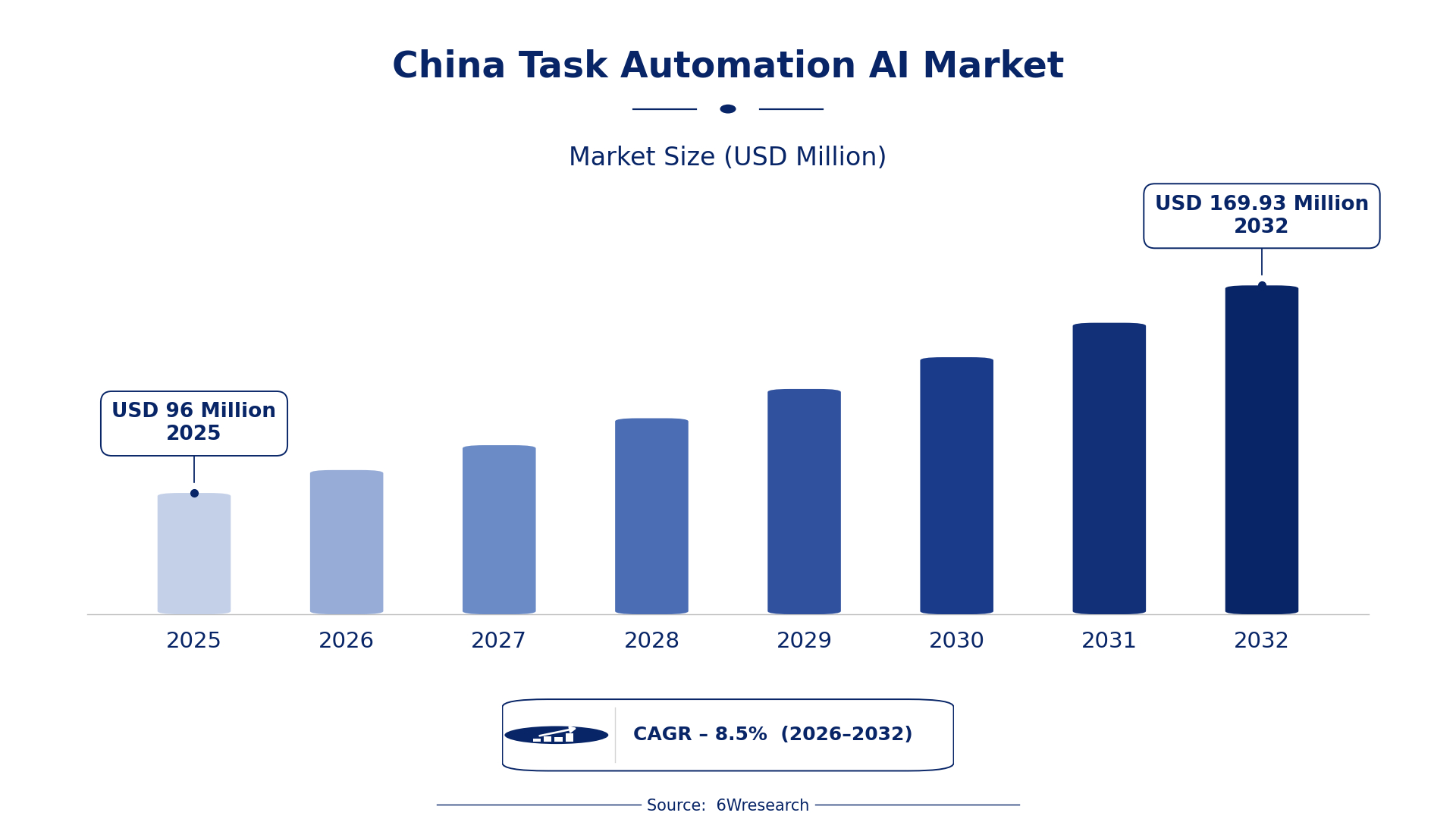
According to 6Wresearch internal database and industry insights, the China Task Automation AI Market was valued at USD 96.0 million in 2025 and is projected to reach USD 169.93 million by 2032, growing at a CAGR of approximately 8.5% during 2026–2032.
China Task Automation AI Market Highlights
| Report Metric | Details |
| Report Name | China Task Automation AI Market |
| Market Size 2025 | USD 96.0 million |
| Market Size 2032 | USD 169.93 million |
| Absolute Growth 2025–2032 | USD 73.93 million |
| CAGR 2026–2032 | 8.5% |
| Peak Annual Growth | 11.0% in 2030 |
| Forecast Period | 2026–2032 |
| Historical Data | 2022–2025 |
| Base Year | 2025 |
| Leading Automation Type, 2025 | Robotic Process Automation (40% share) |
| Leading AI Technology Used, 2025 | ML + Rule-Based Engines (41% share) |
| Leading Use Case, 2025 | Invoice Processing (40% share) |
| Leading End User, 2025 | Enterprises (46% share) |
| Fastest-Growing Automation Type | Workflow Automation (10.1% CAGR) |
| Fastest-Growing AI Technology Used | NLP & Decision Trees (11.1% CAGR) |
| Fastest-Growing Use Case | Customer Service (9.6% CAGR) |
| Fastest-Growing End User | SaaS Platforms (9.7% CAGR) |
| Growing Sector | SaaS Platforms |
| Key End Users | Enterprises, Finance Departments, SaaS Platforms, Tech Support Teams |
China Task Automation AI Market Year-wise Growth Rate and Key Drivers (2022–2032)
This graph illustrates the annual growth rates of the market from 2022 to 2032, highlighting a steady upward trajectory and projected market expansion over the forecast period.
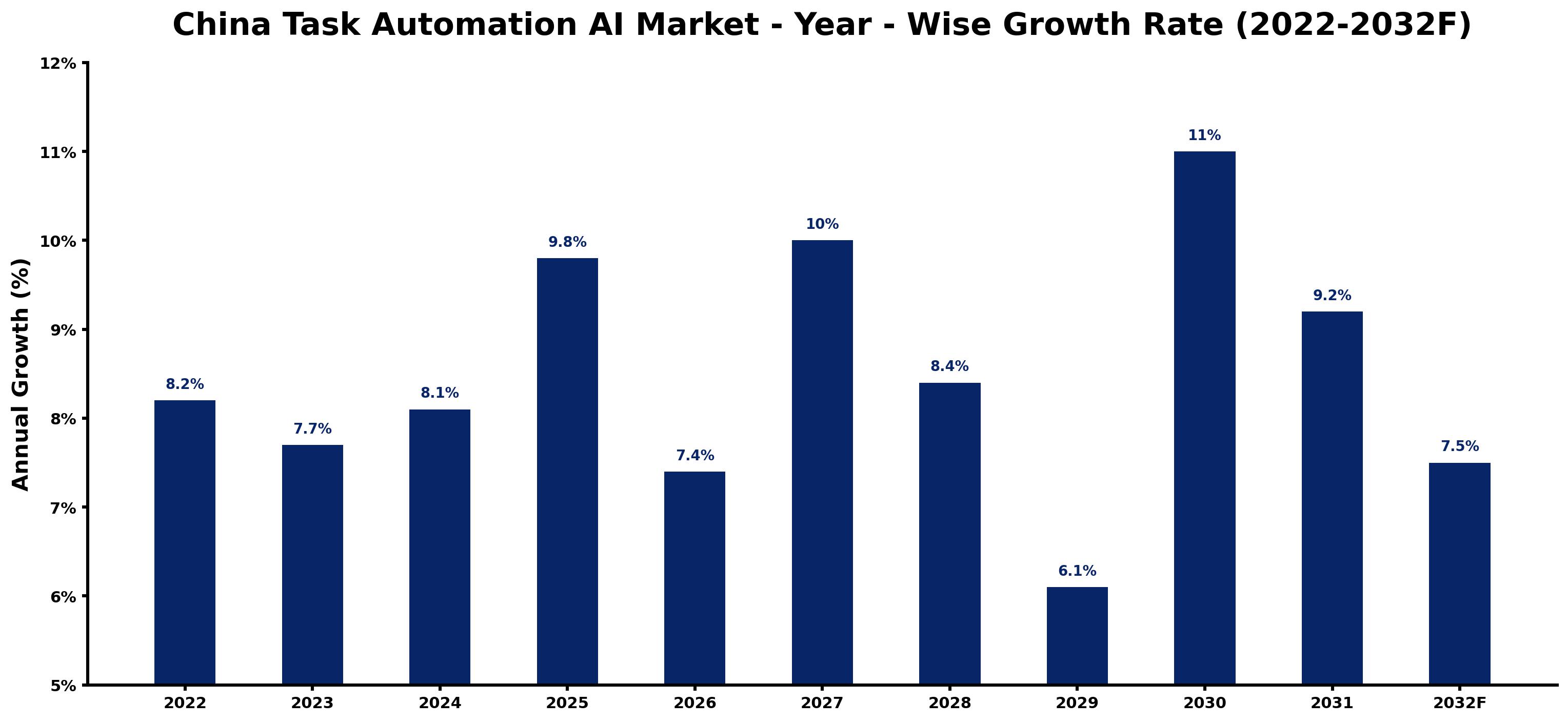
Each row of the following table gives one year's estimated growth and the event or demand shift that explains it.
| Year | Estimated Annual Growth (%) | Market Rationale |
| 2022 | 8.2 | The number of enterprises using task automation reached 50 million, reflecting strong adoption. |
| 2023 | 7.7 | Growth slowed as enterprises adjusted to the integration of automation technologies in their operations. |
| 2024 | 8.1 | Increased demand for operational efficiency led to a rise in task automation implementations. |
| 2025 | 9.8 | The market peaked with a focus on automating finance and healthcare processes. |
| 2026 | 7.4 | Adoption slowed as enterprises faced challenges in scaling automation across all departments. |
| 2027 | 10.0 | Growth picked up as companies enhanced their automation strategies and investments. |
| 2028 | 8.4 | Market growth decelerated as enterprises consolidated their automation solutions. |
| 2029 | 6.1 | The slowdown continued as companies reassessed their automation investments amid economic uncertainty. |
| 2030 | 11.0 | A surge in demand for automation technologies drove market growth to its peak. |
| 2031 | 9.2 | Growth moderated as enterprises focused on optimising existing automation solutions. |
| 2032 | 7.5 | The market continued to grow, driven by ongoing digital transformation initiatives. |
Note: Market size estimations and growth projections presented in this report are based on 6Wresearch's proprietary forecasting methodology, utilizing the latest available industry data, government publications, and primary research inputs.
China Task Automation AI Market Synopsis
Task Automation AI in China encompasses technologies that automate repetitive tasks using artificial intelligence. This includes machine learning algorithms and natural language processing techniques, which improve operational efficiency and customer interactions. The China Task Automation AI Market is expanding due to a surge in digital transformation efforts across various sectors, particularly in finance and healthcare. In 2023, over 70% of large enterprises adopted task automation. Initiatives like the 'Digital China' programme are further driving investments in AI capabilities.
Market Dynamics Impact Analysis (2026–2032)
| Factor | Type | Impact | Primary Segment Affected |
| Growing enterprise adoption of automation technologies to enhance productivity. | Driver | High | Enterprises |
| Increased investment in AI research and development initiatives. | Driver | High | Finance Departments |
| The rise of AI integration in manufacturing processes presents significant opportunities. | Opportunity | High | Robotic Process Automation |
| The demand for automation in customer service is increasing, creating new market prospects. | Opportunity | High | Customer Service |
| Challenges in scaling automation across various departments can hinder growth. | Restraint | Medium | Workflow Automation |
| Limited understanding of AI technologies among smaller enterprises restricts market expansion. | Restraint | Medium | Robotic Process Automation |
| The Task Automation AI market in China faces integration challenges due to diverse enterprise needs. | Challenge | High | IT Task Bots |
| Competition from international AI firms may affect local market share. | Challenge | Medium | Virtual Assistants |
Evaluation of Drivers in China Task Automation AI Market (2026–2032)
The factors lifting demand, and the evidence behind each, are summarised below.
| Drivers | Primary Segment Affected | Why It Matters (Evidence) |
| Increased enterprise investment in automation technologies. | Enterprises | Over 70% of large enterprises have implemented task automation, driving demand for solutions. |
| Growing focus on operational efficiency in finance departments. | Finance Departments | The installed base of AI systems in finance departments reached 30 million units in 2023. |
| Rising demand for automation in customer service processes. | Customer Service | The need for improved customer interactions is pushing enterprises to adopt automation solutions. |
| Expansion of AI capabilities in manufacturing sectors. | Robotic Process Automation | The 'Smart Manufacturing' strategy promotes automation technologies to improve production efficiency. |
| Government support for AI research and development initiatives. | Finance Departments | In 2023, the government allocated 2 billion CNY for AI research and development. |
Growth in the Task Automation AI market in China comes from increased enterprise investment in automation technologies, with over 70% of large enterprises implementing solutions. The installed base of AI systems in finance departments reached 30 million units in 2023, driving demand for operational efficiency. Demand for automation in customer service processes is rising as enterprises seek to improve interactions. Expansion of AI capabilities in manufacturing sectors is supported by the 'Smart Manufacturing' strategy, which promotes automation technologies.
Evaluation of Restraints in China Task Automation AI Market
Below mentioned are some major restraints and their influence on market dynamics.
| Market Restraint | Primary Segment Affected | Why It Matters (Evidence) |
| Challenges in scaling automation across various departments can hinder growth. | Workflow Automation | Enterprises often struggle to implement automation uniformly across their operations. |
| Limited understanding of AI technologies among smaller enterprises restricts market expansion. | Robotic Process Automation | Smaller enterprises may lack the knowledge to effectively adopt automation solutions. |
| Integration issues arise due to diverse enterprise needs and existing systems. | IT Task Bots | The varying requirements of enterprises complicate the integration of task automation. |
| Competition from international AI firms may affect local market share. | Virtual Assistants | Local firms face challenges in competing with established international AI providers. |
| Economic uncertainty can lead enterprises to delay automation investments. | Workflow Automation | Enterprises may postpone automation projects due to concerns about financial stability. |
China Task Automation AI Market Challenges
The China Task Automation AI market encounters practical challenges, starting with buyers facing difficulties in sourcing effective task automation solutions. Many companies lack access to advanced AI technologies, which hampers operational efficiency and slows necessary digital transformation. Competition is intensifying, as over 50 million enterprises have adopted task automation, leading to market saturation and reduced profit margins for smaller suppliers. Rising costs in AI development, with 2 billion CNY earmarked for research in 2023, strain budgets for small and medium enterprises, while a shortage of skilled professionals in AI limits firms' capacity to implement these systems effectively, impacting productivity.
Trends in the China Task Automation AI Market
Four trends stand out in the China Task Automation AI Market.
- Shift from Traditional to AI-Driven Automation: Since 2021, enterprises in Beijing have increasingly embraced AI-driven automation solutions, improving operational efficiency. In 2023, over 50 million enterprises implemented task automation, reflecting this trend.
- Transition from Manual to Automated Invoice Processing: In 2022, finance departments in Shanghai began shifting towards automated invoice processing. This change reduced manual entry errors, with 30 million AI systems installed by 2023.
- Emergence of AI in Customer Service: In 2023, customer service departments across China started integrating AI technologies to improve response times. This trend is clear as enterprises seek to enhance customer interactions through automation.
- Prioritisation of Smart Manufacturing Initiatives: The 'Smart Manufacturing' initiative launched in 2020 has led to increased automation in manufacturing sectors. By 2023, many facilities adopted AI technologies to streamline production processes.
Investment Opportunities in the China Task Automation AI Market
Below are the investment opportunities with the strongest case in the China Task Automation AI Market.
- Beijing as a Hub for AI Integration: Beijing's focus on AI integration presents opportunities for automation suppliers. With a projected growth of 10 billion CNY in AI investments, suppliers can partner with local enterprises to provide automation solutions.
- Supply of Automation Solutions for Finance Departments: The demand for automation solutions in finance departments is increasing, with 30 million AI systems in use. Suppliers can target this sector by providing tailored automation technologies.
- Enterprises Seeking Improved Customer Interactions: As enterprises increasingly adopt automation for customer service, there is a demand for effective solutions. Suppliers can enter this market by collaborating with enterprises to develop AI tools.
- Timing for Investment in Smart Manufacturing: The 'Smart Manufacturing' initiative encourages investment in automation technologies. With a focus on improving efficiency, suppliers can engage with manufacturing facilities to provide automation solutions.
Government Initiatives in the China Task Automation AI Market
The 'AI Innovation Action Plan' by the Ministry of Industry and Information Technology, launched in 2021, aims to improve AI capabilities in various industries. This plan allocates 2 billion CNY for AI research and development, building on previous initiatives to promote automation technologies. The updated National Standards of China for AI applications in 2022 further support the integration of automation, ensuring compliance and standardisation across sectors. These measures collectively improve the operational environment for task automation producers and buyers in China.
In 2023, a framework for AI ethics and standards was approved, guiding responsible use of automation technologies. The National Development and Reform Commission initiated the 'Digital Economy Development Plan' in 2022, promoting AI and automation technologies with a focus on funding innovative projects. These agencies are essential in approving funding for AI initiatives, ensuring that enterprises can access the necessary resources to implement automation solutions effectively. The ongoing support from these bodies is vital for the growth of the Task Automation AI market.
Future Insight of the China Task Automation AI Market
The China Task Automation AI market is set for substantial growth by 2032, driven by several pivotal factors. The 'Digital China' initiative will facilitate broader AI integration across various sectors, encouraging widespread adoption. The 'Smart Manufacturing' strategy will enhance the application of automation technologies in production, improving operational efficiency. By 2025, the installed base of AI systems is expected to reach 50 million units, indicating a growing dependence on task automation. Ongoing government support through updated National Standards for AI applications will further stimulate innovation, benefiting buyers and suppliers alike.
Market Segmentation Analysis
The analysis below covers each segmentation, its leading category in 2025 and its fastest-growing category through 2032.
By Automation Type – Robotic Process Automation Dominated, Workflow Automation Expected to Grow Fastest
According to Sumit Sagar, AM at 6Wresearch, the largest automation type category in 2025 was Robotic Process Automation, with a 40% share of total revenue. Robotic Process Automation holds the largest share in the China Task Automation AI Market due to its extensive application in automating routine tasks across various businesses. For instance, over 70% of large enterprises in China have implemented this technology to streamline operations and enhance efficiency. The quickest growth will come from Workflow Automation, forecast to expand at a CAGR of 10.1% between 2026 and 2032. Workflow Automation is experiencing rapid growth as it is essential for streamlining processes and improving efficiency in diverse sectors. The 'Digital China' initiative, aiming to enhance capabilities by 2025, is a key driver for this segment's expansion. Suppliers should focus on enhancing Workflow Automation solutions to meet the increasing demand from enterprises.
By AI Technology Used – ML + Rule-Based Engines Dominated, NLP & Decision Trees Expected to Grow Fastest
ML + Rule-Based Engines held a 41% share of the China Task Automation AI Market by ai technology used in 2025. ML + Rule-Based Engines dominate the market share as they are critical for decision-making processes in automation, particularly in sectors like finance and healthcare. This technology is widely adopted by enterprises to improve operational efficiency and reduce errors in task execution. NLP & Decision Trees are projected to grow fastest, at a CAGR of 11.1% during 2026–2032. NLP & Decision Trees are the fastest-growing technologies because they are vital for understanding and processing human language in automation tasks. Their integration into customer service applications significantly drives this growth, as businesses seek to improve user interactions. Buyers should prioritise solutions that leverage NLP & Decision Trees to enhance user interactions and operational effectiveness.
By Use Case – Invoice Processing Dominated, Customer Service Expected to Grow Fastest
With a 40% revenue share in 2025, Invoice Processing was the largest use case category. Invoice Processing leads the market share as it is commonly automated to reduce manual entry errors, making it a priority for many enterprises. This use case is particularly prevalent in finance departments where accuracy and efficiency are critical to operations. Over 2026–2032, Customer Service is expected to post the fastest growth, at a CAGR of 9.6%. Customer Service is the fastest-growing use case, enhanced through automated responses and support systems that improve customer interactions. The increasing demand for efficient customer service solutions is propelling this segment's growth, as businesses strive to meet consumer expectations. Suppliers must develop advanced automation solutions for Customer Service to capitalise on the growing market demand.
By End User – Enterprises Dominated, SaaS Platforms Expected to Grow Fastest
Enterprises took a 46% share of end user in 2025, more than any other category. Enterprises represent the largest share in the China Task Automation AI Market as they broadly adopt automation to enhance productivity across various functions. The widespread implementation of automation in large enterprises underscores their pivotal role in driving market growth and innovation. SaaS Platforms are set to record the highest CAGR in this split, 9.7% over 2026–2032. SaaS Platforms are the fastest-growing end user segment, integrating automation features to attract users and improve service offerings. The trend towards cloud-based solutions is a significant factor in this rapid growth, as more businesses seek scalable options. Suppliers should focus on developing automation capabilities tailored for SaaS Platforms to meet the evolving needs of the market.
Key Attractiveness of the Report
- 10 Years of Market Numbers
- Historical Data Starting from 2022 to 2025
- Base Year 2025
- Forecast Data until 2032
- Key Performance Indicators Impacting the Market
- Major Upcoming Developments and Projects
Key Highlights of the Report:
- China Task Automation AI Market Outlook
- Market Size of China Task Automation AI Market, 2025
- Forecast of China Task Automation AI Market, 2032
- Historical Data and Forecast of China Task Automation AI Revenues & Volume for the Period 2022 - 2032F
- China Task Automation AI Market Trend Evolution
- China Task Automation AI Market Drivers and Challenges
- China Task Automation AI Price Trends
- China Task Automation AI Porter's Five Forces
- China Task Automation AI Industry Life Cycle
- Historical Data and Forecast of China Task Automation AI Market Revenues & Volume By Automation Type for the Period 2022 - 2032F
- Historical Data and Forecast of China Task Automation AI Market Revenues & Volume By Robotic Process Automation for the Period 2022 - 2032F
- Historical Data and Forecast of China Task Automation AI Market Revenues & Volume By Workflow Automation for the Period 2022 - 2032F
- Historical Data and Forecast of China Task Automation AI Market Revenues & Volume By Virtual Assistants for the Period 2022 - 2032F
- Historical Data and Forecast of China Task Automation AI Market Revenues & Volume By IT Task Bots for the Period 2022 - 2032F
- Historical Data and Forecast of China Task Automation AI Market Revenues & Volume By AI Technology Used for the Period 2022 - 2032F
- Historical Data and Forecast of China Task Automation AI Market Revenues & Volume By ML + Rule-Based Engines for the Period 2022 - 2032F
- Historical Data and Forecast of China Task Automation AI Market Revenues & Volume By NLP & Decision Trees for the Period 2022 - 2032F
- Historical Data and Forecast of China Task Automation AI Market Revenues & Volume By Generative AI for the Period 2022 - 2032F
- Historical Data and Forecast of China Task Automation AI Market Revenues & Volume By Predictive Algorithms for the Period 2022 - 2032F
- Historical Data and Forecast of China Task Automation AI Market Revenues & Volume By Use Case for the Period 2022 - 2032F
- Historical Data and Forecast of China Task Automation AI Market Revenues & Volume By Invoice Processing for the Period 2022 - 2032F
- Historical Data and Forecast of China Task Automation AI Market Revenues & Volume By HR Onboarding for the Period 2022 - 2032F
- Historical Data and Forecast of China Task Automation AI Market Revenues & Volume By Customer Service for the Period 2022 - 2032F
- Historical Data and Forecast of China Task Automation AI Market Revenues & Volume By System Monitoring for the Period 2022 - 2032F
- Historical Data and Forecast of China Task Automation AI Market Revenues & Volume By End User for the Period 2022 - 2032F
- Historical Data and Forecast of China Task Automation AI Market Revenues & Volume By Finance Departments for the Period 2022 - 2032F
- Historical Data and Forecast of China Task Automation AI Market Revenues & Volume By Enterprises for the Period 2022 - 2032F
- Historical Data and Forecast of China Task Automation AI Market Revenues & Volume By SaaS Platforms for the Period 2022 - 2032F
- Historical Data and Forecast of China Task Automation AI Market Revenues & Volume By Tech Support Teams for the Period 2022 - 2032F
- China Task Automation AI Import Export Trade Statistics
- Market Opportunity Assessment By Automation Type
- Market Opportunity Assessment By AI Technology Used
- Market Opportunity Assessment By Use Case
- Market Opportunity Assessment By End User
- China Task Automation AI Top Companies Market Share
- China Task Automation AI Competitive Benchmarking By Technical and Operational Parameters
- China Task Automation AI Company Profiles
- China Task Automation AI Key Strategic Recommendations
Market Covered
The report offers an extensive study of the following market segments.
By Automation Type
- Robotic Process Automation
- Workflow Automation
- Virtual Assistants
- IT Task Bots
By AI Technology Used
- ML + Rule-Based Engines
- NLP & Decision Trees
- Generative AI
- Predictive Algorithms
By Use Case
- Invoice Processing
- HR Onboarding
- Customer Service
- System Monitoring
By End User
- Finance Departments
- Enterprises
- SaaS Platforms
- Tech Support Teams































