China Telecom Billing Market Size & Growth Rate
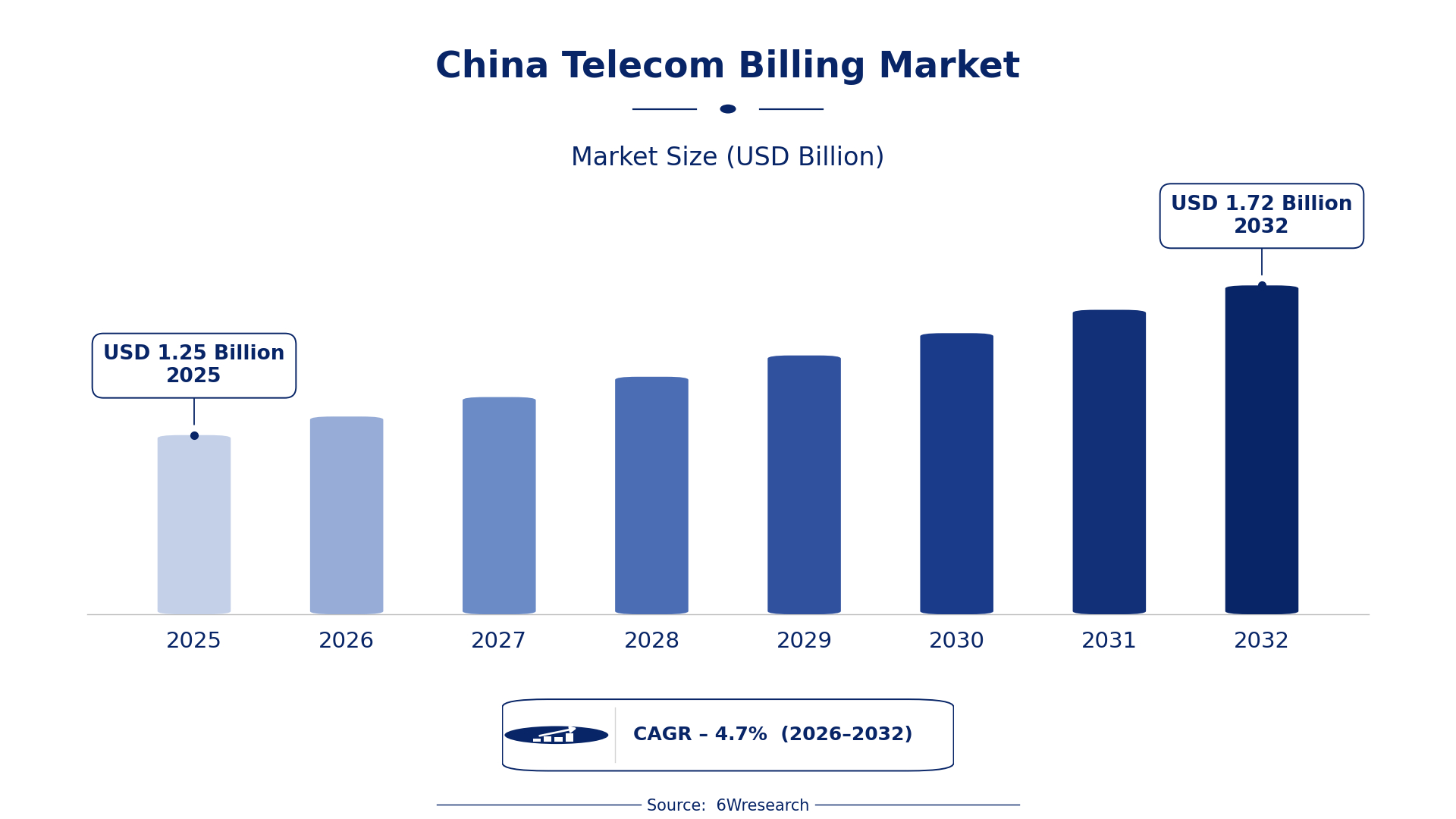
According to 6Wresearch internal database and industry insights, the China Telecom Billing Market was valued at USD 1.25 billion in 2025 and is projected to reach USD 1.72 billion by 2032, growing at a CAGR of approximately 4.7% during 2026–2032.
China Telecom Billing Market Highlights
| Report Metric | Details |
| Report Name | China Telecom Billing Market |
| Market Size 2025 | USD 1.25 billion |
| Market Size 2032 | USD 1.72 billion |
| Absolute Growth 2025–2032 | USD 0.47 billion |
| CAGR 2026–2032 | 4.7% |
| Peak Annual Growth | 6.4% in 2031 |
| Forecast Period | 2026–2032 |
| Historical Data | 2022–2025 |
| Base Year | 2025 |
| Leading Telecom Billing Type, 2025 | Postpaid Billing Systems (42% share) |
| Leading Product Type, 2025 | OSS/BSS Solutions (35% share) |
| Leading Billing Type, 2025 | Postpaid (36% share) |
| Leading Distribution Channel, 2025 | Direct Sales (49% share) |
| Leading End User Industry, 2025 | Mobile Network Operators (37% share) |
| Fastest-Growing Telecom Billing Type | Cloud Billing Platforms (7.4% CAGR) |
| Fastest-Growing Product Type | SaaS Platforms (6.7% CAGR) |
| Fastest-Growing Billing Type | Usage-Based (7.4% CAGR) |
| Fastest-Growing Distribution Channel | Cloud Vendors (6.9% CAGR) |
| Fastest-Growing End User Industry | MVNOs (7.1% CAGR) |
| Growing Sector | MVNOs |
| Key End Users | Mobile Network Operators, Telecom Providers, MVNOs, Triple Play Operators |
China Telecom Billing Market Year-wise Growth Rate and Key Drivers (2022–2032)
This graph illustrates the annual growth rates of the market from 2022 to 2032, highlighting a steady upward trajectory and projected market expansion over the forecast period.
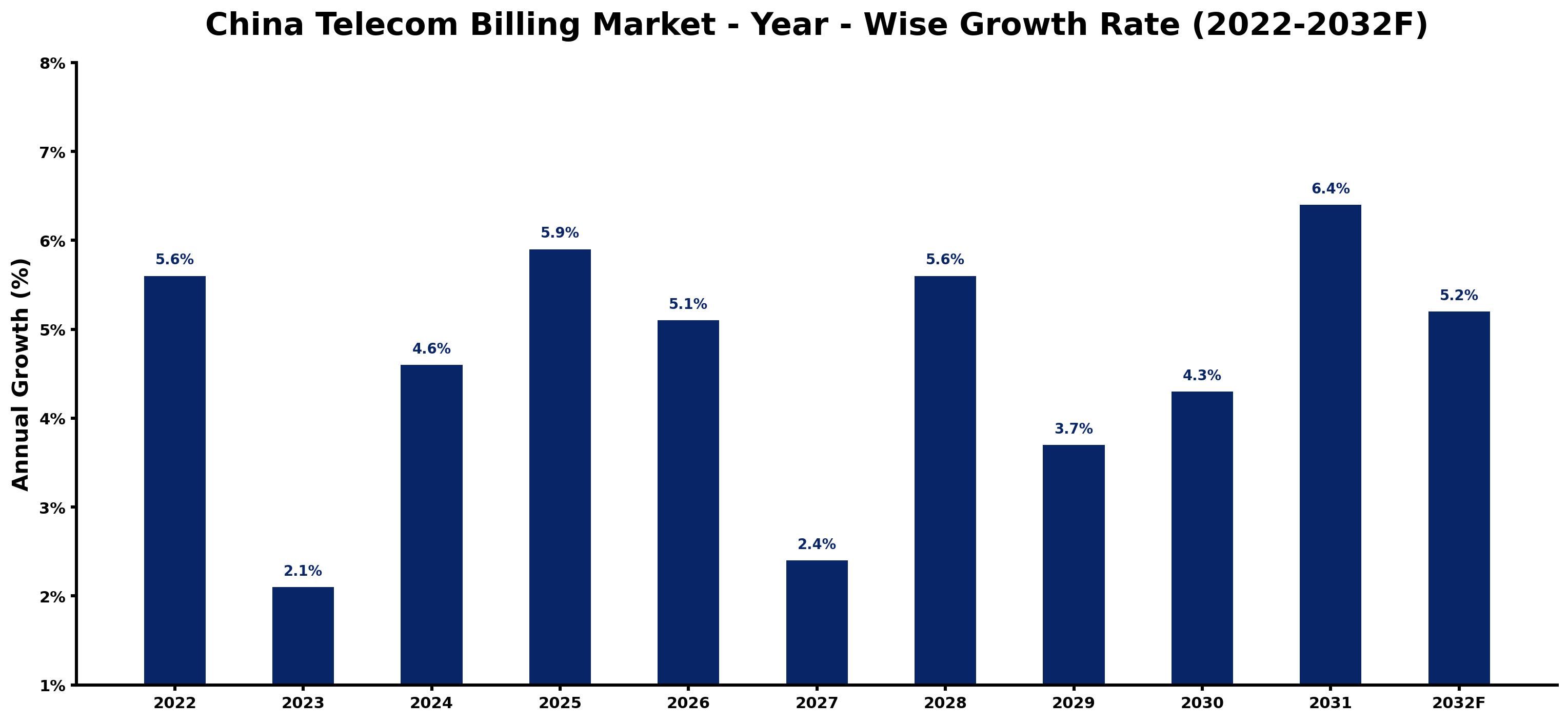
Below, each year's estimated growth is shown next to the factor that most influenced it.
| Year | Estimated Annual Growth (%) | Market Rationale |
| 2022 | 5.6 | The telecom sector accounted for 4.5% of China's GDP, driving demand for billing solutions. |
| 2023 | 2.1 | Growth slowed due to the impact of the ongoing digital transformation in telecom operations. |
| 2024 | 4.6 | Increased adoption of cloud billing platforms accelerated growth as providers sought flexibility. |
| 2025 | 5.9 | Postpaid billing systems gained traction, contributing to market growth. |
| 2026 | 5.1 | Investment in OSS/BSS solutions is expected to moderate growth as firms adjust to new standards. |
| 2027 | 2.4 | Cloud billing platforms will continue to grow, but at a slower rate than previous years. |
| 2028 | 5.6 | The market is projected to rebound as telecom providers embrace AI technologies for customer management. |
| 2029 | 3.7 | Demand for integrated billing systems will face a slowdown as firms reassess their strategies. |
| 2030 | 4.3 | The introduction of new standards is expected to revitalise interest in telecom billing solutions. |
| 2031 | 6.4 | A surge in digital transformation initiatives will drive peak growth in the market. |
| 2032 | 5.2 | Cloud billing adoption will continue to rise, but growth rates will normalise after the peak. |
Note: Market size estimations and growth projections presented in this report are based on 6Wresearch's proprietary forecasting methodology, utilizing the latest available industry data, government publications, and primary research inputs.
China Telecom Billing Market Synopsis
Telecom Billing in China encompasses the systems and processes used by telecom companies to manage customer accounts and payments. It integrates various billing types and functionalities, essential for both prepaid and postpaid users. Investments in digital transformation and the adoption of cloud billing platforms are driving this growth. The ongoing 'Digital China' initiative further improves telecom infrastructure, supporting demand for advanced billing solutions.
Market Dynamics Impact Analysis (2026–2032)
| Factor | Type | Impact | Primary Segment Affected |
| Growing mobile subscriber base drives demand for billing solutions. | Driver | High | Postpaid Billing Systems |
| Increased investment in cloud technologies enhances billing flexibility. | Driver | High | Postpaid Billing Systems |
| The rapid growth of MVNOs creates a need for efficient billing systems. | Opportunity | High | MVNOs |
| The shift towards AI technologies in billing presents new market opportunities. | Opportunity | High | Postpaid Billing Systems |
| Compliance with ISO 20022 standards increases operational costs. | Restraint | Medium | Postpaid Billing Systems |
| The need for constant upgrades to meet new standards may limit growth. | Restraint | Medium | Postpaid Billing Systems |
| Integration of new technologies can be costly and time-consuming. | Challenge | High | Postpaid Billing Systems |
| Competition among telecom providers may lead to pricing pressures. | Challenge | Medium | Telecom Providers |
Evaluation of Drivers in China Telecom Billing Market (2026–2032)
The factors lifting demand, and the evidence behind each, are summarised below.
| Drivers | Primary Segment Affected | Why It Matters (Evidence) |
| Rising mobile subscriber numbers increase demand for billing solutions. | Prepaid Billing Systems | China has over 400 million prepaid mobile users as of 2023, necessitating effective account management. |
| Investment in OSS/BSS solutions improves operational efficiency. | OSS/BSS Solutions | OSS/BSS solutions are critical for over 90% of telecom operations in urban regions. |
| Cloud billing platforms offer flexibility and scalability for telecom providers. | Cloud Billing Platforms | Projected adoption increase of 30% by 2025 reflects growing demand for cloud solutions. |
| Postpaid billing systems cater to higher-end users, driving revenue growth. | Postpaid Billing Systems | Approximately 25% of mobile subscribers in China use postpaid services, boosting billing needs. |
| The 'Digital China' initiative supports telecom infrastructure improvements. | Telecom Providers | The initiative aims to improve telecom services nationwide, increasing demand for billing systems. |
Growth in the Telecom Billing market in China comes from increasing mobile subscriber numbers, substantial investments in OSS/BSS solutions, and the rapid adoption of cloud billing platforms. With over 1.6 billion mobile subscribers in 2023, telecom providers are compelled to upgrade their billing systems to manage this growth. The projected increase of 30% in cloud billing adoption by 2025 highlights the shift towards more flexible billing options. OSS/BSS solutions are essential for over 90% of telecom operations in urban regions, prompting significant investments in these technologies. As telecom providers invest heavily in digital transformation, the demand for advanced billing solutions continues to rise.
Evaluation of Restraints in China Telecom Billing Market
The following restraints limit how fast demand can grow.
| Market Restraint | Primary Segment Affected | Why It Matters (Evidence) |
| Compliance with ISO 20022 standards raises operational costs. | Postpaid Billing Systems | Telecom billing systems must comply with the ISO 20022 standard, increasing costs for providers. |
| Frequent upgrades to billing systems can strain budgets. | Telecom Providers | The need for constant upgrades to meet new standards may limit growth for telecom providers. |
| Integration of new technologies can delay implementation. | Postpaid Billing Systems | The complexity of integrating new billing technologies can lead to longer implementation times. |
| Pricing pressures from competition may affect profitability. | Telecom Providers | Competition among telecom providers can lead to reduced margins and profitability challenges. |
| Market saturation in urban areas limits growth potential. | Telecom Providers | The telecom market in urban areas is approaching saturation, constraining further growth opportunities. |
China Telecom Billing Market Challenges
Telecom billing systems must conform to the ISO 20022 standard, complicating operations for producers who frequently need to update their systems, potentially causing delays in service delivery. Technology integration poses another challenge; over 90% of telecom operations depend on OSS/BSS solutions, yet many producers struggle with effective implementation, leading to slower rollout times. Cost pressures are pronounced as telecom providers are investing over $10 billion in digital transformation by 2025, compelling buyers to absorb increased operational expenses. Buyers also face constraints with the average revenue per user at around $5.50 per month, limiting their capacity to invest in advanced billing solutions.
Trends in the China Telecom Billing Market
Four trends stand out in the China Telecom Billing Market.
- Shift towards Cloud Billing Platforms: The adoption of cloud billing platforms is accelerating, with a projected increase of 30% by 2025. This trend is reflected in the growing number of telecom providers transitioning to cloud solutions to improve flexibility.
- Integration of AI in Customer Management: Telecom providers are increasingly adopting AI technologies for customer management, improving service efficiency. This shift is supported by ongoing initiatives aimed at modernising telecom infrastructure.
- Emergence of MVNOs in the Telecom Sector: The rise of MVNOs is reshaping telecom billing, creating new demands for efficient billing solutions. Approximately 25% of mobile subscribers are using postpaid systems, indicating a shift in consumer preferences.
- Focus on Sustainable Billing Practices: The 'Green Telecom Initiative' launched in 2023 encourages telecom providers to adopt sustainable billing practices. This initiative aims to reduce environmental impact while improving operational efficiency.
Investment Opportunities in the China Telecom Billing Market
Several openings in the China Telecom Billing Market merit attention from investors.
- $10 billion investment in digital transformation: Telecom providers are investing over $10 billion in digital transformation by 2025, creating opportunities for billing solution suppliers to offer advanced technologies and services.
- Demand for AI-driven billing solutions: The increasing integration of AI in telecom billing systems presents an opportunity for suppliers to develop advanced solutions that improve customer management and operational efficiency.
- Expansion of MVNOs creates billing needs: The rise of MVNOs, which require effective billing systems, opens up opportunities for suppliers to cater to this growing segment within the telecom market.
- Increasing adoption of cloud solutions: With a projected 30% increase in cloud billing adoption by 2025, suppliers can focus on providing scalable and flexible billing solutions to meet this demand.
Government Initiatives in the China Telecom Billing Market
The 'Digital China' initiative, launched by the Ministry of Industry and Information Technology in 2021, aims to improve telecom infrastructure and services nationwide. This initiative supports the development of advanced billing systems, ensuring telecom providers can meet the growing demands of subscribers. The '5G Development Plan' initiated in 2020 includes provisions for upgrading billing systems to support new 5G services, further driving innovation in the sector. The government is also investing significantly in telecom infrastructure, with a $5 billion plan approved in 2022 to improve services across the country. These measures strengthen the operational capabilities of telecom billing systems, benefiting both providers and users.
Telecom providers are utilising the 'Digital China' initiative to modernise their billing systems and improve service delivery. This initiative encourages investment in technology and infrastructure, enabling telecom companies to better manage customer accounts and billing processes. The Ministry of Industry and Information Technology oversees these efforts, ensuring compliance with updated standards and regulations. As a result, telecom providers can enhance customer satisfaction and operational efficiency while keeping pace with industry demands. These government measures facilitate a more responsive and efficient telecom billing environment.
Future Insight of the China Telecom Billing Market
The 'Digital China' initiative will improve telecom infrastructure, facilitating more efficient billing systems. Cloud billing solutions are expected to grow rapidly, with adoption projected to increase by 30% by 2025, enabling better customer management. The integration of AI technologies in billing services will streamline operations and improve user experience. The updated National Standard for telecom billing systems will enhance interoperability, providing clear benefits for both buyers and suppliers.
Market Segmentation Analysis
The analysis below covers each segmentation, its leading category in 2025 and its fastest-growing category through 2032.
By Telecom Billing Type – Postpaid Billing Systems Dominated, Cloud Billing Platforms Expected to Grow Fastest
According to Sumit Sagar, AM at 6Wresearch, with a 42% revenue share in 2025, Postpaid Billing Systems was the largest telecom billing type category. Postpaid billing systems dominate the market due to their necessity for managing the accounts of approximately 25% of mobile subscribers in China. This segment is vital for telecom operators focused on delivering reliable services to their postpaid clientele. Over 2026–2032, Cloud Billing Platforms are expected to post the fastest growth, at a CAGR of 7.4%. Cloud billing platforms are set to expand rapidly, with a projected growth of 30% by 2025, as telecom providers increasingly seek flexible and scalable solutions. The government's digital transformation initiatives further support this upward trend in cloud adoption. Suppliers should focus on developing cloud-based billing solutions to meet the rising demand for flexibility in telecom billing.
By Product Type – OSS/BSS Solutions Dominated, SaaS Platforms Expected to Grow Fastest
OSS/BSS Solutions took a 35% share of product type in 2025, more than any other category. OSS/BSS solutions hold the largest market share as they are essential for over 90% of telecom operations, ensuring efficient billing processes across the industry. Their foundational role makes them critical for maintaining operational integrity within telecom companies. The quickest growth will come from SaaS Platforms, forecast to expand at a CAGR of 6.7% between 2026 and 2032. SaaS platforms are gaining traction due to their ability to reduce infrastructure costs and improve accessibility for telecom providers. This trend reflects a broader shift towards embracing digital solutions in the telecom sector. Buyers should consider SaaS options to optimise their billing processes and lower operational expenses.
By Billing Type – Postpaid Dominated, Usage-Based Expected to Grow Fastest
Postpaid held a 36% share of the China Telecom Billing Market by billing type in 2025. Postpaid billing is the leading segment, catering to higher-end users who require comprehensive billing solutions for their services. This type of billing is crucial for telecom operators aiming to maximise revenue from premium customers. Usage-Based is projected to grow fastest, at a CAGR of 7.4% during 2026–2032. Usage-based billing is emerging as a fast-growing segment, particularly appealing in niche markets where customers prefer to pay based on actual usage. This model aligns with consumer preferences for more tailored billing solutions. Suppliers should integrate usage-based billing options to attract a broader range of customers seeking flexibility.
By Distribution Channel – Direct Sales Dominated, Cloud Vendors Expected to Grow Fastest
The largest distribution channel category in 2025 was Direct Sales, with a 49% share of total revenue. Direct sales are the primary distribution channel for telecom billing solutions, enabling providers to engage directly with clients and customise their offerings. This method ensures that telecom companies receive personalised support and service tailored to their needs. Cloud Vendors are set to record the highest CAGR in this split, 6.9% over 2026–2032. Cloud vendors are rapidly becoming the fastest-growing channel, providing essential infrastructure for cloud billing solutions that align with industry demands for agility. Their role is increasingly critical amid ongoing digital transformation efforts. Suppliers must strengthen partnerships with cloud vendors to enhance market reach and service delivery.
By End User Industry – Mobile Network Operators Dominated, MVNOs Expected to Grow Fastest
In 2025, Mobile Network Operators led the end user industry split with a 37% share. Mobile network operators represent the largest end user group, as they are the primary consumers of telecom billing systems necessary for managing extensive customer bases. Their substantial market share underscores the critical need for effective billing solutions in the telecom sector. Over 2026–2032, MVNOs are expected to post the fastest growth, at a CAGR of 7.1%. MVNOs are the fastest-growing segment, relying heavily on efficient billing systems to manage their operations effectively. As the number of MVNOs increases, their demand for tailored billing solutions is expected to surge. Suppliers should tailor their offerings to meet the specific needs of MVNOs to capture this growing market segment.
Key Attractiveness of the Report
- 10 Years of Market Numbers
- Historical Data Starting from 2022 to 2025
- Base Year 2025
- Forecast Data until 2032
- Key Performance Indicators Impacting the Market
- Major Upcoming Developments and Projects
Key Highlights of the Report:
- China Telecom Billing Market Outlook
- Market Size of China Telecom Billing Market, 2025
- Forecast of China Telecom Billing Market, 2032
- Historical Data and Forecast of China Telecom Billing Revenues & Volume for the Period 2022 - 2032F
- China Telecom Billing Market Trend Evolution
- China Telecom Billing Market Drivers and Challenges
- China Telecom Billing Price Trends
- China Telecom Billing Porter's Five Forces
- China Telecom Billing Industry Life Cycle
- Historical Data and Forecast of China Telecom Billing Market Revenues & Volume By Telecom Billing Type for the Period 2022 - 2032F
- Historical Data and Forecast of China Telecom Billing Market Revenues & Volume By Prepaid Billing Systems for the Period 2022 - 2032F
- Historical Data and Forecast of China Telecom Billing Market Revenues & Volume By Postpaid Billing Systems for the Period 2022 - 2032F
- Historical Data and Forecast of China Telecom Billing Market Revenues & Volume By Convergent Billing for the Period 2022 - 2032F
- Historical Data and Forecast of China Telecom Billing Market Revenues & Volume By Cloud Billing Platforms for the Period 2022 - 2032F
- Historical Data and Forecast of China Telecom Billing Market Revenues & Volume By Product Type for the Period 2022 - 2032F
- Historical Data and Forecast of China Telecom Billing Market Revenues & Volume By OSS/BSS Solutions for the Period 2022 - 2032F
- Historical Data and Forecast of China Telecom Billing Market Revenues & Volume By Customer Management for the Period 2022 - 2032F
- Historical Data and Forecast of China Telecom Billing Market Revenues & Volume By Integrated Billing for the Period 2022 - 2032F
- Historical Data and Forecast of China Telecom Billing Market Revenues & Volume By SaaS Platforms for the Period 2022 - 2032F
- Historical Data and Forecast of China Telecom Billing Market Revenues & Volume By Billing Type for the Period 2022 - 2032F
- Historical Data and Forecast of China Telecom Billing Market Revenues & Volume By Prepaid for the Period 2022 - 2032F
- Historical Data and Forecast of China Telecom Billing Market Revenues & Volume By Postpaid for the Period 2022 - 2032F
- Historical Data and Forecast of China Telecom Billing Market Revenues & Volume By Hybrid for the Period 2022 - 2032F
- Historical Data and Forecast of China Telecom Billing Market Revenues & Volume By Usage-Based for the Period 2022 - 2032F
- Historical Data and Forecast of China Telecom Billing Market Revenues & Volume By Distribution Channel for the Period 2022 - 2032F
- Historical Data and Forecast of China Telecom Billing Market Revenues & Volume By Direct Sales for the Period 2022 - 2032F
- Historical Data and Forecast of China Telecom Billing Market Revenues & Volume By Online Platforms for the Period 2022 - 2032F
- Historical Data and Forecast of China Telecom Billing Market Revenues & Volume By Cloud Vendors for the Period 2022 - 2032F
- Historical Data and Forecast of China Telecom Billing Market Revenues & Volume By Telecom Integrators for the Period 2022 - 2032F
- Historical Data and Forecast of China Telecom Billing Market Revenues & Volume By End User Industry for the Period 2022 - 2032F
- Historical Data and Forecast of China Telecom Billing Market Revenues & Volume By Mobile Network Operators for the Period 2022 - 2032F
- Historical Data and Forecast of China Telecom Billing Market Revenues & Volume By Telecom Providers for the Period 2022 - 2032F
- Historical Data and Forecast of China Telecom Billing Market Revenues & Volume By Triple Play Operators for the Period 2022 - 2032F
- Historical Data and Forecast of China Telecom Billing Market Revenues & Volume By MVNOs for the Period 2022 - 2032F
- China Telecom Billing Import Export Trade Statistics
- Market Opportunity Assessment By Telecom Billing Type
- Market Opportunity Assessment By Product Type
- Market Opportunity Assessment By Billing Type
- Market Opportunity Assessment By Distribution Channel
- Market Opportunity Assessment By End User Industry
- China Telecom Billing Top Companies Market Share
- China Telecom Billing Competitive Benchmarking By Technical and Operational Parameters
- China Telecom Billing Company Profiles
- China Telecom Billing Key Strategic Recommendations
Market Covered
The report offers an extensive study of the following market segments.
By Telecom Billing Type
- Prepaid Billing Systems
- Postpaid Billing Systems
- Convergent Billing
- Cloud Billing Platforms
By Product Type
- OSS/BSS Solutions
- Customer Management
- Integrated Billing
- SaaS Platforms
By Billing Type
- Prepaid
- Postpaid
- Hybrid
- Usage-Based
By Distribution Channel
- Direct Sales
- Online Platforms
- Cloud Vendors
- Telecom Integrators
By End User Industry
- Mobile Network Operators
- Telecom Providers
- Triple Play Operators
- MVNOs































