China Telecom Chipset Market Size & Growth Rate
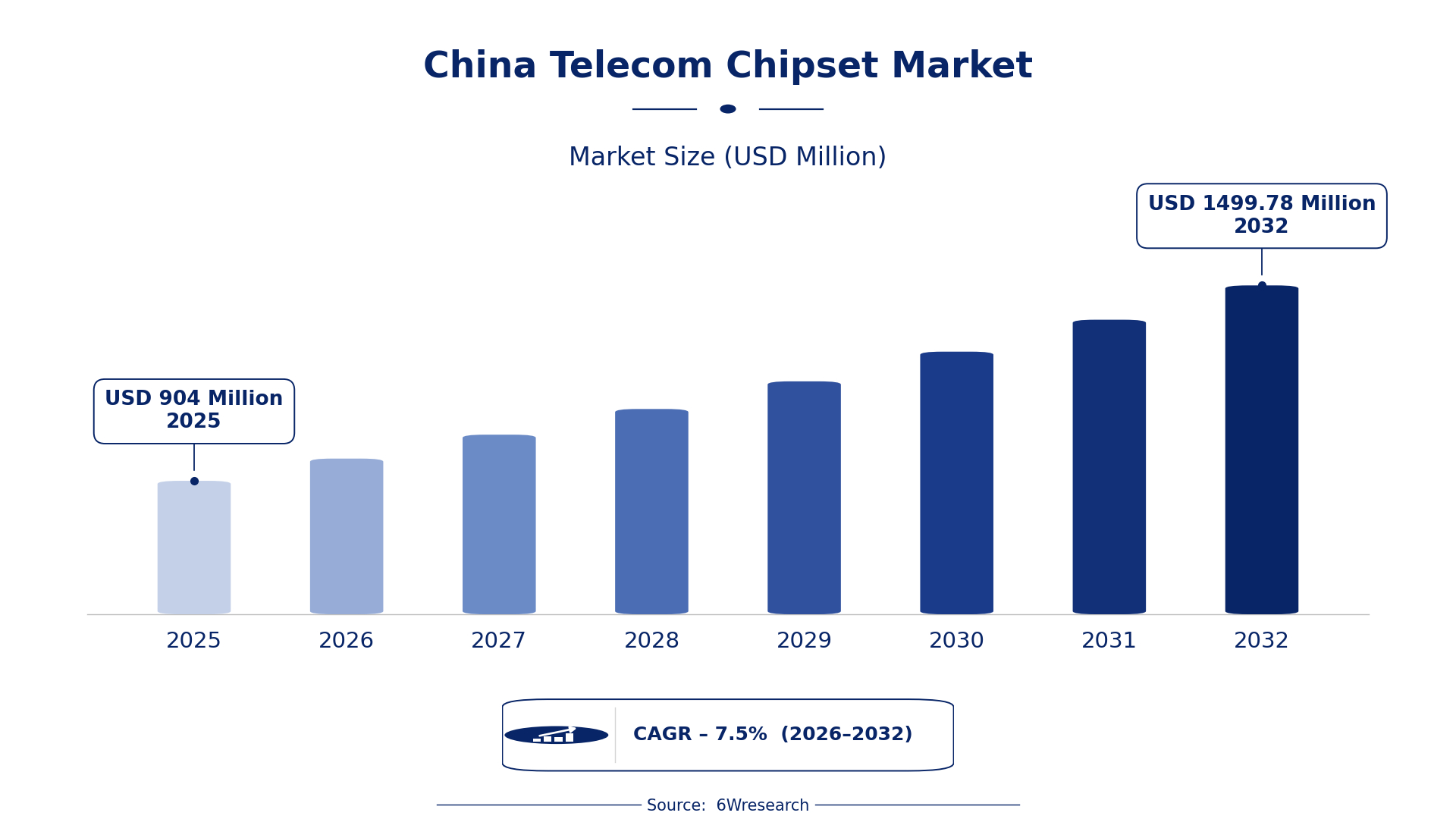
According to 6Wresearch internal database and industry insights, the China Telecom Chipset Market was valued at USD 904.0 million in 2025 and is projected to reach USD 1,499.78 million by 2032, growing at a CAGR of approximately 7.5% during 2026–2032.
China Telecom Chipset Market Highlights
| Report Metric | Details |
| Report Name | China Telecom Chipset Market |
| Market Size 2025 | USD 904.0 million |
| Market Size 2032 | USD 1,499.78 million |
| Absolute Growth 2025–2032 | USD 595.78 million |
| CAGR 2026–2032 | 7.5% |
| Peak Annual Growth | 9.3% in 2027 |
| Forecast Period | 2026–2032 |
| Historical Data | 2022–2025 |
| Base Year | 2025 |
| Leading Telecom Chipset Type, 2025 | Baseband Processors (44% share) |
| Leading Product Type, 2025 | 4G/5G Chipsets (42% share) |
| Leading Chipset Type, 2025 | RF + Modem (40% share) |
| Leading Distribution Channel, 2025 | OEM Supply (44% share) |
| Leading End User Industry, 2025 | Smartphone Manufacturers (45% share) |
| Fastest-Growing Telecom Chipset Type | Optical Communication ICs (10.1% CAGR) |
| Fastest-Growing Product Type | mmWave Chips (9.3% CAGR) |
| Fastest-Growing Chipset Type | Silicon Photonics (9.8% CAGR) |
| Fastest-Growing Distribution Channel | Distributors (9.6% CAGR) |
| Fastest-Growing End User Industry | Telecom Infrastructure (10.0% CAGR) |
| Growing Sector | Telecom Infrastructure |
| Key End Users | Smartphone Manufacturers, Telecom Infrastructure, Wireless Equipment OEMs |
China Telecom Chipset Market Year-wise Growth Rate and Key Drivers (2022–2032)
This graph illustrates the annual growth rates of the market from 2022 to 2032, highlighting a steady upward trajectory and projected market expansion over the forecast period.
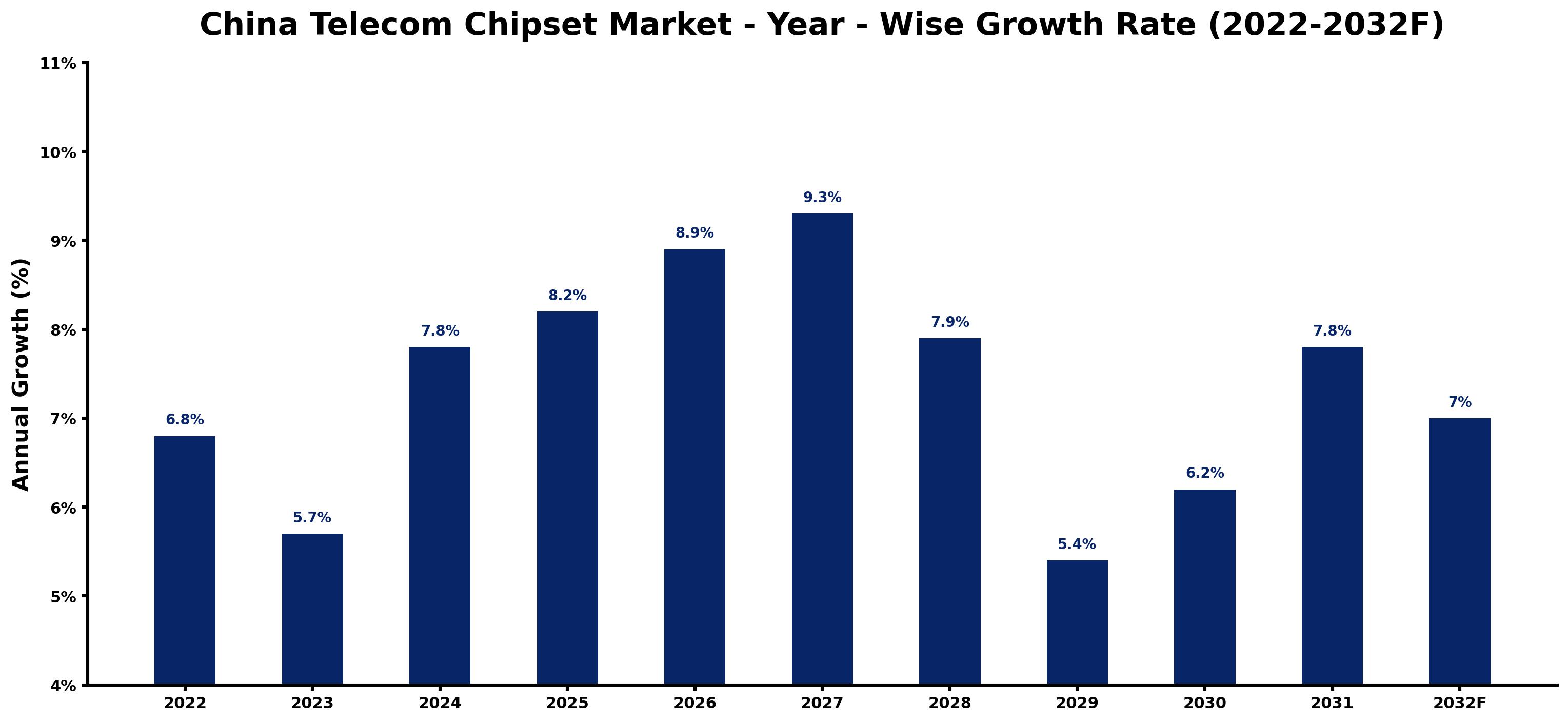
Year by year, the estimates below pair each growth rate with the development that shaped it.
| Year | Estimated Annual Growth (%) | Market Rationale |
| 2022 | 6.8 | The market experienced stable growth due to a strong demand for mobile communication. |
| 2023 | 5.7 | Growth slowed as the '5G Application Promotion Plan' began to take effect. |
| 2024 | 7.8 | Increased investments in 5G infrastructure spurred faster growth this year. |
| 2025 | 8.2 | The market saw a peak in growth driven by production increases in 5G chipsets. |
| 2026 | 8.9 | Rising demand for advanced chipsets is expected to support continued growth in the market. |
| 2027 | 9.3 | The introduction of new applications for 5G technology is projected to lead to peak growth. |
| 2028 | 7.9 | Growth is expected to slow as the market begins to stabilise after rapid expansion. |
| 2029 | 5.4 | The market will continue to grow but at a slower rate due to maturing demand. |
| 2030 | 6.2 | Investments in telecom infrastructure are anticipated to pick up again, boosting growth. |
| 2031 | 7.8 | The market is expected to experience renewed growth driven by upgrades in telecom systems. |
| 2032 | 7.0 | Growth will slow as the market approaches saturation in certain segments. |
Note: Market size estimations and growth projections presented in this report are based on 6Wresearch's proprietary forecasting methodology, utilizing the latest available industry data, government publications, and primary research inputs.
China Telecom Chipset Market Synopsis
The Telecom Chipset Market in China encompasses semiconductor devices essential for telecommunications. These chipsets enable mobile communication, data transmission, and network management, with production reaching 1.5 billion units in 2022. Driven by over 1.4 billion mobile subscribers, the market is supported by investments in 5G infrastructure exceeding $100 billion. The ongoing rollout of 5G technology and the Digital China Initiative further fuel demand, indicating a strong future for the market.
Market Dynamics Impact Analysis (2026–2032)
| Factor | Type | Impact | Primary Segment Affected |
| Strong demand from smartphone manufacturers due to mobile communication needs. | Driver | High | 4G/5G Chipsets |
| Increasing investments in telecom infrastructure by network operators. | Driver | High | Telecom Infrastructure |
| Rising demand for advanced optical communication technologies. | Opportunity | High | Optical Communication ICs |
| Growing need for high-frequency communication solutions in 5G. | Opportunity | High | mmWave Chips |
| Supply chain disruptions affecting semiconductor availability. | Restraint | High | Baseband Processors |
| Regulatory compliance costs for telecom equipment manufacturers. | Restraint | Medium | RF Front-End Chips |
| Competition from international chipset manufacturers affecting pricing. | Challenge | High | Network Processors |
| Technological advancements outpacing local production capabilities. | Challenge | Medium | Transceiver Chips |
Evaluation of Drivers in China Telecom Chipset Market (2026–2032)
Below mentioned are some major drivers and their influence on market dynamics.
| Drivers | Primary Segment Affected | Why It Matters (Evidence) |
| Increasing mobile subscribers driving demand for chipsets. | 4G/5G Chipsets | China's telecom market has over 1.4 billion mobile subscribers, resulting in higher chipset demand. |
| Investments in 5G infrastructure. | Telecom Infrastructure | Investments exceeding $100 billion in 5G rollout are boosting chipset production. |
| Rising demand for high-speed data transmission. | Optical Communication ICs | The installed base of 5G base stations surpassed 2 million, increasing the need for optical components. |
| Growing adoption of advanced communication technologies. | mmWave Chips | The push for high-frequency communication is driving demand for mmWave chipsets. |
| Expansion of smartphone manufacturing capabilities. | Baseband Processors | Smartphone manufacturers are ramping up production, increasing the need for baseband processors. |
Market growth in China for Telecom Chipset relies on a rise in mobile subscribers, substantial investments in 5G infrastructure, and an increasing need for high-speed data transmission. The telecom sector boasts over 1.4 billion mobile subscribers, driving up chipset demand. Investments in the 5G rollout are set to surpass $100 billion, enhancing production capabilities. The installed base of 5G base stations has exceeded 2 million, intensifying the need for optical components. The push for high-frequency communication is also increasing the demand for mmWave chipsets, as manufacturers scale up production to meet these needs.
Evaluation of Restraints in China Telecom Chipset Market
The following restraints limit how fast demand can grow.
| Market Restraint | Primary Segment Affected | Why It Matters (Evidence) |
| Supply chain disruptions affecting semiconductor availability. | Baseband Processors | Supply chain issues have led to delays in chipset production, impacting availability. |
| Regulatory compliance costs for telecom equipment manufacturers. | RF Front-End Chips | Manufacturers face high costs to meet safety standards, affecting profitability. |
| Technological advancements outpacing local production capabilities. | Transceiver Chips | Rapid technological changes require constant upgrades, straining local manufacturers. |
| Competition from international chipset manufacturers affecting pricing. | Network Processors | Local manufacturers struggle to compete with lower-priced imports, impacting market share. |
| Limited investment in research and development. | Optical Communication ICs | Insufficient R&D funding hampers innovation in optical technologies. |
China Telecom Chipset Market Challenges
Buyers and suppliers in the China telecom chipset market face a critical skills shortage, with over 300,000 qualified engineers needed by 2025. This shortage stems from rapid advancements in 5G technology, which outpace the current workforce's capabilities. Intense competition among local manufacturers leads to aggressive pricing strategies, squeezing profit margins for suppliers. Production costs are rising, as semiconductor material prices increased by 15%, which complicates pricing for buyers. Ongoing supply chain disruptions cause shipment delays, extending project timelines for telecom infrastructure initiatives.
Trends in the China Telecom Chipset Market
Several trends are reshaping the China Telecom Chipset Market; the most important are set out below.
- Shift from 4G to 5G Technology: The transition to 5G technology commenced in 2020, driven by the demand for faster mobile networks. The installed base of 5G base stations surpassed 2 million in 2023, reflecting a shift in infrastructure priorities.
- Emergence of Optical Communication Technologies: The growing demand for high-speed data transmission has spurred the rise of optical communication technologies. The Optical Communication ICs segment is projected to grow at a CAGR of 10.1% from 2026 to 2032, underscoring this trend.
- Increased Focus on Semiconductor Safety Standards: In 2020, the National Standard GB/T 35273-2020 was enacted to ensure safety in telecom equipment. This standard requires manufacturers to meet strict safety requirements, influencing product development.
- Expansion of Telecom Infrastructure Investments: In 2022, the State Council approved the '14th Five-Year Plan for Digital Economy Development', aiming for increased investments in telecom infrastructure. This plan seeks to drive overall market growth by improving network capabilities.
Investment Opportunities in the China Telecom Chipset Market
Investors looking at the China Telecom Chipset Market should consider the following areas.
- Growing Demand for 5G Applications: With the launch of the '5G Application Promotion Plan' in 2023, there is a chance for investment in 5G technologies. Telecom Infrastructure providers can take advantage of this trend, as the market is projected to reach USD 1,499.78 million by 2032.
- Investment in Optical Communication Technologies: The rising need for high-speed data transmission opens doors in optical communication. Telecom Infrastructure companies in the Beijing-Tianjin-Hebei region can gain from investing in this expanding segment.
- Expansion of Semiconductor Manufacturing Capabilities: The Guangdong province serves as a key hub for telecom manufacturing, presenting opportunities for local partnerships. Companies can enter the market by collaborating with local manufacturers to improve production capabilities.
- Focus on Advanced Chipset Development: The demand for mmWave chips is on the rise, creating opportunities for investment in advanced chipset technologies. Wireless Equipment OEMs can explore this segment to meet the increasing market needs.
Government Initiatives in the China Telecom Chipset Market
The '5G Application Promotion Plan' launched by the Ministry of Industry and Information Technology in 2023 builds on previous initiatives by emphasising the expansion of 5G application scenarios across various industries. This measure aims to accelerate the adoption of 5G technology, which is crucial for telecom chipset manufacturers and buyers. It promotes innovation and investment in 5G solutions, creating a more competitive environment in the telecom sector. The plan is expected to influence the market by broadening the use of 5G across multiple applications.
The Ministry of Industry and Information Technology manages various schemes, including the '14th Five-Year Plan for Digital Economy Development'. This plan supports funding for telecom infrastructure projects, ensuring that manufacturers have access to essential resources. Additionally, the China Communications Industry Association encourages industry standards and collaboration among stakeholders. These initiatives help streamline processes for chipset manufacturers and facilitate compliance with regulations, ultimately benefiting buyers through improved product availability and quality.
Future Insight of the China Telecom Chipset Market
The China telecom chipset market will undergo substantial changes by 2032, driven by the extensive rollout of 5G technology. The government's '5G Application Promotion Plan' will facilitate the establishment of over 2 million 5G base stations, significantly enhancing connectivity. Network upgrade investments are forecasted to reach $70 billion by 2025, supporting the production of 1.5 billion chipsets annually. The 'Digital China Initiative' will further strengthen digital infrastructure, creating new opportunities for suppliers and improving service delivery for buyers.
Market Segmentation Analysis
The report offers a comprehensive study of the following market segments and their leading categories in the market.
By Telecom Chipset Type – Baseband Processors Dominated, Optical Communication ICs Expected to Grow Fastest
According to Sumit Sagar, AM at 6Wresearch, Baseband Processors accounted for a 44% market share by telecom chipset type in 2025. Baseband processors are crucial for signal processing in mobile devices, catering to the needs of over 1.4 billion mobile subscribers in China. Their integration in smartphones and communication devices reinforces their dominant market share in the telecom chipset sector. Over 2026–2032, Optical Communication ICs are expected to post the fastest growth, at a CAGR of 10.1%. Optical communication ICs are experiencing rapid growth due to the increasing demand for high-speed data transmission over fibre optics, particularly with the acceleration of 5G networks. Significant government investments in 5G infrastructure are a primary catalyst for this expansion. Suppliers should prioritise the development of optical communication ICs to capitalise on the increasing demand within the telecom chipset market.
By Product Type – 4G/5G Chipsets Dominated, mmWave Chips Expected to Grow Fastest
4G/5G Chipsets took a 42% share of product type in 2025, more than any other category. 4G/5G chipsets are vital for enabling next-generation mobile networks, with the installed base of 5G base stations in China surpassing 2 million. This widespread adoption by mobile operators secures a leading market share for these chipsets. mmWave Chips are set to record the highest CAGR in this split, 9.3% over 2026–2032. mmWave chips are rapidly gaining prominence as they are essential for high-frequency communication in 5G, supported by substantial investments in 5G infrastructure. The rising demand for faster data transmission speeds is driving growth in this segment. Buyers should focus on acquiring mmWave chips to maintain a competitive edge in the fast-evolving telecom environment.
By Chipset Type – RF + Modem Dominated, Silicon Photonics Expected to Grow Fastest
The largest chipset type category in 2025 was RF + Modem, with a 40% share of total revenue. RF + modem chipsets are integrated for efficient communication in devices, making them indispensable for manufacturers in the telecom sector. Their widespread application in smartphones and other devices contributes to their leading market share. The quickest growth will come from Silicon Photonics, forecast to expand at a CAGR of 9.8% between 2026 and 2032. Silicon photonics, while currently a minor player, is emerging as a promising technology for future applications in telecommunications. As demand for high-speed data solutions increases, this segment is expected to grow rapidly. Suppliers must keep an eye on silicon photonics developments to align with future technological advancements in telecom.
By Distribution Channel – OEM Supply Dominated, Distributors Expected to Grow Fastest
OEM Supply held a 44% share of the China Telecom Chipset Market by distribution channel in 2025. OEM supply serves as the primary channel for delivering chipsets to manufacturers, establishing a direct connection between chipset producers and device makers. This well-established relationship solidifies OEM supply's market share in the telecom chipset distribution framework. Distributors are projected to grow fastest, at a CAGR of 9.6% during 2026–2032. Distributors are becoming increasingly important as they enhance market access for various chipset types, especially amidst rising demand. Their role in linking manufacturers with end-users is vital for expanding market reach. Suppliers should enhance partnerships with distributors to improve their market presence and accessibility.
By End User Industry – Smartphone Manufacturers Dominated, Telecom Infrastructure Expected to Grow Fastest
In 2025, Smartphone Manufacturers led the end user industry split with a 45% share. Smartphone manufacturers are the largest end users of telecom chipsets, driven by the necessity to support over 1.4 billion mobile subscribers in China. Their ongoing demand for advanced chipsets ensures a significant market share for this segment. Over 2026–2032, Telecom Infrastructure is expected to post the fastest growth, at a CAGR of 10.0%. Telecom infrastructure is witnessing robust growth due to heightened demand from network operators for improved connectivity solutions. This surge in investment for network upgrades is propelling the telecom infrastructure segment forward. Buyers in the telecom infrastructure sector should invest in advanced chipsets to address the escalating demands of network operators.
Key Attractiveness of the Report
- 10 Years of Market Numbers
- Historical Data Starting from 2022 to 2025
- Base Year 2025
- Forecast Data until 2032
- Key Performance Indicators Impacting the Market
- Major Upcoming Developments and Projects
Key Highlights of the Report:
- China Telecom Chipset Market Outlook
- Market Size of China Telecom Chipset Market, 2025
- Forecast of China Telecom Chipset Market, 2032
- Historical Data and Forecast of China Telecom Chipset Revenues & Volume for the Period 2022 - 2032F
- China Telecom Chipset Market Trend Evolution
- China Telecom Chipset Market Drivers and Challenges
- China Telecom Chipset Price Trends
- China Telecom Chipset Porter's Five Forces
- China Telecom Chipset Industry Life Cycle
- Historical Data and Forecast of China Telecom Chipset Market Revenues & Volume By Telecom Chipset Type for the Period 2022 - 2032F
- Historical Data and Forecast of China Telecom Chipset Market Revenues & Volume By Baseband Processors for the Period 2022 - 2032F
- Historical Data and Forecast of China Telecom Chipset Market Revenues & Volume By Network Processors for the Period 2022 - 2032F
- Historical Data and Forecast of China Telecom Chipset Market Revenues & Volume By RF Front-End Chips for the Period 2022 - 2032F
- Historical Data and Forecast of China Telecom Chipset Market Revenues & Volume By Optical Communication ICs for the Period 2022 - 2032F
- Historical Data and Forecast of China Telecom Chipset Market Revenues & Volume By Product Type for the Period 2022 - 2032F
- Historical Data and Forecast of China Telecom Chipset Market Revenues & Volume By 4G/5G Chipsets for the Period 2022 - 2032F
- Historical Data and Forecast of China Telecom Chipset Market Revenues & Volume By Packet Handling ICs for the Period 2022 - 2032F
- Historical Data and Forecast of China Telecom Chipset Market Revenues & Volume By mmWave Chips for the Period 2022 - 2032F
- Historical Data and Forecast of China Telecom Chipset Market Revenues & Volume By Transceiver Chips for the Period 2022 - 2032F
- Historical Data and Forecast of China Telecom Chipset Market Revenues & Volume By Chipset Type for the Period 2022 - 2032F
- Historical Data and Forecast of China Telecom Chipset Market Revenues & Volume By RF + Modem for the Period 2022 - 2032F
- Historical Data and Forecast of China Telecom Chipset Market Revenues & Volume By Multi-core ASICs for the Period 2022 - 2032F
- Historical Data and Forecast of China Telecom Chipset Market Revenues & Volume By GaN/GaAs for the Period 2022 - 2032F
- Historical Data and Forecast of China Telecom Chipset Market Revenues & Volume By Silicon Photonics for the Period 2022 - 2032F
- Historical Data and Forecast of China Telecom Chipset Market Revenues & Volume By Distribution Channel for the Period 2022 - 2032F
- Historical Data and Forecast of China Telecom Chipset Market Revenues & Volume By OEM Supply for the Period 2022 - 2032F
- Historical Data and Forecast of China Telecom Chipset Market Revenues & Volume By Direct Sales for the Period 2022 - 2032F
- Historical Data and Forecast of China Telecom Chipset Market Revenues & Volume By Distributors for the Period 2022 - 2032F
- Historical Data and Forecast of China Telecom Chipset Market Revenues & Volume By Online Platforms for the Period 2022 - 2032F
- Historical Data and Forecast of China Telecom Chipset Market Revenues & Volume By End User Industry for the Period 2022 - 2032F
- Historical Data and Forecast of China Telecom Chipset Market Revenues & Volume By Smartphone Manufacturers for the Period 2022 - 2032F
- Historical Data and Forecast of China Telecom Chipset Market Revenues & Volume By Telecom Infrastructure for the Period 2022 - 2032F
- Historical Data and Forecast of China Telecom Chipset Market Revenues & Volume By Wireless Equipment OEMs for the Period 2022 - 2032F
- Historical Data and Forecast of China Telecom Chipset Market Revenues & Volume By Data Centers for the Period 2022 - 2032F
- China Telecom Chipset Import Export Trade Statistics
- Market Opportunity Assessment By Telecom Chipset Type
- Market Opportunity Assessment By Product Type
- Market Opportunity Assessment By Chipset Type
- Market Opportunity Assessment By Distribution Channel
- Market Opportunity Assessment By End User Industry
- China Telecom Chipset Top Companies Market Share
- China Telecom Chipset Competitive Benchmarking By Technical and Operational Parameters
- China Telecom Chipset Company Profiles
- China Telecom Chipset Key Strategic Recommendations
Market Covered
This report examines the market across the segments below.
By Telecom Chipset Type
- Baseband Processors
- Network Processors
- RF Front-End Chips
- Optical Communication ICs
By Product Type
- 4G/5G Chipsets
- Packet Handling ICs
- mmWave Chips
- Transceiver Chips
By Chipset Type
- RF + Modem
- Multi-core ASICs
- GaN/GaAs
- Silicon Photonics
By Distribution Channel
- OEM Supply
- Direct Sales
- Distributors
- Online Platforms
By End User Industry
- Smartphone Manufacturers
- Telecom Infrastructure
- Wireless Equipment OEMs
- Data Centers































