China Telecom Cybersecurity Market Size & Growth Rate
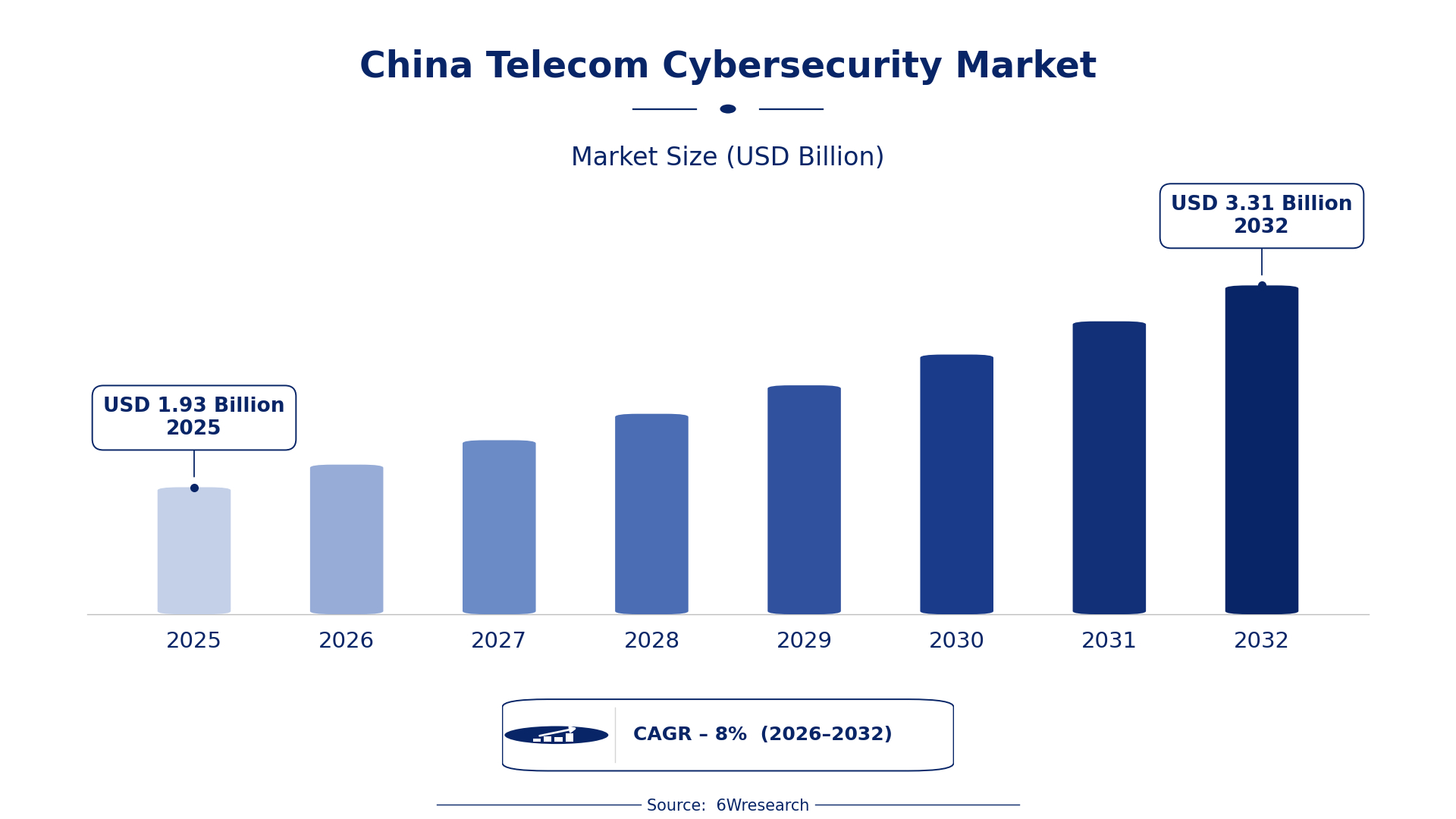
According to 6Wresearch internal database and industry insights, the China Telecom Cybersecurity Market was valued at USD 1.93 billion in 2025 and is projected to reach USD 3.31 billion by 2032, growing at a CAGR of approximately 8% during 2026–2032.
China Telecom Cybersecurity Market Highlights
| Report Metric | Details |
| Report Name | China Telecom Cybersecurity Market |
| Market Size 2025 | USD 1.93 billion |
| Market Size 2032 | USD 3.31 billion |
| Absolute Growth 2025–2032 | USD 1.38 billion |
| CAGR 2026–2032 | 8% |
| Peak Annual Growth | 10.5% in 2030 |
| Forecast Period | 2026–2032 |
| Historical Data | 2022–2025 |
| Base Year | 2025 |
| Leading Telecom Cybersecurity Type, 2025 | DDoS Protection Tools (38% share) |
| Leading Product Type, 2025 | NGFW/UTM Devices (52% share) |
| Leading Security Layer, 2025 | Network (46% share) |
| Leading Distribution Channel, 2025 | Security Vendors (54% share) |
| Leading End User Industry, 2025 | ISPs (39% share) |
| Fastest-Growing Product Type | IAM Solutions (10.2% CAGR) |
| Fastest-Growing Security Layer | Application (10.3% CAGR) |
| Fastest-Growing Distribution Channel | Cloud Integrators (9.7% CAGR) |
| Fastest-Growing End User Industry | Telco Enterprises (9.5% CAGR) |
| Growing Sector | Telecom |
| Key End Users | ISPs, Telco Enterprises, Mobile Carriers |
China Telecom Cybersecurity Market Year-wise Growth Rate and Key Drivers (2022–2032)
This graph illustrates the annual growth rates of the market from 2022 to 2032, highlighting a steady upward trajectory and projected market expansion over the forecast period.
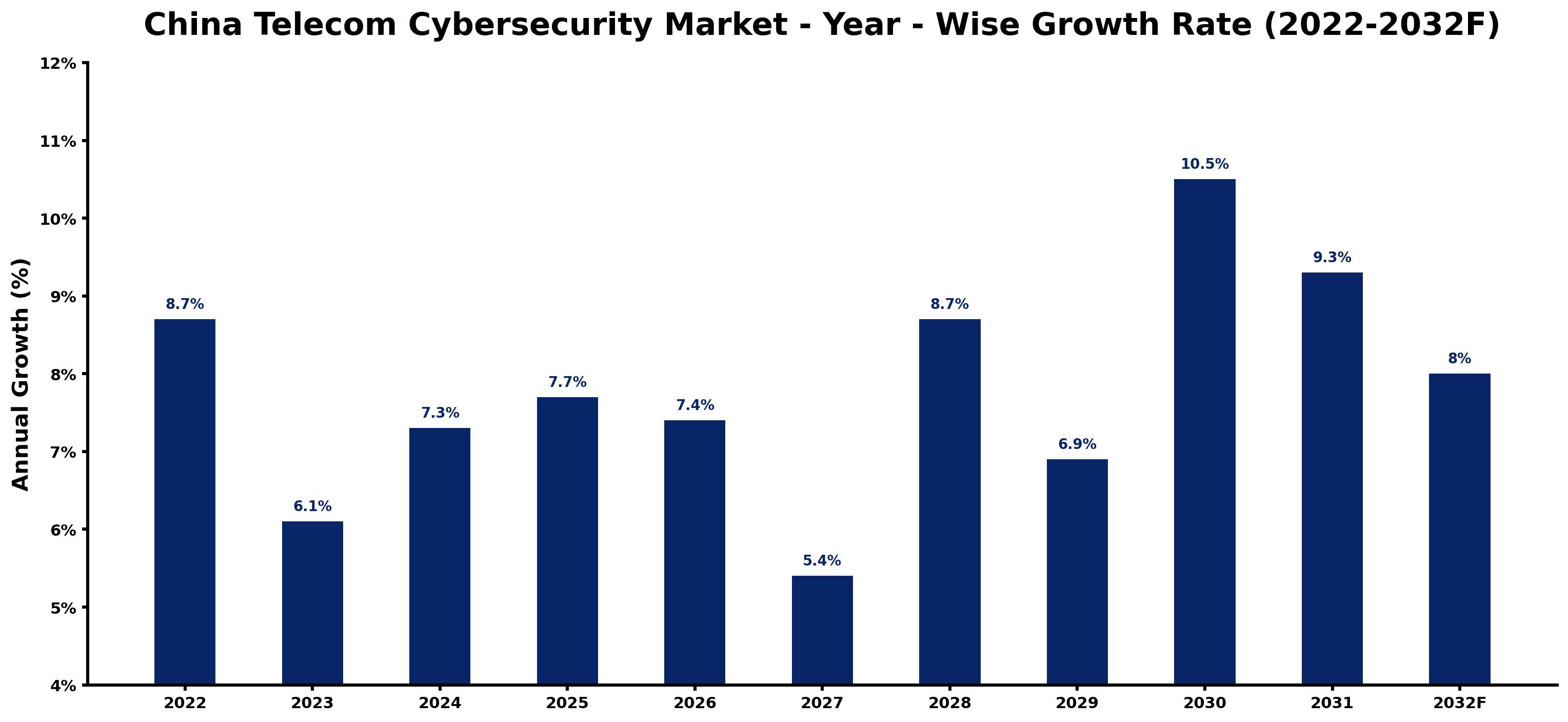
Annual growth estimates for each year appear below with the principal reason behind them, explaining the shifts that set the pace of the market.
| Year | Estimated Annual Growth (%) | Market Rationale |
| 2022 | 8.7 | The market experienced strong demand driven by increased cybersecurity incidents in the telecom sector. |
| 2023 | 6.1 | Growth slowed due to a temporary dip in investment as operators adjusted to new regulations. |
| 2024 | 7.3 | A rise in cybersecurity incidents led to increased spending on protective measures by telecom operators. |
| 2025 | 7.7 | Investment in cybersecurity solutions grew as operators focused on compliance with updated national standards. |
| 2026 | 7.4 | A slowdown occurred as the market adjusted to the previous year's rapid growth and regulatory changes. |
| 2027 | 5.4 | Demand remained steady as telecom operators continued to enhance their cybersecurity measures. |
| 2028 | 8.7 | Growth accelerated again due to rising awareness of cyber threats among telecom users. |
| 2029 | 6.9 | A slight slowdown was noted as the market matured and competition intensified among providers. |
| 2030 | 10.5 | Peak growth was achieved as major telecom operators invested heavily in advanced cybersecurity solutions. |
| 2031 | 9.3 | The market saw a slowdown as growth stabilised following the peak investment phase. |
| 2032 | 8.0 | Growth continued at a moderate pace as telecom operators maintained ongoing cybersecurity investments. |
Note: Market size estimations and growth projections presented in this report are based on 6Wresearch's proprietary forecasting methodology, utilizing the latest available industry data, government publications, and primary research inputs.
China Telecom Cybersecurity Market Synopsis
Telecom Cybersecurity in China involves technologies and practices aimed at safeguarding telecommunications networks from cyber threats. Solutions such as firewalls, identity management systems, and DDoS protection tools are crucial for maintaining data integrity and user privacy. The market is expanding due to increased investments in digital infrastructure and a surge in cybersecurity incidents. With over 1.4 billion mobile subscribers, the demand for robust cybersecurity measures continues to rise. The ongoing development of national cybersecurity regulations further propels this market's growth.
Market Dynamics Impact Analysis (2026–2032)
| Factor | Type | Impact | Primary Segment Affected |
| Increased cybersecurity incidents drive demand for protective measures. | Driver | High | DDoS Protection Tools |
| Growing investments in digital infrastructure create opportunities for cybersecurity solutions. | Driver | High | Network Firewalls |
| Rising awareness among ISPs about cybersecurity risks presents a significant opportunity. | Opportunity | High | Identity Management Systems |
| The need for compliance with national standards opens avenues for new cybersecurity solutions. | Opportunity | High | NGFW/UTM Devices |
| Limited availability of skilled cybersecurity professionals hampers market growth. | Restraint | High | SIEM Systems |
| High costs of implementing advanced cybersecurity measures may deter smaller operators. | Restraint | Medium | IAM Solutions |
| The rapid evolution of cyber threats poses ongoing challenges for telecom operators. | Challenge | High | Threat Mitigation |
| Regulatory compliance requirements can create delays in the implementation of cybersecurity measures. | Challenge | Medium | Analytics Platforms |
Evaluation of Drivers in China Telecom Cybersecurity Market (2026–2032)
The table below links each growth driver to the segment it affects and the evidence for it.
| Drivers | Primary Segment Affected | Why It Matters (Evidence) |
| Rising cybersecurity incidents necessitate enhanced protective measures. | DDoS Protection Tools | The increase in reported incidents, reaching 5,000 in 2022, compels telecom operators to invest in DDoS protection. |
| Growing investments in digital infrastructure drive demand for cybersecurity solutions. | Network Firewalls | The telecom sector's valuation over 1 trillion CNY in 2023 indicates a strong market for network security. |
| Increased mobile subscriptions lead to higher demand for cybersecurity. | Identity Management Systems | With over 1.4 billion mobile subscribers, the need for secure identity management is critical. |
| Compliance with national cybersecurity standards boosts market demand. | NGFW/UTM Devices | Telecom operators must adhere to ISO/IEC 27001 standards, increasing the need for unified threat management. |
| Growing awareness of cyber threats among telecom users enhances demand. | SIEM Systems | As incidents rise, operators seek real-time monitoring solutions to protect their networks. |
Expansion of the Telecom Cybersecurity market in China is driven by a rise in cybersecurity incidents, growing investments in digital infrastructure, and an increase in mobile subscriptions. The telecom sector, valued at over 1 trillion CNY in 2023, fuels the demand for network security solutions. With over 1.4 billion mobile subscribers, there is a pressing need for secure identity management systems. Compliance with ISO/IEC 27001 standards requires operators to invest in unified threat management devices. In addition, reported cybersecurity incidents reached 5,000 in 2022, prompting operators to seek real-time monitoring solutions to mitigate risks.
Evaluation of Restraints in China Telecom Cybersecurity Market
The key brakes on demand, and where they bite hardest, are shown below.
| Market Restraint | Primary Segment Affected | Why It Matters (Evidence) |
| Limited availability of skilled cybersecurity professionals restricts market growth. | SIEM Systems | The ongoing skills shortage hampers the ability of telecom operators to implement effective security measures. |
| High implementation costs deter smaller telecom operators from investing in advanced cybersecurity. | IAM Solutions | Smaller operators may struggle to allocate budgets for comprehensive identity management systems. |
| Complex regulatory compliance can delay the adoption of necessary cybersecurity measures. | Analytics Platforms | Telecom operators face challenges in meeting evolving compliance standards, impacting timely implementation. |
| Rapidly evolving cyber threats require constant updates to security measures. | Threat Mitigation | The fast pace of cyber threats necessitates continuous investment, which can strain resources for operators. |
| Market saturation in certain cybersecurity segments limits growth potential. | DDoS Protection Tools | Increased competition among providers can lead to price wars, impacting profitability. |
China Telecom Cybersecurity Market Challenges
The National Cybersecurity Law mandates strict measures for telecom operators, which can delay project timelines for producers by up to six months. Supply chain issues also arise as domestic vendors struggle to meet the increasing demand for cybersecurity solutions, leading to potential service gaps for telecom operators. Rising costs are another concern; cybersecurity investment is projected to exceed 100 billion CNY by 2025, raising operational expenses significantly for telecom operators and ultimately affecting service quality for over 1.4 billion mobile subscribers.
Trends in the China Telecom Cybersecurity Market
The trends below show where the China Telecom Cybersecurity Market is heading.
- Shift in Focus to Advanced Threat Protection: Telecom operators are prioritising advanced threat protection solutions to combat rising cyber threats. The Cybersecurity Enhancement Plan initiated in 2021 highlights this shift, with investment in advanced systems projected to exceed 100 billion CNY by 2025.
- Transition from Traditional to Integrated Security Solutions: The integration of various cybersecurity solutions is becoming a trend among telecom operators. The National Cybersecurity Strategy, approved in 2022, encourages the adoption of integrated systems to improve overall security posture.
- Emergence of Cloud-based Security Solutions: Cloud integrators are gaining traction as telecom operators seek scalable cybersecurity solutions. The projected growth of cloud-based security services reflects a 9.7% CAGR in the coming years, indicating a shift towards flexible security frameworks.
- Increased Investment in Cybersecurity Talent Development: The Cybersecurity Talent Development Program initiated in 2021 aims to address skills shortages in the sector. With a target of training thousands of professionals by 2025, this initiative is vital for supporting the growing cybersecurity market.
Investment Opportunities in the China Telecom Cybersecurity Market
Below are the investment opportunities with the strongest case in the China Telecom Cybersecurity Market.
- ISPs require advanced security solutions to protect user data.: With over 1.4 billion mobile subscribers, ISPs are seeking cybersecurity measures. Investment in DDoS protection tools is essential to safeguard their networks against increasing cyber threats.
- Partnerships with local vendors can strengthen service offerings.: The gap in cybersecurity talent presents an opportunity for joint ventures with local providers. Collaborating with regional vendors can help improve service offerings and ensure compliance with national standards.
- Investment in NGFW/UTM devices is essential for telecom operators.: Projected cybersecurity investments in the telecom sector are expected to exceed 100 billion CNY by 2025. This creates an opportunity for suppliers to provide unified threat management solutions.
- Telecom enterprises require identity management systems.: As Telco Enterprises grow, the demand for IAM solutions is increasing. Suppliers can enter this market through local partnerships to meet the rising need for secure identity management.
Government Initiatives in the China Telecom Cybersecurity Market
The Cybersecurity Law of the People's Republic of China, enacted by the National People's Congress in 2017, mandates strict cybersecurity protocols for telecom operators to enhance national security. The National Standard for Cybersecurity was revised in 2021 to incorporate telecom-specific guidelines, ensuring operators comply with necessary security measures. The Ministry of Industry and Information Technology launched the Cybersecurity Enhancement Plan in 2021, focusing on bolstering the resilience of telecom networks against cyber threats. The National Development and Reform Commission initiated the Digital Economy Development Plan in 2020, which includes investments in telecom cybersecurity infrastructure.
Cybersecurity initiatives are supported by the Cybersecurity Review Office, established in 2023, which oversees compliance for telecom operators. The Ministry of Public Security implemented the Cybersecurity Protection Program in 2021, targeting improved security for telecom services and infrastructure.
Future Insight of the China Telecom Cybersecurity Market
The Cybersecurity Enhancement Initiative will streamline compliance processes for telecom operators, improving operational efficiency. The Cybersecurity Talent Development Program will address the skills gap, ensuring a steady supply of qualified professionals. With the number of cybersecurity incidents reported reaching 5,000 in 2022, the urgency for advanced protection measures will drive innovation in local cybersecurity solutions, ultimately enhancing user privacy and data integrity.
Market Segmentation Analysis
Each segment group is reviewed below, with the leader by share and the fastest grower by CAGR.
By Telecom Cybersecurity Type – DDoS Protection Tools Dominated and Is Expected to Record the Fastest Growth
According to Sumit Sagar, AM at 6Wresearch, DDoS Protection Tools took a 38% share of telecom cybersecurity type in 2025, more than any other category. DDoS protection tools are essential for telecom operators to mitigate distributed denial-of-service attacks that threaten service continuity. The significant increase in reported cybersecurity incidents, reaching 5,000 in 2022, underscores the critical need for these tools in maintaining network reliability. DDoS Protection Tools are also forecast to expand faster than any other category, at a CAGR of 9.8% over 2026–2032. The rising frequency of cyber threats is driving demand for DDoS protection tools, making them a fundamental requirement for telecom operators. As these tools become increasingly standardised, their market lead is expected to expand further. Suppliers must focus on enhancing DDoS protection capabilities to meet the urgent demands of telecom operators.
By Product Type – NGFW/UTM Devices Dominated, IAM Solutions Expected to Grow Fastest
The largest product type category in 2025 was NGFW/UTM Devices, with a 52% share of total revenue. NGFW/UTM devices play a crucial role in unified threat management within telecom networks, delivering comprehensive protection against diverse cyber threats. Their widespread adoption among telecom operators, largely influenced by regulatory compliance, solidifies their status as the leading product type in the market. IAM Solutions are set to record the highest CAGR in this split, 10.2% over 2026–2032. IAM solutions are gaining traction as they address the pressing need for secure identity and access management in the evolving digital landscape. This growth reflects a heightened awareness of the security risks associated with user identities in telecom services. Buyers should prioritise IAM solutions to strengthen their cybersecurity frameworks.
By Security Layer – Network Dominated, Application Expected to Grow Fastest
Network held a 46% share of the China Telecom Cybersecurity Market by security layer in 2025. The network layer is fundamental for securing telecommunications infrastructure, acting as the backbone of all communication services. Its dominant market position arises from the necessity to safeguard core network components from various cyber threats. Application is projected to grow fastest, at a CAGR of 10.3% during 2026–2032. The application layer is witnessing rapid growth as telecom operators recognise the importance of securing applications that underpin their services. This trend indicates a shift towards a more holistic cybersecurity strategy that encompasses application-level protections. Suppliers must develop solutions that cater to both network and application security requirements.
By Distribution Channel – Security Vendors Dominated, Cloud Integrators Expected to Grow Fastest
In 2025, Security Vendors led the distribution channel split with a 54% share. Security vendors are the primary providers of cybersecurity solutions, offering a wide array of products tailored specifically for the telecom sector. Their established partnerships with telecom operators enable them to maintain a robust market share. The quickest growth will come from Cloud Integrators, forecast to expand at a CAGR of 9.7% between 2026 and 2032. Cloud integrators are increasingly vital as telecom companies migrate to cloud-based solutions, which require robust cybersecurity measures. This transition is expected to propel the growth of cloud integrators as key players in the cybersecurity distribution channel. Suppliers should consider forming alliances with cloud integrators to broaden their market presence.
By End User Industry – ISPs Dominated, Telco Enterprises Expected to Grow Fastest
With a 39% revenue share in 2025, ISPs was the largest end user industry category. ISPs are major end-users of telecom cybersecurity solutions, consistently facing threats to their networks and customer data. Their substantial market share highlights their essential role in delivering secure telecommunications services. Over 2026–2032, Telco Enterprises are expected to post the fastest growth, at a CAGR of 9.5%. Telco enterprises are rapidly adopting advanced cybersecurity measures to protect their operations and customer information, positioning them as the fastest-growing end user industry. This trend reflects an increased emphasis on security within the telecom sector. Suppliers should customise their offerings to address the unique needs of telco enterprises.
Key Attractiveness of the Report
- 10 Years of Market Numbers
- Historical Data Starting from 2022 to 2025
- Base Year 2025
- Forecast Data until 2032
- Key Performance Indicators Impacting the Market
- Major Upcoming Developments and Projects
Key Highlights of the Report:
- China Telecom Cybersecurity Market Outlook
- Market Size of China Telecom Cybersecurity Market, 2025
- Forecast of China Telecom Cybersecurity Market, 2032
- Historical Data and Forecast of China Telecom Cybersecurity Revenues & Volume for the Period 2022 - 2032F
- China Telecom Cybersecurity Market Trend Evolution
- China Telecom Cybersecurity Market Drivers and Challenges
- China Telecom Cybersecurity Price Trends
- China Telecom Cybersecurity Porter's Five Forces
- China Telecom Cybersecurity Industry Life Cycle
- Historical Data and Forecast of China Telecom Cybersecurity Market Revenues & Volume By Telecom Cybersecurity Type for the Period 2022 - 2032F
- Historical Data and Forecast of China Telecom Cybersecurity Market Revenues & Volume By Network Firewalls for the Period 2022 - 2032F
- Historical Data and Forecast of China Telecom Cybersecurity Market Revenues & Volume By Identity Management Systems for the Period 2022 - 2032F
- Historical Data and Forecast of China Telecom Cybersecurity Market Revenues & Volume By DDoS Protection Tools for the Period 2022 - 2032F
- Historical Data and Forecast of China Telecom Cybersecurity Market Revenues & Volume By SIEM Systems for the Period 2022 - 2032F
- Historical Data and Forecast of China Telecom Cybersecurity Market Revenues & Volume By Product Type for the Period 2022 - 2032F
- Historical Data and Forecast of China Telecom Cybersecurity Market Revenues & Volume By NGFW/UTM Devices for the Period 2022 - 2032F
- Historical Data and Forecast of China Telecom Cybersecurity Market Revenues & Volume By IAM Solutions for the Period 2022 - 2032F
- Historical Data and Forecast of China Telecom Cybersecurity Market Revenues & Volume By Threat Mitigation for the Period 2022 - 2032F
- Historical Data and Forecast of China Telecom Cybersecurity Market Revenues & Volume By Analytics Platforms for the Period 2022 - 2032F
- Historical Data and Forecast of China Telecom Cybersecurity Market Revenues & Volume By Security Layer for the Period 2022 - 2032F
- Historical Data and Forecast of China Telecom Cybersecurity Market Revenues & Volume By Network for the Period 2022 - 2032F
- Historical Data and Forecast of China Telecom Cybersecurity Market Revenues & Volume By Application for the Period 2022 - 2032F
- Historical Data and Forecast of China Telecom Cybersecurity Market Revenues & Volume By Infrastructure for the Period 2022 - 2032F
- Historical Data and Forecast of China Telecom Cybersecurity Market Revenues & Volume By Monitoring for the Period 2022 - 2032F
- Historical Data and Forecast of China Telecom Cybersecurity Market Revenues & Volume By Distribution Channel for the Period 2022 - 2032F
- Historical Data and Forecast of China Telecom Cybersecurity Market Revenues & Volume By Security Vendors for the Period 2022 - 2032F
- Historical Data and Forecast of China Telecom Cybersecurity Market Revenues & Volume By SaaS Providers for the Period 2022 - 2032F
- Historical Data and Forecast of China Telecom Cybersecurity Market Revenues & Volume By Direct Sales for the Period 2022 - 2032F
- Historical Data and Forecast of China Telecom Cybersecurity Market Revenues & Volume By Cloud Integrators for the Period 2022 - 2032F
- Historical Data and Forecast of China Telecom Cybersecurity Market Revenues & Volume By End User Industry for the Period 2022 - 2032F
- Historical Data and Forecast of China Telecom Cybersecurity Market Revenues & Volume By ISPs for the Period 2022 - 2032F
- Historical Data and Forecast of China Telecom Cybersecurity Market Revenues & Volume By Telco Enterprises for the Period 2022 - 2032F
- Historical Data and Forecast of China Telecom Cybersecurity Market Revenues & Volume By Internet Gateways for the Period 2022 - 2032F
- Historical Data and Forecast of China Telecom Cybersecurity Market Revenues & Volume By Mobile Carriers for the Period 2022 - 2032F
- China Telecom Cybersecurity Import Export Trade Statistics
- Market Opportunity Assessment By Telecom Cybersecurity Type
- Market Opportunity Assessment By Product Type
- Market Opportunity Assessment By Security Layer
- Market Opportunity Assessment By Distribution Channel
- Market Opportunity Assessment By End User Industry
- China Telecom Cybersecurity Top Companies Market Share
- China Telecom Cybersecurity Competitive Benchmarking By Technical and Operational Parameters
- China Telecom Cybersecurity Company Profiles
- China Telecom Cybersecurity Key Strategic Recommendations
Market Covered
This report examines the market across the segments below.
By Telecom Cybersecurity Type
- Network Firewalls
- Identity Management Systems
- DDoS Protection Tools
- SIEM Systems
By Product Type
- NGFW/UTM Devices
- IAM Solutions
- Threat Mitigation
- Analytics Platforms
By Security Layer
- Network
- Application
- Infrastructure
- Monitoring
By Distribution Channel
- Security Vendors
- SaaS Providers
- Direct Sales
- Cloud Integrators
By End User Industry
- ISPs
- Telco Enterprises
- Internet Gateways
- Mobile Carriers































