China Telecom Network Orchestration Market Size & Growth Rate
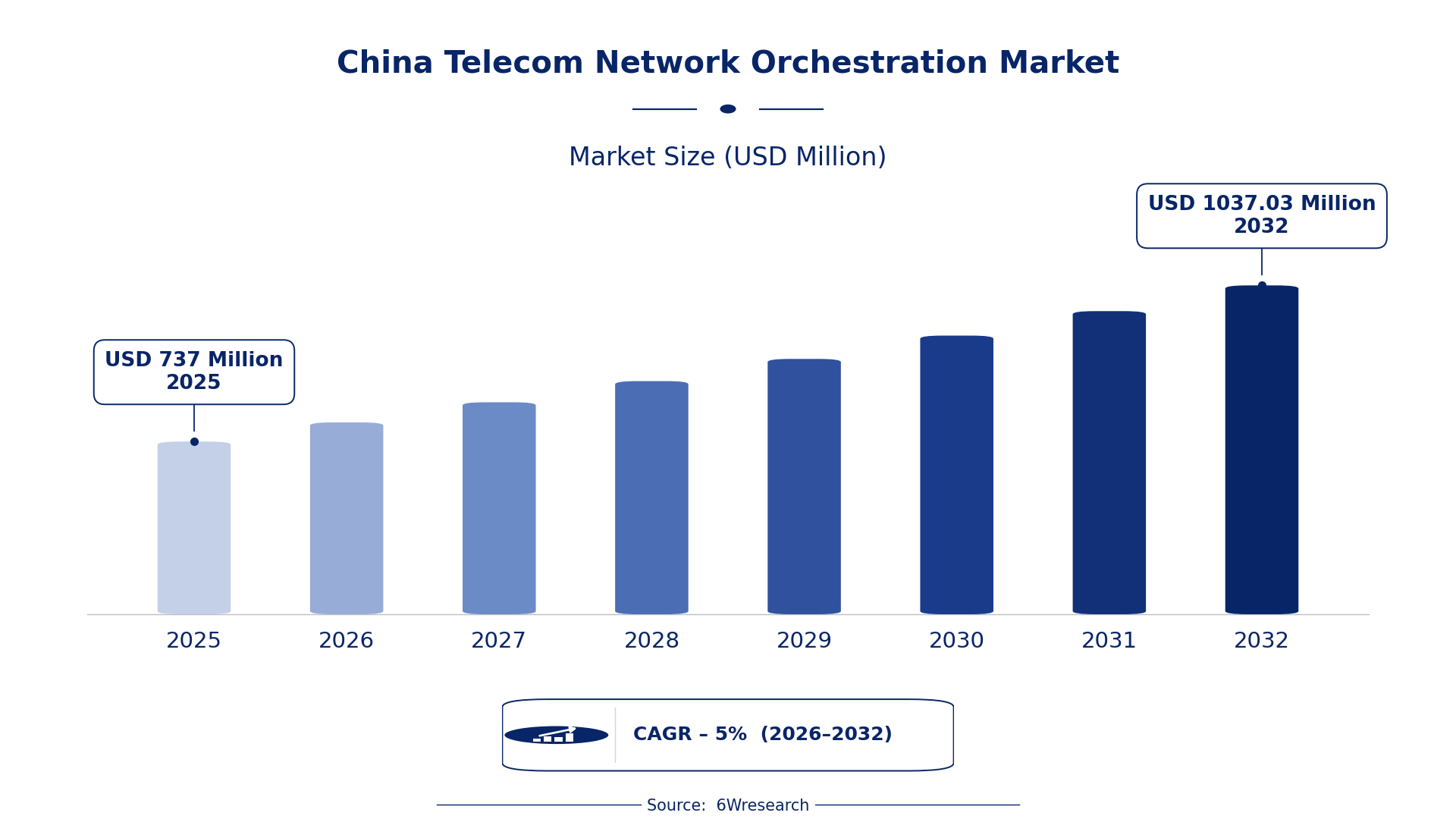
According to 6Wresearch internal database and industry insights, the China Telecom Network Orchestration Market was valued at USD 737.0 million in 2025 and is projected to reach USD 1,037.03 million by 2032, growing at a CAGR of approximately 5% during 2026–2032.
China Telecom Network Orchestration Market Highlights
| Report Metric | Details |
| Report Name | China Telecom Network Orchestration Market |
| Market Size 2025 | USD 737.0 million |
| Market Size 2032 | USD 1,037.03 million |
| Absolute Growth 2025–2032 | USD 300.03 million |
| CAGR 2026–2032 | 5% |
| Peak Annual Growth | 7.4% in 2028 |
| Forecast Period | 2026–2032 |
| Historical Data | 2022–2025 |
| Base Year | 2025 |
| Leading Network Orchestration, 2025 | SDN Orchestration (43% share) |
| Leading Product Type, 2025 | Software Controllers (48% share) |
| Leading Platform Type, 2025 | OpenFlow (49% share) |
| Leading Distribution Channel, 2025 | Direct Sales (46% share) |
| Leading End User Industry, 2025 | Network Providers (56% share) |
| Fastest-Growing Network Orchestration | End-to-End Orchestration (7.7% CAGR) |
| Fastest-Growing Product Type | VNFs Manager (7.4% CAGR) |
| Fastest-Growing Platform Type | MANO Framework (7.6% CAGR) |
| Fastest-Growing Distribution Channel | Cloud Integrators (7.1% CAGR) |
| Fastest-Growing End User Industry | Virtual Telcos (7.2% CAGR) |
| Growing Sector | Telecommunications |
| Key End Users | Network Providers, Virtual Telcos, Enterprise Networks |
China Telecom Network Orchestration Market Year-wise Growth Rate and Key Drivers (2022–2032)
This graph illustrates the annual growth rates of the market from 2022 to 2032, highlighting a steady upward trajectory and projected market expansion over the forecast period.
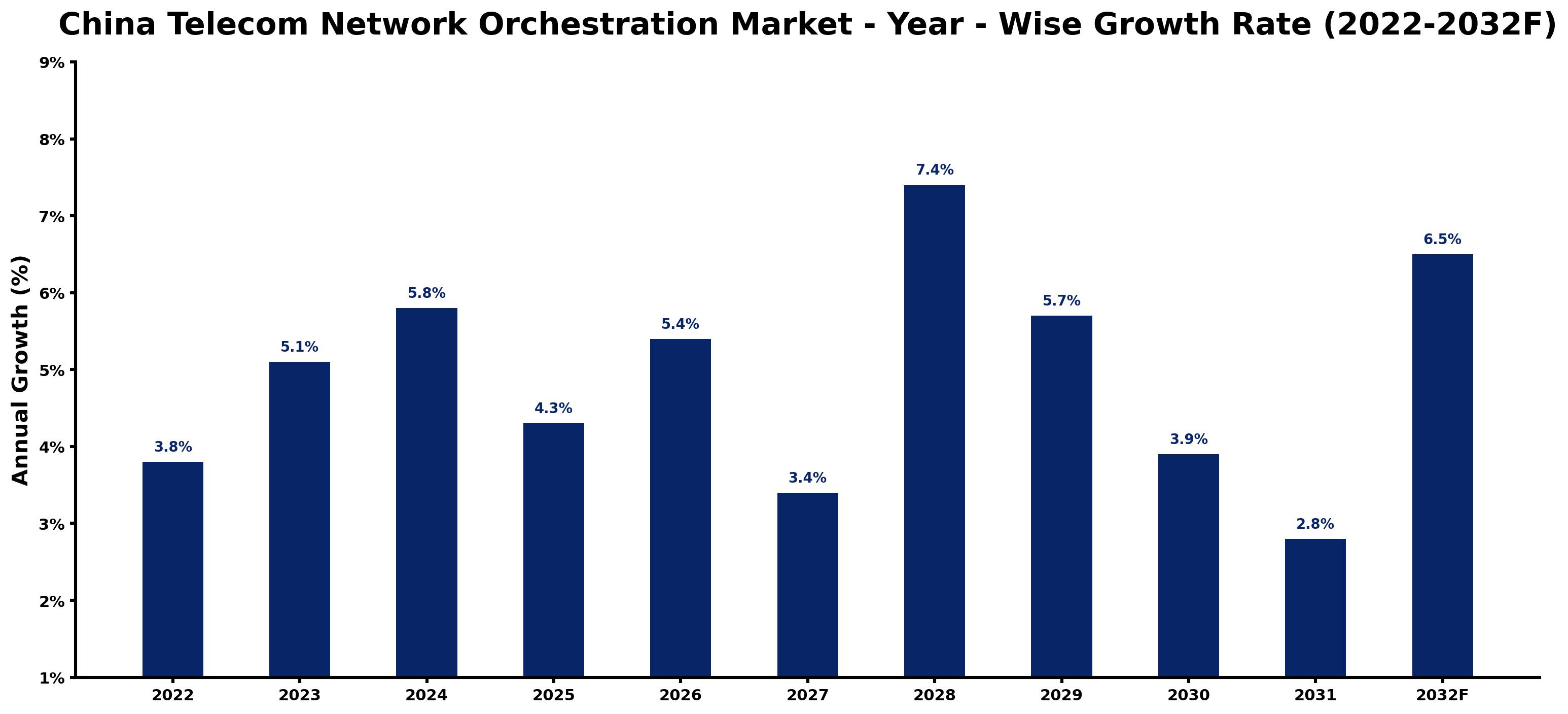
Annual growth estimates for each year appear below with the principal reason behind them, explaining the shifts that set the pace of the market.
| Year | Estimated Annual Growth (%) | Market Rationale |
| 2022 | 3.8 | The market experienced steady growth due to ongoing digital transformation initiatives. |
| 2023 | 5.1 | Increased investments in 5G infrastructure accelerated demand for orchestration solutions. |
| 2024 | 5.8 | The rollout of advanced network technologies further boosted market expansion. |
| 2025 | 4.3 | Growth slowed as firms adjusted to new operational frameworks and standards. |
| 2026 | 5.4 | Rising adoption of software-defined networking drove renewed interest in orchestration. |
| 2027 | 3.4 | Market growth slowed as companies faced integration challenges with legacy systems. |
| 2028 | 7.4 | A surge in 5G deployment led to a peak in orchestration demand. |
| 2029 | 5.7 | Growth decelerated as market players consolidated their service offerings. |
| 2030 | 3.9 | The market continued to grow, albeit at a slower pace due to competitive pressures. |
| 2031 | 2.8 | Demand slowed further as companies focused on cost management strategies. |
| 2032 | 6.5 | A resurgence in network upgrades is expected to stimulate market growth. |
Note: Market size estimations and growth projections presented in this report are based on 6Wresearch's proprietary forecasting methodology, utilizing the latest available industry data, government publications, and primary research inputs.
China Telecom Network Orchestration Market Synopsis
Telecom Network Orchestration in China includes technologies that manage and automate network resources through software-defined networking and network function virtualization. This technology improves network efficiency and lowers operational costs for telecommunications providers. The telecom sector generated over 1 trillion CNY in revenue in 2022, highlighting the increasing demand for advanced orchestration solutions.
Market Dynamics Impact Analysis (2026–2032)
| Factor | Type | Impact | Primary Segment Affected |
| Growing investments in 5G infrastructure are driving demand for orchestration solutions. | Driver | High | SDN Orchestration |
| The increasing number of mobile subscribers creates a need for efficient network management. | Driver | High | NFV Orchestration |
| The integration of telecom and AI technologies presents new opportunities for service enhancement. | Opportunity | High | End-to-End Orchestration |
| The push for digital infrastructure under the 'Digital China' strategy opens avenues for investment. | Opportunity | High | Network Providers |
| Integration challenges with legacy systems may hinder the adoption of orchestration technologies. | Restraint | High | Edge Orchestration |
| The complexity of managing multi-vendor environments can limit operational efficiency. | Restraint | Medium | Software Controllers |
| The need for skilled professionals in orchestration technology remains a significant barrier. | Challenge | High | VNFs Manager |
| Regulatory compliance requirements can delay implementation timelines for new solutions. | Challenge | Medium | Hybrid Controllers |
Evaluation of Drivers in China Telecom Network Orchestration Market (2026–2032)
The main growth drivers and the segments they affect most are set out below.
| Drivers | Primary Segment Affected | Why It Matters (Evidence) |
| Increased investments in 5G infrastructure drive the need for orchestration solutions. | SDN Orchestration | China's telecom industry is expected to invest 2 trillion CNY in network upgrades by 2025. |
| The growing mobile subscriber base necessitates efficient network management solutions. | NFV Orchestration | With over 1.4 billion mobile subscribers as of 2023, demand for orchestration technologies is rising. |
| The 'Digital China' strategy promotes advanced digital infrastructure development in telecom. | End-to-End Orchestration | This initiative aims to improve digital infrastructure by 2025, benefiting telecom service providers. |
| The integration of AI technologies into telecom networks boosts the demand for orchestration solutions. | Edge Orchestration | The 'New Infrastructure' initiative promotes the integration of telecom and AI technologies, driving demand for orchestration. |
| Standardisation efforts in telecom orchestration support market growth. | Software Controllers | Telecom orchestration standards are being developed under the China Communications Standards Association, facilitating better integration. |
The Telecom Network Orchestration market in China is growing as end-use demand rises from the telecom sector. Investments in 5G infrastructure are expected to reach 2 trillion CNY by 2025, driving the need for advanced orchestration solutions. With over 1.4 billion mobile subscribers as of 2023, network providers must manage resources efficiently to maintain service quality. The integration of AI technologies into telecom networks is likely to further boost demand for orchestration solutions, reflecting a vibrant market environment. Standardisation efforts will also create a clearer framework for operations, encouraging collaboration across the industry.
Evaluation of Restraints in China Telecom Network Orchestration Market
Below mentioned are some major restraints and their influence on market dynamics.
| Market Restraint | Primary Segment Affected | Why It Matters (Evidence) |
| Integration challenges with legacy systems hinder orchestration adoption. | Edge Orchestration | Many telecom providers still rely on outdated infrastructure, complicating new implementations and delaying projects by up to six months. |
| Complexity in managing multi-vendor environments limits operational efficiency. | Software Controllers | Diverse systems create compatibility issues, which can increase operational costs by approximately 20%. |
| The shortage of skilled professionals in orchestration technology poses a barrier. | VNFs Manager | Limited talent availability can delay project timelines and increase costs, affecting service delivery for buyers. |
| Regulatory compliance requirements can slow down implementation timelines. | Hybrid Controllers | Telecom providers must navigate complex regulations, impacting deployment speed and increasing project costs by up to 15%. |
| High initial investment costs can deter smaller firms from adopting orchestration solutions. | SDN Orchestration | Smaller network providers may struggle to allocate sufficient budgets for advanced technologies, limiting their growth potential. |
China Telecom Network Orchestration Market Challenges
The telecom network orchestration market in China still has to solve a few problems, starting with fierce competition that compresses profit margins, making it challenging for producers to sustain their operations. Buyers often face service delivery delays caused by inconsistent management of network resources, which can prolong project timelines by up to six months. Increasing operational costs, especially for network upgrades, pose a financial strain on telecom providers, with an estimated investment of 2 trillion CNY needed by 2025. A shortage of skilled professionals in advanced network management technologies hampers the effective rollout of 5G networks, limiting service options for buyers.
Trends in the China Telecom Network Orchestration Market
Buyers and suppliers in the China Telecom Network Orchestration Market are adjusting to the following trends.
- Shift towards AI-Integrated Telecom Solutions: China is increasingly adopting AI technologies in telecom orchestration, improving efficiency and service delivery. The 'New Infrastructure' initiative promotes this integration, with an estimated investment of 2 trillion CNY by 2025.
- Expansion of 5G Networks Nationwide: The deployment of 5G networks across China is accelerating demand for orchestration solutions. As of 2023, the telecom sector generated over 1 trillion CNY in revenue, reflecting this trend.
- Growth in End-to-End Orchestration: End-to-End Orchestration is gaining traction as telecom providers seek comprehensive management solutions. This segment is projected to grow at a CAGR of 7.7% from 2026 to 2032.
- Increased Focus on Cybersecurity in Telecom: With the introduction of the 'Telecom Network Security Protection Regulation' in 2020, providers are prioritising cybersecurity measures, impacting orchestration strategies.
Investment Opportunities in the China Telecom Network Orchestration Market
Some of the investment opportunities in the China Telecom Network Orchestration Market are mentioned below.
- Investment in 5G Infrastructure: With an expected investment of 2 trillion CNY by 2025, there is an opportunity for suppliers of orchestration solutions to partner with network providers to improve service delivery.
- Collaboration with Cloud Integrators: The rise of Cloud Integrators presents opportunities for partnerships to improve orchestration services, particularly as this segment is projected to grow significantly in the coming years.
- Focus on Digital Economy Development: Virtual Telcos are increasingly relying on orchestration for service delivery, presenting an opportunity for targeted investments in this segment.
- Enhancement of Cybersecurity Measures: The introduction of new regulations creates a demand for orchestration solutions that integrate robust cybersecurity protocols, benefiting telecom providers.
Government Initiatives in the China Telecom Network Orchestration Market
In 2023, the State Council issued the 'Action Plan for Promoting the Development of the Digital Economy' to boost investment in digital infrastructure, including telecom networks. This measure complements the 'Digital Economy Development Plan' approved in 2022, which focuses on advancing digital infrastructure and services in the telecom sector. Both initiatives aim to improve productivity and service delivery across the industry, ultimately benefiting telecom network orchestration and its providers. Additionally, the '5G+ Industrial Internet' initiative launched in 2021 promotes the integration of 5G and industrial applications, enhancing operational efficiency for telecom companies.
The National Development and Reform Commission oversees the implementation of various initiatives, including the '5G+ Industrial Internet' initiative. This initiative aims to improve productivity and efficiency in various sectors, including telecommunications. The Ministry of Industry and Information Technology supports projects that align with these goals, facilitating funding and approvals for relevant developments. By providing financial backing and regulatory support, these agencies enable telecom providers to adopt advanced orchestration solutions more effectively.
Future Insight of the China Telecom Network Orchestration Market
Several forward-looking factors should support the telecom network orchestration market in China over the coming years. The '5G+ Industrial Internet' initiative will stimulate demand for advanced management solutions, driving improvements in network performance. By 2025, the 'Digital China' strategy aims for substantial upgrades in digital infrastructure, which will benefit both buyers and suppliers. The establishment of telecom standards by the China Communications Standards Association will provide a clearer operational framework, facilitating collaboration across the sector.
Market Segmentation Analysis
Each segment group is reviewed below, with the leader by share and the fastest grower by CAGR.
By Network Orchestration – SDN Orchestration Dominated, End-to-End Orchestration Expected to Grow Fastest
According to Sumit Sagar, AM at 6Wresearch, SDN Orchestration accounted for a 43% market share by network orchestration in 2025. SDN Orchestration commands the largest share due to its essential role in efficiently managing network resources for telecom providers. The deployment of over 1.4 billion mobile subscriptions in China highlights the critical reliance on SDN for optimising operational performance. End-to-End Orchestration is set to record the highest CAGR in this split, 7.7% over 2026–2032. End-to-End Orchestration is rapidly growing as it is crucial for comprehensive network management, particularly with the nationwide rollout of 5G networks. The push from the 'Digital China' strategy to enhance digital infrastructure by 2025 will further drive this demand. Suppliers should focus on developing advanced SDN solutions to address the increasing requirements of network providers.
By Product Type – Software Controllers Dominated, VNFs Manager Expected to Grow Fastest
In 2025, Software Controllers led the product type split with a 48% share. Software Controllers dominate the market share as they are fundamental for the effective control of network operations. Their extensive use among telecom providers demonstrates their importance in optimising network performance and resource allocation. The quickest growth will come from VNFs Manager, forecast to expand at a CAGR of 7.4% between 2026 and 2032. VNFs Manager is witnessing rapid growth due to the rising need for managing virtual network functions within modern telecom infrastructures. As telecom companies invest heavily in network upgrades, the demand for VNFs Managers will continue to surge. Buyers should prioritise acquiring robust VNFs Manager solutions to maintain competitiveness in the evolving telecom landscape.
By Platform Type – OpenFlow Dominated, MANO Framework Expected to Grow Fastest
OpenFlow took a 49% share of platform type in 2025, more than any other category. OpenFlow leads the market share as the key protocol for SDN implementations, making it indispensable for telecom operators. Its established presence in the industry ensures that telecom providers can effectively manage their network resources. MANO Framework is projected to grow fastest, at a CAGR of 7.6% during 2026–2032. The MANO Framework is experiencing rapid growth as it is vital for managing NFV architecture, which is becoming increasingly relevant with the expansion of virtualised networks. This trend aligns with the broader shift towards advanced orchestration solutions in the telecom sector. Suppliers need to invest in developing MANO Framework capabilities to meet the rising demand from telecom operators.
By Distribution Channel – Direct Sales Dominated, Cloud Integrators Expected to Grow Fastest
The largest distribution channel category in 2025 was Direct Sales, with a 46% share of total revenue. Direct Sales captures the largest share as the primary method for selling orchestration solutions, allowing for personalised customer interactions. This approach is particularly effective in the telecom sector, where tailored solutions are essential for success. Over 2026–2032, Cloud Integrators are expected to post the fastest growth, at a CAGR of 7.1%. Cloud Integrators are gaining momentum as they facilitate cloud-based orchestration solutions, which are increasingly sought after by telecom providers. The transition towards cloud services is propelling this growth as companies seek flexible deployment options. Suppliers should enhance partnerships with cloud integrators to capitalise on the growing demand for cloud-based orchestration solutions.
By End User Industry – Network Providers Dominated, Virtual Telcos Expected to Grow Fastest
With a 56% revenue share in 2025, Network Providers was the largest end user industry category. Network Providers represent the largest share as the primary users of orchestration technologies, which are essential for their operations. Their ongoing investment in network upgrades underscores their pivotal role in the telecom ecosystem. Virtual Telcos are set to record the highest CAGR in this split, 7.2% over 2026–2032. Virtual Telcos are experiencing the fastest growth as they depend on orchestration for efficient service delivery in a competitive market. The increasing number of virtual telcos signifies a shift towards more agile and flexible telecom solutions. Buyers must consider the orchestration needs of virtual telcos to remain relevant in the evolving telecom landscape.
Key Attractiveness of the Report
- 10 Years of Market Numbers
- Historical Data Starting from 2022 to 2025
- Base Year 2025
- Forecast Data until 2032
- Key Performance Indicators Impacting the Market
- Major Upcoming Developments and Projects
Key Highlights of the Report:
- China Telecom Network Orchestration Market Outlook
- Market Size of China Telecom Network Orchestration Market, 2025
- Forecast of China Telecom Network Orchestration Market, 2032
- Historical Data and Forecast of China Telecom Network Orchestration Revenues & Volume for the Period 2022 - 2032F
- China Telecom Network Orchestration Market Trend Evolution
- China Telecom Network Orchestration Market Drivers and Challenges
- China Telecom Network Orchestration Price Trends
- China Telecom Network Orchestration Porter's Five Forces
- China Telecom Network Orchestration Industry Life Cycle
- Historical Data and Forecast of China Telecom Network Orchestration Market Revenues & Volume By Network Orchestration for the Period 2022 - 2032F
- Historical Data and Forecast of China Telecom Network Orchestration Market Revenues & Volume By SDN Orchestration for the Period 2022 - 2032F
- Historical Data and Forecast of China Telecom Network Orchestration Market Revenues & Volume By NFV Orchestration for the Period 2022 - 2032F
- Historical Data and Forecast of China Telecom Network Orchestration Market Revenues & Volume By End-to-End Orchestration for the Period 2022 - 2032F
- Historical Data and Forecast of China Telecom Network Orchestration Market Revenues & Volume By Edge Orchestration for the Period 2022 - 2032F
- Historical Data and Forecast of China Telecom Network Orchestration Market Revenues & Volume By Product Type for the Period 2022 - 2032F
- Historical Data and Forecast of China Telecom Network Orchestration Market Revenues & Volume By Software Controllers for the Period 2022 - 2032F
- Historical Data and Forecast of China Telecom Network Orchestration Market Revenues & Volume By VNFs Manager for the Period 2022 - 2032F
- Historical Data and Forecast of China Telecom Network Orchestration Market Revenues & Volume By Hybrid Controllers for the Period 2022 - 2032F
- Historical Data and Forecast of China Telecom Network Orchestration Market Revenues & Volume By Edge Controllers for the Period 2022 - 2032F
- Historical Data and Forecast of China Telecom Network Orchestration Market Revenues & Volume By Platform Type for the Period 2022 - 2032F
- Historical Data and Forecast of China Telecom Network Orchestration Market Revenues & Volume By OpenFlow for the Period 2022 - 2032F
- Historical Data and Forecast of China Telecom Network Orchestration Market Revenues & Volume By MANO Framework for the Period 2022 - 2032F
- Historical Data and Forecast of China Telecom Network Orchestration Market Revenues & Volume By AI-Powered for the Period 2022 - 2032F
- Historical Data and Forecast of China Telecom Network Orchestration Market Revenues & Volume By Kubernetes-based for the Period 2022 - 2032F
- Historical Data and Forecast of China Telecom Network Orchestration Market Revenues & Volume By Distribution Channel for the Period 2022 - 2032F
- Historical Data and Forecast of China Telecom Network Orchestration Market Revenues & Volume By Direct Sales for the Period 2022 - 2032F
- Historical Data and Forecast of China Telecom Network Orchestration Market Revenues & Volume By Cloud Integrators for the Period 2022 - 2032F
- Historical Data and Forecast of China Telecom Network Orchestration Market Revenues & Volume By SaaS Platforms for the Period 2022 - 2032F
- Historical Data and Forecast of China Telecom Network Orchestration Market Revenues & Volume By DevOps Partners for the Period 2022 - 2032F
- Historical Data and Forecast of China Telecom Network Orchestration Market Revenues & Volume By End User Industry for the Period 2022 - 2032F
- Historical Data and Forecast of China Telecom Network Orchestration Market Revenues & Volume By Network Providers for the Period 2022 - 2032F
- Historical Data and Forecast of China Telecom Network Orchestration Market Revenues & Volume By Virtual Telcos for the Period 2022 - 2032F
- Historical Data and Forecast of China Telecom Network Orchestration Market Revenues & Volume By Enterprise Networks for the Period 2022 - 2032F
- Historical Data and Forecast of China Telecom Network Orchestration Market Revenues & Volume By IoT Networks for the Period 2022 - 2032F
- China Telecom Network Orchestration Import Export Trade Statistics
- Market Opportunity Assessment By Network Orchestration
- Market Opportunity Assessment By Product Type
- Market Opportunity Assessment By Platform Type
- Market Opportunity Assessment By Distribution Channel
- Market Opportunity Assessment By End User Industry
- China Telecom Network Orchestration Top Companies Market Share
- China Telecom Network Orchestration Competitive Benchmarking By Technical and Operational Parameters
- China Telecom Network Orchestration Company Profiles
- China Telecom Network Orchestration Key Strategic Recommendations
Market Covered
Segments analysed in this report are listed below.
By Network Orchestration
- SDN Orchestration
- NFV Orchestration
- End-to-End Orchestration
- Edge Orchestration
By Product Type
- Software Controllers
- VNFs Manager
- Hybrid Controllers
- Edge Controllers
By Platform Type
- OpenFlow
- MANO Framework
- AI-Powered
- Kubernetes-based
By Distribution Channel
- Direct Sales
- Cloud Integrators
- SaaS Platforms
- DevOps Partners
By End User Industry
- Network Providers
- Virtual Telcos
- Enterprise Networks
- IoT Networks































