China Telehealth Software Market Size & Growth Rate
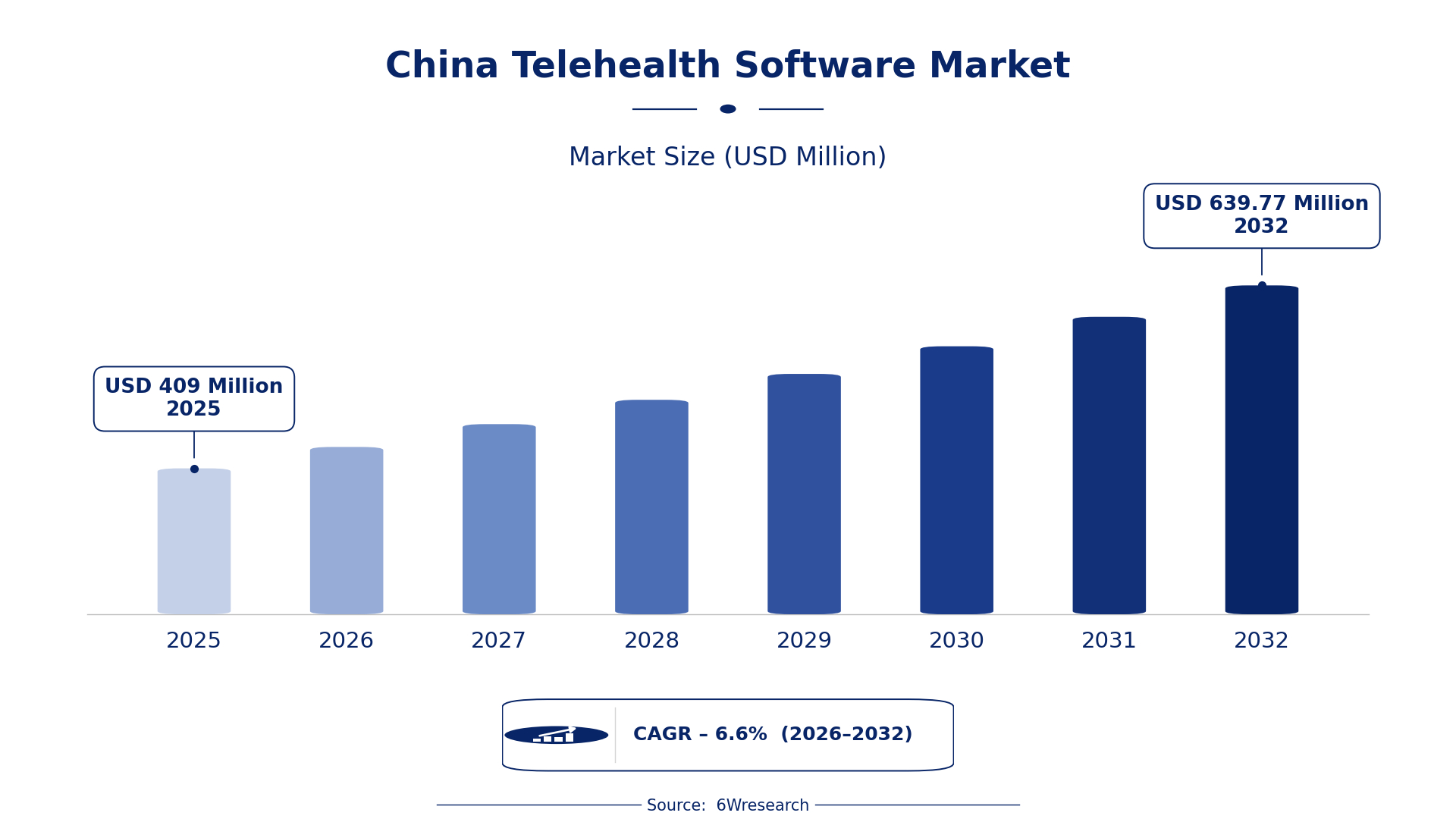
According to 6Wresearch internal database and industry insights, the China Telehealth Software Market was valued at USD 409.0 million in 2025 and is projected to reach USD 639.77 million by 2032, growing at a CAGR of approximately 6.6% during 2026–2032.
China Telehealth Software Market Highlights
| Report Metric | Details |
| Report Name | China Telehealth Software Market |
| Market Size 2025 | USD 409.0 million |
| Market Size 2032 | USD 639.77 million |
| Absolute Growth 2025–2032 | USD 230.77 million |
| CAGR 2026–2032 | 6.6% |
| Peak Annual Growth | 8.0% in 2027 |
| Forecast Period | 2026–2032 |
| Historical Data | 2022–2025 |
| Base Year | 2025 |
| Leading Telehealth Software, 2025 | Video Conferencing Platforms (37% share) |
| Leading Product Type, 2025 | Virtual Clinics (41% share) |
| Leading Deployment Model, 2025 | Cloud/Web-Based (45% share) |
| Leading Distribution Channel, 2025 | SaaS Providers (42% share) |
| Leading End User Industry, 2025 | Hospitals (41% share) |
| Fastest-Growing Telehealth Software | AI Symptom Checker (7.8% CAGR) |
| Fastest-Growing Product Type | Chatbot Platforms (8.8% CAGR) |
| Fastest-Growing Deployment Model | API-Based (8.7% CAGR) |
| Fastest-Growing Distribution Channel | Online Subscriptions (8.7% CAGR) |
| Fastest-Growing End User Industry | Digital Health Startups (9.3% CAGR) |
| Growing Sector | Digital Health Startups |
| Key End Users | Hospitals, Multi-Specialty Clinics, Independent Practices, Digital Health Startups |
China Telehealth Software Market Year-wise Growth Rate and Key Drivers (2022–2032)
This graph illustrates the annual growth rates of the market from 2022 to 2032, highlighting a steady upward trajectory and projected market expansion over the forecast period.
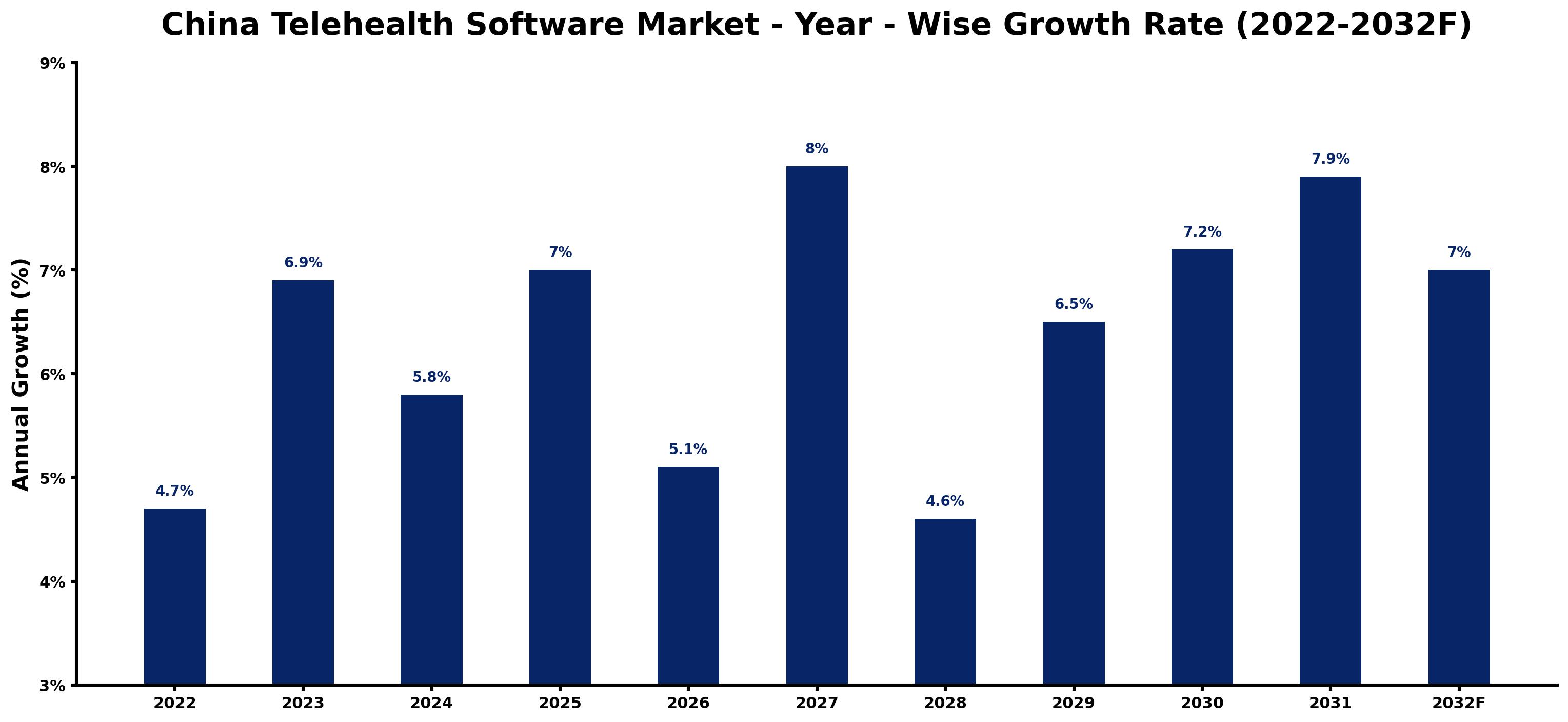
The following table presents the estimated annual growth rate for each year together with the principal factor influencing market performance.
| Year | Estimated Annual Growth (%) | Market Rationale |
| 2022 | 4.7 | The market experienced steady growth as telehealth solutions gained traction among healthcare providers, supported by the National Health Commission's Telemedicine Development Plan. |
| 2023 | 6.9 | Increased adoption was driven by over 70% of urban hospitals implementing telehealth solutions, improving patient access. |
| 2024 | 5.8 | Growth slowed slightly as some hospitals faced integration challenges with existing systems, impacting telehealth deployment. |
| 2025 | 7.0 | The market rebounded with faster growth, supported by the National Standard for Telemedicine Services improving service quality. |
| 2026 | 5.1 | A slowdown is expected as hospitals adjust to new telehealth regulations and standards, affecting implementation speed. |
| 2027 | 8.0 | Growth is projected to accelerate again, driven by the Digital Health Promotion Program encouraging telehealth adoption. |
| 2028 | 4.6 | The market is expected to see a slowdown as hospitals focus on optimising existing telehealth systems and processes. |
| 2029 | 6.5 | Growth is anticipated to pick up due to rising patient demand for telehealth services in major cities, increasing usage. |
| 2030 | 7.2 | The market is projected to continue growing as digital health startups expand their telehealth offerings and services. |
| 2031 | 7.9 | Growth is expected to remain strong, supported by increasing patient acceptance of telehealth solutions and technologies. |
| 2032 | 7.0 | The market growth rate is projected to slow as telehealth services become more established in healthcare practices. |
Note: Market size estimations and growth projections presented in this report are based on 6Wresearch's proprietary forecasting methodology, utilizing the latest available industry data, government publications, and primary research inputs.
China Telehealth Software Market Synopsis
Telehealth Software in China includes digital platforms that enable remote healthcare services, such as video conferencing and patient management tools. Developed with cloud technology, this software ensures easy access to healthcare services. The China Telehealth Software Market is expanding due to increasing demand from urban hospitals and digital health startups. In 2023, over 70% of urban hospitals adopted telehealth solutions, marking a notable change in healthcare delivery. The rise in internet penetration, with more than 1.4 billion users, further supports this trend.
Market Dynamics Impact Analysis (2026–2032)
| Factor | Type | Impact | Primary Segment Affected |
| Growing internet penetration facilitates telehealth adoption. | Driver | High | Video Conferencing Platforms |
| Rapid implementation of telehealth solutions by hospitals increases demand. | Driver | High | Hospitals |
| Rising patient acceptance of telehealth services presents opportunities. | Opportunity | High | Video Conferencing Platforms |
| Digital health startups are innovating telehealth solutions, creating new markets. | Opportunity | High | Digital Health Startups |
| Integration challenges with existing healthcare systems can hinder adoption. | Restraint | Medium | Video Conferencing Platforms |
| Regulatory compliance requirements may slow down implementation. | Restraint | Medium | Video Conferencing Platforms |
| Limited awareness among rural populations affects service uptake. | Challenge | Medium | Video Conferencing Platforms |
| Technology infrastructure gaps in some regions can delay service delivery. | Challenge | Medium | Video Conferencing Platforms |
Evaluation of Drivers in China Telehealth Software Market (2026–2032)
The main growth drivers and the segments they affect most are set out below.
| Drivers | Primary Segment Affected | Why It Matters (Evidence) |
| Increased internet users improve access to telehealth services. | Video Conferencing Platforms | In 2022, China had over 1.4 billion internet users, facilitating telehealth adoption. |
| Urban hospitals rapidly adopt telehealth solutions to enhance patient care. | Hospitals | In 2023, over 70% of hospitals in urban areas implemented telehealth solutions. |
| The National Standard for Telemedicine Services drives compliance and integration. | Video Conferencing Platforms | Established in 2022, it improves service quality and interoperability across platforms. |
| The Digital Health Promotion Program incentivises hospitals to adopt telehealth solutions. | Hospitals | Launched in 2023, it provides financial support for implementation and integration. |
| Digital health startups are driving innovation in telehealth solutions. | Digital Health Startups | In 2023, over 300 digital health startups focused on telehealth solutions, expanding market offerings. |
In 2023, over 70% of urban hospitals implemented telehealth solutions, which improved patient access. The vast user base of over 1.4 billion internet users in China facilitates the adoption of telehealth, allowing more patients to benefit from these services. The National Standard for Telemedicine Services, introduced in 2022, promotes compliance and integration across platforms, improving service quality. With over 300 digital health startups in 2023, innovation is flourishing, expanding market offerings and driving demand for telehealth software.
Evaluation of Restraints in China Telehealth Software Market
The main factors holding the market back are set out below.
| Market Restraint | Primary Segment Affected | Why It Matters (Evidence) |
| Integration challenges with existing healthcare systems can hinder telehealth adoption. | Hospitals | In 2023, some hospitals faced difficulties integrating telehealth with legacy systems, delaying implementation. |
| Regulatory compliance requirements may slow down implementation of telehealth services. | Video Conferencing Platforms | Healthcare providers must navigate complex regulations, impacting rollout speed and efficiency. |
| Limited awareness among rural populations affects telehealth service uptake. | Video Conferencing Platforms | In 2023, many rural residents remained unaware of available telehealth options, reducing potential user base. |
| Technology infrastructure gaps in some regions can delay service delivery. | Video Conferencing Platforms | Inadequate internet connectivity in rural areas affects telehealth access and usage rates. |
| High initial setup costs for telehealth systems may deter smaller practices. | Independent Practices | Independent practices often struggle with the financial burden of implementation, limiting their service offerings. |
China Telehealth Software Market Challenges
The China Telehealth Software Market encounters several practical issues, starting with a skills shortage among healthcare professionals. This gap arises because the rapid growth of telehealth has outpaced the availability of training programs, hindering the adoption of these solutions in clinics. Supply chain constraints affect many telehealth providers who depend on a limited number of technology suppliers, resulting in service disruptions that can lead to longer wait times for hospitals. Some healthcare facilities face challenges with outdated technology, which restricts the integration of modern telehealth systems and limits patient access to timely care. Increased competition among digital health startups drives down prices, which may compromise service quality for buyers seeking affordable options.
Trends in the China Telehealth Software Market
Four trends stand out in the China Telehealth Software Market.
- Digital Health Promotion Program Encouraging Adoption: The Digital Health Promotion Program launched in 2023 is motivating hospitals to adopt telehealth solutions. With financial incentives for implementation, over 80% of multi-specialty clinics reported using telehealth software, indicating a shift in healthcare delivery.
- Shift Towards Cloud-Based Solutions: Cloud-based telehealth solutions represent 85% of the market share in China. This trend highlights a preference for accessible and scalable healthcare delivery methods, enabling healthcare providers to effectively reach more patients.
- Growing Use of Virtual Clinics: Virtual Clinics have become the leading platform for delivering remote healthcare services, holding a 41% market share in 2025. This shift underscores the increasing reliance on digital platforms for patient consultations and care.
- Rise of AI Symptom Checkers: AI Symptom Checkers are becoming more popular in telehealth, with a projected CAGR of 7.8% from 2026 to 2032. This trend reflects a growing interest in integrating AI tools for preliminary diagnosis and patient engagement.
Investment Opportunities in the China Telehealth Software Market
The following opportunities in the China Telehealth Software Market pair current demand with a clear way in.
- Hospitals Seeking Telehealth Solutions: Hospitals are increasingly pursuing telehealth solutions to enhance patient care. With over 70% of urban hospitals implementing these systems, there is a strong opportunity to provide software solutions that meet their needs.
- Digital Health Startups Innovating: The emergence of over 300 digital health startups focusing on telehealth solutions offers a unique opportunity. Suppliers can invest in partnerships or technology to support these innovators and effectively capture market share.
- Multi-Specialty Clinics Expanding Services: Multi-specialty clinics are broadening their services through telehealth, with 80% reporting usage in 2023. This creates a demand for comprehensive telehealth software solutions that address diverse patient needs and improve operational efficiency.
- Growing Demand for Patient Management Tools: The need for effective patient management tools is increasing, with hospitals adopting telehealth solutions at a higher rate. Suppliers can focus on developing integrated platforms that streamline patient interactions and data management, aligning with market demands.
Government Initiatives in the China Telehealth Software Market
The Telemedicine Development Plan (2021-2025) by the National Health Commission aims to integrate telehealth into primary healthcare, improving access for rural populations. This initiative encourages hospitals to adopt telehealth solutions, enhancing service delivery across regions. In 2022, the Ministry of Industry and Information Technology launched the Digital Health Initiative with a budget of 500 million CNY, promoting telehealth technologies and providing funding for hospitals to implement these systems. The Health Information Technology Standards were updated in 2023 to include telehealth requirements for data security and interoperability, ensuring compliance and improving service quality.
The National Health Insurance Administration oversees the inclusion of telehealth services in reimbursement policies, expanding access for patients. This agency ensures that healthcare providers meet the necessary standards for telehealth implementation, facilitating smoother integration into existing healthcare systems. Financial incentives are provided to hospitals adopting telehealth solutions, encouraging broader acceptance and use of these technologies. The Digital Health Initiative also funds projects aimed at enhancing telehealth capabilities in various healthcare settings.
Future Insight of the China Telehealth Software Market
By 2032, transformative changes in the China Telehealth Software Market will stem from government initiatives and technological advancements. The Telemedicine Development Plan aims to expand digital health services, likely increasing telehealth usage among rural populations. Over 70% of hospitals in urban areas have already implemented telehealth solutions, paving the way for broader adoption. The establishment of the National Standard for Telemedicine Services will create uniform practices, improving service quality and building greater patient trust in remote healthcare.
Market Segmentation Analysis
The report offers a comprehensive study of the following market segments and their leading categories in the market.
By Telehealth Software – Video Conferencing Platforms Dominated, AI Symptom Checker Expected to Grow Fastest
According to Sumit Sagar, AM at 6Wresearch, Video Conferencing Platforms held a 37% share of the China Telehealth Software Market by telehealth software in 2025. Video conferencing platforms capture the largest share of the market as they are essential for remote consultations and patient interactions. With over 70% of hospitals in urban areas implementing these platforms, their significance in telehealth delivery is undeniable. AI Symptom Checker is projected to grow fastest, at a CAGR of 7.8% during 2026–2032. The AI symptom checker is rapidly gaining traction as it serves as an adjunct tool for preliminary diagnosis, thereby enhancing patient engagement. As more patients utilise telehealth services, the demand for such tools will continue to escalate. This trend suggests that suppliers should focus on improving video conferencing capabilities to cater to the growing demand.
By Product Type – Virtual Clinics Dominated, Chatbot Platforms Expected to Grow Fastest
With a 41% revenue share in 2025, Virtual Clinics was the largest product type category. Virtual clinics dominate the market share as they are the primary platform for delivering remote healthcare services, addressing the needs of a large patient base. The fact that over 70% of urban hospitals have integrated telehealth solutions reinforces their leading position. Over 2026–2032, Chatbot Platforms are expected to post the fastest growth, at a CAGR of 8.8%. Chatbot platforms are experiencing the fastest growth as they provide essential assistance in telehealth services. The rise of digital health startups is likely to drive the demand for efficient patient engagement tools like chatbots, further accelerating their adoption. Suppliers should consider investing in chatbot technologies to leverage this expanding market segment.
By Deployment Model – Cloud/Web-Based Dominated, API-Based Expected to Grow Fastest
In 2025, Cloud/Web-Based led the deployment model split with a 45% share. Cloud/web-based solutions hold the largest market share as they represent the most common deployment model, ensuring accessibility for users across various healthcare settings. The significant share attributed to cloud technology indicates that this model effectively meets modern healthcare demands. API-Based is set to record the highest CAGR in this split, 8.7% over 2026–2032. API-based solutions are witnessing rapid growth as they facilitate integration with existing systems, even though they are not standalone products. The surge in digital health startups is propelling the need for such integration capabilities, further boosting this segment's growth. Vendors should enhance their API offerings to attract clients seeking integrated telehealth solutions.
By Distribution Channel – SaaS Providers Dominated, Online Subscriptions Expected to Grow Fastest
SaaS Providers accounted for a 42% market share by distribution channel in 2025. SaaS providers lead the distribution channel, serving as the main delivery model for telehealth software. This model has become increasingly popular due to its flexibility and ease of access for healthcare providers. The quickest growth will come from Online Subscriptions, forecast to expand at a CAGR of 8.7% between 2026 and 2032. Online subscriptions are rapidly gaining traction as a preferred model for accessing telehealth services. The convenience and affordability of subscription-based access are appealing to both providers and patients, driving this growth in the market. Suppliers should focus on optimising their online subscription models to meet the changing preferences of users.
By End User Industry – Hospitals Dominated, Digital Health Startups Expected to Grow Fastest
The largest end user industry category in 2025 was Hospitals, with a 41% share of total revenue. Hospitals represent the largest share of telehealth software users, employing these solutions extensively for patient care and management. The integration of telehealth solutions in over 70% of urban hospitals highlights their vital role in healthcare delivery. Digital Health Startups are projected to grow fastest, at a CAGR of 9.3% during 2026–2032. Digital health startups are expanding swiftly, driving innovation in telehealth software development. Their agility and focus on new technologies are reshaping the market, leading to increased competition and diverse offerings. This indicates that suppliers should collaborate with digital health startups to maintain a competitive edge in the telehealth market.
Key Attractiveness of the Report
- 10 Years of Market Numbers
- Historical Data Starting from 2022 to 2025
- Base Year 2025
- Forecast Data until 2032
- Key Performance Indicators Impacting the Market
- Major Upcoming Developments and Projects
Key Highlights of the Report:
- China Telehealth Software Market Outlook
- Market Size of China Telehealth Software Market, 2025
- Forecast of China Telehealth Software Market, 2032
- Historical Data and Forecast of China Telehealth Software Revenues & Volume for the Period 2022 - 2032F
- China Telehealth Software Market Trend Evolution
- China Telehealth Software Market Drivers and Challenges
- China Telehealth Software Price Trends
- China Telehealth Software Porter's Five Forces
- China Telehealth Software Industry Life Cycle
- Historical Data and Forecast of China Telehealth Software Market Revenues & Volume By Telehealth Software for the Period 2022 - 2032F
- Historical Data and Forecast of China Telehealth Software Market Revenues & Volume By Video Conferencing Platforms for the Period 2022 - 2032F
- Historical Data and Forecast of China Telehealth Software Market Revenues & Volume By EHR Integration Software for the Period 2022 - 2032F
- Historical Data and Forecast of China Telehealth Software Market Revenues & Volume By Scheduling & Billing Tools for the Period 2022 - 2032F
- Historical Data and Forecast of China Telehealth Software Market Revenues & Volume By AI Symptom Checker for the Period 2022 - 2032F
- Historical Data and Forecast of China Telehealth Software Market Revenues & Volume By Product Type for the Period 2022 - 2032F
- Historical Data and Forecast of China Telehealth Software Market Revenues & Volume By Virtual Clinics for the Period 2022 - 2032F
- Historical Data and Forecast of China Telehealth Software Market Revenues & Volume By Patient Records Sync for the Period 2022 - 2032F
- Historical Data and Forecast of China Telehealth Software Market Revenues & Volume By Admin Portals for the Period 2022 - 2032F
- Historical Data and Forecast of China Telehealth Software Market Revenues & Volume By Chatbot Platforms for the Period 2022 - 2032F
- Historical Data and Forecast of China Telehealth Software Market Revenues & Volume By Deployment Model for the Period 2022 - 2032F
- Historical Data and Forecast of China Telehealth Software Market Revenues & Volume By Cloud/Web-Based for the Period 2022 - 2032F
- Historical Data and Forecast of China Telehealth Software Market Revenues & Volume By API-Based for the Period 2022 - 2032F
- Historical Data and Forecast of China Telehealth Software Market Revenues & Volume By On-Prem/Cloud for the Period 2022 - 2032F
- Historical Data and Forecast of China Telehealth Software Market Revenues & Volume By ML-Based for the Period 2022 - 2032F
- Historical Data and Forecast of China Telehealth Software Market Revenues & Volume By Distribution Channel for the Period 2022 - 2032F
- Historical Data and Forecast of China Telehealth Software Market Revenues & Volume By SaaS Providers for the Period 2022 - 2032F
- Historical Data and Forecast of China Telehealth Software Market Revenues & Volume By Direct Licensing for the Period 2022 - 2032F
- Historical Data and Forecast of China Telehealth Software Market Revenues & Volume By Medical Software Vendors for the Period 2022 - 2032F
- Historical Data and Forecast of China Telehealth Software Market Revenues & Volume By Online Subscriptions for the Period 2022 - 2032F
- Historical Data and Forecast of China Telehealth Software Market Revenues & Volume By End User Industry for the Period 2022 - 2032F
- Historical Data and Forecast of China Telehealth Software Market Revenues & Volume By Hospitals for the Period 2022 - 2032F
- Historical Data and Forecast of China Telehealth Software Market Revenues & Volume By Multi-Specialty Clinics for the Period 2022 - 2032F
- Historical Data and Forecast of China Telehealth Software Market Revenues & Volume By Independent Practices for the Period 2022 - 2032F
- Historical Data and Forecast of China Telehealth Software Market Revenues & Volume By Digital Health Startups for the Period 2022 - 2032F
- China Telehealth Software Import Export Trade Statistics
- Market Opportunity Assessment By Telehealth Software
- Market Opportunity Assessment By Product Type
- Market Opportunity Assessment By Deployment Model
- Market Opportunity Assessment By Distribution Channel
- Market Opportunity Assessment By End User Industry
- China Telehealth Software Top Companies Market Share
- China Telehealth Software Competitive Benchmarking By Technical and Operational Parameters
- China Telehealth Software Company Profiles
- China Telehealth Software Key Strategic Recommendations
Market Covered
Segments analysed in this report are listed below.
By Telehealth Software
- Video Conferencing Platforms
- EHR Integration Software
- Scheduling & Billing Tools
- AI Symptom Checker
By Product Type
- Virtual Clinics
- Patient Records Sync
- Admin Portals
- Chatbot Platforms
By Deployment Model
- Cloud/Web-Based
- API-Based
- On-Prem/Cloud
- ML-Based
By Distribution Channel
- SaaS Providers
- Direct Licensing
- Medical Software Vendors
- Online Subscriptions
By End User Industry
- Hospitals
- Multi-Specialty Clinics
- Independent Practices
- Digital Health Startups































