China Telemedicine and Surgical Simulation Market Size & Growth Rate
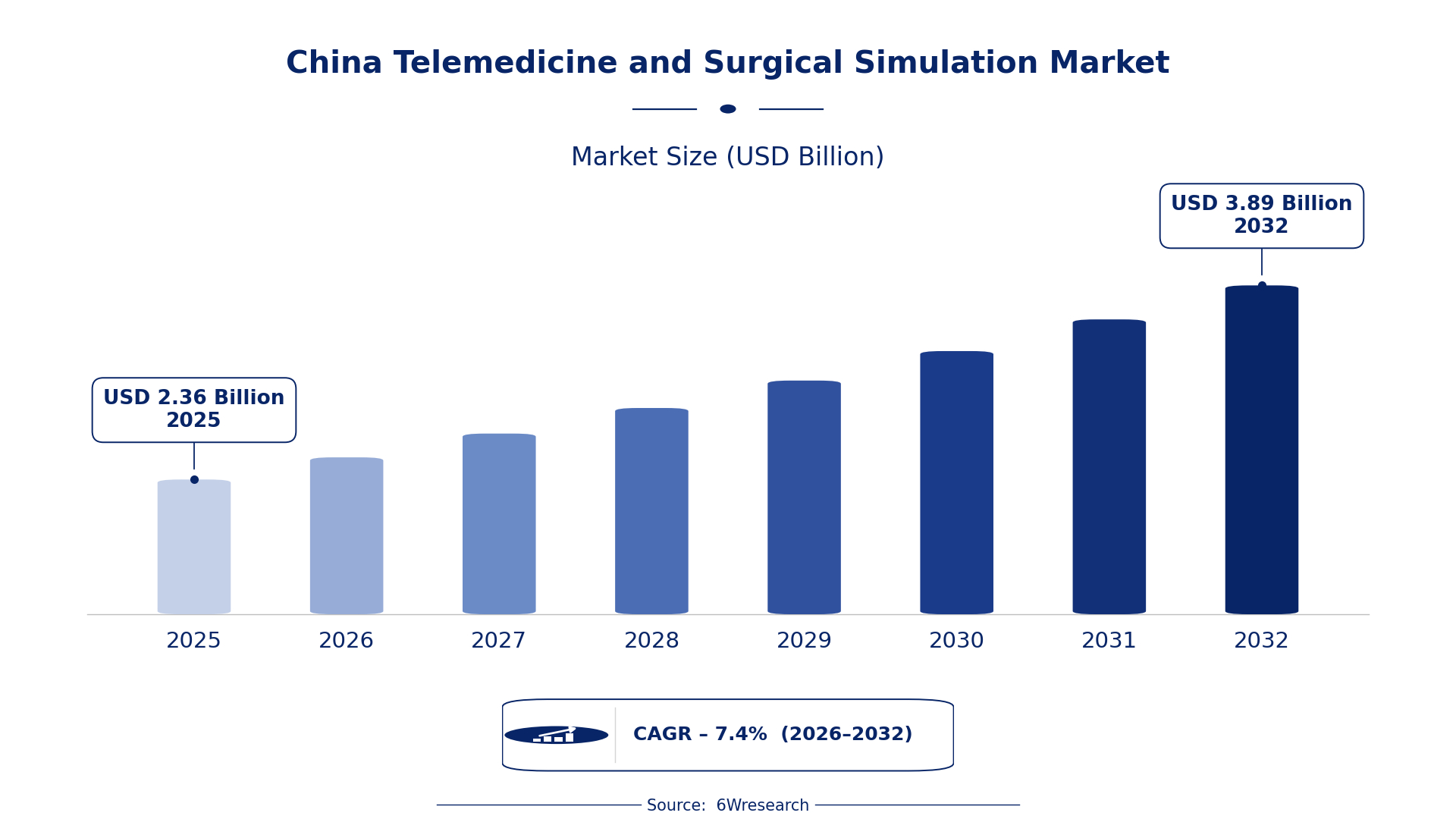
According to 6Wresearch internal database and industry insights, the China Telemedicine and Surgical Simulation Market was valued at USD 2.36 billion in 2025 and is projected to reach USD 3.89 billion by 2032, growing at a CAGR of approximately 7.4% during 2026–2032.
China Telemedicine and Surgical Simulation Market Highlights
| Report Metric | Details |
| Report Name | China Telemedicine and Surgical Simulation Market |
| Market Size 2025 | USD 2.36 billion |
| Market Size 2032 | USD 3.89 billion |
| Absolute Growth 2025–2032 | USD 1.53 billion |
| CAGR 2026–2032 | 7.4% |
| Peak Annual Growth | 9.2% in 2032 |
| Forecast Period | 2026–2032 |
| Historical Data | 2022–2025 |
| Base Year | 2025 |
| Leading Application Type, 2025 | Clinical Teleconsultation (43% share) |
| Leading Simulation Mode, 2025 | VR-Based Training (47% share) |
| Leading Platform Type, 2025 | SaaS-Based Platforms (53% share) |
| Leading End User, 2025 | Tertiary Hospitals (48% share) |
| Fastest-Growing Application Type | Remote Surgery Guidance (9.4% CAGR) |
| Fastest-Growing Simulation Mode | AI-Enabled Modules (8.7% CAGR) |
| Fastest-Growing End User | Research Centers (9.5% CAGR) |
| Growing Sector | Healthcare |
| Key End Users | Tertiary Hospitals, Medical Schools, Surgical Institutions, Research Centers |
China Telemedicine and Surgical Simulation Market Year-wise Growth Rate and Key Drivers (2022–2032)
This graph illustrates the annual growth rates of the market from 2022 to 2032, highlighting a steady upward trajectory and projected market expansion over the forecast period.
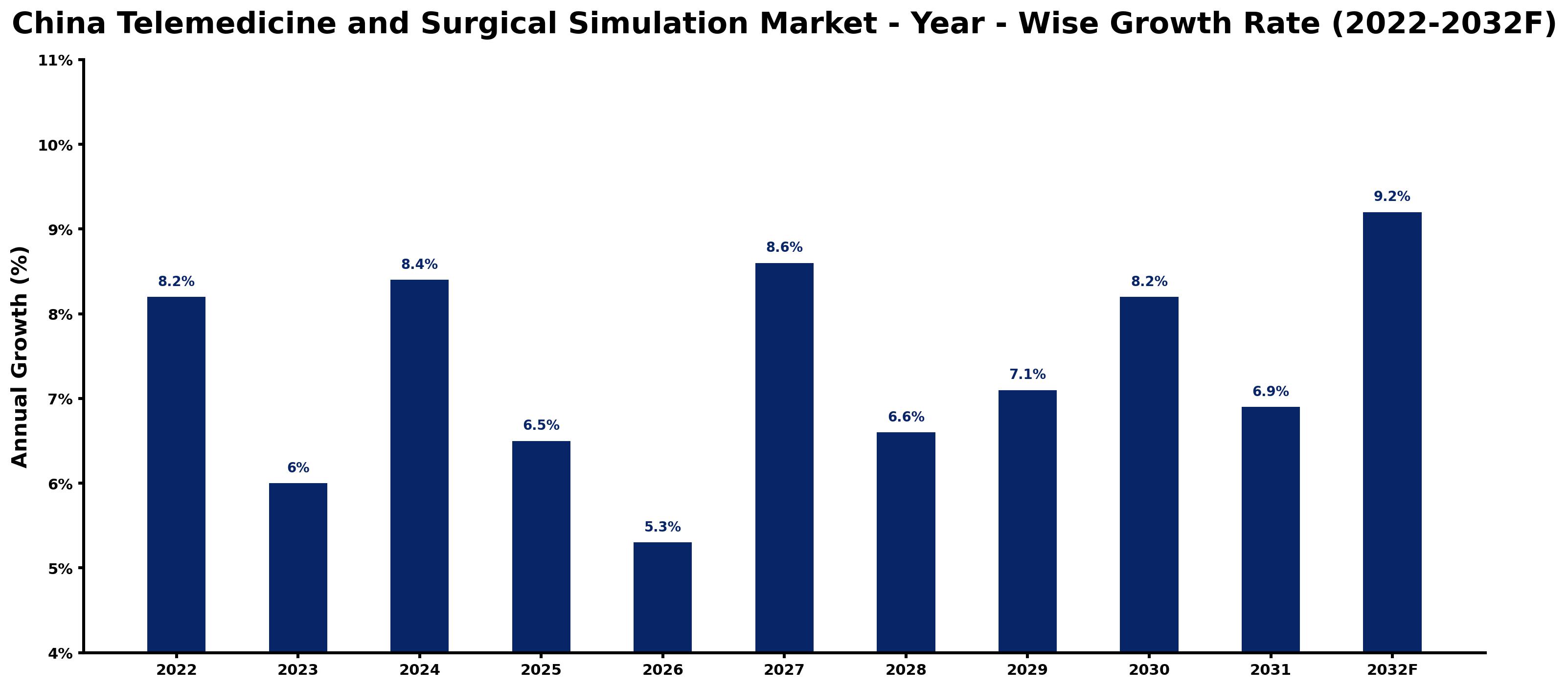
The table below sets out the estimated growth rate for each year and the main factor behind it.
| Year | Estimated Annual Growth (%) | Market Rationale |
| 2022 | 8.2 | The market experienced steady growth due to increased telemedicine adoption among hospitals. |
| 2023 | 6.0 | Growth slowed as hospitals focused on integrating telemedicine into existing systems. |
| 2024 | 8.4 | Demand surged with the rise of clinical teleconsultation services across medical institutions. |
| 2025 | 6.5 | Growth slowed again as hospitals adjusted to new telemedicine regulations and standards. |
| 2026 | 5.3 | The market is expected to face a slowdown as hospitals prioritise operational efficiency over expansion. |
| 2027 | 8.6 | Demand is projected to increase with advancements in remote surgery guidance technologies. |
| 2028 | 6.6 | Growth is expected to slow as hospitals face challenges in implementing new telemedicine solutions. |
| 2029 | 7.1 | Demand is anticipated to rise again due to the increasing integration of telemedicine in medical education. |
| 2030 | 8.2 | Growth is expected to accelerate as urban hospitals expand telemedicine services to meet patient needs. |
| 2031 | 6.9 | Growth is projected to slow as hospitals deal with regulatory compliance and resource allocation. |
| 2032 | 9.2 | The market is expected to peak as telemedicine becomes a standard practice in healthcare delivery. |
Note: Market size estimations and growth projections presented in this report are based on 6Wresearch's proprietary forecasting methodology, utilizing the latest available industry data, government publications, and primary research inputs.
China Telemedicine and Surgical Simulation Market Synopsis
Telemedicine and Surgical Simulation in China encompasses technology that facilitates remote medical services and surgical training. This includes the integration of advanced software and hardware for virtual reality and artificial intelligence applications. The China Telemedicine and Surgical Simulation Market is expanding as hospitals and medical institutions increasingly demand these services, driven by initiatives like the "Healthy China 2030" programme. With over 200 tertiary hospitals adopting these technologies, the market is poised for growth as healthcare providers aim to improve patient care and operational efficiency.
Market Dynamics Impact Analysis (2026–2032)
| Factor | Type | Impact | Primary Segment Affected |
| Growing adoption of telemedicine in hospitals | Driver | High | Clinical Teleconsultation |
| Increasing integration of telemedicine in medical education | Driver | High | VR-Based Training |
| Expansion of telemedicine infrastructure | Opportunity | High | Remote Surgery Guidance |
| Rising demand for surgical training technologies | Opportunity | High | Clinical Teleconsultation |
| Regulatory compliance challenges | Restraint | High | SaaS-Based Platforms |
| Limited telemedicine access in rural areas | Restraint | Medium | Preoperative Planning |
| High costs of advanced telemedicine technologies | Challenge | High | Real-Time Simulation |
| Delays in regulatory approvals for new technologies | Challenge | Medium | Integrated Imaging Systems |
Evaluation of Drivers in China Telemedicine and Surgical Simulation Market (2026–2032)
The main growth drivers and the segments they affect most are set out below.
| Drivers | Primary Segment Affected | Why It Matters (Evidence) |
| Increased telemedicine adoption among hospitals | Clinical Teleconsultation | This has led to a 60% adoption rate among hospitals in 2023, increasing patient consultations. |
| Integration of telemedicine in medical school curricula | VR-Based Training | With 70% of medical schools adopting telemedicine, future healthcare professionals are better prepared. |
| Government funding for telemedicine infrastructure improvements | Remote Surgery Guidance | The "Telemedicine Development Plan" allocates 500 million yuan for improvements, boosting service delivery. |
| Growing demand for surgical training technologies | Clinical Teleconsultation | VR-based surgical simulations are now used in over 100 institutions, enhancing training effectiveness. |
| Expansion of telemedicine services in urban areas | SaaS-Based Platforms | The average population served by a platform is around 1 million, increasing accessibility. |
The Telemedicine and Surgical Simulation market in China is growing on the back of increased telemedicine adoption among hospitals, with a 60% adoption rate in 2023. Integration of telemedicine in medical school curricula is also rising, as 70% of institutions have adopted it. Funding for telemedicine infrastructure improvements is projected to boost service delivery. There is a growing need for surgical training technologies, with VR-based simulations used in over 100 institutions. The average population served by a telemedicine platform in urban areas is around 1 million, increasing accessibility and driving further purchases.
Evaluation of Restraints in China Telemedicine and Surgical Simulation Market
Below mentioned are some major restraints and their influence on market dynamics.
| Market Restraint | Primary Segment Affected | Why It Matters (Evidence) |
| High costs of advanced telemedicine technologies | Real-Time Simulation | These costs limit adoption, particularly in smaller hospitals with budget constraints. |
| Regulatory compliance challenges | SaaS-Based Platforms | Complex regulations slow down the implementation of new telemedicine solutions. |
| Limited telemedicine access in rural areas | Preoperative Planning | This restricts the reach of telemedicine services, affecting patient outcomes. |
| Insufficient training for healthcare providers | VR-Based Training | A lack of trained personnel hinders the effective use of simulation technologies. |
| Delays in regulatory approvals for new technologies | Integrated Imaging Systems | These delays can postpone the introduction of new solutions in the market. |
China Telemedicine and Surgical Simulation Market Challenges
High costs in the China telemedicine and surgical simulation market hinder hospitals, as they must allocate substantial budgets for advanced technology integration. Intense competition among providers leads to inflated service prices, forcing medical institutions to spend more on remote consultations. Skills shortages limit the effectiveness of training programs, with many hospitals reporting a lack of qualified personnel, which can delay surgical training by up to six months. Integration issues arise for buyers, as 60% of hospitals face challenges in adopting telemedicine services, resulting in inefficient patient care and increased operational costs.
Trends in the China Telemedicine and Surgical Simulation Market
Several trends are reshaping the China Telemedicine and Surgical Simulation Market; the most important are set out below.
- Launch of the "Healthy China 2030" Initiative: The "Healthy China 2030" initiative aims to improve telemedicine access across rural areas by 2025, promoting remote consultations and surgical training. This has led to a 60% adoption rate among hospitals.
- Increase in VR-Based Training Utilisation: In 2023, VR-based surgical simulations are used in over 100 medical institutions, improving training for future healthcare professionals. This trend reflects a commitment to immersive learning experiences.
- Shift Towards AI Integration in Telemedicine: The "Smart Healthcare Initiative" launched in 2023 focuses on integrating AI in telemedicine services, particularly in urban hospitals. This shift is expected to streamline patient care and improve outcomes.
- Expansion of Telemedicine in Medical Schools: In 2023, 70% of medical schools in China integrated telemedicine into their curricula, reflecting a shift in training future healthcare professionals. This trend supports the rising need for telemedicine services.
Investment Opportunities in the China Telemedicine and Surgical Simulation Market
Some of the investment opportunities in the China Telemedicine and Surgical Simulation Market are mentioned below.
- Supply of Advanced Telemedicine Technologies: With a 60% adoption rate among hospitals, there is an opportunity to supply advanced telemedicine technologies. Urban hospitals are particularly in need of these solutions, and partnerships with local firms can facilitate entry.
- Investment in Telemedicine Training Programs: The Ministry of Education supports telemedicine training programs in over 50 universities, creating a demand for training resources. Investing in educational tools can effectively meet this need.
- Development of Remote Surgery Guidance Solutions: The market for Remote Surgery Guidance is growing rapidly. Focusing on this area can yield substantial returns, especially among surgical institutions.
- Expansion of SaaS-Based Telemedicine Platforms: SaaS-Based Platforms accounted for 53% of the market in 2025, indicating strong demand for scalable solutions. Collaborating with tertiary hospitals can improve market penetration.
Government Initiatives in the China Telemedicine and Surgical Simulation Market
The "Smart Healthcare Initiative" launched in 2023 aims to integrate AI into telemedicine services, improving healthcare delivery. This builds on the "Healthy China 2030" initiative from 2016, which sought to enhance telemedicine access in rural areas by 2025. Together, these measures are designed to streamline telemedicine regulations and promote service delivery across the country.
The National Health Commission oversees the implementation of the "Telemedicine Development Plan" which allocates 500 million yuan for telemedicine infrastructure improvements. Additionally, the Ministry of Education promotes telemedicine training in over 50 universities, ensuring that future healthcare professionals are well-equipped to use these technologies.
Future Insight of the China Telemedicine and Surgical Simulation Market
The China telemedicine and surgical simulation market is set to evolve by 2032, driven by the "Healthy China 2030" initiative and the integration of telemedicine into medical curricula. The adoption of VR-based surgical simulations will expand, with over 100 medical institutions expected to implement these technologies. Enhanced regulatory frameworks will streamline the approval process for new telemedicine technologies, enabling faster access for medical institutions. The development of advanced telemedicine platforms will significantly improve remote healthcare services, benefiting both buyers and suppliers.
Market Segmentation Analysis
The report offers a comprehensive study of the following market segments and their leading categories in the market.
By Application Type – Clinical Teleconsultation Dominated, Remote Surgery Guidance Expected to Grow Fastest
According to Sumit Sagar, AM at 6Wresearch, Clinical Teleconsultation held a 43% share of the China Telemedicine and Surgical Simulation Market by application type in 2025. Clinical teleconsultation holds the largest share due to its extensive use in over 200 tertiary hospitals, facilitating effective patient consultations. The support from the National Health Commission's "Healthy China 2030" initiative further solidifies its importance in the telemedicine landscape. Remote Surgery Guidance is set to record the highest CAGR in this split, 9.4% over 2026–2032. Remote surgery guidance is experiencing rapid growth as it plays a vital role in delivering surgical expertise to underserved areas, with increasing adoption among medical institutions. The 60% telemedicine adoption rate among hospitals in 2023 reflects the escalating demand for this application. This trend suggests that suppliers should enhance clinical teleconsultation features while also investing in remote surgery guidance solutions.
By Simulation Mode – VR-Based Training Dominated, AI-Enabled Modules Expected to Grow Fastest
In 2025, VR-Based Training led the simulation mode split with a 47% share. VR-based training commands the largest share as it is increasingly adopted in over 100 medical institutions for immersive surgical training experiences. This method allows for realistic practice scenarios, making it a preferred choice among educators and trainees alike. Over 2026–2032, AI-Enabled Modules are expected to post the fastest growth, at a CAGR of 8.7%. AI-enabled modules are growing swiftly as they complement VR-based training by providing intelligent insights and adaptive learning experiences. The ongoing development of these modules under the guidance of the China National Health Commission highlights their rising importance in surgical education. Suppliers should prioritise the integration of AI capabilities into their training solutions to meet the evolving demands of medical institutions.
By Platform Type – SaaS-Based Platforms Dominated and Is Expected to Record the Fastest Growth
The largest platform type category in 2025 was SaaS-Based Platforms, with a 53% share of total revenue. SaaS-based platforms dominate the market due to their broad adoption, offering the accessibility and scalability required by healthcare providers throughout China. This model allows for efficient management of telemedicine services, making it the preferred choice for many institutions. Its lead should widen, with a projected CAGR of 9.0% during 2026–2032, the highest in this split. SaaS-based platforms are also the fastest-growing segment, as their flexibility and user-friendliness attract more healthcare providers aiming to implement telemedicine solutions. The increasing reliance on cloud technologies in healthcare is anticipated to further accelerate this growth. Suppliers must ensure their SaaS offerings are robust and user-friendly to effectively capture the expanding market share.
By End User – Tertiary Hospitals Dominated, Research Centers Expected to Grow Fastest
Tertiary Hospitals accounted for a 48% market share by end user in 2025. Tertiary hospitals lead the market as they are the primary users of advanced telemedicine technologies, utilising these services to enhance patient care. Their pivotal role in the healthcare system guarantees a steady demand for telemedicine solutions. Research Centers are projected to grow fastest, at a CAGR of 9.5% during 2026–2032. Research centers are the fastest-growing end users, focusing on the development and testing of new telemedicine solutions that improve healthcare delivery. This growth highlights a heightened emphasis on research and innovation within the telemedicine sector. This indicates that suppliers should engage with research centres to promote collaboration and drive innovation in telemedicine applications.
Key Attractiveness of the Report
- 10 Years of Market Numbers
- Historical Data Starting from 2022 to 2025
- Base Year 2025
- Forecast Data until 2032
- Key Performance Indicators Impacting the Market
- Major Upcoming Developments and Projects
Key Highlights of the Report:
- China Telemedicine and Surgical Simulation Market Outlook
- Market Size of China Telemedicine and Surgical Simulation Market, 2025
- Forecast of China Telemedicine and Surgical Simulation Market, 2032
- Historical Data and Forecast of China Telemedicine and Surgical Simulation Revenues & Volume for the Period 2022 - 2032F
- China Telemedicine and Surgical Simulation Market Trend Evolution
- China Telemedicine and Surgical Simulation Market Drivers and Challenges
- China Telemedicine and Surgical Simulation Price Trends
- China Telemedicine and Surgical Simulation Porter's Five Forces
- China Telemedicine and Surgical Simulation Industry Life Cycle
- Historical Data and Forecast of China Telemedicine and Surgical Simulation Market Revenues & Volume By Application Type for the Period 2022 - 2032F
- Historical Data and Forecast of China Telemedicine and Surgical Simulation Market Revenues & Volume By Remote Surgery Guidance for the Period 2022 - 2032F
- Historical Data and Forecast of China Telemedicine and Surgical Simulation Market Revenues & Volume By Preoperative Planning for the Period 2022 - 2032F
- Historical Data and Forecast of China Telemedicine and Surgical Simulation Market Revenues & Volume By Clinical Teleconsultation for the Period 2022 - 2032F
- Historical Data and Forecast of China Telemedicine and Surgical Simulation Market Revenues & Volume By Real-Time Simulation for the Period 2022 - 2032F
- Historical Data and Forecast of China Telemedicine and Surgical Simulation Market Revenues & Volume By Simulation Mode for the Period 2022 - 2032F
- Historical Data and Forecast of China Telemedicine and Surgical Simulation Market Revenues & Volume By VR-Based Training for the Period 2022 - 2032F
- Historical Data and Forecast of China Telemedicine and Surgical Simulation Market Revenues & Volume By Haptic Feedback for the Period 2022 - 2032F
- Historical Data and Forecast of China Telemedicine and Surgical Simulation Market Revenues & Volume By Video/Voice for the Period 2022 - 2032F
- Historical Data and Forecast of China Telemedicine and Surgical Simulation Market Revenues & Volume By AI-Enabled Modules for the Period 2022 - 2032F
- Historical Data and Forecast of China Telemedicine and Surgical Simulation Market Revenues & Volume By Platform Type for the Period 2022 - 2032F
- Historical Data and Forecast of China Telemedicine and Surgical Simulation Market Revenues & Volume By Desktop/AR Headset for the Period 2022 - 2032F
- Historical Data and Forecast of China Telemedicine and Surgical Simulation Market Revenues & Volume By Simulated Models for the Period 2022 - 2032F
- Historical Data and Forecast of China Telemedicine and Surgical Simulation Market Revenues & Volume By SaaS-Based Platforms for the Period 2022 - 2032F
- Historical Data and Forecast of China Telemedicine and Surgical Simulation Market Revenues & Volume By Integrated Imaging Systems for the Period 2022 - 2032F
- Historical Data and Forecast of China Telemedicine and Surgical Simulation Market Revenues & Volume By End User for the Period 2022 - 2032F
- Historical Data and Forecast of China Telemedicine and Surgical Simulation Market Revenues & Volume By Surgical Institutions for the Period 2022 - 2032F
- Historical Data and Forecast of China Telemedicine and Surgical Simulation Market Revenues & Volume By Medical Schools for the Period 2022 - 2032F
- Historical Data and Forecast of China Telemedicine and Surgical Simulation Market Revenues & Volume By Tertiary Hospitals for the Period 2022 - 2032F
- Historical Data and Forecast of China Telemedicine and Surgical Simulation Market Revenues & Volume By Research Centers for the Period 2022 - 2032F
- China Telemedicine and Surgical Simulation Import Export Trade Statistics
- Market Opportunity Assessment By Application Type
- Market Opportunity Assessment By Simulation Mode
- Market Opportunity Assessment By Platform Type
- Market Opportunity Assessment By End User
- China Telemedicine and Surgical Simulation Top Companies Market Share
- China Telemedicine and Surgical Simulation Competitive Benchmarking By Technical and Operational Parameters
- China Telemedicine and Surgical Simulation Company Profiles
- China Telemedicine and Surgical Simulation Key Strategic Recommendations
Market Covered
Segments analysed in this report are listed below.
By Application Type
- Remote Surgery Guidance
- Preoperative Planning
- Clinical Teleconsultation
- Real-Time Simulation
By Simulation Mode
- VR-Based Training
- Haptic Feedback
- Video/Voice
- AI-Enabled Modules
By Platform Type
- Desktop/AR Headset
- Simulated Models
- SaaS-Based Platforms
- Integrated Imaging Systems
By End User
- Surgical Institutions
- Medical Schools
- Tertiary Hospitals
- Research Centers































