China Terrain Following Radar Market Size & Growth Rate
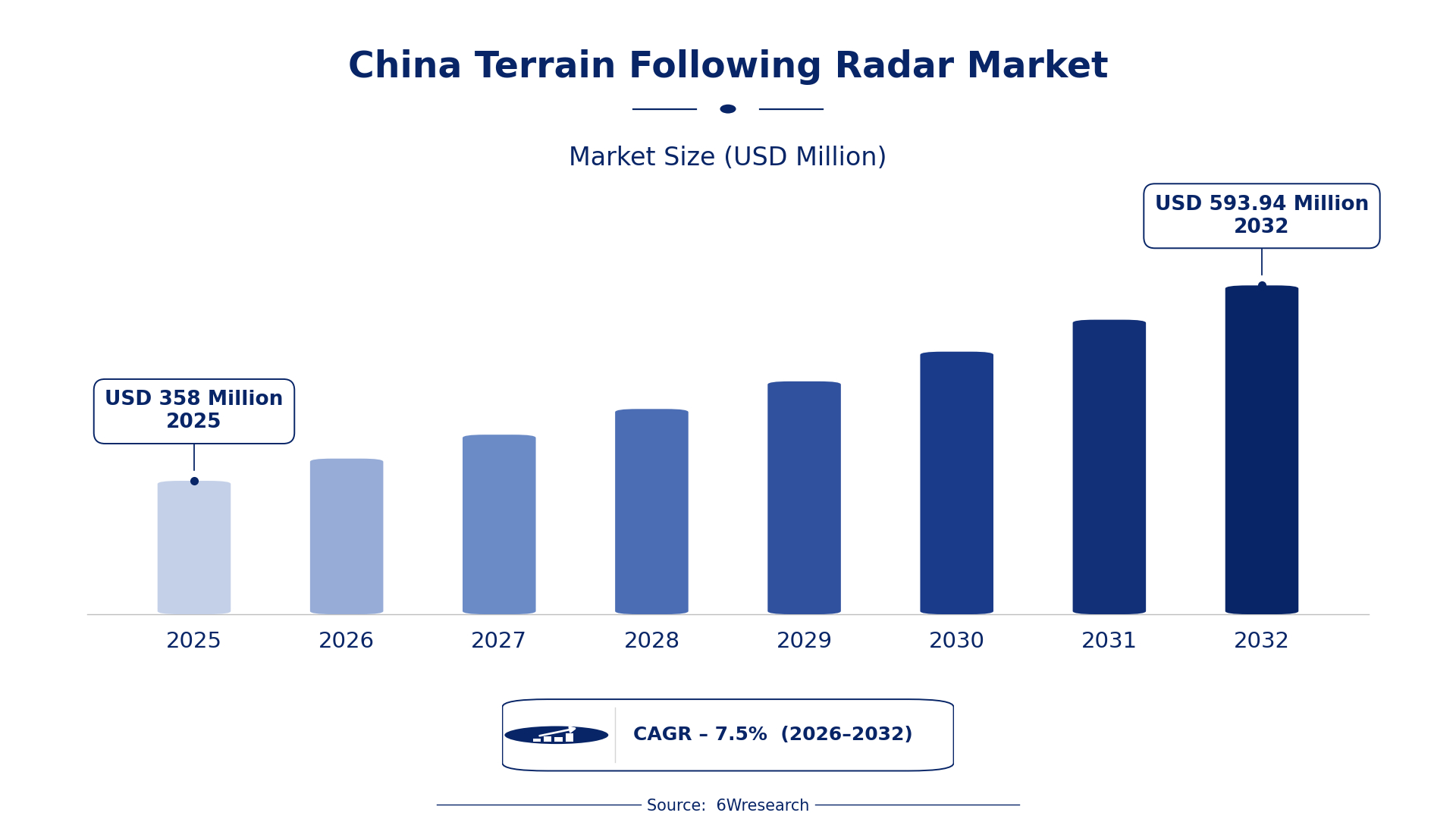
According to 6Wresearch internal database and industry insights, the China Terrain Following Radar Market was valued at USD 358.0 million in 2025 and is projected to reach USD 593.94 million by 2032, growing at a CAGR of approximately 7.5% during 2026–2032.
China Terrain Following Radar Market Highlights
| Report Metric | Details |
| Report Name | China Terrain Following Radar Market |
| Market Size 2025 | USD 358.0 million |
| Market Size 2032 | USD 593.94 million |
| Absolute Growth 2025–2032 | USD 235.94 million |
| CAGR 2026–2032 | 7.5% |
| Peak Annual Growth | 10.0% in 2032 |
| Forecast Period | 2026–2032 |
| Historical Data | 2022–2025 |
| Base Year | 2025 |
| Leading Terrain Following Radar, 2025 | Airborne TFR Systems (56% share) |
| Leading Product Type, 2025 | Fighter Jet Radar (44% share) |
| Leading Radar Type, 2025 | Pulse-Doppler (39% share) |
| Leading Distribution Channel, 2025 | Defense OEMs (44% share) |
| Leading End User Industry, 2025 | Military Air Forces (50% share) |
| Fastest-Growing Terrain Following Radar | UAV Terrain Radar (10.1% CAGR) |
| Fastest-Growing Product Type | Rotary‑wing Systems (10.0% CAGR) |
| Fastest-Growing Radar Type | SAR Terrain Mapping (9.8% CAGR) |
| Fastest-Growing Distribution Channel | Drone Manufacturers (9.1% CAGR) |
| Fastest-Growing End User Industry | Tactical UAV Programs (10.1% CAGR) |
| Growing Sector | Military Air Forces |
| Key End Users | Military Air Forces, Special Operations, Drone Manufacturers |
China Terrain Following Radar Market Year-wise Growth Rate and Key Drivers (2022–2032)
This graph illustrates the annual growth rates of the market from 2022 to 2032, highlighting a steady upward trajectory and projected market expansion over the forecast period.
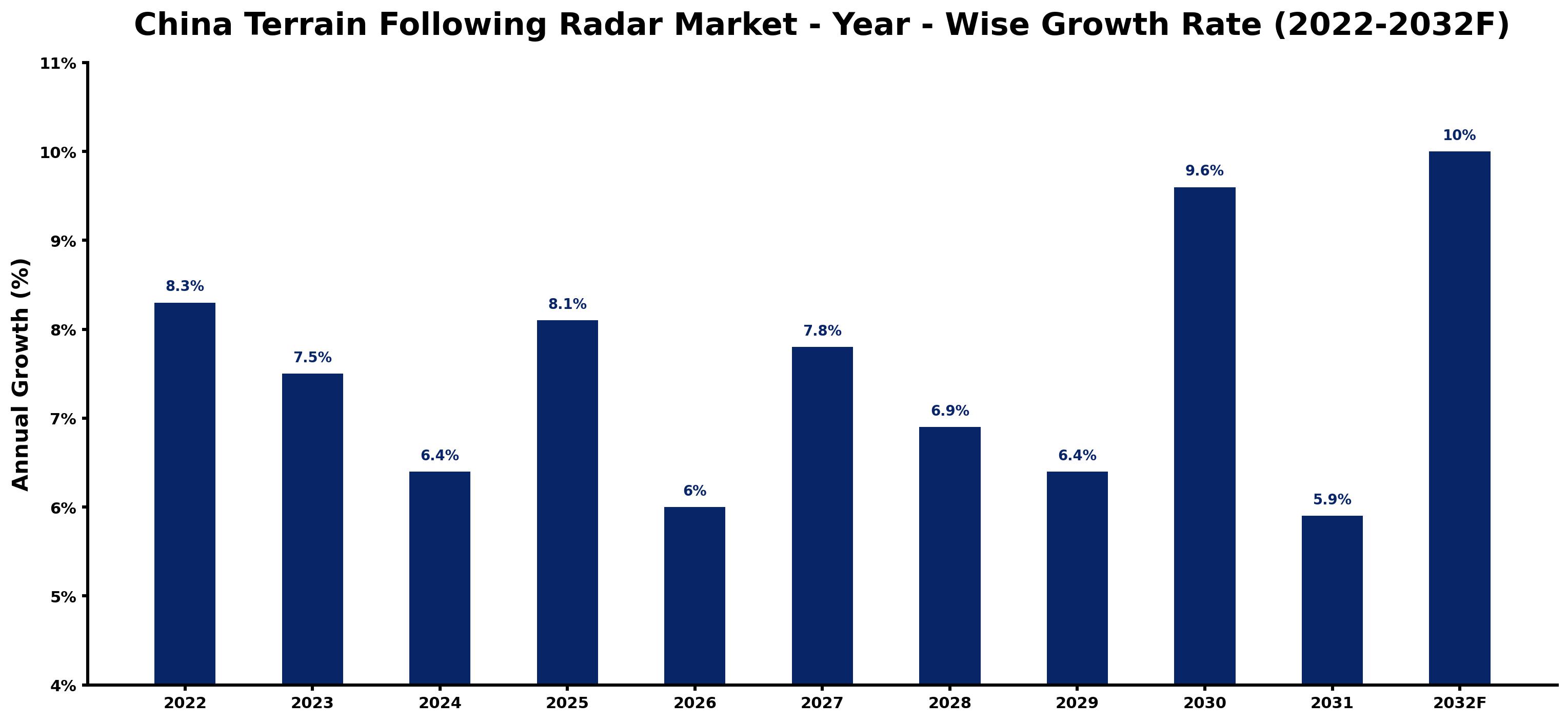
The table below sets out the estimated growth rate for each year and the main factor behind it.
| Year | Estimated Annual Growth (%) | Market Rationale |
| 2022 | 8.3 | Growth was driven by increased military spending and the launch of new defense programs. |
| 2023 | 7.5 | Demand was supported by ongoing military programs focusing on advanced radar technologies and modernization efforts. |
| 2024 | 6.4 | A slowdown occurred as projects faced delays in procurement processes and funding allocations due to regulatory changes. |
| 2025 | 8.1 | Growth accelerated due to successful joint military exercises demonstrating terrain-following radar capabilities. |
| 2026 | 6.0 | Demand is expected to slow as the market adjusts to new procurement regulations and compliance standards. |
| 2027 | 7.8 | Increased investment in UAV capabilities is projected to spur demand for terrain-following radar systems in military operations. |
| 2028 | 6.9 | The market is expected to slow as competition intensifies among domestic manufacturers and new entrants. |
| 2029 | 6.4 | Demand is projected to slow as military budgets face scrutiny amid broader economic concerns and funding priorities. |
| 2030 | 9.6 | Growth is expected to surge with the announcement of new defense initiatives aimed at improving radar technology capabilities. |
| 2031 | 5.9 | A slowdown is projected as the market stabilises following rapid technological advancements in radar systems and integration efforts. |
| 2032 | 10.0 | Demand is expected to peak as military modernization efforts reach their final phases with significant funding allocations. |
Note: Market size estimations and growth projections presented in this report are based on 6Wresearch's proprietary forecasting methodology, utilizing the latest available industry data, government publications, and primary research inputs.
China Terrain Following Radar Market Synopsis
Terrain Following Radar in China serves as a key technology for low-altitude navigation in military contexts. This system enables aircraft to navigate complex terrains while avoiding obstacles, which is critical for mission success. The China Terrain Following Radar Market is growing due to substantial military investments and ongoing modernization efforts, with the military budget reaching approximately $230 billion in 2023. The PLA Air Force operates over 1,500 aircraft equipped with terrain-following radar, underscoring its importance for operational effectiveness. Increasing demand from military air forces and special operations units further propels market growth.
Market Dynamics Impact Analysis (2026–2032)
| Factor | Type | Impact | Primary Segment Affected |
| Increased military spending fuels demand for advanced radar systems. | Driver | High | Airborne TFR Systems |
| Growing need for low-altitude navigation in military operations enhances market prospects. | Driver | High | UAV Terrain Radar |
| Investment in UAV capabilities presents opportunities for radar integration. | Opportunity | High | UAV Terrain Radar |
| Collaboration between military and civilian sectors opens new avenues for innovation. | Opportunity | Medium | Pulse-Doppler |
| Regulatory changes may impact procurement timelines and processes. | Restraint | High | Fighter Jet Radar |
| Competition among domestic manufacturers could limit market share for new entrants. | Restraint | Medium | Rotary‑wing Systems |
| Buyers face challenges in navigating complex procurement regulations. | Challenge | High | Defense OEMs |
| Suppliers encounter delays in technology approvals, affecting production schedules. | Challenge | Medium | Aviation Suppliers |
Evaluation of Drivers in China Terrain Following Radar Market (2026–2032)
The factors lifting demand, and the evidence behind each, are summarised below.
| Drivers | Primary Segment Affected | Why It Matters (Evidence) |
| Increased military budget allocation for modernization. | Airborne TFR Systems | China's military budget for 2023 is approximately $230 billion, driving demand for advanced radar systems and technologies. |
| Growing operational requirements for low-altitude navigation. | UAV Terrain Radar | The PLA Air Force operates over 1,500 aircraft, many equipped with terrain-following radar systems, creating a strong demand for these technologies. |
| Focus on advanced radar technology development. | Pulse-Doppler | In 2022, China launched a national defense innovation program focusing on advanced radar technologies, enhancing capabilities across military branches. |
| Joint military exercises demonstrating TFR effectiveness. | Fighter Jet Radar | The PLA has conducted joint exercises demonstrating the effectiveness of terrain-following radar in low-altitude missions, reinforcing its necessity. |
| Expansion of UAV capabilities in military operations. | Drone Manufacturers | In 2023, China announced a new initiative to integrate terrain-following radar into UAVs, boosting demand for advanced systems. |
Growth in the Terrain Following Radar market in China comes from increased military budget allocations, driving demand for advanced systems. In 2023, the military budget reached approximately $230 billion, boosting modernization efforts significantly. The PLA Air Force operates over 1,500 aircraft, many equipped with terrain-following radar systems, creating a strong demand for these technologies. Joint military exercises conducted by the PLA demonstrate the effectiveness of terrain-following radar in low-altitude missions, reinforcing the need for such systems.
Evaluation of Restraints in China Terrain Following Radar Market
Below mentioned are some major restraints and their influence on market dynamics.
| Market Restraint | Primary Segment Affected | Why It Matters (Evidence) |
| Complex procurement regulations may delay acquisition processes. | Fighter Jet Radar | The updated Defense Procurement Regulations in 2023 streamline acquisitions but also introduce new compliance requirements that can slow down procurement timelines. |
| Intense competition among domestic manufacturers may limit new entrants' market share. | Rotary‑wing Systems | The market is dominated by established players, making it challenging for new suppliers to gain traction and secure contracts. |
| Budget constraints could impact funding for radar technology projects. | Airborne TFR Systems | Economic pressures may lead to reduced military spending in certain areas, affecting investments in new radar systems. |
| Technological approval delays can hinder production timelines. | UAV Terrain Radar | Suppliers face challenges in meeting regulatory requirements for new radar technologies, which can disrupt delivery schedules. |
| Market saturation in certain radar segments may limit growth potential. | Pulse-Doppler | With many established products in the market, innovation is necessary to differentiate offerings and attract new customers. |
China Terrain Following Radar Market Challenges
Buyers and suppliers in the China Terrain Following Radar market encounter supply chain disruptions due to dependence on specific radar components, which can delay production timelines for military aircraft. This challenge stems from a concentrated supplier base, leading to potential shortages that could affect the operational readiness of over 1,500 aircraft equipped with TFR systems. High costs associated with advanced radar technology also pose challenges for buyers, as the military budget for 2023 is approximately $230 billion, necessitating careful resource allocation. The rapid pace of technological advancements creates a skills gap, as the workforce may lack the necessary training to effectively implement new technologies, hindering operational efficiency for military air forces.
Trends in the China Terrain Following Radar Market
Several trends are reshaping the China Terrain Following Radar Market; the most important are set out below.
- Shift towards Advanced UAV Integration: China is increasingly incorporating terrain-following radar into UAV systems, enhancing operational capabilities for military missions. In 2023, the government announced a new initiative aimed at improving UAV capabilities, with a budget of $500 million allocated for this purpose.
- Transition from Traditional to Modern Radar Systems: The PLA is modernising its radar systems, advancing towards technologies such as SAR Terrain Mapping. In 2022, SAR Terrain Mapping technology was highlighted during reconnaissance missions conducted by the PLA.
- Growing Demand for Tactical Applications: Military Air Forces are prioritising tactical applications of radar technology, especially in combat scenarios. The X-Band radar is widely utilised in Chinese fighter jets for tactical operations, improving their effectiveness in the field.
- Increased Collaboration in Defense Technology: The Military-Civilian Integration Strategy encourages collaboration between military and civilian sectors in radar technology development. This strategy, approved in 2020, aims to stimulate innovation and production capabilities across the sector.
Investment Opportunities in the China Terrain Following Radar Market
Several openings in the China Terrain Following Radar Market merit attention from investors.
- $500 million investment gap in UAV radar integration: The Chinese government has allocated $500 million to improve UAV capabilities, creating opportunities for suppliers of terrain-following radar systems to enter the market. Collaborating with local defense manufacturers can facilitate market entry and growth.
- Defense OEMs seeking advanced radar solutions: The demand for advanced radar systems in defense OEMs is increasing, as they look to upgrade their offerings and capabilities. Establishing partnerships with these manufacturers can provide significant market access and opportunities for suppliers.
- Growing need for retrofitting existing systems: As military forces look to upgrade older aircraft, there is a rising demand for retrofit TFR kits. Focusing on this segment can yield substantial returns for suppliers looking to meet military modernization needs.
- Emerging Tactical UAV Programs: With Tactical UAV Programs projected to grow at 10.1%, there is a significant opportunity for radar integration. Engaging with military air forces can help suppliers establish a foothold in this expanding market.
Government Initiatives in the China Terrain Following Radar Market
The 'National Defense Technology Development Plan' launched by the Ministry of Industry and Information Technology in 2021 aims to improve radar technology capabilities. This plan promotes innovation and enhances domestic production of advanced radar systems. Additionally, the 'Military-Civilian Integration Strategy' approved in 2020 encourages collaboration between military and civilian sectors, facilitating advancements in radar technology. These measures directly impact the development and procurement of terrain-following radar systems in China, ensuring that producers can effectively meet military demands.
The Ministry of National Defense oversees the implementation of radar systems in military operations, ensuring compliance with updated regulations. The National Development and Reform Commission initiated the 'Advanced Radar Technology Promotion Program' in 2022, supporting research and development with a budget of $500 million. This program aims to improve the capabilities of radar systems, benefiting both producers and buyers in the terrain-following radar market. Furthermore, the Defense Technology Innovation Fund established in 2020 supports startups focusing on radar and sensor technologies, promoting innovation in the sector and enhancing production capabilities.
Future Insight of the China Terrain Following Radar Market
The China Terrain Following Radar market is expected to evolve significantly by 2032, driven by initiatives like the national defense innovation program that focuses on advanced radar technologies. The integration of TFR in UAV operations will transform military capabilities, allowing for improved low-altitude navigation. By 2025, the PLA aims to enhance its reconnaissance missions through advanced terrain mapping technologies. Additionally, new defense research institutes dedicated to radar technology development will foster collaboration and innovation, ensuring a steady supply of advanced systems for military applications.
Market Segmentation Analysis
The analysis below covers each segmentation, its leading category in 2025 and its fastest-growing category through 2032.
By Terrain Following Radar – Airborne TFR Systems Dominated, UAV Terrain Radar Expected to Grow Fastest
According to Vasudha, AM at 6Wresearch, Airborne TFR Systems accounted for a 56% market share by terrain following radar in 2025. Airborne TFR Systems hold the largest market share as they are crucial for military aircraft navigation, especially within the PLA Air Force, which operates a significant fleet of over 1,500 aircraft equipped with this technology. The widespread application of TFR in tactical missions reinforces its leading position in the market. UAV Terrain Radar is projected to grow fastest, at a CAGR of 10.1% during 2026–2032. UAV Terrain Radar is experiencing rapid growth due to the rising demand for advanced UAV capabilities, particularly following the 2023 initiative aimed at integrating terrain-following radar into drone operations. This trend towards unmanned aerial systems highlights a modern military focus on adaptability and operational efficiency. Suppliers should prioritise the development of UAV Terrain Radar to align with the increasing demand for enhanced drone capabilities in military applications.
By Product Type – Fighter Jet Radar Dominated, Rotary‑wing Systems Expected to Grow Fastest
In 2025, Fighter Jet Radar led the product type split with a 44% share. Fighter Jet Radar commands the largest share as it is integral to combat aircraft, ensuring effective tracking and targeting during missions. The reliance of the PLA Air Force on advanced radar systems in their fleet solidifies this sub-segment's leading position. The quickest growth will come from Rotary‑wing Systems, forecast to expand at a CAGR of 10.0% between 2026 and 2032. Rotary‑wing Systems are the fastest-growing segment, driven by the increasing need for advanced radar in helicopter missions, particularly in tactical operations. The expansion of rotary-wing capabilities in military applications highlights the importance of this technology. Manufacturers should invest in rotary-wing radar technologies to capture the growing demand in military aviation.
By Radar Type – Pulse-Doppler Dominated, SAR Terrain Mapping Expected to Grow Fastest
Pulse-Doppler took a 39% share of radar type in 2025, more than any other category. Pulse-Doppler radar technology commands the largest market share due to its prevalent use in tracking and targeting during military operations. Its proven effectiveness across various combat scenarios makes it the preferred choice among military air forces. Over 2026–2032, SAR Terrain Mapping is expected to post the fastest growth, at a CAGR of 9.8%. SAR Terrain Mapping is the fastest-growing radar type, driven by its essential role in reconnaissance missions for the PLA. The increasing focus on intelligence-gathering capabilities in military strategies significantly fuels this growth. Radar manufacturers need to concentrate on advancing SAR Terrain Mapping technologies to meet the escalating demands of military reconnaissance.
By Distribution Channel – Defense OEMs Dominated, Drone Manufacturers Expected to Grow Fastest
With a 44% revenue share in 2025, Defense OEMs was the largest distribution channel category. Defense OEMs lead the market share as the primary manufacturers of Terrain Following Radar systems, providing essential technology for military applications. Their established relationships with the military ensure a steady demand for TFR products. Drone Manufacturers are set to record the highest CAGR in this split, 9.1% over 2026–2032. Drone Manufacturers are the fastest-growing distribution channel, reflecting the rising integration of TFR into UAVs for modern military operations. This trend underscores the shift towards unmanned aerial systems in defence strategies. Suppliers should strengthen partnerships with drone manufacturers to capitalise on the increasing integration of TFR in UAVs.
By End User Industry – Military Air Forces Dominated, Tactical UAV Programs Expected to Grow Fastest
The largest end user industry category in 2025 was Military Air Forces, with a 50% share of total revenue. Military Air Forces are the largest users of Terrain Following Radar, utilising this technology for operational superiority across various missions. The widespread integration of TFR in military aircraft ensures a strong market share for this segment. Tactical UAV Programs are projected to grow fastest, at a CAGR of 10.1% during 2026–2032. Tactical UAV Programs are the fastest-growing end user industry, spurred by the necessity for advanced surveillance and reconnaissance capabilities in modern warfare. The growing focus on tactical missions underscores the importance of integrating TFR into UAVs. Suppliers should target tactical UAV programs to align with the increasing emphasis on drone capabilities in military operations.
Key Attractiveness of the Report
- 10 Years of Market Numbers
- Historical Data Starting from 2022 to 2025
- Base Year 2025
- Forecast Data until 2032
- Key Performance Indicators Impacting the Market
- Major Upcoming Developments and Projects
Key Highlights of the Report:
- China Terrain Following Radar Market Outlook
- Market Size of China Terrain Following Radar Market, 2025
- Forecast of China Terrain Following Radar Market, 2032
- Historical Data and Forecast of China Terrain Following Radar Revenues & Volume for the Period 2022 - 2032F
- China Terrain Following Radar Market Trend Evolution
- China Terrain Following Radar Market Drivers and Challenges
- China Terrain Following Radar Price Trends
- China Terrain Following Radar Porter's Five Forces
- China Terrain Following Radar Industry Life Cycle
- Historical Data and Forecast of China Terrain Following Radar Market Revenues & Volume By Terrain Following Radar for the Period 2022 - 2032F
- Historical Data and Forecast of China Terrain Following Radar Market Revenues & Volume By Airborne TFR Systems for the Period 2022 - 2032F
- Historical Data and Forecast of China Terrain Following Radar Market Revenues & Volume By Helicopter TFR Units for the Period 2022 - 2032F
- Historical Data and Forecast of China Terrain Following Radar Market Revenues & Volume By UAV Terrain Radar for the Period 2022 - 2032F
- Historical Data and Forecast of China Terrain Following Radar Market Revenues & Volume By Retrofit TFR Kits for the Period 2022 - 2032F
- Historical Data and Forecast of China Terrain Following Radar Market Revenues & Volume By Product Type for the Period 2022 - 2032F
- Historical Data and Forecast of China Terrain Following Radar Market Revenues & Volume By Fighter Jet Radar for the Period 2022 - 2032F
- Historical Data and Forecast of China Terrain Following Radar Market Revenues & Volume By Rotary wing Systems for the Period 2022 - 2032F
- Historical Data and Forecast of China Terrain Following Radar Market Revenues & Volume By Compact Radar Units for the Period 2022 - 2032F
- Historical Data and Forecast of China Terrain Following Radar Market Revenues & Volume By Add-On Modules for the Period 2022 - 2032F
- Historical Data and Forecast of China Terrain Following Radar Market Revenues & Volume By Radar Type for the Period 2022 - 2032F
- Historical Data and Forecast of China Terrain Following Radar Market Revenues & Volume By Pulse-Doppler for the Period 2022 - 2032F
- Historical Data and Forecast of China Terrain Following Radar Market Revenues & Volume By X Band for the Period 2022 - 2032F
- Historical Data and Forecast of China Terrain Following Radar Market Revenues & Volume By Millimeter-wave for the Period 2022 - 2032F
- Historical Data and Forecast of China Terrain Following Radar Market Revenues & Volume By SAR Terrain Mapping for the Period 2022 - 2032F
- Historical Data and Forecast of China Terrain Following Radar Market Revenues & Volume By Distribution Channel for the Period 2022 - 2032F
- Historical Data and Forecast of China Terrain Following Radar Market Revenues & Volume By Defense OEMs for the Period 2022 - 2032F
- Historical Data and Forecast of China Terrain Following Radar Market Revenues & Volume By Aviation Suppliers for the Period 2022 - 2032F
- Historical Data and Forecast of China Terrain Following Radar Market Revenues & Volume By Drone Manufacturers for the Period 2022 - 2032F
- Historical Data and Forecast of China Terrain Following Radar Market Revenues & Volume By MRO Distributors for the Period 2022 - 2032F
- Historical Data and Forecast of China Terrain Following Radar Market Revenues & Volume By End User Industry for the Period 2022 - 2032F
- Historical Data and Forecast of China Terrain Following Radar Market Revenues & Volume By Military Air Forces for the Period 2022 - 2032F
- Historical Data and Forecast of China Terrain Following Radar Market Revenues & Volume By Special Operations for the Period 2022 - 2032F
- Historical Data and Forecast of China Terrain Following Radar Market Revenues & Volume By Tactical UAV Programs for the Period 2022 - 2032F
- Historical Data and Forecast of China Terrain Following Radar Market Revenues & Volume By Armed Missions for the Period 2022 - 2032F
- China Terrain Following Radar Import Export Trade Statistics
- Market Opportunity Assessment By Terrain Following Radar
- Market Opportunity Assessment By Product Type
- Market Opportunity Assessment By Radar Type
- Market Opportunity Assessment By Distribution Channel
- Market Opportunity Assessment By End User Industry
- China Terrain Following Radar Top Companies Market Share
- China Terrain Following Radar Competitive Benchmarking By Technical and Operational Parameters
- China Terrain Following Radar Company Profiles
- China Terrain Following Radar Key Strategic Recommendations
Market Covered
The report offers an extensive study of the following market segments.
By Terrain Following Radar
- Airborne TFR Systems
- Helicopter TFR Units
- UAV Terrain Radar
- Retrofit TFR Kits
By Product Type
- Fighter Jet Radar
- Rotary‑wing Systems
- Compact Radar Units
- Add-On Modules
By Radar Type
- Pulse-Doppler
- X‑Band
- Millimeter-wave
- SAR Terrain Mapping
By Distribution Channel
- Defense OEMs
- Aviation Suppliers
- Drone Manufacturers
- MRO Distributors
By End User Industry
- Military Air Forces
- Special Operations
- Tactical UAV Programs
- Armed Missions































