China Textile Anti‑Static Solutions Market Size & Growth Rate
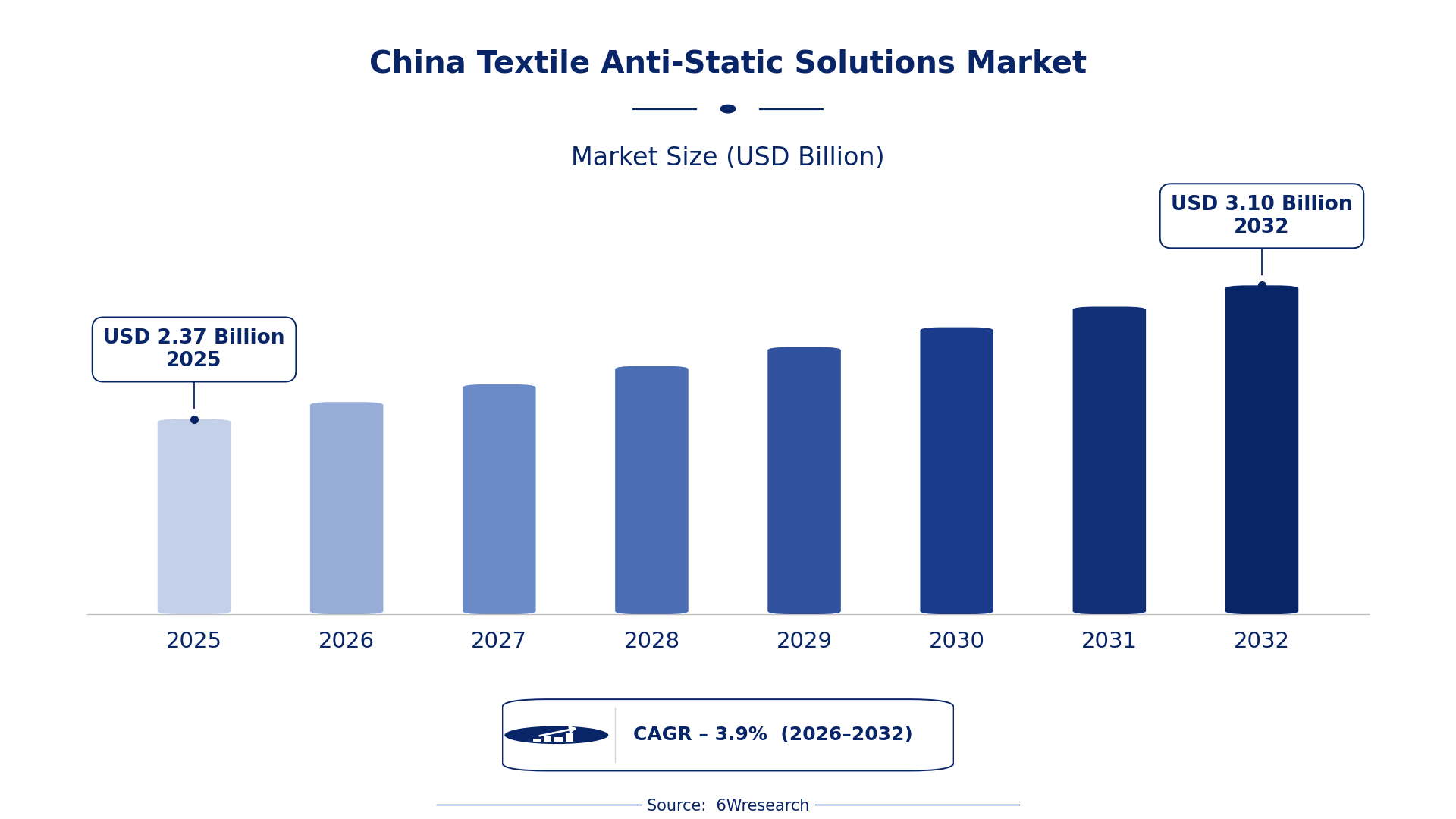
According to 6Wresearch internal database and industry insights, the China Textile Anti‑Static Solutions Market was valued at USD 2.37 billion in 2025 and is projected to reach USD 3.10 billion by 2032, growing at a CAGR of approximately 3.9% during 2026–2032.
China Textile Anti‑Static Solutions Market Highlights
| Report Metric | Details |
| Report Name | China Textile Anti‑Static Solutions Market |
| Market Size 2025 | USD 2.37 billion |
| Market Size 2032 | USD 3.10 billion |
| Absolute Growth 2025–2032 | USD 0.73 billion |
| CAGR 2026–2032 | 3.9% |
| Peak Annual Growth | 6.2% in 2029 |
| Forecast Period | 2026–2032 |
| Historical Data | 2022–2025 |
| Base Year | 2025 |
| Leading Anti‑Static Solutions, 2025 | Fabric Finishing Agents (45% share) |
| Leading Product Type, 2025 | Liquid Finishers (50% share) |
| Leading Chemical Type, 2025 | Quaternary Ammonium (45% share) |
| Leading Distribution Channel, 2025 | Direct Sales (43% share) |
| Leading End User Industry, 2025 | Apparel Manufacturers (40% share) |
| Fastest-Growing Anti‑Static Solutions | Masterbatch Additives (6.0% CAGR) |
| Fastest-Growing Product Type | Polymer Additives (5.8% CAGR) |
| Fastest-Growing Chemical Type | Antistatic Polymers (5.5% CAGR) |
| Fastest-Growing Distribution Channel | Industrial Distributors (5.9% CAGR) |
| Fastest-Growing End User Industry | Technical Textiles (5.3% CAGR) |
| Growing Sector | Technical Textiles |
| Key End Users | Apparel Manufacturers, Automotive Fabrics, Technical Textiles |
China Textile Anti‑Static Solutions Market Year-wise Growth Rate and Key Drivers (2022–2032)
This graph illustrates the annual growth rates of the market from 2022 to 2032, highlighting a steady upward trajectory and projected market expansion over the forecast period.
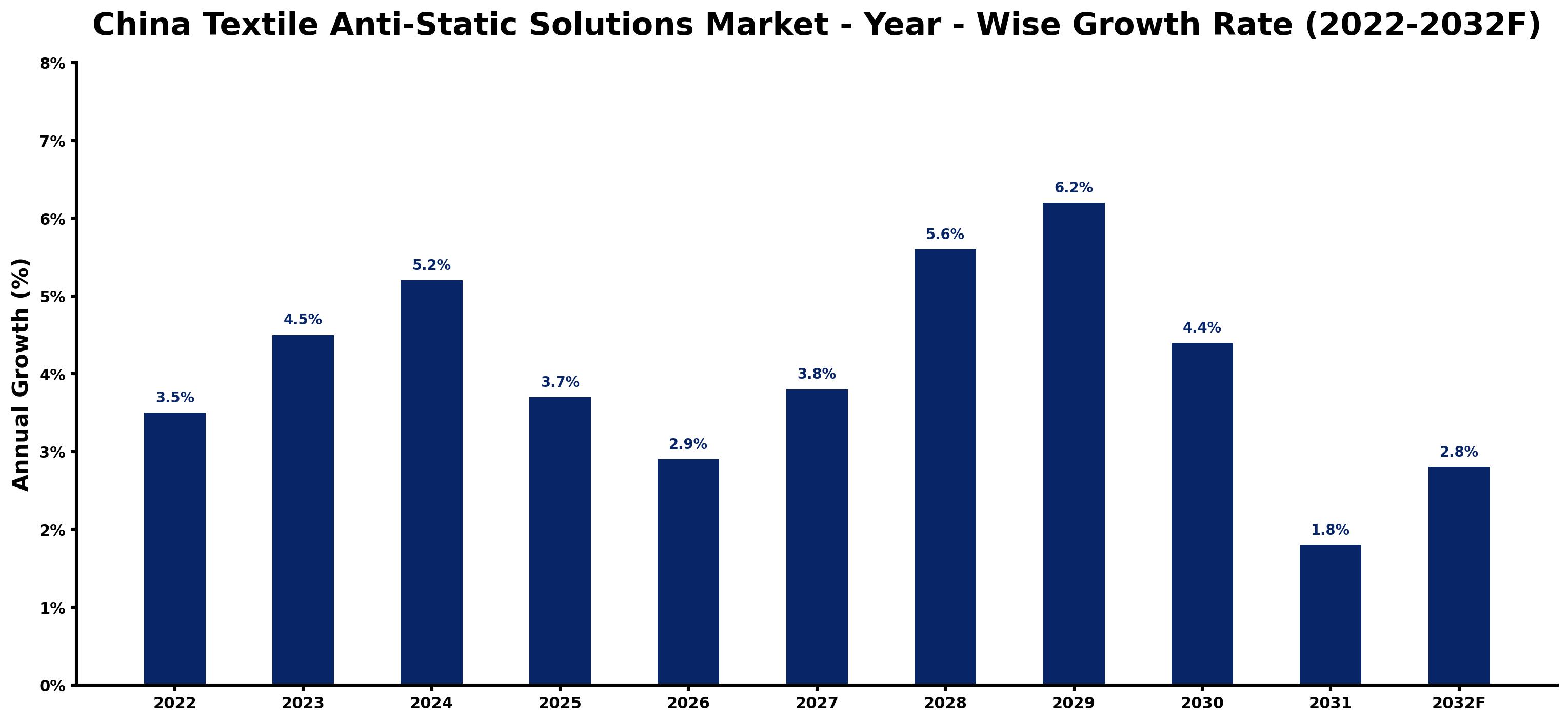
The following table presents the estimated annual growth rate for each year together with the principal factor influencing market performance.
| Year | Estimated Annual Growth (%) | Market Rationale |
| 2022 | 3.5 | The textile industry produced over 50 million tons of fabric, driving demand for anti-static solutions. |
| 2023 | 4.5 | Growth was supported by the launch of the 'Textile Industry Upgrade Plan' by the Ministry of Industry and Information Technology. |
| 2024 | 5.2 | The market experienced growth due to rising demand from apparel manufacturers and technical textiles. |
| 2025 | 3.7 | Demand slowed as the market adjusted to new production standards and regulations. |
| 2026 | 2.9 | Growth is expected to slow as manufacturers face challenges in meeting environmental standards. |
| 2027 | 3.8 | The market is projected to see renewed interest as technical textiles gain traction in various applications. |
| 2028 | 5.6 | Demand is expected to increase with the growing automotive textiles market valued at over 20 billion yuan. |
| 2029 | 6.2 | The peak growth is projected to be driven by the adoption of advanced anti-static solutions in apparel manufacturing. |
| 2030 | 4.4 | Growth will slow as competition intensifies among suppliers in the textile anti-static solutions market. |
| 2031 | 1.8 | The market is expected to continue growing, albeit at a slower pace due to market saturation. |
| 2032 | 2.8 | Demand is projected to rise again as manufacturers invest in innovative anti-static technologies. |
Note: Market size estimations and growth projections presented in this report are based on 6Wresearch's proprietary forecasting methodology, utilizing the latest available industry data, government publications, and primary research inputs.
China Textile Anti‑Static Solutions Market Synopsis
Textile Anti-Static Solutions in China are chemical formulations designed to reduce static electricity in textiles. These solutions are made by blending various chemical agents that impart conductive properties to fabrics, improving their performance in apparel manufacturing and automotive applications. The China Textile Anti-Static Solutions Market is expanding due to significant domestic demand, driven by over 50 million tons of fabric produced in 2022 and the implementation of the 'Textile Industry Upgrade Plan'. The increasing production of technical textiles, which accounted for 25% of textile production in 2022, further fuels market expansion.
Market Dynamics Impact Analysis (2026–2032)
| Factor | Type | Impact | Primary Segment Affected |
| Growing demand from apparel manufacturers for high-quality textiles | Driver | High | Fabric Finishing Agents |
| Increasing adoption of anti-static solutions in automotive textiles | Driver | High | Automotive Fabrics |
| Rising investment in technical textiles by manufacturers | Opportunity | High | Technical Textiles |
| Expansion of distribution channels through industrial distributors | Opportunity | Medium | Industrial Distributors |
| Challenges in meeting environmental standards for textile production | Restraint | High | Fabric Finishing Agents |
| Market saturation leading to intense competition among suppliers | Restraint | Medium | Fabric Finishing Agents |
| Textile Anti-Static Solutions market in China faces regulatory hurdles | Challenge | High | Fabric Finishing Agents |
| Dependence on traditional textile manufacturing processes | Challenge | Medium | Fabric Finishing Agents |
Evaluation of Drivers in China Textile Anti‑Static Solutions Market (2026–2032)
The table below links each growth driver to the segment it affects and the evidence for it.
| Drivers | Primary Segment Affected | Why It Matters (Evidence) |
| Rising demand for high-quality textiles drives the need for effective anti-static solutions, with apparel manufacturers increasing their orders. | Fabric Finishing Agents | In 2022, the textile industry produced over 50 million tons of fabric. |
| The automotive sector's growth leads to increased demand for anti-static solutions, as automotive fabrics require improved performance. | Automotive Fabrics | The automotive textiles market was valued at over 20 billion yuan in 2022. |
| Investment in technical textiles is rising, prompting manufacturers to adopt advanced anti-static solutions for better performance. | Technical Textiles | Technical textiles accounted for 25% of China's textile production in 2022. |
| The expansion of industrial distributors improves access to anti-static solutions for manufacturers, boosting overall sales. | Industrial Distributors | Direct Sales held a significant share in the distribution of anti-static solutions. |
| The implementation of the 'Textile Industry Upgrade Plan' encourages manufacturers to invest in modern anti-static technologies. | Fabric Finishing Agents | This plan was launched by the Ministry of Industry and Information Technology in 2023. |
Growth in the Textile Anti-Static Solutions market in China comes from increasing demand for high-quality textiles, particularly from apparel manufacturers and the automotive sector. The textile industry produced over 50 million tons of fabric in 2022, driving the need for effective anti-static solutions. The automotive textiles market was valued at over 20 billion yuan in 2022, leading to increased orders for these products. Investment in technical textiles is also on the rise, with these textiles accounting for 25% of production in 2022. The 'Textile Industry Upgrade Plan' in 2023 has encouraged manufacturers to modernise their processes, boosting demand for advanced anti-static technologies.
Evaluation of Restraints in China Textile Anti‑Static Solutions Market
The key brakes on demand, and where they bite hardest, are shown below.
| Market Restraint | Primary Segment Affected | Why It Matters (Evidence) |
| Regulatory hurdles complicate the production of anti-static textiles, impacting supply chains. | Fabric Finishing Agents | Manufacturers must comply with national standards like GB/T 19083-2010. |
| Environmental standards require investment in sustainable practices, affecting profitability. | Fabric Finishing Agents | The Chinese government aims to reduce textile waste by 30% by 2030. |
| Market saturation leads to intense competition, resulting in price pressures for suppliers. | Fabric Finishing Agents | The textile industry employs over 20 million people, increasing competition. |
| Dependence on traditional manufacturing processes limits the adoption of modern solutions. | Fabric Finishing Agents | Many manufacturers are slow to adapt to new technologies. |
| Limited awareness of the benefits of anti-static solutions among smaller manufacturers hampers market growth. | Fabric Finishing Agents | Smaller players often lack resources for education and training. |
China Textile Anti‑Static Solutions Market Challenges
The China Textile Anti-Static Solutions Market encounters a technological gap, as many producers struggle to access advanced chemical formulations, which diminishes product effectiveness and competitiveness. Skills shortages exacerbate this issue, with over 20 million textile workers requiring specialised training to implement anti-static solutions effectively, causing delays in production timelines. Increased competition from international suppliers offering lower prices pressures domestic buyers to consider cheaper alternatives, potentially compromising quality. Supply chain disruptions in the Jiangsu province can inflate costs for producers, ultimately affecting pricing strategies and availability for buyers.
Trends in the China Textile Anti‑Static Solutions Market
The trends below show where the China Textile Anti‑Static Solutions Market is heading.
- Shift from Traditional to Advanced Anti-Static Solutions: China is transitioning towards advanced anti-static solutions in textile manufacturing, motivated by the demand for improved performance. The implementation of the 'Textile Industry Upgrade Plan' in 2023 has accelerated this transition, with manufacturers increasingly investing in new technologies.
- Transition from Direct Sales to Online Platforms: Distribution of anti-static solutions is increasingly moving towards online platforms, enabling smaller manufacturers to access products more conveniently. In 2022, Direct Sales held a noteworthy share, but online channels are rapidly emerging as a viable alternative.
- Emergence of Sustainable Anti-Static Solutions: A growing emphasis on sustainable anti-static solutions is evident in the textile industry, as manufacturers strive to meet environmental standards. The adoption of ISO 14001 is becoming more prevalent among textile producers, reflecting this trend.
- Increasing Integration of Technical Textiles: Technical textiles are becoming more integrated into various applications, such as automotive interiors. In 2022, technical textiles accounted for 25% of textile production, indicating a clear shift in market focus.
Investment Opportunities in the China Textile Anti‑Static Solutions Market
Some of the investment opportunities in the China Textile Anti‑Static Solutions Market are mentioned below.
- Investment in Technical Textiles: Jiangsu province serves as a major hub for textile manufacturing, presenting opportunities for investment in technical textiles. With a projected average annual growth rate of 5% through 2025, manufacturers can take advantage of this expanding market.
- Expansion of Distribution Channels: The emergence of industrial distributors in the textile anti-static solutions market creates opportunities for suppliers. With a projected growth rate of 5.9% through 2032, companies can tap into this channel to reach a wider customer base.
- Development of Sustainable Anti-Static Solutions: Investing in sustainable anti-static solutions is timely, as the Chinese government aims for a 30% reduction in textile waste by 2030. Manufacturers can collaborate with local firms to develop eco-friendly products.
- Collaboration with Apparel Manufacturers: Apparel manufacturers are increasingly in search of high-quality anti-static solutions, presenting opportunities for suppliers. By forming joint ventures with local manufacturers, companies can effectively penetrate this growing market.
Government Initiatives in the China Textile Anti‑Static Solutions Market
The national standard GB/T 19083-2010 outlines the requirements for anti-static textiles, ensuring that producers meet safety and quality benchmarks. This standard impacts all manufacturers in the textile sector, compelling them to invest in compliant solutions. The 'Textile Industry Upgrade Plan' launched in 2023 by the Ministry of Industry and Information Technology further supports this initiative, aiming to improve the overall quality and sustainability of textile production in China.
The Ministry of Industry and Information Technology is responsible for approving and funding projects related to textile innovation and sustainability. This agency has facilitated various initiatives, including the promotion of ISO 14001 standards among textile manufacturers. By providing funding and resources, the Ministry encourages compliance with environmental regulations and the adoption of advanced technologies, ultimately benefiting buyers and producers in the textile anti-static solutions market.
Future Insight of the China Textile Anti‑Static Solutions Market
The China Textile Anti-Static Solutions Market will evolve by 2032, driven by the 'Textile Industry Upgrade Plan' and a projected 5% annual growth rate in technical textiles. Stricter environmental standards will compel manufacturers to adopt sustainable practices, appealing to eco-conscious consumers. The government's target to reduce textile waste by 30% by 2030 will motivate producers to innovate in anti-static solutions. As a result, buyers will benefit from improved product quality and performance, while suppliers will discover new opportunities in a more competitive landscape.
Market Segmentation Analysis
Each segment group is reviewed below, with the leader by share and the fastest grower by CAGR.
By Anti‑Static Solutions – Fabric Finishing Agents Dominated, Masterbatch Additives Expected to Grow Fastest
According to Vasudha, AM at 6Wresearch, with a 45% revenue share in 2025, Fabric Finishing Agents was the largest anti‑static solutions category. Fabric Finishing Agents dominate the market share because they are crucial for enhancing fabric properties, especially in Jiangsu province, a key textile manufacturing area. Their vital contribution to the production of over 50 million tons of fabric in 2022 solidifies their leading position. Over 2026–2032, Masterbatch Additives are expected to post the fastest growth, at a CAGR of 6.0%. Masterbatch Additives are rapidly gaining traction due to their essential role in producing anti-static fibers, which are increasingly demanded across various textile applications. The 'Textile Industry Upgrade Plan' launched in 2023 is expected to further accelerate this growth by modernising production processes. Suppliers should focus on increasing the availability of Masterbatch Additives to meet the rising demand and capitalise on growth opportunities.
By Product Type – Liquid Finishers Dominated, Polymer Additives Expected to Grow Fastest
In 2025, Liquid Finishers led the product type split with a 50% share. Liquid Finishers capture a significant market share as they are widely used in textile finishing processes, making them indispensable for manufacturers aiming for high-quality outputs. Their extensive application across the textile industry ensures a steady demand for these solutions. The quickest growth will come from Polymer Additives, forecast to expand at a CAGR of 5.8% between 2026 and 2032. Polymer Additives are set to experience rapid growth due to their critical role in enhancing material properties, which are increasingly vital in competitive textile markets. The demand for higher performance textiles is further propelling this segment's expansion. Buyers should invest in Polymer Additives to improve product quality and maintain a competitive advantage.
By Chemical Type – Quaternary Ammonium Dominated, Antistatic Polymers Expected to Grow Fastest
Quaternary Ammonium held a 45% share of the China Textile Anti‑Static Solutions Market by chemical type in 2025. Quaternary Ammonium leads the market share due to its common use as a chemical agent in anti-static solutions, essential for various textile applications. Its established presence in the industry ensures a reliable supply and consistent demand across the sector. Antistatic Polymers are projected to grow fastest, at a CAGR of 5.5% during 2026–2032. Antistatic Polymers are witnessing the fastest growth as they are crucial for producing anti-static materials, particularly in the expanding technical textiles segment. This segment accounted for 25% of production in 2022, driving the demand for these polymers. Suppliers should prioritise the development of Antistatic Polymers to effectively address the rising demand in the technical textiles sector.
By Distribution Channel – Direct Sales Dominated, Industrial Distributors Expected to Grow Fastest
The largest distribution channel category in 2025 was Direct Sales, with a 43% share of total revenue. Direct Sales remains the leading channel for reaching manufacturers, allowing suppliers to effectively meet the needs of the textile industry. Established relationships within this channel facilitate consistent supply and demand dynamics, making it essential for market players. Industrial Distributors are set to record the highest CAGR in this split, 5.9% over 2026–2032. Industrial Distributors are experiencing rapid growth as they play a crucial role in bulk supply to industries, addressing the increasing production needs of textile manufacturers. Their efficiency in streamlining distribution enhances market access for suppliers, supporting overall growth. Suppliers should strengthen partnerships with Industrial Distributors to enhance market penetration and reach.
By End User Industry – Apparel Manufacturers Dominated, Technical Textiles Expected to Grow Fastest
Apparel Manufacturers took a 40% share of end user industry in 2025, more than any other category. Apparel Manufacturers represent the largest end users of anti-static solutions, driven by their demand for high-quality textiles in a competitive landscape. With over 20 million people employed in the textile industry, the demand from this segment is substantial and consistent. Over 2026–2032, Technical Textiles are expected to post the fastest growth, at a CAGR of 5.3%. Technical Textiles are witnessing the fastest growth due to their significant application areas, particularly in advanced textile solutions. The projected average annual growth rate of 5% through 2025 highlights their increasing relevance in the market. Suppliers should concentrate on developing tailored solutions for the Technical Textiles sector to seize emerging opportunities and drive growth.
Key Attractiveness of the Report
- 10 Years of Market Numbers
- Historical Data Starting from 2022 to 2025
- Base Year 2025
- Forecast Data until 2032
- Key Performance Indicators Impacting the Market
- Major Upcoming Developments and Projects
Key Highlights of the Report:
- China Textile Anti Static Solutions Market Outlook
- Market Size of China Textile Anti Static Solutions Market, 2025
- Forecast of China Textile Anti Static Solutions Market, 2032
- Historical Data and Forecast of China Textile Anti Static Solutions Revenues & Volume for the Period 2022 - 2032F
- China Textile Anti Static Solutions Market Trend Evolution
- China Textile Anti Static Solutions Market Drivers and Challenges
- China Textile Anti Static Solutions Price Trends
- China Textile Anti Static Solutions Porter's Five Forces
- China Textile Anti Static Solutions Industry Life Cycle
- Historical Data and Forecast of China Textile Anti Static Solutions Market Revenues & Volume By Anti Static Solutions for the Period 2022 - 2032F
- Historical Data and Forecast of China Textile Anti Static Solutions Market Revenues & Volume By Fabric Finishing Agents for the Period 2022 - 2032F
- Historical Data and Forecast of China Textile Anti Static Solutions Market Revenues & Volume By Masterbatch Additives for the Period 2022 - 2032F
- Historical Data and Forecast of China Textile Anti Static Solutions Market Revenues & Volume By Spray Coatings for the Period 2022 - 2032F
- Historical Data and Forecast of China Textile Anti Static Solutions Market Revenues & Volume By Yarn Additives for the Period 2022 - 2032F
- Historical Data and Forecast of China Textile Anti Static Solutions Market Revenues & Volume By Product Type for the Period 2022 - 2032F
- Historical Data and Forecast of China Textile Anti Static Solutions Market Revenues & Volume By Liquid Finishers for the Period 2022 - 2032F
- Historical Data and Forecast of China Textile Anti Static Solutions Market Revenues & Volume By Polymer Additives for the Period 2022 - 2032F
- Historical Data and Forecast of China Textile Anti Static Solutions Market Revenues & Volume By Anti Static Spray for the Period 2022 - 2032F
- Historical Data and Forecast of China Textile Anti Static Solutions Market Revenues & Volume By Fiber-Level Solutions for the Period 2022 - 2032F
- Historical Data and Forecast of China Textile Anti Static Solutions Market Revenues & Volume By Chemical Type for the Period 2022 - 2032F
- Historical Data and Forecast of China Textile Anti Static Solutions Market Revenues & Volume By Quaternary Ammonium for the Period 2022 - 2032F
- Historical Data and Forecast of China Textile Anti Static Solutions Market Revenues & Volume By Antistatic Polymers for the Period 2022 - 2032F
- Historical Data and Forecast of China Textile Anti Static Solutions Market Revenues & Volume By Silicone/Polyester for the Period 2022 - 2032F
- Historical Data and Forecast of China Textile Anti Static Solutions Market Revenues & Volume By Conductive Polymers for the Period 2022 - 2032F
- Historical Data and Forecast of China Textile Anti Static Solutions Market Revenues & Volume By Distribution Channel for the Period 2022 - 2032F
- Historical Data and Forecast of China Textile Anti Static Solutions Market Revenues & Volume By Direct Sales for the Period 2022 - 2032F
- Historical Data and Forecast of China Textile Anti Static Solutions Market Revenues & Volume By Industrial Distributors for the Period 2022 - 2032F
- Historical Data and Forecast of China Textile Anti Static Solutions Market Revenues & Volume By Online Platforms for the Period 2022 - 2032F
- Historical Data and Forecast of China Textile Anti Static Solutions Market Revenues & Volume By Textile Integrators for the Period 2022 - 2032F
- Historical Data and Forecast of China Textile Anti Static Solutions Market Revenues & Volume By End User Industry for the Period 2022 - 2032F
- Historical Data and Forecast of China Textile Anti Static Solutions Market Revenues & Volume By Apparel Manufacturers for the Period 2022 - 2032F
- Historical Data and Forecast of China Textile Anti Static Solutions Market Revenues & Volume By Technical Textiles for the Period 2022 - 2032F
- Historical Data and Forecast of China Textile Anti Static Solutions Market Revenues & Volume By Home Furnishing for the Period 2022 - 2032F
- Historical Data and Forecast of China Textile Anti Static Solutions Market Revenues & Volume By Automotive Fabrics for the Period 2022 - 2032F
- China Textile Anti Static Solutions Import Export Trade Statistics
- Market Opportunity Assessment By Anti Static Solutions
- Market Opportunity Assessment By Product Type
- Market Opportunity Assessment By Chemical Type
- Market Opportunity Assessment By Distribution Channel
- Market Opportunity Assessment By End User Industry
- China Textile Anti Static Solutions Top Companies Market Share
- China Textile Anti Static Solutions Competitive Benchmarking By Technical and Operational Parameters
- China Textile Anti Static Solutions Company Profiles
- China Textile Anti Static Solutions Key Strategic Recommendations
Market Covered
This report examines the market across the segments below.
By Anti‑Static Solutions
- Fabric Finishing Agents
- Masterbatch Additives
- Spray Coatings
- Yarn Additives
By Product Type
- Liquid Finishers
- Polymer Additives
- Anti‑Static Spray
- Fiber-Level Solutions
By Chemical Type
- Quaternary Ammonium
- Antistatic Polymers
- Silicone/Polyester
- Conductive Polymers
By Distribution Channel
- Direct Sales
- Industrial Distributors
- Online Platforms
- Textile Integrators
By End User Industry
- Apparel Manufacturers
- Technical Textiles
- Home Furnishing
- Automotive Fabrics































