China Thermal Barrier Materials Market Size & Growth Rate
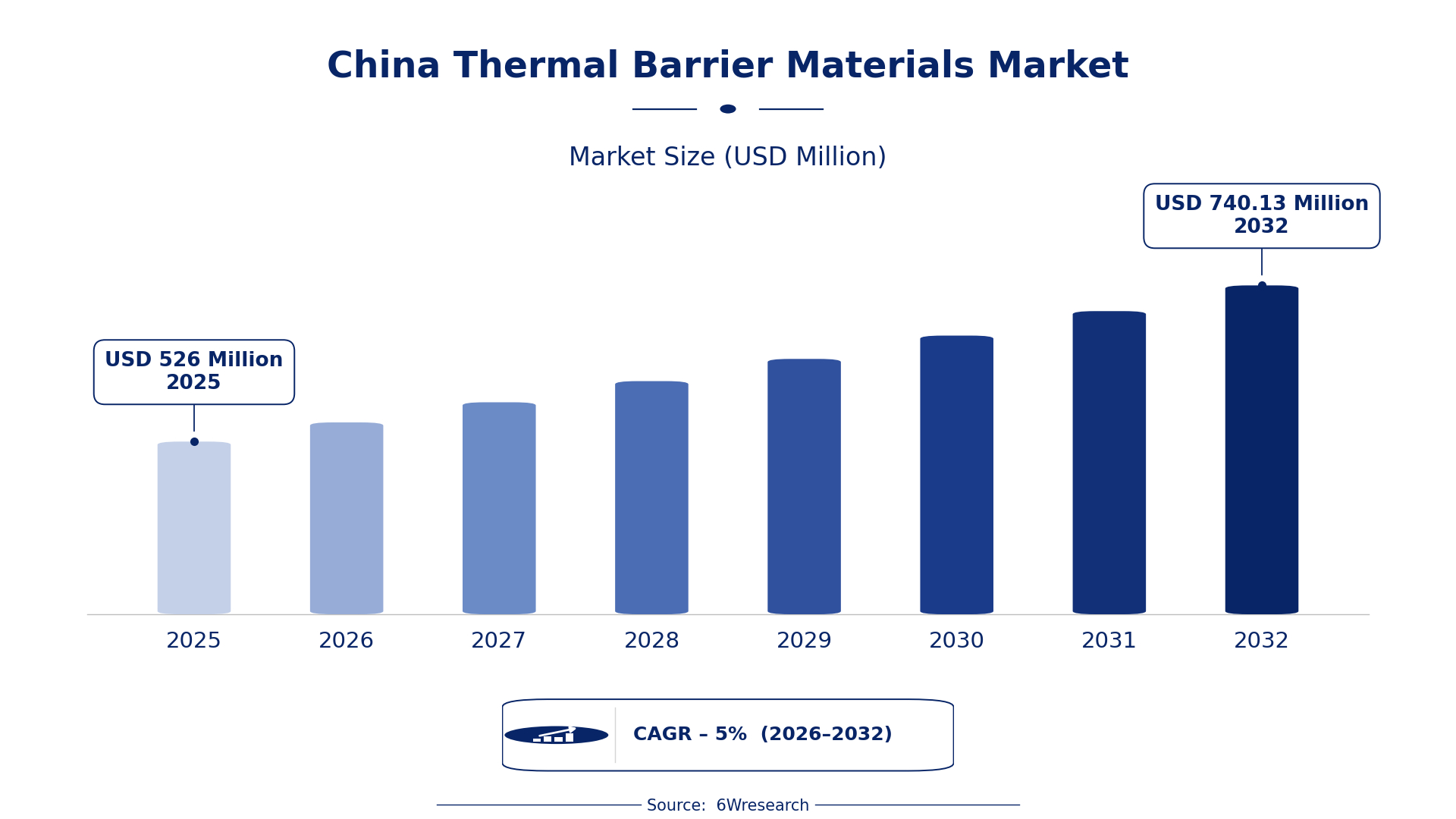
According to 6Wresearch internal database and industry insights, the China Thermal Barrier Materials Market was valued at USD 526.0 million in 2025 and is projected to reach USD 740.13 million by 2032, growing at a CAGR of approximately 5% during 2026–2032.
China Thermal Barrier Materials Market Highlights
| Report Metric | Details |
| Report Name | China Thermal Barrier Materials Market |
| Market Size 2025 | USD 526.0 million |
| Market Size 2032 | USD 740.13 million |
| Absolute Growth 2025–2032 | USD 214.13 million |
| CAGR 2026–2032 | 5% |
| Peak Annual Growth | 7.2% in 2030 |
| Forecast Period | 2026–2032 |
| Historical Data | 2022–2025 |
| Base Year | 2025 |
| Leading Material Type, 2025 | Ceramic Coatings (47% share) |
| Leading Thermal Resistance Level, 2025 | High (>1300°C) (47% share) |
| Leading Application Area, 2025 | Aircraft Engines (50% share) |
| Leading End User, 2025 | Aerospace OEMs (46% share) |
| Fastest-Growing Thermal Resistance Level | Medium (~600°C) (6.0% CAGR) |
| Fastest-Growing Application Area | Spacecraft Components (6.3% CAGR) |
| Fastest-Growing End User | Defense Contractors (7.2% CAGR) |
| Growing Sector | Aerospace |
| Key End Users | Aerospace OEMs, Defense Contractors, Space Agencies, MRO Providers |
China Thermal Barrier Materials Market Year-wise Growth Rate and Key Drivers (2022–2032)
This graph illustrates the annual growth rates of the market from 2022 to 2032, highlighting a steady upward trajectory and projected market expansion over the forecast period.
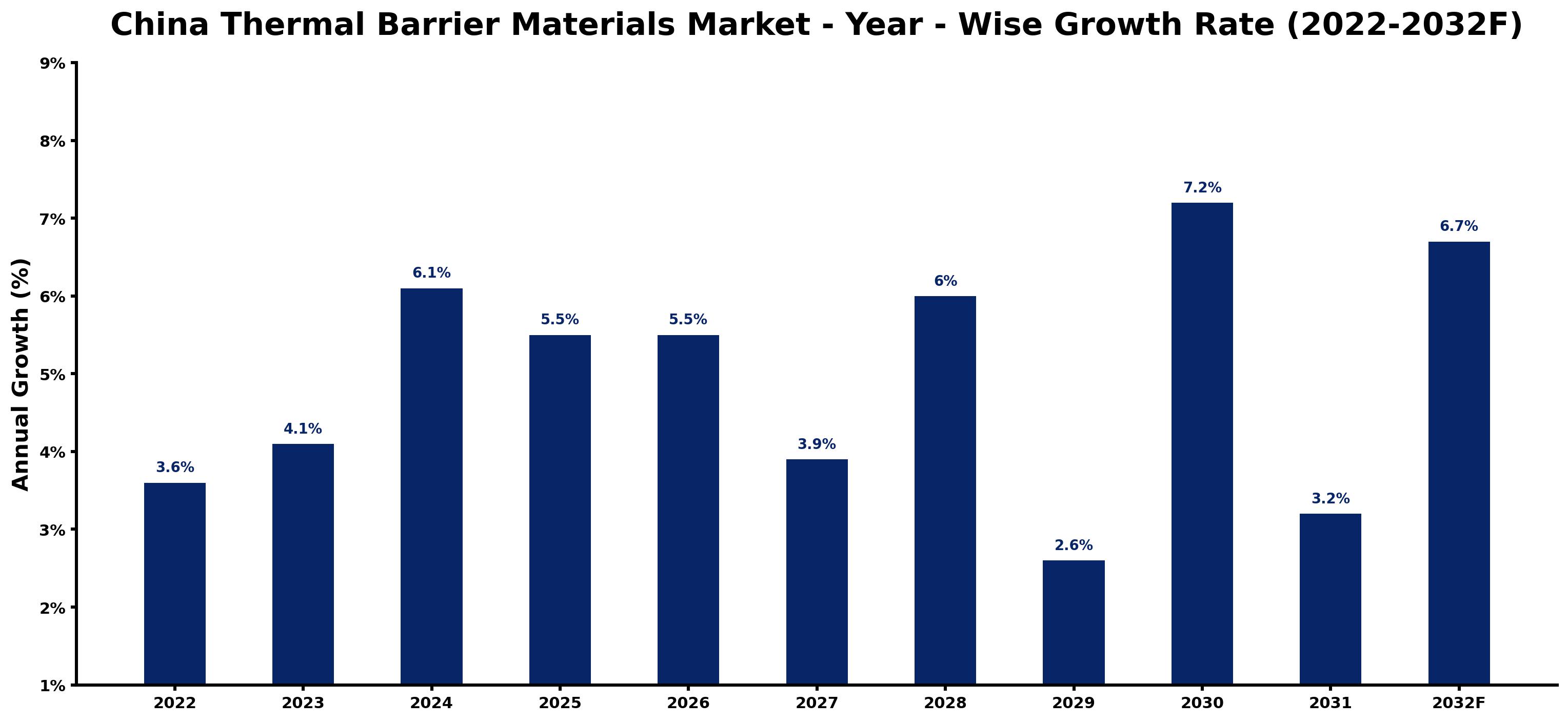
Annual growth estimates for each year appear below with the principal reason behind them, explaining the shifts that set the pace of the market.
| Year | Estimated Annual Growth (%) | Market Rationale |
| 2022 | 3.6 | The market experienced steady growth due to ongoing aerospace projects and increased aircraft production. |
| 2023 | 4.1 | Demand rose as domestic manufacturers expanded their capabilities in thermal barrier technologies. |
| 2024 | 6.1 | Growth accelerated with the production of 300 commercial aircraft, boosting material requirements. |
| 2025 | 5.5 | The market saw a slowdown as growth moderated after a peak in aircraft manufacturing. |
| 2026 | 5.5 | Demand remained stable as manufacturers continued to invest in thermal protection solutions. |
| 2027 | 3.9 | The market faced a slowdown as growth rates decreased amid evolving industry standards. |
| 2028 | 6.0 | Growth picked up again with rising investments in aerospace R&D and technology advancements. |
| 2029 | 2.6 | The market slowed as manufacturers adjusted to new standards and production capacities. |
| 2030 | 7.2 | Demand surged with the implementation of advanced thermal barrier solutions in aerospace applications. |
| 2031 | 3.2 | Growth slowed again as the market stabilised following rapid advancements in technology. |
| 2032 | 6.7 | The market rebounded with renewed investments in aerospace projects and thermal material innovations. |
Note: Market size estimations and growth projections presented in this report are based on 6Wresearch's proprietary forecasting methodology, utilizing the latest available industry data, government publications, and primary research inputs.
China Thermal Barrier Materials Market Synopsis
Composed of ceramics, polymers, or composites, these materials play a critical role in aircraft engines and spacecraft components. Key factors include rising aircraft production and substantial investments in defence technology. The National Aerospace Administration's standards further stimulate the demand for high-performance thermal materials.
Market Dynamics Impact Analysis (2026–2032)
| Factor | Type | Impact | Primary Segment Affected |
| Rising aircraft production in China drives demand for thermal barrier materials. | Driver | High | Ceramic Coatings |
| Increased investment in aerospace R&D enhances the need for advanced thermal materials. | Driver | High | Insulation Mats |
| Growing defense budget creates opportunities for thermal barrier material suppliers. | Opportunity | High | Aerospace OEMs |
| The need for improved thermal protection in spacecraft components presents investment opportunities. | Opportunity | High | Spacecraft Components |
| High production costs of advanced materials can limit market growth. | Restraint | Medium | Thermal Paints |
| Stringent quality standards may hinder the entry of new suppliers into the market. | Restraint | Medium | Composite Barriers |
| Challenges in meeting evolving aerospace standards can delay product approvals. | Challenge | High | Aerospace OEMs |
| Limited availability of skilled labour in advanced material manufacturing affects production capacity. | Challenge | Medium | Defense Contractors |
Evaluation of Drivers in China Thermal Barrier Materials Market (2026–2032)
Key forces behind demand, with the segment each one moves most, are listed below.
| Drivers | Primary Segment Affected | Why It Matters (Evidence) |
| Increased aircraft production supports demand for high-performance thermal barrier materials. | Ceramic Coatings | In 2022, China produced 300 commercial aircraft, leading to higher material requirements. |
| Growing investment in aerospace technology drives demand for insulation materials. | Insulation Mats | China's defense budget for 2023 allocates significant funds for aerospace technology development. |
| Rising defense spending boosts the need for advanced thermal barrier solutions. | Aerospace OEMs | The defense budget is projected to support various aerospace projects and innovations. |
| The National Aerospace Administration's standards elevate demand for quality thermal materials. | Spacecraft Components | The agency has established standards for thermal materials in aerospace applications. |
| The Shanghai region's aerospace hub stimulates innovation and demand for thermal barriers. | Composite Barriers | The region is a key area for aerospace R&D and manufacturing. |
Market growth in China for Thermal Barrier Materials rests on rising aircraft production, increased investment in aerospace technology, and growing defense spending. In 2022, China produced 300 commercial aircraft, which boosted material requirements. The defense budget for 2023 allocates substantial funds for aerospace technology development, driving demand for advanced thermal barrier solutions. Updated standards for thermal materials raise quality requirements, further supporting the market. Investment in R&D within the Guangdong province is creating a thriving environment for thermal barrier material suppliers, enhancing overall market dynamics.
Evaluation of Restraints in China Thermal Barrier Materials Market
The following restraints limit how fast demand can grow.
| Market Restraint | Primary Segment Affected | Why It Matters (Evidence) |
| High production costs of advanced thermal materials limit market growth. | Thermal Paints | Producers face challenges in maintaining competitive pricing due to expensive raw materials. |
| Stringent quality standards hinder new suppliers from entering the market. | Composite Barriers | Compliance with evolving aerospace standards requires substantial investment and testing. |
| Challenges in meeting evolving aerospace standards delay product approvals. | Aerospace OEMs | Manufacturers must adapt to new regulations, which can extend time-to-market. |
| Limited availability of skilled labour affects production capacity. | Defense Contractors | A shortage of trained professionals in advanced materials impacts operational efficiency. |
| Market fluctuations can create uncertainty for suppliers and manufacturers. | Insulation Mats | Economic changes may affect funding for aerospace projects and material procurement. |
China Thermal Barrier Materials Market Challenges
The China Thermal Barrier Materials Market encounters stringent regulatory standards that prolong product approval times, costing producers up to six months in time-to-market. Intense competition among local manufacturers drives prices down, potentially reducing profit margins for suppliers by about 15%. Distributors face supply chain disruptions, particularly in sourcing raw materials, leading to lead times that can increase by up to 20%, affecting their ability to fulfil buyer orders. Buyers are experiencing rising costs due to fluctuating material prices, inflating project budgets by around 10%, which constrains their overall investment in aerospace technologies.
Trends in the China Thermal Barrier Materials Market
Below mentioned are some of the trends shaping the China Thermal Barrier Materials Market growth.
- Shift in Focus to Advanced Thermal Solutions: China's aerospace sector is increasingly prioritising advanced thermal barrier materials to improve performance. The National Aerospace Administration's updated guidelines in 2022 reflect this shift, promoting higher standards for thermal protection, which will drive innovation in material development.
- Transition from Conventional to Composite Materials: Since 2020, there has been a noticeable shift towards composite thermal barrier materials in aerospace applications. The Ministry of Industry and Information Technology's initiatives support this trend, aiming to improve material performance and reduce weight, which is critical for aircraft efficiency.
- Emergence of Spacecraft Component Innovations: The focus on spacecraft components has intensified, with increased R&D efforts since the launch of the China National Space Administration's program in 2020. This initiative aims to improve thermal protection technologies, leading to a surge in demand for specialised thermal barrier materials.
- Growing Investment in Aerospace R&D: The Guangdong province has become a key area for aerospace R&D and manufacturing since 2021. With a budget of $10 billion allocated for the Aerospace Industry Development Plan, investment in thermal barrier technologies is projected to rise significantly.
Investment Opportunities in the China Thermal Barrier Materials Market
Several openings in the China Thermal Barrier Materials Market merit attention from investors.
- Partnerships with Local Manufacturers: Local partnerships can facilitate entry into China's aerospace market, projected to reach $1 trillion by 2035. Collaborating with aerospace OEMs in the Shanghai region can improve market presence and access to resources.
- Investment in Advanced Material Development: With the defence budget for 2023 increasing, there is a $10 billion opportunity for suppliers focusing on advanced thermal materials. Engaging with government initiatives can provide funding and support for new technologies.
- Expansion in the Guangdong Aerospace Hub: The Guangdong province offers a growing market for thermal barrier materials, with significant R&D investments. Establishing joint ventures with local firms can improve product development and market penetration.
- Utilising National Standards for Market Entry: The adoption of GB/T 34580-2017 standards creates opportunities for suppliers to certify their products. Meeting these standards can facilitate access to the aerospace market and increase competitiveness.
Government Initiatives in the China Thermal Barrier Materials Market
The 'Aerospace Industry Development Plan' launched by the State Council in 2021 aims to improve material technology, with a budget of $10 billion to boost domestic production. This plan focuses on increasing the efficiency and quality of thermal barrier materials used in aerospace applications. The '14th Five-Year Plan for Aerospace Development' initiated by the Ministry of Industry and Information Technology includes measures to support innovation in thermal materials, ensuring compliance with international standards.
The Ministry of Science and Technology's 'National Key R&D Program' initiated in 2022 focuses on advanced thermal materials for aerospace applications. This program funds research projects aimed at developing new thermal barrier technologies. The China National Space Administration's updated 'Guidelines for Spacecraft Thermal Protection Materials' in 2022 improve standards and performance, ensuring that manufacturers meet the required specifications for aerospace components.
Future Insight of the China Thermal Barrier Materials Market
The China Thermal Barrier Materials Market will undergo significant changes by 2032, driven by advancements in aerospace technology and strong government support for innovation. The implementation of the national standard GB/T 34580-2017 will enhance product quality and reliability, encouraging wider adoption among manufacturers. Initiatives from the Ministry of Industry and Information Technology will promote research and development, leading to new material innovations. As China's aerospace industry aims for a value of $1 trillion by 2035, demand for high-performance thermal barrier materials will rise sharply.
Market Segmentation Analysis
The report offers a comprehensive study of the following market segments and their leading categories in the market.
By Material Type – Ceramic Coatings Dominated and Is Expected to Record the Fastest Growth
According to Vasudha, AM at 6Wresearch, Ceramic Coatings held a 47% share of the China Thermal Barrier Materials Market by material type in 2025. Ceramic coatings dominate the China thermal barrier materials market due to their superior performance in high-temperature aerospace environments. Their extensive use in aircraft engines highlights a robust demand from manufacturers and a well-established installed base. Its lead should widen, with a projected CAGR of 7.1% during 2026–2032, the highest in this split. Ceramic coatings are set to maintain their rapid growth as aerospace OEMs increasingly adopt advanced thermal barrier solutions to enhance performance. The continuous investments in aircraft technologies will further solidify their leading position in the market. Suppliers should focus on ceramic coatings to align with the rising demands of aerospace manufacturers.
By Thermal Resistance Level – High (>1300°C) Dominated, Medium (~600°C) Expected to Grow Fastest
With a 47% revenue share in 2025, High (>1300°C) was the largest thermal resistance level category. High thermal resistance materials, capable of withstanding temperatures above 1300 degrees Celsius, are essential for aerospace engines operating under extreme conditions. Their critical role in ensuring engine performance contributes to a substantial market share in thermal barrier materials. Over 2026–2032, Medium (~600°C) is expected to post the fastest growth, at a CAGR of 6.0%. Medium thermal resistance materials, designed for applications requiring protection against temperatures around 600 degrees Celsius, are gaining traction due to their versatility in various aerospace applications. This trend suggests a growing preference for adaptable solutions among manufacturers. Buyers should consider medium resistance options for applications needing moderate heat protection, expanding their procurement strategies.
By Application Area – Aircraft Engines Dominated, Spacecraft Components Expected to Grow Fastest
Aircraft Engines accounted for a 50% market share by application area in 2025. Aircraft engines serve as the primary application area for thermal barrier materials, necessitating strong protection against extreme heat. The significant production and operational numbers of aircraft in China ensure a considerable market share for this segment. The quickest growth will come from Spacecraft Components, forecast to expand at a CAGR of 6.3% between 2026 and 2032. Spacecraft components are witnessing rapid growth as investments in space exploration initiatives rise. The increasing demand for advanced thermal protection in spacecraft highlights the importance of this segment within the aerospace sector. Suppliers should target spacecraft components to capitalise on the growing investments in space technology.
By End User – Aerospace OEMs Dominated, Defense Contractors Expected to Grow Fastest
In 2025, Aerospace OEMs led the end user split with a 46% share. Aerospace OEMs are the leading end users of thermal barrier materials, as they rely heavily on these materials for manufacturing aircraft and components. Their substantial market share reflects the ongoing production and innovation within the aerospace sector. Defense Contractors are projected to grow fastest, at a CAGR of 7.2% during 2026–2032. Defense contractors are experiencing rapid growth in their use of thermal barrier materials due to increased military aerospace applications. The rising defence budget and focus on advanced technologies will likely drive further demand in this segment. Suppliers must engage with defense contractors to meet the rising demand for advanced thermal barrier solutions.
Key Attractiveness of the Report
- 10 Years of Market Numbers
- Historical Data Starting from 2022 to 2025
- Base Year 2025
- Forecast Data until 2032
- Key Performance Indicators Impacting the Market
- Major Upcoming Developments and Projects
Key Highlights of the Report:
- China Thermal Barrier Materials Market Outlook
- Market Size of China Thermal Barrier Materials Market, 2025
- Forecast of China Thermal Barrier Materials Market, 2032
- Historical Data and Forecast of China Thermal Barrier Materials Revenues & Volume for the Period 2022 - 2032F
- China Thermal Barrier Materials Market Trend Evolution
- China Thermal Barrier Materials Market Drivers and Challenges
- China Thermal Barrier Materials Price Trends
- China Thermal Barrier Materials Porter's Five Forces
- China Thermal Barrier Materials Industry Life Cycle
- Historical Data and Forecast of China Thermal Barrier Materials Market Revenues & Volume By Material Type for the Period 2022 - 2032F
- Historical Data and Forecast of China Thermal Barrier Materials Market Revenues & Volume By Ceramic Coatings for the Period 2022 - 2032F
- Historical Data and Forecast of China Thermal Barrier Materials Market Revenues & Volume By Thermal Paints for the Period 2022 - 2032F
- Historical Data and Forecast of China Thermal Barrier Materials Market Revenues & Volume By Insulation Mats for the Period 2022 - 2032F
- Historical Data and Forecast of China Thermal Barrier Materials Market Revenues & Volume By Composite Barriers for the Period 2022 - 2032F
- Historical Data and Forecast of China Thermal Barrier Materials Market Revenues & Volume By Thermal Resistance Level for the Period 2022 - 2032F
- Historical Data and Forecast of China Thermal Barrier Materials Market Revenues & Volume By High ( 1300 C) for the Period 2022 - 2032F
- Historical Data and Forecast of China Thermal Barrier Materials Market Revenues & Volume By Medium ( 600 C) for the Period 2022 - 2032F
- Historical Data and Forecast of China Thermal Barrier Materials Market Revenues & Volume By Low ( 300 C) for the Period 2022 - 2032F
- Historical Data and Forecast of China Thermal Barrier Materials Market Revenues & Volume By Variable for the Period 2022 - 2032F
- Historical Data and Forecast of China Thermal Barrier Materials Market Revenues & Volume By Application Area for the Period 2022 - 2032F
- Historical Data and Forecast of China Thermal Barrier Materials Market Revenues & Volume By Aircraft Engines for the Period 2022 - 2032F
- Historical Data and Forecast of China Thermal Barrier Materials Market Revenues & Volume By Exhaust Systems for the Period 2022 - 2032F
- Historical Data and Forecast of China Thermal Barrier Materials Market Revenues & Volume By Interior Cabin for the Period 2022 - 2032F
- Historical Data and Forecast of China Thermal Barrier Materials Market Revenues & Volume By Spacecraft Components for the Period 2022 - 2032F
- Historical Data and Forecast of China Thermal Barrier Materials Market Revenues & Volume By End User for the Period 2022 - 2032F
- Historical Data and Forecast of China Thermal Barrier Materials Market Revenues & Volume By Aerospace OEMs for the Period 2022 - 2032F
- Historical Data and Forecast of China Thermal Barrier Materials Market Revenues & Volume By MRO Providers for the Period 2022 - 2032F
- Historical Data and Forecast of China Thermal Barrier Materials Market Revenues & Volume By Defense Contractors for the Period 2022 - 2032F
- Historical Data and Forecast of China Thermal Barrier Materials Market Revenues & Volume By Space Agencies for the Period 2022 - 2032F
- China Thermal Barrier Materials Import Export Trade Statistics
- Market Opportunity Assessment By Material Type
- Market Opportunity Assessment By Thermal Resistance Level
- Market Opportunity Assessment By Application Area
- Market Opportunity Assessment By End User
- China Thermal Barrier Materials Top Companies Market Share
- China Thermal Barrier Materials Competitive Benchmarking By Technical and Operational Parameters
- China Thermal Barrier Materials Company Profiles
- China Thermal Barrier Materials Key Strategic Recommendations
Market Covered
Segments analysed in this report are listed below.
By Material Type
- Ceramic Coatings
- Thermal Paints
- Insulation Mats
- Composite Barriers
By Thermal Resistance Level
- High (>1300°C)
- Medium (~600°C)
- Low (~300°C)
- Variable
By Application Area
- Aircraft Engines
- Exhaust Systems
- Interior Cabin
- Spacecraft Components
By End User
- Aerospace OEMs
- MRO Providers
- Defense Contractors
- Space Agencies































