China Toddler Clothing Market Size & Growth Rate
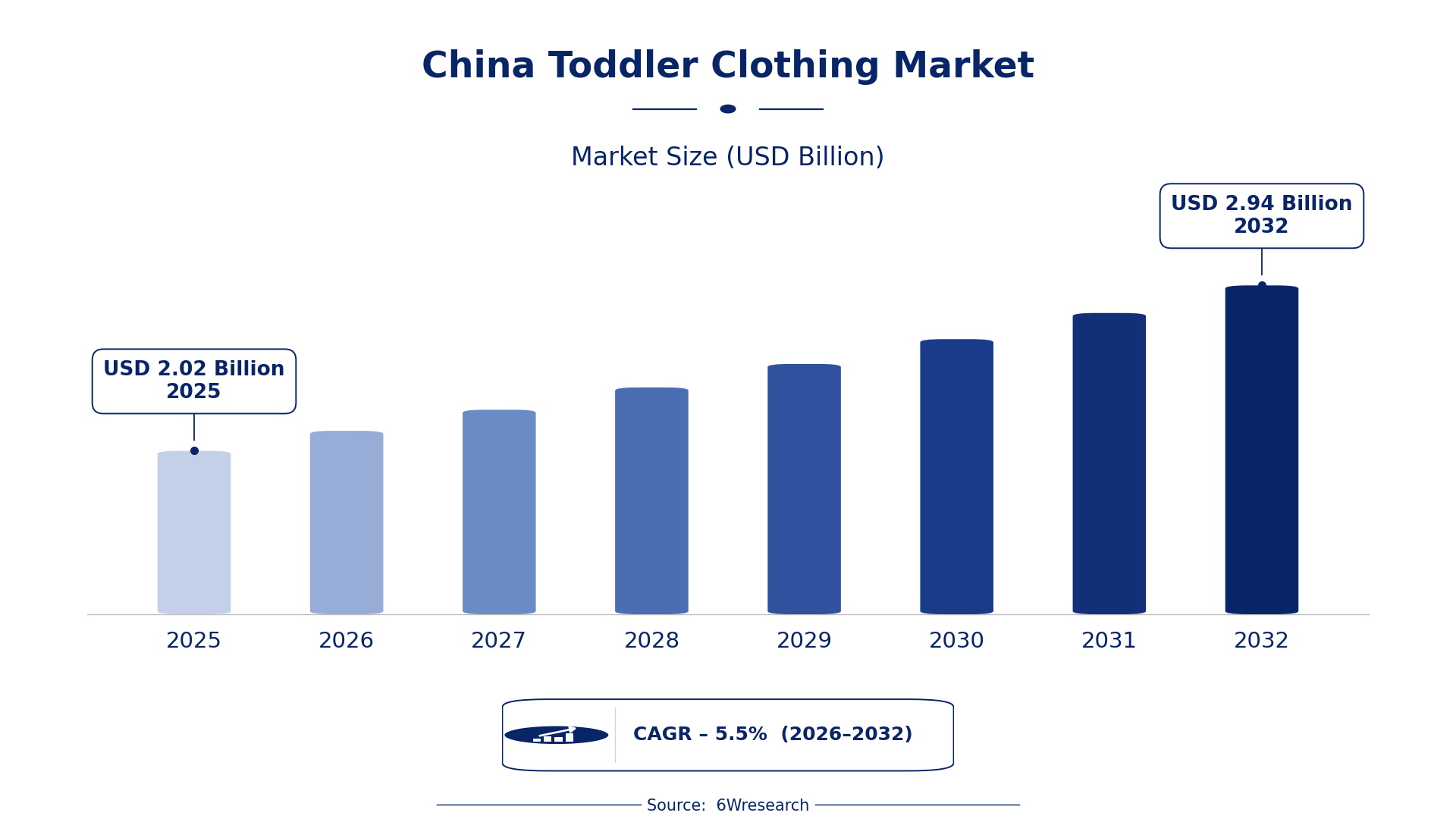
According to 6Wresearch internal database and industry insights, the China Toddler Clothing Market was valued at USD 2.02 billion in 2025 and is projected to reach USD 2.94 billion by 2032, growing at a CAGR of approximately 5.5% during 2026–2032.
China Toddler Clothing Market Highlights
| Report Metric | Details |
| Report Name | China Toddler Clothing Market |
| Market Size 2025 | USD 2.02 billion |
| Market Size 2032 | USD 2.94 billion |
| Absolute Growth 2025–2032 | USD 0.92 billion |
| CAGR 2026–2032 | 5.5% |
| Peak Annual Growth | 8.0% in 2027 |
| Forecast Period | 2026–2032 |
| Historical Data | 2022–2025 |
| Base Year | 2025 |
| Leading Clothing Type, 2025 | Pajamas (43% share) |
| Leading Fabric Type, 2025 | Cotton Blend (40% share) |
| Leading Age Group, 2025 | 0–24 Months (39% share) |
| Leading End User, 2025 | Online Platforms (39% share) |
| Fastest-Growing Clothing Type | Dresses (6.5% CAGR) |
| Fastest-Growing Fabric Type | Organic Cotton (7.9% CAGR) |
| Fastest-Growing Age Group | 1–3 Years (8.0% CAGR) |
| Fastest-Growing End User | Children's Boutiques (7.1% CAGR) |
| Growing Sector | Children's Boutiques |
| Key End Users | Online Platforms, Retail Stores, Apparel Retailers, Children's Boutiques |
China Toddler Clothing Market Year-wise Growth Rate and Key Drivers (2022–2032)
This graph illustrates the annual growth rates of the market from 2022 to 2032, highlighting a steady upward trajectory and projected market expansion over the forecast period.
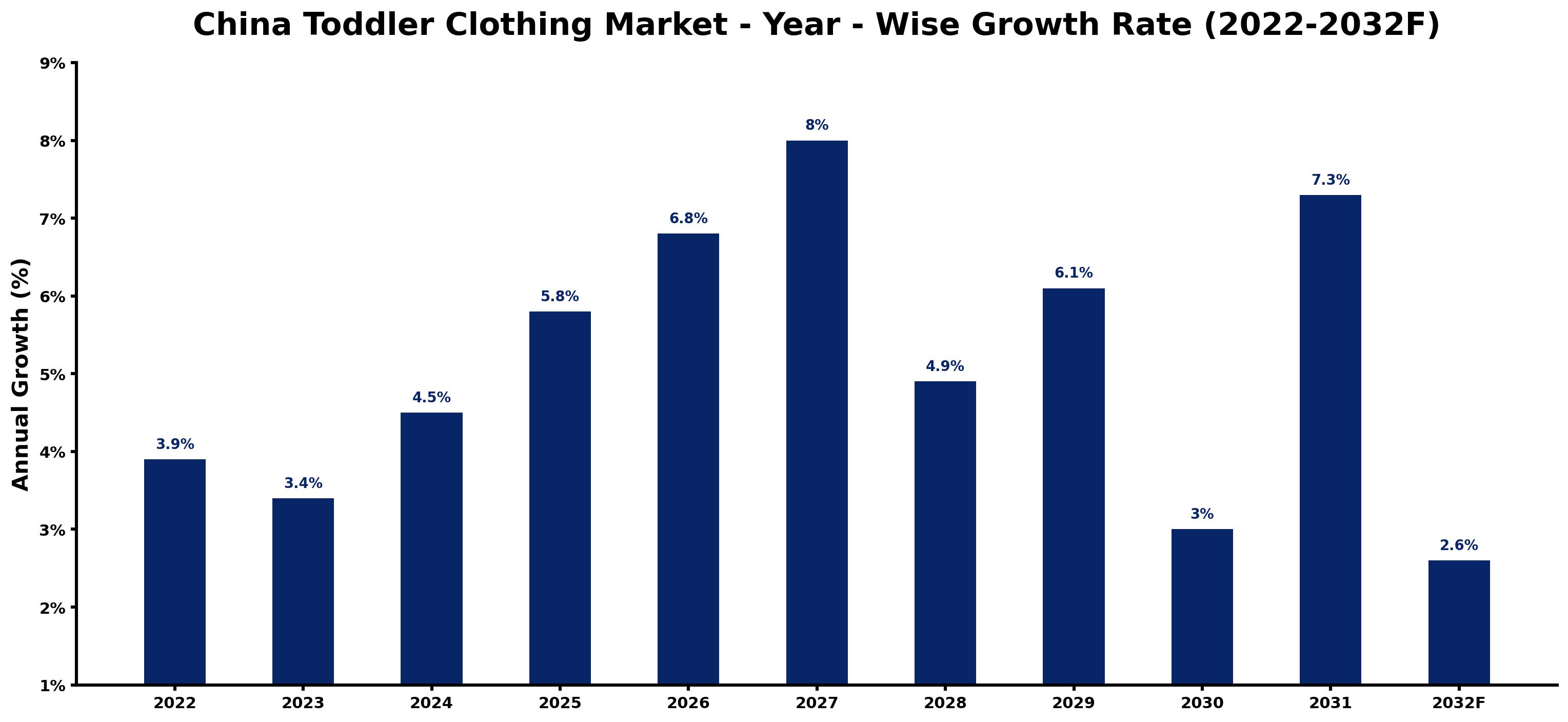
Year by year, the estimates below pair each growth rate with the development that shaped it.
| Year | Estimated Annual Growth (%) | Market Rationale |
| 2022 | 3.9 | The toddler population reached approximately 80 million, driving demand for clothing. |
| 2023 | 3.4 | Spending on toddler clothing remained stable, but growth slowed due to market adjustments. |
| 2024 | 4.5 | Increased consumer interest in sustainable fabrics led to a rise in demand for organic cotton. |
| 2025 | 5.8 | Retail sales surged as families prioritised quality clothing for their toddlers. |
| 2026 | 6.8 | Innovation in textile manufacturing contributed to enhanced product offerings in the market. |
| 2027 | 8.0 | The introduction of new styles and designs spurred significant growth in toddler clothing sales. |
| 2028 | 4.9 | Consumer spending patterns shifted, resulting in slower growth compared to the previous year. |
| 2029 | 6.1 | A resurgence in online shopping boosted sales, particularly through e-commerce platforms. |
| 2030 | 3.0 | Economic factors led to a slowdown in growth as families reassessed their budgets. |
| 2031 | 7.3 | The growing popularity of children's boutiques drove increased demand for unique toddler clothing. |
| 2032 | 2.6 | Market growth will slow as the focus shifts to sustainable practices and eco-friendly materials. |
Note: Market size estimations and growth projections presented in this report are based on 6Wresearch's proprietary forecasting methodology, utilizing the latest available industry data, government publications, and primary research inputs.
China Toddler Clothing Market Synopsis
Toddler Clothing in China includes garments for children aged 0 to 4 years, crafted from a variety of fabrics. These clothes serve multiple purposes, including everyday wear, sleepwear, and seasonal outfits. The China Toddler Clothing Market is growing as consumer spending rises and online shopping becomes more popular. In 2022, retail sales reached 100 billion CNY, with online platforms contributing 40% of this figure. The increasing number of toddlers further drives demand, creating opportunities for the adoption of sustainable fabrics.
Market Dynamics Impact Analysis (2026–2032)
| Factor | Type | Impact | Primary Segment Affected |
| Rising consumer spending on quality toddler clothing drives demand. | Driver | High | Retail Stores |
| Growing preference for eco-friendly materials creates opportunities for sustainable products. | Opportunity | High | Cotton Blend |
| Safety regulations enhance product quality, boosting consumer confidence. | Driver | High | Children's Boutiques |
| Increased online shopping accessibility expands market reach. | Opportunity | High | Online Platforms |
| Market adjustments in spending patterns may limit growth. | Restraint | Medium | Apparel Retailers |
| Supply chain disruptions can affect product availability. | Restraint | Medium | Children's Boutiques |
| High production costs can limit profit margins for manufacturers. | Challenge | Medium | Cotton Blend |
| Regulatory compliance can delay product launches in the market. | Challenge | Medium | Retail Stores |
Evaluation of Drivers in China Toddler Clothing Market (2026–2032)
Below mentioned are some major drivers and their influence on market dynamics.
| Drivers | Primary Segment Affected | Why It Matters (Evidence) |
| Increased spending on toddler clothing due to rising disposable incomes. | Retail Stores | The average family spends around 1,500 CNY annually on toddler clothing, boosting retail sales. |
| Growing demand for organic cotton as eco-consciousness rises among consumers. | Cotton Blend | The average price of organic cotton is increasing, appealing to environmentally aware parents. |
| The expansion of online shopping platforms improves accessibility for consumers. | Online Platforms | In 2022, online platforms accounted for 40% of sales, reflecting a shift in shopping behaviour towards convenience. |
| Safety regulations improve product quality, increasing consumer trust. | Children's Boutiques | The National Standard for Children's Clothing ensures compliance, enhancing safety for parents. |
| Innovations in textile manufacturing lead to new product offerings. | Apparel Retailers | The government's subsidy program of 500 million CNY supports investment in textile innovation. |
Growth in the Toddler Clothing market in China comes from increased consumer spending, innovation in textile manufacturing, and the expansion of online shopping platforms. In 2022, families spent approximately 1,500 CNY annually on toddler clothing, driving retail sales to 100 billion CNY. The average price of a toddler dress is around 200 CNY, encouraging parents to invest in quality garments. The rising interest in organic cotton is reshaping product offerings as parents seek sustainable options. With 40% of sales in 2022 coming from online channels, convenience is a key driver of purchasing decisions.
Evaluation of Restraints in China Toddler Clothing Market
Below mentioned are some major restraints and their influence on market dynamics.
| Market Restraint | Primary Segment Affected | Why It Matters (Evidence) |
| High production costs limit profit margins for manufacturers. | Cotton Blend | Increased costs of raw materials affect pricing strategies, impacting profitability. |
| Supply chain disruptions can lead to product shortages. | Children's Boutiques | Logistical challenges hinder timely delivery, affecting inventory levels in boutiques. |
| Regulatory compliance can delay product launches. | Retail Stores | Manufacturers must meet safety standards, which can extend time-to-market. |
| Market adjustments in consumer spending patterns may limit growth. | Apparel Retailers | Economic uncertainty leads families to reassess their budgets for clothing. |
| Competition from international brands can pressure local manufacturers. | Online Platforms | Global brands often offer lower prices, challenging local market share. |
China Toddler Clothing Market Challenges
Producers in the China toddler clothing market are contending with increasing production costs, as the average price of a toddler dress stands at around 200 CNY, impacting profit margins. Families face challenges with affordability, allocating a considerable portion of their budgets to clothing, which affects spending on other essentials. Competition is fierce, with both domestic and international brands competing for market share, leading to aggressive pricing strategies that may undermine brand loyalty. Compliance with regulations, particularly the National Standard for Children's Clothing, can cause delays for producers, affecting their ability to meet consumer demand swiftly.
Trends in the China Toddler Clothing Market
The trends below show where the China Toddler Clothing Market is heading.
- Shift Towards Sustainable Fabrics: Retailers are increasingly incorporating sustainable fabrics into toddler clothing, responding to consumer demand for eco-friendly options. The 'Green Textile Development Program' initiated in 2023 aims for 20% adoption by 2025, transforming the market.
- Growth of Online Shopping: The rise of e-commerce has changed how parents buy toddler clothing. In 2022, online platforms represented 40% of sales, indicating a shift in consumer behaviour towards convenience.
- Increased Focus on Safety Standards: The National Standards for Children's Clothing, updated in 2020, have strengthened safety measures. This revision ensures that products undergo rigorous quality checks, boosting consumer trust.
- Emergence of Children's Boutiques: Children's boutiques are becoming more popular as parents seek distinctive clothing options. This segment is expected to grow at a CAGR of 7.1%, catering to niche markets.
Investment Opportunities in the China Toddler Clothing Market
The following opportunities in the China Toddler Clothing Market pair current demand with a clear way in.
- Growing Demand for Organic Cotton: With the market for organic cotton projected to grow significantly, manufacturers can invest in sustainable fabric production. This opportunity aligns with the eco-conscious preferences of parents.
- Expansion of E-commerce Platforms: Online platforms continue to dominate toddler clothing sales, accounting for 40% in 2022. Investing in e-commerce capabilities can help retailers capture this growing market segment.
- Support for Local Manufacturers: The Ministry of Commerce's 500 million CNY program supports local children's apparel manufacturers. Engaging in this initiative can improve production capabilities and market reach.
- Increased Investment in Textile Innovation: The government's subsidy program for textile innovation encourages advancements in manufacturing. Companies can utilise this funding to develop new, high-quality products.
Government Initiatives in the China Toddler Clothing Market
The regulatory framework for toddler clothing in China includes the National Standards for Children's Clothing, revised in 2020, which enhances safety and quality measures. The Child Health and Safety Initiative, launched in 2022, promotes safe clothing for toddlers in educational settings. These measures ensure that manufacturers comply with strict guidelines, improving product safety for consumers. The Green Textile Development Program, initiated in 2021, targets 20% adoption of sustainable practices by 2025, encouraging eco-friendly production methods.
The Ministry of Industry and Information Technology oversees the implementation of various initiatives, including the 'Green Textile Development Program' and the 'Child Health and Safety Initiative'. These programmes provide funding to local manufacturers and promote adherence to safety standards, ensuring that products meet consumer expectations. The State Administration for Market Regulation also plays a role in enforcing safety regulations, enhancing consumer trust in toddler clothing.
Future Insight of the China Toddler Clothing Market
The China toddler clothing market will experience notable changes by 2032, driven by the Green Textile Development Program that encourages sustainable fabric use. Innovations in textile manufacturing will improve product quality, benefiting both buyers and suppliers. Online platforms are projected to account for over 50% of total sales, altering how consumers shop for toddler clothing. Stricter enforcement of the Child Health and Safety Initiative will raise safety standards, ensuring families receive higher quality and safer products.
Market Segmentation Analysis
The report offers a comprehensive study of the following market segments and their leading categories in the market.
By Clothing Type – Pajamas Dominated, Dresses Expected to Grow Fastest
According to Vasudha, AM at 6Wresearch, Pajamas held a 43% share of the China Toddler Clothing Market by clothing type in 2025. Pajamas command a substantial share in the China toddler clothing market as they are essential for sleep, with many families prioritising their purchase for comfort during the night. This category's strong position is particularly evident in major urban areas like Shanghai and Beijing, where demand for quality sleepwear is high. Over 2026–2032, Dresses are expected to post the fastest growth, at a CAGR of 6.5%. Dresses are experiencing rapid growth as they are increasingly chosen for special occasions, appealing to parents who seek stylish options for their children. This trend indicates a shift in consumer preferences towards fashionable toddler attire, further boosting the segment's market position. Suppliers should focus on expanding pajama offerings while innovating dress designs to meet the evolving tastes of parents.
By Fabric Type – Cotton Blend Dominated, Organic Cotton Expected to Grow Fastest
Cotton Blend accounted for a 40% market share by fabric type in 2025. Cotton blend fabrics dominate the market due to their widespread application in toddler clothing, providing a balance of comfort and durability that resonates with parents. With cotton blends constituting 60% of the market, they are the preferred choice for everyday wear, ensuring a significant market share. The quickest growth will come from Organic Cotton, forecast to expand at a CAGR of 7.9% between 2026 and 2032. Organic cotton is rapidly gaining traction as a preferred choice among eco-conscious parents, driven by heightened awareness of sustainable textile practices. The introduction of the 'Green Textile Development Program' in 2023 has accelerated this trend, enhancing its growth potential in the market. Manufacturers should invest in organic cotton production to align with the increasing consumer demand for sustainable toddler clothing options.
By Age Group – 0–24 Months Dominated, 1–3 Years Expected to Grow Fastest
In 2025, 0–24 Months led the age group split with a 39% share. The 0–24 months age group holds a significant market share as this range requires a variety of clothing for infants, including sleepwear and everyday outfits. With an estimated toddler population of 80 million in China, there is robust demand for clothing tailored to this specific age bracket. 1–3 Years are set to record the highest CAGR in this split, 8.0% over 2026–2032. The 1–3 years age group is witnessing the fastest growth due to the increasing need for versatile clothing as toddlers become more active. Parents are seeking durable and comfortable options that cater to their children's developmental needs, driving expansion in this segment. Retailers should develop targeted marketing strategies for the 1–3 years age group to capitalise on this growing demand.
By End User – Online Platforms Dominated, Children's Boutiques Expected to Grow Fastest
The largest end user category in 2025 was Online Platforms, with a 39% share of total revenue. Online platforms lead the toddler clothing market as they offer a convenient shopping experience, accounting for 40% of total sales in 2022. This shift towards e-commerce reflects changing consumer behaviours, especially in urban centres where parents increasingly rely on online shopping for toddler clothing. Children's Boutiques are projected to grow fastest, at a CAGR of 7.1% during 2026–2032. Children's boutiques are the fastest-growing segment, catering to niche markets with unique and stylish offerings that appeal to discerning parents. This trend towards boutique shopping highlights a shift towards personalised and quality-focused purchasing decisions in the toddler clothing market. Suppliers should enhance their online presence while exploring partnerships with children's boutiques to effectively reach diverse consumer segments.
Key Attractiveness of the Report
- 10 Years of Market Numbers
- Historical Data Starting from 2022 to 2025
- Base Year 2025
- Forecast Data until 2032
- Key Performance Indicators Impacting the Market
- Major Upcoming Developments and Projects
Key Highlights of the Report:
- China Toddler Clothing Market Outlook
- Market Size of China Toddler Clothing Market, 2025
- Forecast of China Toddler Clothing Market, 2032
- Historical Data and Forecast of China Toddler Clothing Revenues & Volume for the Period 2022 - 2032F
- China Toddler Clothing Market Trend Evolution
- China Toddler Clothing Market Drivers and Challenges
- China Toddler Clothing Price Trends
- China Toddler Clothing Porter's Five Forces
- China Toddler Clothing Industry Life Cycle
- Historical Data and Forecast of China Toddler Clothing Market Revenues & Volume By Clothing Type for the Period 2022 - 2032F
- Historical Data and Forecast of China Toddler Clothing Market Revenues & Volume By Onesies for the Period 2022 - 2032F
- Historical Data and Forecast of China Toddler Clothing Market Revenues & Volume By Pajamas for the Period 2022 - 2032F
- Historical Data and Forecast of China Toddler Clothing Market Revenues & Volume By Dresses for the Period 2022 - 2032F
- Historical Data and Forecast of China Toddler Clothing Market Revenues & Volume By Outerwear for the Period 2022 - 2032F
- Historical Data and Forecast of China Toddler Clothing Market Revenues & Volume By Fabric Type for the Period 2022 - 2032F
- Historical Data and Forecast of China Toddler Clothing Market Revenues & Volume By Cotton Blend for the Period 2022 - 2032F
- Historical Data and Forecast of China Toddler Clothing Market Revenues & Volume By Organic Cotton for the Period 2022 - 2032F
- Historical Data and Forecast of China Toddler Clothing Market Revenues & Volume By Fleece/Cotton for the Period 2022 - 2032F
- Historical Data and Forecast of China Toddler Clothing Market Revenues & Volume By Waterproof/Synthetic for the Period 2022 - 2032F
- Historical Data and Forecast of China Toddler Clothing Market Revenues & Volume By Age Group for the Period 2022 - 2032F
- Historical Data and Forecast of China Toddler Clothing Market Revenues & Volume By 0 24 Months for the Period 2022 - 2032F
- Historical Data and Forecast of China Toddler Clothing Market Revenues & Volume By 1 3 Years for the Period 2022 - 2032F
- Historical Data and Forecast of China Toddler Clothing Market Revenues & Volume By 2 4 Years for the Period 2022 - 2032F
- Historical Data and Forecast of China Toddler Clothing Market Revenues & Volume By Toddlers for the Period 2022 - 2032F
- Historical Data and Forecast of China Toddler Clothing Market Revenues & Volume By End User for the Period 2022 - 2032F
- Historical Data and Forecast of China Toddler Clothing Market Revenues & Volume By Retail Stores for the Period 2022 - 2032F
- Historical Data and Forecast of China Toddler Clothing Market Revenues & Volume By Online Platforms for the Period 2022 - 2032F
- Historical Data and Forecast of China Toddler Clothing Market Revenues & Volume By Children s Boutiques for the Period 2022 - 2032F
- Historical Data and Forecast of China Toddler Clothing Market Revenues & Volume By Apparel Retailers for the Period 2022 - 2032F
- China Toddler Clothing Import Export Trade Statistics
- Market Opportunity Assessment By Clothing Type
- Market Opportunity Assessment By Fabric Type
- Market Opportunity Assessment By Age Group
- Market Opportunity Assessment By End User
- China Toddler Clothing Top Companies Market Share
- China Toddler Clothing Competitive Benchmarking By Technical and Operational Parameters
- China Toddler Clothing Company Profiles
- China Toddler Clothing Key Strategic Recommendations
Market Covered
This report examines the market across the segments below.
By Clothing Type
- Onesies
- Pajamas
- Dresses
- Outerwear
By Fabric Type
- Cotton Blend
- Organic Cotton
- Fleece/Cotton
- Waterproof/Synthetic
By Age Group
- 0–24 Months
- 1–3 Years
- 2–4 Years
- Toddlers
By End User
- Retail Stores
- Online Platforms
- Children's Boutiques
- Apparel Retailers































