China Turbofan Propulsion Market Size & Growth Rate
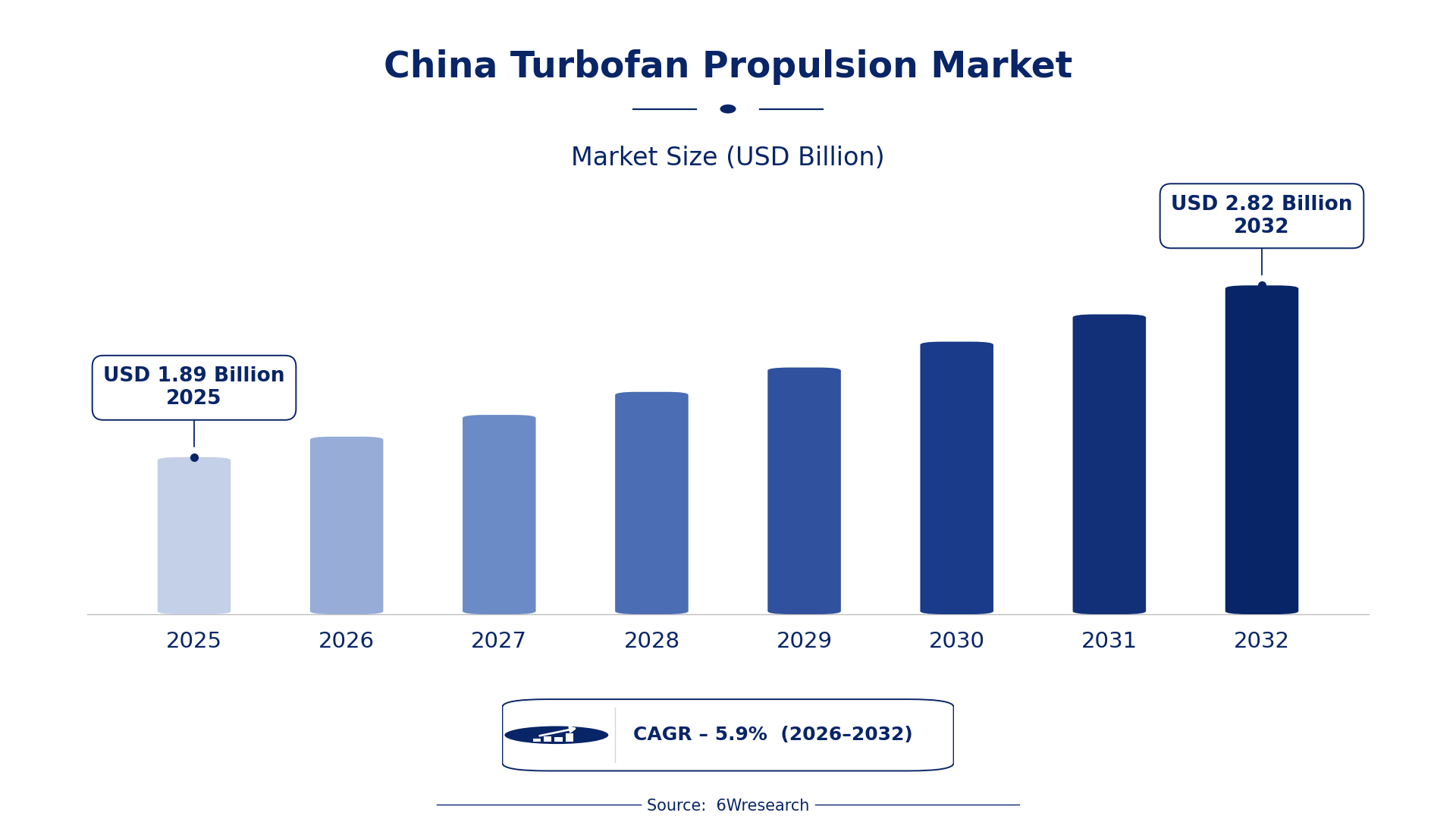
According to 6Wresearch internal database and industry insights, the China Turbofan Propulsion Market was valued at USD 1.89 billion in 2025 and is projected to reach USD 2.82 billion by 2032, growing at a CAGR of approximately 5.9% during 2026–2032.
China Turbofan Propulsion Market Highlights
| Report Metric | Details |
| Report Name | China Turbofan Propulsion Market |
| Market Size 2025 | USD 1.89 billion |
| Market Size 2032 | USD 2.82 billion |
| Absolute Growth 2025–2032 | USD 0.93 billion |
| CAGR 2026–2032 | 5.9% |
| Peak Annual Growth | 8.3% in 2026 |
| Forecast Period | 2026–2032 |
| Historical Data | 2022–2025 |
| Base Year | 2025 |
| Leading Turbofan Propulsion Trype, 2025 | Commercial Propulsion (40% share) |
| Leading Propulsion Type, 2025 | High‑Bypass Turbofans (50% share) |
| Leading Engine Technology, 2025 | Ultra‑High Bypass (52% share) |
| Leading Distribution Channel, 2025 | Aero Engine OEMs (33% share) |
| Leading End User Industry, 2025 | Airlines (40% share) |
| Fastest-Growing Turbofan Propulsion Trype | Demonstrator Engines (7.7% CAGR) |
| Fastest-Growing Propulsion Type | Geared Turbofans (8.4% CAGR) |
| Fastest-Growing Distribution Channel | OEM R&D Divisions (8.3% CAGR) |
| Fastest-Growing End User Industry | Future Tech Programs (7.2% CAGR) |
| Growing Sector | Future Tech Programs |
| Key End Users | Airlines, Combat Aircraft, Regional Airlines, Future Tech Programs |
China Turbofan Propulsion Market Year-wise Growth Rate and Key Drivers (2022–2032)
This graph illustrates the annual growth rates of the market from 2022 to 2032, highlighting a steady upward trajectory and projected market expansion over the forecast period.
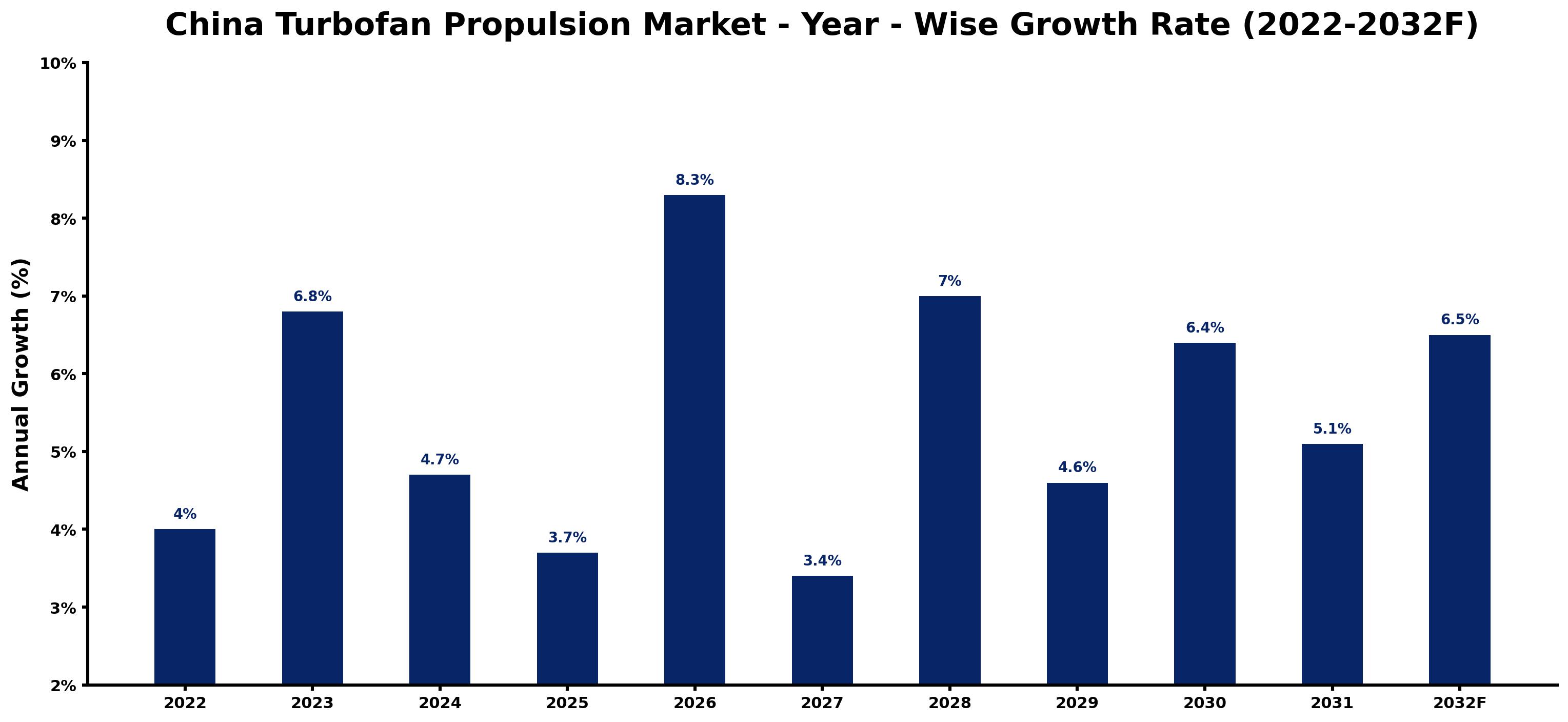
Annual growth estimates for each year appear below with the principal reason behind them, explaining the shifts that set the pace of the market.
| Year | Estimated Annual Growth (%) | Market Rationale |
| 2022 | 4.0 | Demand from domestic airlines remained strong, supporting growth in the turbofan propulsion sector. |
| 2023 | 6.8 | The aviation market expanded rapidly, driven by increased passenger traffic and aircraft production. |
| 2024 | 4.7 | Growth slowed as manufacturers faced challenges in sourcing advanced materials for production. |
| 2025 | 3.7 | Continued demand from regional airlines contributed to a stable market performance. |
| 2026 | 8.3 | A surge in military expenditure is expected to boost demand for turbofan engines in combat aircraft. |
| 2027 | 3.4 | The market will experience a slowdown as competition intensifies among local producers. |
| 2028 | 7.0 | Increased investment in R&D will lead to new engine technologies, driving growth. |
| 2029 | 4.6 | Demand from airlines is projected to stabilise, maintaining a steady growth rate in the market. |
| 2030 | 6.4 | The aviation sector's expansion is expected to continue, with a projected 1.6 billion passengers served. |
| 2031 | 5.1 | Growth will slow as manufacturers adjust to changing market conditions and competition. |
| 2032 | 6.5 | The national program for aerospace technology enhancement is projected to further stimulate market growth. |
Note: Market size estimations and growth projections presented in this report are based on 6Wresearch's proprietary forecasting methodology, utilizing the latest available industry data, government publications, and primary research inputs.
China Turbofan Propulsion Market Synopsis
Turbofan Propulsion in China includes jet engines that use fans for thrust, primarily in commercial and military aircraft. These engines are crafted using advanced engineering techniques and materials such as titanium. The China Turbofan Propulsion Market is expanding due to increasing demand from domestic airlines and military initiatives. In 2022, China produced over 1,000 commercial aircraft, showcasing the growth of the aviation sector. The national program launched in 2023 aims to advance aerospace technology, further boosting the need for efficient turbofan engines.
Market Dynamics Impact Analysis (2026–2032)
| Factor | Type | Impact | Primary Segment Affected |
| Increased domestic airline operations drive demand for commercial turbofan engines. | Driver | High | Commercial Propulsion |
| Growing military expenditure on aviation technology boosts demand for military turbofan engines. | Driver | High | Military Propulsion |
| Investment in regional airlines presents opportunities for turbofan propulsion suppliers. | Opportunity | Medium | Regional Propulsion |
| Emerging demand for demonstrator engines offers potential for innovation and testing. | Opportunity | Medium | Demonstrator Engines |
| Stringent regulations on noise emissions require costly modifications for existing engines. | Restraint | High | Commercial Propulsion |
| Competition from international manufacturers pressures local producers to innovate. | Restraint | Medium | Military Propulsion |
| The China turbofan propulsion market faces challenges in sourcing advanced materials. | Challenge | High | Commercial Propulsion |
| Rising production costs due to material price increases affect profitability. | Challenge | Medium | Military Propulsion |
Evaluation of Drivers in China Turbofan Propulsion Market (2026–2032)
Below mentioned are some major drivers and their influence on market dynamics.
| Drivers | Primary Segment Affected | Why It Matters (Evidence) |
| Increased passenger traffic leads to higher demand for commercial aircraft. | Commercial Propulsion | In 2022, China produced over 1,000 commercial aircraft, prompting airlines to seek efficient turbofan engines. |
| Military modernization programs are expanding the need for advanced propulsion systems. | Military Propulsion | China's military expenditure for aviation technology reached $20 billion in 2023, driving engine procurement. |
| Investment in regional airlines is creating opportunities for turbofan suppliers. | Regional Propulsion | With over 200 regional airlines operating, demand for efficient engines is on the rise. |
| Technological advancements in engine design are improving performance and efficiency. | Geared Turbofans | The adoption of geared turbofans is expected to improve fuel efficiency, attracting more buyers. |
| Government support for aerospace innovation is driving growth in the turbofan sector. | Demonstrator Engines | The Aerospace Industry Development Plan aims for a 15% increase in domestic production by 2025. |
In 2022, over 1,000 commercial aircraft were produced, indicating strong demand from airlines. The military's aviation technology expenditure reached $20 billion in 2023, boosting procurement of advanced engines. With over 200 regional airlines in operation, the need for reliable propulsion systems continues to grow.
Evaluation of Restraints in China Turbofan Propulsion Market
Below mentioned are some major restraints and their influence on market dynamics.
| Market Restraint | Primary Segment Affected | Why It Matters (Evidence) |
| Sourcing advanced materials for engine production remains a challenge. | Commercial Propulsion | Rising costs of titanium and composites increase production expenses, affecting profitability. |
| Regulatory compliance with noise emission standards requires costly modifications. | Military Propulsion | The GB/T 12348 standard for noise emissions can exceed $5 million per aircraft. |
| Competition from international manufacturers pressures local producers to innovate. | Military Propulsion | Local manufacturers must invest heavily in R&D to remain competitive in the market. |
| Delays in aircraft production timelines impact operational schedules for airlines. | Commercial Propulsion | Stricter regulations enforced by the Civil Aviation Administration of China slow down approval processes. |
| Market fluctuations in demand can affect production planning and resource allocation. | Regional Propulsion | Economic uncertainties may lead to reduced orders from airlines, impacting supply chains. |
China Turbofan Propulsion Market Challenges
The China turbofan propulsion market encounters a pressing challenge as buyers find it difficult to secure engines that comply with the latest aviation standards, leading to production delays for airlines reliant on timely aircraft delivery. Regulatory compliance poses another challenge, with the Civil Aviation Administration of China enforcing the GB/T 12348 standard for noise emissions, potentially necessitating modifications costing over $5 million per aircraft. Competition from international manufacturers heightens pressure on local producers, compelling them to allocate funds to R&D, which restricts resources for other important investments. Additionally, increasing costs of advanced materials like titanium raise production expenses, impacting profitability for suppliers in the market.
Trends in the China Turbofan Propulsion Market
Buyers and suppliers in the China Turbofan Propulsion Market are adjusting to the following trends.
- Shift Towards Geared Turbofans: China is increasingly adopting geared turbofans to enhance fuel efficiency in commercial aviation. This trend is noticeable as manufacturers invest in this technology, with a projected CAGR of 8.4% for geared turbofans through 2032.
- Expansion of Regional Airlines: The number of regional airlines in China is on the rise, with over 200 currently in operation. This growth is driving demand for efficient turbofan engines, as regional carriers aim to improve their fleets.
- Advancements in Aerospace Technology: Investment in aerospace technology is accelerating, particularly with the national program launched in 2023. This initiative seeks to increase R&D funding by 30% over the next five years, promoting innovation.
- Increased Military Expenditure: China's military expenditure for aviation technology reached $20 billion in 2023, reflecting a strategic focus on enhancing combat capabilities. This trend is expected to further increase demand for advanced turbofan engines.
Investment Opportunities in the China Turbofan Propulsion Market
Investors looking at the China Turbofan Propulsion Market should consider the following areas.
- Regional Airlines Seeking Efficient Engines: Regional airlines in China are actively pursuing efficient turbofan engines to improve their operations. With over 200 airlines in operation, suppliers can focus on this expanding segment to meet demand.
- Investment in Aerospace Technology Development: There is a notable opportunity to invest in aerospace technology development, particularly in geared turbofans. Collaborating with local research institutions can facilitate entry into this growing market.
- Military Contracts for Advanced Propulsion Systems: The military sector is in search of advanced propulsion systems to support modernization efforts. Suppliers can connect with defence contractors to secure contracts for turbofan engines.
- Partnerships for R&D Initiatives: Forming partnerships with local aerospace manufacturers can strengthen R&D initiatives. This collaboration will enable suppliers to align with national objectives for aerospace innovation.
Government Initiatives in the China Turbofan Propulsion Market
The 'Military Aircraft Engine Development Program' initiated by the State Administration for Science, Technology and Industry for National Defense in 2023 aims to enhance local production capabilities. This program complements existing regulations by focusing on boosting domestic engine manufacturing, thereby reducing reliance on imports.
The 'Aerospace Industry Development Plan' launched by the Ministry of Industry and Information Technology in 2021 aims for a 15% increase in domestic production by 2025. This initiative supports local manufacturers by providing funding and resources to improve production efficiency and innovation.
Future Insight of the China Turbofan Propulsion Market
The China turbofan propulsion market is set for significant changes by 2032, driven by the national program launched in 2023 aimed at advancing aerospace technology. This initiative will assist local manufacturers in achieving self-sufficiency in engine production, thereby reducing reliance on foreign imports. The aviation sector is projected to serve 1.6 billion passengers by 2030, leading to a heightened demand for efficient turbofan engines. Collaborations with international aerospace organizations will facilitate knowledge transfer, enabling local suppliers to innovate and enhance their competitive position globally.
Market Segmentation Analysis
The analysis below covers each segmentation, its leading category in 2025 and its fastest-growing category through 2032.
By Turbofan Propulsion Trype – Commercial Propulsion Dominated, Demonstrator Engines Expected to Grow Fastest
According to Vasudha, AM at 6Wresearch, with a 40% revenue share in 2025, Commercial Propulsion was the largest turbofan propulsion trype category. Commercial propulsion holds the largest share as it is essential for passenger transport, evidenced by over 1,000 commercial aircraft produced in China in 2022. The rapid expansion of domestic airline fleets to meet increasing air travel demand further cements this segment's leading position. The quickest growth will come from Demonstrator Engines, forecast to expand at a CAGR of 7.7% between 2026 and 2032. Demonstrator engines are experiencing swift growth as they are crucial for testing new technologies, particularly following the launch of a national program in 2023 aimed at enhancing aerospace technology. This focus on innovation is likely to drive ongoing investments in demonstrator engines, maintaining their significance in the market. Suppliers should prioritise partnerships with commercial airlines to capitalise on the rising demand for turbofan propulsion.
By Propulsion Type – High‑Bypass Turbofans Dominated, Geared Turbofans Expected to Grow Fastest
High‑Bypass Turbofans took a 50% share of propulsion type in 2025, more than any other category. High-bypass turbofans dominate the market due to their efficiency and suitability for commercial aviation, making them the preferred choice for most airlines. This engine type powers the majority of new aircraft entering service, reinforcing its substantial market share. Geared Turbofans are set to record the highest CAGR in this split, 8.4% over 2026–2032. Geared turbofans are rapidly becoming popular as they provide improved fuel efficiency and reduced emissions, aligning with the global shift towards sustainable aviation solutions. Increasing regulatory pressures for greener technologies are anticipated to expedite their market adoption. Buyers should consider the long-term benefits of investing in geared turbofans to comply with future environmental regulations.
By Engine Technology – Ultra‑High Bypass Dominated and Is Expected to Record the Fastest Growth
In 2025, Ultra‑High Bypass led the engine technology split with a 52% share. Ultra-high bypass engines lead the market as they are specifically designed for large commercial aircraft, offering superior fuel efficiency which is a priority for airlines. This technology is becoming the standard for new aircraft models, ensuring its continued dominance. The same category is also set to grow fastest, at a CAGR of 7.2% during 2026–2032. Ultra-high bypass engines are also the fastest-growing segment, as their efficiency aligns with the industry's shift towards sustainability and cost reduction. As more airlines seek to modernise their fleets, demand for this technology will continue to rise. Suppliers must focus on developing ultra-high bypass technologies to remain competitive in the evolving turbofan propulsion market.
By Distribution Channel – Aero Engine OEMs Dominated, OEM R&D Divisions Expected to Grow Fastest
Aero Engine OEMs accounted for a 33% market share by distribution channel in 2025. Aero engine OEMs command the largest share as they are the primary manufacturers of turbofan engines, supplying the bulk of the market's needs. Their established relationships with airlines and military contracts solidify their position in the industry. OEM R&D Divisions are projected to grow fastest, at a CAGR of 8.3% during 2026–2032. OEM R&D divisions are the fastest-growing segment, driven by the need for continuous innovation in engine technology to meet emerging market demands. As the aerospace sector pushes for advancements, these divisions will play a critical role in shaping future products. Suppliers should engage with OEM R&D divisions to align their offerings with the latest technological advancements in turbofan propulsion.
By End User Industry – Airlines Dominated, Future Tech Programs Expected to Grow Fastest
Airlines held a 40% share of the China Turbofan Propulsion Market by end user industry in 2025. Airlines hold the largest share of the end user industry, being the primary consumers of commercial turbofan engines for passenger transport. With China's aviation market projected to accommodate 1.6 billion passengers by 2030, the significance of this segment is clear. The quickest growth will come from Future Tech Programs, forecast to expand at a CAGR of 7.2% between 2026 and 2032. Future tech programs represent the fastest-growing end user segment, highlighting the industry's emphasis on experimental engine technologies that improve performance and sustainability. This trend indicates a shift towards innovation within the aviation sector. Buyers should seek collaborations with future tech programs to remain at the forefront of advancements in turbofan propulsion.
Key Attractiveness of the Report
- 10 Years of Market Numbers
- Historical Data Starting from 2022 to 2025
- Base Year 2025
- Forecast Data until 2032
- Key Performance Indicators Impacting the Market
- Major Upcoming Developments and Projects
Key Highlights of the Report:
- China Turbofan Propulsion Market Outlook
- Market Size of China Turbofan Propulsion Market, 2025
- Forecast of China Turbofan Propulsion Market, 2032
- Historical Data and Forecast of China Turbofan Propulsion Revenues & Volume for the Period 2022 - 2032F
- China Turbofan Propulsion Market Trend Evolution
- China Turbofan Propulsion Market Drivers and Challenges
- China Turbofan Propulsion Price Trends
- China Turbofan Propulsion Porter's Five Forces
- China Turbofan Propulsion Industry Life Cycle
- Historical Data and Forecast of China Turbofan Propulsion Market Revenues & Volume By Turbofan Propulsion Trype for the Period 2022 - 2032F
- Historical Data and Forecast of China Turbofan Propulsion Market Revenues & Volume By Commercial Propulsion for the Period 2022 - 2032F
- Historical Data and Forecast of China Turbofan Propulsion Market Revenues & Volume By Regional Propulsion for the Period 2022 - 2032F
- Historical Data and Forecast of China Turbofan Propulsion Market Revenues & Volume By Military Propulsion for the Period 2022 - 2032F
- Historical Data and Forecast of China Turbofan Propulsion Market Revenues & Volume By Demonstrator Engines for the Period 2022 - 2032F
- Historical Data and Forecast of China Turbofan Propulsion Market Revenues & Volume By Propulsion Type for the Period 2022 - 2032F
- Historical Data and Forecast of China Turbofan Propulsion Market Revenues & Volume By High Bypass Turbofans for the Period 2022 - 2032F
- Historical Data and Forecast of China Turbofan Propulsion Market Revenues & Volume By Medium Bypass for the Period 2022 - 2032F
- Historical Data and Forecast of China Turbofan Propulsion Market Revenues & Volume By Low Bypass for the Period 2022 - 2032F
- Historical Data and Forecast of China Turbofan Propulsion Market Revenues & Volume By Geared Turbofans for the Period 2022 - 2032F
- Historical Data and Forecast of China Turbofan Propulsion Market Revenues & Volume By Engine Technology for the Period 2022 - 2032F
- Historical Data and Forecast of China Turbofan Propulsion Market Revenues & Volume By Ultra High Bypass for the Period 2022 - 2032F
- Historical Data and Forecast of China Turbofan Propulsion Market Revenues & Volume By Standard Bypass for the Period 2022 - 2032F
- Historical Data and Forecast of China Turbofan Propulsion Market Revenues & Volume By Afterburning for the Period 2022 - 2032F
- Historical Data and Forecast of China Turbofan Propulsion Market Revenues & Volume By Prototype Testing for the Period 2022 - 2032F
- Historical Data and Forecast of China Turbofan Propulsion Market Revenues & Volume By Distribution Channel for the Period 2022 - 2032F
- Historical Data and Forecast of China Turbofan Propulsion Market Revenues & Volume By Aero Engine OEMs for the Period 2022 - 2032F
- Historical Data and Forecast of China Turbofan Propulsion Market Revenues & Volume By Defense Suppliers for the Period 2022 - 2032F
- Historical Data and Forecast of China Turbofan Propulsion Market Revenues & Volume By Military OEM Contracts for the Period 2022 - 2032F
- Historical Data and Forecast of China Turbofan Propulsion Market Revenues & Volume By OEM R&D Divisions for the Period 2022 - 2032F
- Historical Data and Forecast of China Turbofan Propulsion Market Revenues & Volume By End User Industry for the Period 2022 - 2032F
- Historical Data and Forecast of China Turbofan Propulsion Market Revenues & Volume By Airlines for the Period 2022 - 2032F
- Historical Data and Forecast of China Turbofan Propulsion Market Revenues & Volume By Regional Airlines for the Period 2022 - 2032F
- Historical Data and Forecast of China Turbofan Propulsion Market Revenues & Volume By Combat Aircraft for the Period 2022 - 2032F
- Historical Data and Forecast of China Turbofan Propulsion Market Revenues & Volume By Future Tech Programs for the Period 2022 - 2032F
- China Turbofan Propulsion Import Export Trade Statistics
- Market Opportunity Assessment By Turbofan Propulsion Trype
- Market Opportunity Assessment By Propulsion Type
- Market Opportunity Assessment By Engine Technology
- Market Opportunity Assessment By Distribution Channel
- Market Opportunity Assessment By End User Industry
- China Turbofan Propulsion Top Companies Market Share
- China Turbofan Propulsion Competitive Benchmarking By Technical and Operational Parameters
- China Turbofan Propulsion Company Profiles
- China Turbofan Propulsion Key Strategic Recommendations
Market Covered
Segments analysed in this report are listed below.
By Turbofan Propulsion Trype
- Commercial Propulsion
- Regional Propulsion
- Military Propulsion
- Demonstrator Engines
By Propulsion Type
- High‑Bypass Turbofans
- Medium‑Bypass
- Low‑Bypass
- Geared Turbofans
By Engine Technology
- Ultra‑High Bypass
- Standard Bypass
- Afterburning
- Prototype Testing
By Distribution Channel
- Aero Engine OEMs
- Defense Suppliers
- Military OEM Contracts
- OEM R&D Divisions
By End User Industry
- Airlines
- Regional Airlines
- Combat Aircraft
- Future Tech Programs































