China Vehicle Access and Authentication Systems Market Size & Growth Rate
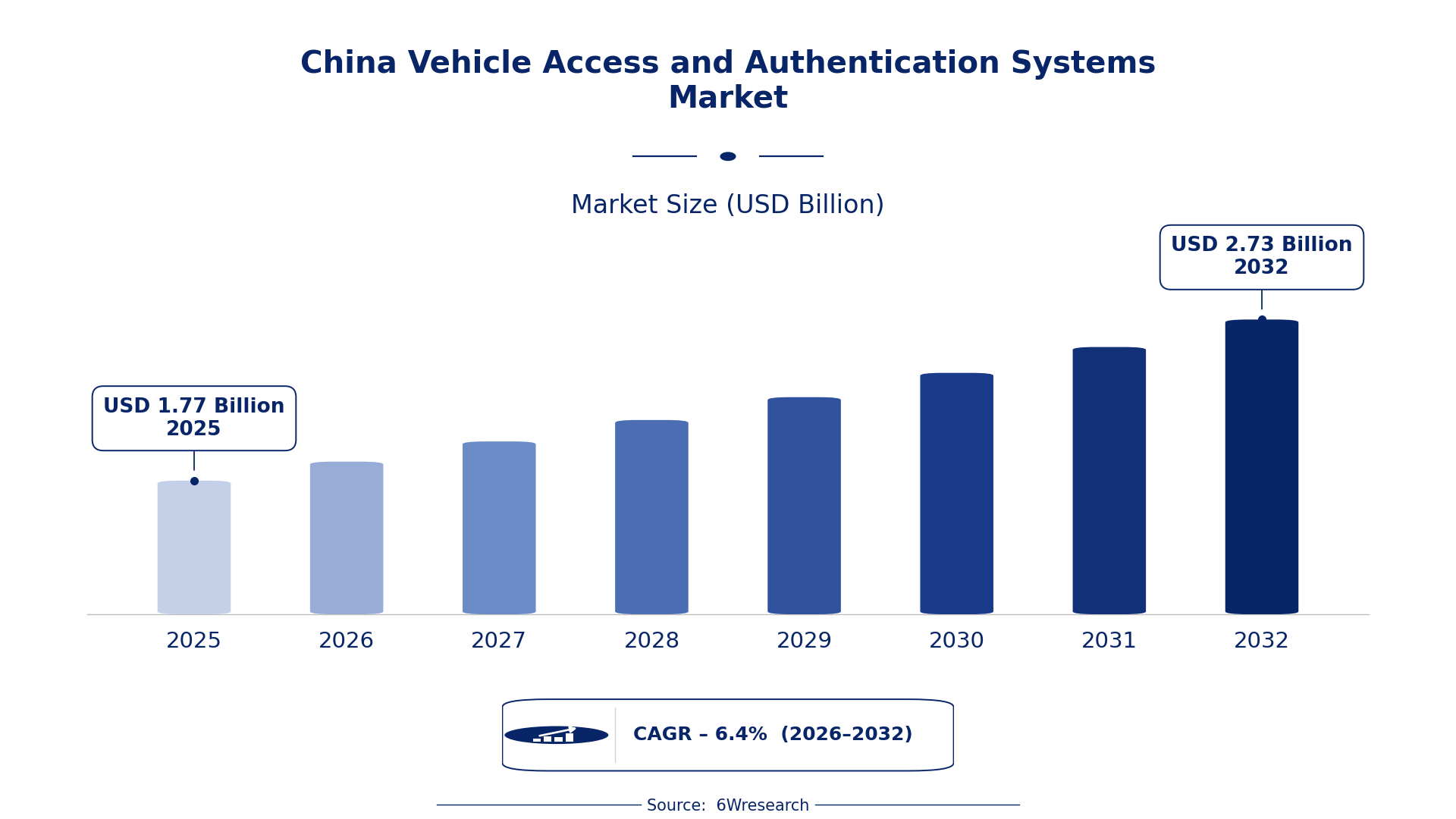
According to 6Wresearch internal database and industry insights, the China Vehicle Access and Authentication Systems Market was valued at USD 1.77 billion in 2025 and is projected to reach USD 2.73 billion by 2032, growing at a CAGR of approximately 6.4% during 2026–2032.
China Vehicle Access and Authentication Systems Market Highlights
| Report Metric | Details |
| Report Name | China Vehicle Access and Authentication Systems Market |
| Market Size 2025 | USD 1.77 billion |
| Market Size 2032 | USD 2.73 billion |
| Absolute Growth 2025–2032 | USD 0.96 billion |
| CAGR 2026–2032 | 6.4% |
| Peak Annual Growth | 8.5% in 2026 |
| Forecast Period | 2026–2032 |
| Historical Data | 2022–2025 |
| Base Year | 2025 |
| Leading Access Type, 2025 | Keyless Entry (35% share) |
| Leading Authentication Method, 2025 | Proximity Sensors (42% share) |
| Leading Technology Used, 2025 | RFID/NFC (41% share) |
| Leading End User, 2025 | Car Owners (45% share) |
| Fastest-Growing Access Type | Smartphone Unlock (8.7% CAGR) |
| Fastest-Growing Authentication Method | App-Based Control (8.8% CAGR) |
| Fastest-Growing Technology Used | Bluetooth/UWB (7.7% CAGR) |
| Fastest-Growing End User | Connected Car Ecosystem (7.6% CAGR) |
| Growing Sector | automotive |
| Key End Users | car owners, premium vehicle OEMs, connected car ecosystem, commercial fleets |
China Vehicle Access and Authentication Systems Market Year-wise Growth Rate and Key Drivers (2022–2032)
This graph illustrates the annual growth rates of the market from 2022 to 2032, highlighting a steady upward trajectory and projected market expansion over the forecast period.
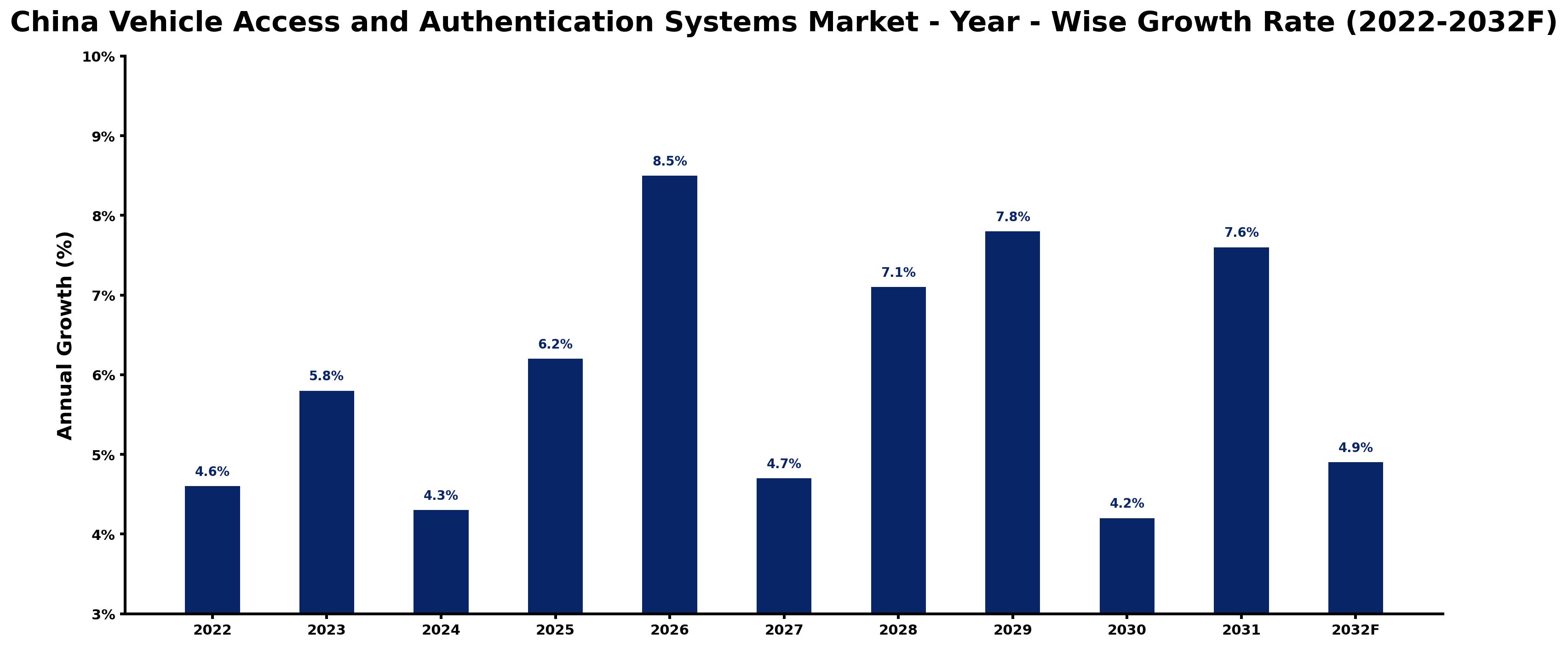
Below, each year's estimated growth is shown next to the factor that most influenced it.
| Year | Estimated Annual Growth (%) | Market Rationale |
| 2022 | 4.6 | The market experienced steady demand with over 300 million registered vehicles needing access systems. |
| 2023 | 5.8 | Growth accelerated due to increased urban vehicle sales and the adoption of smart technologies. |
| 2024 | 4.3 | A slight slowdown occurred as new vehicle registrations began to stabilise in urban areas. |
| 2025 | 6.2 | Demand surged as keyless entry systems became standard in 60% of new vehicles sold. |
| 2026 | 8.5 | The market peaked with significant investments in smart vehicle technologies and rising consumer interest. |
| 2027 | 4.7 | Growth slowed as market maturity set in, with fewer new innovations introduced. |
| 2028 | 7.1 | A resurgence in demand was driven by the connected car ecosystem gaining traction. |
| 2029 | 7.8 | Continued growth was supported by rising consumer preferences for smartphone integration in vehicles. |
| 2030 | 4.2 | The market saw a slowdown as new vehicle sales began to plateau in urban centres. |
| 2031 | 7.6 | Demand picked up again due to the increasing popularity of biometric systems in vehicles. |
| 2032 | 4.9 | Growth moderated as the market stabilised, reflecting broader trends in vehicle technology. |
Note: Market size estimations and growth projections presented in this report are based on 6Wresearch's proprietary forecasting methodology, utilizing the latest available industry data, government publications, and primary research inputs.
China Vehicle Access and Authentication Systems Market Synopsis
Vehicle Access and Authentication Systems in China include technologies like RFID, NFC, and biometrics that enhance vehicle security and convenience. These systems enable keyless entry, biometric authentication, and smartphone integration. The China Vehicle Access and Authentication Systems Market is growing alongside the increase in domestic vehicle production and the evolution of the connected car environment. With over 300 million registered vehicles needing access systems, urban vehicle sales and technological advancements drive this demand. The automotive sector is set for substantial growth, further propelling market expansion.
Market Dynamics Impact Analysis (2026–2032)
| Factor | Type | Impact | Primary Segment Affected |
| Rising urban vehicle sales drive demand for advanced access systems, enhancing security and convenience. | Driver | High | Keyless Entry |
| Increasing integration of smart technologies in vehicles creates opportunities for innovative access solutions. | Driver | High | Biometric Systems |
| The average adoption rate of biometric systems is around 15%, indicating a gap for growth in this area. | Opportunity | High | Biometric Systems |
| The connected car ecosystem is expected to grow by 20% annually, presenting a significant market opportunity. | Opportunity | High | Connected Car Ecosystem |
| The market faces challenges from stringent national standards that require compliance for new technologies. | Restraint | High | Keyless Entry |
| The slow adoption of advanced access systems in rural areas limits overall market growth potential. | Restraint | Medium | Keyless Entry |
| The Vehicle Access and Authentication Systems market in China is hindered by high development costs for new technologies. | Challenge | High | Biometric Systems |
| Competition from traditional access methods poses a challenge to the adoption of newer technologies. | Challenge | Medium | Keyless Entry |
Evaluation of Drivers in China Vehicle Access and Authentication Systems Market (2026–2032)
The table below links each growth driver to the segment it affects and the evidence for it.
| Drivers | Primary Segment Affected | Why It Matters (Evidence) |
| Increased vehicle registrations in urban areas drive demand for keyless entry systems, with 60% of new vehicles sold featuring this technology. | Keyless Entry | This trend prompts manufacturers to invest in advanced access solutions. |
| The growing connected car environment boosts demand for biometric systems, with an average adoption rate of 15% in urban vehicles. | Biometric Systems | This creates opportunities for suppliers to develop new security features. |
| Rising consumer preference for smartphone integration in vehicles increases demand for app-based control systems, expected to grow at 8.8% CAGR. | App-Based Control | This shift leads to higher purchases from tech-savvy consumers. |
| The Guangdong province is a major hub for automotive manufacturing, driving demand for proximity sensors in access systems, which hold a 42% market share. | Proximity Sensors | This concentration of production facilities supports local supply chains. |
| The introduction of the 'Smart Vehicle Innovation and Development Strategy' aims for 50% smart vehicle penetration by 2025, promoting advanced access systems. | Keyless Entry | This national initiative encourages manufacturers to innovate and comply with new standards. |
The Vehicle Access and Authentication Systems market in China is growing as urban vehicle registrations rise, with over 300 million vehicles in need of access systems. Keyless entry systems are standard in 60% of new vehicles sold, prompting purchases from car owners. The connected car environment is anticipated to expand by 20% annually, increasing the demand for advanced access solutions. Guangdong province stands out as a key automotive manufacturing hub, strengthening local supply chains and attracting investment in new technologies. With biometric systems averaging a 15% adoption rate, there is a clear opportunity for growth in this segment.
Evaluation of Restraints in China Vehicle Access and Authentication Systems Market
Below mentioned are some major restraints and their influence on market dynamics.
| Market Restraint | Primary Segment Affected | Why It Matters (Evidence) |
| Strict compliance with national standards, such as GB/T 34500-2017, increases development costs for manufacturers. | Keyless Entry | This regulation requires extensive testing and certification, delaying product launches. |
| Limited adoption of advanced access systems in rural areas restricts market expansion opportunities. | Keyless Entry | This results in lower sales volumes outside urban centres, affecting overall growth. |
| High development costs for biometric systems deter smaller manufacturers from entering the market. | Biometric Systems | This limits competition and innovation in the sector. |
| Competition from traditional key-based access methods hampers the adoption of newer technologies. | Keyless Entry | This leads to slower consumer acceptance of advanced systems. |
| The market faces challenges from fluctuating consumer preferences, impacting demand for specific access technologies. | Keyless Entry | This uncertainty can lead to inconsistent sales and investment decisions. |
China Vehicle Access and Authentication Systems Market Challenges
The China Vehicle Access and Authentication Systems market experiences supply chain disruptions due to reliance on imported components, which can delay production timelines for manufacturers. This situation compels producers to keep higher inventory levels, raising costs by about 15%. Buyers face challenges from the limited availability of advanced access systems, which may increase vehicle security system prices by 20%. Intense competition among local manufacturers results in price wars that diminish profit margins and affect the quality of available access systems. Compliance with national standards such as GB/T 34500-2017 complicates operations, causing delays in product launches and hindering market responsiveness.
Trends in the China Vehicle Access and Authentication Systems Market
Buyers and suppliers in the China Vehicle Access and Authentication Systems Market are adjusting to the following trends.
- Shift Towards Biometric Authentication: Car owners are increasingly embracing biometric systems for enhanced security features, with an average adoption rate of 15% in urban areas. This trend indicates a rising demand for advanced vehicle access solutions.
- Transition to App-Based Control: The surge in smartphone integration within vehicles has prompted a shift towards app-based control systems. This segment is projected to grow at an 8.8% CAGR, driven by tech-savvy consumers.
- Emergence of Connected Car Environment: The connected car environment is gaining momentum, with an expected growth of 20% annually through 2025. This shift is reshaping consumer expectations and elevating demand for advanced access technologies.
- Growing Importance of Proximity Sensors: Proximity sensors are becoming crucial for modern vehicle access systems, holding a 42% market share in 2025. This trend underscores the necessity for manufacturers to invest in advanced sensor technologies.
Investment Opportunities in the China Vehicle Access and Authentication Systems Market
The following opportunities in the China Vehicle Access and Authentication Systems Market pair current demand with a clear way in.
- Market Gap for Biometric Systems: With an average adoption rate of 15%, there is considerable potential for growth in biometric systems. Suppliers can target urban car owners seeking enhanced security features.
- Investment in App-Based Control Solutions: The anticipated growth of app-based control systems presents an opportunity for suppliers to create new solutions. Focusing on tech-savvy consumers in urban areas can facilitate market entry.
- Expansion in Guangdong Province: Guangdong province, a prominent automotive manufacturing hub, provides opportunities for investment in vehicle access technologies. Collaborating with local manufacturers can strengthen market presence.
- Partnerships for Smart Vehicle Technologies: The 'Smart Vehicle Innovation and Development Strategy' aims for 50% smart vehicle penetration by 2025, generating a need for advanced access systems. Forming joint ventures with local firms can aid compliance and market entry.
Government Initiatives in the China Vehicle Access and Authentication Systems Market
The 'Smart Vehicle Innovation and Development Strategy' introduced by the Ministry of Industry and Information Technology in 2021 aims for 50% smart vehicle penetration by 2025. This measure encourages manufacturers to develop advanced vehicle access technologies, ensuring compliance with emerging standards. Additionally, the 'New Energy Vehicle Industry Development Plan' updated in 2022 focuses on integrating smart access systems in electric vehicles, promoting innovation in the sector.
The National Development and Reform Commission oversees the approval of smart vehicle technologies, funding initiatives that improve access systems. The 'Automotive Industry Standards Development Program' launched in 2023 aims to improve standards for vehicle access technologies, ensuring all products meet regulatory requirements. Furthermore, the 'Green Vehicle Development Plan' initiated in 2021 promotes the use of advanced access systems in electric vehicles, supporting sustainable automotive practices.
Future Insight of the China Vehicle Access and Authentication Systems Market
The China Vehicle Access and Authentication Systems market is set for substantial transformation by 2032, driven by the government's promotion of smart vehicle technologies. The adoption of advanced access technologies will increase, enhancing security features for buyers. Innovations in RFID technology will improve logistics and fleet management, streamlining operations for producers. The expanding connected car environment will create new opportunities for suppliers, allowing them to offer more integrated and user-friendly access solutions.
Market Segmentation Analysis
Each segment group is reviewed below, with the leader by share and the fastest grower by CAGR.
By Access Type – Keyless Entry Dominated, Smartphone Unlock Expected to Grow Fastest
According to Bhawna Singh, Assistant Manager at 6Wresearch, Keyless Entry held a 35% share of the China Vehicle Access and Authentication Systems Market by access type in 2025. Keyless entry systems dominate the market due to their standardisation in 60% of new vehicles sold in urban areas, reflecting a strong consumer preference for convenience and security. This widespread adoption illustrates the significant installed base supporting the growth of these systems. The quickest growth will come from Smartphone Unlock, forecast to expand at a CAGR of 8.7% between 2026 and 2032. Smartphone unlock systems are experiencing rapid growth as smartphone integration becomes more prevalent in vehicles, showcasing a shift towards modern technological solutions. This trend will likely continue as consumer preferences evolve towards more connected experiences. Suppliers should focus on enhancing smartphone integration features to meet the rising consumer demand for advanced access solutions.
By Authentication Method – Proximity Sensors Dominated, App-Based Control Expected to Grow Fastest
Proximity Sensors took a 42% share of authentication method in 2025, more than any other category. Proximity sensors lead the authentication method segment, essential for modern vehicle access systems that allow seamless entry without physical contact. Their effectiveness in improving user experience solidifies their dominant position in the market. App-Based Control is projected to grow fastest, at a CAGR of 8.8% during 2026–2032. App-based control is the fastest-growing method, driven by the increasing adoption of smart technology in vehicles, enabling users to manage access through mobile applications. This trend reflects a broader preference for digital solutions in vehicle security. Buyers will increasingly seek vehicles equipped with app-based control features for enhanced convenience and security.
By Technology Used – RFID/NFC Dominated, Bluetooth/UWB Expected to Grow Fastest
With a 41% revenue share in 2025, RFID/NFC was the largest technology used category. RFID/NFC technology holds the largest market share, commonly used for vehicle access solutions that enhance security and convenience. Its established role in logistics and fleet management reinforces its dominance in vehicle access systems. Bluetooth/UWB is set to record the highest CAGR in this split, 7.7% over 2026–2032. Bluetooth/UWB technology is rapidly gaining traction as it provides secure and convenient access solutions, appealing to a tech-savvy consumer base. This growth is expected to accelerate alongside the expansion of the connected car ecosystem. Suppliers should invest in Bluetooth/UWB technology to capture the growing market share driven by consumer demand for advanced access solutions.
By End User – Car Owners Dominated, Connected Car Ecosystem Expected to Grow Fastest
Car Owners accounted for a 45% market share by end user in 2025. Car owners represent the largest user group for vehicle access systems, as they are the primary consumers of these technologies for personal security and convenience. Their significant presence in the market drives demand for various access solutions. Over 2026–2032, Connected Car Ecosystem is expected to post the fastest growth, at a CAGR of 7.6%. The connected car ecosystem is the fastest-growing segment, reflecting the increasing integration of smart technologies in vehicles, enhancing user experience and connectivity. This growth indicates a shift towards more advanced vehicle features. Suppliers must align their offerings with the needs of the connected car ecosystem to remain competitive in the evolving market.
Key Attractiveness of the Report
- 10 Years of Market Numbers
- Historical Data Starting from 2022 to 2025
- Base Year 2025
- Forecast Data until 2032
- Key Performance Indicators Impacting the Market
- Major Upcoming Developments and Projects
Key Highlights of the Report:
- China Vehicle Access and Authentication Systems Market Outlook
- Market Size of China Vehicle Access and Authentication Systems Market, 2025
- Forecast of China Vehicle Access and Authentication Systems Market, 2032
- Historical Data and Forecast of China Vehicle Access and Authentication Systems Revenues & Volume for the Period 2022 - 2032F
- China Vehicle Access and Authentication Systems Market Trend Evolution
- China Vehicle Access and Authentication Systems Market Drivers and Challenges
- China Vehicle Access and Authentication Systems Price Trends
- China Vehicle Access and Authentication Systems Porter's Five Forces
- China Vehicle Access and Authentication Systems Industry Life Cycle
- Historical Data and Forecast of China Vehicle Access and Authentication Systems Market Revenues & Volume By Access Type for the Period 2022 - 2032F
- Historical Data and Forecast of China Vehicle Access and Authentication Systems Market Revenues & Volume By Keyless Entry for the Period 2022 - 2032F
- Historical Data and Forecast of China Vehicle Access and Authentication Systems Market Revenues & Volume By Biometric Systems for the Period 2022 - 2032F
- Historical Data and Forecast of China Vehicle Access and Authentication Systems Market Revenues & Volume By Smartphone Unlock for the Period 2022 - 2032F
- Historical Data and Forecast of China Vehicle Access and Authentication Systems Market Revenues & Volume By Card-Based Access for the Period 2022 - 2032F
- Historical Data and Forecast of China Vehicle Access and Authentication Systems Market Revenues & Volume By Authentication Method for the Period 2022 - 2032F
- Historical Data and Forecast of China Vehicle Access and Authentication Systems Market Revenues & Volume By Proximity Sensors for the Period 2022 - 2032F
- Historical Data and Forecast of China Vehicle Access and Authentication Systems Market Revenues & Volume By Fingerprint/Face for the Period 2022 - 2032F
- Historical Data and Forecast of China Vehicle Access and Authentication Systems Market Revenues & Volume By App-Based Control for the Period 2022 - 2032F
- Historical Data and Forecast of China Vehicle Access and Authentication Systems Market Revenues & Volume By NFC/RFID Cards for the Period 2022 - 2032F
- Historical Data and Forecast of China Vehicle Access and Authentication Systems Market Revenues & Volume By Technology Used for the Period 2022 - 2032F
- Historical Data and Forecast of China Vehicle Access and Authentication Systems Market Revenues & Volume By RFID/NFC for the Period 2022 - 2032F
- Historical Data and Forecast of China Vehicle Access and Authentication Systems Market Revenues & Volume By AI/Optical Sensors for the Period 2022 - 2032F
- Historical Data and Forecast of China Vehicle Access and Authentication Systems Market Revenues & Volume By Bluetooth/UWB for the Period 2022 - 2032F
- Historical Data and Forecast of China Vehicle Access and Authentication Systems Market Revenues & Volume By Low-Energy Tech for the Period 2022 - 2032F
- Historical Data and Forecast of China Vehicle Access and Authentication Systems Market Revenues & Volume By End User for the Period 2022 - 2032F
- Historical Data and Forecast of China Vehicle Access and Authentication Systems Market Revenues & Volume By Car Owners for the Period 2022 - 2032F
- Historical Data and Forecast of China Vehicle Access and Authentication Systems Market Revenues & Volume By Premium Vehicle OEMs for the Period 2022 - 2032F
- Historical Data and Forecast of China Vehicle Access and Authentication Systems Market Revenues & Volume By Connected Car Ecosystem for the Period 2022 - 2032F
- Historical Data and Forecast of China Vehicle Access and Authentication Systems Market Revenues & Volume By Commercial Fleets for the Period 2022 - 2032F
- China Vehicle Access and Authentication Systems Import Export Trade Statistics
- Market Opportunity Assessment By Access Type
- Market Opportunity Assessment By Authentication Method
- Market Opportunity Assessment By Technology Used
- Market Opportunity Assessment By End User
- China Vehicle Access and Authentication Systems Top Companies Market Share
- China Vehicle Access and Authentication Systems Competitive Benchmarking By Technical and Operational Parameters
- China Vehicle Access and Authentication Systems Company Profiles
- China Vehicle Access and Authentication Systems Key Strategic Recommendations
Market Covered
Segments analysed in this report are listed below.
By Access Type
- Keyless Entry
- Biometric Systems
- Smartphone Unlock
- Card-Based Access
By Authentication Method
- Proximity Sensors
- Fingerprint/Face
- App-Based Control
- NFC/RFID Cards
By Technology Used
- RFID/NFC
- AI/Optical Sensors
- Bluetooth/UWB
- Low-Energy Tech
By End User
- Car Owners
- Premium Vehicle OEMs
- Connected Car Ecosystem
- Commercial Fleets































