China Vehicle Body Structure Welding Market Size & Growth Rate
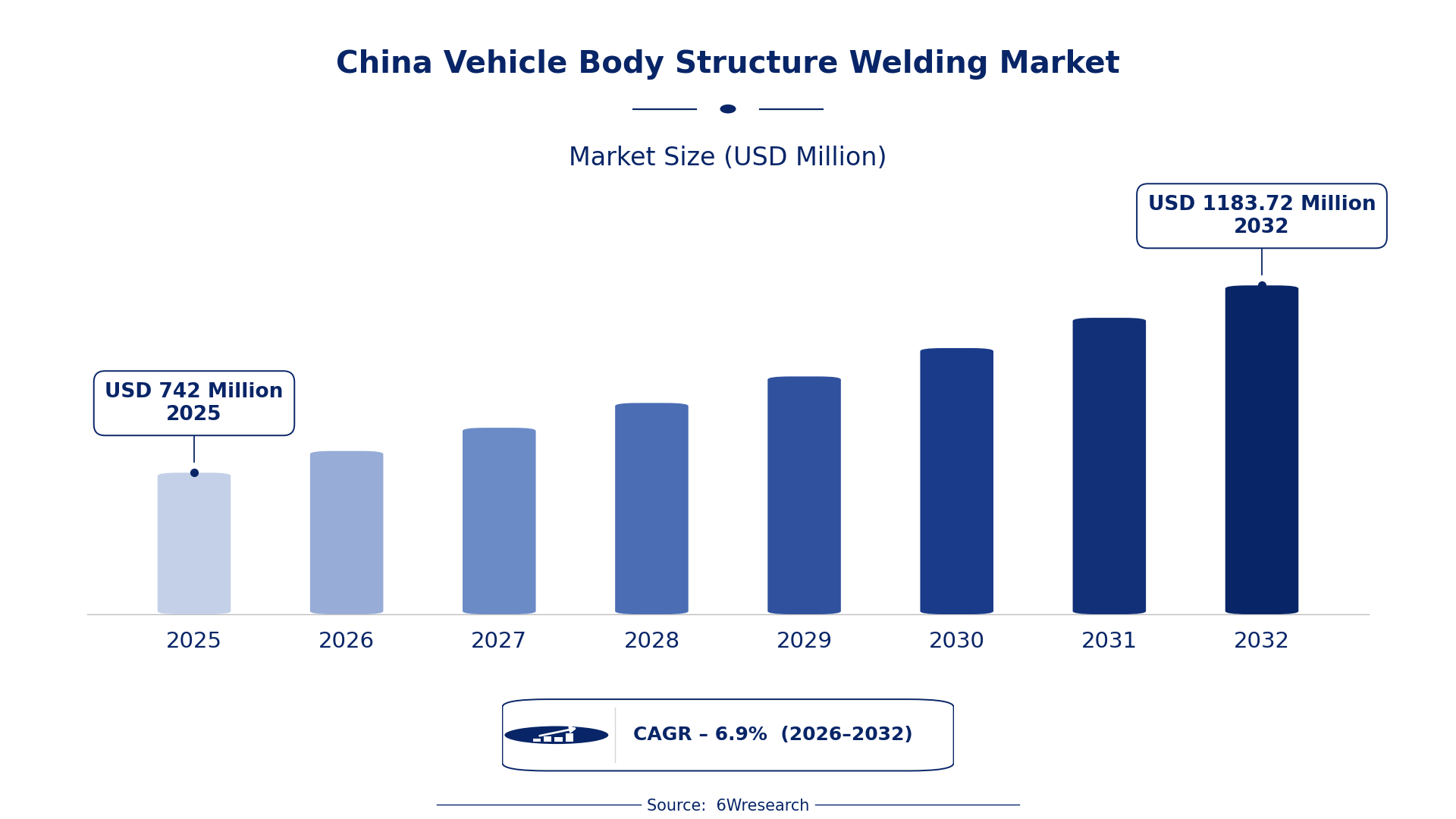
According to 6Wresearch internal database and industry insights, the China Vehicle Body Structure Welding Market was valued at USD 742.0 million in 2025 and is projected to reach USD 1,183.72 million by 2032, growing at a CAGR of approximately 6.9% during 2026–2032.
China Vehicle Body Structure Welding Market Highlights
| Report Metric | Details |
| Report Name | China Vehicle Body Structure Welding Market |
| Market Size 2025 | USD 742.0 million |
| Market Size 2032 | USD 1,183.72 million |
| Absolute Growth 2025–2032 | USD 441.72 million |
| CAGR 2026–2032 | 6.9% |
| Peak Annual Growth | 9.2% in 2027 |
| Forecast Period | 2026–2032 |
| Historical Data | 2022–2025 |
| Base Year | 2025 |
| Leading Welding Method, 2025 | Spot Welding (51% share) |
| Leading Application Type, 2025 | Body Panel Joining (40% share) |
| Leading Automation Level, 2025 | Robotic (50% share) |
| Leading End User, 2025 | OEM Assembly Lines (35% share) |
| Fastest-Growing Welding Method | Laser Welding (7.9% CAGR) |
| Fastest-Growing Application Type | Lightweight Panels (9.5% CAGR) |
| Fastest-Growing Automation Level | Fully Automated (8.1% CAGR) |
| Fastest-Growing End User | EV Manufacturers (8.5% CAGR) |
| Growing Sector | Automotive Manufacturing |
| Key End Users | OEM Assembly Lines, EV Manufacturers, High-Volume Car Plants |
China Vehicle Body Structure Welding Market Year-wise Growth Rate and Key Drivers (2022–2032)
This graph illustrates the annual growth rates of the market from 2022 to 2032, highlighting a steady upward trajectory and projected market expansion over the forecast period.
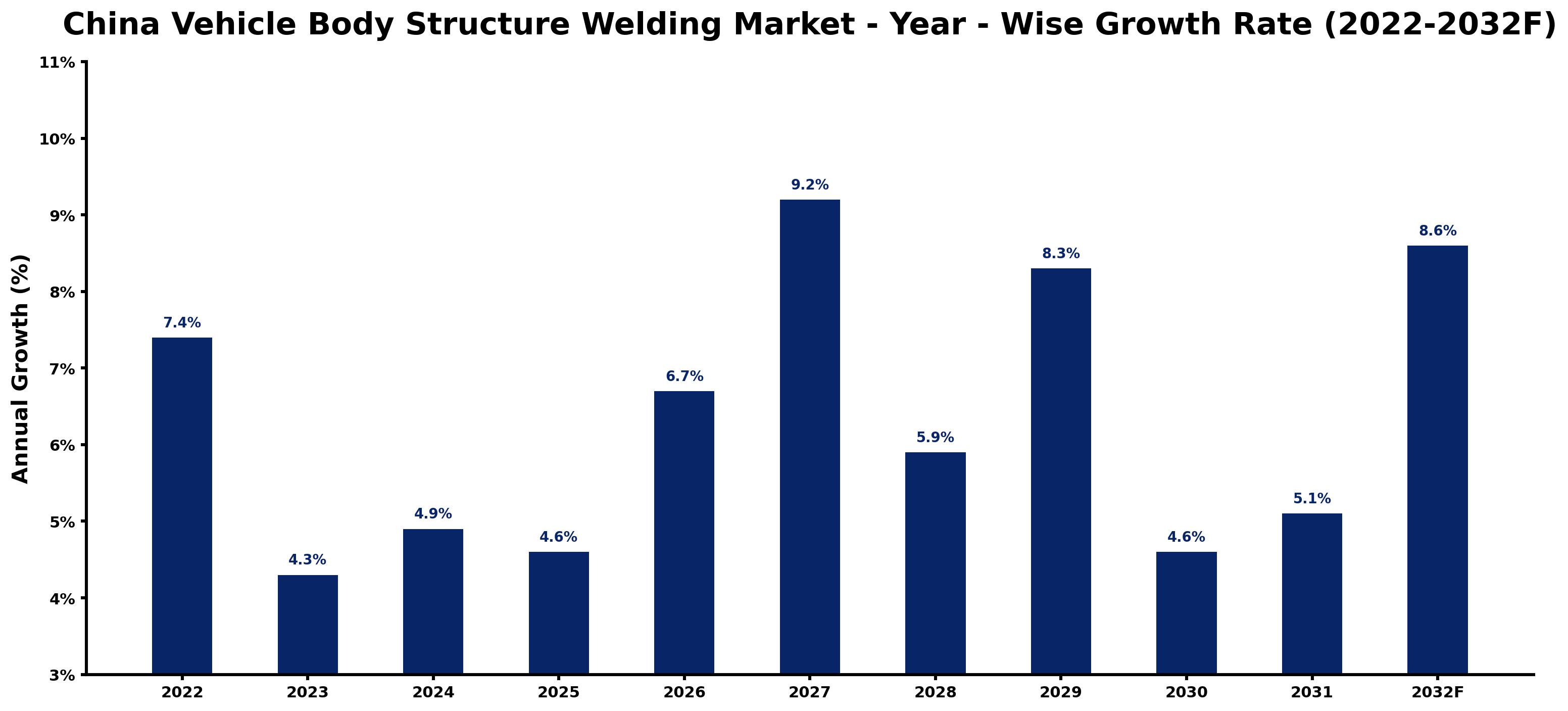
The following table presents the estimated annual growth rate for each year together with the principal factor influencing market performance.
| Year | Estimated Annual Growth (%) | Market Rationale |
| 2022 | 7.4 | Demand surged due to the production of over 25 million vehicles, driving welding technology needs. |
| 2023 | 4.3 | Growth slowed as the market adjusted to the previous year's high production levels. |
| 2024 | 4.9 | Increased vehicle production and investments in automation led to a rise in demand for welding. |
| 2025 | 4.6 | Demand continued to grow as automotive manufacturers focused on improving production efficiency. |
| 2026 | 6.7 | Investment in robotic welding systems accelerated, boosting demand for advanced welding techniques. |
| 2027 | 9.2 | The peak growth year is driven by a surge in electric vehicle production and associated welding needs. |
| 2028 | 5.9 | Growth slowed as the market began to stabilise after rapid expansion in previous years. |
| 2029 | 8.3 | Renewed interest in electric vehicles and lightweight materials spurred demand for innovative welding solutions. |
| 2030 | 4.6 | Market growth slowed as manufacturers adjusted to production capacities and market conditions. |
| 2031 | 5.1 | Increased focus on sustainability in vehicle production led to a rise in demand for advanced welding. |
| 2032 | 8.6 | The market is projected to grow as the shift towards electric vehicles continues to drive welding technology adoption. |
Note: Market size estimations and growth projections presented in this report are based on 6Wresearch's proprietary forecasting methodology, utilizing the latest available industry data, government publications, and primary research inputs.
China Vehicle Body Structure Welding Market Synopsis
Vehicle Body Structure Welding in China encompasses the joining of metal components in vehicle manufacturing, utilising techniques like MIG, TIG, and laser welding. This process is vital for assembling vehicle body panels, ensuring structural integrity and safety. The China Vehicle Body Structure Welding Market is expanding due to strong demand from domestic manufacturers and investments in automation. With over 25 million vehicles produced in 2022, the market is supported by a projected $1 trillion investment in the automotive sector by 2025, highlighting the growing need for advanced welding technologies.
Market Dynamics Impact Analysis (2026–2032)
| Factor | Type | Impact | Primary Segment Affected |
| Rising production of electric vehicles increases demand for advanced welding techniques. | Driver | High | Laser Welding |
| The shift towards lightweight materials enhances the need for innovative welding solutions. | Driver | High | Lightweight Panels |
| The automotive sector's projected $1 trillion investment by 2025 creates opportunities for suppliers of welding technologies. | Opportunity | High | OEM Assembly Lines |
| The increasing adoption of robotic welding systems presents a significant opportunity for automation suppliers. | Opportunity | High | Robotic |
| High competition among manufacturers may lead to price pressures on welding services. | Restraint | Medium | Spot Welding |
| The complexity of welding standards can hinder compliance for smaller manufacturers. | Restraint | Medium | MIG Welding |
| Limited skilled workforce in advanced welding techniques poses challenges for production efficiency. | Challenge | High | Fully Automated |
| Supply chain disruptions can delay the availability of welding equipment and materials. | Challenge | Medium | TIG Welding |
Evaluation of Drivers in China Vehicle Body Structure Welding Market (2026–2032)
The factors lifting demand, and the evidence behind each, are summarised below.
| Drivers | Primary Segment Affected | Why It Matters (Evidence) |
| Increased production of electric vehicles drives demand for advanced welding techniques. | Laser Welding | China aims for 20% of all vehicles to be electric by 2025, increasing welding technology needs. |
| The automotive industry's shift towards lightweight materials increases the need for efficient welding solutions. | Lightweight Panels | With over 25 million vehicles produced in 2022, manufacturers require efficient welding for new materials. |
| Growing investments in automation boost the adoption of robotic welding systems. | Robotic | Robotic welding systems are increasingly adopted in new automotive plants, enhancing production efficiency. |
| The demand for high-quality welding standards supports the growth of the market. | Spot Welding | ISO 3834 is a key standard for welding quality management in the automotive sector. |
| The expansion of OEM assembly lines increases the need for efficient welding technologies. | OEM Assembly Lines | OEM assembly lines are primary users of welding technologies in vehicle production. |
Expansion of the Vehicle Body Structure Welding market in China is backed by rising production of electric vehicles, increasing investments in automation, and the shift towards lightweight materials. In 2022, over 25 million vehicles were produced, driving demand for advanced welding technologies. The automotive sector is projected to invest approximately $1 trillion by 2025, which will further increase demand for efficient welding solutions. Adoption of robotic welding systems in new automotive plants improves production efficiency. The focus on high-quality welding standards, such as ISO 3834, supports market growth.
Evaluation of Restraints in China Vehicle Body Structure Welding Market
Below mentioned are some major restraints and their influence on market dynamics.
| Market Restraint | Primary Segment Affected | Why It Matters (Evidence) |
| High competition among manufacturers may lead to price pressures on welding services. | Spot Welding | In a market with over 25 million vehicles produced, price competition can impact profitability. |
| The complexity of welding standards can hinder compliance for smaller manufacturers. | MIG Welding | Smaller manufacturers may struggle to meet the rigorous standards set by the industry. |
| Limited skilled workforce in advanced welding techniques poses challenges for production efficiency. | Fully Automated | The automotive industry employs over 5 million people, but skilled workers are in short supply. |
| Supply chain disruptions can delay the availability of welding equipment and materials. | TIG Welding | Global supply chain issues have affected the timely delivery of essential welding materials. |
| The high cost of robotic welding systems can deter smaller manufacturers from upgrading. | Robotic | Investment in automation can be prohibitive for smaller firms in a competitive market. |
China Vehicle Body Structure Welding Market Challenges
The China Vehicle Body Structure Welding market encounters several practical challenges, beginning with outdated technology. Many manufacturers still depend on traditional welding techniques, which can elevate production costs for buyers by up to 15%. A shortage of skilled welders worsens this issue, resulting in project delays and increased training expenses for suppliers. Buyers also contend with fluctuating raw material prices, which can vary by as much as 20% annually, complicating financial planning. Intense competition among local manufacturers further pressures prices, squeezing profit margins for suppliers and limiting their capacity to invest in new technologies.
Trends in the China Vehicle Body Structure Welding Market
Several trends are reshaping the China Vehicle Body Structure Welding Market; the most important are set out below.
- Shift towards Lightweight Materials in Vehicle Manufacturing: The automotive industry is increasingly adopting lightweight materials to improve fuel efficiency. The demand for lightweight panels is expected to grow at a CAGR of 9.5% from 2026 to 2032, driven by the need for better performance.
- Transition from Manual to Robotic Welding: Robotic welding systems are becoming the norm in new automotive plants, with 80% adoption rates. This shift improves efficiency and precision, resulting in better production outcomes in the automotive sector.
- Emergence of Advanced Welding Standards: The establishment of the Automotive Industry Standardization Technical Committee in 2023 aims to improve welding standards across the industry. This initiative supports manufacturers in achieving higher quality and safety in welding processes.
- Focus on Sustainability in Automotive Production: The 'Green Manufacturing Program' initiated in 2021 promotes environmental standards in automotive production. This trend is driving demand for advanced welding techniques that align with sustainability goals.
Investment Opportunities in the China Vehicle Body Structure Welding Market
Investors looking at the China Vehicle Body Structure Welding Market should consider the following areas.
- Investment in Robotic Welding Systems: With the automotive sector projected to invest $1 trillion by 2025, there is an opportunity for suppliers of robotic welding systems. OEM assembly lines are increasingly adopting these technologies to improve production efficiency.
- Expansion of Electric Vehicle Manufacturing: China's goal to have 20% of all vehicles be electric by 2025 creates a gap for advanced welding solutions. EV manufacturers are seeking effective welding technologies to support their production needs.
- Development of Lightweight Vehicle Structures: The growing demand for lightweight panels presents an opportunity for suppliers of welding technologies. Manufacturers in Shandong and Jiangsu provinces are focusing on these materials to improve vehicle performance.
- Automation in Welding Processes: The increasing focus on automation in the automotive industry creates a demand for fully automated welding solutions. This is particularly relevant for high-volume car plants looking to improve efficiency.
Government Initiatives in the China Vehicle Body Structure Welding Market
The '14th Five-Year Plan for the Automotive Industry' approved in 2021 focuses on innovation and sustainability in vehicle manufacturing. This plan updates previous regulations by promoting advanced technologies and environmental standards in automotive production. It aims to support manufacturers in adopting modern welding techniques and improving overall production quality. The plan sets ambitious targets for reducing carbon emissions and improving production efficiency in the automotive sector.
In 2022, the National Development and Reform Commission introduced subsidies for electric vehicle manufacturers meeting specific production standards. The Ministry of Industry and Information Technology oversees these subsidies, which aim to encourage compliance with advanced welding standards and promote the adoption of new technologies in the automotive sector. This initiative is expected to benefit manufacturers by reducing production costs and facilitating access to advanced welding equipment.
Future Insight of the China Vehicle Body Structure Welding Market
Several forward-looking factors are set to support the China Vehicle Body Structure Welding market in the coming years. The automotive sector's planned investment of around $1 trillion by 2025 will improve production capabilities and efficiency. The adoption of advanced welding technologies will enhance manufacturing precision and reduce waste. The 'New Energy Vehicle Industry Development Plan' aims to significantly boost electric vehicle production, driving demand for effective welding solutions. Compliance with ISO 3834 standards will elevate quality management practices, benefiting both buyers and suppliers.
Market Segmentation Analysis
The analysis below covers each segmentation, its leading category in 2025 and its fastest-growing category through 2032.
By Welding Method – Spot Welding Dominated, Laser Welding Expected to Grow Fastest
According to Bhawna Singh, Assistant Manager at 6Wresearch, Spot Welding accounted for a 51% market share by welding method in 2025. Spot welding captures the largest market share due to its essential function in mass production within automotive assembly lines. This method is heavily relied upon in key manufacturing regions like Shandong and Jiangsu, where vehicle output is notably high. Laser Welding is projected to grow fastest, at a CAGR of 7.9% during 2026–2032. Laser welding is experiencing rapid growth as manufacturers increasingly embrace this technology for its enhanced speed and quality in contemporary production settings. The trend towards advanced welding techniques is clear, with a significant portion of new automotive facilities adopting robotic systems. Suppliers must focus on developing laser welding solutions to meet the growing demand for efficiency and quality in vehicle manufacturing.
By Application Type – Body Panel Joining Dominated, Lightweight Panels Expected to Grow Fastest
Body Panel Joining held a 40% share of the China Vehicle Body Structure Welding Market by application type in 2025. Body panel joining commands the largest share as it is critical for ensuring the structural integrity of vehicles. This application is fundamental in the production processes of numerous automotive manufacturers across China. Lightweight Panels are set to record the highest CAGR in this split, 9.5% over 2026–2032. Lightweight panels are the fastest-growing segment, driven by the automotive industry's push for improved fuel efficiency. The shift towards electric vehicles further accelerates the demand for lightweight materials in vehicle construction. Buyers should prioritise lightweight panel solutions to align with industry trends towards fuel efficiency and sustainability.
By Automation Level – Robotic Dominated, Fully Automated Expected to Grow Fastest
With a 50% revenue share in 2025, Robotic was the largest automation level category. Robotic welding dominates the market share as it significantly boosts efficiency and precision in welding processes, crucial for high-volume production. This method is widely implemented in many new automotive plants across China, ensuring consistent quality in manufacturing. The quickest growth will come from Fully Automated, forecast to expand at a CAGR of 8.1% between 2026 and 2032. Fully automated welding systems are on the rise, representing the future of high-volume production in the automotive sector. With substantial investments directed towards automation, this segment is set for impressive growth in the years ahead. Suppliers should concentrate on creating advanced fully automated solutions to satisfy the increasing demand for efficiency in automotive manufacturing.
By End User – OEM Assembly Lines Dominated, EV Manufacturers Expected to Grow Fastest
OEM Assembly Lines took a 35% share of end user in 2025, more than any other category. OEM assembly lines hold the largest market share as they are the primary users of welding technologies in vehicle production. The scale of operations in these lines requires reliable and efficient welding methods to achieve optimal output. Over 2026–2032, EV Manufacturers are expected to post the fastest growth, at a CAGR of 8.5%. EV manufacturers are the fastest-growing end user segment, propelled by the surge in electric vehicle production in China. With government initiatives targeting a 20% electric vehicle adoption rate by 2025, this segment's growth trajectory is poised to continue. Suppliers should strategically target EV manufacturers to capitalise on the expanding market for electric vehicle production.
Key Attractiveness of the Report
- 10 Years of Market Numbers
- Historical Data Starting from 2022 to 2025
- Base Year 2025
- Forecast Data until 2032
- Key Performance Indicators Impacting the Market
- Major Upcoming Developments and Projects
Key Highlights of the Report:
- China Vehicle Body Structure Welding Market Outlook
- Market Size of China Vehicle Body Structure Welding Market, 2025
- Forecast of China Vehicle Body Structure Welding Market, 2032
- Historical Data and Forecast of China Vehicle Body Structure Welding Revenues & Volume for the Period 2022 - 2032F
- China Vehicle Body Structure Welding Market Trend Evolution
- China Vehicle Body Structure Welding Market Drivers and Challenges
- China Vehicle Body Structure Welding Price Trends
- China Vehicle Body Structure Welding Porter's Five Forces
- China Vehicle Body Structure Welding Industry Life Cycle
- Historical Data and Forecast of China Vehicle Body Structure Welding Market Revenues & Volume By Welding Method for the Period 2022 - 2032F
- Historical Data and Forecast of China Vehicle Body Structure Welding Market Revenues & Volume By MIG Welding for the Period 2022 - 2032F
- Historical Data and Forecast of China Vehicle Body Structure Welding Market Revenues & Volume By Spot Welding for the Period 2022 - 2032F
- Historical Data and Forecast of China Vehicle Body Structure Welding Market Revenues & Volume By TIG Welding for the Period 2022 - 2032F
- Historical Data and Forecast of China Vehicle Body Structure Welding Market Revenues & Volume By Laser Welding for the Period 2022 - 2032F
- Historical Data and Forecast of China Vehicle Body Structure Welding Market Revenues & Volume By Application Type for the Period 2022 - 2032F
- Historical Data and Forecast of China Vehicle Body Structure Welding Market Revenues & Volume By Body Panel Joining for the Period 2022 - 2032F
- Historical Data and Forecast of China Vehicle Body Structure Welding Market Revenues & Volume By Sheet Metal Assembly for the Period 2022 - 2032F
- Historical Data and Forecast of China Vehicle Body Structure Welding Market Revenues & Volume By Precision Structures for the Period 2022 - 2032F
- Historical Data and Forecast of China Vehicle Body Structure Welding Market Revenues & Volume By Lightweight Panels for the Period 2022 - 2032F
- Historical Data and Forecast of China Vehicle Body Structure Welding Market Revenues & Volume By Automation Level for the Period 2022 - 2032F
- Historical Data and Forecast of China Vehicle Body Structure Welding Market Revenues & Volume By Robotic for the Period 2022 - 2032F
- Historical Data and Forecast of China Vehicle Body Structure Welding Market Revenues & Volume By Fully Automated for the Period 2022 - 2032F
- Historical Data and Forecast of China Vehicle Body Structure Welding Market Revenues & Volume By Manual/Hybrid for the Period 2022 - 2032F
- Historical Data and Forecast of China Vehicle Body Structure Welding Market Revenues & Volume By CNC Controlled for the Period 2022 - 2032F
- Historical Data and Forecast of China Vehicle Body Structure Welding Market Revenues & Volume By End User for the Period 2022 - 2032F
- Historical Data and Forecast of China Vehicle Body Structure Welding Market Revenues & Volume By OEM Assembly Lines for the Period 2022 - 2032F
- Historical Data and Forecast of China Vehicle Body Structure Welding Market Revenues & Volume By High-Volume Car Plants for the Period 2022 - 2032F
- Historical Data and Forecast of China Vehicle Body Structure Welding Market Revenues & Volume By Custom Car Workshops for the Period 2022 - 2032F
- Historical Data and Forecast of China Vehicle Body Structure Welding Market Revenues & Volume By EV Manufacturers for the Period 2022 - 2032F
- China Vehicle Body Structure Welding Import Export Trade Statistics
- Market Opportunity Assessment By Welding Method
- Market Opportunity Assessment By Application Type
- Market Opportunity Assessment By Automation Level
- Market Opportunity Assessment By End User
- China Vehicle Body Structure Welding Top Companies Market Share
- China Vehicle Body Structure Welding Competitive Benchmarking By Technical and Operational Parameters
- China Vehicle Body Structure Welding Company Profiles
- China Vehicle Body Structure Welding Key Strategic Recommendations
Market Covered
This report examines the market across the segments below.
By Welding Method
- MIG Welding
- Spot Welding
- TIG Welding
- Laser Welding
By Application Type
- Body Panel Joining
- Sheet Metal Assembly
- Precision Structures
- Lightweight Panels
By Automation Level
- Robotic
- Fully Automated
- Manual/Hybrid
- CNC Controlled
By End User
- OEM Assembly Lines
- High-Volume Car Plants
- Custom Car Workshops
- EV Manufacturers































