China Vehicle Climate Control System Market Size & Growth Rate
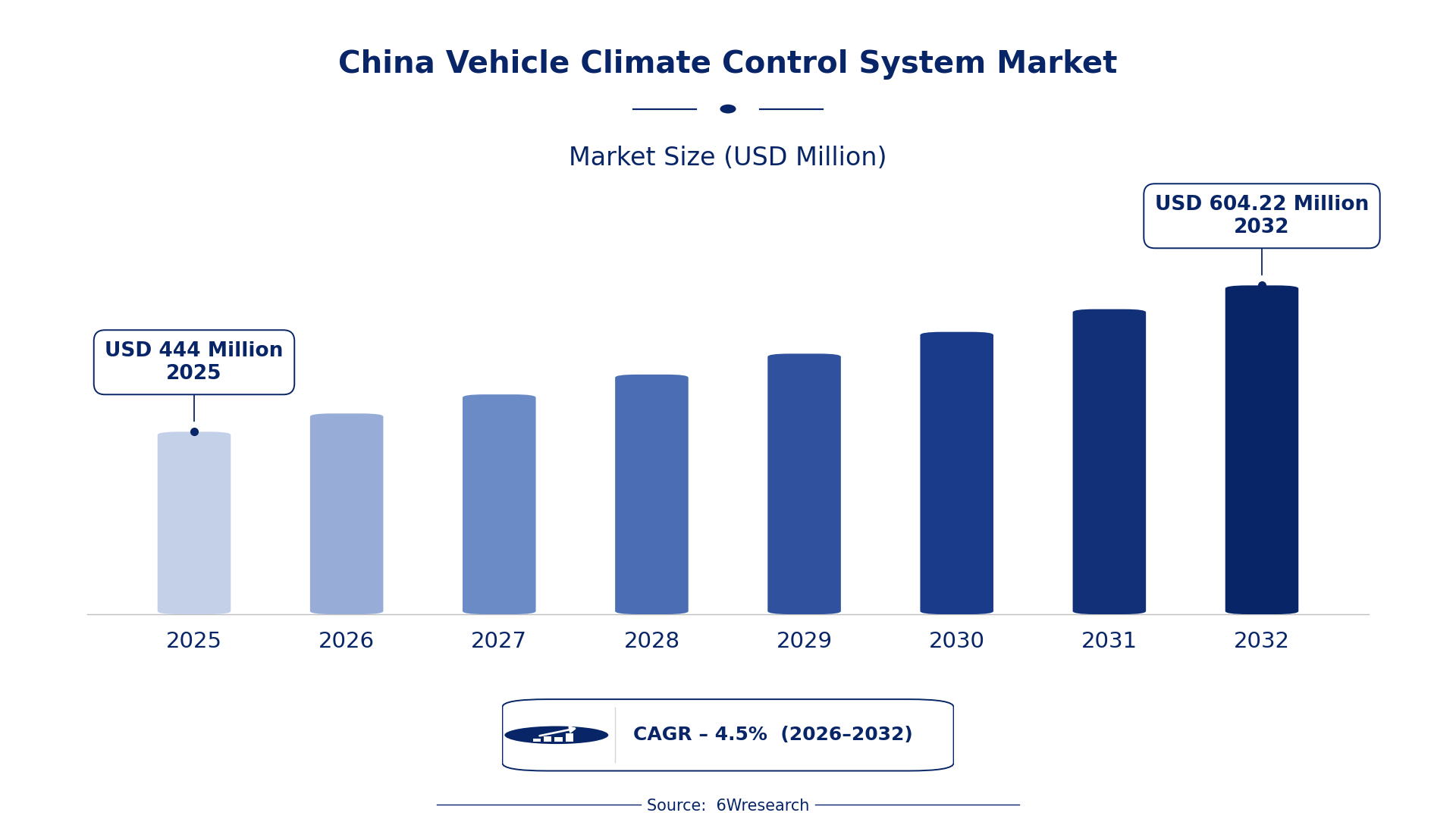
According to 6Wresearch internal database and industry insights, the China Vehicle Climate Control System Market was valued at USD 444.0 million in 2025 and is projected to reach USD 604.22 million by 2032, growing at a CAGR of approximately 4.5% during 2026–2032.
China Vehicle Climate Control System Market Highlights
| Report Metric | Details |
| Report Name | China Vehicle Climate Control System Market |
| Market Size 2025 | USD 444.0 million |
| Market Size 2032 | USD 604.22 million |
| Absolute Growth 2025–2032 | USD 160.22 million |
| CAGR 2026–2032 | 4.5% |
| Peak Annual Growth | 7.4% in 2032 |
| Forecast Period | 2026–2032 |
| Historical Data | 2022–2025 |
| Base Year | 2025 |
| Leading System Type, 2025 | Automatic Climate Control (40% share) |
| Leading Technology Used, 2025 | ECU Controlled (39% share) |
| Leading Vehicle Type, 2025 | Electric Vehicles (53% share) |
| Leading End User, 2025 | Passenger Car OEMs (43% share) |
| Fastest-Growing System Type | Electric Heat Pumps (5.9% CAGR) |
| Fastest-Growing Technology Used | Multi-Zone Sensors (5.8% CAGR) |
| Fastest-Growing End User | EV OEMs (6.0% CAGR) |
| Growing Sector | EV OEMs |
| Key End Users | Passenger Car OEMs, EV OEMs, Family Car Manufacturers, Budget Vehicle Makers |
China Vehicle Climate Control System Market Year-wise Growth Rate and Key Drivers (2022–2032)
This graph illustrates the annual growth rates of the market from 2022 to 2032, highlighting a steady upward trajectory and projected market expansion over the forecast period.
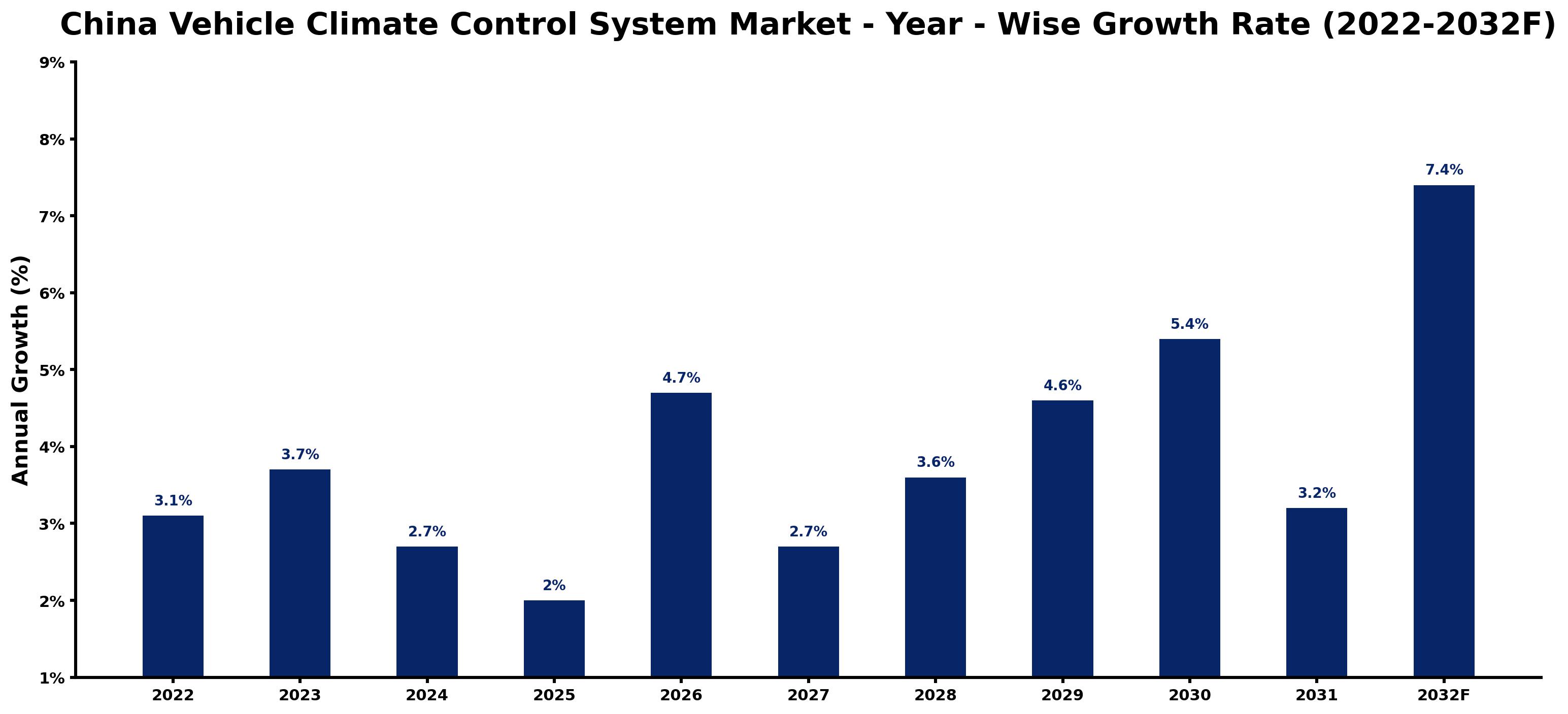
Below, each year's estimated growth is shown next to the factor that most influenced it.
| Year | Estimated Annual Growth (%) | Market Rationale |
| 2022 | 3.1 | The automotive sector employed approximately 5 million people, driving demand for climate control systems. |
| 2023 | 3.7 | Increased production of over 27 million passenger vehicles heightened the need for effective climate control. |
| 2024 | 2.7 | The market is expected to experience slower growth as manufacturers adjust to evolving consumer preferences. |
| 2025 | 2.0 | Investment in energy-efficient technologies will lead to a further slowdown in growth rates. |
| 2026 | 4.7 | Rising demand for electric vehicles is projected to spur growth in climate control systems designed for efficiency. |
| 2027 | 2.7 | The market is anticipated to slow as manufacturers face challenges in adapting to new standards. |
| 2028 | 3.6 | Technological advancements in climate control systems are expected to contribute to renewed growth in the sector. |
| 2029 | 4.6 | The growing focus on energy efficiency in vehicles will lead to increased demand for advanced climate control. |
| 2030 | 5.4 | The automotive sector's investment in R&D for climate control systems is projected to support growth in this area. |
| 2031 | 3.2 | The market is expected to experience a slowdown as competition intensifies among manufacturers. |
| 2032 | 7.4 | The peak growth will be driven by the government's push for electric vehicle adoption and climate control innovations. |
Note: Market size estimations and growth projections presented in this report are based on 6Wresearch's proprietary forecasting methodology, utilizing the latest available industry data, government publications, and primary research inputs.
China Vehicle Climate Control System Market Synopsis
Vehicle Climate Control System in China encompasses technologies that regulate temperature and air quality within vehicles. These systems improve passenger comfort and vehicle performance, primarily made using advanced electronic controls and sensors. The China Vehicle Climate Control System Market is expanding due to the booming automotive industry, which produced over 27 million vehicles in 2022. The shift towards electric vehicles is a key driver, supported by government initiatives like the New Energy Vehicle Industry Development Plan launched in 2023. As the market evolves, investments in energy-efficient climate control technologies are expected to increase.
Market Dynamics Impact Analysis (2026–2032)
| Factor | Type | Impact | Primary Segment Affected |
| Growing demand for electric vehicles drives the need for advanced climate control systems. | Driver | High | Electric Vehicles |
| Investment in R&D for climate control technologies presents opportunities for manufacturers. | Opportunity | High | Automatic Climate Control |
| Stricter emissions standards necessitate compliance, impacting production costs. | Restraint | Medium | Manual HVAC Systems |
| The demand for multi-zone climate systems is increasing among luxury vehicle buyers. | Opportunity | High | Dual-Zone Climate Systems |
| Intense rivalry among manufacturers can lead to price wars, affecting profitability. | Challenge | Medium | Passenger Car OEMs |
| The need for ISO 9001 certification can slow down market entry for new manufacturers. | Restraint | Medium | Electric Heat Pumps |
| Supply chain disruptions can hinder the availability of critical components. | Challenge | High | ECU Controlled |
| Technological advancements require continuous investment, which can strain budgets. | Challenge | Medium | Multi-Zone Sensors |
Evaluation of Drivers in China Vehicle Climate Control System Market (2026–2032)
The table below links each growth driver to the segment it affects and the evidence for it.
| Drivers | Primary Segment Affected | Why It Matters (Evidence) |
| Increased production of electric vehicles drives demand for climate control systems. | Electric Vehicles | The Chinese government aims for 50% of new vehicle sales to be electric by 2035. |
| Investment in R&D for climate control technologies boosts innovation and efficiency. | Automatic Climate Control | The automotive sector is projected to invest over 100 billion RMB in R&D by 2025. |
| Growing consumer preference for comfort drives demand for advanced climate control features. | Dual-Zone Climate Systems | The average temperature range in China necessitates effective climate control systems for comfort. |
| Stricter emissions standards compel manufacturers to develop more efficient climate control systems. | Manual HVAC Systems | The Ministry of Ecology and Environment introduced stricter emissions standards in 2021, pushing for compliance. |
| Increasing focus on energy efficiency in vehicles drives demand for electric heat pumps. | Electric Heat Pumps | The New Energy Vehicle Development Plan targets a 20% market share for electric vehicles by 2025. |
Market growth for Vehicle Climate Control System in China is underpinned by rising investments in energy-efficient technologies, expanding production of passenger vehicles, and increasing consumer demand for comfort. In 2022, over 27 million passenger vehicles were produced, creating a substantial need for advanced climate control solutions. The automotive sector is projected to invest over 100 billion RMB in R&D for climate control technologies by 2025, driving innovation. Stricter emissions standards introduced in 2021 also encourage manufacturers to develop more effective systems, propelling overall market growth.
Evaluation of Restraints in China Vehicle Climate Control System Market
The main factors holding the market back are set out below.
| Market Restraint | Primary Segment Affected | Why It Matters (Evidence) |
| Stricter emissions standards can increase production costs for manufacturers. | Manual HVAC Systems | Compliance with the Ministry of Ecology and Environment's standards requires additional investment of up to 15%. |
| Supply chain disruptions can delay the availability of essential components for production. | ECU Controlled | Global supply chain issues have affected the automotive industry's ability to source materials, leading to delays of up to three months. |
| The need for ISO 9001 certification can slow down market entry for new manufacturers. | Electric Heat Pumps | Manufacturers must invest time and resources to achieve compliance with quality standards, which can take up to six months. |
| Intense rivalry among manufacturers may lead to price wars, impacting profitability. | Passenger Car OEMs | Rivalry can force companies to lower prices, affecting their financial stability and margins by approximately 10%. |
| Technological advancements require continuous investment, which can strain budgets. | Multi-Zone Sensors | Manufacturers must keep pace with rapid changes in technology, increasing R&D costs by around 20%. |
China Vehicle Climate Control System Market Challenges
Buyers in the China Vehicle Climate Control System market face a skills shortage, as the rapid expansion of passenger vehicle production requires specialised technical expertise. This issue arises because educational institutions often do not provide training aligned with industry demands, resulting in delays of up to six months for manufacturers in launching new products. Suppliers struggle with supply chain disruptions, relying heavily on specific components sourced from limited regions, which can lead to production delays of up to three months. Increasing costs for raw materials, influenced by global market trends, raise the average production cost of vehicle climate control systems by approximately 15%, impacting pricing strategies for manufacturers.
Trends in the China Vehicle Climate Control System Market
Four trends stand out in the China Vehicle Climate Control System Market.
- Shift towards Electric Heat Pumps: China is increasingly adopting electric heat pumps in vehicles to improve energy efficiency. In 2023, the government launched the New Energy Vehicle Industry Development Plan, promoting these technologies. This shift aids manufacturers in meeting consumer demands for sustainable solutions.
- Rising Demand for Dual-Zone Climate Systems: The demand for dual-zone climate systems is increasing, particularly in family vehicles. In 2022, over 27 million passenger vehicles were produced, leading to heightened interest in features that improve passenger comfort. This trend encourages manufacturers to innovate and enhance their offerings.
- Expansion of ECU Controlled Systems: ECU controlled climate systems are becoming more prevalent in modern vehicles. With a projected market share of 39% by 2025, these systems are integral to improving precision in climate control. This trend reflects the industry's focus on advanced technology.
- Increased Focus on Multi-Zone Sensors: Multi-zone sensors are gaining traction in luxury vehicles, enhancing passenger comfort. The growing demand for premium features is clear, with manufacturers investing in these technologies. This trend is likely to continue as consumer preferences evolve.
Investment Opportunities in the China Vehicle Climate Control System Market
Some of the investment opportunities in the China Vehicle Climate Control System Market are mentioned below.
- Guangdong Province as a Manufacturing Hub: Guangdong province serves as a major hub for automotive manufacturing, presenting opportunities for climate control system suppliers. With over 27 million vehicles produced in 2022, there is a strong demand for advanced climate control technologies.
- Investment Gap in Electric Vehicle Climate Control: With the Chinese government targeting 50% electric vehicle sales by 2035, there is a gap in climate control solutions for these vehicles. Suppliers can focus on developing energy-efficient systems to meet this demand, driven by government initiatives.
- Timing for Advanced Climate Control Technologies: The automotive sector is projected to invest over 100 billion RMB in R&D for climate control systems by 2025. This investment presents an opportunity for suppliers to introduce innovative technologies that align with market needs.
- Focus on Energy-Efficient Solutions: The push for energy-efficient vehicles creates an opportunity for suppliers of advanced climate control systems. The National Development and Reform Commission supports initiatives that promote energy-efficient technologies, encouraging investment in this area.
Government Initiatives in the China Vehicle Climate Control System Market
In 2022, the Ministry of Industry and Information Technology launched the '14th Five-Year Plan for Automotive Industry Development' to promote energy-efficient vehicle technologies, including climate control systems. This plan builds on previous initiatives by setting clear targets for emissions reductions and energy efficiency improvements. It encourages manufacturers to adopt advanced technologies, ensuring compliance with new standards and enhancing competitiveness in the market. The plan aims to support the development of innovative climate control solutions that meet the evolving needs of consumers and regulatory requirements. By 2025, the automotive sector is expected to see significant advancements in climate control technologies as a result of this framework.
The National Energy Administration's subsidy program for electric vehicle manufacturers focuses on advanced climate control technologies, with a budget of 10 billion RMB initiated in 2023. This program supports manufacturers in developing energy-efficient climate control systems, making it easier for them to comply with new standards. As a result, buyers benefit from improved product offerings and enhanced energy efficiency in their vehicles. The program is designed to encourage innovation and investment in climate control technologies, ensuring that manufacturers can meet the growing demand for electric vehicles and their specific climate control needs. This initiative aligns with the government's broader goals of promoting sustainable transportation solutions.
Future Insight of the China Vehicle Climate Control System Market
The China Vehicle Climate Control System market will undergo significant transformations by 2032, influenced by several forward-looking factors. The government's 'New Energy Vehicle Industry Development Plan' will enhance the development of energy-efficient climate control technologies. By 2025, the automotive sector is set to invest over 100 billion RMB in research and development, leading to advancements in system performance. The push for 50% of new vehicle sales to be electric by 2035 will necessitate the creation of specialised climate control systems tailored for electric vehicles. Enhanced quality standards driven by ISO 9001 certification will further elevate manufacturing practices.
Market Segmentation Analysis
The analysis below covers each segmentation, its leading category in 2025 and its fastest-growing category through 2032.
By System Type – Automatic Climate Control Dominated, Electric Heat Pumps Expected to Grow Fastest
According to Bhawna Singh, Assistant Manager at 6Wresearch, in 2025, Automatic Climate Control led the system type split with a 40% share. Automatic Climate Control holds the largest market share due to its widespread adoption in modern vehicles, ensuring passenger comfort. This system is essential in the majority of the over 27 million passenger vehicles produced in China in 2022. The quickest growth will come from Electric Heat Pumps, forecast to expand at a CAGR of 5.9% between 2026 and 2032. Electric Heat Pumps are experiencing rapid growth as they are increasingly integrated into electric vehicles, driven by the government's push for energy efficiency. The 'New Energy Vehicle Industry Development Plan' launched in 2023 highlights this trend. Suppliers should focus on developing advanced electric heat pump technologies to meet the growing demand in the electric vehicle segment.
By Technology Used – ECU Controlled Dominated, Multi-Zone Sensors Expected to Grow Fastest
The largest technology used category in 2025 was ECU Controlled, with a 39% share of total revenue. ECU Controlled technology commands the largest share in the market as it is integral to modern climate control systems, ensuring precision across a wide range of vehicles. Its widespread adoption in China's automotive sector enhances overall vehicle performance, making it a preferred choice among manufacturers. Over 2026–2032, Multi-Zone Sensors are expected to post the fastest growth, at a CAGR of 5.8%. Multi-Zone Sensors are witnessing rapid growth due to their necessity in luxury and multi-passenger vehicles, which significantly elevate passenger comfort. The increasing consumer demand for personalised climate experiences is propelling this segment's expansion, indicating a shift in market preferences. Suppliers must focus on advancing multi-zone sensor technologies to align with the growing consumer expectations for customised comfort in vehicle climate control systems.
By Vehicle Type – Electric Vehicles Dominated and Is Expected to Record the Fastest Growth
With a 53% revenue share in 2025, Electric Vehicles was the largest vehicle type category. Electric Vehicles capture a substantial market share as they are a rapidly growing segment with specific climate control needs, particularly with the government's goal of 50% electric vehicle sales by 2035. This transition is reshaping the requirements for climate control technologies in the automotive sector. The same category are also set to grow fastest, at a CAGR of 6.3% during 2026–2032. Electric Vehicles are also the fastest-growing segment, spurred by heightened consumer interest and supportive government policies. The alignment of climate control technologies with the unique requirements of electric vehicles will further strengthen this segment's market position. Suppliers must align their product development strategies with the electric vehicle market to effectively tap into the growing demand for climate control solutions.
By End User – Passenger Car OEMs Dominated, EV OEMs Expected to Grow Fastest
Passenger Car OEMs took a 43% share of end user in 2025, more than any other category. Passenger Car OEMs dominate the market share as they are the primary manufacturers of vehicle climate control systems, serving the extensive automotive market in China. Their established relationships with component suppliers ensure a consistent supply chain for these technologies. EV OEMs are projected to grow fastest, at a CAGR of 6.0% during 2026–2032. EV OEMs are the fastest-growing segment, as they are increasingly focusing on climate control efficiency tailored specifically for electric vehicles. The expansion of the electric vehicle market is prompting these manufacturers to prioritise advanced climate control solutions to meet evolving consumer needs. Suppliers should target EV OEMs to capitalise on the growing emphasis on climate control efficiency in the electric vehicle segment.
Key Attractiveness of the Report
- 10 Years of Market Numbers
- Historical Data Starting from 2022 to 2025
- Base Year 2025
- Forecast Data until 2032
- Key Performance Indicators Impacting the Market
- Major Upcoming Developments and Projects
Key Highlights of the Report:
- China Vehicle Climate Control System Market Outlook
- Market Size of China Vehicle Climate Control System Market, 2025
- Forecast of China Vehicle Climate Control System Market, 2032
- Historical Data and Forecast of China Vehicle Climate Control System Revenues & Volume for the Period 2022 - 2032F
- China Vehicle Climate Control System Market Trend Evolution
- China Vehicle Climate Control System Market Drivers and Challenges
- China Vehicle Climate Control System Price Trends
- China Vehicle Climate Control System Porter's Five Forces
- China Vehicle Climate Control System Industry Life Cycle
- Historical Data and Forecast of China Vehicle Climate Control System Market Revenues & Volume By System Type for the Period 2022 - 2032F
- Historical Data and Forecast of China Vehicle Climate Control System Market Revenues & Volume By Automatic Climate Control for the Period 2022 - 2032F
- Historical Data and Forecast of China Vehicle Climate Control System Market Revenues & Volume By Manual HVAC Systems for the Period 2022 - 2032F
- Historical Data and Forecast of China Vehicle Climate Control System Market Revenues & Volume By Dual-Zone Climate Systems for the Period 2022 - 2032F
- Historical Data and Forecast of China Vehicle Climate Control System Market Revenues & Volume By Electric Heat Pumps for the Period 2022 - 2032F
- Historical Data and Forecast of China Vehicle Climate Control System Market Revenues & Volume By Technology Used for the Period 2022 - 2032F
- Historical Data and Forecast of China Vehicle Climate Control System Market Revenues & Volume By ECU Controlled for the Period 2022 - 2032F
- Historical Data and Forecast of China Vehicle Climate Control System Market Revenues & Volume By Rotary Switch for the Period 2022 - 2032F
- Historical Data and Forecast of China Vehicle Climate Control System Market Revenues & Volume By Multi-Zone Sensors for the Period 2022 - 2032F
- Historical Data and Forecast of China Vehicle Climate Control System Market Revenues & Volume By EV Integrated for the Period 2022 - 2032F
- Historical Data and Forecast of China Vehicle Climate Control System Market Revenues & Volume By Vehicle Type for the Period 2022 - 2032F
- Historical Data and Forecast of China Vehicle Climate Control System Market Revenues & Volume By Premium Cars for the Period 2022 - 2032F
- Historical Data and Forecast of China Vehicle Climate Control System Market Revenues & Volume By Entry-Level Vehicles for the Period 2022 - 2032F
- Historical Data and Forecast of China Vehicle Climate Control System Market Revenues & Volume By SUVs for the Period 2022 - 2032F
- Historical Data and Forecast of China Vehicle Climate Control System Market Revenues & Volume By Electric Vehicles for the Period 2022 - 2032F
- Historical Data and Forecast of China Vehicle Climate Control System Market Revenues & Volume By End User for the Period 2022 - 2032F
- Historical Data and Forecast of China Vehicle Climate Control System Market Revenues & Volume By Passenger Car OEMs for the Period 2022 - 2032F
- Historical Data and Forecast of China Vehicle Climate Control System Market Revenues & Volume By Budget Vehicle Makers for the Period 2022 - 2032F
- Historical Data and Forecast of China Vehicle Climate Control System Market Revenues & Volume By Family Car Manufacturers for the Period 2022 - 2032F
- Historical Data and Forecast of China Vehicle Climate Control System Market Revenues & Volume By EV OEMs for the Period 2022 - 2032F
- China Vehicle Climate Control System Import Export Trade Statistics
- Market Opportunity Assessment By System Type
- Market Opportunity Assessment By Technology Used
- Market Opportunity Assessment By Vehicle Type
- Market Opportunity Assessment By End User
- China Vehicle Climate Control System Top Companies Market Share
- China Vehicle Climate Control System Competitive Benchmarking By Technical and Operational Parameters
- China Vehicle Climate Control System Company Profiles
- China Vehicle Climate Control System Key Strategic Recommendations
Market Covered
This report examines the market across the segments below.
By System Type
- Automatic Climate Control
- Manual HVAC Systems
- Dual-Zone Climate Systems
- Electric Heat Pumps
By Technology Used
- ECU Controlled
- Rotary Switch
- Multi-Zone Sensors
- EV Integrated
By Vehicle Type
- Premium Cars
- Entry-Level Vehicles
- SUVs
- Electric Vehicles
By End User
- Passenger Car OEMs
- Budget Vehicle Makers
- Family Car Manufacturers
- EV OEMs































