Colombia Food & Grocery Retail Market Size, Share & Growth Rate
The Colombia Food & Grocery Retail Market was estimated at USD 603 Million in 2025 and is projected to reach USD 1039 Million by 2032, growing at a CAGR of 8.1% from 2026 to 2032. This upward trajectory is fueled by urbanization trends, which are leading to a shift in consumer preferences towards organized retail channels, as well as rising disposable incomes that enable a broader selection of purchasing options. Moreover, the increasing popularity of online grocery shopping reflects the evolving dynamics of consumer behavior, emphasizing convenience and quality.
Colombia Food & Grocery Retail Market Year-wise Growth Rate and Key Drivers
This graph highlights how the Colombia Food & Grocery Retail Market has steadily grown over the years, supported by major growth factors.
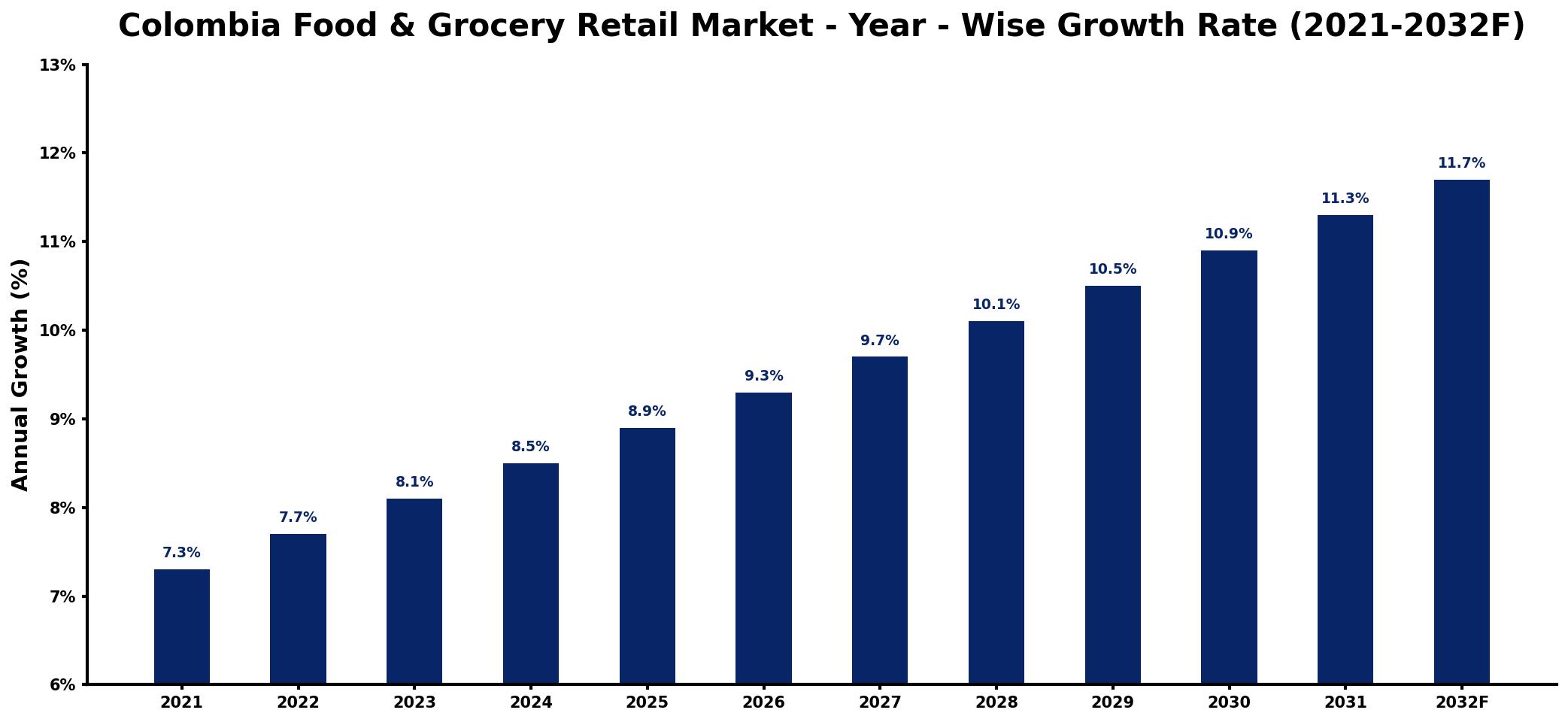
The table below presents the year‑wise growth rates along with the key drivers influencing the market
| Year | Growth Rate | Major Drivers |
| 2021 | 7.3% | Rising consumer disposable income levels |
| 2022 | 7.7% | Expansion of e-commerce platforms |
| 2023 | 8.1% | Increased urban population density |
| 2024 | 8.5% | Growth in health conscious consumers |
| 2025 | 8.9% | Innovation in delivery services |
| 2026 | 9.3% | Investment in supply chain technology |
| 2027 | 9.7% | Diversification of product offerings |
| 2028 | 10.1% | Emergence of local brands popularity |
| 2029 | 10.5% | Strengthening of distribution networks |
| 2030 | 10.9% | Enhancement of customer loyalty programs |
| 2031 | 11.3% | Adoption of sustainable practices |
| 2032 | 11.7% | Rise in private label products |
Note: Market size estimations and growth projections presented in this report are based on 6Wresearch's proprietary forecasting methodology, utilizing the latest available industry data, government publications, and primary research inputs.
Colombia Food & Grocery Retail Market Synopsis
The Colombian food and grocery retail landscape is undergoing a significant transformation. Traditional neighborhood stores, while still a staple in many communities, are facing competition from larger supermarkets and e-commerce platforms that offer broader product selections and competitive pricing. As urban lifestyles change, so too do consumer expectations regarding shopping convenience and product variety.
Increasing health consciousness among consumers has led to a burgeoning demand for organic and locally-sourced products, which retailers are keen to incorporate into their offerings. This evolving market presents opportunities for both established players and newcomers to connect with a more discerning customer base looking for quality and value in their grocery purchases.
- The sector is witnessing substantial growth driven by urbanization and rising disposable income levels.
- Consumer preferences are shifting towards healthier, organic, and locally sourced food options.
- Online grocery shopping is gaining momentum, particularly among busy urban consumers seeking convenience.
- Intense competition and market fragmentation pose challenges for retailers trying to maintain profit margins.
- Government initiatives aim to promote sustainable practices and support local producers in the food retail sector.
Despite the growth opportunities, the Colombia Food & Grocery Retail Market is not without its challenges. The intense competition among domestic and international players creates a highly fragmented environment, often leading to price wars that compress profit margins. Fluctuating consumer preferences can make it difficult for retailers to anticipate demand accurately, while regulatory hurdles and economic uncertainties can further complicate market operations. Additionally, supply chain inefficiencies and logistics issues can impede retailers' ability to deliver a consistent and high-quality shopping experience, hindering growth potential.
Current trends indicate a marked shift towards online grocery shopping, spurred by technological advancements and an increasing reliance on digital platforms. Consumers are also gravitating towards personalized shopping experiences, leveraging mobile apps and loyalty programs that enhance engagement. Moreover, the trend towards sustainable and health-conscious options continues to grow, with consumers demanding transparency about product sourcing and nutritional content.
For investors and retailers, the Colombia Food & Grocery Retail Market presents a plethora of opportunities. Expanding e-commerce platforms tailored to the unique needs of urban consumers could yield significant returns. Furthermore, specialized stores focusing on organic and health-centric products cater to a rising demographic concerned with wellness. Collaborations with local producers not only offer a distinct product line but also appeal to consumers growing preference for sustainability and support for local economies.
The Colombian government has established several policies aimed at creating a more robust and competitive food retail sector. These include stringent food safety standards and labeling requirements to ensure consumer protection. Additionally, initiatives have been introduced to support local agriculture, promoting sustainable practices and encouraging retailers to provide nutritious options. Efforts to stimulate fair competition and empower small and medium-sized enterprises are also key aspects of governmental focus.
Looking ahead to the period from 2026 to 2032, the Colombia Food & Grocery Retail Market is poised for significant evolution. As urbanization continues to accelerate, an expanded consumer base will likely drive demand for innovative retail solutions. Retailers that successfully navigate regulatory challenges and embrace technology are expected to thrive, capitalizing on the growing consumer appetite for diverse and quality products. The focus on sustainability and local sourcing will further shape the market landscape, opening avenues for strategic growth and investment.
Recent developments in the Colombian food and grocery retail sector have highlighted a growing trend towards the adoption of technology, with retailers increasingly investing in e-commerce capabilities to meet the demands of modern consumers. Moreover, there is a notable emphasis on sustainability initiatives, as businesses seek to incorporate environmentally friendly practices into their operations. Enhanced customer engagement strategies, including the use of loyalty programs and personalized marketing, have also emerged as focal points for retailers looking to differentiate themselves in a competitive market.
- 10 Years of Market Numbers
- Historical Data Starting from 2022 to 2025
- Base Year: 2025
- Forecast Data until 2032
- Key Performance Indicators Impacting the Market
- Major Upcoming Developments and Projects
Key Highlights of the Report:
- Colombia Food & Grocery Retail Market Outlook
- Market Size of Colombia Food & Grocery Retail Market, 2025
- Forecast of Colombia Food & Grocery Retail Market, 2032
- Historical Data and Forecast of Colombia Food & Grocery Retail Revenues & Volume for the Period 2022-2032F
- Colombia Food & Grocery Retail Market Trend Evolution
- Colombia Food & Grocery Retail Market Drivers and Challenges
- Colombia Food & Grocery Retail Price Trends
- Colombia Food & Grocery Retail Porter's Five Forces
- Colombia Food & Grocery Retail Industry Life Cycle
- Historical Data and Forecast of Colombia Food & Grocery Retail Market Revenues & Volume By Product for the Period 2022-2032F
- Historical Data and Forecast of Colombia Food & Grocery Retail Market Revenues & Volume By Fresh Food for the Period 2022-2032F
- Historical Data and Forecast of Colombia Food & Grocery Retail Market Revenues & Volume By Frozen Food for the Period 2022-2032F
- Historical Data and Forecast of Colombia Food & Grocery Retail Market Revenues & Volume By Food Cupboard for the Period 2022-2032F
- Historical Data and Forecast of Colombia Food & Grocery Retail Market Revenues & Volume By Beverages for the Period 2022-2032F
- Historical Data and Forecast of Colombia Food & Grocery Retail Market Revenues & Volume By Cleaning & Household for the Period 2022-2032F
- Historical Data and Forecast of Colombia Food & Grocery Retail Market Revenues & Volume By Others for the Period 2022-2032F
- Historical Data and Forecast of Colombia Food & Grocery Retail Market Revenues & Volume By Distribution Channel for the Period 2022-2032F
- Historical Data and Forecast of Colombia Food & Grocery Retail Market Revenues & Volume By Supermarkets & Hypermarkets for the Period 2022-2032F
- Historical Data and Forecast of Colombia Food & Grocery Retail Market Revenues & Volume By Convenience Stores for the Period 2022-2032F
- Historical Data and Forecast of Colombia Food & Grocery Retail Market Revenues & Volume By Departmental Stores & Clubs for the Period 2022-2032F
- Historical Data and Forecast of Colombia Food & Grocery Retail Market Revenues & Volume By Online for the Period 2022-2032F
- Colombia Food & Grocery Retail Import Export Trade Statistics
- Market Opportunity Assessment By Product
- Market Opportunity Assessment By Distribution Channel
- Colombia Food & Grocery Retail Top Companies Market Share
- Colombia Food & Grocery Retail Competitive Benchmarking By Technical and Operational Parameters
- Colombia Food & Grocery Retail Company Profiles
- Colombia Food & Grocery Retail Key Strategic Recommendations






































