Colombia Real Estate Market Size, Share & Growth Rate
The Colombia Real Estate Market was estimated at USD 457 Million in 2025 and is projected to reach USD 602 Million by 2032, growing at a CAGR of 4.0% from 2026 to 2032. This growth trajectory is largely fueled by increased urbanization and a burgeoning middle class, which is driving demand for both residential and commercial properties in urban centers. Furthermore, the influx of foreign investment is enhancing development opportunities and further stimulating market activity.
Colombia Real Estate Market Year-wise Growth Rate and Key Drivers
This graph highlights how the Colombia Real Estate Market has steadily grown over the years, supported by major growth factors.
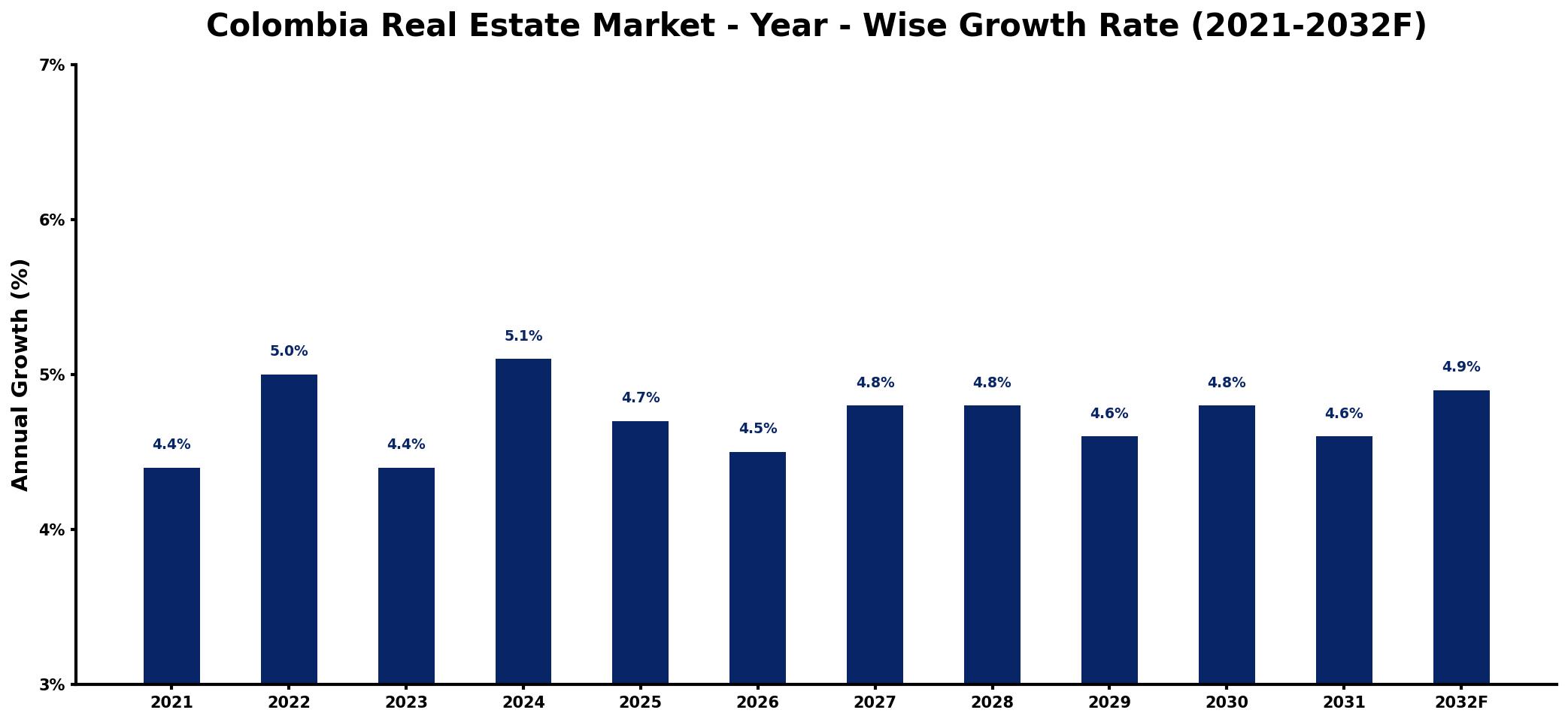
The table below presents the year‑wise growth rates along with the key drivers influencing the market
| Year | Growth Rate | Major Drivers |
| 2021 | 4.4% | Increased foreign investment opportunities |
| 2022 | 5.0% | Rising urban population growth |
| 2023 | 4.4% | Expansion of infrastructure projects |
| 2024 | 5.1% | Growth in tourism sector demand |
| 2025 | 4.7% | Strengthened mortgage financing options |
| 2026 | 4.5% | Increased industrial development activity |
| 2027 | 4.8% | Surge in residential property interest |
| 2028 | 4.8% | Boost in commercial leasing trends |
| 2029 | 4.6% | Enhanced digital marketing strategies |
| 2030 | 4.8% | Growing demand for sustainable housing |
| 2031 | 4.6% | Rise in property management services |
| 2032 | 4.9% | Increased investment in urban renewal |
Note: Market size estimations and growth projections presented in this report are based on 6Wresearch's proprietary forecasting methodology, utilizing the latest available industry data, government publications, and primary research inputs.
Colombia Real Estate Market Synopsis
Colombia's real estate landscape is undergoing a transformation, with cities like Bogota, Medellin, and Cartagena witnessing a notable surge in new construction projects. This uptick is not only addressing the demand for housing but also enhancing commercial spaces that cater to a growing professional class.
Despite challenges in affordable housing and potential oversupply in some areas, the market shows resilience. The increasing focus on sustainable and eco-friendly properties indicates a shift toward long-term viability and responsibility among developers, attracting environmentally-conscious investors.
Colombia Real Estate Market Key Takeaways
- The market is characterized by rapid urbanization, particularly in major cities.
- Foreign investment is on the rise, especially from North America and Europe.
- Sustainable building practices are becoming a key focus for developers.
- There is a growing demand for co-living and co-working spaces, reflecting changing consumer preferences.
- Government reforms are making property investment more accessible and attractive.
Evaluation of Restraints in Colombia Real Estate Market
The Colombia real estate market faces significant challenges that could impede its growth. Issues surrounding land title verification often complicate property transactions, as disputes can lead to delays and uncertainties. A lack of transparency in the market has further fueled concerns among investors, making it crucial to address these systemic inefficiencies. Furthermore, ongoing issues with corruption and informal practices continue to undermine investor confidence, necessitating robust legal reforms to create a more stable and trustworthy environment for all stakeholders.
Colombia Real Estate Market Trends
Several trends are emerging within the Colombia real estate market that reflect broader societal changes. The demand for residential properties remains strong, fueled by the rising middle class seeking homeownership. Additionally, the growing interest in eco-friendly and energy-efficient buildings is influencing the design and construction of new developments. The commercial sector is also adapting to new dynamics, with co-living and co-working spaces becoming increasingly popular among a mobile workforce.
Colombia Real Estate Market Opportunities
Investment opportunities abound in the Colombian real estate sector, particularly within the residential market in urban hubs such as Bogota and Medellin. The tourism boom presents another avenue for growth, with increasing demand for vacation rentals in picturesque locations. Commercial real estate also offers solid long-term returns as businesses seek modern office spaces and retail options to accommodate evolving consumer needs. The government's initiatives to bolster infrastructure and attract foreign investments further enhance the appeal of the Colombian real estate market.
Government Initiatives in the Colombia Real Estate Market
The Colombian government is actively implementing policies designed to stimulate real estate growth. These include tax incentives for foreign investors and streamlined processes for property acquisition. Additionally, the government has introduced financing programs aimed at improving housing accessibility for low-income families, ensuring that as the market expands, affordability remains a critical focus. Sustainability regulations also emphasize responsible development practices, promoting a balanced approach to growth and environmental stewardship.
Future Insights of the Colombia Real Estate Market
The outlook for the Colombia real estate market from 2026 to 2032 is notably positive, with anticipated steady growth underpinned by economic stability and urban expansion. As the middle class continues to grow and foreign interest intensifies, demand for both residential and commercial properties is set to rise. However, potential regulatory changes and political uncertainties may introduce challenges that require careful navigation. Overall, Colombia's evolving real estate landscape is poised for significant investment opportunities as the market matures.
Colombia Real Estate Market Latest Developments (2025 - 2026)
Recent developments in the Colombia real estate market indicate a robust pipeline of projects focused on sustainable living and mixed-use spaces. There has been an uptick in financing for eco-friendly initiatives as developers respond to consumer demand for greener properties. Furthermore, innovative business models, such as co-living arrangements, are beginning to reshape urban living dynamics, catering to a younger demographic seeking flexibility and community engagement.
Colombia Real Estate Market - Key Attractiveness of the Report
- 10 Years of Market Numbers
- Historical Data Starting from 2022 to 2025
- Base Year: 2025
- Forecast Data until 2032
- Key Performance Indicators Impacting the Market
- Major Upcoming Developments and Projects
Key Highlights of the Report:
- Colombia Real Estate Market Outlook
- Market Size of Colombia Real Estate Market, 2025
- Forecast of Colombia Real Estate Market, 2032
- Historical Data and Forecast of Colombia Real Estate Revenues & Volume for the Period 2022-2032F
- Colombia Real Estate Market Trend Evolution
- Colombia Real Estate Market Drivers and Challenges
- Colombia Real Estate Price Trends
- Colombia Real Estate Porter's Five Forces
- Colombia Real Estate Industry Life Cycle
- Historical Data and Forecast of Colombia Real Estate Market Revenues & Volume By Property for the Period 2022-2032F
- Historical Data and Forecast of Colombia Real Estate Market Revenues & Volume By Residential for the Period 2022-2032F
- Historical Data and Forecast of Colombia Real Estate Market Revenues & Volume By Commercial for the Period 2022-2032F
- Historical Data and Forecast of Colombia Real Estate Market Revenues & Volume By Industrial for the Period 2022-2032F
- Historical Data and Forecast of Colombia Real Estate Market Revenues & Volume By Land for the Period 2022-2032F
- Historical Data and Forecast of Colombia Real Estate Market Revenues & Volume By Others for the Period 2022-2032F
- Historical Data and Forecast of Colombia Real Estate Market Revenues & Volume By Type for the Period 2022-2032F
- Historical Data and Forecast of Colombia Real Estate Market Revenues & Volume By Sales for the Period 2022-2032F
- Historical Data and Forecast of Colombia Real Estate Market Revenues & Volume By Rental for the Period 2022-2032F
- Historical Data and Forecast of Colombia Real Estate Market Revenues & Volume By Lease for the Period 2022-2032F
- Colombia Real Estate Import Export Trade Statistics
- Market Opportunity Assessment By Property
- Market Opportunity Assessment By Type
- Colombia Real Estate Top Companies Market Share
- Colombia Real Estate Competitive Benchmarking By Technical and Operational Parameters
- Colombia Real Estate Company Profiles
- Colombia Real Estate Key Strategic Recommendations






































