Croatia Converter Transformer Market Size (2020-2030)
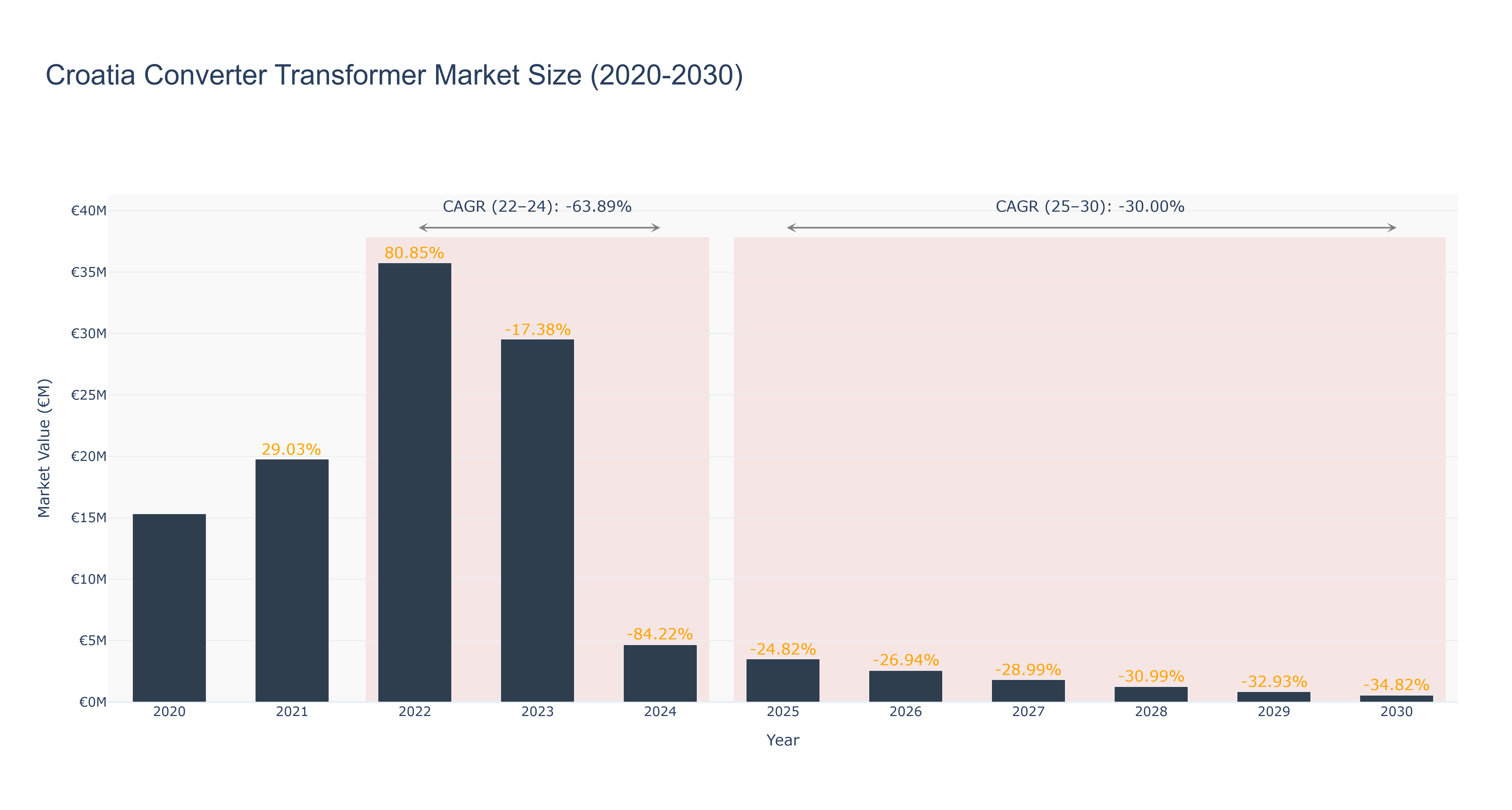
Croatia's Converter Transformer Market has witnessed a significant decline in market size over the years. The peak market size of €35.76 million was recorded in 2022, followed by a sharp decrease to €4.66 million in 2024. The forecasted market size from 2025 to 2030 continues to show a downward trend, with a projected size of €0.55 million in 2030. The CAGR values reflect this decline, with a CAGR of -63.89% from 2022 to 2024 and -30.0% from 2025 to 2030. The industry drivers behind this trend could be attributed to technological advancements leading to decreased demand for traditional transformer products. Looking ahead, Croatia's Converter Transformer Market may see potential growth opportunities with the development of smart grid infrastructure projects aimed at enhancing energy efficiency and reliability in the country.
Croatia Converter Transformer Market: Production & Trade Performance (2019-2025)
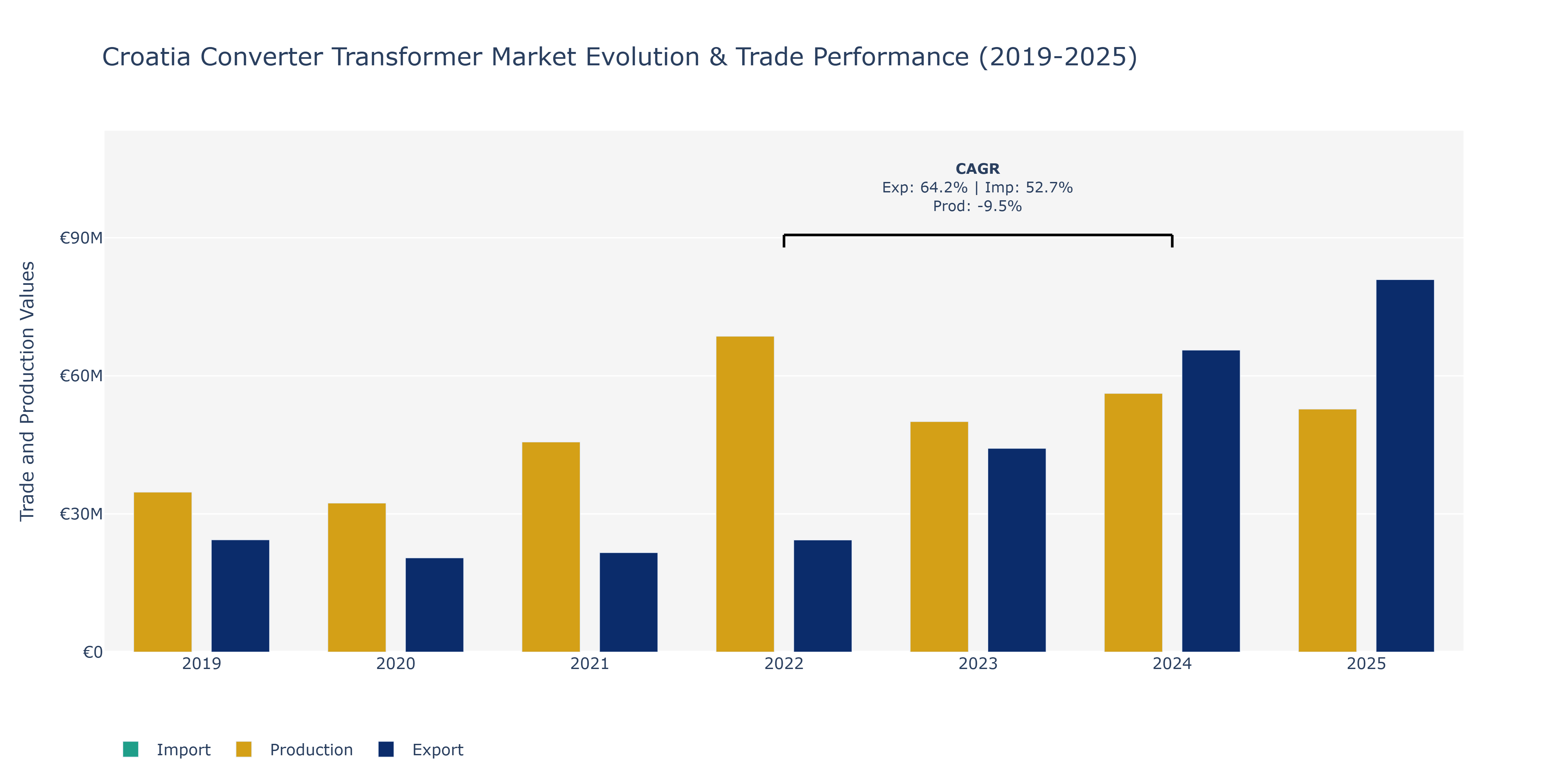
Between 2019 and 2025, Croatia's Converter Transformer Market demonstrated notable trends in Exports, Imports, and Production. Exports showed a steady growth trajectory, with values increasing from €24.38 million in 2019 to €80.9 million in 2025, marking a peak in the latter year. This growth can be attributed to Croatia's strategic position in the European market and the increasing global demand for energy infrastructure. In contrast, Imports fluctuated, reaching a peak of €7.04 million in 2025 after a decline in 2021. The fluctuations may reflect variations in international trade agreements and domestic manufacturing capabilities. Production peaked at €68.61 million in 2022 before declining to €52.78 million in 2025. This decline might be due to market saturation, technological disruptions, or shifts in energy policies impacting the demand for converter transformers. To sustain growth, Croatia may need to focus on enhancing production efficiency and fostering innovation in the converter transformer sector.
Croatia Converter Transformer Market Overview
The converter transformer market in Croatia focuses on transformers used in electrical systems to convert voltage levels and facilitate power transmission. Converter transformers are essential for applications such as HVDC (High Voltage Direct Current) systems and power conversion. The market is driven by the need for efficient power transmission, advancements in transformer technology, and the growth of electrical infrastructure.
Drivers of the market
The converter transformer market in Croatia is driven by the increasing demand for electrical equipment that converts and regulates electrical power in various applications. Converter transformers are used in power transmission, industrial processes, and renewable energy systems. The rise in energy consumption, advancements in transformer technologies, and the focus on improving power efficiency and reliability drive market demand. Additionally, the growth of the energy and industrial sectors supports market expansion.
Challenges of the market
The converter transformer market in Croatia is challenged by high production costs and the need for advanced technologies. The production of converter transformers requires specialized materials and components, driving up costs. Furthermore, meeting the demand for energy-efficient and high-performance transformers adds complexity to manufacturing processes.
Government Policy of the market
The Croatian government regulates the converter transformer market to ensure the safety, reliability, and efficiency of transformers used in electrical systems. Policies include standards for product performance, safety, and environmental impact. The government supports the development of advanced transformer technologies and provides incentives for businesses investing in innovative and energy-efficient solutions.
Key Highlights of the Report:
- Croatia Converter Transformer Market Outlook
- Market Size of Croatia Converter Transformer Market, 2024
- Forecast of Croatia Converter Transformer Market, 2031
- Historical Data and Forecast of Croatia Converter Transformer Revenues & Volume for the Period 2021-2031
- Croatia Converter Transformer Market Trend Evolution
- Croatia Converter Transformer Market Drivers and Challenges
- Croatia Converter Transformer Price Trends
- Croatia Converter Transformer Porter`s Five Forces
- Croatia Converter Transformer Industry Life Cycle
- Historical Data and Forecast of Croatia Converter Transformer Market Revenues & Volume By Configuration for the Period 2021-2031
- Historical Data and Forecast of Croatia Converter Transformer Market Revenues & Volume By Back-to-Back for the Period 2021-2031
- Historical Data and Forecast of Croatia Converter Transformer Market Revenues & Volume By Monopolar for the Period 2021-2031
- Historical Data and Forecast of Croatia Converter Transformer Market Revenues & Volume By Bipolar for the Period 2021-2031
- Historical Data and Forecast of Croatia Converter Transformer Market Revenues & Volume By Multi-terminal for the Period 2021-2031
- Historical Data and Forecast of Croatia Converter Transformer Market Revenues & Volume By Application for the Period 2021-2031
- Historical Data and Forecast of Croatia Converter Transformer Market Revenues & Volume By Windfarms for the Period 2021-2031
- Historical Data and Forecast of Croatia Converter Transformer Market Revenues & Volume By Oil & Gas for the Period 2021-2031
- Historical Data and Forecast of Croatia Converter Transformer Market Revenues & Volume By Grid interconnections for the Period 2021-2031
- Croatia Converter Transformer Import Export Trade Statistics
- Market Opportunity Assessment By Configuration
- Market Opportunity Assessment By Application
- Croatia Converter Transformer Top Companies Market Share
- Croatia Converter Transformer Competitive Benchmarking By Technical and Operational Parameters
- Croatia Converter Transformer Company Profiles
- Croatia Converter Transformer Key Strategic Recommendations






































