Croatia Kegs Market Top 5 Importing Countries and Market Competition (HHI) Analysis
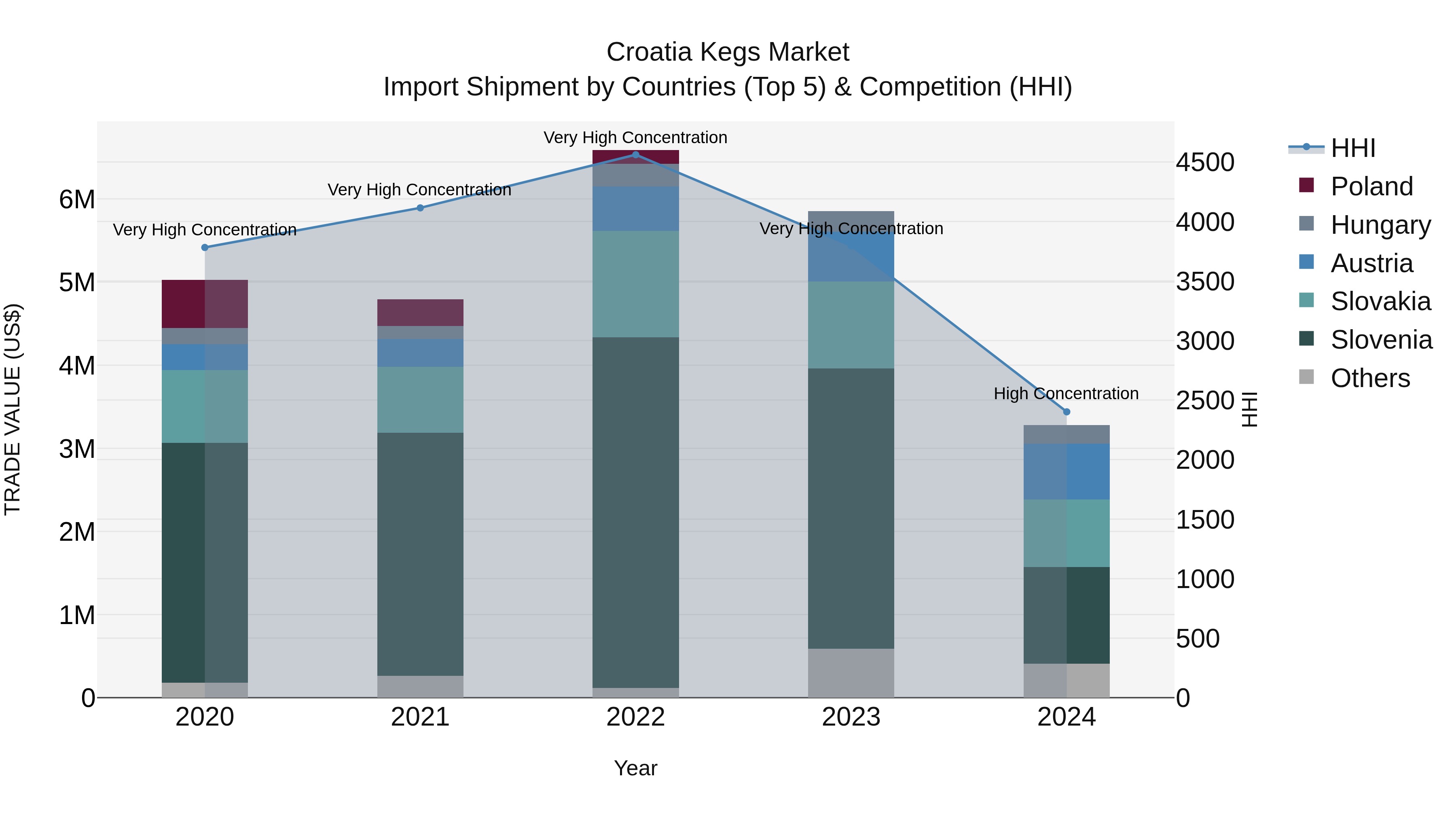
Croatia kegs import market in 2024 saw a shift in top exporting countries, with Slovenia, Slovakia, Austria, Serbia, and Hungary leading the way. Despite a decrease in the CAGR from 2020 to 2024 at -10.13%, the market experienced a significant growth rate decline of -44.02% from 2023 to 2024. The market concentration, as measured by the HHI, remained high in 2024 after a very high concentration in 2023. These trends suggest a dynamic and potentially competitive landscape in the Croatian kegs import market, with opportunities for further analysis and strategic decision-making.
Kegs Market: Croatia vs Top 5 Major Economies in 2027 (Europe)
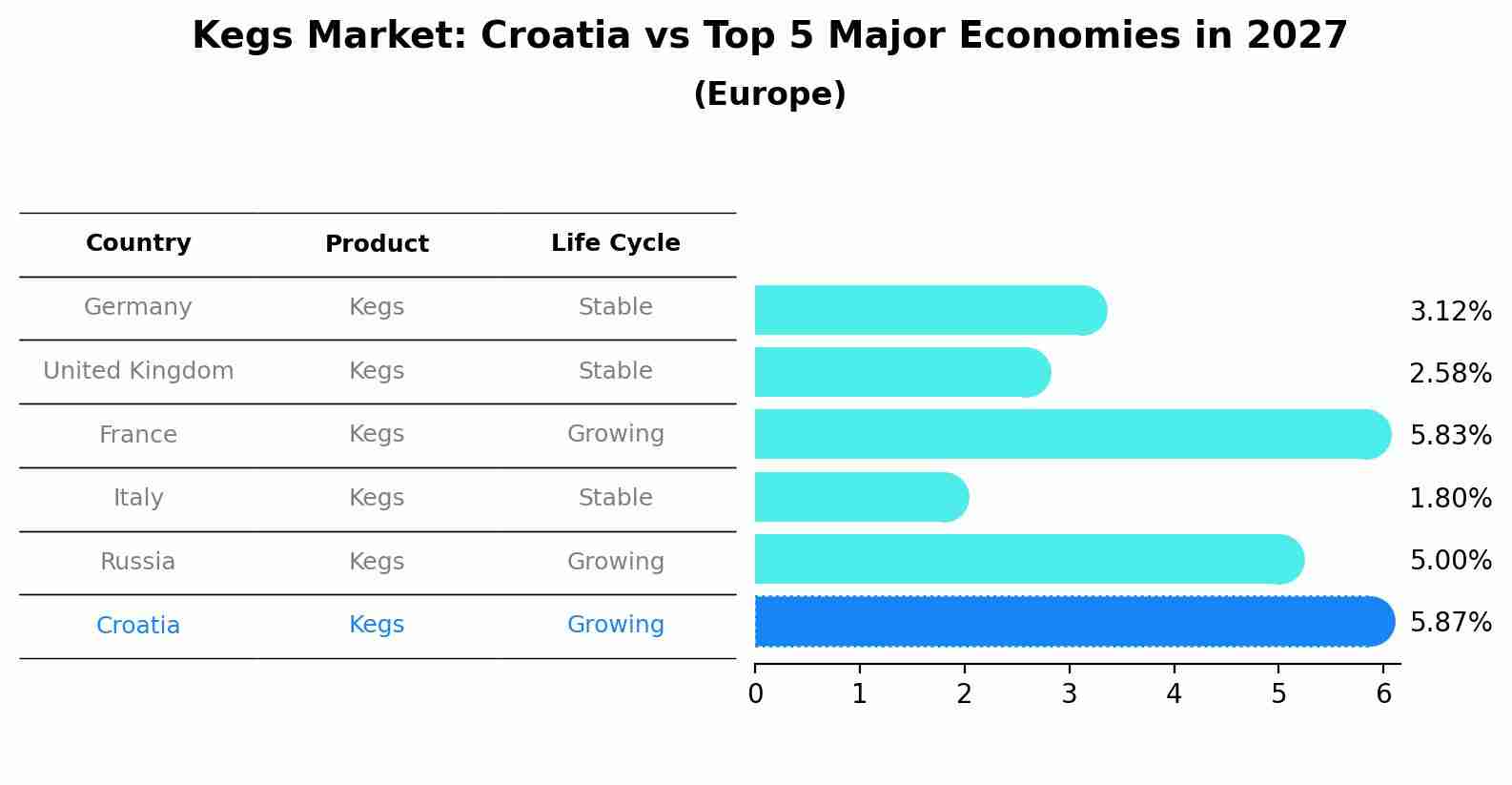
In the Europe region, the Kegs market in Croatia is projected to expand at a growing growth rate of 5.87% by 2027. The largest economy is Germany, followed by United Kingdom, France, Italy and Russia.
Croatia Kegs Market Overview
The kegs market in Croatia is expanding due to the growth of the craft beer industry and an increasing demand for beverages served in bulk. Kegs are commonly used in breweries, restaurants, and events for the efficient distribution of beer and other drinks. This market is also supported by innovations in keg materials and designs that improve sustainability and durability.
Drivers of the market
The growth of the Croatian hospitality and brewery industries is a key driver for the kegs market. The increasing consumption of beer and other beverages in restaurants, bars, and events has spurred demand for efficient beverage storage and dispensing solutions, such as kegs. Additionally, the rise of craft beer culture contributes to market expansion.
Challenges of the market
The kegs market in Croatia struggles with limited demand from local breweries due to their small scale of operations. The high cost of keg manufacturing and distribution also poses significant challenges. Furthermore, environmental concerns over metal usage and recycling processes add to operational burdens for keg producers.
Government Policy of the market
The Croatian government regulates the kegs market through food and beverage industry standards, particularly in the brewing sector. Additionally, government incentives for metal and plastic recycling support sustainable keg production.
Key Highlights of the Report:
- Croatia Kegs Market Outlook
- Market Size of Croatia Kegs Market, 2024
- Forecast of Croatia Kegs Market, 2031
- Historical Data and Forecast of Croatia Kegs Revenues & Volume for the Period 2021-2031
- Croatia Kegs Market Trend Evolution
- Croatia Kegs Market Drivers and Challenges
- Croatia Kegs Price Trends
- Croatia Kegs Porter`s Five Forces
- Croatia Kegs Industry Life Cycle
- Historical Data and Forecast of Croatia Kegs Market Revenues & Volume By Material for the Period 2021-2031
- Historical Data and Forecast of Croatia Kegs Market Revenues & Volume By Plastic for the Period 2021-2031
- Historical Data and Forecast of Croatia Kegs Market Revenues & Volume By Tin for the Period 2021-2031
- Historical Data and Forecast of Croatia Kegs Market Revenues & Volume By Stainless Steel for the Period 2021-2031
- Historical Data and Forecast of Croatia Kegs Market Revenues & Volume By Capacity for the Period 2021-2031
- Historical Data and Forecast of Croatia Kegs Market Revenues & Volume By Up to 20 Liter for the Period 2021-2031
- Historical Data and Forecast of Croatia Kegs Market Revenues & Volume By 20 Liter to 40 Liter for the Period 2021-2031
- Historical Data and Forecast of Croatia Kegs Market Revenues & Volume By 40 Liter to 60 Liter for the Period 2021-2031
- Historical Data and Forecast of Croatia Kegs Market Revenues & Volume By Above 60 Liter for the Period 2021-2031
- Historical Data and Forecast of Croatia Kegs Market Revenues & Volume By End Use for the Period 2021-2031
- Historical Data and Forecast of Croatia Kegs Market Revenues & Volume By Alcoholic Beverages for the Period 2021-2031
- Historical Data and Forecast of Croatia Kegs Market Revenues & Volume By Non-Alcoholic Beverages for the Period 2021-2031
- Historical Data and Forecast of Croatia Kegs Market Revenues & Volume By Cooking Oil for the Period 2021-2031
- Historical Data and Forecast of Croatia Kegs Market Revenues & Volume By Chemicals for the Period 2021-2031
- Historical Data and Forecast of Croatia Kegs Market Revenues & Volume By Others for the Period 2021-2031
- Historical Data and Forecast of Croatia Kegs Market Revenues & Volume By Distribution Channel for the Period 2021-2031
- Historical Data and Forecast of Croatia Kegs Market Revenues & Volume By Supermarket/Hypermarket for the Period 2021-2031
- Historical Data and Forecast of Croatia Kegs Market Revenues & Volume By Commercial Liquor Store for the Period 2021-2031
- Historical Data and Forecast of Croatia Kegs Market Revenues & Volume By Others for the Period 2021-2031
- Croatia Kegs Import Export Trade Statistics
- Market Opportunity Assessment By Material
- Market Opportunity Assessment By Capacity
- Market Opportunity Assessment By End Use
- Market Opportunity Assessment By Distribution Channel
- Croatia Kegs Top Companies Market Share
- Croatia Kegs Competitive Benchmarking By Technical and Operational Parameters
- Croatia Kegs Company Profiles
- Croatia Kegs Key Strategic Recommendations






































