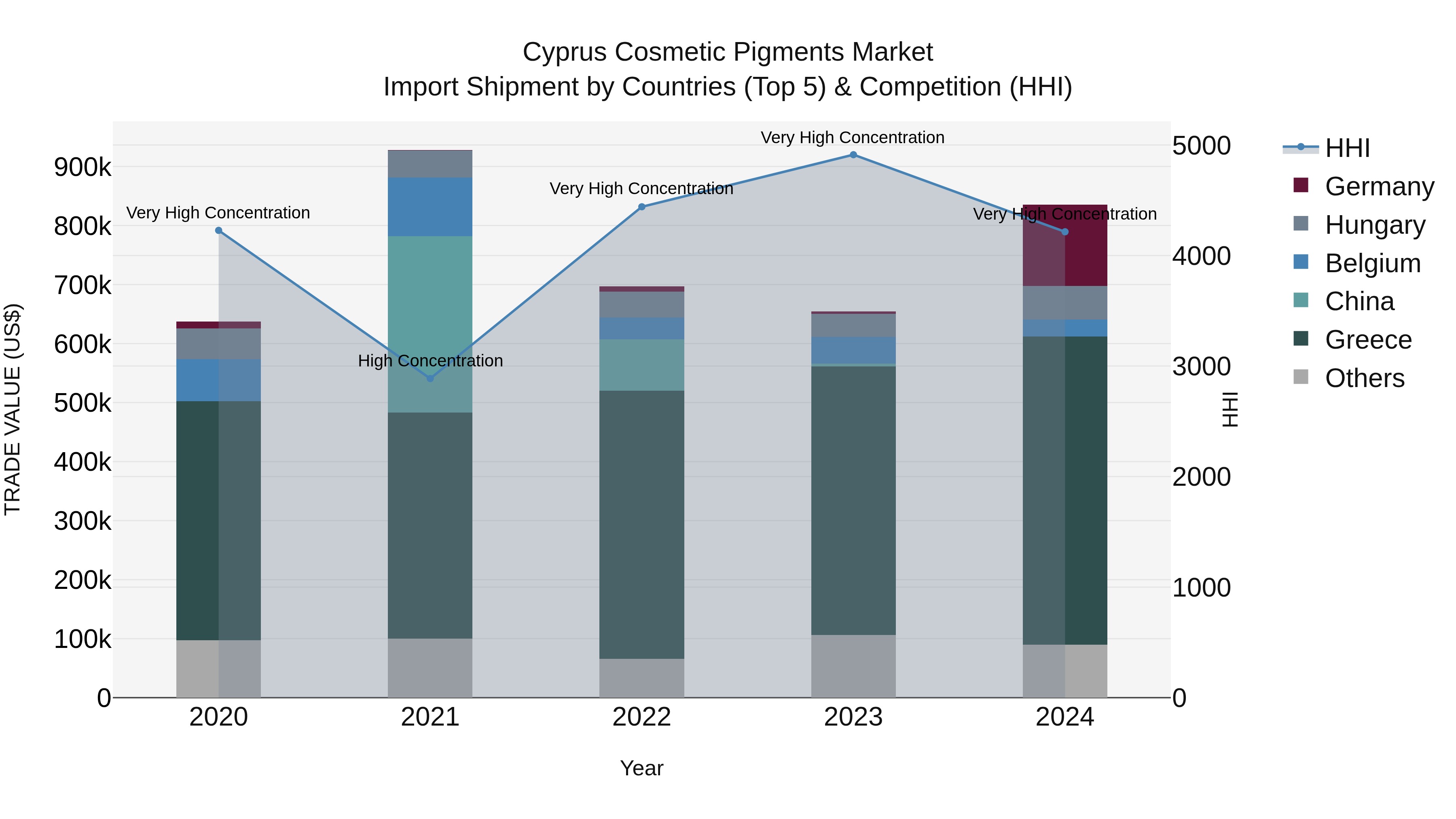
Cyprus Cosmetic Pigments Market Import Shipment by Countries (Top 5) & Competition (HHI)
The Cyprus cosmetic pigments import market in 2024 continued to see a high level of concentration, with the top exporting countries being Greece, Germany, Hungary, Belgium, and Italy. The market exhibited strong growth with a Compound Annual Growth Rate (CAGR) of 6.98% from 2020 to 2024, and a notable growth rate of 27.64% from 2023 to 2024. This indicates a robust demand for cosmetic pigments in Cyprus and highlights the importance of these key exporting countries in supplying the market with high-quality products.
Key Highlights of the Report:
- Cyprus Cosmetic Pigments Market Outlook
- Market Size of Cyprus Cosmetic Pigments Market, 2024
- Forecast of Cyprus Cosmetic Pigments Market, 2031
- Historical Data and Forecast of Cyprus Cosmetic Pigments Revenues & Volume for the Period 2021-2031
- Cyprus Cosmetic Pigments Market Trend Evolution
- Cyprus Cosmetic Pigments Market Drivers and Challenges
- Cyprus Cosmetic Pigments Price Trends
- Cyprus Cosmetic Pigments Porter`s Five Forces
- Cyprus Cosmetic Pigments Industry Life Cycle
- Historical Data and Forecast of Cyprus Cosmetic Pigments Market Revenues & Volume By Elemental Composition for the Period 2021-2031
- Historical Data and Forecast of Cyprus Cosmetic Pigments Market Revenues & Volume By Inorganic Pigments for the Period 2021-2031
- Historical Data and Forecast of Cyprus Cosmetic Pigments Market Revenues & Volume By Organic Pigments for the Period 2021-2031
- Historical Data and Forecast of Cyprus Cosmetic Pigments Market Revenues & Volume By Type for the Period 2021-2031
- Historical Data and Forecast of Cyprus Cosmetic Pigments Market Revenues & Volume By Special Effect Pigments for the Period 2021-2031
- Historical Data and Forecast of Cyprus Cosmetic Pigments Market Revenues & Volume By Surface-Treated Pigments for the Period 2021-2031
- Historical Data and Forecast of Cyprus Cosmetic Pigments Market Revenues & Volume By Nano Pigments for the Period 2021-2031
- Historical Data and Forecast of Cyprus Cosmetic Pigments Market Revenues & Volume By Natural Colorants for the Period 2021-2031
- Historical Data and Forecast of Cyprus Cosmetic Pigments Market Revenues & Volume By Application for the Period 2021-2031
- Historical Data and Forecast of Cyprus Cosmetic Pigments Market Revenues & Volume By Facial Makeup for the Period 2021-2031
- Historical Data and Forecast of Cyprus Cosmetic Pigments Market Revenues & Volume By Eye Makeup for the Period 2021-2031
- Historical Data and Forecast of Cyprus Cosmetic Pigments Market Revenues & Volume By Lip Products for the Period 2021-2031
- Historical Data and Forecast of Cyprus Cosmetic Pigments Market Revenues & Volume By Nail Products for the Period 2021-2031
- Historical Data and Forecast of Cyprus Cosmetic Pigments Market Revenues & Volume By Hair Color Products for the Period 2021-2031
- Historical Data and Forecast of Cyprus Cosmetic Pigments Market Revenues & Volume By Special effect & Special Purpose Products for the Period 2021-2031
- Historical Data and Forecast of Cyprus Cosmetic Pigments Market Revenues & Volume By Others for the Period 2021-2031
- Cyprus Cosmetic Pigments Import Export Trade Statistics
- Market Opportunity Assessment By Elemental Composition
- Market Opportunity Assessment By Type
- Market Opportunity Assessment By Application
- Cyprus Cosmetic Pigments Top Companies Market Share
- Cyprus Cosmetic Pigments Competitive Benchmarking By Technical and Operational Parameters
- Cyprus Cosmetic Pigments Company Profiles
- Cyprus Cosmetic Pigments Key Strategic Recommendations






































