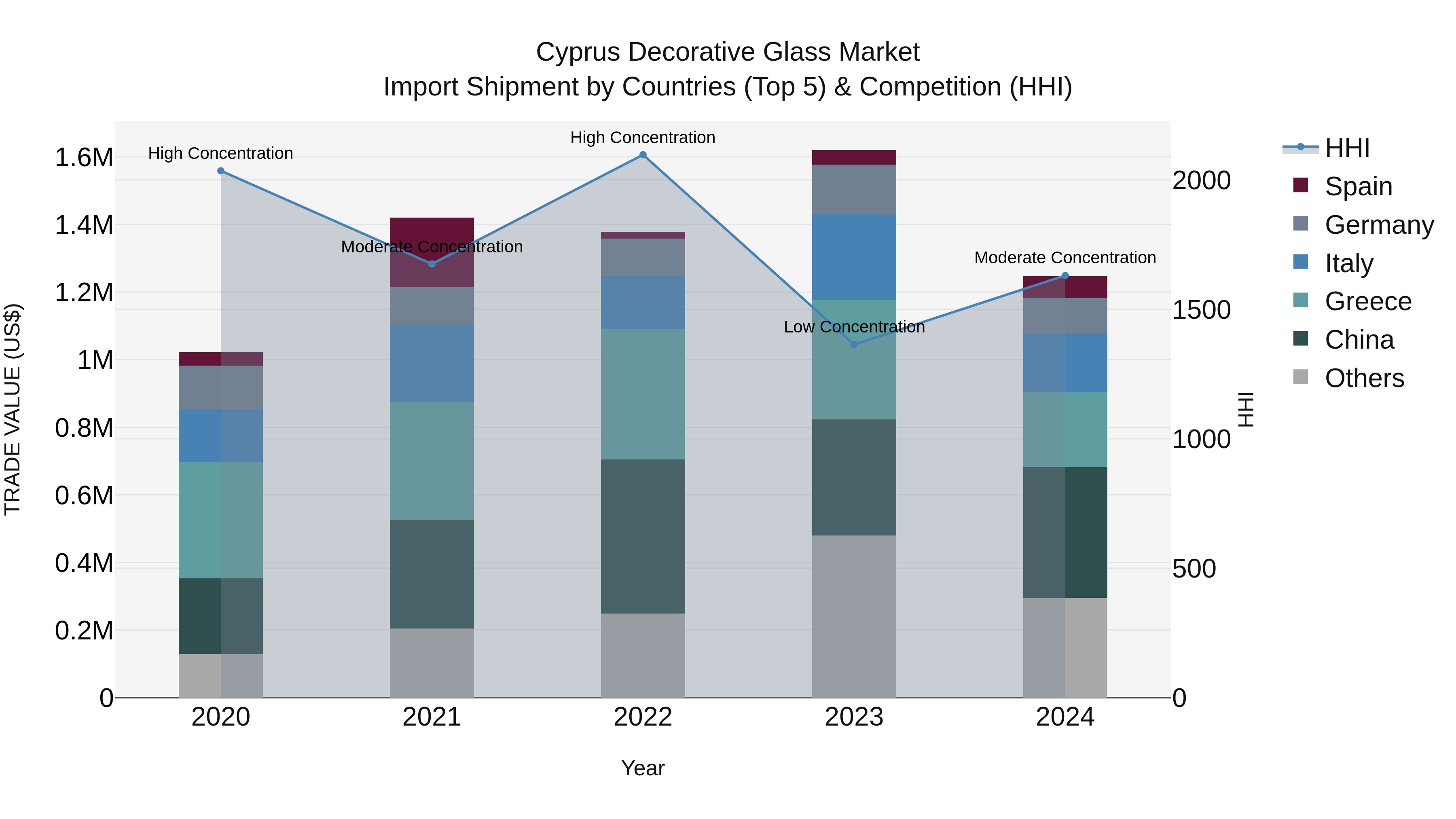
Cyprus Decorative Glass Market Import Shipment by Countries (Top 5) & Competition (HHI)
Cyprus's decorative glass import market saw a shift towards moderate concentration in 2024, with top exporting countries being China, Greece, Italy, Germany, and the Netherlands. Despite a negative growth rate in 2024, the compound annual growth rate from 2020 to 2024 stands at a healthy 5.11%. This indicates a resilient market with potential for further development. Cyprus continues to diversify its sources of decorative glass imports, highlighting a competitive landscape and opportunities for market expansion in the coming years.
Decorative Glass Market: Cyprus vs Top 5 Major Economies in 2027 (Europe)
Cyprus's Decorative Glass market is anticipated to experience a growing growth rate of 6.54% by 2027, reflecting trends observed in the largest economy Germany, followed by United Kingdom, France, Italy and Russia.

Key Highlights of the Report:
- Cyprus Decorative Glass Market Outlook
- Market Size of Cyprus Decorative Glass Market, 2024
- Forecast of Cyprus Decorative Glass Market, 2031
- Historical Data and Forecast of Cyprus Decorative Glass Revenues & Volume for the Period 2021-2031
- Cyprus Decorative Glass Market Trend Evolution
- Cyprus Decorative Glass Market Drivers and Challenges
- Cyprus Decorative Glass Price Trends
- Cyprus Decorative Glass Porter`s Five Forces
- Cyprus Decorative Glass Industry Life Cycle
- Historical Data and Forecast of Cyprus Decorative Glass Market Revenues & Volume By Product for the Period 2021-2031
- Historical Data and Forecast of Cyprus Decorative Glass Market Revenues & Volume By Low-e for the Period 2021-2031
- Historical Data and Forecast of Cyprus Decorative Glass Market Revenues & Volume By Special for the Period 2021-2031
- Historical Data and Forecast of Cyprus Decorative Glass Market Revenues & Volume By Other for the Period 2021-2031
- Historical Data and Forecast of Cyprus Decorative Glass Market Revenues & Volume By Application for the Period 2021-2031
- Historical Data and Forecast of Cyprus Decorative Glass Market Revenues & Volume By Commercial Building for the Period 2021-2031
- Historical Data and Forecast of Cyprus Decorative Glass Market Revenues & Volume By Residential Building for the Period 2021-2031
- Historical Data and Forecast of Cyprus Decorative Glass Market Revenues & Volume By Public Building for the Period 2021-2031
- Cyprus Decorative Glass Import Export Trade Statistics
- Market Opportunity Assessment By Product
- Market Opportunity Assessment By Application
- Cyprus Decorative Glass Top Companies Market Share
- Cyprus Decorative Glass Competitive Benchmarking By Technical and Operational Parameters
- Cyprus Decorative Glass Company Profiles
- Cyprus Decorative Glass Key Strategic Recommendations






































